Archive for the ‘Astoria’ Category
highly visible
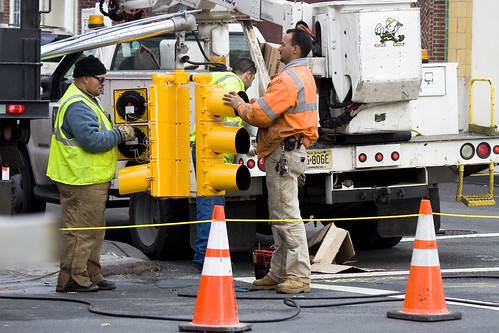
Broadway near Steinway Street – photo by Mitch Waxman
As your humble narrator scuttles from place to place, turning over rocks to see what blind albino abnormalities might lurk beneath, a significant amount of road construction is encountered. New York is always in a state of near collapse and an army of municipal and contractor labor is kept busy filling in the cracks. Conflicted over sneaking pictures of these folks, I nevertheless find them fascinating, for the high visibility colors they wear excite the eye.
from workzonesafety.org
Title: ANSI/ISEA 107-2004: Revised American National Standard for High-Visibility Safety Apparel and HeadwearAbstract: This standard provides a uniform, authoritative guide for the design, performance specifications, and use of high-visibility and reflective apparel including vests, jackets, bib/jumpsuit coveralls, trousers and harnesses. Garments that meet this standard can be worn 24 hours a day to provide users with a high level of conspicuity through the use of combined fluorescent and retroreflective materials. The revised version of the standard expands the product coverage to include high-visibility headwear. It also contains additional testing procedures for knitted fabrics used as background material, and eliminates tests from the previous edition that added no value. Publisher: International Safety Equipment Association

Third Avenue Manhattan – photo by Mitch Waxman
If it won’t blind or distract the crews, don’t forget that this is heavy industry and quite dangerous work, try turning on the camera flash when photographing them. The reflective fabrics, technically retroreflective fabrics (which function like a Cat’s eyeshine), will blaze up and be the brightest point in the photo. New York City street signs also function in a similar fashion, and even the weakest flash will light them up from blocks away. Try it, especially on a dark and stormy day, the effects are somewhat unpredictable and often produce a prismatic and surreal photo.
from simplifiedsafety.org
Class 1: needs to be conspicuous and use retroreflective materials not less than 25mm in width.
- Used when workers are well separated from traffic
- Vehicle speeds of less than 25 mph
- Parking attendants
- Shopping cart retrievers
- Warehouse workers
- Roadside/sidewalk maintenance workers
- Delivery vehicle drivers
Class 2: maintains superior visibility and are more conspicuous than the Class 1 garments. Minimum width of retroreflective material used on these is not less than 35mm.
- Used when workers are on or near roadways
- Vehicle speeds of 25 to 50 mph
- Roadway construction workers
- Utility workers
- Survey crews
- Law enforcement personnel
- Crossing guards
- High-volume parking lot or toll-gate attendants
- Airport baggage handlers and ground crews
- Railway workers
- Emergency response personnel
- Accident site investigators
Class 3: has greatest visibility. Maintains more retroreflective material than Class 2 and must have sleeves with retroreflective material between the shoulders and elbows. Not less than 50mm wide of retroreflective material.
- Used for workers in high risk situations
- Allows them to be seen from a minimum distance of 1,280 ft.
- Vehicle speeds of greater than 50 mph
- Roadway construction workers
- Utility workers
- Survey crews
- Emergency response personnel

31st street, Astoria – photo by Mitch Waxman
All of the municipal and construction rules are meant to conform to the national OSHA specifications, but individual city organizations have their own wrinkle on safety gear. MTA workers, for instance, are often observed wearing goggles and ear protection as they work. No doubt, this is due to individual union agreements and task specific requirements.
from nysdot.gov
All DOT employees, contractor employees and visitors must wear protective helmets and high visibility construction apparel while working within a highway right of way or contract limits. Flaggers must wear high visibility traffic control apparel when directing or spotting traffic. High-visibility apparel is not required for employees and visitors when they are within a completely enclosed cab constructed of steel frame and glass, or inside a motor vehicle.

37th avenue, Dutch Kills – photo by Mitch Waxman
NYFD, of course, has the most stringent series of rules for its crews. In the shot above, a 5 alarm fire at an industrial warehouse was belching black smoke into the street, but the firefighters are clearly identifiable through the murk- due to camera flash. Be careful around NYFD however, as they’re kind of busy people, and you don’t want to distract them. Also, should there be any piezoelectric activated equipment in use- DO NOT use your flash for fear of activating something.
from fasny.com
Back in November of 2008, there was a lot of confusion about the use of high-visibility vests at roadway incidents due to a new Federal Highway Administration (FHWA) Rule. The new regulation, Rule 634, stated that “All workers within the right-of-way of a Federal-aid highway who are exposed either to traffic (vehicles using the highway for purposes of travel) or to construction equipment within the work area shall wear high-visibility safety apparel.”
That regulation created a dilemma for fire departments who were truly interested in protecting their personnel. The training classes and material used by the Emergency Responder Safety Institute (ERSI) for years has suggested the use of high-visibility garments for public safety personnel when working around traffic. NFPA 1500, the Firefighter Health and Safety Standard has included a requirement for firefighters to wear safety vests at traffic incidents in the last two most recent editions. NIOSH Line of Duty Death Investigations have also included recommendations for responders to wear highly visible flagger vests when exposed to moving traffic. In the fire service community it was generally understood that the vests were not appropriate personal protective equipment (PPE) for personnel who were actively engaged in firefighting operations because those garments are not designed for exposure to fire, heat flame or hazardous materials. Rule 634, as originally published however did not outline any exemptions for firefighters engaged in direct firefighting operations and that created the dilemma.

Bridge Plaza North, Queens Plaza – photo by Mitch Waxman
The shot above is fascinating to me, for reasons that have little to do with the safety equipment exhibited. The trench that this trio is working in is down by Queens Plaza, and the cutaway shows a historical record. Notice the top layer of asphalt, then two distinct layers of cobblestones, then dirt and rock fill. Asphalt- modern, cobbles 1- the construction of the Queensboro bridge and associated roadways, cobbles 2- the pre bridge street, dirt and fill- that’s a 19th century, civil war era street. I’d love to have an archaeologist sift through this trench, but there’s nothing of historic importance in Queens… according to the City.
Note- the Charles Rudebaker wiki quote below… I’m a little squirrely on this particular wikipedia entry. The only info I could find on Rudebaker, a New Yorker who supposedly invented the Traffic Cone, parroted this exact wording all across the net. Take it with a grain of salt, until I can find out more. It very well might be a “false meme” which is a sort of “Lulz“.
from wikipedia
Traffic cones, also called road cones, highway cones, safety cones or construction cones, are usually cone-shaped markers that are placed on roads or footpaths to temporarily redirect traffic in a safe manner. They are often used to create separation or merge lanes during road construction projects or automobile accidents, although heavier, more permanent markers or signs are used if the diversion is to stay in place for a long period of time.
Traffic cones were invented in 1914 by Charles P. Rudebaker. Although originally made of concrete, today’s versions are more commonly brightly-coloured thermoplastic or rubber cones. Not all traffic cones are conical. Pillar shaped movable bollards fulfil a similar function.
…this one’s for the birds

– photo by Mitch Waxman
Washington, whose actual birthday is on February 22, would have avoided shopping on this holiday- I would think.
Have no doubt that the American Augustus had significant material aspirations and enjoyed a lifestyle that could only be maintained by a subjugate army of slaves, but I’d like to believe that he would be resistant to having his birthday celebrated with a crass and consumerist bacchanal.
I like to think he’d be embarrassed, but as I’m a non-slaver, it’s difficult for me to imagine the mindset of the “founding fathers”.
from wikipedia
Titled Washington’s Birthday, the federal holiday was originally implemented by the United States Congress in 1880 for government offices in the District of Columbia (20 Stat. 277) and expanded in 1885 to include all federal offices (23 Stat. 516). As the first federal holiday to honor an American citizen, the holiday was celebrated on Washington’s actual birthday, February 22. On 1 January 1971, the federal holiday was shifted to the third Monday in February by the Uniform Monday Holiday Act. This date places it between February 15 and 21, which makes the name “Washington’s Birthday” a misnomer, since it never lands on Washington’s actual birthday, February 22. A draft of the Uniform Holidays Bill of 1968 would have renamed the holiday to Presidents’ Day to honor the birthdays of both Washington and Lincoln, but this proposal failed in committee and the bill as voted on and signed into law on 28 June 1968, kept the name Washington’s Birthday.

– photo by Mitch Waxman
February 15th is also Susan B. Anthony‘s birthday, who is at least as important to our republic as its founder. If Washington was indeed Augustus, Anthony was Trajan. Speaking of pagan times, incidentally, today is the third day of Lupercalia – a Roman spring cleaning ritual that is also known as Februa. The particular deity of this ancient rite is Februus– an Etruscan god of malaria- although its the ritual that lends its name to the calendrical month, not the god.
Closer to home, February 15th is also the birthday of a man who sired one of Astoria’s most important families– Heinrich Engelhard Steinweg.
from wikipedia
Because of the unstable political climate in Germany, Steinweg decided to leave the country. He emigrated from Braunschweig to New York City in 1851 with four of his sons, but before leaving he gave the company to his son, Theodor Steinweg. Once in New York, he anglicized his name to Henry E. Steinway, and he and his sons worked for other piano companies until they could establish their own production under the name of Steinway & Sons in 1853.
The overstrung scale in a square piano earned the Steinway Piano first prize at the New York Industrial Fair of 1855.[3] In 1862 they gained the first prize in London in competition with the most eminent makers in Europe; and this victory was followed in 1867 by a similar success at the Universal exposition in Paris. According to Franz Liszt, Anton Rubinstein, and other high authorities, the Steinways have done more to advance the durability, action, and tone-quality of their instruments than any other makers of Europe or America.
He and his wife, Juliane, had seven children: Albert Steinway, Charles H. Steinway, Christian Friedrich Theodor Steinweg, Doretta Steinway, Henry Steinway, Jr., Wilhelmina Steinway and William Steinway.
Abominable Snowman of Astoria

– photo by Mitch Waxman
Zuzu, our noble dog and faithful subject, demanded reasonable access to the amenities of curb and hydrant and so compelled- I grabbed the camera and we went out into the storm. On the corner of 45th and Broadway, we came across this sinister homunculus.

– photo by Mitch Waxman
Mastery over snow and ice is but one of Zuzu’s many abilities, but her foot pads are vulnerable to ice melting chemicals and road salt. Her pads were prepared for the saline ponds and frozen mounds with an application of Musher’s Wax, which is a commercial variant of Beeswax. We left her comical coats and sweaters at home, since there really was no point in them as Zuzu was punching in and out of snow banks. Cry Havoc, and let slip, declareth the dog, and we went to Newtown Rd. and 43rd street.

– photo by Mitch Waxman
It was decided that Broadway, where we just were, would be a superior spot to sniff. As always, the corner grocery is open. Somehow, these guys had power back during the Astoria black out in 2006, and their sandwich counter is both clean and surprisingly affordable. They even make home made yogurt! Zuzu stared at this corner for a while, it was probably since she knows that this is where yogurt comes from.

– photo by Mitch Waxman
Giving my loyal canine a moment of privacy, Zuzu went about her business while I stared up into the trees. A dogs life has so little dignity, offering a moment of discretion when they need to powder their noses is only polite. Cleaning up her steaming dog egg, I realized that the snow was again taking a turn for the worse. So did Zuzu.

– photo by Mitch Waxman
Zuzu got cold, or hungry, and decided it was time to go home at this point. I followed.

– photo by Mitch Waxman
Zuzu during warmer times.
Crows of Queens

Red Crow van spotted – photo by Mitch Waxman
Returning from a trip to Third Calvary Cemetery the other day (searching for Gilman) to my Astoria, I came across this red van with a disturbingly heterogeneous collection of mattresses affixed to it. This red van is a familiar sight around the neighborhood, personal conveyance of a Crow. For clarity and codification lords and ladies, this gentleman shall be referred to as “Red Crow”, here at your Newtown Pentacle.

Red Crow appears – photo by Mitch Waxman
Crows is a nickname given to the refuse and metal collectors who harvest valuable metals from everyday garbage, as assigned to them here in the old village of Astoria. Some are individuals, others are multi man operations, and a variety of vehicles are purposed to the task. If its not nailed down, and copper-steel-iron or gold can be harvested, a Crow will fly in and scoop it up. Furniture and bicycles are highly prized.

Red Crow goes back for more – photo by Mitch Waxman
Usually an hour or two ahead of the Sanitation trucks, the Crows may be observed on DSNY “bulk pickup days”, cruising the streets with the wary aspect of a Police Detective hunting a criminal. Most are specialists, collecting a specific kind of refuse. Almost all of them are metal collectors, no doubt selling the found materials by the pound down at the Newtown Creek.
This is a surmise, incidentally, filling in the dots as it were- as I cannot prove what I’m asserting- i.e. I can’t show you a photo of some lump of metal in Astoria, grabbed by a Crow, and then the same lump transacted for in Greenpoint. I have observed the beginning (this post) and the product of such scavenging at metal dealers in Brooklyn, however.

Red Crow reappears – photo by Mitch Waxman
One of the rules of dumpster diving in the City of Greater New York dictates that mattresses are not a desirable item and are in fact avoided like lepers. If its on the street, there’s either an infestation or somebody died on it, and Bedbugs can jump like Fleas. Essentially valueless as a manufactured good, the general custom is for the merchant that sold and delivered your bedding is to remove and dispose of the old mattress- often at no cost. Nobody really wants a used mattress. What, then, would motivate this incongruously well dressed Crow into such an odd pursuit?

Red Crow hitches – photo by Mitch Waxman
Steel springs, the coil structure within the bedding, are highly prized items for recycling. The reason that its not economical for a commercial enterprise to do so is the cost of removing the deeply embedded metal from its surrounding padding and removal of the metals using electromagnetics. Mattress merchants factor the cost of this process into every new bed sold, by statute in some places.

Red Crow adjusts – photo by Mitch Waxman
Not conforming to OSHA or environmental guidelines, the Crows have a developed a far simpler system to separate the wheat from the chaff. They call it fire.

Red Crow ties – photo by Mitch Waxman
Somewhere, whether it be in the backyard of an isolated house in Flushing or an empty lot along the Newtown Creek in Greenpoint or East Williamsburg, the steel springs will be freed and the charred padding discarded. Elsewhere, plastic insulation will be melted off copper wire and tires will be melted open to reveal their internal steel belting. The Crows will clean up after themselves and no one will be the wiser for the extra tax free bucks that they pick up off the streets.

Red Crow done – photo by Mitch Waxman
This is recycling, manifest, incidentally. A crude layman version of it, but the way that things actually work, one of those “Green Jobs of the Future” the politicians keep going on about.

Red Crow drivers side door doesn’t want to open, uses passenger door – photo by Mitch Waxman
I bring this Crow to your attention simply because the history of our times will be culled from sources that promote an oligarchal viewpoint, and the story that will be told is that of the princes and potentates who stare down at the world from skyscraper windows. Phenomena like these “Crows of Queens” will escape the notice and mention of the future, leaving behind virtually no documentation that they ever existed, like the omnipresent “shmata” men of Manhattan’s Lower East Side a mere 100 years ago.

Red Crow resumes hunt – photo by Mitch Waxman
Revisionist by nature, the urge to focus a historical lens on the machinations of the rich and powerful is strong, and desire to know and emulate the successful is a strong desire. The story of the bosses is not all that’s going on these days.
You have to appreciate this fellow, he looks mid-50’s to me, and here he is in 25 degree weather scavenging the streets and struggling to tie down his load. The rest of us just walked by and saw a pile of junk, he saw opportunity, and was willing to go that extra step and do the job. Know what I see, when I look at these Crows of Queens?

Red Crow, notice PBA stickers and window washer duct tape repair – photo by Mitch Waxman
I see that which made America great, and will do so again.
A walk around Hallet’s Cove
Feel like taking a walk? Bring your camera, and ID…

the grill on the dome light says “the lordship”- photo by Mitch Waxman
Hallet’s Cove is the area surrounding the Noguchi Museum and Socrates Sculpture Garden at the border of Astoria and Ravenswood, although it was once the name for the entire village that became Astoria.
Well known to the residents of modern Queens due to the presence of a warehouse operation called Costco, and to its ancient citizens for the ferries to Blackwells Island and Manhattan- Hallet’s Cove is less well known for its industrial history, and the machinations of real estate interests in the locale are obvious to the knowing eye. The times are a-changing, indeed.
from wikipedia
Beginning in the early 19th century, affluent New Yorkers constructed large residences around 12th and 14th streets, an area that later became known as Astoria Village (now Old Astoria). Hallet’s Cove, founded in 1839 by fur merchant Steven Halsey, was a noted recreational destination and resort for Manhattan’s wealthy.
During the second half of the 1800s, economic and commercial growth brought about increased immigration from German settlers, mostly furniture and cabinet makers. One such settler was Heinrich Engelhard Steinweg, patriarch of the Steinway family who founded the piano company Steinway & Sons in 1853, which today is a worldwide piano company. Afterwards, the Steinways built a sawmill and foundry, as well as a streetcar line. The family eventually established Steinway Village for their workers, a community that provided school instruction in German as well as English.
In 1870, Astoria and several other surrounding villages, including Steinway, were incorporated into Long Island City. Long Island City remained an independent municipality until it was incorporated into New York City in 1898. The area’s farms were turned into housing tracts and street grids to accommodate the growing number of residents.

Socrates Sculpture Park – photo by Mitch Waxman
Socrates Sculpture Park presents the picture that the modern City wants you to believe about these “up and coming” corners of river front property. Middle and upper class citizens improving their minds and bodies in a clean and safe environment of esthetic esteem- the epitome of the physical culture movement’s dreams for the urban environment. Nothing wrong with that, of course, and for sporting pursuits and cookouts- the nearby Rainey Park is available to their coarser neighbors from the Ravenswood or Astoria Houses who might not be interested in Yoga- but the neighborhood is becoming a little too “Ayn Rand” for my tastes. There is another side to this place, of course, off the beaten path.
from wikipedia
Socrates Sculpture Park is an outdoor exhibition space for sculpture. It is located at the intersection of Broadway and Vernon Boulevard in the neighborhood of Long Island City, Queens, New York City, United States, North America. In addition to exhibition space, the park offers an arts education program and job training.

A block away from Socrates Sculpture Park – photo by Mitch Waxman
Aboriginal swamplands were conquered in the late 19th century, as the floods of the Sunswick Creek and the East River were tamed by the enterprise of engineers. The industrial mills and combines of Long Island City and Ravenswood extended all the way to Astoria Point, exploiting the valuable river front. In modernity, this is another corridor of dirty industry being swept aside to make room for an urban population bursting at the seams, with little regard for the past or present. Deemed underutilized, experts have named the area as an industrial relict, better demolished than preserved.
If one leaves the carefully mapped walking paths suggested by city planners, another picture emerges. Generations have quietly made lives here, in noble homes whose architectural influences suggest hints of the nautical culture of eastern Long Island and New England.
from socratessculpturepark.org
Socrates Sculpture Park was an abandoned riverside landfill and illegal dumpsite until 1986 when a coalition of artists and community members, under the leadership of artist Mark di Suvero, transformed it into an open studio and exhibition space for artists and a neighborhood park for local residents. Today it is an internationally renowned outdoor museum and artist residency program that also serves as a vital New York City park offering a wide variety of public services.
This is what the Queens waterfront used to look like, notice the small stature of the buildings, except for the Piano factory, since converted over to Condos.


Horror at Hallet’s Cove- Nelson’s Galvanizing site 2010- photo by Mitch Waxman
Across the Newtown Pentacle, where a speculative real estate bubble has recently burst, empty lots are fenced off from their environs. Unlike the abandoned lots of ground that peppered the landscape of New York in the 1970’s and 80’s before the bubble, these patches of shattered masonry are not abandoned- instead they are being held in reserve for future usage. Rapid demolition of these properties follows the quiet acquisition of said lots, to hasten the building process when economic times are better and to head off environmental or historical concerns about erasing possibly significant structures. In the case of this property, Newtown Pentacle readers may remember an examination of the “Nelson Galvanizing” site- titled “The Horrors of Hallet’s Cove“- and the multiple links to various environmental violations assigned to it by the City and State of New York. This is going to be the home of a future apartment house, incidentally.
photo from the “The Horrors at Hallet’s Cove posting”

Horror at Hallet’s Cove- Nelson’s Galvanizing site 2008 – photo by Mitch Waxman

Vernon Blvd. and Broadway – photo by Mitch Waxman
On the corner of Vernon Blvd. and Broadway, with the aforementioned Sculpture Park at my back, the comical Greenstreets sign on a traffic island- surrounded on all sides by “warehoused” former industrial building sites. Large tracts have been demolished to make way for future construction of multiple story, Manhattan style, apartment houses. Underserved by mass transit as it is, with a sewer system designed in the 1920’s, this is the Hallet’s Cove of 2010.
For the Hallet’s Cove of 1840, click here to check out a map and street necrology from pefagan.com

– photo by Mitch Waxman
Formerly one of the tallest residential buildings in the area, this enigmatic survivor of “the good old days” is dwarfed by the newly built tower rising menacingly some 2 blocks away. Just to make myself clear, I’m not anti anything, and regard such development work as inevitable and completely out of my hands. This angers and frustrates colleagues and friends in the antiquarian community, who view this pragmatism as acknowledging defeat, a tacit surrender to the princes of the city and their claims of oligarchal inevitability. In reality, I’m just trying to see all sides of the story.
Always, I must remain an Outsider.
from nydailynews.com
Undaunted by the floundering housing market, a New Jersey real estate firm is looking to build 2,400 residential units on the Astoria Peninsula, the Daily News has learned.
Lincoln Equities of East Rutherford has a contract to buy five parcels of land once used for manufacturing on First Ave., along the portion of the East River waterfront known as Hallets Cove.
Lincoln plans to bulldoze several warehouses on the land and build five residential buildings, one of which would rise 40 stories, company officials said.
“We don’t know what the market will indicate, but it is our intent to have a blend of rentals and condos,” said Hank Sheinkopf, a prominent Democratic political strategist who has been hired as a spokesman for the project.
The project, known as Hallets Point Development, would require the zoning be changed from manufacturing to residential.
Formal plans, which also could include ground-floor retail space, are expected to be submitted by the end of the year.
The proposal would join a growing list of high-density residential developments under construction or planned for the Long Island City waterfront – a list led by the state’s Queens West megadevelopment in Hunters Point and the city’s proposed Hunters Point South community.
Sheinkopf said 20% of the 2,400 units will be affordable housing, but it was unclear how the prices for the project, which is privately funded, would be determined.

– photo by Mitch Waxman
Ultimately, the shocking scale of these new structures dwarf the surrounding neighborhoods- blocking the panoramic views and open skies of a formerly 2 and 3 story cityscape, where a large structure was 5 stories. Philosophically, I tend to regard LeCorbusier style tower parks (and gated communities on the whole) as anti-democratic and very bad for the future of the Republic, as it tends to isolate political centers away from each other and foists an unsustainable population onto local streets and sewers. Like many of these new towers, parking amenities are planned into the structure, but that too brings more traffic onto the local streets which were not designed to handle the increased load. Quality of life in the City of New York is more than just law and order, lords and ladies of Newtown, it’s streets and sewers and electrical infrastructure.
The Hallets, from the Annals of Newtown
William Hallett, their ancestor, was b. in Dorsetshire, Eng., in 1616, and emigrating to New-England, joined in the settlement of Greenwich, Ct., whence he removed to Long Island, and acquired a large estate at Hellgate. (See pp. 29, 63.) In the fall of 1655 the Indians destroyed his house and plantation at Hallett’s Cove, which induced him to take up his residence at Flushing. Here he was appointed sheriff in 1656, but the same year was deposed by Stuyvesant, fined and imprisoned, for entertaining the Rev. Wm. “VVickenden from Rhode Island, allowing him to preach at his house and receiving the sacrament of the Lord’s Supper from his hands. Disgusted at this treatment, Mr. Hallett, on the revolt of Long Island from the Dutch, warmly advocated the claims of Connecticut ; and, being sent as a delegate to the general court of that colony/he was appointed a commissioner or justice of the peace for Flushing. Afterwards he again located at Hellgate, where he lived to the age of about 90 yrs. He had two sons, William- and Samuel,6 between whom, in 1688, he divided his property in Hellgate Neck.
2.. William Hallett, eldest son of William,1 received that portion of his father’s lands which lay south of the road now forming Greenoak, Welling, and Main streets, and Newtown avenue; which road divided his possessions from those of his brother Samuel on the north

– photo by Mitch Waxman
Shot from the Queensboro Bridge, with mighty Triborough and Hells Gate in the background, that’s Big Allis on the left- just for scale. Hallets Cove, where the Sunswick Creek once drained into the East River, is located roughly across the street from the large new building on the right.

– photo by Mitch Waxman
The strip of bare shoreline, a rarity along the East River, is the actual sandy beach of Hallets Cove. During the summer, kayaks are launched from here- I believe courtesy of the LIC Boathouse– but I may be incorrect. Looking south, one sees Blackwells- oops- I mean Roosevelt Island, and Manhattan commands the horizon. Interesting to some may be the observation that in New York, up until recent times, when an entrepreneur was building a new venture in an existing community, it was expected that other improvements would follow- whether roads, streets, or schools.
from the Greater Astoria Historical Society
HALSEY, Stephen Alling.
He donated a tract of land, 100 by 200 feet, extending from Academy street to First Avenue, for school purposes. A commodious school house was shortly afterwards erected on this site, which is to-day used by the Fourth Ward school. He invested in other property, in almost every instance showing his progressive spirit by laying out streets, grading them, &c. The ferry (then running to 86th street) was owned by him up to 1860, and he it was who placed the first modern ferryboat on the line.
He was a great lover of horticulture, and in the garden in front of Capt. Monson’s house on Fulton street may be seen some of the largest Magnolia trees on Long Island, 75 feet in height, planted by him. He had a particular admiration for shade trees which he gratuitously gave to parties desirous of planting shade trees in front of their property. The fine Elms on Washington street and Perrot Avenue still stand as specimens of his planting.

– photo by Mitch Waxman
Now, I go to a lot of places that most people would consider insane, but the folks at undercity.org have actually been down in the sewers beneath Astoria. Check out their gallery and adventures which truly do answer the question- who can guess what it is, that may be buried down there? – Click here.
The folks from watercourses have been through here as well- check out their Sunswick Creek page, with maps.
also, from the Greater Astoria Historical Society
Sunswick Creek. A drained marsh near the foot of Broadway. Scholars believe it may come from an Indian word “Sunkisq” meaning perhaps “Woman Chief” or “Sachem’s Wife.”

– photo by Mitch Waxman
Finally- check out this nytimes.com 1914 article, which describes following a “forgotten-ny” style mapping and exploration of the city along a path forged by by Sarah Comstock in 1849. The map she followed was called “12 miles around New York” (map at new york public library, of course- and check out Comstock’s “Old roads from the heart of New York” at archive.org). She starts with a journey on the Astoria Ferry from 86th street in Manhattan to Hallet’s point and continues through the Newtown Pentacle all the way to the ancient town of Flushing, as well as other destinations.
as it turns out, treadsoftly, a blog I like, rolled through here at the beginning of the week. Check it out.


 The Newtown Pentacle