Archive for the ‘Blissville’ Category
it shines and shakes and laughs

– photo by Mitch Waxman
How one has missed the filth and degradation. Rendering the urgency of returning to these places, lonely and swept by a poisonous fume called wind, and finding the lessons offered has been a source of great angst for your humble narrator. It is difficult to describe my personal experience with these lots and parcels, or defend my deep affection for something like the former Phelps Dodge property at Laurel Hill. This is a shunned place, avoided by all given a choice, yet one finds himself moving inexorably toward it after pinning cap to head and telling “Our Lady of the Pentacle” that “I’m going out for a walk”.

– photo by Mitch Waxman
There is little honey to be found here, unless one uses the euphemism favored by DEP employees for the material they handle. Everywhere is a concretized and apocalyptic post industrial landscape and active culture of garbage handlers and warehouse employees. Barren, the landscape enjoys only the crudest amenities. Street trees are quickly shattered by trucks, and a loose sandy gravel seemingly composed of powderized automotive glass reflects a weak and diffuse light transmitted by the burning thermonuclear eye of god itself.

– photo by Mitch Waxman
For one such as myself, a ghastly and shambling outcast scuttling about in a filthy black raincoat, the only thought a place like Maspeth Creek can evince is “Hallelujah”. Every suspicion about the truth of the great human hive is manifest here, and condemnation of society at large is readily at hand. Perhaps this is why I am so drawn to this forgotten valley of corrupted nature, as it mirrors the sickness in my own thoughts. An inch behind my eyes, I believe, is naught but black mayonnaise.

– photo by Mitch Waxman
Maybe I am “all ‘effed up”, but to me, this is one of the most beautiful places I’ve ever seen. “Welcome to Newtown Creek”, say I, with hardly any sense or ironic humor or twee dispatch.
Also- Upcoming tours…

for an expanded description of the October 13th Kill Van Kull tour, please click here

for an expanded description of the October 20th Newtown Creek tour, please click here
for more information on the October 27th Newtown Creek Boat Tour, click here

for more information on the November 9th Newtown Creek Magic Lantern Show, click here

for an expanded description of the November 11th Newtown Creek tour, please click here
monotonous whine

– photo by Mitch Waxman
Polyandrion, Calvary Cemetery welcomes, and all roads lead here. After vainglorious attempts at normalcy, laced with some latent desire to fit into society at large, your humble narrator returns at last to a true place. There is no facade here, in this latent psychic cauldron of thwarted ambition and manifest hubris. There are only the tomb legions, and the groundling burrowers, and an odd man in a shabby black raincoat wandering a hill once called Laurel.

– photo by Mitch Waxman
Neglectful, a joyless and pitiless avatar of failed ambition has been ignoring this place for too long, occupied as it were with politicking and social engagement. A long season which has exposed many to my vast inadequacy during multitudinous tours and meetings is nearly at an end. To be seen by so many diminishes me, and frequent company on my walks obfuscates recognition of those patterns and curious relics of earlier times hidden in plain by torch bearing Dutchmen and buckskin clad Aborigines alike.

– photo by Mitch Waxman
For the last several months, Calvary has been a place passed by, often gazed upon with the sort of fondness reserved for a matron aunt or an overlooked friendship. No longer is this the case, recent sojourns have proven both productive and fascinating journeys- or perhaps it is merely the season of the year? Queens is speaking to me again, and for the first time in months, intelligibly.

– photo by Mitch Waxman
Oddly, the ever present headphones worn while walking this path- literally as these shots were being captured- began playing Wagner’s “Flight of the Valkyries”. As this is a random classical piece, lost amongst the hundreds of hardcore punk and death metal songs contained in the same playlist. One considers this to be significant somehow, but often, small things seem important while wandering through the marble heart of the Newtown Pentacle.
Also- Upcoming tours…
for an expanded description of the October 13th Kill Van Kull tour, please click here
for an expanded description of the October 20th Newtown Creek tour, please click here
old manor

– photo by Mitch Waxman
It may have been noticed, lords and ladies, that several shots of the loquacious Newtown Creek from an odd angle have appeared at this- your Newtown Pentacle- in the last few days. Your humble narrator recently found himself coerced into a bird watching expedition, by canoe, by certain powers and potentates of the Newtown Creek Alliance. It should be explained, as it has been mentioned in the past, that if the leadership of NCA can be analogized as the “Super Friends“- your humble narrator plays the role of Gleek the super monkey in the group.
Accordingly, when they ask me to go bird watching on Newtown Creek in a canoe with the North Brooklyn Boat Club, I go.
Hey, look, we saw an Osprey.
from wikipedia
The Osprey (Pandion haliaetus), sometimes known as the sea hawk, fish eagle or fish hawk, is a diurnal, fish-eating bird of prey. It is a large raptor, reaching more than 60 cm (24 in) in length and 180 cm (71 in) across the wings. It is brown on the upperparts and predominantly greyish on the head and underparts, with a black eye patch and wings.
The Osprey tolerates a wide variety of habitats, nesting in any location near a body of water providing an adequate food supply. It is found on all continents except Antarctica although in South America it occurs only as a non-breeding migrant.
As its other common name suggests, the Osprey’s diet consists almost exclusively of fish. It possesses specialised physical characteristics and exhibits unique behaviour to assist in hunting and catching prey. As a result of these unique characteristics, it has been given its own taxonomic genus, Pandion and family, Pandionidae. Four subspecies are usually recognised. Despite its propensity to nest near water, the Osprey is not a sea-eagle.

– photo by Mitch Waxman
Personal preference for motorized transport on the water aside, the folks from the North Brooklyn Boat House took great care of us and the afternoon went pretty well. Aside from the Osprey, we witnessed several other avian critters- including the Great Blue Heron which I’ve been chasing around the Creek all year. Unfortunately, the camera rig I carry isn’t purpose built for this sort of thing. The images in today’s post are pretty close to “actual pixels”, a 100% crop of a larger image, and look a bit rougher than my normal photos accordingly.
Bird photography, done properly, requires a powerful and expensive lens to get right.
from nytimes.com
Ospreys — large birds with dramatic brown and white markings and four-foot wing spans — occupy the top of the food chain, eating all kinds of fish, and are thus important indicators of the health of their environment. Along with other birds of prey, they were decimated by the widespread use of the pesticide DDT in the 1950s and ’60s, which led to a thinning of eggshells. Once DDT was banned in 1972, however, ospreys began a remarkable comeback, especially in the Northeast.

– photo by Mitch Waxman
Even those of us familiar with the Creeklands have been startled by the diversity of specie observed during these surveys. Your humble narrator, as an omnivore consumer of visual data, has little to no expertise in such matters- but those well versed with ornithological endeavors have been left slack jawed at the thriving ecosystem observed around the so called “dead sea” of the Newtown Creek.
from dec.ny.gov
The osprey is probably the longest studied and monitored raptor in New York. The New York State Department of Environmental Conservation (NYSDEC) monitors the status and productivity of the majority of New York’s population. Each year, both ground and aerial surveys are conducted by NYSDEC to document osprey nests in the state.
From 1980-1987, the NYSDEC released 36 young ospreys taken from nests on Long Island in an attempt to establish a third or “satellite” population in southwestern New York. During the seven years of the project, 30 young ospreys were released into the wild. This has lead to successful nests in the area, including nine nesting pairs in 1998. There are also close to a dozen breeding pairs in central New York and one in Southeastern New York in Sullivan County.
central chamber

– photo by Mitch Waxman
Recently, while out on the Newtown Creek on a Newtown Creek Alliance mission, the inestimable Executive Director of the group – Kate Zidar- gestured toward a certain structure on the Queens side and asked me what I knew about it. My mandate in the organization is to act as historian, as well as photographer, and the building in question is known to modernity as the “Lukoil Getty Terminal”. It’s waterfront is categorized by Dock Code 616, a 300 foot frontage, and it sits in plain view of the Greenpoint Avenue Bridge.
To me, it will always be referred to as Tidewater.
from wikipedia
Tidewater Oil Company (also rendered as Tide Water Oil Company) was a major petroleum refining and marketing concern in the United States for more than 80 years. Tidewater was best known for its Flying A–branded products and gas stations, and for Veedol motor oil, which was known throughout the world.
Tidewater was founded in New York City in 1887. The company entered the gasoline market just before World War I, and by 1920 was selling gasoline, oil and other products on the East Coast under its Tydol brand. In 1931, Tidewater expanded its reach into the midwestern U.S. by purchasing Northwestern Oil Company of Superior, Wisconsin.
Soon thereafter, Standard Oil Company of New Jersey (now ExxonMobil) gained control of Tidewater, and set up the subsidiary Mission Corporation to operate it. J. Paul Getty’s purchase of Mission in 1937 set the stage for the birth of Tidewater as a major national player in the oil industry.
In 1938, Getty merged Tidewater with Associated Oil Company, based in San Francisco with a market area limited to the Far West. Associated, founded in 1901, had created the prominent Flying A brand for its premium-grade gasoline in 1932.
With the merger and creation of Tidewater Associated Oil Company, Flying A became the primary brand name for the company, though the Tydol and Associated names were also retained in their respective marketing areas. Tydol During the 1950s, the Associated and Tydol brands gradually fell into disuse, and were dropped entirely in 1956. That same year, “Associated” was removed from the corporate name. The Veedol trademark was retained for motor oils and lubricants. BP acquired the Veedol brand when it bought Burmah-Castrol (who then owned the Veedol brand). In February 2011 announced that they wished to sell the Veedol Brand. Tidewater operated refineries on both the Atlantic and Pacific coasts, as well as a small fleet of West Coast-based tankers.

– photo by Mitch Waxman
In the early years of the American Oil industry, it seems, there were literally hundreds of small players who drilled or refined petroleum. A behemoth which emerged from the crowded field, that would dominate the sector in one way or another to this very day, was John D Rockefeller’s Standard Oil. Standard controlled the means of delivery, whether it be defacto control of the rail lines leading from oil rich regions (which were in Pennsylvania, back then) to refinery, or through ownership of the local pipelines which supplied their refined product to end use customers.
This allowed Standard to fix prices at a certain level, manipulate supply and demand in its own favor, or to keep competitors from getting their goods to market.
from 1919’s “Platts power, Volume 50“. courtesy google books
N.Y., Long Island City – The Tidewater Oil Co., 11 Broadway New York City, awarded the contract for the construction of a 2 story 30 x 140 ft warehouse on Greenpoint Ave and Newtown Creek, to H.D. Best, 949 Broadway, New York City. A steam heating system will be installed in same

– photo by Mitch Waxman
Unfair and underhanded, the Standard Trust went out of its way to destroy or stifle its competition and before long it controlled 90-95% of the oil business in the United States. Competitors came along as the years passed, most of which fell before the attentions of the Rockefellers. Some, like Charles Pratt, sold their operations to Standard and joined with it. Others were driven into bankruptcy. Technological advances and invention offered an opportunity to bypass the rail system dominated by the trust, and the dream of a pipeline which would feed oil to the independent refineries on the Atlantic coast of the United States became feasible.
The company that crystallized this challenge to Standard was the Tidewater Oil Company.
from 1889’s “Stoddart’s Encyclopaedia Americana: a dictionary of arts, sciences, and general literature“, courtesy google books

– photo by Mitch Waxman
For many years, Rockefeller and his Standard men (with their armies of bought and paid for politicians and local officials) ridiculed and fought against the pipeline company, but when his independent competitors banded together under the Tidewater brand in the 1870’s – he knew that Standard must innovate. In one of the first business moves of its kind, Standard began purchasing common stock in Tidewater, and by 1883 controlled a majority share in it.
Rather than using the well honed “breaking” techniques of industrial monopoly on the rival company, Rockefeller simply purchased his competition.
from “Harper’s magazine, Volume 72“, courtesy google books
– photo by Mitch Waxman
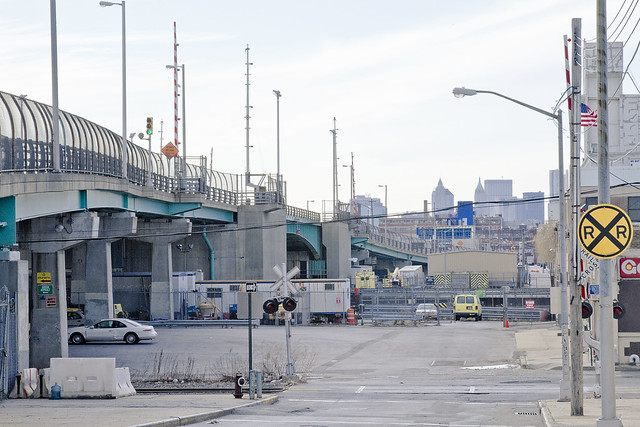
As an aside, it should be noted that the path Greenpoint Avenue takes, in modernity, as it crosses the Newtown Creek is slightly eastward of its ancient footprint. The modern bridge, which replaced an older swing bridge that carried LIRR and light rail tracks as well as vehicles, actually pulls traffic away from the ancestral road. In the early 20th century LUNA image linked to below, which is the inverse of my recent shot above, notice that only the bridge and rail tracks are still in place.
The Tidewater building would be to the left in the historic shot below.

X

– photo by Mitch Waxman
A recommended primer for anyone interested in the story of the early American Oil industry is “The History of the Standard Oil Company, By Ida Minerva Tarbell“, an admittedly biased and muckraking account told by the daughter of an oil pioneer whose business was wiped out by the Standard Trust. Tarbell disliked the term muckraker, and considering that she was a pioneering female journalist and investigative reporter in an age not exactly known for either- let’s just respect her wishes.
from “The History of the Standard Oil Company, Volume 2 By Ida Minerva Tarbell” courtesy google books

– photo by Mitch Waxman
Like most who opposed Rockefeller, who would die as the richest man in human history (in fact, adjusting for inflation- Rockefeller died richer than Augustus of Rome, and all the Pharoahs of Egypt, and all the kings of England- put together) Tidewater ended up a footnote, and being used as an instrument by which Standard could further dominate the competition.
Standard was broken up by the actions of the federal government in the early 20th century, shattered into several smaller corporations. Standard Oil Company of NY (SOCONY) was one of these, and it would become Mobil. Standard Oil Company of NJ (SOCONJ) would become Exxon.
Rockefeller’s bank account would one day attain sentience and become Chase Manhattan bank.
from wikipedia
In 1904, Standard controlled 91% of production and 85% of final sales. Most of its output was kerosene, of which 55% was exported around the world. After 1900 it did not try to force competitors out of business by underpricing them. The federal Commissioner of Corporations studied Standard’s operations from the period of 1904 to 1906 and concluded that “beyond question… the dominant position of the Standard Oil Company in the refining industry was due to unfair practices—to abuse of the control of pipe-lines, to railroad discriminations, and to unfair methods of competition in the sale of the refined petroleum products”.
effective radius

– photo by Mitch Waxman
A lesser sabbat on the great wheel of the year, at 10:49 this morning, New York City will pass through the fall equinox. Today, the day and night will oppose each other equally, and from now until March, darkness will rule as relative to light. Summer ends, and the harvest time is visited upon all that walk beneath the ever fainter emanations of the burning thermonuclear eye of god itself.

– photo by Mitch Waxman
Before long will we all be sitting before tables of bounty, gazing upon roasted meats and other oven baked fare. Just the other night, a filthy black raincoat was removed from its summer hook, and a humble narrator again filled it. Chill is the night, which grows ever longer. Soon shall we all feast, and learn new ways to laugh and revel and enjoy ourselves, as we give our so called “thanks”.

– photo by Mitch Waxman
Nepenthe is found in this season, as we slouch roughly toward Samhain and the Yule, as it’s the time of tales told. Stories of goblins and werecats, ghosts and ghasts, and the hidden world of the occultist will soon be readily revealed. On the wheel of the year, this is the start of the spooky time- when farmers fields become the property of crows and ravens, and odd occurrences abound- during the endless nights.


 The Newtown Pentacle