Archive for the ‘Brooklyn Bridge’ Category
tangible things

– photo by Mitch Waxman
Hanging around the East River side of Lower Manhattan recently, your humble narrator was elated to see the Bouchard Tug “Ellen S. Bouchard” transiting past Governors Island. Such prurient thrills are all that I’m still capable of getting excited about these days, so I whipped out the camera and started shooting.
Built in 1982, by Halter Marine of New Orleans, Louisiana (hull #1036) as the Ellen S. Bouchard for Bouchard Transportation of Melville, New York.

– photo by Mitch Waxman
That’s a fuel barge that the tug is managing, and odds would be good that it’s journey began on either the Kill Van Kull or the Port of Newark. It would be foolish to guess where it was headed, except to say that it will drop its cargo off at a distribution center for eventual disposition to end customers via tanker trucks.
From his first voyage at eleven years of age as a cabin boy on a sailing ship bound for China, Captain Bouchard knew that shipping would be his life. By 1915, he was the youngest tugboat captain in the Port of New York.

– photo by Mitch Waxman
The barge would be carrying something close to the equivalent capacity of fifty standard sized oil trucks, and was accordingly making its way through the narrow East River in a slow and deliberate fashion. Such caution is necessary, as an accidental allision or collision would spell disaster for both natural and unnatural features alike.
from wikipedia
Bouchard Transportation Co., Inc, based in Melville, New York, and founded in 1918, is primarily a family and employee-owned company that provides transportation and logistics services in U.S..

– photo by Mitch Waxman
There’s something about the sight of Tug passing under the Brooklyn Bridge that causes one to want to buy a slice of pizza or order a bagel with cream cheese and lox and complain about the Mayor or the Yankees. It’s just so “New York”.
from wikipedia
The tugboat is one symbol of New York. Along with its more famous icons of Lady Liberty, the Empire State Building, and the Brooklyn Bridge, the sturdy little tugs, once all steam powered, working quietly in the harbor became a sight in the city.
The first hull was the paddler tug Rufus W. King of 1828.
time worn

– photo by Mitch Waxman
One hundred and twenty nine years ago- on May 30, 1883- 12 people were killed and 35 wounded upon the Brooklyn Bridge in what would best be described as constituting a personal nightmare scenario to your humble narrator. I’ve never liked crowds, and shy away from congested areas where a sudden panic might carry me toward apotheosis randomly. Surely this is born of an experience in racially polarized South Brooklyn back in the early 1980’s when I found myself swept in the surge of a small race riot while onboard a bus.
from nytimes.com
A woman fell down the wooden steps at the end of the New-York approach to the Brooklyn bridge yesterday afternoon while the pathway was crowded with thousands of men, women, and children walking and passing one another. As she lost her footing another woman screamed, and the throng behind crowded forward so rapidly that those at the top of the steps were pushed over and fell in a heap.

– photo by Mitch Waxman
Weak, poorly developed physically, and given to panic- a young narrator watched with growing horror as a group of “Cugenes” (slang for Italian kids in my old hood) approached the Bushwick bound B78 bus intent on ferreting out a certain African American youth with whom they had a conflict. The Cugenes come onto the bus swinging, and as tribal affiliations ruled the day- the pushing started. I found myself a helpless and unwilling cork bobbing on a sea of witless hatred, an experience which has stayed with me to this day.
from wikipedia
The Brooklyn Bridge is one of the oldest suspension bridges in the United States. Completed in 1883, it connects the New York City boroughs of Manhattan and Brooklyn by spanning the East River. With a main span of 1,595.5 feet (486.3 m), it was the longest suspension bridge in the world from its opening until 1903, and the first steel-wire suspension bridge.
Originally referred to as the New York and Brooklyn Bridge and as the East River Bridge, it was dubbed the Brooklyn Bridge, a name from an earlier January 25, 1867 letter to the editor of the Brooklyn Daily Eagle, and formally so named by the city government in 1915. Since its opening, it has become an icon of New York City, and was designated a National Historic Landmark in 1964 and a National Historic Civil Engineering Landmark in 1972.

– photo by Mitch Waxman
Unending nightmares of such situations guide me to this day, and one is quite phobic about being trapped within a crowd without egress or a clear pathway of escape. I think it’s part of the reason that places like Times Square fill me with nameless dread, and I prefer the concrete desolations of the sparsely populated Newtown Creek.
I’m all ‘effed up.
from chroniclingamerica.loc.gov
A terrible disaster occurred yesterday afternoon on tho East River Bridge, by which twelve persons lost their lives and a great many others were injured more or less seriously. While there were no less than 15,000 persons on the Bridge, a blockade was formed on the footpath at the head of a flight of steps nine feet high extending from the masonry above the anchorage to the first iron truss, the same place at which blockades of people have occurred heretofore. A panic followed the pushing and struggling in which men and women tried to free themselves from the crowd. In the midst of this rush, started, it is thought by a gang of roughs, either thoughtlessly or with mischievous intent, several persons were carried over the edge of the steps. They fell on the landing and at the foot of the stairs, ethers stumbled on them, and more than forty persons were trampled underfoot by the panic-stricken multitude.
primitive ruins
– photo by Mitch Waxman
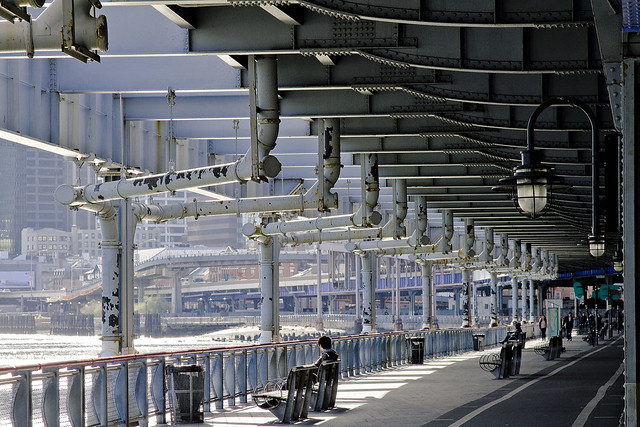
Recent business brought me to Manhattan, and an opportunity to walk along the East River while moving downtown presented itself. A spectacular promenade has recently emerged along the coast of the Shining City, much of which is unfortunately cement. Shiny and new, the sections above Corlears Hook made me a little nervous, as if one had wandered into an architect’s drawing populated by spandex wearing fitness models riding bicycles and running determinedly. Downtown, between East River Bridge Two and One (Manhattan and Brooklyn) this waterfront parkland was just grungy and old enough to feel lived in, by ordinary folk.

– photo by Mitch Waxman
It is difficult to complain about these open air trottoirs, which allow the citizenry a chance to gaze at the splendors of the harbor, especially given what these areas were like a mere 20-30 years ago. Trash strewn and off limits, New York had left its waterfront to rot away. The great shame of it all, and this is where the kvetching and Monday morning quarterbacking comes in, is that the infrastructure of docks and wharfs which literally made New York great is gone- never to return. Once something becomes a park, it is virtually impossible for it to return to other usage. No ship will be arriving here ever again.

– photo by Mitch Waxman
It’s the way of things, of course, and long ago was it decided that maritime interests were unimportant to Manhattan. So few are the docks on the island nowadays that it is scantly possible to find a berth. Word has it that the various waterfront vision plans include the usage of “temporary” or “floating” docks at some point in the future, but the days when a ship could unexpectedly arrive in the City- laden with some mysterious cargo from the south seas- seem to be over.
middle stature

– photo by Mitch Waxman
It’s Maritime Sunday once again at this, your Newtown Pentacle, and today the focus is on Thornton Towing’s 1600 HP and 1958 vintage “Thornton Bros.” tugboat. Call sign WDD6171, Thornton Bros. is some 25m x 8m in size and has been clocked going as fast as 8 knots.
from wikipedia
Merchant and naval vessels are assigned call signs by their national licensing authorities. In the case of states such as Liberia or Panama, which are flags of convenience for ship registration, call signs for larger vessels consist of the national prefix plus three letters (for example, 3LXY, and sometimes followed by a number, i.e. 3Lxy2). United States merchant vessels are given call signs beginning with the letters “W” or “K” while US naval ships are assigned callsigns beginning with “N”. Originally both ships and broadcast stations were given call signs in this series consisting of three or four letters, but as demand for both marine radio and broadcast call signs grew, gradually American-flagged vessels were given longer call signs with mixed letters and numbers.

– photo by Mitch Waxman
From what I’ve been able to determine, the actual Thornton Brothers are local boys, although I’ve never met them. The tug Thornton Bros., however, seems to spend a lot of time transporting bulk metals around the harbor. These are the same sort of barges which one often observes at SimsMetal at Newtown Creek, so one might presume that they are part of the “recycling industrial complex”.
from marinesteel.com
Thornton Towing & Transportation is owned by Gerard and Richard Thornton, and Ed Carr; all of whom have spent their entire professional careers working on and around the waters of New York Harbor.

– photo by Mitch Waxman
Originally launched as the John E. Matton, the tug has had a long career and undergone more than one change of ownership. As is maritime custom, each owner has leased the boat with a unique sobriquet, which is detailed by the always reliable folks at tugboatinformation.com in the link below.
Built in 1958, by Matton Shipyard of Cohoes, New York (hull #325) as the John E. Matton.
The Morania Oil Tanker corporation chartered the vessel and eventually purchased her, where she was renamed as the Morania No. 12 .
When Morania phased out their canal fleet and the Morania No. 12 was acquired by Reinauer Transportation of Staten Island, New York where she was renamed as the Cissi Reinauer .

– photo by Mitch Waxman
John Matton was a shipbuilder upstate, located in Cohoes NY. A largely forgotten industrial center, Cohoes was also a center of brick manufacturing and to this day- one can discern thousands of red bricks scattered along the Hudson River shoreline.
The tale begins in 1899. An enterprising boat builder by the name of John E. Matton opened a boat building and repair facility along the enlarged, mule-drawn Champlain Canal about three miles north of the Waterford side-cut. At the time, the ill-fated “$9 million improvement” of New York’s canals was on life support but still limping along against the backdrop of corruption and scandal in Albany. John E. Matton had no reason to expect that he would not be able to work out of his present location for years and years to come.
Just four years later, however, after Theodore Roosevelt had appointed a new commission to chart a future for New York’s canals, the Barge Canal Act was passed by the State Legislature and approved by New York voters. What would this mean for John E. Matton? That his facility would be utterly useless in a matter of years when the new Barge Canal was completed.
mural history

– photo by Mitch Waxman
Wandering around Calvary Cemetery is often a revelatory experience, and while perambulating through the hallows of Section 9 the other day, the shock of sudden recognition nearly laid me low. While scanning the monolith studded landscape for certain things which cannot be mentioned, the name of one of history’s most famous New Yorkers suddenly appeared before me.
Steve Brodie… The man who jumped from the Brooklyn Bridge and lived to talk about it.

Steve Brodie, photo courtesy Wikipedia
also from wikipedia
Steve Brodie (December 25, 1861 – January 31, 1901) was an American from New York City who claimed to have jumped off the Brooklyn Bridge and survived on July 23, 1886. The resulting publicity from the supposed jump, whose veracity was disputed, gave Brodie publicity, a thriving saloon and a career as an actor.
Brodie’s fame persisted long past his death, with Brodie portrayed in films and with the slang terms “taking a Brodie” and “Brodie” entering the language for “taking a chance” and “suicidal leap.”

– photo by Mitch Waxman
There weren’t just three major newspapers in 1886, there were hundreds, and the proto “media” ate up Steve Brodie’s story, turning him into a celebrity. From all accounts, Brodie found every advantage offered by fame- opening a swank saloon on the Bowery and starring in a popular play about his exploits.
He would always be known as the “bridge jumper”.
from nytimes.com
A tall, slim man, who looked very much like an overgrown street boy, stood talking to a young woman at the New-York end of the Brooklyn bridge a little after 2 o’clock yesterday afternoon. He bade her good-bye and kissed her.

– photo by Mitch Waxman
The scourge of the 19th century was “consumption”, or as we call it “tuberculosis”, and Brodie took ill. Like other “lungers”, it was thought that the dry air of the southwest would aid him in fighting the affliction and he packed off for San Antonio in Texas.
That’s where he died.
from nytimes.com
The body was taken to Calvary Cemetery for burial. A crowd of 500 or 600 men, women, and children, attracted by curiosity remained in the streets during the services at the house, and many of them followed the funeral cortege to Ninety Second Street Ferry on its way to the cemetery.

– photo by Mitch Waxman
It is a real shame that someone has decided to pry the probable white bronze marker from the monument, which would have occurred in the empty oval space directly above the names and dates which remain. Such is the case though, and there are many instances of such theft not just at Calvary but at all the cemeteries which comprise the cemetery belt of western Queens.
It’s pretty low to steal from the dead, in one humble narrators opinion.
An interesting analysis of whether or not Mr. Brodie actually made his jump was published by “The Day” in 1986. Click here for the article by Larry McShane.

Steve Brodie, photo courtesy Wikipedia
ALSO, this Friday:

My own attempt at presenting a cogent narrative and historical journey “up the creek” is up coming as well-
Your humble narrator will be narrating humbly on Friday, February 24th at 7:30 P.M. for the“Ridgewood Democratic Club, 60-70 Putnam Avenue, Ridgewood, NY 11385” as the “Newtown Creek Magic Lantern Show” is presented to their esteemed group. The club hosts a public meeting, with guests and neighbors welcome, and say that refreshments will be served.
The “Magic Lantern Show” is actually a slideshow, packed with informative text and graphics, wherein we approach and explore the entire Newtown Creek. Every tributary, bridge, and significant spot are examined and illustrated with photography. This virtual tour will be augmented by personal observation and recollection by yours truly, with a question and answer period following.
For those of you who might have seen it last year, the presentation has been streamlined, augmented with new views, and updated with some of the emerging stories about Newtown Creek which have been exclusively reported on at this- your Newtown Pentacle.
For more information, please contact me here.
What: Newtown Creek Magic Lantern Show
When: Friday, February 24th at 7:30 P.M.
Where: Ridgewood Democratic Club, 60-70 Putnam Avenue, Ridgewood, NY 11385


 The Newtown Pentacle