Archive for the ‘Brooklyn’ Category
old gardens

– photo by Mitch Waxman
Williamsburg is iconic “Brooklyn”, but it was very much its own city until relatively late in the game. Technically, the city of Brooklyn ended at the Wallabout Creek, and that’s where the upstart city of Williamsburg began. Williamsburg had earlier broken away from the larger municipality of Bushwick which it had been a part of during the colonial era, when it was known as “The Strand”. During the terror induced walk which carried me from Manhattan back to Astoria in a somnambulist haze, Williamsburg was a magnetic pole which attracted a humble narrator, at least according to the images I found on my camera card.
Such folly amuses that thing which cannot exist in the Sapphire megalith of Queens, which neither thinks nor breathes but instead hungers.

– photo by Mitch Waxman
A wasteland of nettles and thorns called the “cripplebush“, and both the Bushwick and Wallabout Creeks served to isolate the Strand from its neighbors in olden times. Accordingly the coastal town looked to New York, as Manhattan was called, for a trading partner. Williamsburg had natural advantages in the age of mercantile trade, deep water docks and such, and grew rapaciously.
At one time, this little city represented 10% of the wealth present in the entire United States.

– photo by Mitch Waxman
When the Bridge came, Williamsburg had already been absorbed by the City of Brooklyn, and even the City of Brooklyn itself has been “consolidated” within the City of Greater New York (which began the period of Manhattancentric development and urban planning), but even then it didn’t quite fit into the “borough of churches and houses”. Williamsburg’s population were former Lower East Siders, born and bred in the mean streets of industrial Manhattan- unlike the baronial farmers of Flatbush or the staid German brewers of Bushwick.
Tenements went up, and great factory and mill complexes arose. Legendary fortunes were achieved, whether in the sugar business or petroleum or in garment manufacturing. The head count in Williamsburg kept on rising.

– photo by Mitch Waxman
The first half of the 20th century saw Williamsburg become a smoking industrial center, with confluences of rail and harbor traffic which made it a difficult place to live. Again, the experiences of my own family are mentioned, who left the area for the southern and eastern districts of Brooklyn during the Great Depression. Owing to it’s heritage on Manhattan’s Delancey Street, the character of the neighborhood retained the familiar ethnic makeup of a few Germans, many Jews, and Italians.
A unique urban patois emerged in the locally accented form of english, the sound of which is best described as “Bugs Bunny has a Williamsburg accent”.

– photo by Mitch Waxman
Grand street is named to match its counterpart on the New York side, and although its head is known as Borinquen Place in modernity, once this was the site of what we might describe as an intermodal transportation facility.
Robert Fulton’s Grand street ferry, a steam service, shuttled Brooklynites and Manhattanites back and forth across the East River. On the Williamsburg side, horse and electric streetcars waited to move passengers inland (the Q59 bus replicates one of these routes today). From here, you could reach Jamaica or Newtown if you needed to. If one desires to go to either location from this point today, you’re best served by heading back into Manhattan and routing from there.

– photo by Mitch Waxman
Williamsburg always had a certain Jewish character to it, especially after the Bridge opened and the so called “Jewtown” or “Ghetto” of the Lower East Side began to deflate. The Hasidic population arrived mid century, when the neighborhood entered a period of hard times. Additionally, a new population of Caribbean islanders who had arrived contemporaneously in New York with the Hasidim (who favored cheap rent and pre war apartments to house enormous families)– the Puerto Ricans- began to leave the lower east side and cross into infinite Brooklyn.
Ethnic neighborhoods tended to move together- as a loose group, in my observation, during the late 20th century. My own family, with our Italian and Irish counterparts from the “old neighborhood”, continued moving eastward- my parents settled in Flatlands, and many members of the clan went first to Nassau and then Suffolk counties on Long Island.

– photo by Mitch Waxman
In my panic induced stupor, I seem to have focused in on an amazing artifact at 455 Grand Street. Notice that the lock is in the center of the carved wood of the door? Unless this is a modern imposture, it would indicate that the wood in this door was harvested no less than century ago. The google tells me that the modern occupation of it’s surrounding structure houses a recording studio, and it’s historical occupants had some sort of plumbing problem in 1908.
Can anyone fill a humble narrator in on this plank of centuried goodness?
mottled blossoms

– photo by Mitch Waxman
Continuing the “Grand walk” whose beginnings on the Lower East side of Manhattan at St. Patrick’s Old Cathedral were discussed in two prior postings… And as a note, the external shots of the Williamsburg Bridge were photographed on a separate occasion from the afore described narcoleptic perambulation and are included for the sake of “establishing shots”.
I quite obviously didn’t find myself bodily whirling around the Bridge, in the manner of a superhero.
from wikipedia
This bridge and the Manhattan Bridge are the only suspension bridges in New York City that still carry both automobile and rail traffic. In addition to this two-track rail line, connecting the New York City Subway’s BMT Nassau Street Line and BMT Jamaica Line, there were once two sets of trolley tracks.
The Brooklyn landing is between Grand Street and Broadway, which both had ferries at the time. The five ferry routes operated from these landings withered and went out of business by 1908.
The bridge has been under reconstruction since the 1980s, largely to repair damage caused by decades of deferred maintenance. The bridge was completely shut down to motor vehicle traffic and subway trains on April 12, 1988 after inspectors discovered severe corrosion in a floor beam. The cast iron stairway on the Manhattan side, and the steep ramp from Driggs Avenue on the Williamsburg side to the footwalks, were replaced to allow handicapped access in the 1990s.

– photo by Mitch Waxman
Oh- would that I had born capable of such superhuman feats- stronger, more robust of mind and spirit, and not incarnated as the least of men. Were it not my lot to disappoint, discourage, and disabuse myself of opportunities to please others. When I stare in the mirror, an assassin of joy gazes back. I’m all ‘effed up.
Unfortunately, when “one of my states” comes upon me, any notion or pretense I might have of manhood goes out the window and a screeching ape like coward inhabits my mind. Full conviction is evinced that were I magically transported back to the New York City which saw this bridge go up in 1903, I would be consumed by its inmates within minutes.
from nyc.gov
The Williamsburg Bridge has served New York for over 100 years, but in 1988, age, weather, traffic volume increases and deferred maintenance finally caught up with the Bridge and it had to be temporarily closed. At that time, a technical advisory committee formed to decide the fate of the Williamsburg Bridge proposed three options:
- Permanently close the bridge, which would shift traffic through local communities to one of the other already congested East River crossings.
- Build a new bridge, which require locating bridge approaches, possibly through the acquisition of stores and residences. Plus, the existing bridge would still require repairs while the new bridge was being built.
- Repair the existing bridge
Of those three options, the one with the least impact on drivers and local communities was the third. And in 1988, the decision was made to repair the Williamsburg Bridge while keeping it open. The Williamsburg Bridge Reconstruction Project is one of the most ambitious projects undertaken by the New York City Department of Transportation-Division of Bridges.

– photo by Mitch Waxman
The tales of the “Fin de siècle” “Lower East Side” and it’s counterpart communities in Brooklyn, as transmitted by doting grandparents who sought to conceal the darker side of things from their fat American born families, are lost to time.
The New York City of the late 19th and early 20th century was peopled by a specie of predators according to published anecdote and municipal statistic alike, a population hardened and formed by harsh experience and ill fortune. They didn’t emigrate to the United States, they escaped to America.
Routine physical hardship, sickness, and unfairness were their lot upon arriving, and the gentle mannerisms so common to the 21st century were a luxury few could afford.
from Handbook of cost data for contractors and engineers By Halbert Powers Gillette, 1910, courtesy google books
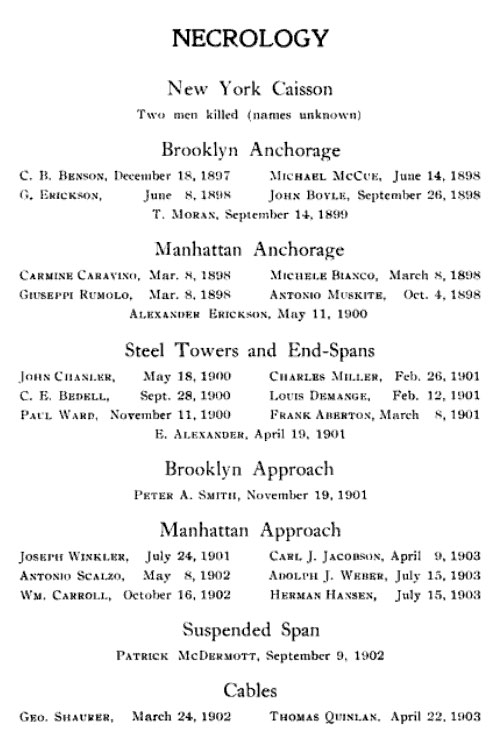
The work here described consisted of sinking two large caissons. 63 x 79 ft. In size on the Brooklyn side of the Williamsburg Bridge to bed rock. In one case 86 ft. and in the other 110 ft below mean high water, filling same with concrete and building masonry piers upon this foundation inside of coffer dams up to elevation plus 23 ft. above M. H. W. All work was done by contract during the years 1897 to 1899.
The caissons were constructed of yellow pine timber at the site of the work, launched, floated Into place and sunk to the river bottom, which was about 55 ft. below M. H. W., by filling them with concrete.
Compressed air was then turned on, and the caissons were sunk to bed rock. The material encountered, consisting of river mud, sand, clay and rock, was excavated either by means of Moran patent material locks or by wet blow out; finally the working chamber was filled with concrete. While the caissons were being sunk, the coffer dams, which were attached to the caissons, were added in order to keep their tops above water, and inside of these coffer dams the masonry piers were built. During the sinking process the masonry was built only In sufficient quantity to give the weight necessary for sinking the caissons. After the caissons were sealed and the air taken off. the shafting and piping were removed, the spaces occupied by them filled with concrete, and the pier carried up to Its final elevation. The coffer dams were then removed.

– photo by Mitch Waxman
The working people, whether they came from Sicilian village or the Jewish Shtetl, understood that America was a choice they made which would have to be lived with. There was no going back, at a time when the new political and economic theory called Capitalism could be best described as “predatory”.
The mills and factories were hellish, but reliably put bills to rest and provided a meager but steady series of meals for their families. The poorest of the poor were in Manhattan, a smoky warren of tenements and factories entirely ringed by the busiest waterfront on Earth. When and if savings were available, the aspiration of every tenement family was to move away and go live in the country- which was Brooklyn or Queens back then.
from Architecture: Volumes 7-8 – Page 104, 1903, courtesy google books
The Mayor appointed a Board of expert Bridge Engineers to examine the new plans, and their approval, together with that of the Municipal Art Commission, having been obtained, the city has accomplished something of which tew municipalities can boast.
Considering the Williamsburg Bridge first, its comparison with the old Brooklvn Bridge suffices to show how7 inartistic and reallv uglv it is, and how graceful and beautiful the older bridge appears. It is interesting to note that professional opinion has severely criticised the appearance of the Williamsburg Bridge, and that the city was willing to, and did, appropriate money to beautify this bridge.
Now, this sort of architectural padding or embellishment is the popular idea of an architect’s function in beautifying an engineering structure. “The bridge is built, happens to be ugly, employ an architect, and add some fancy features.” Or, the engineer makes the design, hands it to the architect to add a lantern or two, makes it fancy, and the artistic conscience of the interested community is at rest. The Williamsburg Bridge can never be made to look well, no matter how much it is padded; its angular lines may possiblv be softened, but that is about all that can be done.

– photo by Mitch Waxman
Remember, the America which so many members of the body politic wistfully pine for was a divided society.
What has always struck your humble narrator comically, however, is that the division was not so simple as we believe in our comfortable and streamlined modernity. Efforts of mid 20th century educators, social reformers, and political factions defined the notion of an America divide that was simply “black or white”.
The reality was that it was the Protestant gentry (of strict Anglo Saxon, or Germanic descent with a pre Civil War arrival date) and everybody else. Even the French were seen as sub human, and you can just forget about what was said about the Irish, Italians, and Jews. In my readings, Eugenics comes up a lot, and those Protestant mission houses in the “Five Points” and “Jewtown” weren’t exactly benign entities- rather they were colonialist appendages of the upper class hoping to create better servants from the lesser breeds.
from Mayor Low’s administration in New York By City Club of New York, 1903, courtesy google books
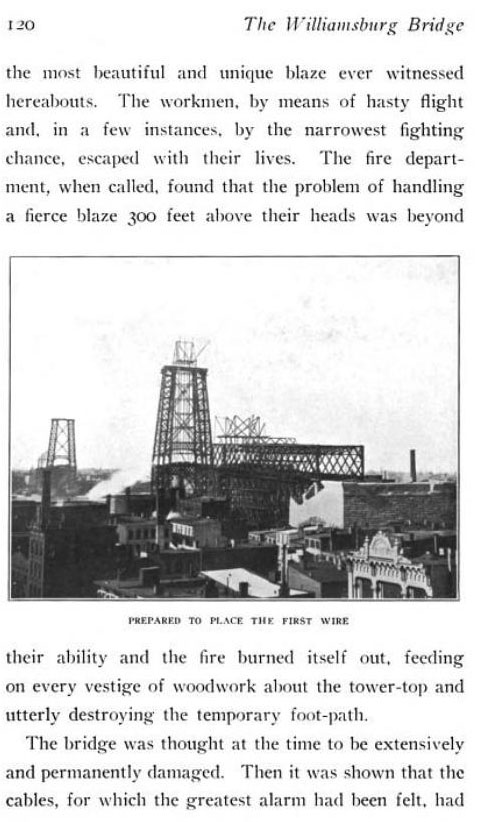
The general plan of the bridge was adjopted by the East River bridge commission on August 19th, 1896, and filed in the department of public works of each of the two cities. In May, 1897, an amended plan was adopted and filed. The first actual work on the bridge was begun on the Manhattan tower foundation on October 28th, 1896.
The tower foundations on both sides of the river rest on solid rock. The north pier on the Manhattan side sinks to a depth of 56 feet below high water and the south pier 66 feet below high water. On the Brooklyn side the north pier extends to a maximum depth of about 101 feet below high water and the south pier to a maximum depth of about 90 feet below high water. The Manhattan anchorage rests on 3,500 piles driven through clay to a bed of sand overlying the rock. The Brooklyn anchorage rests on natural sand.

– photo by Mitch Waxman
What is interesting to me (and as a son of Brooklyn- beautiful) is the way in which the imperious bourgeois (called the Knickerbocracy at the time) ending up being supplanted in power and position by these lesser breeds.
A combination of luck, hard work, and business acumen resulted in vast fortunes agglutinating amongst the immigrant hordes. The reactionary “establishment” responded with tightened immigration laws, progressive movements whose goal was “slum clearance”, and in the case of the Five Points itself- physical eradication of the neighborhood. The Public Schools were not established out of municipal altruism, rather they were a reaction to the Roman Catholic church offering free education (what would someday be the Parochial Schools) to all who wished to attend, regardless of affiliation.
Contemporary opinion rendered this as a “Papish attempt to inculcate, infiltrate, and infect the Republic with the poisons of Europe”.
also from from Mayor Low’s administration in New York By City Club of New York, 1903, courtesy google books
Transportation on the Williamsburg bridge, especially the movement of trolley cars, will not have to contend with some of the obstacles that now conspire to impede traffic on the Brooklyn bridge. The roadways for vehicles on the Williamsburg bridge will be entirely separated from the railway tracks, both trolley and elevated. This will allow the trolley cars ample space, unobstructed by vehicular traffic. The terminals will also have adequate facilities for the trolley and elevated tracks and passengers, thus avoiding the congestion now witnessed at the Brooklyn bridge terminals.

– photo by Mitch Waxman
By the period which saw the East River bridges rise, the Dutch were largely gone save for a few hold outs from ancient times. The vast majority of their population was either bred out into English lines, or had gone into the west and north. New York was firmly in the hands of the Irish empowered Tammany Hall, and the landlords of the City had realized that they could earn more by illegally subdividing existing housing stock into smaller units called “tenements”.
Manhattan was dangerously overcrowded, and everybody agreed that someone should do something about it.
from The Williamsburg Bridge: an account of the ceremonies attending the formal opening of the structure, December the nineteenth, MDCCCCIII : together with an illustrated historical and descriptive sketch of the enterprise, courtesy google books

– photo by Mitch Waxman
The Brooklyn Bridge, first of the East River bridges, had proven to be a great generator of wealth on both sides of the river despite it’s outlandish cost and efforts. Modern documents emanating from municipal sources and persoanlly witnessed have referred to the modern day “Williamsburg Bridge Financial Corridor”, an attempt to explain the rejuvenation of the neighborhood from the Bowery to East River along Delancey Street as a direct consequence of the new affluence that current day Williamsburg has come to represent due to its darling status for the Real Estate industry.
In a sense, it was the original “Brooklyn Bridge Financial Corridor” which ultimately put an end to the slums of lower Manhattan, and allowed it’s occupants a chance to escape into Brooklyn. Queens came later, of course.
also from The Williamsburg Bridge: an account of the ceremonies attending the formal opening of the structure, December the nineteenth, MDCCCCIII : together with an illustrated historical and descriptive sketch of the enterprise, courtesy google books

– photo by Mitch Waxman
Prior to the Williamsburg Bridge, there were two scheduled ferries one might utilize to transit from Manhattan to Williamsburg.
One was Robert Fulton’s “Grand Street Ferry”, which crossed between the Brooklyn and Manhattan roads of the same name, and a Houston street ferry made the trip albeit less frequently and with a smaller capacity of passengers. Additionally, hundreds of smaller vessels made the trip carrying some passengers, but mainly shuttling manufactured cargo or agricultural product between the coasts. An unpredictable eddy of currents and inclement weather often stranded passengers on one or the other sides of the river, sometimes for a day or more.
also from The Williamsburg Bridge: an account of the ceremonies attending the formal opening of the structure, December the nineteenth, MDCCCCIII : together with an illustrated historical and descriptive sketch of the enterprise, courtesy google books

– photo by Mitch Waxman
After the 2nd East River Bridge was completed, Brooklyn’s population began to grow exponentially. Always the junior member of the two great cities on the harbor, it nevertheless absorbed millions while Manhattan began to transform- transmogrify in fact- into the Shining City we know today. Blocks of tenements were cleared away, deep pilings sunk, and the office towers began to rise and scrape the sky. The 3rd and 4th bridges were already underway and discussion of crossing the Narrows was beginning.
Bridge Commissioner Lindenthal commented on the age he lived in as being unique, knowing that the resources to conceptualize and build projects of this size only come along once or twice in the history of any city, and described himself as living in “The Age of Iron”.
also from The Williamsburg Bridge: an account of the ceremonies attending the formal opening of the structure, December the nineteenth, MDCCCCIII : together with an illustrated historical and descriptive sketch of the enterprise, courtesy google books

– photo by Mitch Waxman
As mentioned at the beginning of this post, your humble narrator is composed of lesser stuff than most and certainly does not exhibit any of the qualities of iron besides corrosion. While examining the contents of my camera card, which bore hundreds of shots I did not remember taking, my hands began to shake as I saw this familiar scene…
…I had entered the truest place, and the ultimate reality…
…that pole of consciousness and latent possibility which all other locations are mere reflections of…
…the one place where “do or die” actually means something…
from wikipedia
Williamsburg is a neighborhood in the New York City borough of Brooklyn, bordering Greenpoint to the north, Bedford-Stuyvesant to the south, Bushwick to the east and the East River to the west. The neighborhood is part of Brooklyn Community Board 1. The neighborhood is served by the NYPD’s 90th Precinct. In the City Council the western and southern part of the neighborhood is represented by the 33rd District; and the eastern part of the neighborhood is represented by the 34th District.
Many ethnic groups have enclaves within Williamsburg, including Hasidic Jews, Italians, Puerto Ricans, and Dominicans. It is also an influential hub for indie rock, hipster culture, and the local art community, all of which are associated with one of its main thoroughfares, Bedford Avenue. The neighborhood is being redefined by a growing population and the rapid development of housing and retail space.

– photo by Mitch Waxman
…I had come to Infinite Brooklyn…
also from wikipedia
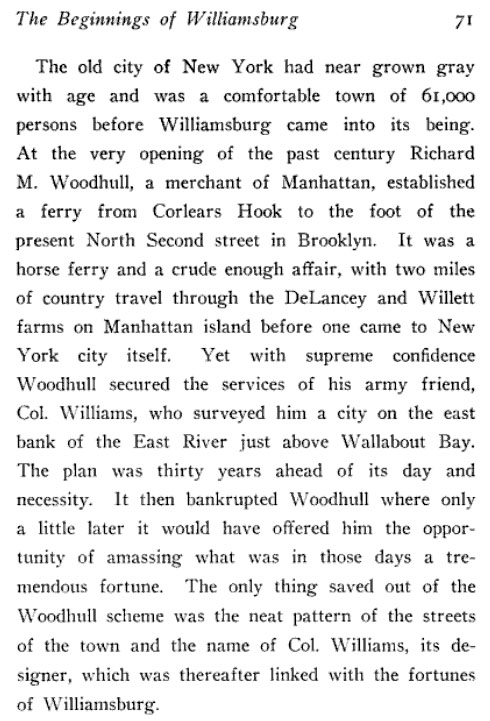
In 1638 the Dutch West India Company first purchased the area’s land from the local Native Americans. In 1661, the company chartered the Town of Boswijck, including land that would later become Williamsburg. After the English takeover of New Netherland in 1664, the town’s name was anglicized to Bushwick. During colonial times, villagers called the area “Bushwick Shore.” This name lasted for about 140 years. Bushwick Shore was cut off from the other villages in Bushwick by Bushwick Creek to the north and by Cripplebush, a region of thick, boggy shrub land which extended from Wallabout Creek to Newtown Creek, to the south and east. Bushwick residents called Bushwick Shore “the Strand.” Farmers and gardeners from the other Bushwick villages sent their goods to Bushwick Shore to be ferried across the East River to New York City for sale via a market at present day Grand Street. Bushwick Shore’s favorable location close to New York City led to the creation of several farming developments. In 1802, real estate speculator Richard M. Woodhull acquired 13 acres (53,000 m²) near what would become Metropolitan Avenue, then North 2nd Street. He had Colonel Jonathan Williams, a U.S. Engineer, survey the property, and named it Williamsburgh (with an h at the end) in his honor. Originally a 13-acre (53,000 m2) development within Bushwick Shore, Williamsburg rapidly expanded during the first half of the nineteenth century and eventually seceded from Bushwick and formed its own independent city.
athwart the desert

– photo by Mitch Waxman
Many things find a piquant and interested perch in my thoughts.
Autocthonic, these wonderings are often based on observations of a block or two of grandiose structures which seem out of place in modern context, Greenpoint Avenue between Manhattan Ave. and the East River is just one.
There is a distinct and obviously missing element which once defined its “reason for being”, and like many of the other occlusions which abound along the coastline of North Brooklyn and Western Queens- the answer is presented by First Calvary Cemetery.
from the “DIGEST OF SPECIAL STATUTES By THE CITY OF NEW YORK” courtesy google books
1865: This act incorporates the Green Point and Calvary Railroad Company, and authorizes the construction of a railroad, to be operated by horse power only, from at or near the Green Point and Tenth street ferry, at the foot of Green Point avenue, in the city of Brooklyn, thence along Green Point avenue to Green Point avenue plank road, across the bridge over Newtown creek; thence easterly along said road to the easterly side of Calvary cemetery at or near the point where the, said road intersects the main road leading from Calvary cemetery to Hunter’s Point; thence to Central avenue; thence along Central avenue and Commercial street to Franklin avenue, to Freeman street, to Washington street, to the place of beginning.

– photo by Mitch Waxman
It’s no accident that Almiralls chapel is clearly visible from the paramount of Greenpoint Avenue at Manhattan Avenue.
It’s a latecomer to the scene of course, having been built in the early years of the 20th century, but in 1865 when the Streetcar Line described above was mandated there were 1,000 interments a day going on at Calvary. Some portion of those were the graves which were being uprooted over in Manhattan of course, when cemeteries there were outlawed by the Rural Cemetery Act of 1848, but the majority of the dead coming to Queens were from a sausage grinder called the Five Points and the Tenth Street Ferry was how you got from points A to B for the funerals.
from “A history of the city of Brooklyn By Henry Reed Stiles” courtesy google books
The Green-point Ferries are from the foot of Green-Point Avenue, Brooklyn, E. D., to the foot of East Tenth and East Twenty-Third streets, New York. The first named route was established in 1852 (lease dated 1850), by the efforts of Mr. Neziah Bliss, of Green-Point; and was soon transferred to Mr. Shepard Knapp, being now held by G. Lee Knapp. The Twenty-Third street route was established in 1857, and held by St. Patrick’s Cathedral, per G. Lee Knapp. Rent of the Tenth street ferry, $1,300, and of the Twenty-Third street, $600 per annum, both expiring in 1874.

– photo by Mitch Waxman
It’s not the facts of the Ferry or Streetcar that make me curious, of course.
What I’ve been wondering about lately is how the ethnic neighborhoods in the boroughs came to be. Everybody started in Manhattan on the Lower East Side, yet the Jews of Bayard Street and the Italians of Mulberry found a path to Williamsburg and Greenpoint (Tenth Street Ferry?), while the Catholic Germans found their way to Ridgewood and Astoria (86th Street Ferry?). The Irish were everywhere, but made colonies of Woodside and Rockaway.
What natural synergies drew large populations of ethnic brethren to these neighborhoods?
Work was certainly a factor (garment and stone industries in the industrial mills of Newtown Creek and Williamsburg, etc.), but I’m wondering if it wasn’t the lost Ferry and Streetcar connections which allowed and encouraged these ethnic populations to agglutinate.
from “The Sun’s guide to New York” in 1892 courtesy google books
Tenth Street Ferry Branch (color cream): Runs from foot Chambers St., cor. West (ferry to Pavonia Ave., Jersey City and Erie R. R. Depot), through West to Charlton, to Prince, to Bowery, to Pitt St., to Ave. C, to foot E. 10th St. (Tenth St. Ferry to Greenpoint Ave., Brooklyn), returning by E. 10th St., to Ave. D, to E. llth St., to Ave. C, to E. 3d St., to 1st Ave., to Houston St., to West, to Chambers, cor. West.
lined with sorrow

– photo by Mitch Waxman
One of my little phrases, that I bandy about as if I know what I’m talking about, is “Newtown Creek is where the Industrial Revolution actually happened”.
Ruminating on this, literally this morning, I started putting this post together, picking a random and unremarked spot along Newtown Creek (which I had ok photos of, naturally) and shining a light on it. The semi modern history of this spot, an auto impound lot which was a “Gaseteria” facility more recently than it was the Ditmas Oil Terminal, which lies along the English Kills tributary of the Newtown Creek isn’t that hard to find out.
Child’s play, if the child happens to be 40 and change years old, and refers to himself constantly as your “humble narrator”, that is.
from nyc.gov
During the early nineteenth century, the portion of present-day Brooklyn between the village of Williamsburgh and New town Creek was a rural farm area dotted by small settlements. Beginning in the second decade of the nineteenth century, at the time the ferries to Manhattan were initiated, the Williamsburgh and Jamaica Plank Road was established on the route of the present-day Metropolitan Avenue.
Around the same time, the Newtown and Bushwick Turnpike, also known as the North Road to Newtown, was built on the present-day Meeker Avenue. The turnpike crossed Newtown Creek at a site where a ferry had operated since the late 1600s; in 1836 a toll bridge was built which came to be known as the “Penny Bridge” after the fee charged to pedestrians. Bushwick Avenue, which connected with Humboldt Street, was an important north-south route.

– photo by Mitch Waxman
This part of the English Kills canal follows the grid of the surrounding Brooklyn streets and looks nothing like the vernal wonderland of salt marsh and game laden grasses described by the Dutch and so carefully mapped by the English. This is the work of 19th century engineers, who were trying to put nature right, imposing right angles and impossible angles upon the water. It’s not too far from the intersection of Metropolitan and Grand Avenues in East Williamsburg.
It’s also pretty close to where the Bushwick Chemical Works of M. Kalbfleisch & Sons once stood, if it’s not the actual spot.
from “A history of American manufactures from 1608 to 1860” via google books
The Bushwick Chemical Works—M. Kalbfleisch & Sons,
Situated in the Eastern District of Brooklyn, a few miles from New York, are among the most important and extensive Chemical manufactories in the United States. The Works are composed of numerous buildings of various sizes, the largest being from one hundred and sixty to two hundred feet in length, and from sixty to seventy feet in width. Among them is a Glass House and Pottery, in which are made all the Retorts and Bottles used in manufacturing and packing the Acids and other products of the Chemical Department. The whole group of structures, with their extended walls, spacious roofs, and lofty chimneys, covers an area of over five acres, and presents an imposing appearance even at a distance. The interior appointments and equipments are of a character corresponding with the extent of the buildings. One of the chambers, for manufacturing Sulphuric Acid, is two hundred and seventeen feet long by fifty feet wide, no doubt the largest in existence, and is a model in every particular. Among the noticeable objects that attract the attention of visitors, are three Platina Stills, imported from France, at a cost of about fifteen thousand dollars each.
The products of these Works include a great number of those articles recognized as standards in the commerce of the world. Of Sulphuric Acid they have a capacity for producing three hundred thousand pounds weekly, and of Muriatic Acid, about three hundred and fifty carboys weekly.
Besides these, they manufacture Aquafortis, Muriate of Tin, Strong Ox. Muriate Tin, Soda Ash, Aqua Ammonia, Tin Chrystals, Nitrate of Iron, Sulphate of Zinc, and other officinal chemicals. The firm employ constantly from seventy to eighty workmen, for whom they have provided comfortable dwellings in the vicinity of the Works. The Office and Salesrooms are in the City of New York, at the corner of Fulton and Cliff streets.

– photo by Mitch Waxman
Like the precursor of Phelps Dodge over on the Queens side of the Creek (which was known first as Nichols and then as General Chemical) M. Kalbfleisch & Sons manufactured the wonder chemical of the early 19th century- sulfuric acid.
The chemical itself had been around in one form or another for centuries, but its manufacture was the provence of jewelers and alchemists, and its manufacture was a particularly ugly process and produced limited quantities of the stuff. It required large glass or earthenware vessels to distill, which were prone to breakage, which is bad when acid is involved.
One would either burn sulfur and saltpeter along with sodium nitrate and combine the ashes with water, or distill the stuff from a mixture of ferric sulfate and silica. The former mixture is also known as Brimstone, and the latter as Oil of Vitriol to esotericists.
from America’s Successful Men of Affairs , An Encyclopedia of Contemporaneous Biography via google books
MARTIN KALBFLEISCH, chemist, a native of Flushing, Netherlands, born Feb. 8, 1804, died in Brooklyn, N. Y., Feb. 12, 1873. In 1822, the youth sailed to the island of Sumatra, but finding that the Asiatic cholera was raging there, he promptly returned with his ship to Antwerp Thence he went to Havre, France, and spent four years in commercial enterprise. In 1826, he came to the United States with small means but splendid pluck.
In New York city, hard work as a clerk and chemist brought him a little money and, in 1835, he started a manufactory of colors and chemicals in Harlem. After several changes of location, the business, which had prospered under his energetic management, was finally moved to Metropolitan Avenue in Brooklyn.
The works now occupy eleven acres of ground on Newtown creek.
Mr. Kalbfleisch was a man of clear head, strong common sense and ability. He served in various public offices in Brooklyn and was elected Mayor in 1861. In 1862, his fellow citizens sent him to Congress and in 1867 and 1871 again made him Mayor.
Later, they offered him the nomination for Governor of the State on the same ticket with Horace Greeley.
In 1854, he was married to Elizabeth Harvey. Eleven children were born to them: Elizabeth W., wife of Robert Robinson; Frederick W. Kalbfleisch; Helen M., wife of Rodney Thursby; Edward L. G., Charles H., Albert M., and Franklin H. Kalbfleisch; Josephine M. L., wife of Robert S. Fleet; Isabella G., wife of James E. Weaver; and John and George Kalbfleisch.
He retired from business in 1868 in favor of his sons, who thereupon organized the firm of Martin Kalbfleisch’s Sons, which controlled the business until 1886.

– photo by Mitch Waxman
The sulfuric acid part of the industrial revolution started when a fellow in Great Britain named Roebuck figured out that he could produce the stuff by the pound, and then the ton, using an innovative series of lead tanks to distill the acid. The method spread and evolved, and even today, sulfuric acid accounts for nearly 40% of total U.S. chemical industry volume output.
Manufacture of sulfuric acid has advanced considerably, of course, since the days of M. Kalbfleisch & Sons. The company itself seems to have suffered a premature decline, due to mismanagement (and I’ve found hints of some sort of Standard Oil interference with it as well but nothing I could back up). The fellow who got the property in receivership was a manufacturer of electrical glass, the sort of material you see on high tension wire connections.
Who can guess, all there is, that might be buried down there?
from A history of the city of Brooklyn, By Henry Reed Stiles via google books
damnable man-lizards

– photo by Mitch Waxman
Suffering from the early stages of a summer cold, your humble narrator nevertheless keeps calm and carries on…
Today, a set of images captured in the “fancy” part of Brooklyn, the estimable Williamsburg itself. I should explain that no love has been lost for the fanciful desolation of the Creeklands, and The Newtown Pentacle is not “upping its brand” by exploring the tonier parts of town- instead, I had the pleasure of accompanying the colorful Ms. Heather (of nyshitty.com) on a photo walk one recent afternoon.
The shot above, which is as “ich ein Brooklyner” as a photo could possibly be, is one of the products of this perambulating with the queen of Brooklyn’s northern extant.
from wikipedia
Williamsburg is a neighborhood in the New York City borough of Brooklyn, bordering Greenpoint to the north, Bedford-Stuyvesant to the south, Bushwick to the east and the East River to the west. The neighborhood is part of Brooklyn Community Board 1. The neighborhood is served by the NYPD’s 90th Precinct. In the City Council the western and southern part of the neighborhood is represented by the 33rd District; and the eastern part of the neighborhood is represented by the 34th District.
Many ethnic groups have enclaves within Williamsburg, including Hasidic Jews, Italians, Puerto Ricans, and Dominicans. It is also an influential hub for indie rock, hipster culture, and the local art community, all of which are associated with one of its main thoroughfares, Bedford Avenue. The neighborhood is being redefined by a growing population and the rapid development of housing and retail space.

– photo by Mitch Waxman
We wandered in a generally south eastern direction, along the coastline, and I regaled my companion with tales of 1980’s Brooklyn, and the absolute hell on earth that Williamsburg once was. Bedford avenue, for instance, was once typified by burnt out buildings and empty brick lots. One job I held- located in a rat stricken factory (on Kent avenue at South 5th street) where I was employed cutting color separations for screen printed apparel from a material called “rubylith”, placed signage in the men’s room warning against use of the local prostitutes due to various venereal diseases which they were rumored to carry- especially a new and terrifying one called “SIDS” at the time which we now affectionately refer to as “HIV”. There were distinct groups of whores, some worked the parking lots (as in our particular building) while others were consigned to the street. Believe it or not, hipsters, Bedford and South 4th used to be like that HBO “hookers at the point” movie.
from wikipedia
“Prostitute” is a direct borrowing from the Latin prostituta, the feminine past participle of the verb prostituere (to set forth in public, to expose to dishonor, to prostitute, to put to unworthy use). The Latin verb is a composition of pro (forward) and statuere (to cause to stand, to station, place erect). A literal translation therefore would be: “to place forward”. “The notion of ‘sex for hire’ is not inherent in the etymology, which rather suggests one ‘exposed to lust’ or sex ‘indiscriminately offered.'” The word statuere is a derivative of stare (to stand), which derives from the proto-Indo-European root stā.
A variety of terms are used for those who engage in prostitution, some of which distinguish between different kinds or imply a value judgment about them. Common alternatives for prostitute include escort and whore; however, not all professional escorts are prostitutes.

– photo by Mitch Waxman
These shots are from early May, which most likely describes the vast backlog of photos which are in the process of digital development or haven’t been published here yet. It’s been a very interesting month, with lots of exciting sights and disturbing portents- I’m taking a breath this week at the urging of Our Lady of the Pentacle and medical staff alike. My tremulous health is finely balanced and controlled by an extensive schedule of prescripted pharmaceuticals, after all, and if care is not exercised I may fall into a decline- “one of my states”.
All work and no play makes Mitch a Mitch Mitch Mitchity Mitch.
from mayoclinic.com
Nervous breakdown isn’t a medical term, however, nor does it indicate a specific mental illness. But that doesn’t mean it’s a normal or a healthy response to stress. A nervous breakdown may indicate an underlying mental health problem that needs attention, such as depression or anxiety.
Signs of a nervous breakdown vary from person to person and depend on the underlying cause. Exactly what constitutes a nervous breakdown also varies from one culture to another. Generally, it’s understood to mean that a person is no longer able to function normally. For example, he or she may:
- Call in sick to work for days or longer
- Avoid social engagements and miss appointments
- Have trouble following healthy patterns of eating, sleeping and hygiene
A number of other unusual or dysfunctional behaviors may be considered signs and symptoms of a nervous breakdown.

– photo by Mitch Waxman
Needless to say, what I consider a break is what other folks call a dissertation. Look forward to daily, but quite ephemeral postings this week, stuff I’ve seen and wondered about but have chosen not to delve too deeply into.
There’s a massive load of hardcore creek stuff in the pipes, and a couple of cool announcements about tours and events I’m either participating in or leading coming as well. Let’s just say that July 16th, which is “City of Water Day“, we’re going somewhere cool by boat…
Additionally, I’ve been haunting and annoying the DEP staff at the Temple of Cloacina in Greenpoint and have personally witnessed the actual bowels of New York City- with my camera. Additionally, the Working Harbor Committee has resumed it’s summer schedule of boat tours and I have been onboard whenever possible.
rom nyc.gov
…Sewage originating south of E. 73rd Street is conveyed to the Newtown Creek WPCP. Sewage is transferred by combined sewers along E. 70th Street and E. 71st Street, which connect with the combined sewer along York Avenue. The Newtown Creek WPCP, with a rated design capacity of 310 mgd, discharges the effluent into the East River. The 2002 average dry weather flow of the Newtown Creek WPCP is 216 mgd and the average total flow is 229 mgd.

– photo by Mitch Waxman
I’ve also been riding the East River Ferry a bit, and must comment on the lamentable appointments at the dock in Hunters Point. I’m not going to post my reactions to the ferry dock, it’s horrible state, or the profoundly odd manner in which it is being managed for a little while. The shaming photos of it’s first days are in my possession, and one hopes that what these shots show are merely growing pains and not a horrible confirmation of what people in Queens believe to be a bias shown by the Manhattan elites toward us. Please ride the ferry yourself, get off in Brooklyn, get off in Manhattan, and then come to Hunters Point and decide for youself.
Lastly, I have no idea what this milky white substance in the mason jar is or represents. As is my policy, such items are never touched, only recorded. Perhaps its the property of one of the newer residents of Williamsburg recently migrated from the continent.
from wikipedia
The Lizard Man of Scape Ore Swamp (also known as the Lizard Man of Lee County) is a humanoid cryptid which is said to inhabit areas of swampland in and around Lee County, South Carolina along with the sewers and abandoned subways in towns near the swamp…
The first reported sighting of the creature was made by Christopher Davis, a 17 year old local, who said he encountered the creature while driving home from work at 2 AM on June 29, 1988. According to his account, Davis stopped on a road bordering Scape Ore Swamp in order to change a tire which had blown out. When he was finishing up he reported having heard a thumping noise from behind him and having turned around to see the creature running towards him.
Davis said the creature tried to grab at the car and then jumped on its roof as he tried to escape, clinging on to it as Davis swerved from side to side in an effort to throw it off. After he returned home, Davis’ side-view-mirror was found to be badly damaged, and scratch marks were found on the car’s roof, though there was no other physical evidence of his encounter.
“I looked back and saw something running across the field towards me. It was about 25 yards away and I saw red eyes glowing. I ran into the car and as I locked it, the thing grabbed the door handle. I could see him from the neck down – the three big fingers, long black nails and green rough skin. It was strong and angry. I looked in my mirror and saw a blur of green running. I could see his toes and then he jumped on the roof of my car. I thought I heard a grunt and then I could see his fingers through the front windshield, where they curled around on the roof. I sped up and swerved to shake the creature off.”
In the month that followed the Davis sighting there were several further reports of a large lizard like creature, and of unusual scratches and bite marks found on cars parked close to the swamp. Most of these are said to have occurred within a 3 miles (5 km) radius of the swamps of Bishopville.


