Archive for the ‘East River’ Category
lively antics

– photo by Mitch Waxman
Shackled by impotent pride and stalled ambitions, your humble narrator can often be observed scuttling along area sidewalks, a strange old man identified by malign aspect and the odd omnipresence of a camera. A great dread is experienced when someone on the street perceives my phantasmic presence, and I am forced into an encounter with someone who is unashamedly alive. Just such an encounter was had near Hells Gate on the East River, near Astoria Park, at the end of June 2010.
from nycgovparks.org
Although widely known for its beautiful pool, the oldest and largest in the city, Astoria Park offers more than aquatic pleasures. Outdoor tennis courts, a track, a bandstand, multiple trails, basketball courts, and playgrounds lure visitors from the five boroughs and beyond. And the views! Sitting on the edge of the East River and resting between the Triborough Bridge and Hell Gate Bridge, the park offers shoreline sights and sounds that make the benches along its perimeter popular spots year-round.

– photo by Mitch Waxman
This gentleman informed me that he was an ethnic musician, and made his living playing hellenic folk music at area “tavernas” and at weddings. The instrument he carried was crafted by his ancestors, and he carried it with him to America when he arrived here in the early 1960’s. He did tell me his name, but I did not write it down. It might have been Peter. Perhaps George.
also from nycgovparks.org
Due to its proximity to Hell Gate, a turbulent area in the East River, this playground has been named for the monster Charybdis. According to Greek mythology, Charybdis was the daughter of Poseidon, the god of the sea. As a young nymph, she flooded lands to add to her father’s kingdom until Zeus, the supreme ruler of the gods, turned her into a monster.
Charybdis and her partner Scylla are personifications of the violent waters in the Straits of Messina, which separate Sicily from the Italian peninsula. Charybdis was said to dwell under a fig tree on the Sicilian shore and, three times each day, drink from the strait and spit the water back into the strait several hours later, creating perilous whirlpools and terrifying sailors. In The Odyssey, by Homer, the hero survived Charybdis’s wrath by clinging to a tree for hours until she spit out the water and his raft floated to the surface.

– photo by Mitch Waxman
Practiced, his hands flew along the fret boards, and he demonstrated musical forms that are typical of the island cultures of the Hellenic Republic which is known as Greece to the english speaking world. His serenade was lilting, thrilling, and reminded me of the Greek musical genre called Rembetiko.
from wikipedia
The melodies of most rebetiko songs are thus often considered to follow one or more dromos or dromoi (gr. δρόμος, plural δρόμοι). The names of the dromoi are derived in all but a few cases from the names of various Turkish modes, known in Turkish as makam.
However, the majority of rebetiko songs have been accompanied by instruments capable of playing chords according to the Western harmonic system, and have thereby been harmonized in a manner which corresponds neither with conventional European harmony, nor with Ottoman art music, which is a monophonic form normally not harmonized. Furthermore, rebetika has come to be played on instruments tuned in equal temperament, in direct conflict with the more complex pitch divisions of the makam system.

– photo by Mitch Waxman
He described the instrument he wielded as being well over a century old, and suggested that it had certain supernatural powers against which the female gender possesses no defense. He also claimed he could calm stormy seas with it, but one thing life in Astoria has taught me is that when a Greek guy is telling a good story well – just go with it.
from wikipedia
This is the classical type of bouzouki that was the mainstay of most Rebetiko music. It has fixed frets and it has 6 strings in three pairs. In the lower-pitched (bass) course, the pair consists of a thick wound string and a thin string tuned an octave apart. The conventional modern tuning of the trichordo bouzouki is Dd-aa-dd. This tuning was called the “European tuning” by Markos Vamvakaris, who described several other tunings, or douzenia, in his autobiography. The illustrated bouzouki was made by Karolos Tsakirian of Athens, and is a replica of a trichordo bouzouki made by his grandfather for Markos Vamvakaris. The absence of the heavy mother of pearl ornamentation often seen on modern bouzoukia is typical of bouzoukia of the period. It has tuners for eight strings, but has only six strings, the neck being too narrow for eight. The luthiers of the time often used sets of four tuners on trichordo instruments, as these were more easily available, since they were used on mandolins.

– photo by Mitch Waxman
Charming guy, he was intent on hanging out at the park and mentioned something about the fishes wanting to hear some Rembetiko as I was taking my leave of him.
from wikipedia
Greek emigration to the United States started in earnest towards the end of the 19th century. From then onwards, and in the years following the Asia Minor Disaster, until immigration became restricted in the mid-1920s, a great number of Greeks emigrated to the United States, bringing their musical traditions with them. American companies began recording Greek music performed by these immigrants as early as 1896. The first Greek-American recording enterprises made their appearance in 1919. From the latter years of the second decade of the century there exist a number of recordings that can be considered as rebetiko, a few years before such songs began to appear on recordings in Greece.
The music industry in the United States came to play a particular role from the mid-1930s onwards in recording rebetiko lyrics which would not have passed the censors in Greece. This phenomenon came to repeat itself during the period of the Greek military junta of 1967–1974. A notable example of American recording studios permitting some ‘bolder’ lyrics can be found in the LP “Otan Kapnizei O Loulas”, ie “When They Smoke The Hookah”, released in 1973. Releasing this album in Greece, with to its overt references to various aspects of drug use, would have been impossible at that time. It is worth noting, however, that the censorship laws invoked in Greece by Metaxas were never officially revoked until 1981, seven years after the fall of the junta. A further characteristic of American Greek recordings of the time was the continued recordings of songs in the Anatolian musical styles of rebetiko, which continued to be recorded in the United States well into the 1950s. Even songs originally recorded with typical bouzouki-baglamas-guitar accompaniment could appear in Anatolian garments.
After WWII, beginning in the early 1950s, many Greek rebetiko musicians and singers traveled from Greece to tour the United States, and some stayed for longer periods. Prominent among them were Ioannis Papaioannou, Manolis Hiotis, Vassilis Tsitsanis, Iordanis Tsomidis, Roza Eskenazi, Stratos Pagioumdzis, Stavros Tzouanakos and Ioannis Tatasopoulos, of whom the latter three died in the United States.

– photo by Mitch Waxman
Clearly he was amused by the kayakers from the LIC Boat House as they passed by, and he launched into a wild melody on his centenarian instrument.
a fun story about Hells Gate from 1899 can be accessed here at nytimes.com– here’s the headline:
A HELL GATE SEA SERPENT.; Valiant Bowery Boatmen Bring Its Headless Body Ashore
wonderful epics of a nameless city

– photo by Mitch Waxman
This is not the world you know, this unmentioned and currently undefended border between Brooklyn and Queens, where the requiescant waters of the Newtown Creek gurgle and splash. Beyond the Pulaski Bridge- where an observable and otherworldly colour stains animal, and structure, and vegetable- the heavy industries which conspire to sustain the shining city of Manhattan spread out under the Newtown sun.
from nycedc.com
The Newtown Creek according to the Army Corps of Engineers (ACE) had a listing of 26 piers with a total of 8,483 feet of berthing space. However, only 16 piers with a total of 4,986 feet of berthing space are in use by 12 firms. Furthermore, six firms are using their 1,952 feet of pier berthing space and waterfront facilities occasionally only. The waterfront activity is primarily for ship and barge.

– photo by Mitch Waxman
Along its path, the bulkheaded shorelines of the Newtown Creek reveal the rotted timber and risible decay associated with exposure to the poisons and refuse of the vast human hive, and its associated infestations. The waters have been observed, personally, to host a surprising variety of life forms- including a dizzying array of non vertebrates. Within the cemented and artificial shores, internal voids and long abandoned pipelines shelter teeming populations of rodent forms, and unguessable possibilities present themselves when discussing what else may be hiding down there, in flooded cellar and forgotten basement.
from wikipedia
The creek begins near the intersection of 47th Street and Grand Avenue on the Brooklyn-Queens border 40°43′06″N 73°55′27″W at the intersection of the East Branch and English Kills. It empties into the East River at 40°44′14″N 73°57′40″W (2nd Street and 54th Avenue in Long Island City) opposite Bellevue Hospital in Manhattan at 26th Street. Its waterfront, and that of its tributaries Dutch Kills, Whale Creek, Maspeth Creek and English Kills, are heavily industrialized.
The creek has no natural waterflows. Its outgoing flow of 14,000 million gallons/year consists of combined sewer overflow, urban runoff, raw domestic sewage, and industrial wastewater. Being estuarine, the creek is largely stagnant. Since there is no current in the creek, sludge has congealed into a 15-foot thick layer of “black mayonnaise” on the creek bed.

– photo by Mitch Waxman
Just after passing the yawning mouth of the malign Dutch Kills, one encounters a scrap metal operation, which operates a car shredding operation. The great mill utilizes the “Newtown Creek Dock” and is owned and operated by the Hugo Neu Schnitzer East Co.
In a nutshell, the way that things work is:
Hugo Neu Schnitzer East Co. (HNSEC from this point) receives the metal glass and plastic collected by the DSNY and private contractors at its Hunts Point bulkheads in the Bronx, New Jersey, and Brooklyn…
- HNSEC then barges certain materials to Newtown Creek, where bulk metal is separated from the less valuable plastic and virtually worthless glass.
- A preliminary sorting of plastic and glass is performed, while the bulk metal is loaded onto barges.
- The metals are shipped by barge to other facilities, and offered for sale on the worldwide commodities markets.
According to those principalities who authored and designed this system, it reduces the per ton cost of processing the waste stream as well as reducing the reliance on automotive conveyance for it and nourishes the maritime industry.
from a nytimes.com article of 2004
One of the toughest challenges with recycling has always been finding markets for the recycled goods, whose resale can then help defray the costs of the program. In announcing a 20-year recycling contract yesterday, the Bloomberg administration said it had solved that problem by encouraging a company to find those markets.

– photo by Mitch Waxman
As is the way of things, Hugo Neu merged with Sim Group in 2005, and formed one of the largest recycling conglomerates in the world. According to our friends at Habitatmap, whose stout adherence to the scientific method and stalwart advocacy of the unvarnished truth has both terrified and impressed your humble narrator, the composite company- SimsMetal- is the largest single source of air pollution to be found along the modern Newtown Creek.
from simsmm.com
Sims Metal Management was originally established in 1917 by Albert Sims, a Sydney-based recycled metals dealer. The business was incorporated as Albert G. Sims Limited in 1928 and was renamed Simsmetal Limited in 1968.
In 1970, it merged with Consolidated Metal Products Limited and the merged ASX-listed company was named Sims Consolidated Limited. In 1979, Sims Consolidated Limited was acquired by Peko-Wallsend Limited and subsequently delisted. Sims Consolidated Limited was then acquired by North Limited (previously known as North Broken Hill Holdings Limited, and then North Broken Hill Peko Limited) in 1988. In 1989, North Limited sold the business to Elders Resources NZFP Limited, a diversified resources company.
In 1990, Carter Holt Harvey Limited made a successful takeover bid for Elders Resources NZFP Limited and divested that company’s non-forestry businesses, which included Sims. Sims changed its name to Simsmetal Limited in 1990 and relisted on the ASX in 1991. Simsmetal Limited changed its name to Sims Group Limited in 2003.
Sims Metal Management’s corporate strategy includes leading industry consolidation through acquisitions. Over a number of years, with experience gained from numerous international acquisitions, Sims Metal Management has established strict acquisition criteria. The acquisition criteria require that any acquisition target holds the number one or number two market position, delivers access to domestic and international customers, offers a sound platform for future growth and, above all else, will likely enhance shareholder value. The acquisition criteria have underpinned Sims Metal Management’s strong track record of international expansion.
In October 2005, Sims Group Limited merged with the recycling businesses of Hugo Neu Corporation, a privately owned U.S. corporation. The merger created a new ASX listed company named Sims Group Limited, which is traded under the ASX code “SGM.”

– photo by Mitch Waxman
I am told by knowledgeable sources that much of this scrap metal will eventually find its way to the mercantile courts of far away Asia, with the bulk of it headed to the smokestacks of China. This is less recycling and waste disposal than it is mining, if one actually takes a step back and looks at it.
from wikipedia
The scrap industry contributed $65 billion in 2006 and is one of the few contributing positively to the U.S. balance of trade, exporting $15.7 billion in scrap commodities in 2006. This imbalance of trade has resulted in rising scrap prices during 2007 and 2008 within the United States.[2] Scrap recycling also helps reduce greenhouse gas emissions and conserves energy and natural resources. For example, scrap recycling diverts 145,000,000 short tons (129,464,286 long tons; 131,541,787 t) of materials away from landfills. Recycled scrap is a raw material feedstock for 2 out of 3 pounds of steel made in the U.S., for 60% of the metals and alloys produced in the U.S., for more than 50% of the U.S. paper industry’s needs, and for 33% of U.S. aluminum. Recycled scrap helps keep air and water cleaner by removing potentially hazardous materials and keeping them out of landfills.

– photo by Mitch Waxman
Frequently observed on the East River, these barges of shredded steel and metal maintain a regular schedule back and forth from the Newtown Creek. This particular barge is the 886 gross ton Cape Lucy, a 146 foot long freight vessel operated by the Inland Barge Corporation, and constructed by Bethlehem Steel in 1953.
Always fascinated by minutia, your humble narrator wonders if this barge is a “leave behind” from the construction of the Pulaski Bridge by the self same Bethlehem Steel in 1953.
from nyc.gov
In 1881, the New York City Department of Street Cleaning was created in response to the public uproar over litter-lined streets and disorganized garbage collection. Originally called the Department of Street Cleaning, the agency took over waste responsibilities from the New York City Police Department. In 1933, the name was changed to the Department of Sanitation.
Throughout the 1880’s, 75% of NYC’s waste was dumped into the Atlantic Ocean. In 1895, Commissioner George Waring instituted a waste management plan that eliminated ocean dumping and mandated recycling. Household waste was separated into three categories: food waste, which was steamed and compressed to eventually produce grease (for soap products) and fertilizer; rubbish, from which paper and other marketable materials were salvaged; and ash, which along with the nonsalable rubbish was landfilled. The Police Department, under the direction of its Commissioner, Theodore Roosevelt, enforced the recycling law.

– photo by Mitch Waxman
Heavy equipment and esoteric machinery is always on display at this location, and it attracts no small amount of attention from area photographic enthusiasts. Proximity to the Newtown Creek Waste Water Treatment Plant Nature Walk, with its wide open sight lines and panoramic scope, no doubt aids in the fame of this place. These shots, however, were captured from onboard a boat which was plying the volatile surface of the Newtown Creek.
from wikipedia
Critics dispute the net economic and environmental benefits of recycling over its costs, and suggest that proponents of recycling often make matters worse and suffer from confirmation bias. Specifically, critics argue that the costs and energy used in collection and transportation detract from (and outweigh) the costs and energy saved in the production process; also that the jobs produced by the recycling industry can be a poor trade for the jobs lost in logging, mining, and other industries associated with virgin production; and that materials such as paper pulp can only be recycled a few times before material degradation prevents further recycling. Proponents of recycling dispute each of these claims, and the validity of arguments from both sides has led to enduring controversy.

– photo by Mitch Waxman
Weirdly organic, the Sennebogen hydraulic loaders which effortlessly move the scrap from land to barge seem to be a favored item for the scrap industry to purchase (and Sims Metal in particular), valued for its mechanical advantages and engineering accumen. Sennebogen, like the fabled Steinway clan which has left such an indelible stamp on the surrounding communities, is a German corporation operated by a single family and founded by an enigmatic sire.
from sennebogen-na.com
RICHMOND, CA – The existing pedestal crane at the 18-acre Sims Metal Management scrap metal yard in Richmond, California had become a bit of a production liability for Jesse Garcia, Sims NW Equipment Manager. Repairs to the pedestal crane were difficult and Garcia often found himself having to lease replacement equipment to keep up production on the yard’s shear when the crane went down. When it came time to replace the crane, Garcia chose a SENNEBOGEN 840 R special, a purpose-built material handler that gives him the mobility and problem-free reliability and uptime he was seeking.
“Metal on metal”
“A scrap yard is a tough environment – it’s constant metal on metal. You need dependable equipment that is built for this application. SENNEBOGEN machines are purpose-built for handling scrap metal, they’re not just retrofitted excavators,” says Garcia. “Our tracked SENNEBOGEN 840 R special is perfect for this application. We can move it in and out for quick, easy maintenance, and should the shear go down, we can utilize it elsewhere in the yard.”

– photo by Mitch Waxman
Forgotten by modernity, even your humble narrator had to consult with one of the “Rabbi’s” to double confirm that this dock was originally the location of the “Manure Dock”, where Manhattan’s human waste products, animal carcasses, and organic waste would be barged to.
Journalists of the era referred to it as the “Offal dock“.
Some of the redolant cargo would be shipped untreated to points East by the LIRR to be utilized as fertilizer on the bountiful farms which once typified the eastern counties, and some percentage of it was processed by local commercial rendering operations owned by the likes of Conrad Wessel and Peter Cooper who saw the rotting filth as a raw material for various food products- aspic, isenglass, and gelatin amongst others. The remnants of that process, which involved the usage of high pressure steam and other state of the art victorian technologies, were further processed into glues, waxes, and potent acids.
from wikipedia
Where a cargo is coarser in size than minerals, commonly for scrap metal, then an orange-peel grab may be used instead of a shell. These have six or eight segments of “peel” independently hinged around a central core. They are better able to grab at an uneven load, rather than just scooping at small pieces. If the load is made of long thin pieces, a grab may also be able to carry far more than a single “grabful” at one time.
Although orange-peel grabs may be hung from cables on a jib, they’re also commonly mounted directly onto a jib. This is more suitable for grabbing at awkward loads that might otherwise tend to tip a hanging grab over. They may also use hydraulics to control the segments rather than weight and hoist cables.

– photo by Mitch Waxman
The concept of recycling is nothing new, here in the megalopolis of New York, and then as now- it was the Newtown Creek and its surrounding communities that absorbed and absolved Manhattan’s sins. The stink, as reported in the late 19th century, that arose from this section of the Creek was legendary even to those hardened by close quartered tenement conditions and the press of an unventilated and crowded city which counted its draft animals in the hundreds of thousands.
Imagine a hot August day in Manhattan, 100 years ago, and that same day… on a slick of oily water some 4 miles long that defined the undefended border between the cities of Long Island City, Newtown, Greenpoint, Bushwick, and Williamsburg.
Pictured above is the DonJon towing Tug Peter Andrew, part of the DonJon Marine fleet that handles the metal and other recyclables trade from Newtown Creek to and from the Newtown Creek to the other links in the waste stream scattered about the New York Harbor archipelago. Photo is from last year, and was shot on the East River.
from donjon.com
Donjon Marine Co., Inc. offers the marine community full-service solutions to meet your every need in the field of marine salvage, dredging, material recycling and related services. Founded in 1964 by Mr. J. Arnold Witte, Donjon’s President and Chief Executive Officer, Donjon Marine’s principal business activities were marine salvage, marine transportation, and related services. Today Donjon Marine is a true provider of multifaceted marine services. Donjon’s controlled expansion into related businesses such as dredging, ferrous and non-ferrous recycling and heavy lift services are a natural progression, paralleling our record of solid technical and cost-effective performance.
mother of invention

– photo by Mitch Waxman
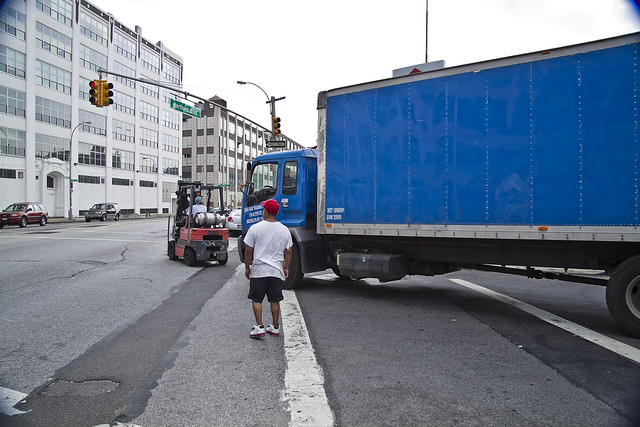
Another recent bit of serendipity experienced during a random walk, this time a bit further down Northern Blvd. and directly across the street from the Standard Motor Products building on 39th street, it seems that the good fellows who operate this largish delivery truck had experienced an unlucky turn when its engine suddenly stranded them. Luckily, they seemed to have a tiny red forklift on board, of a sort which I’ve always heard referred to as a “Bobcat”.
from wikipedia
Forklifts are rated for loads at a specified maximum weight and a specified forward centre of gravity. This information is located on a nameplate provided by the manufacturer, and loads must not exceed these specifications. In many jurisdictions it is illegal to remove or tamper with the nameplate without the permission of the forklift manufacturer.
An important aspect of forklift operation is that most have rear-wheel steering. While this increases maneuverability in tight cornering situations, it differs from a driver’s traditional experience with other wheeled vehicles. While steering, as there is no caster action, it is unnecessary to apply steering force to maintain a constant rate of turn.
Another critical characteristic of the forklift is its instability. The forklift and load must be considered a unit with a continually varying centre of gravity with every movement of the load. A forklift must never negotiate a turn at speed with a raised load, where centrifugal and gravitational forces may combine to cause a disastrous tip-over accident. The forklift are designed with a load limit for the forks which is decreased with fork elevation and undercutting of the load (i.e. load does not butt against the fork “L”). A loading plate for loading reference is usually located on the forklift. A forklift should not be used as a personnel lift without the fitting of specific safety equipment, such as a “cherry picker” or “cage”.

– photo by Mitch Waxman
The inert truck was borrowing its motive power from the smaller and self propelled tool. Its driver clearly seemed embarrassed by all the attention he garnered. Several of us stood on the corners, males all, sporting broad smiles and cheering him on while he waited for a red light to turn. This sort of situation appeals to we men, I don’t know why, but it does.
I was betting on either the inadequate chain just sundering into constituents, or the forklift burning out its transmission before it moved the giant blue vehicle more than a couple of feet.
from wikipedia
A high-tensile chain, also referred to as a transport chain, is a link chain with a high tensile strength used for drawing or securing loads. This type of chain usually consist of broad (thick/heavy) metal, oblong torus-shaped links for high strength. All the links of the chain are usually identical, and on the ends are usually two hooks of the appropriate size and strength to slide easily over one chain link but small enough not let the links slip by. When the ability to grasp the load is required, a slip hook is used.
The chain used for tire chains on tractors and some automobiles for better traction is very similar; usually consisting of the same type of link, especially so for snow chains; however, instead of being a single chain, it is more of a network of interconnected chains with no hooked ends; the size and design of the network depending on the tire it was intended for.

– photo by Mitch Waxman
The signal turned, and that tiny forklift and its driver wouldn’t let anything like the laws of Physics or the limits of engineering stop them from getting the truck moving.
Whom, indeed, says that an ant can’t move a rubber tree plant? Whom?
from wikipedia
They usually range in size 4 to 7 m in length, with smaller or larger sizes existing but being rare in North America. They usually have a garage door-like rear door that rolls up. On some box trucks, the cargo area is accessible from the cab through a small door.
Box trucks are usually used by companies that need to haul appliances or furniture. They are also used as moving trucks which can be rented from companies such as U-Haul or Ryder.
In North America, Ford, Dodge and Chevrolet/GMC have historically been the most common manufacturers of conventional cab/chassis to which various producers (called body builders or upfitters) attach the box that holds cargo. Isuzu, Mitsubishi Fuso and UD/Nissan Diesel have been the most common marketers of cabover-type medium duty cab/chassis used as platforms for box trucks. In North America, these trucks can range from Class 3 to Class 7 (12,500 lb. to 33,000 lb. gross vehicle weight rating, or GVWR).
– photo by Mitch Waxman
The drivers around these parts- borderland and angle between Sunnyside, Astoria, and Dutch Kills- are not exactly a sagacious or patient lot. Normal practice for them is to hit their horns in the quarter second before the traffic light goes from red to green, and to accelerate precipitously in an effort to “beat the lights”. Queens Plaza is nearby, and their probable destination of Manhattan- unlike Queens- is a heavily regulated and well policed thicket of traffic jams. This is their last chance to see the sky.
Well… not for long.
from wikipedia
A gross vehicle weight rating (GVWR) is the maximum allowable total mass of a road vehicle or trailer when loaded – i.e including the weight of the vehicle itself plus fuel, passengers, cargo, and trailer tongue weight.
The difference between gross weight and curb weight is the total passenger and cargo weight capacity of the vehicle. For example, a pickup truck with a curb weight of 4,500 pounds (2,041 kg) might have a cargo capacity of 2,000 pounds (907 kg), meaning it can have a gross weight of 6,500 pounds (2,948 kg) when fully loaded.

– photo by Mitch Waxman
Witness the tenacity and determination of the American workforce- its inchoate improvisations and hazard ridden solutions that keep the machines running no matter what, its complete disregard for official procedure and personal safety -unstoppable, indefatigable, the children of necessity.
from wikipedia
New York State Route 25A (NY 25A) is a New York State highway and the main east–west route for most of the North Shore of Long Island, running from the Queens Midtown Tunnel in the New York City borough of Queens at its western terminus to Calverton in Suffolk County at its eastern end.
Known for its scenic route through decidedly lesser-developed areas such as Brookville, Fort Salonga, Centerport, and the Roslyn Viaduct, 25A begins as 21st Street in Long Island City. As you go farther through 25A, it is then known as Jackson Avenue for a short period and is variously named Northern Boulevard east of Queens Plaza (NY 25), North Hempstead Turnpike, Main Street, Fort Salonga Road, and North Country Road. It merges with NY 25 for approximately 1.5 miles (2.4 km) in Smithtown.
harbor shots

– photo by Mitch Waxman
At the start of June, your humble narrator was offered the rare chance to act as… a humble narrator.
Nobody of more august character was available, I supposed, when the Working Harbor Committee asked me if I would be interested in speaking during a Circle Line cruise.
Wow.
from wikipedia
Circumnavigation of Manhattan became possible in 1905 with the construction of the Harlem Ship Canal, the first regularly scheduled trip being the Tourist captained by John Roberts in 1908.
On June 15, 1945 Frank Barry, Joe Moran and other partners merged several sightseeing boats to form the Circle Line operating out of Battery Park.
In 1955 it began operating at its current Pier 83 location. In 1962 it bought the Hudson River Day Line.
In 1981 the two companies split.
In 1988 the 42nd Street company bought World Yachts operating upscale dining cruises from Chelsea Piers. In 1998 the 42nd Street company also launched The Beast, a speedboat ride which takes tourists around the Statue of Liberty and goes 45 mph.

– photo by Mitch Waxman
An eerie quiet came over me when the microphone was first passed over, and panic quickly overcame any attempt at “being cool”. Luckily, veteran MC John Doswell of the Working Harbor Committee rescued a drowning man. By the second tour of the day, I managed to catch a little of his “vibe” and followed the narrative he supplied after my disappointing showing on the first tour. While John was speaking I managed to grab a few interesting shots. The fireboat above, for instance, is the FDNY’s newly minted 343 at the Brooklyn Navy Yard.
from nycfireboat.com
Because of the very real threat of additional terrorist attacks after 9/11/01, the boats will also be capable of protecting firefighters from Chemical, Biological, Radiological, Nuclear agents (CBRN). While performing in any of these hostile environments, the crew will be protected in a pressurized area that will also have it’s air supply filtered by special charcoal and HEPA filters.

– photo by Mitch Waxman
As always, the Empire State Building commands the scene from both the East River…
from wikipedia
The South Street Seaport is a historic area in the New York City borough of Manhattan, located where Fulton Street meets the East River, and adjacent to the Financial District. The Seaport is a designated historic district, distinct from the neighboring Financial District. It features some of the oldest architecture in downtown Manhattan, and includes the largest concentration of restored early 19th-century commercial buildings in the city. This includes renovated original mercantile buildings, renovated sailing ships, the former Fulton Fish Market, and modern tourist malls featuring food, shopping and nightlife, with a view of the Brooklyn Bridge. At the entrance to the Seaport is the Titanic Memorial lighthouse.

– photo by Mitch Waxman
And from the North- or lower Hudson- River. There is a satisfaction to the design of this structure, a governing and massive esthetic that has always drawn me. Center stage is where it belongs, IMHO, with the rest of the skyline of Manhattan descending in bilateral asymmetries around it. Empire State and its nearby rival- the Chrysler Building- are what skyscrapers should look like.
from wikipedia
The building design most closely associated with New York City is the skyscraper, whose introduction and widespread adoption saw New York buildings shift from the low-scale European convention to the vertical rise of business districts.
As of August 2008, New York City has 5,538 highrise buildings,[70] with 50 completed skyscrapers taller than 656 feet (200 m). This is more than any other city in United States, and second in the world behind Hong Kong. New York has architecturally noteworthy buildings in a wide range of styles. These include the Woolworth Building (1913), an early gothic revival skyscraper built with massively scaled gothic detailing able to be read from street level several hundred feet below. The 1916 Zoning Resolution required setback in new buildings, and restricted towers to a percentage of the lot size, to allow sunlight to reach the streets below.

– photo by Mitch Waxman
Traffic observed on the Hudson included this tug, the Shannon Dann heading South. 96 feet long, 31 feet high, and blessed with 2 2,400 HP engines- it’s hitched to a Lehigh Cement barge, slipping it past the Marine and Aviation Pier. Shots like these hang on the Empire State building, which says New York City louder than any banner headline could.
from lehighcement.com
Lehigh Cement Company was founded in 1897 in Allentown, Pennsylvania. Over the years, through a visionary policy of acquisitions, equipment modernization and productivity improvements, Lehigh Cement Company and its related companies have become leading suppliers of cements and construction materials in the United States and Canada.

– photo by Mitch Waxman
Also noticed was the Vane Brothers Nanticoke, a 2004 vintage tug nearly 95 feet long with 4,800 HP purring under its hood. Again- no Empire State Building- Meh shot.
from vanebrothers.com
The Vane Brothers Company has served the maritime industry in the Port of Baltimore and the U.S. Eastern Seaboard for more than 100 years. Today, we are comprised of five divisions operating out of the ports of Baltimore, Maryland; Brooklyn, New York; Philadelphia, Pennsylvania and Norfolk, Virginia.

– photo by Mitch Waxman
Chelsea Piers in the fore. By the end of the second tour, I thought that I hit some kind of rhythm and felt better about my performance. Ultimately your humble narrator was able to forget his troubles for a moment, as it was quite a beautiful day.
from wikipedia
Chelsea Piers is a series of historic piers on the West Side of Manhattan in New York City that was a passenger ship terminal in the early 1900s that was used by the RMS Lusitania and was the destination of the RMS Titanic.
The piers are currently used by the Chelsea Piers Sports & Entertainment Complex. The new complex includes film and television production facilities, including those for CBS College Sports Network and Food Network, a health club, a day spa, the city’s largest training center for gymnastics, two basketball courts, playing fields for indoor lacrosse and soccer, batting cages, a rock climbing wall and dance studios. In addition there is an AMF Bowling center, a golf club with multi-story driving range, and two full sized ice rinks for skating. It is located in the Chelsea neighborhood, on the northern edge of Greenwich Village and the Meatpacking District.
exhalted beyond thought

– photo by Mitch Waxman
Police methods are varied, and ingenious.
The NYPD Harbor patrol, staffed by fierce and dedicated mariners, has become quite modern of late. Recently noticed, but in their use for some time, was this Defender class boat patrolling the malign waters of the 21st century. The military variant of this watercraft carries an esoteric catalog of weapons and electronics, but the civilian police version shares only a love for speed and adept maneuvering with it’s Coast Guard cousins, and is not equipped with the high caliber machine gun on its prow.
from safeboats.com
The Defender class comes standard with full cabin to protect the crew from weather and an independent forced air diesel heater, both of which provide the crew with the maximum amount of comfort and minimal fatigue. The Defender has the direct benefit of years of evolutionary USCG Non Standard boat history to maximize its operational availability. Just one sea trial will prove that the Defender Class is unmatched in performance, work ability, fit, finish and quality.

– photo by Mitch Waxman
Vigilant, notice that the officer noticed me taking his picture, which will be apparent if you click through to the larger incarnations of the image found at Flickr. The boat appeared to slice through waves, and it’s general appearance was that of a predator, silvery quick and able to strike at any time it chose. Comic book metaphors ring out, and if outfitted with large wing shaped hydrofoils and a certain insignia, this could very well be the Batboat of the late 1970’s come to life.
from wikipedia
The importance of the container shipping industry is equally matched by its vulnerabilities to terrorist attack. The U.S. maritime system consists of over 300 sea and river ports with more than 3,700 cargo and passenger terminals. The United States and global economies depend on commercial shipping as the most reliable, cost efficient method of transporting goods, with U.S. ports handling approximately 20% of the maritime trade worldwide. The volume of trade throughout the U.S. and the world creates a desirable target for terrorist attack. An attack on any aspect of the maritime system, mainly major ports, can severely hamper trade and potentially affect the global economy by billions of dollars. The security of ports and their deficiencies are numerous and leave our ports vulnerable to terrorist attack. The vulnerabilities of our ports are many, leading to potential security breaches in almost all aspects of the container shipping industry. With the sheer volume of maritime traffic, there is serious concern of cargo/passenger ship hijackings and pirate attack, as well as accountability of the millions of shipping containers transported worldwide. Given the overwhelming number of ships and containers, there are many areas of concern regarding the security of U.S. ports.

– photo by Mitch Waxman
The Harbor Unit sped off, and as it did, I noticed the quick moving harbor pilot launch America nearby. Luckily, I was fairly close to America earlier in the trip, and got a couple of OK shots of a very capable boat. Incidentally, I’ve recently been exposed to a maritime truism that helps to distinguish when to call a water craft “boat” or “ship”. A “ship” can carry and launch a boat, not the other way around.
from uscg.mil
Developed in a direct response to the need for additional Homeland Security assets in the wake of the September 11th terrorist attacks, the Defender Class boats were procured under an emergency acquisition authority. With a contract for up to 700 standard response boats, the Defender Class acquisition is one of the largest boat buys of its type in the world. The 100 boat Defender A Class (RB-HS) fleet began arriving at units in MAY 2002 and continued through AUG 2003. After several configuration changes, most notably a longer cabin and shock mitigating rear seats, the Defender B Class (RB-S) boats were born. This fleet was first delivered to the field in OCT 2003, and there are currently 357 RB-S boats in operation.
The 457 Defender Class boats currently in operation are assigned to the Coast Guards Maritime Safety and Security Teams (MSST), Maritime Security Response Team (MSRT), Marine Safety Units (MSU), and Small Boat Stations throughout the Coast Guard. With an overall length of 25 feet, two 225 horsepower outboard engines, unique turning radius, and gun mounts boat forward and aft, the Defender Class boats are the ultimate waterborne assets for conducting fast and high speed maneuvering tactics in a small deployable package. This is evidenced in the fact that several Defender Class boats are already in operation by other Homeland Security Department agencies as well as foreign military services for their homeland security missions.

– photo by Mitch Waxman
This is the Sandy Hook Pilots Launch Boat “America”. Like her namesake, she’s a tough cookie that can move very quickly, but works way too hard.
from state.nj.us
All pilot vessels are maintained to a high standard, and are equipped with state of the art electronic navigation and communications equipment. All motor boats are equipped with rescue equipment, including a “Life Sling” and davit for man overboard retrieval operations. Pilot boats must operate under severe weather and sea conditions. The hull material of the pilot boats is audio-gauged regularly, and steel/aluminum plating is serviced and/or renewed when required. In general, Planned Maintenance (“PM”) procedures and Service Life Extension Program (“SLEP”) work have prolonged the in-service usage of floating equipment used in the State pilotage system, in many cases well beyond its originally intended design life.
The newest addition to the fleet, the Yankee, a 53 foot aluminum, twin screw pilot launch is stationed at the Sandy Hook pilot base in Staten Island. It is used as part of a fleet of four similar launches at the entrance of the port, and sometimes as a shuttle craft from the base to/from sea.
The fleet of four similar launches – America, Wanderer, Phantom, and Yankee allow a maintenance schedule to exist to address the substantial wear and tear on the boats throughout the year. One boat is always at sea – two others ready to go – one under maintenance.

– photo by Mitch Waxman
Tumultuous, storm prone, and crowded- NY Harbor is an estuarine environment of cross currents and drowned hazards. The archipelago itself must be protected at all costs, lest an out of control cargo ship or barge stray too close to a bridge or waterfront condominium. Experts on the intricate interplay of aquatic course and geographic knowledge, the Sandy Hook Pilots remain redoubtable.
from sandyhookpilots.com
The history of the Sandy Hook Pilots begins in 1694 when the population of New York City was under 3,000. In those days, the harbors of the Northeast were the commercial arteries of the New World. It soon became apparent that the aid to vessels entering and departing the port was necessary, and the Colonial Assembly commissioned a small group of local seamen to assist the ship masters as pilots. This port would eventually become one of the greatest commercial centers of the world.


 The Newtown Pentacle