Archive for the ‘fire’ Category
unavoidable oversight
What the end of the world will look like, as observed in Greenpoint USA.

– photo by Mitch Waxman
Manhattan’s recyclable paper and plastic went up in flames in Greenpoint the other night, when a blaze began at the Rapid Processing Center on Humboldt St. and Greenpoint Ave. at around 7 p.m. on March 18th. The operation was in the Waste Transfer Station Recycling business, acting as a depot for the unloading of the DSNY’s white packer trucks which perform curbside pickup of paper and plastic materials.

– photo by Mitch Waxman
In the end, it took 200 firefighters and all of their arts to fight this four alarm fire.
Almost as soon as it started, social media sites like Facebook began to light up as well with comments and queries offered by community members about the fire and the possible hazards of being exposed to its smoke and effluents.

– photo by Mitch Waxman
It seems that the torrents of water used to combat the blaze also flooded the streets, and news reports described a lake of water on Greenpoint Avenue, which carried garbage off the site and allowed it to move around with the wind as flotsam. As you can see in the shot above, puddles of unusual size persist, and carry a sheen of something on their surface.
These shots were captured yesterday, March 23rd, and the mound of material was still smoldering.

– photo by Mitch Waxman
The structure is a total loss, obviously, and I did observe air quality monitoring equipment at work. Directly following the fire, FDNY announced that there was nothing, air quality wise, for the community to fret about.
Of course, there was reportedly NO air quality monitoring going on during the fire when a plume of (probably) dioxin laced smoke was infiltrating into the neighborhood.

– photo by Mitch Waxman
There was talk following the flooding of Hurricane Sandy about prepositioning environmental sampling kits around Greenpoint, so that actual “time of event” samples could be captured, but that seems to have been forgotten.
Green Infrastructure, instead, is the buzzword of the present day.

– photo by Mitch Waxman
During the fire your humble narrator was safe and sound and upwind in Astoria, but a point was made of interjecting myself into their lively debate to adjure the Greenpointers to call 311 and complain of the smoke, as this would have compelled DEP to set up air monitors DURING the event. No one listened, and no monitors were set up, so everything is fine and nobody was exposed to anything bad.
If you smell something, say something, and call 311.
New York City would not acknowledge the presence of an elephant in the City Council chamber room unless a statistically relevant number of 311 calls were received about it.
“follow” me on Twitter- @newtownpentacle
sinister exultation

– photo by Mitch Waxman
It was a mid summer day in the city, July 24th to be exact, and the kind of weather which feels like one has been wrapped in hot barber shop towels was upon us. Occluded by a humid and occasionally precipitating mist, the burning thermonuclear eye of god itself was absent from the scene, but its influence was seen and felt by everyone here in this old section of Long Island City once known as the Degnon Terminal.
While marching down Skillman Avenue, your humble narrator could not help but notice a not so minor conflagration at the nearby Hunters Point rail station.

– photo by Mitch Waxman
It seems that an Amtrak engine, part of a problematic series of units employed by the rail conglomerate which are known as being given to sudden and unexpected events of immolation (or so my rail fan contacts tell me) had caught fire.
It was no surprise that the only camera on the scene was my own, as there are few in the Greater City who care for Queens and it’s burdens. FDNY (which does care about Queens) was on scene in great numbers, including members of several units which the Manhattan Political Elites had recently attempted to close due to budget issues.

– photo by Mitch Waxman
The engine seemed to be suffering from an electrical issue, which was anecdotally confirmed by one of the fire department commanders who was gracious enough to discuss the issue with me. Frustration was evinced by this veteran of New York’s never ending war on combustion that the spot which the engine had halted at was beyond the reach of his hose lines, and that they could only put band aids on the fire using hand held extinguishers.
There were literally dozens of fire team specialists in full tactical gear and several mobile command posts arrayed at strategic spots around the rail yard, but their ambitions were stymied by security fence and distance from hydrants.

– photo by Mitch Waxman
The commander, a lanky Irishman of solid build whose height easily passed the six foot mark, next informed me that their plan was to bring a second engine in from the nearby Sunnyside Yard complex and hitch it to the back of the train.
This second unit would then tow the burning engine and it’s passenger cars back to the titan Sunnyside Yard where both equipment and resources to combat the blaze would be available and abundant.

– photo by Mitch Waxman
Over the last few years, of course, your humble narrator has discovered or happened across every possible vantage point large enough to stick a camera lens through around the fenced off and often carefully obscured rail infrastructure which weaves through Western Queens and knowing FDNY’s plan, moved into a more propitious spot to record the event.
One must be careful when photographing trains and trackways, lest one accidentally step onto federal or state property and violate not just homeland security regulations but archaic laws which have persisted since the early days of the iron road, many of which carry mandatory sentences.

– photo by Mitch Waxman
The irony of these so called regulations, of course, is that whether it is because of expedience or carelessness, many of the employee entrances to the rail yard are often left ajar and unguarded. Was this to occur in Manhattan, there would undoubtedly be a series of broadcast and print media articles and investigations, followed by political posturing and a spate of sham regulations.
Since this is Queens, where the Borough motto should be “welcome to Queens, now go fuck yourself”, nothing will happen and the issue will never be discussed.

– photo by Mitch Waxman
The smell of burning insulation and plastics mixed freely with the humid air, and a monstrous storm was building in the milky sky. Far off thunder to the south indicated that a storm was coming. Your humble narrator, not too far from home however, persevered and dared the weather to do it’s worst.
Besides, the reason I was on Skillman Avenue in the first place was that I had to meet some guy to talk about a thing down here, and I caught this whole event simply because Queens wanted me to witness her burdens again.

– photo by Mitch Waxman
Perhaps it’s the impending anniversary of the September 11 attacks, or merely the normal late summer ennui which always darkens my mood, but the notion that the FDNY hasn’t got fire hose lines long enough to put out a train fire here- at so critical a spot in the infrastructure of the Megalopolis, and that an ordinary civilian like myself can so easily gain visual and physical access to all this- worries me.
In my travels across the concrete desolations of the river communities of North Brooklyn and Western Queens, there are so many of these unguarded and strategic points which have presented themselves that frankly- I don’t like taking the Train or Ferry anymore. When I point these vulnerabilities out to associates who are employed by government agencies or elected officials, they roll their eyes and tell me not to worry.
Same thing they used to do when I wondered out loud back in the 90’s about whether or not the United States had a system of air defenses protecting the defacto capitol city of North America.
Tombstone Territory

– photo by Mitch Waxman
Just a short posting today, and as you might observe, your humble narrator has been hanging out around cemeteries again. The other day, as I was leaving Calvary via the Greenpoint Avenue Gates, I spotted Ladder 128’s truck (which had apparently just been washed) sparkling in the cascading emanations of the thermonuclear eye of god itself. As I’ve mentioned in the past, the subject of the NYFD and their wonderful equipment reduces me to early childhood. When a fire engine or ladder truck screams past with lights and sirens on, it is a very difficult thing for me not to run after it yelling “Firemen, Firemen!!!”.
from nypost.com
Ladder 128 has played an integral role in the community over the past 100 years, and the stories from within the house were feted as that which makes a life complete by the hundreds who attended Friday’s celebration at the Blissville location. The firehouse covers the areas of Blissville, Long Island City, Sunnyside, Woodside and Greenpoint, Brooklyn.
“Ladder 128 has produced some true strong leaders,” Fire Commissioner Salvatore Cassano said. “%u2026 You’ve responded to some of the toughest fires we’ve had. Members of Ladder 128 have served this city with distinction.”
Chief of Department Edward Kilduff called the centennial a tremendous milestone for the firehouse, nicknamed “tombstone territory” thanks to its location across from Calvary Cemetery, one of the largest and oldest burial grounds in the country.
“This is one of the most diverse areas in the city,” Kilduff said. “You have everything here from high-rises to tunnels to rail yards. The commercial buildings are extreme challenges for anybody. A place like this really represents the heart and soul in the Fire Department.”

– photo by Mitch Waxman
Far away from the carven hillocks of Calvary, along the graven lanes of Broadway in Astoria, that’s Engine 263 and Ladder 163 doing something important that involved the ancient Subway platform at 46th street.

– photo by Mitch Waxman
What I believe is Ladder 136 at the scene of a 5 alarm fire in a Dutch Kills commercial building last year.
highly visible
Broadway near Steinway Street – photo by Mitch Waxman
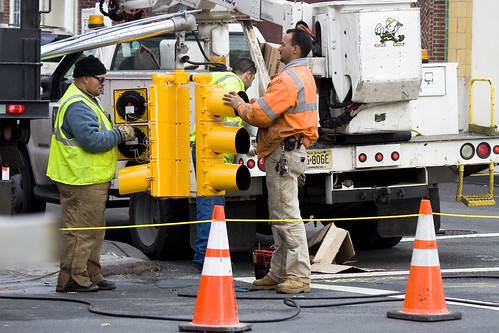
As your humble narrator scuttles from place to place, turning over rocks to see what blind albino abnormalities might lurk beneath, a significant amount of road construction is encountered. New York is always in a state of near collapse and an army of municipal and contractor labor is kept busy filling in the cracks. Conflicted over sneaking pictures of these folks, I nevertheless find them fascinating, for the high visibility colors they wear excite the eye.
from workzonesafety.org
Title: ANSI/ISEA 107-2004: Revised American National Standard for High-Visibility Safety Apparel and HeadwearAbstract: This standard provides a uniform, authoritative guide for the design, performance specifications, and use of high-visibility and reflective apparel including vests, jackets, bib/jumpsuit coveralls, trousers and harnesses. Garments that meet this standard can be worn 24 hours a day to provide users with a high level of conspicuity through the use of combined fluorescent and retroreflective materials. The revised version of the standard expands the product coverage to include high-visibility headwear. It also contains additional testing procedures for knitted fabrics used as background material, and eliminates tests from the previous edition that added no value. Publisher: International Safety Equipment Association

Third Avenue Manhattan – photo by Mitch Waxman
If it won’t blind or distract the crews, don’t forget that this is heavy industry and quite dangerous work, try turning on the camera flash when photographing them. The reflective fabrics, technically retroreflective fabrics (which function like a Cat’s eyeshine), will blaze up and be the brightest point in the photo. New York City street signs also function in a similar fashion, and even the weakest flash will light them up from blocks away. Try it, especially on a dark and stormy day, the effects are somewhat unpredictable and often produce a prismatic and surreal photo.
from simplifiedsafety.org
Class 1: needs to be conspicuous and use retroreflective materials not less than 25mm in width.
- Used when workers are well separated from traffic
- Vehicle speeds of less than 25 mph
- Parking attendants
- Shopping cart retrievers
- Warehouse workers
- Roadside/sidewalk maintenance workers
- Delivery vehicle drivers
Class 2: maintains superior visibility and are more conspicuous than the Class 1 garments. Minimum width of retroreflective material used on these is not less than 35mm.
- Used when workers are on or near roadways
- Vehicle speeds of 25 to 50 mph
- Roadway construction workers
- Utility workers
- Survey crews
- Law enforcement personnel
- Crossing guards
- High-volume parking lot or toll-gate attendants
- Airport baggage handlers and ground crews
- Railway workers
- Emergency response personnel
- Accident site investigators
Class 3: has greatest visibility. Maintains more retroreflective material than Class 2 and must have sleeves with retroreflective material between the shoulders and elbows. Not less than 50mm wide of retroreflective material.
- Used for workers in high risk situations
- Allows them to be seen from a minimum distance of 1,280 ft.
- Vehicle speeds of greater than 50 mph
- Roadway construction workers
- Utility workers
- Survey crews
- Emergency response personnel

31st street, Astoria – photo by Mitch Waxman
All of the municipal and construction rules are meant to conform to the national OSHA specifications, but individual city organizations have their own wrinkle on safety gear. MTA workers, for instance, are often observed wearing goggles and ear protection as they work. No doubt, this is due to individual union agreements and task specific requirements.
from nysdot.gov
All DOT employees, contractor employees and visitors must wear protective helmets and high visibility construction apparel while working within a highway right of way or contract limits. Flaggers must wear high visibility traffic control apparel when directing or spotting traffic. High-visibility apparel is not required for employees and visitors when they are within a completely enclosed cab constructed of steel frame and glass, or inside a motor vehicle.

37th avenue, Dutch Kills – photo by Mitch Waxman
NYFD, of course, has the most stringent series of rules for its crews. In the shot above, a 5 alarm fire at an industrial warehouse was belching black smoke into the street, but the firefighters are clearly identifiable through the murk- due to camera flash. Be careful around NYFD however, as they’re kind of busy people, and you don’t want to distract them. Also, should there be any piezoelectric activated equipment in use- DO NOT use your flash for fear of activating something.
from fasny.com
Back in November of 2008, there was a lot of confusion about the use of high-visibility vests at roadway incidents due to a new Federal Highway Administration (FHWA) Rule. The new regulation, Rule 634, stated that “All workers within the right-of-way of a Federal-aid highway who are exposed either to traffic (vehicles using the highway for purposes of travel) or to construction equipment within the work area shall wear high-visibility safety apparel.”
That regulation created a dilemma for fire departments who were truly interested in protecting their personnel. The training classes and material used by the Emergency Responder Safety Institute (ERSI) for years has suggested the use of high-visibility garments for public safety personnel when working around traffic. NFPA 1500, the Firefighter Health and Safety Standard has included a requirement for firefighters to wear safety vests at traffic incidents in the last two most recent editions. NIOSH Line of Duty Death Investigations have also included recommendations for responders to wear highly visible flagger vests when exposed to moving traffic. In the fire service community it was generally understood that the vests were not appropriate personal protective equipment (PPE) for personnel who were actively engaged in firefighting operations because those garments are not designed for exposure to fire, heat flame or hazardous materials. Rule 634, as originally published however did not outline any exemptions for firefighters engaged in direct firefighting operations and that created the dilemma.

Bridge Plaza North, Queens Plaza – photo by Mitch Waxman
The shot above is fascinating to me, for reasons that have little to do with the safety equipment exhibited. The trench that this trio is working in is down by Queens Plaza, and the cutaway shows a historical record. Notice the top layer of asphalt, then two distinct layers of cobblestones, then dirt and rock fill. Asphalt- modern, cobbles 1- the construction of the Queensboro bridge and associated roadways, cobbles 2- the pre bridge street, dirt and fill- that’s a 19th century, civil war era street. I’d love to have an archaeologist sift through this trench, but there’s nothing of historic importance in Queens… according to the City.
Note- the Charles Rudebaker wiki quote below… I’m a little squirrely on this particular wikipedia entry. The only info I could find on Rudebaker, a New Yorker who supposedly invented the Traffic Cone, parroted this exact wording all across the net. Take it with a grain of salt, until I can find out more. It very well might be a “false meme” which is a sort of “Lulz“.
from wikipedia
Traffic cones, also called road cones, highway cones, safety cones or construction cones, are usually cone-shaped markers that are placed on roads or footpaths to temporarily redirect traffic in a safe manner. They are often used to create separation or merge lanes during road construction projects or automobile accidents, although heavier, more permanent markers or signs are used if the diversion is to stay in place for a long period of time.
Traffic cones were invented in 1914 by Charles P. Rudebaker. Although originally made of concrete, today’s versions are more commonly brightly-coloured thermoplastic or rubber cones. Not all traffic cones are conical. Pillar shaped movable bollards fulfil a similar function.
…like a veritable mendicant

– photo by Mitch Waxman
Facile and easily led, your humble narrator was nevertheless in Sunset Park recently, attempting to pry information on the enigmatic “turn of the last century merchant trader” named Gilman (whose grave I’ve been searching for at Calvary Cemetery here in the heart of our Newtown Pentacle) out of a hysterical levantine who had refused my offer of electronic correspondence. This man, a member of some dire cultic offshoot of the Hasidic movement whose disturbing interpretation of the Kabballist mysteries has rendered them outcasts in their own communities, operates from a dust choked office housed in a former industrial warehouse.
from wikipedia
As compared with other Jewish movements, Hasidic Judaism tends to focus on the role of the Rebbe as an elevated spiritual leader and intercessor, a renewed emphasis on prayer, cameraderie, and deeds of kindness, and the study of tangible mystical texts. This replaced Talmudic legalism as the main traditional activity, and offered the unlearned closeness to God through joy and fervour in daily life. It sought to add to required standards of ritual observance, while relaxing others where inspiration predominated. Its communal gatherings celebrated soulful song and storytelling as forms of mystical devotion. Each dynasty follows its own principles; thus Hasidic Judaism is not one movement, but a collection of separate individual groups with some commonality. There are approximately 30 larger Hasidic groups, and several hundred minor Hasidic groups exist. Though there is no one version of Hasidism, individual Hasidic groups often share with each other fundamental philosophy, worship styles, dress, songs, etc.

– photo by Mitch Waxman
His national inheritance was Dutch. Fleeing the inquisition during the religious wars of the 16th and 17th centuries, his forebears found themselves in Bruges, and after that noble city’s Zwin Channel silted up- Amsterdam. Staunch advocates of the Hebrew religion, this family nevertheless adopted a Dutch name- Suydam- and founded a business that imported Syriac, Greek, and Sufi religious texts to the merchant city. Their trade in Christian and Pagan scrolls and books allowed them access to ancient caches of Hebrew mysticism which had been captured, explored, and expanded upon by the Mohammedans.
from wikipedia
The Sephardim (so-called Spanish Jews) had been expelled from Spain and Portugal years earlier, but many remained in the Iberian peninsula, practising Judaism in secret (see crypto-Jews or Marranos). The newly independent Dutch provinces provided an ideal opportunity for the crypto-Jews to re-establish themselves and practise their religion openly, and they migrated, most notably to Amsterdam. Collectively, they brought trading influence to the city as they established in Amsterdam.
In 1593 these Marranos arrived in Amsterdam after having been refused admission to Middelburg and Haarlem. These Jews were important merchants and persons of great ability. They labored assiduously in the cause of the people and contributed materially to the prosperity of the country. They became strenuous supporters of the house of Orange and were in return protected by the stadholder. At this time the commerce of Holland was increasing; a period of development had arrived, particularly for Amsterdam, to which Jews had carried their goods and from which they maintained their relations with foreign lands. Thus they had connections with the Levant and with Morocco. The Emperor of Morocco had an ambassador at The Hague named Samuel Pallache (1591-1626), through whose mediation, in 1620, a commercial understanding was arrived at with the Barbary States.

– photo by Mitch Waxman
A branch of the family moved to New York shortly after the American Civil War, and are mentioned as living on Martense Street in an 1890 census. Near the Borough Hall, on Clinton Street, was where the family business operated from a parlor room. They provided Jewish religious and funerary goods imported from North Africa and the Ottoman empire, and were a shipping address for certain medieval copies of ancient scrolls which had been hidden away from the inquisitors when Moorish Iberia gave way to Catholic Spain. A side line for the Suydams was found in the 19th and 20th century fashion trends that demanded far eastern textiles and faux ceramics in the adornment of domestic rooms.
from wikipedia
The first Jews to come to New York arrived in what became New York City around September in 1654. They arrived on a ship from Recife, a city in what became Brazil. There were 23 Jewish men, woman, and children refugees among the passengers on the boat, whose captain was Jacques de la Motthe.
There was initial hostility and Peter Stuyvesant attempted to evict the Jews from his town. Jewish stockholders in Amsterdam prevailed on the Dutch West India Company to order the governor to let them remain. In 1655, a few Sephardic Jewish families immigrated to the city with a Torah scroll, possibly indicating the start of a private synagogue. Stuyvesant, determined to drive the Jewish settlers out of New Amsterdam, made efforts to restrict their trade, prohibited their owning property, and taxed them to pay for the town watch. In 1655, the Jews applied for a plot of land for a cemetery, but the governor denied the request, pointing out that no one had yet died. The following year the death of one of the Jews compelled him to designate “a little hook of land” beyond the town wall. This site has long since disappeared.
Stuyvesant’s recalcitrance and the extreme cold of New Amsterdam’s winters led the Sephardic Jews to depart for Amsterdam, London, or the Caribbean, where relatives were better established. By 1663, the Torah scroll had been returned to Amsterdam. In 1664 a large British fleet forced Stuyvesant to surrender without firing a shot, and all residents who remained in what was now New York were required to sign an oath of allegiance to the English crown.[1] The one Jewish name on the list was Asser Levy’s. He seems to have maintained the only Jewish presence of record in British New York until he was joined in 1680 by relatives from Amsterdam. Levy’s death on February 1, 1681/82 and burial in the old cemetery unquestionably led Sephardi Joseph Bueno de Mesquita to purchase a separate burying ground for his own family and for a growing group of Sephardim in the community.

– photo by Mitch Waxman
The European part of the family was exterminated during the genocidal rampage of the last known Antichrist during the 1940’s, and the Suydams faded into Brooklyn obscurity during the 1950’s. The man I contacted, named Ari Suydam, is the last of his line. The old Dutch business records were lost, along with a cache of valuable paintings and other rare collectibles (including the legendary De Vermiis Mysteries, and a fragment of the Pnakotic Manuscripts- supposedly), whose recovery via international law and United Nations treaty is the man’s sole obsession. A significant amount of the documentation about a critical phase in the development of Long Island City was lost in a courthouse fire in 1904, including the critical location of Gilman’s Grave at Calvary.
In 1939 there were some 140,000 Dutch Jews living in the Netherlands, among them some 25,000 German-Jewish refugees who had fled Germany in the 1930s (other sources claim that some 34,000 Jewish refugees entered the Netherlands between 1933 and 1940, mostly from Germany and Austria)…
…In 1945 only about 35,000 of them were still alive. The exact number of “full Jews” who survived the Holocaust is estimated to be 34,379 (of whom 8,500 were part of a mixed marriage and thus spared from deportation and possible death in the Nazi concentration camps); the number of “half Jews” who were present in the Netherlands at the end of the Second World War in 1945 is estimated to be 14,545, the number of “quarter Jews” 5,990

– photo by Mitch Waxman
Suydam, it is rumored, has a unique ledger in his possession that contains the otherwise immolated information sought. Unfortunately, a bizarre and exclusionary form of an other wise wholesome orthodoxy called Hasidism that the man adheres to will not allow him to deal with anyone who is not Jewish. When informed that I was raised Jewish, Bar Mitzvah and all, Suydam scornfully informed me that I wasn’t Jewish enough and ordered me to vacate his premise. He said that there were certain things that only Kohanim should know.
Thwarted, I left and walked out into the sunset.
from wikipedia
The kohanim formed a holy order. For the purpose of protecting them against ritual defilement, the Torah imposed on them the following rules for ritual purity, which are still maintained to a certain degree in Orthodox Judaism.
- Kohanim are forbidden to come in contact with dead bodies, nor are they permitted to perform the customary mourning rites. They are commanded, however, to become defiled for their closest relatives: father, mother, brother, unmarried sister, child or wife.
- A kohen is forbidden to enter any house or enclosure, or approach any spot, in which a dead body, or part of a dead body, may be found.
- Practical examples of these prohibitions include: not entering a cemetery or attending a funeral; not being under the same roof (i.e. in a home or hospital) as a dismembered organ. The exact rules and regulations of defilement are quite complex, but a cursory rule of thumb is that they may not enter a room with a dead person or come within a few feet of the body. Proximity to the corpse of a non-Jew is less serious and may only be an issue if actual contact is established.
- A male kohen may not marry a divorcee, a prostitute, a convert, or a dishonored woman.[14] Any kohen who enters into such a marriage loses the entitlements of his priestly status while in that marriage. The kohen is not allowed to “choose to forego his status” and marry a woman prohibited to him.
- According to the Talmud, if a kohen marries in disregard of the above prohibitions, his marriage is still effective. Any children born of the union are legitimate and not mamzer. However, these children are termed chalal (“disqualified”) and lose their kohen status permanently.
- The Kohen Gadol must marry a virgin.
- During the period of the Holy Temple, kohanim were required to abstain from wine and all strong drink while performing their priestly duties.

– photo by Mitch Waxman
Third Avenue is dominated by the steel of the Gowanus Expressway where it joins the Belt Parkway. Fourth Avenue and beyond seemed to be a residential angle between neighborhoods, an immigrant clime whose residents displayed neither sin pitted countenances of old world inheritance nor sullen malignancy. Many eating establishments were observed, and a tremendous amount of vehicular traffic. Second Avenue is where you’ll find the remains of the Bush Terminal, which is the second largest interior space I’ve ever experienced. The cyclopean summit is held by the Vehicle Assembly Building at the Kennedy Space Center in Florida, so large that it forms its own weather system.
from wikipedia
After the Verrazano Narrows Bridge, I-278 continues into Brooklyn on the Gowanus Expressway. Immediately after the bridge, the freeway comes to an eastbound exit and westbound entrance for the Belt Parkway. After this, a full interchange serves 92nd Street at which point I-278 becomes a single-level six-lane freeway. Along this road, one of the eastbound lanes serves as a high-occupancy vehicle lane.[9] The Gowanus Expressway continues northeast into urban residential neighborhoods and reaches an eastbound interchange at Fort Hamilton Parkway and a westbound interchange at 86th Street. Turning more to the north, I-278 comes to a partial interchange at 65th Avenue, with an exit eastbound and entrance westbound. The road curves northwest at this point and comes to a directional interchange providing access to 3rd Avenue and the Belt Parkway.[3][4] The Gowanus Expressway turns northeast again at this interchange and continues along an elevated alignment through urban residential and commercial areas.[3] Along this viaduct, I-278 has interchanges with 38th Street/39th Street and the western terminus of NY 27 (Prospect Expressway). After the NY 27 interchange, the freeway widens to eight lanes and heads north, coming to an interchange with the Brooklyn-Battery Tunnel approach (I-478), with the exit ramps splitting from the median of I-278. Westbound access to the tunnel is provided by the Hamilton Avenue exit.

– photo by Mitch Waxman
Gilman… where is Gilman?


 The Newtown Pentacle