Archive for the ‘Greenpoint’ Category
massing around
“follow” me on Twitter at @newtownpentacle

– photo by Mitch Waxman
An arrangement was made to meet up with some of my North Brooklyn chums to hash around a few ideas and discuss the news of the day at the thankfully reopened Ashbox restaurant in Greenpoint. A bit early for the assignation, your humble narrator drifted down to the street end, and former bulkhead of the Vernon Avenue Bridge, whereupon the Iron Wolf motored by.
from seawolfmarine.net
TUG: IRON WOLF (SINGLE SCREW) 450 HP, COASTWISE, MODEL BOW, HAWSWER TUG

– photo by Mitch Waxman
Long have I wished that my parents had been avid motorcyclists and named me Iron Wolf, but alas. In fact, anything even remotely canid would satisfy this urge, but this could have resulted in my name being “Laddie”, “Butch”, or “Spot.” Iron Wolf sounds like a metal band from the early 1980’s, the sort that would have headlined at L’Amour’s over in Bay Ridge.
from tugboatenthusiastsociety.org
Name: IRON WOLF,
- O/N: 0653661
- Tug, Length: 50
- Width: 16.7
- HP: 400
- Built Year: 1983
- Built At: New Bedford, Ma.
- Builder: Bear Marine Service
- Home Port: New York, NY

– photo by Mitch Waxman
All I could find online about Iron Wolf was terse, straight to the point, and in “all caps.” I suppose that’s appropriate. IF YOU NAME SOMETHING IRON WOLF, YOU SHOULD USE ALL CAPS TO DESCRIBE IT. TERSE GREETINGS AND A MARITIME SUNDAY SHOUT OUT TO THE IRON WOLF. WELCOME TO NEWTOWN CREEK.
from wikipedia
A tugboat (tug) is a boat that maneuvers vessels by pushing or towing them. Tugs move vessels that either should not move themselves, such as ships in a crowded harbor or a narrow canal, or those that cannot move by themselves, such as barges, disabled ships, log rafts, or oil platforms. Tugboats are powerful for their size and strongly built, and some are ocean-going.
Also:
Remember that event in the fall which got cancelled due to Hurricane Sandy?
The “Up the Creek” Magic Lantern Show presented by the Obscura Society NYC is back on at Observatory.
Click here or the image below for more information and tickets.

calm alabaster
“follow” me on Twitter at @newtownpentacle

– photo by Mitch Waxman
If one doth dare, acknowledging and admiring the languid splendors of the Newtown Creek from midstream is neither commonplace nor ordinary. Intellectual inebriation is experienced by one such as myself while engaged in ribald contemplation of the place.
Ineffable wonder surmounts the water body, and no place is more steeped in legend and litigation than the southern banks found between Greenpoint and Meeker Avenues in infinite Brooklyn.

– photo by Mitch Waxman
In focus this day, here at your Newtown Pentacle, are the fuel tanks which betray the presence of the British Petroleum (formerly Amoco) facility at Apollo Street. This was a sliver of the gargantuan Standard Oil works, a bulk storage yard built on the property in 1969 by the fore mentioned Amoco oil corporation.
Refining of petroleum distillates ceased on Newtown Creek in 1966, and the local oil business in modernity is all about storage and distribution.

– photo by Mitch Waxman
The BP yard is 9.98 acres, hosting one underground and eleven above ground tanks with an overall capacity of 5,902,512 gallons of storage. There is Kerosene, Gasoline, Ethanol, and #2 fuel oil in supply- all of which are available for bulk purchase by local companies.
Additionally, there’s eight dual phase recovery wells on site which, as of 2011, had siphoned some 21,500 gallons of petroleum from deep underground. That’s where a story that started during the 1880’s actually began in 1978.

– photo by Mitch Waxman
Apollo Street in Greenpoint Brooklyn, where the Locust Hill refinery fire happened, and where the Standard Oil operation once towered, is pretty close to ground zero of the infamous and much referred to “Greenpoint Oil Spill”. In 1978, when a Coast Guard helicopter pilot first noticed that oil was oozing from the bulkheads of Newtown Creek- it was right across Apollo from the BP yard, at a former Paragon Oil terminal owned in modernity by a beverage importer and distributor.
In the shot above, the spot to look for are the three garage doors on the cream colored building just beyond the tanks. That’s where the Coast Guard first spotted the plume.

– photo by Mitch Waxman
As a point of fact, however, it should be mentioned that the traditional manner in which Americans pronounce the word “Oil”- Oy Uhl – is incorrect in North Brooklyn.
Around these parts the way to say that word is simply “Erl”.
“Greenspoints Erl Spell” is what “Greenpoint Oil Spill” should sound like, if pronounced in proper Brooklyn patois.
opiate gardens
“follow” me on Twitter at @newtownpentacle

– photo by Mitch Waxman
Imagine the surprise exhibited by Our Lady of the Pentacle and your humble narrator, when we raised the periscope from the bunker this morning, and found that the world above was intact and that the veracity and reliability of the Mayan Calendar had been overstated. Oh well, maybe next time.
Accordingly, back to the business at hand, and familiar places.

– photo by Mitch Waxman
Witness, if you wouldst, this fascinating scene observed in noble Greenpoint’s northwestern quarter, specifically the warren of mostly industrial streets which span the area between Provost Street and Mcguinness Blvd. The van pictured in the shot appears to have suffered a bit of damage, perhaps running afoul of the Hulk.

– photo by Mitch Waxman
This van’s repair job displays a purity of the Brooklyn, and particularly Greenpoint, mentality which would be difficult to explain to outsiders. Such displays of reckless engineering, utilitarian ingenuity, and disregard for the safety of passengers- are one of the reasons that your humble narrator is thankful for the distinct lack of apocalyptic conditions discovered this morning.
fevered state
“follow” me on Twitter at @newtownpentacle

– photo by Mitch Waxman
Gaze in wonder upon the fabled Newtown Creek of the 21st century, whereupon a tug of the Poling and Cutler towing organization wrestles a fuel barge in a westerly course toward the East River. A famously repeated phrase offered by your humble narrator boldly states that “in the late 19th and early 20th century, Newtown Creek carried more commercial traffic than the entire Mississippi River”, a statement which often causes listeners to roll their eyes. It is inconceivable, given the modern appearance of the Creek and its banks, to believe this statement. Some ask me whether or not tugs and barges even operate along the Newtown Creek in this dystopian future we have all found ourselves living in.

– photo by nycma.lunaimaging.com, September 11, 1903
Gaze, thereby, upon the Newtown Creek of 1903. This is roughly the same spot, with the Chelsea fiber mill (modern day Manhattan Avenue and GMDC) on the southern (left) or Greenpoint bank and the Newtown Creek towing company docks on the right or LIC bank (modern day Vernon Blvd. street end). Another shot emanating from the NYC Municipal Archives, this is one of the few extant photographic records of the Newtown Creek’s zenith as the “workshop of America” at the height of the second industrial revolution.
rough handling
“follow” me on Twitter at @newtownpentacle
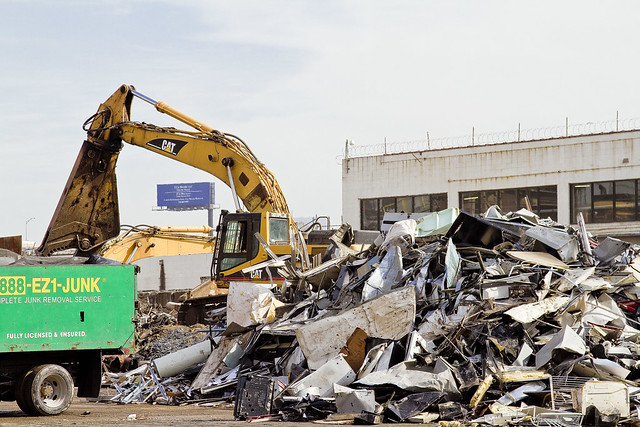
– photo by Mitch Waxman
Rejoice, for this is the day when men and women return to their ancestral villages and seaside hamlets, gathering beneath cobbled roofs and behind garret windows to celebrate “America Recycles Day”. Children shall be offered solemn pledges and vast ritual amalgamations of litter will be assembled for display and dissemination. Many and varied will be the manifestations of this occasion, which is ultimately rooted in the solemn traditions set down by a group known as “Keep America Beautiful”.
from wikipedia
America Recycles Day (ARD) is the only nationally recognized day dedicated to encouraging Americans to recycle and buy recycled products. ARD is celebrated annually on November 15. The World Recycling Day celebrated in most countries, though falls on July 8. Thousands of events are held across the U.S. to raise awareness about the importance of recycling and to encourage Americans to sign personal pledges to recycle and buy products made from recycled materials.
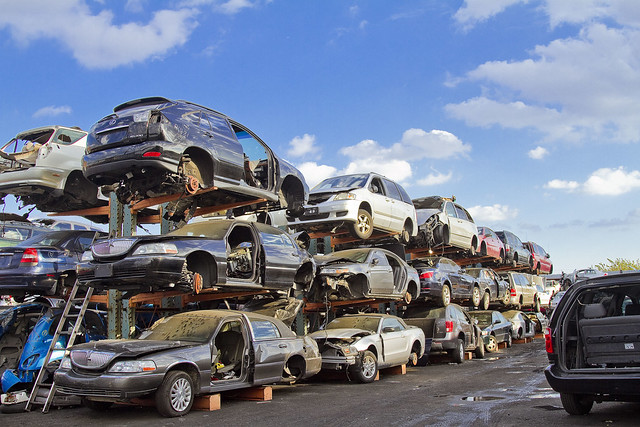
– photo by Mitch Waxman
Gaze in astonished wonder at the industry of man, and the tyranny of wealth. Imagine, if you would, the raw tonnages of refined metals displayed in these shots. Surely, just in today’s posting, we are seeing a greater amount of waste metals than an entire nation might be capable of producing just a scant 200 years ago. We waste so much, and our culture- if nothing else- will prove itself a boon to future archaeologists.
The multitudinous middens of the megalopolis, well moistened with motor oil, will stand as our monument.
from wikipedia
Keep America Beautiful was founded in 1953 by consortium of American businesses (including founding member Philip Morris, Anheuser-Busch, PepsiCo, and Coca-Cola) nonprofit organizations, government agencies, and concerned individuals in reaction to the growing problem of highway litter that followed the construction of the Interstate Highway System, and an increasingly mobile and convenience-oriented American consumer. The original goal of the organization was to reduce litter through public service advertising (PSA) campaigns.
Keep America Beautiful conducted many local PSA campaigns early in its history. One of these early campaigns in Pennsylvania (PENNDOT), some attribute to having coined the term “litterbug”, as opposed to the New York Transit Authority. There is some confusion over the origin of the actual word “litterbug” due to several early uses of it in widespread public service advertisements. It was, in fact, coined by Paul B. Gioni, a copywriter in New York City who originated it for The American Ad Council in 1947. Keep America Beautiful joined with the Ad Council in 1961 to dramatize the idea that every individual must help protect against the terrible effects litter has on the environment.
A popular television campaign theme in 1963, with copy written by Paul B. Gioni who also coined the word “litterbug” in 1947, was “Every Litter Bit Hurts”. Another appeared in 1964 featuring character Susan Spotless. In 1970 KAB began distributing a free brochure; more than 100,000 copies were requested within 4 months.
On Earth Day 1971, a new campaign was launched with the theme “People Start Pollution. People can stop it” featuring the now iconic “Crying Indian” played by Iron Eyes Cody.

– photo by Mitch Waxman
Amongst those who tolerate my presence, some work in the recycling industry. A missive they ask a humble narrator to transmit reads as: “Recycle. Please. Don’t do it for us and our business, do it for your kids”. They continue that it’s probably already too late, and that the future is trashed. Perhaps, just perhaps, they are wrong. Until the ultimate answer is found to this disposables issue, they are likely being far more pragmatic than the rest of us. It is they, after all, who see the trucks tipping and collecting, and spend more time than they would like handling putrescent garbage as a loss leader.
Figuring out when, where and how to recycle in your community couldn’t be easier. Log on to www.americarecyclesday.org and select the “Find Recycling” tab and click on the Earth911.com logo. This will direct you their recycling resource page, where you can enter the item type and your zip code to find the nearest recycling facility.

– photo by Mitch Waxman
By no means should this humble narrator be considered a creature of primal intelligence, good hygiene, or high moral turpitude. Neither should it be inferred that the role of exemplar is claimed, as far as the contributions of my own household to the problem. A lone and singular advantage is that I am instead smart enough to realize how smart I’m not, and realize the shallow depths of my grasp on the situation. Around here, we just try not to be too loose with using things that can’t be washed, or reused, or cross purposed. How about you?
from wikipedia
Recycling statistics:
- 251 million – tons of trash in the United States
- 53.4 – percentage of all paper products recycled in the United States
- 32.5 – percentage of total waste that is recycled in the United States
- 100 – approximate percentage of increase in total recycling in the United States during the past decade
- 8,660 – number of curbside recycling programs in the United States in 2006
- 8,875 – number of curbside recycling programs in the United States in 2003
- 95 – percentage of energy saved by recycling an aluminum can, compared with manufacturing a new one
- 4.6 – pounds of trash per person per day in the United States (most in the world)
- 1.5 – pounds of recycled materials per person per day in the United States


 The Newtown Pentacle