Archive for the ‘Greenpoint’ Category
Newtown Creek, and the Mountains of Madness

– photo by Mitch Waxman
A Friday, on March 19th the Hermetic Hungarian had left his laboratory workshop (a set of rooms on Manhattan’s decadent Upper West Side where he is exploring the deeper meanings and implications of esoteric 19th century clockworks) and ventured forth to Newtown.
The Hermetic Hungarian, referred to as HH from this point on, is a pale and sickly genius who has been intrigued by the presence of certain atavist religions and the persistence of modern adherents to these sects who remain extant along the poison shores surrounding an ancient industrial center called the Newtown Creek. HH had procured an automobile for the day’s exertions- as his fragile health precludes him from the long walks favored by your humble narrator which are so pedantically detailed at this- your Newtown Pentacle.

– photo by Mitch Waxman
Returning from a day of exploration, which first described the extensive branching of the transportation network referred to as “The Great Machine“, we proceeded to the currently undefended border of Maspeth and storied Greenpoint and crossed the Grand Avenue Bridge. HH was searching for evidences of a grandiose clockwork mechanism which long hours of research and supposition have led him to believe existed in the days of Trolley and Rail. Influenced by his metaphysical beliefs, which are both Hasidic and Buddhist in nature, the HH’s itinerary required his trip to be brief- and after spending an afternoon exploring the ancient climes of Newtown, Bushwyck, and Greenpoint- and we headed back toward a transportation artery that would allow him egress back to the Shining City and his hierophant isolations.

– photo by Mitch Waxman
On our return, the bascule mechanisms of the Pulaski Bridge suddenly sprang to life, allowing egress to the Newtown Creek for shipping. The first watchtower on the Creek, the Pulaski is also the busiest of its bridges. While traffic on the Newtown Creek is a shadow of what it once was, there is still a significant industrial presence on the maritime highway that requires connection with the vast enterprises of New York Harbor- especially the petrochemical empires that line the shores of the Kill Van Kull in distant… Staten Island. Additionally the car shredders and other recycling facilities, which bless Newtown with their labor, utilize barges to move their wares to distant customers.

– photo by Mitch Waxman
In this case, it is the petrochemical shipping industry which commanded the opening of the Pulaski Bridge, as evidenced by the appearance of the DBL 28 fuel Barge, a 28,000 BBL double hull tank barge (which conforms to the Oil Pollution Act of 1990’s requirements- no mean feat) which was built in 2006 and weighs some 2,146 gross tons.
from allbusiness.com
The 28,000 bbl capacity DBL 28 measures 297.6-feet in length, with a 54-foot beam and 13-foot depth. The DBL 28 is the first of a series of eight units currently in production at BMF for K-Sea. DBL 28 is coupled with an existing K-Sea tug using the state-of-the-art Beacon JAK 200 tug/barge Push-Pin coupler system, which is designed to increase operating efficiency and enhance safety and reliability by operating as a dual mode ITB. The series of barges are manned, non self-propelled, double hulled with a raked shaped bow, with six cargo tanks. The barges are classed Lakes, Bays & Sound (Inland) Tank Barges, ABS +A1 Oil Tank Barge, and USCG certified. The barges are being constructed primarily for bunkering and harbor service in ports on the U.S. East Coast.

– photo by Mitch Waxman
The fuel Barge was being guided by the K-Sea Davis Sea, a 2,000 HP 95 gross ton, 77 foot long tug whose mast spires nearly 57 feet over the water. Online sources describe the Davis Sea as possessing 6 foot diameter propeller screws, which are powered by twin engines, and as having been built in 1982.
from k-sea.com
K-Sea Transportation Partners L.P., headquartered in East Brunswick, New Jersey, is a leading provider of marine transportation, distribution and logistics services in the U.S. From locations in New York, Philadelphia, Norfolk, Seattle and Honolulu, K-Sea operates a large fleet of tugs and tank barges that serves a wide range of customers, including major oil companies, oil traders and refiners.

– photo by Mitch Waxman
The Davis Sea, of course, is named for the oceanic area along the coast of Eastern Antarctica which abutts the Shackleton and West ice shelfs. Lying along the Indian Ocean side of the polar wasteland, it is the coldest, windiest and driest section of the southern pole. Eastern Antarctica is still largely unknown to man, except by aerial and satellite observation- although the Soviet and American hegemonies established scientific research bases as early as the 1950’s in the relatively ice free coastal areas. Today, all of the great nations are represented in scientific exploration of this final frigid frontier.

– photo by Mitch Waxman
The Gamburtsev Mountain Range as well as the prominences of the Transantarctic Mountains, and the East Antarctica Ranges are amongst the oldest ranges on Earth, although some of these great structures are quite nearly buried beneath the glaciers they have formed. Hostile to normal terrestrial life, these mountains of madness are rumored to contain and house several obscure occult constructs including “The black pit,” “the carven rim,” “the protoShoggoths,” “the windowless solids with five dimensions,” “the nameless cylinder,” “the elder Pharos,” “Yog-Sothoth,” “the primal white jelly,” “the color out of space,” “the wings,” “the eyes in darkness,” “the moon-ladder,” “the original, the eternal, the undying,” and other queer occult concepts.

– photo by Mitch Waxman
Of course, your humble narrator digresses, influenced by a day spent with the limitless intellect of the Hermetic Hungarian- and the Davis Sea pictured above is merely a tugboat making it’s way down an urban waterway, and is not the seat of some cosmic horror which would shatter our notion of civilization and man’s place in the universal order.
The HH began frantically gesturing at me as I stood on the roadway of the Pulaski Bridge just then, lost down the soda straw reality of a telephoto lens.

– photo by Mitch Waxman
Its purpose accomplished, the drawbridge had returned to its vehicular roadway duties, and traffic flow between Greenpoint and Long Island City was about to resume. Angry at the inconveniences offered by the delay, anxious drivers were about to rocket forth into Queens, and would have hardly afforded a specimen such as myself the luxury of not being ground to paste beneath their spinning wheels.

– photo by Mitch Waxman
The Davis Sea proceeded up the Creek, no paddles required or missed. She sauntered past FreshDirect and the Newtown Creek Waste Water Treatment Plant at Whale Creek, churning the languid gelatins which line the Newtown Creek as it went. This must be a difficult course, as there is so little room for error in piloting the narrow and tightly populated channel.

– photo by Mitch Waxman
That is Calvary Cemetery on the horizon, with industrial Queens occupying the left side of the image. Just beyond is the Greenpoint Avenue Bridge and the significant petrochemical facilities- recently upgraded and enlarged and enjoyed by those on the Brooklyn shore – that adjoin it.

– photo by Mitch Waxman
Forced to begin speeding up, the Hermetic Hungarian allowed me one or two last shots of the Davis Sea as it passed into that world of ancient mariners and atavist custom which typify Newtown, while angry motorists behind us employed their horns to display displeasure at our lack of enthusiasm for leaving the scene. Their horns formed a mocking chorus, an antiphonal response to our absent haste whose sound can be described only as…
“Tekeli-li! Tekeli-li!” “Tekeli-li! Tekeli-li!” “Tekeli-li! Tekeli-li!”
Driven to madness by the sound, the Hermetic Hungarian began babbling madly, repeating the names of subway stops as we drove.
Green Jobs of the Future

– photo by Mitch Waxman
One of the current political buzz phrases, “green jobs of the future”, gets under my skin. The 2 shots in today’s posts are what I call “snatch and grabs”, meaning that I was passing by- took a couple of quick shots- and beat it out of there. This is one of the many recycling facilities one may find in Greenpoint, Brooklyn. I bring them to your attention not because of intrinsic merit or photographic interest but rather to make a certain point about this particular political meme. Non union and dirty, the recycling side of waste management enjoys a certain vogue amongst the elites of the intellectual and political class, but the truth of it is somewhat different. Were these elites to actually walk the neighborhood streets where their ideas are made manifest, one wonders how their enthusiasm would fare.
from nyc.gov
Place all paper together in CLEAR bags, or in any bin labeled with green recycling decals or marked ” MIXED PAPER”. (Or place in the white dumpster for paper recycling, if your building has one.)
Flatten and bundle large pieces of corrugated cardboard and tie with sturdy twine, or break into small pieces to place in your recycling bin or bag. (Or place loose in the white dumpster for paper recycling, if your building has one.)

– photo by Mitch Waxman
A neighbor of mine works in one of these plants, located like this one near the Newtown Creek, and has described the process of collection and sorting to me in some detail. Most of this paper ends up getting pulped and processed into shipping boxes. Raw paper is sold by the ton to be shredded into pulp, and free market vagaries apply. He’s told me that as the economy has tanked, so too have the orders for boxes from online retailers (a large part of the recycled paper market), which has depressed the market. His literal quote, which was said without a hint of irony, is that “the bottom has dropped out of the cardboard box market”.
from dec.ny.gov
In the Solid Waste Management Act of 1988, the Legislature established our State Solid Waste Management Policy. The following are the solid waste management priorities in New York State:
- (a) first, to reduce the amount of solid waste generated;
- (b) second, to reuse material for the purpose for which it was originally intended or to recycle material that cannot be reused;
- (c) third, to recover, in an environmentally acceptable manner, energy from solid waste that can not be economically and technically reused or recycled; and
- (d) fourth, to dispose of solid waste that is not being reused, recycled or from which energy is not being recovered, by land burial or other methods approved by the department (from New York State Environmental Conservation Law 27-0106.1).
The primary mandate of the Solid Waste Management Act is to reduce the amount of waste destined for landfills and incinerators in New York State. Source separation and recycling programs are fundamental components to the diminishing of the ultimate volume of solid waste requiring disposal. Source separation and recycling play primary roles in meeting this goal. In New York State, municipalities are required to enact local recycling laws under General Municipal Law section 120-aa.
horrible and unearthly ululations…

– photo by Mitch Waxman (from the Queens Museum of Art’s “Panorama of the City of New York”)
Loathsomeness awaits, in the deep.
At the end of the Pleistocene, when the ice of the Wisconsinan glaciation was at last defeated by ocean and sun, the rubble which spilled from its ruptured facings piled up to form the terminal moraine of a cyclopean coastal sandbar, as well as many smaller islands. The torrents of flowing mud and water – acting in the manner of icy Lahars– interacted with this loose fill of titan boulders and frosty soil, amalgamating around stoney knobs of bedrock. These rough bits of rock, exposed by the motive traction exacted by ten thousand years of mile high ice, formed and agglutinated into an archipelago and estuary familiar to modernity as New York Harbor.
At the western tip of the sandbar, which european cartography called Long Island, an arabesque web of waterways was carved out of this turbulent tidal and river environment.
Welcome to the Newtown Creek.
from wikipedia
The Wisconsin Glacial Episode was the last major advance of continental glaciers in the North American Laurentide ice sheet. This glaciation is made of three glacial maxima (sometimes mistakenly called ice ages) separated by interglacial warm periods (such as the one we are living in). These glacial maxima are called, from oldest to youngest, Tahoe, Tenaya and Tioga. The Tahoe reached its maximum extent perhaps about 70,000 years ago, perhaps as a byproduct of the Toba super eruption. Little is known about the Tenaya. The Tioga was the least severe and last of the Wisconsin Episode. It began about 30,000 years ago, reached its greatest advance 21,000 years ago, and ended about 10,000 years ago. At the height of glaciation the Bering land bridge permitted migration of mammals such as humans to North America from Siberia.
It radically altered the geography of North America north of the Ohio River. At the height of the Wisconsin Episode glaciation, ice covered most of Canada, the Upper Midwest, and New England, as well as parts of Montana and Washington. On Kelleys Island in Lake Erie or in New York’s Central Park, the grooves left by these glaciers can be easily observed. In southwestern Saskatchewan and southeastern Alberta a suture zone between the Laurentide and Cordilleran ice sheets formed the Cypress Hills, which is the northernmost point in North America that remained south of the continental ice sheets.
The Great Lakes are the result of glacial scour and pooling of meltwater at the rim of the receding ice. When the enormous mass of the continental ice sheet retreated, the Great Lakes began gradually moving south due to isostatic rebound of the north shore. Niagara Falls is also a product of the glaciation, as is the course of the Ohio River, which largely supplanted the prior Teays River.
With the assistance of several very large glacial lakes, it carved the gorge now known as the Upper Mississippi River, filling into the Driftless Area and probably creating an annual ice-dam-burst.
In its retreat, the Wisconsin Episode glaciation left terminal moraines that form Long Island, Block Island, Cape Cod, Nomans Land, Marthas Vineyard, and Nantucket, and the Oak Ridges Moraine in south central Ontario, Canada. In Wisconsin itself, it left the Kettle Moraine. The drumlins and eskers formed at its melting edge are landmarks of the Lower Connecticut River Valley.

– photo by Mitch Waxman (from the Queens Museum of Art’s “Panorama of the City of New York”)
3.8 miles long, its mouth is directly opposite the Bellevue Psychiatric Hospital in Manhattan, and defines the currently undefended border between North Brooklyn and Western Queens. Estimates state that some 14 million gallons of combined sewage, storm runoff, and industrial waste provide the only flow of water into the Creek. It’s waters are opaque, and in the height of summer turn an unnatural shade of green.
The soft bottom of the waterway is 15-20 feet below the surface of the water, and the hard bottom is occluded by a gelatinous sediment known as “Black Mayonnaise”. Composed of petroleum residues, coal tar, PCB’s, and human excrement- it lies 15 feet thick on the bed. The oxygen content of the water drops precipitously as soon as one leaves the East River. The first of the drawbridges which cross it- known as the Pulaski Bridge, is the borderline beyond which immersion in this water is worthy of full HAZMAT gear and first responders institute biological decontamination procedures for anyone who finds themselves in it.
As I’ve mentioned in the past… the chemicals Putrescine (an organic chemical compound NH2(CH2)4NH2 (1,4-diaminobutane or butanediamine) and Cadaverine (a toxic diamine with the formula NH2(CH2)5NH2) which are produced by the rotting and putrefaction of animal flesh are abundantly found in the Newtown Creek under industrial aliases like Acrylonitrile and are prominent members on the EPA’s list of Volatile Organic Compounds– or VOC’s..
Who can guess, what it is, that may be buried down there?
from brookhaven national laboratories
Sediments from the New York/New Jersey Harborareas are dredged routinely to maintain navigable water depths for shipping channels and berthing areas to facilitate commerce and safe navigation. Historically, the dredged materials was disposed in the ocean. However, ocean disposal has been restricted due to greater regulatory restrictions on contaminant concentrations in the dredged sediments. The dredged sediments typically contain elevated levels of metals, polynuclear aromatichydrocarbons (PAHs) (tars, oils, fuels) polychlorinated biphenyls (PCBs), chlorinated pesticides and herbicides, dioxins (PCDDs), andfurans (PCDFs) as shown in Table 1-1[l] for Newtown Creek. Table 1-1, included at the end of this section, lists both the range previously available from the Request for Proposal and the average of six samples available to date for the treatability studies.The actual sediment used for the test was a black mayonnaise-like paste that contained few particles (or 0.2% on dry basis) greater than 2 mm, and exhibited an oily, foul odor.
BNL and other governmental federal and state agencies are in the process of developing risk-based and/or specific clean-up standards for the various locations where the treated sediment products are to be used. These standards are likely to be related to the soil clean-up criteria used based on direct soil contact (residential and non-residential) and/or impact to groundwater. For example, Appendix A contains the current soil clean-up criteria used by the State of New Jersey and the Maximum Concentration of Contaminants for the Toxicity Characteristic. Based on the sediment from Newtown Creek and the soil clean-up criteria for direct soil contact, some contaminants already meet the clean-up criteria while some need up to one or two orders-of-magnitude removal. The TCLP values for the Newtown Creek sediment are below the maximum toxicity characteristic value.

– photo by Mitch Waxman
There are 5 major vehicular traffic bridges which hurtle over the Newtown Creek, 3 of which are drawbridges and one is a non functioning swing bridge. It’s tributary branches are also crossed by a variety of other spans, from the high flying Queens Midtown Expressway section of the Long Island Expressway and the grade level Hunter’s Point Avenue drawbridge to the Borden Avenue retractile bridge over the Dutch Kills. Additionally, atavist rail bridges and trackbeds stretch from no longer existing car docks at Hunters Point to the massive rail terminals and switchings in Maspeth and lead to points further East. Municipal neglect has rendered many of these bridges dangerously decayed, non functional, or dangerous to operate. Once, this was the busiest industrial waterway in North America.
A spate of emergency repairs and reconstructions was conducted in the 1980’s and 90’s to shore up these crossings. For instance, the 1910 Hunter’s Point Avenue Bridge, originally a double leaf bascule design like the Pulaski, was replaced by a single leaf design and in 1987- the 1929 Greenpoint Avenue Bridge was rebuilt- and the 1959 Pulaski was rebuilt in the early 1990’s.
from nyc.gov
The Pulaski Bridge, which carries six lanes of traffic and a pedestrian sidewalk over Newton Creek and the Long Island Expressway, is orientated north-south and connects Greenpoint in Brooklyn to Long Island City in Queens. McGuinness Boulevard approaches the bridge from the south and Eleventh Street from the north. The Pulaski Bridge is a 54m double leaf, trunnion type bascule bridge. It has two 10.5m roadways divided by a concrete median barrier. It also carries a 2.7m pedestrian sidewalk. The bridge provides a channel with a horizontal clearance of 45.7m and a vertical clearance of 11.9m in the closed position at MHW and 13m MLW.

– photo by Mitch Waxman
There is a “colour” observed around the Newtown Creek. An iridescent sheen which seems to have been drawn from a palette not of this earth, rather it is best described as looking like some “Colour out of space“. Observable on every oil soaked cobblestone which pushes up through the asphalt, and pulsing through thorny vines which line the rotting bulkheads and sway against the putrid breeze, this colour is only the visible manifestation of a detestable lament which has infected the land and percolates in the swampy underworld hidden by piling and cement some 10-20 feet beneath the so called land. Wild catalogs of chemical compounds congeal in unknowable combinations, pooling in vast subterrene chambers and mixing with an underground water table that feed the sickly trees lining area streets.
Fish and invertebrates harvested from the Newtown Creek display open sores, unexplained tumors, and queerly mutated organs. Weird eyeless things can be seen wriggling in the filth, at low tide.
The surface of the water has tested positive for a variety of bacterial specie including Gonorrhea, Typhus, and Cholera.
from epa.gov
“Newtown Creek is one of the most grossly-contaminated waterways in the country,” said Acting Regional Administrator George Pavlou. “By listing the creek, EPA can focus on doing the extensive sampling needed to figure out the best way to address the contamination and see the work through.”
EPA responded to requests by members of Congress to evaluate specific sites along the creek by publishing a September 2007 report that contained a review of past work and recommendations regarding future work at Newtown Creek. The state of New York referred the site to EPA due to the complex nature of the contamination along the creek.
Newtown Creek is part of the core area of the New York-New Jersey Harbor Estuary, which has been designated by EPA as an “estuary of national significance.” Despite the ongoing pollution problems, some residents currently use the creek for recreational purposes such as kayaking, while others catch fish for consumption out of it. Various sediment and surface water samples have been taken along the creek and reveal the presence of pesticides, metals, PCBs, and volatile organic compounds (VOCs), which are potentially harmful contaminants that can easily evaporate into the air.
In the mid -1800s, the area adjacent to the 3.8-mile Newtown Creek was one of the busiest hubs of industrial activity in New York City. More than 50 industrial facilities were located along its banks, including oil refineries, petrochemical plants, fertilizer and glue factories, sawmills, and lumber and coal yards. The creek was crowded with commercial vessels, including large boats bringing in raw materials and fuel and taking out oil, chemicals and metals. In addition to the industrial pollution that resulted from all of this activity, the city began dumping raw sewage directly into the water in 1856. During World War II, the creek was one of the busiest ports in the nation. Some factories and facilities still operate along it, and various adjacent contaminated sites have contributed to its contamination. Today, as a result of its industrial history, including countless spills, Newtown Creek is badly polluted.

– photo by Mitch Waxman
The northern bank of the Newtown Creek forms the border of Long Island City, and swirls through Laurel Hill (or Blissville), Sunnyside, Ridgewood, and Maspeth in Queens. The southern bank in Brooklyn is dominated by the ancient cities of Greenpoint, Bushwick, and Williamsburg.
from wikipedia
Greenpoint was originally inhabited by Keskachauge (Keshaechqueren) Indians, a sub-tribe of the Lenape. Contemporary accounts describe it as remarkably verdant and beautiful, with Jack pine and oak forest, meadows, fresh water creeks and briny marshes. Water fowl and fish were abundant. The name originally referred to a small bluff of land jutting into the East River at what is now the westernmost end of Freeman Street, but eventually came to describe the whole peninsula.
In 1638 the Dutch West India Company negotiated the right to settle Brooklyn from the Lenape. The first recorded European settler of what is now Greenpoint was Dirck Volckertsen (Dutchified from Holgerssøn), a Norwegian immigrant who in 1645 built a one-and-a-half story farmhouse there with the help of two Dutch carpenters. It was in the contemporary Dutch style just west of what is now the intersection of Calyer St. and Franklin Street. There he planted orchards and raised crops, sheep and cattle. He was called Dirck de Noorman by the Dutch colonists of the region, Noorman being the Dutch word for “Norseman” or “Northman.”
COOPER!!!
First, for almost every correct pronunciation of the name “Cooper”- as enunciated by Tony Todd and Patricia Tallman, click here.
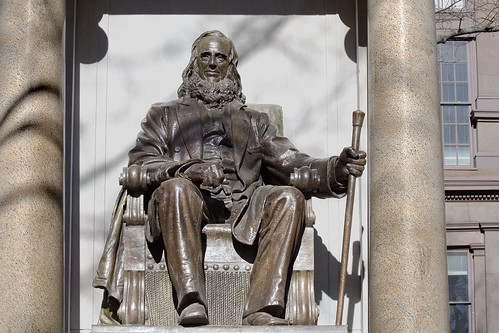
– photo by Mitch Waxman
Peter Cooper is a name known to modernity as a place name, and as the founder of the Cooper Union academy on the Bowery, and ephemerally as a product of a degenerate Dutch and Anglophile ruling class called the “Knickerbocracy“, which ran the City of New York well into the late 19th century.
He was a great deal more, and its odd that histories of the United States produced in the 20th century generally omit the name of this prominent industrialist- an opponent of slavery and proponent of Native American rights, father of a New York City Mayor and father in law of another Mayor– from discussion. His contributions to the Nation’s industrial history are similarly overlooked.
A Newtown Pentacle posting of June,4 2009 revealed that the origins of his great fortune were founded along the loathsome Newtown Creek, where his industrial operations chemically converted animal tissue and bodily waste into useful products like glue and Jell-O brand gelatin (as a note: if you enjoy gealtin treats, NEVER inquire as to what it is actually made from, or the methodologies employed in manufacture– for you will strike this item from your diet forever. I warn you, and point out that similar warnings against investigating the realities of Chimpanzee Attack have been proven out in the past).

from cooper.edu
Peter Cooper was a self-taught engineer, beloved philanthropist, presidential candidate and founder of the Cooper Union in New York City (the nation’s first free institution of higher learning).
Cooper had a number of patents and inventions to his credit. Builder and inventor of the famous “Tom Thumb” protoytpe locomotive, which was used to demonstrate the potential of steam-powered rail transport to leaders of the American transportation industry, he also obtained the very first American patent for the manufacture of gelatin (1845). He subsequently established a number of other patents for its manufacture and established manufacturing standards for its production. Some time later (1895), Pearl B. Wait, a cough syrup manufacturer, bought the patent from Peter Cooper and adapted Cooper’s gelatin dessert into an entirely prepackaged form, which his wife, May David Wait, named “Jell-O.” The rest is history…

– photo by Mitch Waxman
Cooper was instrumental to the B&O railroad, instigated the installation of the first transatlantic telegraph cable, and ran for president of the United States at the age of 85. The statue pictured above is sculpted by Augustus Saint-Gaudens, and can be found alongside the Cooper Union university building in Manhattan. It shows a promethean and physically robust specimen, which is a somewhat inaccurate visual description. Thanks to the archives at that august academy of the arts, photos of the great man in life are available.
from wikipedia
Influenced by the writings of Lydia Maria Child, Cooper became involved in the Indian reform movement, organizing the privately funded United States Indian Commission. This organization, whose members included William E. Dodge and Henry Ward Beecher, was dedicated to the protection and elevation of Native Americans in the United States and the elimination of warfare in the western territories. Cooper’s efforts led to the formation of the Board of Indian Commissioners, which oversaw Ulysses S. Grant’s Peace Policy. Between 1870 and 1875, Cooper sponsored Indian delegations to Washington, D.C., New York City, and other Eastern cities. These delegations met with Indian rights advocates and addressed the public on United States Indian policy. Speakers included: Red Cloud, Little Raven and Alfred B. Meacham and a delegation of Modoc and Klamath Indians.
Cooper was an ardent critic of the gold standard and the debt-based monetary system of bank currency. Throughout the depression from 1873-78, he said that usury was the foremost political problem of the day. He strongly advocated a credit-based, Government-issued currency of United States Notes. He outlined his ideas in his 1883 book Ideas for a Science of Good Government.

photo from cooper.edu

– photo by Mitch Waxman
The 6.5 acre site of Cooper’s glue factory, which picked up stakes and left Brooklyn in 1895, was sold by his descendants to the City of Brooklyn for $55,000 (that’s $55,000 in 1895, by the way). Today, it’s known as Cooper Park, which sits between Sharon and Olive Streets and Maspeth and Morgan Avenues in Greenpoint. The Glue factory was considered quote a nuisance by contemporaries- but one wonders how much of that reportage was driven by politics. Cooper was what modernity would classify as a liberal and progressive reformer, and was a bulwark against the trusts and Tammany. A powerful man gains powerful enemies- or as Stan Lee would put it- “with great power comes great responsibility”.
from uua.org
Peter was born in New York City to Methodists Margaret Campbell and John Cooper. Their home was opened to traveling clergy. Peter later recalled that his “father’s religion was of that kind that he feared everybody would go tumbling into hell.” Although he abandoned his father’s doctrine, he never strayed from the work ethic his father instilled in him from an early age.
John Cooper attempted several craft and merchandising occupations, with little success. Among other tasks, Peter had to “boil the hair out of the rabbit skins to be used in the manufacture of hats.” This experience may well have inspired his later invention of gelatin, made by boiling animal skin and connective tissue. He began inventing early in adolescence. He devised a machine for washing clothes, which aided his mother greatly. He helped his family by finding new ways to net wild pigeons, construct shoes, make bricks, and brew beer. So occupied, he had little opportunity for schooling. “My only recollection of being at school,” Cooper explained in his autobiography, “was at Peekskill [New York] about some three or four quarters and a part of the time it was half-day school.” As he began to hone his entrepreneurial skills, his lively curiosity nevertheless helped him to acquire an informal education.
In 1808 Cooper was apprenticed to a New York coachmaker. Although he showed promise in this trade, he declined to take the loan necessary to set himself up in the business. Instead he took a job in Hempstead, Long Island with a manufacturer of cloth-shearing machines. There he obtained a license to make and sell the machines in New York. He then designed, patented, and manufactured an improved version of the machine. He recalled that “the first money I received for the sale of my machines was from Mr. [Matthew] Vassar, of Poughkeepsie, who afterwards founded that noble institution for female education, called Vassar College.”
In 1813 Cooper married Sarah Raynor Bedell. Only two of their six children, Edward and Sarah Amelia, survived childhood. For a time he operated a grocery store in partnership with his brother-in-law. A jack-of-all-trades, he also ran factories to make furniture, glue, and isinglass. In 1828 he founded the Canton Iron Works in Baltimore, Maryland. This made his fortune. He set up other foundries in New Jersey and Pennsylvania and a rolling mill in New York (which he later moved to Trenton, New Jersey).
In addition to the washing machine, Cooper invented a cutting device for lawn mowers, a torpedo boat, and the first American steam locomotive (named “Tom Thumb”). With his brother Thomas, in 1854 he manufactured the first iron structural beams. He also invented the first blast furnace, a compressed air engine for ferry boats, a water-powered device to move barges down the newly-constructed Erie Canal, a machine to grind and polish plate glass, and a musical cradle.

– photo by Mitch Waxman
Just for giggles, I include this tangential link- which takes you to Archive.org’s “Historic and Antiquarian Scenes in Brooklyn and its vicinity“. Examine the “Suydam House” section, which is the 1700 farmhouse that was commandeered in revolutionary times as a barracks for Hessian soldiers, uses phrases like “Dutch pertinacity” and discusses the history of the site that the Cooper Glue Factory would be built on. Notable moments in the english language found within include:
“It is built as was the invariable practice of the old Hollandish settlers, in a gentle depression of the ground, where it would be protected from the sweep of the dreaded north wind. The airy site and broad prospect which so entice the newer occupants of Brooklyn soil, had no attractions for the phlegmatic and comfort-loving Dutch race.”
“The Germans early entertained a fondness for the soil of Bushwick and Brooklyn, for even at this period they exhibited the strongest desire to escape from military control, and settle upon it. That they had then discovered its capacity for the manufacture and storage of lager beer is susceptible of some proof. Certainly all the frightful tortures which awaited the captured deserter did not deter them from attempting escape from British protection. Many of them settled in Brooklyn, and by their thrift and industry acquired not a little property.
One of the subjects of the Elector of Hesse Cassel, named Louis Warner, in some quiet Dutch fashion of his own, crept out of the watch and ward of his majesty, George the Third’s soldiers, who zealously endeavored to return the dear subjects of the Elector to his paternal care. Louis pursued the occupation of milkman for a long time on the Luqueer farm, in Bushwick, now nearly covered by the building of Peter Cooper’s glue factory, where he had bivouacked with his Hessian comrades for many months during the revolution. “
and finally from rebresearch.com, (click through to their page to see the various diagrams and photos referred to in the quotation)
1820-1865: Age 30, Peter Cooper buys a glue factory from Mr. Vreeland in Kipps Bay (Grammercy Park) Manhattan. Peter had bought glue from there knew the business to be a good one. He sells the grocery shortly thereafter to concentrate upgrading the glue factory. He’s nearly killed several times in this. As business expands he moves the glue factory to Burling Slip, Brooklyn and later to Maspeth, Queens. In Maspeth, Queens, near Newtown creek, Cooper builds the large facrtory shown in the picture below. Peter Cooper invents the double boiler, a major innovation (see figure) that avoids burning the glue by heating it directly with a fire. Instead, in the double boiler water is heated by coal fire, and steam from the hot water cooks the glue. The double boiler is used to this day thoughout the food industry, and steam remains the most popular heat transfer fluid throughout the chemical industry. Using the double boiler Peter Cooper’s begins to make glue in ten, different, standard grades. The lightest grade will be sold as edible gelatin as well as for glue use. Cooper invents a method for freeze-drying glue and similar products, 1845. (need technical details — how was this done in the 1800s?). Quality control is an important part of Cooper glue. Peter Cooper invents a vernier test for glue stiffness (see picture below); a weight is placed on a block of gelled gule, and one measures how far the weight sags. His test method for testing glue stiffness will be used till the 1950s.
Peter Cooper’s glue works also produces animal-fat based oils and chemical products. Of particular importance is Neat’s Foot Oil, a lighting and machine oil made from calves feet. It’s comparable to whale oil, and is still in use today. Peter Cooper invents American Isinglass, a brightener and clarifier derived from fish oil; it is cheaper than Russian Isinglass, used to clarify wine and deserts. In 1865 Cooper retires from active involvement in the glue business. He sells the main factory and land to his son, Edward, his agent, William Serrell, and their children for $200,000. At this point, the Glue Factory is probably the largest in the country, and perhaps in the world. It is selling approximately $200,000 worth of glue per year, with distribution from London to South America. In the 20th century the glue works would leave Queens for Gowanda, NY. There reamins a small monument to the factory in Maspeth, Queens. His Grandson, Peter Cooper Hewitt will patent an improved chiller table for gelatin making.
Tales of Calvary 11- Keegan and Locust Hill

– photo by Mitch Waxman
The monument to Charles Keegan is a familiar one to those who visit First Calvary Cemetery with any regularity. Close to the gates on Greenpoint Avenue, one does not need to penetrate too deeply into the viridian devastations of the place to find it. Keegan was a firefighter, a Foreman of Hook and Ladder No. 4 who was killed during the pursuit of his duties on the 15th of September in 1882 at the conjunction of Meeker Avenue and the loathsome Newtown Creek.
nytimes.com has an article on the Locust Hill Refinery Fire, which presents the grisly details of that night and describes the tragic death of both Keegan and Captain Stuart Duane (whose death counts as one of the most horrible exits from this mortal coil I’ve ever encountered)

– photo by Mitch Waxman
Before the night was over and the vast fire contained, oil barges set aflame by the terrific explosions and spreading flames had been carried all the way to the Penny Bridge, which ended up being consumed itself by fire. The far larger Standard Oil works up the Creek were protected from this spreading conflagration by an ad hoc boom deployed by Firefighters across the Creek, said boom was composed of empty barges and logs. The entire blaze began when lightning struck the petroleum reservoir tanks of Sone & Fleming at the Locust Hill Refinery sparking a fire which spread insidiously across the 18th ward, during a severe thunderstorm.
arrts-arrchives.com has many fascinating images for the antiquarian community to marvel over, but of interest for readers of this posting will be this shot from 1852 (that’s the Newtown Creek, kids, see Calvary in the upper right corner- click image for a larger view at the arrts-archives.com site) showing the Penny Bridge that was burned away.


– photo by Mitch Waxman
By 1929, the independent oil companies around the Newtown Creek were absorbed by the Standard Oil Trust, parent of the modern Exxon and Mobil corporations. Standard Oil, of course was the guilty party concerning the Greenpoint Oil Spill.
William DONALD, proprietor of the Locust Hill Oil Works, where the fire originated, testified that when he reached the fire he saw the only way to save anything was to draw off the oil. By five o’clock in the morning one-half had been drawn off. About twenty minutes later the tank boiled over and filled the yard with burning oil. KEEGAN was near the tank at the time, with several men employed in the works and some firemen. They ran and escaped except KEEGAN, whom the witness afterwards heard was missing. There was about six hundred barrels of crude oil in the tank.


 The Newtown Pentacle