Archive for the ‘Long Island City’ Category
judging from
Thursday
– photo by Mitch Waxman
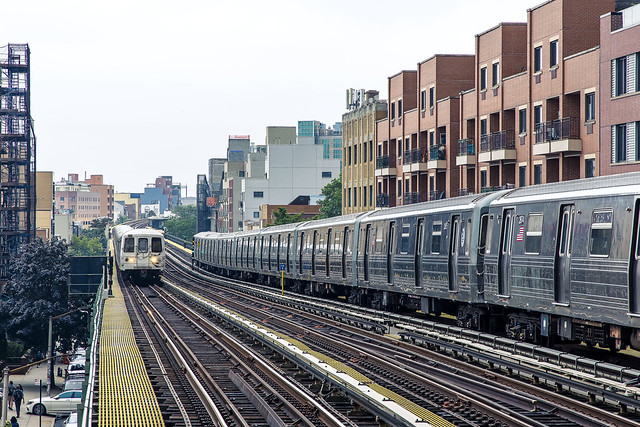
The weather forecast on August 1st wasn’t promising anything pleasant for the days immediately following it, and there was a lot of fog and mist in the air…
How can a humble narrator be expected to ignore atmospheric diffusion? Pfah. One shlepped over to the N train, and away I went.
– photo by Mitch Waxman
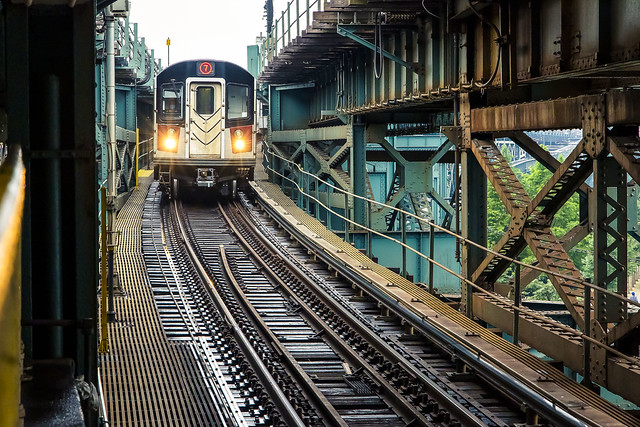
At Queens Plaza, I transferred my allegiances from the N to the 7, and took that line two stops to Hunters Point Avenue.
I had a plan in mind for the foggy afternoon, one which would find me over in Brooklyn’s Greenpoint section.
– photo by Mitch Waxman
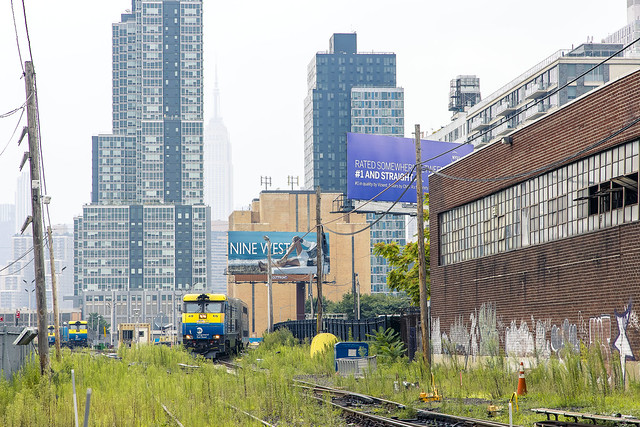
DUPBO – Down Under the Pulaski Bridge Onramp – was part of my plan. In the late afternoons during weekdays, the Long Island Railroad people deploy a train set about every half hour from the Hunters Point Yard. The trains move under the Pulaski Bridge, cross Borden Avenue, and then go off to parts that are unknown but fairly guessable.
My plan involved crossing the Pulaski Bridge on foot, of course, but I wouldn’t be “me” if I didn’t crack out a few shots of a passing locomotive.
– photo by Mitch Waxman
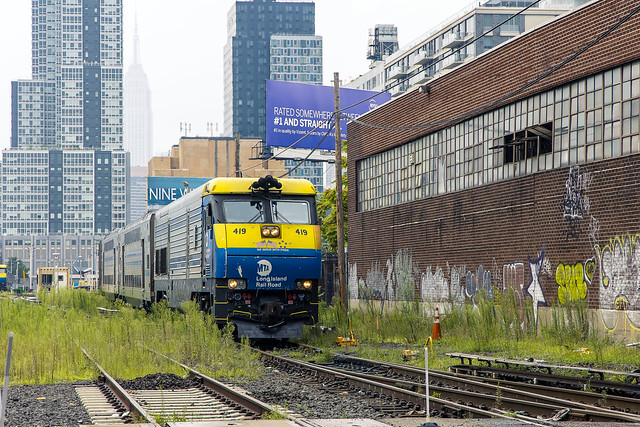
Y’know, I know – intellectually – that they’re going to blow the train horn when they approach a grade crossing. Doesn’t change the fact that I’m startled by the sound each and every time they do it.
It’s what’s known as an autonomic reaction to environmental stimuli.
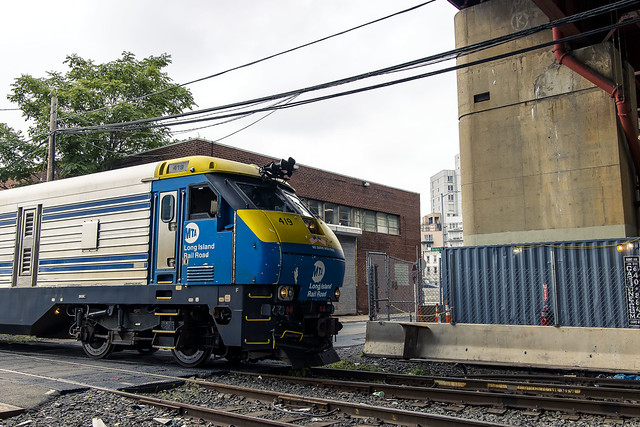
– photo by Mitch Waxman
After getting my LIRR shots, and then inspecting the waterside area under the bridge, I headed over to the steep and well traveled stairs of the Pulaski Bridge.
I guess that about 20 minutes had elapsed while I was wandering around down there.

– photo by Mitch Waxman
Just as I got to the top of the stairs, a second train was released into the wild by the LIRR an I was lucky enough to get another shot.
Pedantic? Maybe? Fun? Yes.
“follow” me on Twitter- @newtownpentacle
Buy a book!
“In the Shadows at Newtown Creek,” an 88 page softcover 8.5×11 magazine format photo book by Mitch Waxman, is now on sale at blurb.com for $30.
inside information
Wednesday

– photo by Mitch Waxman
Whenever I try to say what kind of a bird a bird is, I get it wrong, so I just make up names for them. Thereby, that’s an Old Republic Throat Chewer in the shot above.
As described yesterday, I spent a bit of time at Newtown Creek’s Dutch Kills tributary on Saturday the 30th of July right about sunset.

– photo by Mitch Waxman
The vertical tide of Dutch Kills was rising while I was shooting these. The design of the canal, coupled with its distance from the East River and lack of water flowing in from its banks, negates horizontal flow of the water. The water here goes up and down, rather than exhibiting a laminar pattern like a natural waterway.
The material spilling into the water from the collapsing bulkhead seems to forming spirals, which is fascinating.
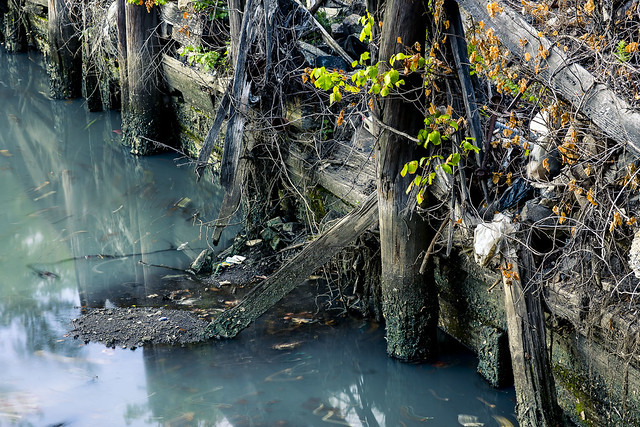
– photo by Mitch Waxman
There’s some of the timber structure I described to you yesterday, which forms the underpin framework of what we perceive as being the land of Queens.
The light began to decline as the burning thermonuclear eye of god itself descended behind New Jersey. I packed up the kit and moved on.
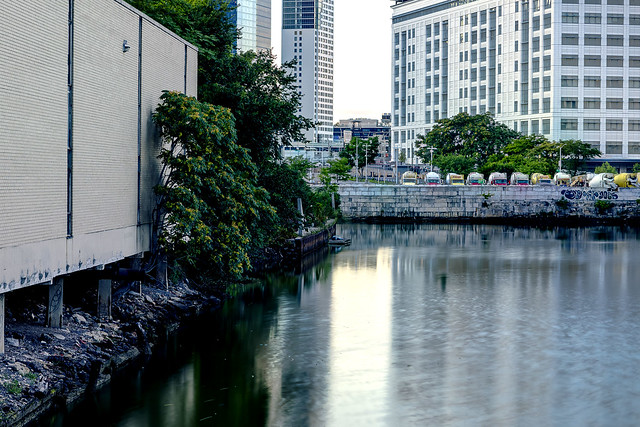
– photo by Mitch Waxman
One stopped at his various “stations of the cross” at Dutch Kills.
My favorite tree is doing pretty well this year, have to say.
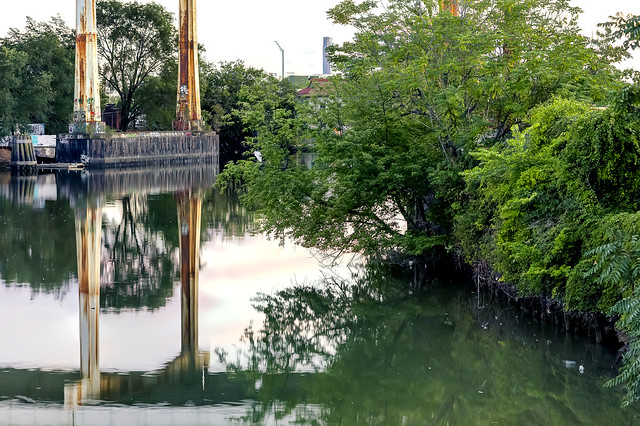
– photo by Mitch Waxman
There were a bunch of big white birds, which I’d call “Non Striped Juvenile Uncle chasers” but which were likely Snowy Egrets, in position over the water waiting for some slimy dinner to appear in the water under them.
The water was teeming with tiny fishies called “Mumichaugs” which are colloquially referred to as “Killie Fish.” There’s also predator fishies in there, Bunkers and the like.
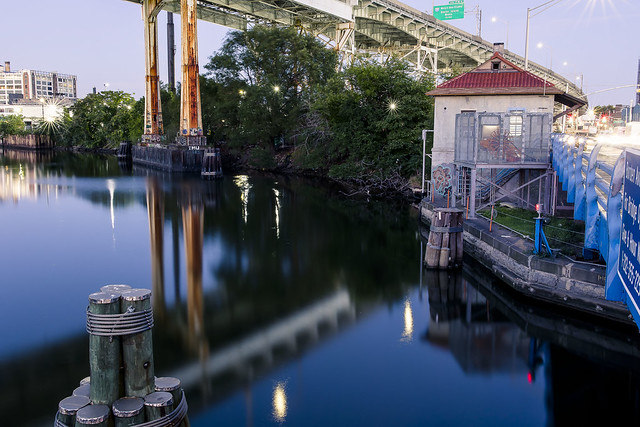
– photo by Mitch Waxman
The tripod section of my evening’s excursion was at an end after capturing this shot along the Borden Avenue Bridge. A quick walk would take me to the Jackson Avenue stop on the 7 line in Hunters Point, which would in turn carry me to Queens Plaza and an assignation with an Astoria bound N train.
Something somewhat different tomorrow.
“follow” me on Twitter- @newtownpentacle
Buy a book!
“In the Shadows at Newtown Creek,” an 88 page softcover 8.5×11 magazine format photo book by Mitch Waxman, is now on sale at blurb.com for $30.
so inquisitive
Tuesday

– photo by Mitch Waxman
So… I was in a quasi “ok” place for these, after a handshake with the property manager who handles this particular location on Dutch Kills. Nothing in writing, mind you, but a handshake. Still, I felt like I was doing something naughty. It was a Saturday night, after all. Wasn’t exactly the “naughty” of illegal street racing for pink slips on Fountain Avenue during the 1980’s, but there you are.
This one looks towards the Hunters Point Avenue Bridge, and a different view of that Tree of Paradise growing up from under a factory eave which has been the focus of so many shots over the years.

– photo by Mitch Waxman
When Newtown Creek’s Dutch Kills tributary was canalized at the start of the 20th century, a “T” shape was built into its terminus which is meant to act as a “turning basin” for maritime traffic. This created a stagnant dead end, which has had horrific effects on the environment. Somebody abandoned two oil barges here sometime in the dim past. They’ve been here since I showed up around fifteen years ago, and my buddy Bernie Ente told me that the two barges had been in this spot for twenty years before that. So, approximately 35 years… leave your car double parked for 5 minutes and you get a ticket, but abandon oil barges in an industrial canal? Nada.
I showed up at Dutch Kills on the 30th with a light kit bag, and then got busy with the camera with an ND filter and the tripod.

– photo by Mitch Waxman
One arrived at this spot about twenty minutes prior to sunset. By “light kit,” I mean that I was carrying the two lenses – a 35mm and an 85mm – which I usually use for night photography. Full kit involves a second bag with a couple of longer reach zoom lenses in it. Sometimes I like to travel light, especially when it’s warm out.
I made it a point of really taking my time with these.

– photo by Mitch Waxman
The point of the ND filter, which is basically a sunglass for the camera, is to “slow” the shot down and allow for longer exposures in daylight condition. I use this sort of filter a lot for these kind of shots. It’s why the water attains that mirror surface, as all of the distracting ripples and movement get smoothed out over the 15-30 seconds of an individual exposure.
The technical issues introduced by the filter include the color cast of the filter glass itself. You can spend a thousand bucks on one of these filters and you still get a color cast, so instead I spent about fifty bucks on one and then I figured out a set of settings for the development process in photoshop which neutralize it.

– photo by Mitch Waxman
That’s the collapsing bulkhead associated with Long Island City’s 29th street which all of the recent hullabaloo is about. When the canal was created a hundred years ago, state of the art for “land reclamation” involved building a latticework of timber boxes whose structure was formed by dock piles driven into the saturated soil and mud of wetlands. Once you had the wooden framing done, you filled the “box” with rock and soil.
At the start of the 20th century, massive amounts of money and labor filtered through Western Queens in pursuit of this sort of land reclamation. More than one Queens Borough President was convicted on corruption charges because of these efforts, and much of the land we walk on today – which is between six and ten feet higher than the tidal zone – was created using the reclamation technique described above. One of Dutch Kills’ tendrils used to snake all the way to 31st street at Northern Blvd. for instance.

– photo by Mitch Waxman
The term I’ve encountered time and again in late 19th and early 20th century reports and literature about this section of Long Island City is “waste meadows.” This refers to grassy tidal lowlands which would flood with the East River tidal cycle. Depending on where you’re talking about, these waste meadows were either swamps or marshes or even Juniper tree lined waterways. Every account I’ve read speaks about lots and lots of deer, waterfowl, shellfish, and the sort of critters who make their living in this sort of environment. In fact, when the Dutch arrived in the 1640’s, they talked about problems arising from an abundance of wolves.
That’s pretty interesting, actually. According to the “wolf people,” an adult wolf of breeding age needs a minimum of nearly 4 pounds of meat a day to survive. That’s a minimum, and whereas Wolves don’t necessarily eat everyday, a breeding age wolf prefers about 10 pounds of meat a day. If you’ve got a “wolf problem,” which indicates a large population of these top predators, you’ve got to do the math on this, regarding the prey animals that fed them. Ten wolves – 100 pounds of meat, 100 wolves – 1,000 pounds, etc. Wolf problem? That’s a whole lot of meat.
This used to be a highly productive ecosystem, these waste meadows.
“follow” me on Twitter- @newtownpentacle
Buy a book!
“In the Shadows at Newtown Creek,” an 88 page softcover 8.5×11 magazine format photo book by Mitch Waxman, is now on sale at blurb.com for $30.
quickly anyhow
Monday

– photo by Mitch Waxman
The 30th of July offered a brief climatological break from the bake of mid summer in NYC, a season which is affectionately referred to as “swamp ass” by we aficionados of the local milieu. Accordingly, one set out for a walk to take advantage of the pleasant atmospherics.
Shortly after leaving HQ, one encountered a fairly traffic free Broadway here in Astoria, which is actually noteworthy in its own right, and the maneuvering of an MTA Q104 line bus. Couldn’t resist.

– photo by Mitch Waxman
My destination for the evening was Newtown Creek’s Dutch Kills tributary, and the area surrounding it. This was a Saturday evening, and since I desired solitude and an extended period of time during which I was not involved in conversation with anyone about anything, I went to where no one else would be.
To get from “here” to “there,” the pathway leads through an area known as the Degnon Terminal. The large brick building on the left side of the shot is a prison (different units inside offer varying levels of security, but it’s classified as a minimum security facility by Corrections Dept.) known as the Queensboro Correctional Facility. It opened in 1975, is designed to house 424 inmates, and is found on the corner of Van Dam Street and 47th Avenue. It’s an “intake and processing” center, I’m told, wherein convicted inmates are classified and categorized on the way to whatever upstate hellhole they’re permanently headed to for the duration of their sentences. Except for the barbed wire and constantly swiveling security cameras, you’d barely notice the place as being a jailhouse.

– photo by Mitch Waxman
The Degnon Terminal was constructed in more or less the same time period as the nearby Sunnyside Yards. It offered rail connections, and barge to rail connections at Dutch Kills, and to Pennsylvania Rail Road/Long Island Railroad trackage infrastructure at Sunnyside Yards. Built by a company headed by Michael Degnon, the terminal had its own railroad system – the Degnon Terminal Railway. Said railway ended up being folded into the MTA property portfolio when that agency was created.
I’m told that rail companies seldom allow their unused tracks to be dug out of the ground as they’d never be able to reacquire the precious “right of way.” Even if the tracks haven’t been used in 50 years, they still pay tax on it to the Federal rail authorities to maintain the right of way. You see these relict tracks everywhere in this area.

– photo by Mitch Waxman
The buildings which composed the Degnon Terminal, despite long 20th century decades of degeneracy, have been coming back to life in recent years. The elimination of hundreds of square acres of industrial space in the name of “affordable housing” in recent decades has reversed a trend that began shortly after the Second World War which saw heavy industrial or “M1” zoned space devalued because there was so much of it laying fallow and empty. Rezonings in East New York, South Brooklyn, Greenpoint, and even here in Long Island City have allowed for the razing of the old factories and for their replacement with tower apartment buildings.
The operative period for the creation of Sunnsyide Yards and the Degnon Terminal developments is during the first 20-30 years of the 20th century. That’s also when the United States Army Corps of Engineers oversaw the canalization of Newtown Creek’s tributaries, and land reclamation efforts that eliminated their wetlands, into what we see today.

– photo by Mitch Waxman
Speaking of Dutch Kills, here I am at 29th street again. The red, white, and blue self storage warehouse – and the television studio next door – used to be the factory HQ of an outfit that called itself “U.S. Cranes.” You can guess what their line of business was, I imagine.
Both the TV Studio and the Storage warehouse are situated on a pier, which sits on stout concrete and steel columns driven down into the Newtown Creek mud. Tracks of the Degnon Terminal Railway are visible on 29th street, which is technically classified as a “railroad access road” and MTA property – which is why MTA is holding the modern bag for the collapsing bulkhead along Dutch Kills.

– photo by Mitch Waxman
Like a vampire, I need to be invited in before I do my work. This is the standard line I offer if I’m ever accused of illegal trespassing. After that press conference I told you about a couple of weeks backs, I’ve actually got a handshake agreement regarding one of those invitations I require.
I mention this in advance of what I’m going to show you over the next couple of posts, so stay tuned.
“follow” me on Twitter- @newtownpentacle
Buy a book!
“In the Shadows at Newtown Creek,” an 88 page softcover 8.5×11 magazine format photo book by Mitch Waxman, is now on sale at blurb.com for $30.
palsied denials
Tuesday

– photo by Mitch Waxman
July 16th was City of Water Day, which is a regional harbor festival curated by the Waterfront Alliance. I, and Newtown Creek Alliance, have been participating in City of Water Day for about a decade now. This year, NCA partnered up with North Brooklyn Boat Club and the Montauk Cutoff Coalition to do a shoreline cleanup, and offer boat rides to the public on the Dutch Kills tributary of Newtown Creek. It was a nice day.
Until the thunderstorm arrived, it was a nice day, that is.

– photo by Mitch Waxman
If you don’t recall, this was the day that about an inch of rain fell in about a half hour and generated a lot of flooding and damage in Queens. We were out in the open, but luckily the public side of things had ended. Everybody found a bit of shelter, under the Long Island Expressway or in some of the shipping containers found along the shoreline.
It felt like a real Götterdämmerung, I tell you.

– photo by Mitch Waxman
Blasting waves of rain pounded down, and heavy wind caused the rain to go absolutely horizontal. Dutch Kills was boiling with sky juices.
When the front moved on, we found ourselves standing in its wake. All of the NCA people grabbed their cameras and phones, since we knew what would be coming next – sewer outflows!

– photo by Mitch Waxman
NYC has a combined sewer system, meaning that sanitary and storm water move through the same pipes. Dry weather, which typified roughly an entire month prior to the 16th, sees this flow go to sewer plants. A quarter inch of rain – citywide – translates to a billion gallons suddenly entering the system, and the City’s protocol is to release the excess flow into area waterways as a prophylactic against street flooding.
You can count it out – 5, 4, 3, 2, 1… blast off.

– photo by Mitch Waxman
Submerged sewer pipes began to excrete into the waters of Dutch Kills. The surface was boiling, and the tumult carried human waste as well as whatever happened to end up in the sewers – trash, motor oil, goo – into Dutch Kills.
Everywhere you looked, filthy water was shooting out of otherwise hidden pipes all over Dutch Kills. In a couple of spots, notably nearby the Hunters Point Avenue Bridge, there were actual geysers of sewerage shooting around.

– photo by Mitch Waxman
Pictured above is a storm sewer, one which drains the Long Island Expressway high above. Thousands of gallons erupted from it.
Exciting, no?
“follow” me on Twitter- @newtownpentacle
Buy a book!
“In the Shadows at Newtown Creek,” an 88 page softcover 8.5×11 magazine format photo book by Mitch Waxman, is now on sale at blurb.com for $30.


 The Newtown Pentacle