Archive for the ‘Long Island City’ Category
Project Firebox 19

– photo by Mitch Waxman
Decapitated, this firebox on Skillman Avenue and Honeywell Street has long been severed from its designed functionality. I’m told by certain knowledgeable sources that you simply cannot remove the stump of an alarm box from its appointed spot, as the circuitry which governs the entire system will be affected by its absence rendering the surrounding neighborhood’s chain of Fireboxes blind to urgent cries of imminent immolation.
This firebox, however, finds a new utility for the needs of the few – or in this case the one- as opposed to the many it once protected, for your humble narrator routinely uses the dinner plate sized platter which crowns it as a makeshift camera platform when photographing the titan Sunnyside Yard with its backdrop of the shield wall of that Shining City which squats squamously across the River of Sound.
profound discouragement

– photo by Mitch Waxman
With my favored vantage on Dutch Kills, the estimable Borden Avenue Bridge, once more accessible– I’ve been making it a point to aim my wanderings toward its general direction whenever I can summon the fortitude to brave the ice. As crazy as it sounds, and regular readers of this- your Newtown Pentacle- have become fairly accustomed to crazy, I really missed this little bridge for the nearly 2 years it had been undergoing emergency repair.

– photo by Mitch Waxman
Perhaps its because this is the first section of the Newtown Creek that I actively explored, researched, and made it a point of documenting. Maybe its simply because this is the most easily attained of the Creek’s tributaries for one who walks, or that it seems to be the most “down on it’s luck” section of the vast watershed and I’m drawn by nature to the runt of the litter.
English Kills in far off Brooklyn makes for far better cautionary tales, but there’s just something tragic about Dutch Kills that always draws me in.

– photo by Mitch Waxman
An actual “out loud gasp” escaped my food hole when I discovered that the resident Crow of the Borden Avenue Bridge had not been forced out of his shanty by the long construction project, and if anything- the fellow had been building additions to the ramshackle hut constructed from found materials.
Last time that I had pointed my lens at this character was in the February 3rd posting of 2010 titled “affordable housing development on Borden Avenue“.

– photo by Mitch Waxman
The smell of a wood fire was wafting from the Crow’s slapdash of plywood, tyvek, and sheet metal- a vague scent which crowded its way into the otherwise extant perfumes normally associated with Dutch Kills.
For those of you who haven’t been reading the Newtown Pentacle since inception- “Crow” is a term I picked up from the neighborhood in Astoria that describes the armies of itinerant scrap metal collectors who find profit in other people’s waste- “put something shiny out on the sidewalk, and the crows will show up and take it” is a common aphorism around my part of Astoria.
I’ve assigned this crow a name “Blue Crow”, but both the “red crow” and the “burgundy crow” have been mentioned previously.

– photo by Mitch Waxman
There’s a bunch of these folks I’ve been spying on, and I’ve even heard rumors of a criminal group who pilfer the white bronze monuments and copper fittings of area cemeteries to sell the valuable metals on the scrap market, but I have yet to regale you with tales of the other- and quite polychromatic- crows who hold the “Green Recycling Jobs of Tomorrow, Today”.
One has also wondered, and more than wondered, at what foul congress the Blue Crow might have had with that which cannot possibly exist in the velvet deep of the malign Dutch Kills.
vainly striving

– photo by Mitch Waxman
Trapped by ice and cold, during that time of the year when the burning thermonuclear eye of god itself shines bright but carries no warmth, your humble narrator is bored-bored-bored. Crippled by vulnerability to cold, I’ve been appeasing myself- during those long hours when sleep is impossible- with long exposures and incessant hand wringing.
Your historical nugget for the day is: This is that time of the year when the ancient colony of Newtown was beset by wolves, and the Sheriff was required to distribute gunshot and powder from his stores to the local gentry- so as the the population of these livestock killing predators around Dutch Kills as well as a nearby swampy area (which would someday be called Queens Plaza) might be reduced.
Wolves.
from wikipedia
Cabin fever is an idiomatic term for a claustrophobic reaction that takes place when a person or group is isolated and/or shut in, in a small space, with nothing to do, for an extended period (as in a simple country vacation cottage during a long rain or snow). Symptoms include restlessness, irritability, irrational frustration with everyday objects, forgetfulness, laughter, excessive sleeping, distrust of anyone they are with, and an urge to go outside even in the rain, snow or dark.

– photo by Mitch Waxman
Making Lemonade from waste fruit is a specialty of mine, however, so the long exposures mentioned above have been of the photographic kind rather than some shocking and lewd behavior.
For the shots above and below, I used my trusty Canon G10 rigged with a specialized mount. A friend here in Astoria found this contraption for me, after I complained about the annoyances of using traditional camera mounts like tripods on the street. A sturdy Croat, he found the device at a hardware store and described it as “a laser level’s magnetic tripod”, which just happens to have a standard .25 inch tripod mounting screw. This thing just kind of “klangs” onto anything magnetic, which opens up a lot of possible places to steady mount the camera- Cars, fire hydrants, fences, signposts- you name it.
You wouldn’t believe how many individual shots it took to achieve the one above, as passing cars or changing traffic signal lights kept on screwing me up.
from wikipedia
Symptoms of SAD may consist of difficulty waking up in the morning, morning sickness, tendency to oversleep as well as to overeat, and especially a craving for carbohydrates, which leads to weight gain. Other symptoms include a lack of energy, difficulty concentrating on completing tasks, and withdrawal from friends, family, and social activities. All of this leads to the depression, pessimistic feelings of hopelessness, and lack of pleasure which characterize a person suffering from this disorder.
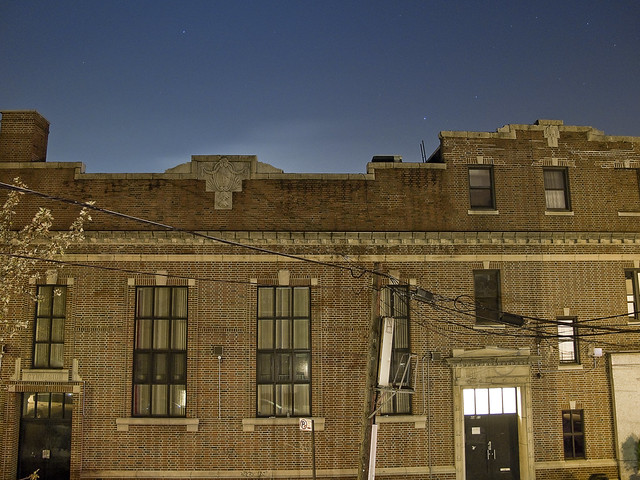
– photo by Mitch Waxman
Problem is that despite its many merits, the G10 is ultimately a point and shoot which Canon has placed certain limits on (specifically the limitation in exposure to 15 seconds), and the magnetic doohickey described above is not stout enough for the weight of a DSLR and lens (which is capable of manual exposure times, supposedly the shutter can be left open for quite some time). Luckily, Astoria offers many opportunities for night photography, despite its omnipresent automotive traffic.
Bored.
from forgotten-ny.com
On June 8, 1875 eight individuals met and organized the Long Island City Turn Verein at Koch’s Hall, N.E. Corner of Broadway and 9th Avenue [today’s 38th St] in Long Island City, N.Y. for the sole purpose of introducing and furthering German Turnerism (which embraces the philosophy of building a “Sound Mind in a Sound Body” fostered by Friedrich Ludwig Jahn in Germany). The society’s purpose was to educate its membership physically and mentally through gymnastic exercises and by encouraging use of the German language.
The present building was constructed in 1928 and sold in the mid-1970s. The society is now based in Nassau County.
Project Firebox 18

– photo by Mitch Waxman
Badder than you, this urban survivor owns the corner of Vernon Vlvd. and Queens Plaza South. Scarlet, its backdrop is mighty Queensboro itself, and the mysterious doorway into its tower. Rumored by area wags and historical enthusiasts alike to have once led to elevators and stairways which carried potential passengers to a trolley platform high above on the bridge itself, local legends abound as to the true purpose of the entrance. Who can say?
Tales of Calvary 12- The Lynch monument

– photo by Mitch Waxman
A magnificent and somewhat unique example of mortuary sculpture found at First Calvary Cemetery here in Queens is the Lynch monument. The screeds engraved on it indicate the presence of several generations of the family, and the quality of the stone work indicates that the Lynches were notable figures during their time. As mentioned in the past, however, when one is searching for information on individuals with a “common” name (particularly a common Irish surname) – things get a little hazy. There have been a lot of folks, both famous and infamous, named “James Lynch”.
Here’s what I’ve been able to positively attribute to this James Lynch, and a promising (tantalizing actually) but false lead…

– photo by Mitch Waxman
When James Lynch’s will was read, it caused quite a stir- it seems that the inheritance he left for his widow and children was in excess of 1.5 million dollars (in 1873, mind you), or so says the NYTimes.com archives. Now, 1.5 million in 1873 was a heck of a lot more money then than now- which means that this fellow was “somebody”. But who?
The archive article denoting the disposition of his will puts the family residence at 129 East 21st street in Manhattan- a tony and somewhat aristocratic address in 1873 (and today) located near Gramercy Park. Teddy Roosevelt, for instance, was born around the corner in 1858 and other neighbors included Samuel Tilden, Peter Cooper, and George Templeton Strong.

– photo by Mitch Waxman
The false lead– I suspected that this might be the same James Lynch (of Tammany) who aroused the ire of the future “paper of record” with a controversial order to the Warden of Bellevue Hospital in 1860 that remanded the bodies of the poor to scientific study (medical schools) and the inquiry of the vivisectionists (coroners).
quoth from the nytimes.com archives
All non-professional men who have ever had occasion to visit a dissecting-room, can well understand the intense loathing and horror with which even condemned malefactors shrink from that portion of the death-sentence which delivers over their bodies after execution to be dissected for the instruction of medical students. No sight can be imagined more revoltingly hideous and horrible than the scientific shambles in which human carcases are cut up, disemboweled, torn limb from limb, dissected and tossed from hand to hand by the young acolytes of surgical science. Half a dozen bodies in this way come to be mingled together in one disgusting mass of flesh, bone, tissues, hair and bowels. Different students carry off particular limbs or organs for home dissection; and then the mingled remains are placed in sacks and carted away at midnight, to be dumped out of sight in whatever sinks or holes the surgeons may have selected for this purpose.
But, alas, I was incorrect.

– photo by Mitch Waxman
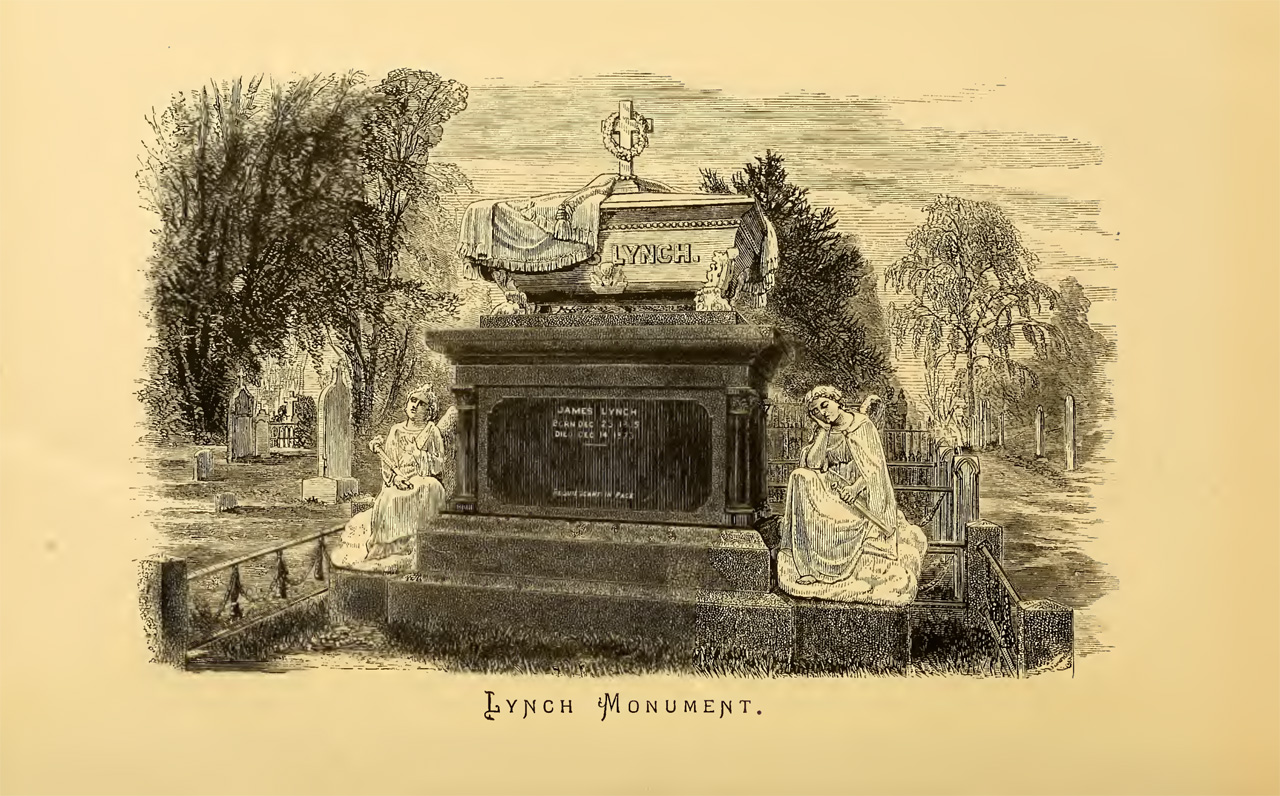
click image for a larger and more detailed incarnation
The illustration above, as well as the following text originate in John J. Foster’s “Visitor’s Guide to Calvary Cemetery” published in 1873
Plot O, Range 9, which is a little to the north of the resident clergyman’s dwelling, (and of which we give an illustration).
It is in the classic style, and consists of a superstructure of solid Quincy granite, in the form of a tomb, with polished columns supporting its entablature, surmounted by a draped sarcophagus, in one entire piece, of the finest Carrara marble. At each end of the base of the tomb, seated on clouds, is an angel, one with a trumpet, to call to judgment; the other emblematic of immortality. These figures are separate memorials. The former having been erected to the memory of the late Miss Katie Lynch, and the latter to the late Miss Agnes Lynci, his two daughters.
The whole work rests on a vault constructed after the style of the old Roman catacombs.
Mr. James Lynch was born December 23, 1805, and died December 14, I873. For nearly thirty years he devoted his attention to the grocery business on an extensive scale, in the city of New York, and retired with a competency in the year 1853. He was a favorite with all who enjoyed his acquaintance, and was well known to the public through his good offices and his manifold services in the advancement of all wise and charitable undertakings that came to his notice. The lively interest he excited in all who knew him secured for him many constant friends who now mourn his loss. His good deeds still survive him. The name of such men should be preserved.

– photo by Mitch Waxman
Clicking on the 1873 illustration, one observes that the only name on this monument when it was drawn was that of the sire of the clan. Scrutiny of the image also reveals an extensive series of footing stones, rails, and decorative plot demarkations which have not survived the century. Additionally, the entire family seems to be accounted for on the monument, with the last interment (Mary Ann) listed as 1922.
I was able to find a scant mention of Emily F. Lynch in the obituaries of the NYTimes.com archives. She lived at 405 Park Avenue, and died there as well.

– photo by Mitch Waxman
In addition to the remarkable centerpiece of the monument, one observes the presence of two weeping angels at the tomb, the presence of which are described in the quoted text as having been installed as separate monuments to Mr. Lynch’s daughters.
Like many of the fine marbles and ornate carvings extant at Calvary Cemetery, long exposure to the toxic atmospheres produced by the industries of the nearby Newtown Creek has badly damaged these sculptural elements, imparting an impression that the stone is melted or rotting away.
This isn’t far from the truth- the nearby Phelps Dodge (then called General Chemical) was actually sued by Calvary’s Board of Trustees in the late 19th century regarding the airborne exhaust of their brimstone based acid manufacturing business and its noxious effluents, and the concept of petrochemical pollution creating “acid rain” is well known to modernity.
from queenslibrary.org
On the plant grounds, General Chemical erected the tallest chimney in the United States to blow the smoke and gases from its furnace away from the neighborhood. For the past number of years neighbor surrounding the plant complained vociferously about the pollution from the factory. Only after a study found that nitric, muriatic, and sulphuric acids from the plant were destroying local cemeteries’ tombstones did the company try and alleviate the problem by building the chimney. This same year the company filed plans with the New York City’s Department of Buildings in Queens to build another 150 foot chimney, an ore breaker, a storage tank, a boiler house, and a stable.

– photo by Mitch Waxman
The NYTimes archives also present a short death notice for Peter W. Lynch, of 253 west 62nd street, whose death corresponds with the date ascribed to Peter W. Lynch on the stone. I have no way of determining if this is the same man, however.
I could find nothing on Katie, but this is not uncommon for the era, as women seldom received mention if they weren’t scandalous, married to, or the mother of a famous man.

– photo by Mitch Waxman
James D. Lynch died at a 120 West 21st street address in 1917, just down the block from the patriarch’s house. Mary Ann and E. Louise seem to have escaped notice when they passed.
Like many of the older plots at Calvary, which once sat long avenues and lanes which were meant to remain as such, the Lynch monument is surrounded by more modern graves. Such is the lot of older cemeteries, whose financial realities demand that new interments must be made in order to maintain the ongoing operations of the enterprise.
A plot purchased in the 1860’s, after all, hardly figured in the cost of 150 years of groundskeeping. This created no small amount of controversy in the past amongst the descendants of those who lie here, but in the end, Calvary prevailed. This is why you’ll often observe modern grave markers peppering around the edges of grandly august Mausolea.

– photo by Mitch Waxman
Hey, you never know what you’re going to find at Calvary Cemetery in Queens.


