Archive for the ‘Manhattan Bridge’ Category
Another Lucky shot

– photo by Mitch Waxman
Social gatherings and year end meetings consume the evening hours of twilit December, and recently, I had occasion to be at the Pier 17 complex at South Street Seaport. Upon arriving at my destination in the cavernous building, this scene greeted me.
Luckily, I had my trusty “old” camera- the Canon G10 with its magnetic tripod gadget attached which allows me to make “on the fly” long exposures. Even so, this was a lucky shot.
A 15 second exposure, looking north along the East River at the Brooklyn, Manhattan, and Williamsburg Bridges, on December 7th, 2010 at 7:50 PM.
harbor shots

– photo by Mitch Waxman
At the start of June, your humble narrator was offered the rare chance to act as… a humble narrator.
Nobody of more august character was available, I supposed, when the Working Harbor Committee asked me if I would be interested in speaking during a Circle Line cruise.
Wow.
from wikipedia
Circumnavigation of Manhattan became possible in 1905 with the construction of the Harlem Ship Canal, the first regularly scheduled trip being the Tourist captained by John Roberts in 1908.
On June 15, 1945 Frank Barry, Joe Moran and other partners merged several sightseeing boats to form the Circle Line operating out of Battery Park.
In 1955 it began operating at its current Pier 83 location. In 1962 it bought the Hudson River Day Line.
In 1981 the two companies split.
In 1988 the 42nd Street company bought World Yachts operating upscale dining cruises from Chelsea Piers. In 1998 the 42nd Street company also launched The Beast, a speedboat ride which takes tourists around the Statue of Liberty and goes 45 mph.

– photo by Mitch Waxman
An eerie quiet came over me when the microphone was first passed over, and panic quickly overcame any attempt at “being cool”. Luckily, veteran MC John Doswell of the Working Harbor Committee rescued a drowning man. By the second tour of the day, I managed to catch a little of his “vibe” and followed the narrative he supplied after my disappointing showing on the first tour. While John was speaking I managed to grab a few interesting shots. The fireboat above, for instance, is the FDNY’s newly minted 343 at the Brooklyn Navy Yard.
from nycfireboat.com
Because of the very real threat of additional terrorist attacks after 9/11/01, the boats will also be capable of protecting firefighters from Chemical, Biological, Radiological, Nuclear agents (CBRN). While performing in any of these hostile environments, the crew will be protected in a pressurized area that will also have it’s air supply filtered by special charcoal and HEPA filters.

– photo by Mitch Waxman
As always, the Empire State Building commands the scene from both the East River…
from wikipedia
The South Street Seaport is a historic area in the New York City borough of Manhattan, located where Fulton Street meets the East River, and adjacent to the Financial District. The Seaport is a designated historic district, distinct from the neighboring Financial District. It features some of the oldest architecture in downtown Manhattan, and includes the largest concentration of restored early 19th-century commercial buildings in the city. This includes renovated original mercantile buildings, renovated sailing ships, the former Fulton Fish Market, and modern tourist malls featuring food, shopping and nightlife, with a view of the Brooklyn Bridge. At the entrance to the Seaport is the Titanic Memorial lighthouse.

– photo by Mitch Waxman
And from the North- or lower Hudson- River. There is a satisfaction to the design of this structure, a governing and massive esthetic that has always drawn me. Center stage is where it belongs, IMHO, with the rest of the skyline of Manhattan descending in bilateral asymmetries around it. Empire State and its nearby rival- the Chrysler Building- are what skyscrapers should look like.
from wikipedia
The building design most closely associated with New York City is the skyscraper, whose introduction and widespread adoption saw New York buildings shift from the low-scale European convention to the vertical rise of business districts.
As of August 2008, New York City has 5,538 highrise buildings,[70] with 50 completed skyscrapers taller than 656 feet (200 m). This is more than any other city in United States, and second in the world behind Hong Kong. New York has architecturally noteworthy buildings in a wide range of styles. These include the Woolworth Building (1913), an early gothic revival skyscraper built with massively scaled gothic detailing able to be read from street level several hundred feet below. The 1916 Zoning Resolution required setback in new buildings, and restricted towers to a percentage of the lot size, to allow sunlight to reach the streets below.

– photo by Mitch Waxman
Traffic observed on the Hudson included this tug, the Shannon Dann heading South. 96 feet long, 31 feet high, and blessed with 2 2,400 HP engines- it’s hitched to a Lehigh Cement barge, slipping it past the Marine and Aviation Pier. Shots like these hang on the Empire State building, which says New York City louder than any banner headline could.
from lehighcement.com
Lehigh Cement Company was founded in 1897 in Allentown, Pennsylvania. Over the years, through a visionary policy of acquisitions, equipment modernization and productivity improvements, Lehigh Cement Company and its related companies have become leading suppliers of cements and construction materials in the United States and Canada.

– photo by Mitch Waxman
Also noticed was the Vane Brothers Nanticoke, a 2004 vintage tug nearly 95 feet long with 4,800 HP purring under its hood. Again- no Empire State Building- Meh shot.
from vanebrothers.com
The Vane Brothers Company has served the maritime industry in the Port of Baltimore and the U.S. Eastern Seaboard for more than 100 years. Today, we are comprised of five divisions operating out of the ports of Baltimore, Maryland; Brooklyn, New York; Philadelphia, Pennsylvania and Norfolk, Virginia.

– photo by Mitch Waxman
Chelsea Piers in the fore. By the end of the second tour, I thought that I hit some kind of rhythm and felt better about my performance. Ultimately your humble narrator was able to forget his troubles for a moment, as it was quite a beautiful day.
from wikipedia
Chelsea Piers is a series of historic piers on the West Side of Manhattan in New York City that was a passenger ship terminal in the early 1900s that was used by the RMS Lusitania and was the destination of the RMS Titanic.
The piers are currently used by the Chelsea Piers Sports & Entertainment Complex. The new complex includes film and television production facilities, including those for CBS College Sports Network and Food Network, a health club, a day spa, the city’s largest training center for gymnastics, two basketball courts, playing fields for indoor lacrosse and soccer, batting cages, a rock climbing wall and dance studios. In addition there is an AMF Bowling center, a golf club with multi-story driving range, and two full sized ice rinks for skating. It is located in the Chelsea neighborhood, on the northern edge of Greenwich Village and the Meatpacking District.
Circumnavigation 3

– photo by Mitch Waxman
Hailing from the Brooklyn neighborhoods of first Flatbush, then Flatlands and Canarsie, my driving into “the City” habits always focused on the red haired step child of the Brooklyn Bridge- the Manhattan Bridge- which was the next great structure that the Circle Line passed.
from wikipedia
The Manhattan Bridge is a suspension bridge that crosses the East River in New York City, connecting Lower Manhattan (at Canal Street) with Brooklyn (at Flatbush Avenue Extension) on Long Island. It was the last of the three suspension bridges built across the lower East River, following the Brooklyn and the Williamsburg bridges. The bridge was opened to traffic on December 31, 1909 and was designed by Leon Moisseiff, who later designed the infamous original Tacoma Narrows Bridge that opened and collapsed in 1940. It has four vehicle lanes on the upper level (split between two roadways). The lower level has three lanes, four subway tracks, a walkway and a bikeway. The upper level, originally used for streetcars, has two lanes in each direction, and the lower level is one-way and has three lanes in peak direction. It once carried New York State Route 27 and later was planned to carry Interstate 478. No tolls are charged for motor vehicles to use the Manhattan Bridge.
The original pedestrian walkway on the south side of the bridge was reopened after forty years in June 2001.[3] It was also used by bicycles until late summer 2004, when a dedicated bicycle path was opened on the north side of the bridge, and again in 2007 while the bike lane was used for truck access during repairs to the lower motor roadway.
Main span: 1,470 ft (448 m)
Length of suspension cables: 3224 ft (983 m)
Total length: 6,855 ft (2,089 m)
The neighborhood near the bridge on the Brooklyn side, once known as Fulton Landing has been gentrified and is called DUMBO, an acronym for Down Under the Manhattan Bridge Overpass.
To celebrate the bridge’s centennial anniversary, a series of events and exhibits were organized by the New York City Bridge Centennial Commission in October 2009. These included a ceremonial parade across the Manhattan Bridge on the morning of October 4th and a fireworks display in the evening. In 2009, the bridge was also designated as a National Historic Civil Engineering Landmark by the American Society of Civil Engineers.

– photo by Mitch Waxman
Your humble narrator was honored to serve as a Bridge Parade Marshall for the aforementioned Centennial Parade, and attended the Landmarking ceremony on March 5th.
Here’s the Newtown Pentacle Posts on the Centennial Parade on October 4th-
Manhattan Bridge Centennial Parade 1
Manhattan Bridge Centennial Parade 2
Manhattan Bridge Centennial Parade 3
Here’s the NP post on the Ceremony in March- Exhausted
And for my personal take on the Manhattan Bridge- DUMBO… or missing my Dad

– photo by Mitch Waxman
Beneath the Bridge, small clots of citizenry were cleaning the shoreline of wind blown refuse and whatever washed up out of the East River over the long and severe winter that New York endured in 2010. It was Earth Day eve, after all.
I wish I could point you to a link about this effort, but the Brooklyn Blogosphere is an impenetrable fortress of noise and self importance which defies even the might of Google. If anybody associated with this effort is reading this, please fill the rest of us in on the particulars.

– photo by Mitch Waxman

– photo by Mitch Waxman
Moving north, ever north, midtown Manhattan’s iconic Chrysler Building rises behind the recently upgraded East River Station cogeneration power plant at 14th street and Ave. D.
The East River Generating Station, one of Consolidated Edison Co. of New York Inc.’s largest and most significant combined-cycle power stations, will be repowered by Slattery Skanska and its subsidiary Gottlieb Skanska.
Located on the east side of Lower Manhattan, the 43,000-sq.-ft. facility produces electricity and steam for homes and businesses throughout New York City. The project was completed May 2004.

– photo by Mitch Waxman
I still owe you, lords and ladies, a proper workup of the Williamsburg bridge. I’m still collecting material research and photography for this posting, so don’t expect it anytime soon. One of my summer projects is “The Grand Walk”, which will start in Manhattan and follow Grand Ave. through Williamsburg and Greenpoint, across the Grand Ave. Bridge into Queens and onto (former Grand Avenue) 30th avenue through Astoria to Hallet’s Cove. An open call for experts on the various phases of the route is being made, by the way, and hopefully I can get a few of you to come along for the first Newtown Pentacle meetup and photowalk at the end of the summer. Bring ID, and a camera.
from wikipedia
Construction on the bridge, the second to cross this river, began in 1896, with Leffert L. Buck as chief engineer, Henry Hornbostel as architect and Holton D. Robinson as assistant engineer, and the bridge opened on December 19, 1903 at a cost of $24,200,000. At the time it was constructed, the Williamsburg Bridge set the record for the longest suspension bridge span on Earth. The record fell in 1924, when the Bear Mountain Bridge was completed.
Circumnavigation 1

– photo by Mitch Waxman
The reason that I was in Manhattan on Saturday the 24th of April, rather than wandering about the dystopian hillocks of Western Queens (as usual), was that a friend was gathering a group of photographers and urban explorer types together on- of all things- a tourist boat. Coupons for a discount trip, and the offer of fraternal companionship, drew me to the west side of Manhattan to ride along for the three hour circumnavigation of the Shining City. The boat left from Pier 83, lately known as “the Circle Line” pier, on the Hudson River. That’s the John J. Harvey fireboat, incidentally- for more on the Harvey- click here, and here, and here.
from wikipedia
The Circle Line is the collective name given to two sightseeing ferry operations in Manhattan:
Circle Line Sightseeing Cruises at 42nd Street which circles Manhattan from its base at Pier 83 in Manhattan
Circle Line Downtown operates out of Pier 16, South Street Seaport. The company name is Circle Line Harbor Cruises, LLC. It is a wholly owned subsidiary of Circle Line Statue of Liberty.
- The two companies split in 1981 from the parent Circle Line company and now have different officers and directors.
- Circumnavigation of Manhattan became possible in 1905 with the construction of the Harlem Ship Canal, the first regularly scheduled trip being the Tourist captained by John Roberts in 1908.
- On June 15, 1945 Frank Barry, Joe Moran and other partners merged several sightseeing boats to form the Circle Line operating out of Battery Park.
- In 1955 it began operating at its current Pier 83 location. In 1962 it bought the Hudson River Day Line.

– photo by Mitch Waxman
River traffic was at a minimum, and the relict gems that dot the coastlines were glittering in the morning sunlight. Pictured above is the Erie-Lackawanna ferry terminal in Hoboken, New Jersey.
check out this fascinating post at Hoboken411.com which details the reconstruction of this historic structure’s clock tower in recent years.

– photo by Mitch Waxman
As the behemoth tourist ship entered into NY Harbor proper from the Hudson, along came the Marie J. Turecamo tugboat- a 2,250 HP twin screw tug operated by Moran Towing. It was originally built as the Traveller in 1968, by Tangier Marine Transport which operated out of the Main Iron Works facility in Houma, LA.
from morantug.com
Moran is a leading provider of marine towing and transportation services, a 150-year-old corporation that was founded as a small towing company in New York Harbor and grew to preeminence in the industry. The cornerstone of our success has been a long-standing reputation for safe, efficient service, achieved through a combination of first-rate people and outstanding vessels and equipment.
Over the course of its history Moran has steadily expanded and diversified, and today offers a versatile range of services stemming from its core capabilities in ship docking, contract towing, LNG activities and marine transportation. Our tug fleet serves the most ports of any operator in the eastern United States, and services LNG terminals along the U.S. East and Gulf Coasts and the West Coast of Mexico. The Moran barge fleet serves the U.S. Atlantic and Pacific Coasts, the Great Lakes, the inland waters of the U.S. eastern seaboard, and the Gulf of Mexico. We also provide worldwide marine transportation services, including operations in the Caribbean and periodic voyages to South America and overseas waters.

– photo by Mitch Waxman
Playing at the serious business of being a tourist is no easy job. The Circle Line narration points out interesting features observed along its route, making frequent mention of “the sights they came to see”. An image of the Statue of Liberty is a popular and desired memory for visitors to the Shining City to acquire, and I couldn’t let it pass without a cursory shot. The events of September 11, 2001 received repeated mention in the script as well.
from wikipedia
The statue is made of a sheathing of pure copper, hung on a framework of steel (originally puddled iron) with the exception of the flame of the torch, which is coated in gold leaf (originally made of copper and later altered to hold glass panes). It stands atop a rectangular stonework pedestal with a foundation in the shape of an irregular eleven-pointed star. The statue is 151 ft (46 m) tall, but with the pedestal and foundation, it is 305 ft (93 m) tall.
Worldwide, the Statue of Liberty is one of the most recognizable icons of the United States.[11] For many years it was one of the first glimpses of the United States for millions of immigrants and visitors after ocean voyages from around the world.
The statue is the central part of Statue of Liberty National Monument, administered by the National Park Service. The National Monument also includes Ellis Island.

– photo by Mitch Waxman
Speaking of 911, one of the newer Coast Guard patrol boats was busily speeding by. This is a “response boat small” I believe, and it was quick and seemed ready to become deadly at any moment.
from uscg.mil
Response Boat-Small (RB-S) was developed in a direct response to the need for additional Homeland Security assets in the wake of the September 11th terrorist attacks. The Defender-class boats were procured under an emergency acquisition authority.
With a contract option for up to 700 standard response boats, the Defender-class acquisition is one of the largest boat buys of its type in the world.
The 100 boat Defender A -class (RB-HS) fleet began arriving at units in May 2002 and continued through August 2003. After several configuration changes, most notably a longer cabin and shock mitigating rear seats, the Defender B-class RB-S boats were born.
This fleet was first delivered to the field in October 2003, and there are currently 457 Defender-class boats in operation assigned to the Coast Guard’s Maritime Safety and Security Teams (MSST), Maritime Security Response Team (MSRT), Marine Safety Units (MSU), and Small Boat Stations throughout the Coast Guard.
Mission Capability:
With an overall length of 25 feet, two 225 horsepower outboard engines, unique turning radius, and gun mounts both forward and aft, the Defender-class boats are the ultimate waterborne assets for conducting high speed maneuvering tactics in a small deployable package. This is evidenced by the fact that several Defender-class boats are already in operation at other Homeland Security Department agencies, as well as foreign military services for homeland security missions.

– photo by Mitch Waxman
As the Circle Line crossed into the East River, nearing the Brooklyn and Manhattan bridges, however, a ship that’s familiar to long time readers of this Newtown pentacle appeared- the M/V Red Hook.
from wnyc.org
When the city invited a select few reporters aboard the Sludge Boat Red Hook, we figured it would reek, naturally enough. But, despite all that human waste and other organic cargo sloshing about, the boat smells just fine.
This is a nice, clean, next-generation sludge vessel: 350 feet long, cruising speed 10 knots. Inside the cabin, it’s all fancy gadgets, everywhere.

– photo by Mitch Waxman
The Red Hook is actually one of the newer Sludge Boats in the City’s fleet, built to modern specifications and environmental regulations.
from ny1.com
The $30 million boat, named Red Hook, is the latest addition to the marine fleet.
It will cart tons of sludge every day to waste water treatment plants. The plant on Wards Island processes about 200 million gallons a day of waste water; the sludge is the solid part of that waste.
“They are removing more of the solids from the water, we’re returning cleaner water to the harbor, but producing more sludge, and that’s a good news thing. But it also requires us to increase our capacity,” said acting DEP Commissioner Steven Lawitts. “This one is higher capacity. It has a capacity for 150,000 cubic feet of sludge, so it’s about 50 percent larger than previous boats.”
The Red Hook was built over a period of three years by a manufacturing company in Texas.
exhausted
Phew. Busy couple of days… sorry for the lack of contact. Creek week is extending into next week as well, but check out what I did on Friday the 5th.
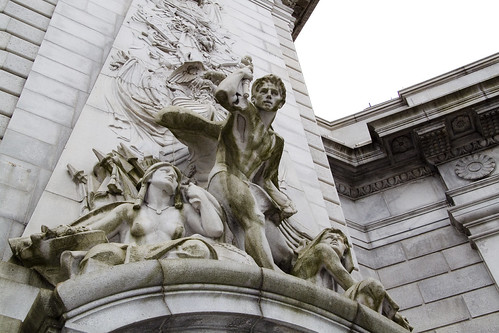
– photo by Mitch Waxman
On Friday, I attended a ceremony which placed a time capsule in the Manhattan Bridge, then walked from Chinatown to Astoria, developed a LOT of photos, slept 4 hours.
Saturday- woke up, took a ride on the Staten Island Ferry, then walked part of the Kill Van Kull shoreline , visited my sick mom in the hospital, and came back to Astoria.
Tomorrow is the “St. Pat’s Day for All” parade in Sunnyside- which promises to be enjoyable AND photogenic- if you’re around the neighborhood- don’t miss it.
Now, here’s a few shots from the Manhattan Bridge event.

DOT Commissioner Janette Sadik-Khan – photo by Mitch Waxman
from nyc.gov
Janette Sadik-Khan serves as the Commissioner of the New York City Department of Transportation since her appointment by Mayor Michael R. Bloomberg in April of 2007. She manages 4,500 skilled employees with wide ranging expertise from engineering to construction finance, to marine navigation, and is responsible for 6,000 miles of streets and highways, nearly 800 bridges, 1.3 million street signs, 300,000 streetlights and 12,000 signalized intersections, as well as the Staten Island Ferry, the nation’s busiest commuter ferry service carrying over 19 million passengers annually.
Since her appointment, Sadik-Khan has implemented an ambitious program to improve safety, mobility and sustainability throughout New York City, and ensure a state of good repair on all the Department’s roads and bridges. In April 2008 the Agency published its Strategic Plan, Sustainable Streets. Projects highlighted in that plan include the first Select Bus routes for NYC, the NYC Plaza Program, the creation of Broadway Boulevard in midtown Manhattan, the addition of 200 miles of on-street bike lanes, car-free summer streets and weekend pedestrian walks.

“Gridlock Sam” Schwartz – photo by Mitch Waxman
from gridlocksam.com
From 1982-86, Sam Schwartz served an extremely successful term as New York City’s Traffic Commissioner before going on to serve the next four years as the New York City Department of Transportation’s Chief Engineer/First Deputy Commissioner.
After nearly twenty years with the New York City Department of Transportation, Mr. Schwartz moved from public service in 1990 to join Hayden-Wegman Consulting Engineers, Inc. as Senior Vice President in charge of transportation engineering, infrastructure, quality control and planning.
In the summer of 1995, The Sam Schwartz Engineering opened its doors with a staff of two. Since that time, the company has grown to include over sixty diverse professionals. Today, under Sam’s direction, The Sam Schwartz Engineering produces some of the finest work in civil engineering, planning, and urban design.

Henry Perahia, Deputy Commissioner Chief Bridge Officer DOT – photo by Mitch Waxman
from nyc.gov
In 1998 Mr. Perahia was promoted to Chief Engineer of the Department. In 1999, he was given the added responsibilities of Chief Bridge Officer. As Chief Engineer, he serves as the Department’s representative on all engineering issues, including review of all major Department projects, response to engineering emergencies, and advising the Commissioner on all engineering issues. As Chief Bridge Officer, he is responsible for the planning and administration of all aspects of design, construction and maintenance of approximately 750 City-owned bridges, tunnels, and culverts, with an annual capital program of approximately $500 million and an annual expense budget of approximately $56 million.
The Division of Bridges is responsible for maintaining the structural integrity of all City owned bridges and tunnels. It undertakes the design and construction of all rehabilitation and reconstruction work, including in-house design, engineering support, engineering review, and quality assurance. It inspects the City’s bridges to identify hazardous or potentially hazardous.

A few of the items that were placed in the Time Capsule – photo by Mitch Waxman

The assembled crowd of dignitaries, DOT workers, and invited well wishers – photo by Mitch Waxman

The time capsule was sealed up within the ornate arches of the Bridge – photo by Mitch Waxman

Specifically, right about here (this is inside the arch) – photo by Mitch Waxman

How could I not have a look around? I mean, how often are you inside the Manhattan Bridge, after all? – photo by Mitch Waxman

A window? – photo by Mitch Waxman

Here’s the view from said window – photo by Mitch Waxman
for the complete set of photos at flickr- click here


 The Newtown Pentacle