Archive for the ‘Manhattan’ Category
sighing uncannily

– photo by Mitch Waxman
A personal theory of mine is that the garden of Eden was actually in midtown Manhattan, specifically the central section of 42nd street. The location where the proverbial tree of good and evil would have been observed in the dim past is the spot where Grand Central Terminal’s information booth will be found today, which is why the clock of the four cardinal directions was placed there. In this rather ridiculous assertion, my theory of what the primordial mother realized when eating the forbidden fruit was not awareness of her nakedness- but rather an awareness of time passing. The Vanderbilts placed the clock there to signify both location and event, I would wager.
from wikipedia
The main information booth is in the center of the concourse. This is a perennial meeting place, and the four-faced clock on top of the information booth is perhaps the most recognizable icon of Grand Central. Each of the four clock faces is made from opal, and both Sotheby’s and Christie’s have estimated the value to be between $10 million and $20 million. Within the marble and brass pagoda lies a “secret” door that conceals a spiral staircase leading to the lower level information booth.

– photo by Mitch Waxman
Time grows short, lords and ladies, an unstoppable river flowing toward oblivion and the embrace of the conqueror worm. Your humble narrator would love to tell you of some epic summer journey this day, a break from the daily grind, but even if I had somewhere to travel to- who would greet me upon arrival? Surely, one such as myself- a shambling and feckless quisling, physical coward, and unreliable lunatic- would be shunned by a sensible and sober local gentry wherever and whenever my shadow is cast.
from wikipedia
The Seth Thomas Clock Company began producing clocks in 1813, and was incorporated as the “Seth Thomas Clock Company” in 1853. The clock at Grand Central Terminal in New York City was manufactured by the company. Seth Thomas Clock Company manufactured longcase clocks as well as mantel, wall, and table-top clocks during this period.

– photo by Mitch Waxman
Exertions of the last few months have worn me down, and left me naught but a reactive shell. A brief surcease of the incessant duties and exhibitions recently performed in obeisance to my beloved Newtown Creek is finally at hand, but as mentioned- I have no where to go. The idea of sitting alongside some vernal water body, or simply communing with an uncorrupted form of the natural world, fills one with dread. Vacations, as they are called, are for others to enjoy- I must remain locked in combat with an eternal and undying human hive and remain consigned to the concrete devastations of a post industrial dystopia.
from nytimes.com
Several times a day, riders troop into the stationmaster’s office in Grand Central Terminal to complain. Even the four faces of the signature brass clock above the information booth in the main concourse, irate riders often point out, are different.
The culprit is not the clocks themselves but something that resembles a giant filing cabinet, tucked away in a closet above one of the Beaux-Arts terminal’s platforms. It is a 15-year-old master clock system, with dials in the middle and two digital displays.
It connects each day at 3 a.m. by shortwave radio signal with the National Institute of Standards and Technology’s atomic clock in Boulder, Colo., and then sends electrical impulses to the terminal’s 20-some historic clocks.
The problem is, the electromechanical devices in the terminal’s master clock system that are sending these signals are becoming increasingly unreliable, making the clocks inaccurate. What’s more, the time displayed on video monitors throughout the terminal is controlled by a different system, not tied to the atomic clock at all.

– photo by Mitch Waxman
Unlike the Vanderbilts, who literally wrote a check when presented with the bill for Grand Central Terminal, my finances continue to be perilous. A disaster as simple as needing a new pair of shoes or a camera repair would sink this Humble Commodore’s fleet, and the frivolity of spending what little cash there is on some diversionary trip is overshadowed by the term “shelter in place”. Better that I just treat those hallucinations which occur when unconsciousness seizes me as my summer getaway.
The plan was expensive. The railroad needed to invest in electrifying its rails, and carve deep into Manhattan’s bedrock (workers would ultimately excavate 2.8 million cubic yards of earth and rock). The solution to the projected $80 million project budget (roughly $2 billion in today?s terms) came from Wilgus as well. Without steam engines, there was no longer a need for an open rail yard. Wilgus proposed that the area from 45th to 49th Streets be paved over and that real estate developers be allowed to erect buildings over the concealed tracks. In exchange for this privilege, developers would pay a premium to the New York Central Railroad for “air rights.” Construction in the years immediately after the completion of Grand Central Terminal would include apartment buildings like the Marguery, the Park Lane, and the Montana, and hotels including the Barclay, the Chatham, the Ambassador, the Roosevelt, and finally the Waldorf-Astoria, completed in 1931. (For many years, hydraulic tanks in the basement of Grand Central Terminal supplied power to these buildings.)

– photo by Mitch Waxman
The odd condition afflicts me on a daily basis (approximately every sixteen to eighteen hours- muscle fatigue and mental confusion begin to manifest, followed by a sudden loss of consciousness and concurrently some six to seven hours are spent caught up in the throws of wild hallucinations. Upon regaining control of my body, odd smells and trails of dried spittle combine with a lack of coordination and a stunted mental capacity. During these periods of involuntary separation from conscious control over my mind and body, oddly, I’ve noticed that my fingernails grow prodigiously), and has since early childhood. it has long been my habit to lock myself away in a protected chamber here at Newtown Pentacle HQ in Queens when the warning signs of this debilitating malady present- far from the dangers of the greater human infestation in a long ago “paradise lost” which is now vulgarly called Manhattan.
from wikipedia
Extending between Sunnyside, Queens, and Grand Central, the project will route the LIRR from its Main Line through new track connections in Sunnyside Yard and through the lower level of the existing 63rd Street Tunnel under the East River. In Manhattan, a new tunnel will begin at the western end of the 63rd Street Tunnel at Second Avenue, curving south under Park Avenue and entering a new LIRR terminal beneath Grand Central.
Current plans call for 24-trains-per-hour service to Grand Central during peak morning hours, with an estimated 162,000 passenger trips to and from Grand Central on an average weekday. Connections to AirTrain JFK at Jamaica Station in Jamaica, Queens, will facilitate travel to John F. Kennedy International Airport from the East Side of Manhattan.
A new LIRR train station in Sunnyside at Queens Boulevard and Skillman Avenue along the Northeast Corridor (which the LIRR uses to get into Pennsylvania Station) will provide one-stop access for area residents to Midtown Manhattan. The station may spur economic development and growth in Long Island City.
scratching restlessly

– photo by Mitch Waxman
Recently observed, the Gage Paul Thornton moving a fuel barge past Pier 16 in Manhattan, providing some focal point for this week’s “Maritime Sunday”. Picturesque, the spot that the boat is moving through is just loaded with NY iconography, recognizable instantly and impossible to confuse with anywhere else.
from marinesteel.com
Thornton Towing & Transportation is owned by Gerard and Richard Thornton, and Ed Carr; all of whom have spent their entire professional careers working on and around the waters of New York Harbor.
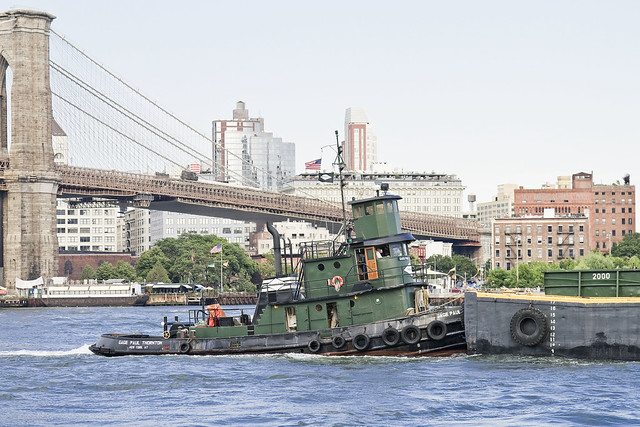
– photo by Mitch Waxman
It’s an odd thing, that when pointing a lens at Manhattan these days, it’s hard to find a place to “pin” the location as identifiably “New York City”. Without the Brooklyn Bridge or Empire State Building in the shot, it’s hard to recognize the formerly iconic skyline anymore. Brooklyn, Queens, and the Bronx still look like NY, but Manhattan has had so much reconstructive and cosmetic surgery that it’s hard to recognize.
another Thornton tug was featured not that long ago at this, your Newtown Pentacle- The Thornton Brothers was seen in the posting “middle stature“

– photo by Mitch Waxman
Similar rhinoplasty and silicon injections are in the works for the other boroughs of course, Williamsburg has had a boob job in recent years, and Long Island City has had a facelift and tummy tuck. One hopes that the process will fizzle out before it goes too far and the Bronx starts to look like Bruce Jenner.
Anyway, a hearty Maritime Sunday shout out is sent to the Gage Paul Thornton and her crew.
from dailymail.co.uk
He was a star athlete and American hero when he brought home the gold medal after the 1976 Olympic Games.
But Bruce Jenner today appears to have chiselled away at the masculine features that graced Wheaties boxes decades ago.
The reality star, better known now as Kim Kardashian’s step-father, was barely recognisable from the retro image as he stepped out for a promotional event this weekend, his face looking distinctly tighter than usual.
deserted midnight

– photo by Mitch Waxman
A friend recently published an excellent book (Eat the City) and your humble narrator was invited to the reception party her publisher was sponsoring on the Lower East Side of Manhattan. On the way to the event, deep in Alphabet City, this church building at 345 East 4th street between Avenues B and C caught my eye.
Built in 1895 as a Russian church, it currently houses the congregation of “San Isidro y San Leandro of the Western Orthodox Catholic Church of the Hispanic Mozarabic Rite”.
from wikipedia
Western Rite Orthodoxy or Western Orthodoxy or Orthodox Western Rite are terms used to describe congregations and groups which are in communion with Eastern Orthodox Churches or Oriental Orthodox Churches using traditional Western liturgies rather than adopting Eastern liturgies such as the Divine Liturgy of St. John Chrysostom. While there are some ancient examples of Western Rite churches in areas predominantly using the Byzantine Rite (the Monastery of Saint Mary of the Latins, often referred to as Amalfi, is a common example), the history of the movement is often considered to begin in the nineteenth century with the life and work of Julius Joseph Overbeck. Less commonly, Western Orthodoxy refers to the Western Church before the Great Schism.

– photo by Mitch Waxman
The history of this structure is somewhat hazy, but it was purpose built as a church. Originally a catholic church serving the St. Elizabeth of Hungary parish, ownership was transferred to the “Russian-Greek Orthodox Chapel of the Holy Trinity” and then the “Russian Orthodox Church of St. Nicholas”. I’ve been unable to tie down exactly when the current congregants took possession of the structure.
from wikipedia
The Mozarabic Rite is the second-best attested liturgy in the Latin Church in terms of preserved documentation. The Mozarabic Rite was considered authoritative for the clarification of a Sacramentary received by Charlemagne from Pope Adrian I (d. 795). The first is, of course, the Roman Rite, which, to encourage unity of faith and worship, generally replaced the Mozarabic in Iberia from about 1080.
In the year 870, Charles the Bald, wishing to see what the ancient Gallican Rite had been like, had priests sent from Spain to celebrate the Mozarabic Rite before him.
In the latter part of the eighth century, the Rite had fallen under some suspicion owing to quotations cited by Elipandus of Toledo in support of his Adoptianist theories, and the Council of Frankfurt 794 spoke somewhat disparagingly of possible Islamic influence on it. It was due to these suspicions that in 924, John X sent a Papal Legate named Zanello to investigate the Rite. Zanello spoke favourably of the Rite, and the Pope gave a new approbation to it, requiring only to change the words of consecration to that of the Roman one. Spanish clergy gradually started to use the Roman words of institution (though there is no evidence whether or not it was done consistently).
When King Alfonso VI of Castile conquered Toledo in 1085, it was being disputed as to which rite Iberian Christians should follow: the Roman rite or Mozarabic Rite. After other ordeals, it was submitted to the trial by fire: One book for each rite was thrown into a fire. The Toledan book was little damaged whilst the Roman one was consumed. Henry Jenner comments in the Catholic Encyclopedia: “No one who has seen a Mozarabic manuscript with its extraordinarily solid vellum, will adopt any hypothesis of Divine Interposition here.” The king allowed six parishes in the city to continue to use the Mozarabic rite.

– photo by Mitch Waxman
Baroque, and literally gothic in its decoration and design elements, the church reminds one that the monolithic Roman Catholic Church of modernity was once rent asunder by schisms. The Church was once caught between two dying and one growing empires (Latin Rome, Greek Rome, and the Arab Rum) which caused isolated pockets of Christian adherents to stray from Vatican orthodoxy. Often, it was the endless sea of politics which created these schisms, but as often as not it was merely regional variation in belief.
from wikipedia
Saint Isidore of Seville (Spanish: San Isidro or San Isidoro de Sevilla, Latin: Isidorus Hispalensis) (c. 560 – 4 April 636) served as Archbishop of Seville for more than three decades and is considered, as the historian Montalembert put it in an oft-quoted phrase, “le dernier savant du monde ancien” (“the last scholar of the ancient world”). Indeed, all the later medieval history-writing of Hispania (modern Spain and Portugal) was based on his histories.
At a time of disintegration of classical culture, and aristocratic violence and illiteracy, he was involved in the conversion of the royal Visigothic Arians to Catholicism, both assisting his brother Leander of Seville, and continuing after his brother’s death. He was influential in the inner circle of Sisebut, Visigothic king of Hispania. Like Leander, he played a prominent role in the Councils of Toledo and Seville. The Visigothic legislation which resulted from these councils is regarded by modern historians as exercising an important influence on the beginnings of representative government.

– photo by Mitch Waxman
The world of a thousand years ago, while bearing strange similarity to our own, saw one of the great wheels of history grinding to a halt. The process that began with Alexander the Great and continued through Rome’s unified empire, then the Western and Eastern Roman imperiums, and the fall of the West and subsequent reign of the barbarous men of the North- spawned several Catholic variants which few have ever heard of. The Copts, Mozarabs, and Syriacs come to mind, of course- as do the Arians, Monophysites, and Nestorians.
from wikipedia
Leander and Isidore and their siblings (all sainted) belonged to an elite family of Hispano-Roman stock of Carthago Nova. Their father Severianus is claimed to be according to their hagiographers a dux or governor of Cartagena, though this seems more of a fanciful interpretation since Isidore simply states that he was a citizen. The family moved to Seville around 554. The children’s subsequent public careers reflect their distinguished origin: Leander and Isidore both became bishops of Seville, and their sister Saint Florentina was an abbess who directed forty convents and one thousand nuns. Even the third brother, Fulgentius, appointed Bishop of Écija at the first triumph of Catholicism over Arianism, but of whom little is known, has been canonised as a saint. The family as a matter of course were staunch Catholics, as were the great majority of the Romanized population, from top to bottom; only the Visigothic nobles and the kings were Arians. It should be stated that there was less Visigothic persecution of Catholics than legend and hagiography have painted. From a modern standpoint, the dangers of Catholic Christianity were more political. The Catholic hierarchy were in collusion with the representatives of the Byzantine emperor, who had maintained a considerable territory in the far south of Hispania ever since his predecessor had been invited to the peninsula by the former Visigothic king several decades before. In the north, Liuvigild struggled to maintain his possessions on the far side of the Pyrenees, where his Merovingian cousins and in-laws cast envious eyes on them and had demonstrated that they would stop at nothing with the murder of Liuvigild’s sister.

– photo by Mitch Waxman
An interesting series of clips, detailing the choral aspects of the Mozarabic rite, can be accessed here. Always fascinated by the prismatic flavors of faith, your humble narrator is glad to have stumbled across this enigmatic little church. Should any congregants of the institution have anything to add or correct, please use the comments link to share your knowledge.
from wikipedia
The Mozarabs (Spanish: mozárabes [moˈθaɾaβes]; Portuguese: moçárabes [muˈsaɾɐβɨʃ]; Catalan: mossàrabs [muˈsaɾəps]; Arabic: مستعرب trans. musta’rab, “Arabized”) were Iberian Christians who lived under Arab Islamic rule in Al-Andalus. Their descendants remained unconverted to Islam, but did however adopt elements of Arabic language and culture. They were mostly Roman Catholics of the Visigothic or Mozarabic Rite.
Most of the Mozarabs were descendants of Hispano–Gothic Christians and were primarily speakers of the Mozarabic language under Islamic rule. Many were also what the arabist Mikel de Epalza calls “Neo-Mozarabs”, that is Northern Europeans who had come to the Iberian Peninsula and picked up Arabic, thereby entering the Mozarabic community.
A few were Arab and Berber Christians coupled with Muslim converts to Christianity who, as Arabic speakers, naturally were at home among the original Mozarabs. A prominent example of Muslims who became Mozarabs by embracing Christianity is the Andalusian rebel and Anti-Umayyad military leader, Umar ibn Hafsun. The Mozarabs of Muslim origin were descendants of those Muslims who converted to Christianity, following the conquest of Toledo and perhaps also, following the expeditions of king Alfonso I of Aragon. These Mozarabs of Muslim origin, who converted en masse at the end of the 11th century, many of them Muladi (ethnic Iberians previously converted to Islam), are totally distinct from the Mudéjars and Moriscos who converted gradually to Christianity between the 12th and 17th centuries. Some Mozarabs were even Converso Sephardi Jews who likewise became part of the Mozarabic milieu.
Separate Mozarab enclaves were located in the large Muslim cities, especially Toledo, Córdoba, Zaragoza, and Seville.
_______________________________________________________________
August 5th, 2012- Newtown Creek Alliance Walking Tour- The Insalubrious Valley- This Sunday

– photo by Mitch Waxman
Newtown Creek Alliance historian Mitch Waxman will be leading a walk through the industrial heartlands of New York City, exploring the insalubrious valley of the Newtown Creek.
The currently undefended border of Brooklyn and Queens, and the place where the Industrial Revolution actually happened, provides a dramatic and picturesque setting for this exploration. We’ll be visiting two movable bridges, the still standing remains of an early 19th century highway, and a forgotten tributary of the larger waterway. As we walk along the Newtown Creek and explore the “wrong side of the tracks” – you’ll hear tales of the early chemical industry, “Dead Animal and Night Soil Wharfs”, colonial era heretics and witches and the coming of the railroad. The tour concludes at the famed Clinton Diner in Maspeth- where scenes from the Martin Scorcese movie “Goodfellas” were shot.
Lunch at Clinton Diner is included with the ticket.
Details/special instructions.
Meetup at the corner of Grand Street and Morgan Avenue in Brooklyn at 11 a.m. on August 5, 2012. The L train serves a station at Bushwick Avenue and Grand Street, and the Q54 and Q59 bus lines stop nearby as well. Check MTA.info as ongoing weekend construction often causes delays and interruptions. Drivers, it would be wise to leave your vehicle in the vicinity of the Clinton Diner in Maspeth, Queens or near the start of the walk at Grand St. and Morgan Avenue (you can pick up the bus to Brooklyn nearby the Clinton Diner).
Be prepared: We’ll be encountering broken pavement, sometimes heavy truck traffic as we move through a virtual urban desert. Dress and pack appropriately for hiking, closed-toe shoes are highly recommended.
Clinton Diner Menu:
- Cheese burger deluxe
- Grilled chicken over garden salad
- Turkey BLT triple decker sandwich with fries
- Spaghetti with tomato sauce or butter
- Greek salad medium
- Greek Salad wrap with French fries
- Can of soda or 16oz bottle of Poland Spring
for August 5th tickets, click here for the Newtown Creek Alliance ticketing page
devour and dissolve

– photo by Mitch Waxman
Just a short one today, as your humble narrator is quite the crunchy critter due to the exertions of yesterday’s Newtown Creek Tour committed for the Working Harbor Committee. The shot above is from the 5th of June, in this year, from an interesting vantage on the water near New Jersey.
Back tomorrow with some announcements of new tour dates, and something a bit more expansive to sink your teeth into. Here’s another shot of the same scene- capturing the spectacular, and high altitude, cloud formation in some detail and framed vertically.

– photo by Mitch Waxman
unreasonable impulse

– photo by Mitch Waxman
Occasion called for your humble narrator to find himself one thousand and fifty feet above Manhattan recently, staring down at the much maligned Newtown Creek. Kryptonian perspective notwithstanding, it was strange to see how small all of it seemed, stretching back a mere four miles from the East River. Always lost in the hidden minutia of the place, it was very odd to see all of it laid out so neatly for inspection.

– photo by Mitch Waxman
The big construction job at Hunters Point South, just getting underway, looks like a child’s sandbox from this height- with an adorable little rail yard next to it. Across the water in Greenpoint, an itsy bitsy sewer plant with its gleaming digester eggs shining in the light of the burning thermonuclear eye of god itself. Others may see only what’s there now, but I see Jack Frost Sugar and Chelsea rope and Newtown Creek Towing Company.
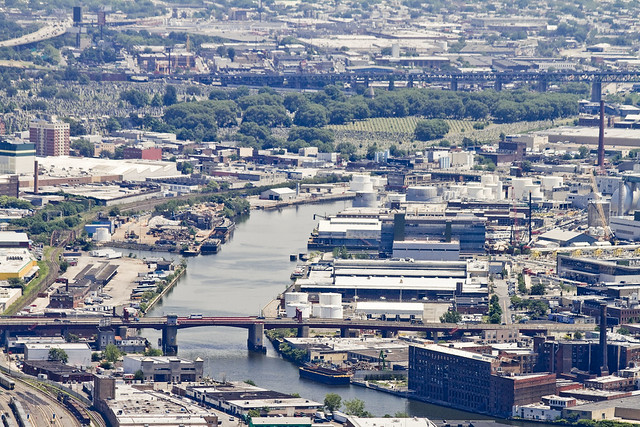
– photo by Mitch Waxman
That green patch is Calvary, with the thrice damned Kosciuszko framing it. Dutch Kills and the SimsMetal Newtown Creek Dock would be at the “9” position were the above shot a clock face, with Pulaski Bridge at the bottom. The Petroleum District in Greenpoint is about where the three would be, and you can just make out the Greenpoint Avenue Bridge. About where the “5” would be- notice the barge at TNT scrap metal on Manhattan Avenue?

– photo by Mitch Waxman
Dizzying, the extreme altitude began to work on my delicate constitution and the shooting session had to be cut short. Additionally, all I was able to think about was the Newsboy Governor and the Knickerbocracy’s Four Hundred for some reason.

– photo by Mitch Waxman
This is the sort of view of the Newtown Creek which I prefer, up close and personal, rather than from atop the world’s fourth largest building. The biggest problem with the Empire State Building’s observation deck, after all, is that you can’t see the Empire State Building.
____________________________________________________________________________
Click for details on Mitch Waxman’s
Upcoming boat tours of Newtown Creek
July 22nd, 2012 NEXT SUNDAY- There are Just a few tickets left, don’t miss out
Working Harbor Committee Newtown Creek Boat Tour


 The Newtown Pentacle