Archive for the ‘Manhattan’ Category
impelling fascination

– photo by Mitch Waxman
Long time readers will recognize the shot above from a January 2012 posting entitled “Hermes Trismegistus“, which describes the great statue which adorns the Vanderbilt Rail Palace known as “Grand Central Terminal” in Manhattan.
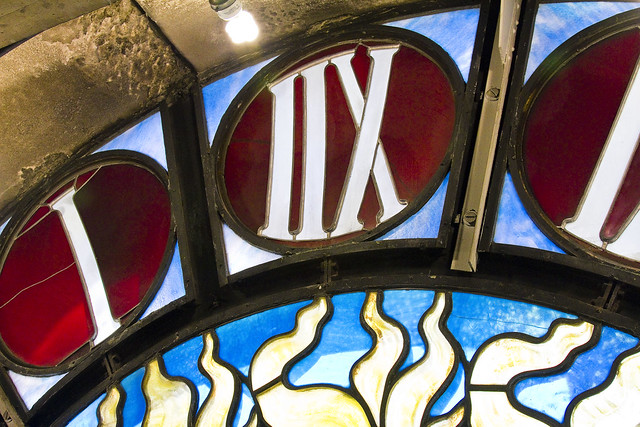
Recent adventure carried me to the place, where I found myself with an uncommon view of the Tiffany Clock which bejewels the carving.

– photo by Mitch Waxman
Inside of it.
More on this in a posting next week, but I can’t just sit on these shots without sharing them. The clock face itself is pretty enormous.
A simple image search will show this to hardly be a unique photo, but regardless, this was a thrilling place to visit.
– photo by Mitch Waxman
There is a chamber back here, of masonry and exposed steel, which the clock is mounted into. The number six on the clock’s face is a window outfitted with a hinge. This wasn’t “urban exploration”, incidentally, my presence here was sanctioned.

– photo by Mitch Waxman
This is what Park Avenue looks like from the clock at Grand Central Station, that’s Union Square in the distance. Click the image to check out larger views at flickr.
More next week.
____________________________________________________________________________
Click for details on Mitch Waxman’s
Upcoming boat tours of Newtown Creek
July 22nd, 2012 NEXT SATURDAY
Working Harbor Committee Newtown Creek Boat Tour

curious customs
– photo by Mitch Waxman
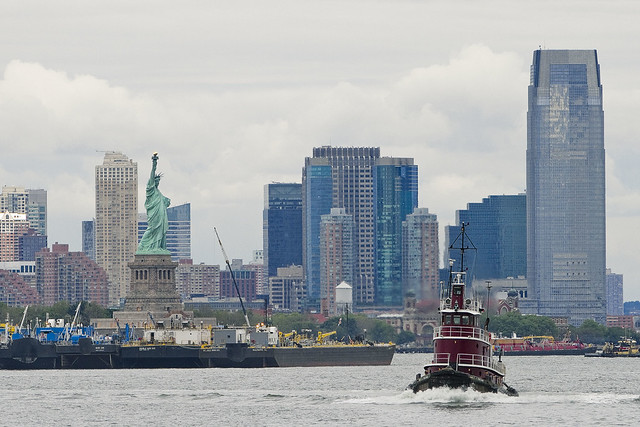
The Marie J. Turecamo tug presented itself to a humble narrator recently, framing iconic views of the harbor for your perusal on this week’s “Maritime Sunday”. Periodically, when some magazine art buyer or advertising stalwart is looking for a harbor shot, my phone will ring and someone will ask for “a tugboat moving past the Statue of Liberty” or something similar. Invariably, the caller is seeking out free usage of the shot.

– photo by Mitch Waxman
Other photographers get angry with me when I allow free usage of this shot or that to various personages or groups, accusing me of devaluing the craft. “Information wants to be free” is my normal reply, and “an image too dearly held has no intrinsic valuation” is the follow up. This is when I’m called a schmuck, and informed that I’m being “taken advantage of”. Allow me to set the record straight on this subject, lords and ladies.

– photo by Mitch Waxman
A regular beneficiary of my largesse, whether it be the estimable Working Harbor Committee or the Newtown Creek Alliance or any of the other “worthy” harbor groups whom I regularly supply images to, receives a limited license to the photo. They cannot, for instance, use my shots in a manner which I haven’t specified or agreed to- web usage versus printed material. A byline is required, and if at any time I decide to ask them to pull the shot, this is my right as I’m retaining the image copyright and full usage rights. In advertising lingo, the shots are offered and licensed as “stock”, and the compensation asked for use of them is somewhat asymmetrical and seldom monetary.

– photo by Mitch Waxman
What I’m ultimately after is photographic access to people, places, and situations which are normally unattainable. I’ve been inside the Manhattan Bridge, walked on a Queensboro bridge completely devoid of traffic, been privy to dozens of situations that “press” photographers would have killed to get near. I’ve been to off limits spots all around the harbor, delved into the deepest recesses of the City, ascended to unattainable and high vantages, and seen things that most living New Yorkers barely suspect. If a group is doing something worth doing, as in the case of WHC with its education programs and senior citizen programming, or NCA’s quest to save the Newtown Creek from sophistry- I’m happy to donate the usage of a few images. On the other hand, if you see something you’d like a print of, or would like to license an image or two for commercial usage- contact me here.
unvocal waves

– photo by Mitch Waxman
Recent business carried me into Manhattan, to a meeting where the alcohol flowed freely and afterwards your humble narrator found himself more than a little tipsy. In prior times of plenty, a taxi might have been hired to carry my besotted husk back to Astoria, but as dire financial circumstances demand- it would be the subway that would ferry me home.
The assignation that night was right in the middle of rich people country, Lexington Avenue in the high 30’s, so the drinks were far better than the usual swill I quaff.

– photo by Mitch Waxman
Making my way through Times Square, by this point more than just a little tipsy and edging on drunk, the notion of attempting a few night shots entered my fevered mind. As mentioned in several prior posts, this is something “I’m working on”. A difficult endeavor under normal circumstance, low light photography is especially interesting after several cocktails have been imbibed over a short interval.

– photo by Mitch Waxman
Luckily, I’ve never felt inhibited taking “street shots” of strangers, and have often been chided for walking right up to people and just starting to click away. Of course, embarrassment ruled over me the next morning, as I found a series of cliche “Times Square Street Photography” shots had been captured in my stupor.
Back to the sobering realities of the Newtown Creek for me.
____________________________________________________________________________
Click for details on Mitch Waxman’s
Upcoming walking and boat tours of Newtown Creek, and Staten Island’s Kill Van Kull
June 30th, 2012- Working Harbor Committee Kill Van Kull walk
for June 30th tickets, click here for the Working Harbor Committee ticketing page
July 8th, 2012- Atlas Obscura Walking Tour- The Insalubrious Valley
for July 8th tickets, click here for the Atlas Obscura ticketing page
July 22nd, 2012- Working Harbor Committee Newtown Creek Boat Tour
supposedly solid

– photo by Mitch Waxman
The DEP Pump House described in yesterday’s posting, which is located in Manhattan’s “Alphabet City” neighborhood, is found across the street from Con Ed’s East River Generating Station. Both facilities are, in turn, surrounded by vast residential complexes which long time New Yorkers might refer to as “The Projects“.
Governmental officials would prefer the term “affordable housing“, of course, or at the very least- “The Jacob Riis Houses”.
from wikipedia
The New York City steam system is a district heating system which takes steam produced by steam generating stations and carries it under the streets of Manhattan to heat, cool, or supply power to high rise buildings and businesses. Some New York businesses and facilities also use the steam for cleaning, climate control and disinfection.
The New York Steam Company began providing service in lower Manhattan in 1882. Today, Consolidated Edison operates the largest commercial steam system in the United States. The organization within Con Edison that is responsible for the system’s operation is known as Steam Operations, providing steam service to nearly 1,800 customers and serving more than 100,000 commercial and residential establishments in Manhattan from Battery Park to 96th Street uptown on the West side and 89th Street on the East side of Manhattan. Roughly 30 billion lbs (just under 13.64 megatons) of steam flow through the system every year.

– photo by Mitch Waxman
The subject of the post today has little to do with the aforementioned complex of buildings, they are mentioned strictly for contextual and geographic orientation of the Con Ed facility. My understanding is that this “cogeneration” facility is considered to be a desirable target to those ragged armies of third world sappers commonly referred to as “terrorists“, and several acquaintances and or friends have found themselves being interviewed by Police and Security personnel merely for having photographed the place.
from coned.com
In the grand tradition of the Jumbo dynamos, the six-story boilers installed at Fourteenth Street and East River were so large that a luncheon for nearly 100 people was served inside one of them before the renovated station went into operation in the late 1920s. During the opening day ceremony in 1926, Queen Marie of Rumania flipped the switch to start the 100,000 horsepower turbine generator.

– photo by Mitch Waxman
The view in the first two shots are from the East River, captured while onboard aquatic vessels, and the shot above is actually from the roof of the DEP Pump house.
The housing complex in the shot above is not true “public housing”, rather it is the Stuyvesant Town property. After the second World War, “urban renewal” projects such as the Riis Houses and Stuyvesant Town were seen as the answer to the endemic poverty found around and propagated by tenement slums. Funding and political impetus for large scale developments such as these- inspired by the ideations of a cryptofascist architect, LeCorbusier, and his disastrous “Tower in a park” conception- were made possible by both Federal and entrepreneurial sources.
Located on the east side of Lower Manhattan, the 43,000-sq.-ft. facility produces electricity and steam for homes and businesses throughout New York City. The project was completed May.
To repower the 360-MW power plant, the project team is performing all civil, structural, electrical and mechanical work, including the installation of major equipment, such as two GE Frame 7FA gas turbines, two Vogt-NEM, Inc. heat recovery steam generators and three Atlas Copco gas compressors. More than 100,000 lin. ft. of process pipe will be installed.
Construction of a new, onsite water treatment plant is also a part of the contract. The new treatment plant will consist of a 9,000 GMP reverse osmosis system that will produce pure water for steam generation. Electrical work includes the installation of 77,000 lin. ft. of conduit, 15,000 lin. ft. of cable tray, 665,000 lin. ft. of power and control cable and 30,000 electrical terminations.

– photo by Mitch Waxman
Historically, this area was known as the Gas House District, so named for an enormous number of multi story “high pressure” tanks and the hundreds of associated industrial buildings which serviced and supplied them. A network of pipes snaked out into Manhattan from the East River, supplying fuel to street lights, commercial customers, and even residences.
The adage “Don’t blow out the light” was displayed prominently in hotels and flop houses all over town during the 19th century, as newcomers to the City would often treat a gas light in the manner they would a candle- which would have disastrous, fatal, and often explosive results. The District followed the East River and extended from 14th to 27th streets.
The neighborhoods surrounding the Gas Light District was notorious for its violent crime.
from gsapp.org
Address: East 14th Street
Architect: Thomas E. Murray/Unknown
Date: 1926/1950s
The Consolidated Edison Company’s East River Generating Station dominates the eastern section of 14th Street, stretching from 13th and 17th Streets and between Avenue C and the East River. It was erected primarily in two phases, the first campaign completed in 1926 and the second in the 1950s. Because of its size and prominence, the East River Generating Station plays an important role in the history of the East River waterfront, as well as in the general evolution of power plant architecture in New York City. The widespread low-scale fabric of the Lower East Side, consisting mostly of tenement buildings, went generally unchanged for most of the nineteenth century and the early part of the twentieth century, while the rest of Manhattan was seeing the erection of skyscrapers and other tall buildings.
Driven by the increasing cost of power plant construction and the need to design “with an eye to the future,” the East River Generating Station of 1926 was designed to be less ostentatious than earlier stations that were typically of the Beaux-Arts Style, yet it was also less monolithic than contemporaries such as Hell Gate or Hudson Avenue Stations. The waterfront façade of this building was divided into three distinct bays in rectilinear form, a design scheme that allowed for easy expansion as need be. The building uses vertical fenestration and horizontal bands of limestone set within a field of dark red brick to give the façade a sense of visual excitement
greater reality

– photo by Mitch Waxman
The opportunity to visit the NYC DEP Manhattan Pump House on the Lower East Side of the Shining City drew me to the center of the human infestation in the desperate manner of an opiate addict.
The Newtown Creek Monitoring Committee is a community group which provides input and access to the people of Greenpoint in matters related to the reconstruction and operations of the Newtown Creek Waste Water Treatment Plant in Brooklyn. Despite geographic and political boundaries, the pump house is an integral part of that facility and has been undergoing its own upgrade and reconstruction.
from nyc.gov
DEP meets monthly with the Newtown Creek Monitoring Committee (NCMC), a committee of volunteers from the Greenpoint community, which was established in 1996 pursuant to a City Council resolution allowing the City to acquire property required for the upgrade of Newtown Creek WWTP. NCMC members are appointed by the local City Council member, the Brooklyn Borough President and Brooklyn Community Board #1. NCMC, with the assistance of its technical consultant, reviews and makes recommendations about activities associated with the treatment plant upgrade in order to mitigate potential impacts to the Greenpoint Community. NCMC worked with DEP to identify and design community amenities such as the Nature Walk, and is one of the longest standing citizen oversight committees in New York City.

– photo by Mitch Waxman
Vast trunk line pipes underlie Manhattan and carry waste water from storm water cisterns and weirs as well as residential sewage. Every cleaning chemical, medicinal formulation, or cold cup of coffee which goes down the drain is agglutinated and homogenized into the flow, all of it headed for a relatively small building sited between a power plant and a city housing project.
Titan works exist hidden here, and the part of the structure visible from street grade elevations are merely the tip of a finger.
from nyc.gov
The Avenue D Pump Station (also known as the 13th Street Pump Station or more commonly the Manhattan Pump Station) is currently being upgraded as part of the Newtown Creek Upgrade Project. The Manhattan Pump Station provides the Newtown Creek WPCP with more than half of its flow, 155 million gallons per day (mgd) for treatment. The pump station was put into service in 1965 and is currently undergoing a total reconstruction upgrade. As part of this upgrade, the station will receive five(5) new 2,500 horsepower motors controlled by energy efficient Variable Frequency Drives, new screening equipment, a full emergency power generation system, and an architectural façade.

– photo by Mitch Waxman
At the lowest levels of the place, one will find the elephantine plumbing which quietly accomplishes the expurgation of Manhattan’s waste. Hidden behind masonry and cement, a multi million gallon tank allows for the orderly disposition of the waste water into the subaqueous piping which carries it across the East River and into Greenpoint, Brooklyn. Our group moved through the facility, visiting several specialized levels and chambers.
The guide for the journey was none other than Jim Pynn of the DEP, an engineer who is superintendent of the ongoing reconstruction project on the larger facility in Brooklyn.
from nyc.gov
Jim Pynn is the Plant Superintendent for the Newtown Creek Wastewater Treatment plant in the Greenpoint section of Brooklyn. Jim, a lifelong Brooklynite, has worked at DEP for nearly 36 years. He enjoys the daily challenge of working at a venue that taps into his high energy and his ability to multi-task. There is no such thing as a routine day. “In addition to regular work with the staff here at the plant,” Jim said, “my day can begin with a meeting with construction contractors, engineers and architects, followed by a visit from a local school and end with a meeting with members of the community. I really enjoy the variety.”

– photo by Mitch Waxman
Ascending into it’s heights, Mr. Pynn described the function of the various caches of machinery we passed by, offering insight and experience gained during his long employment and familiarity with the construction, design, and function of the DEP infrastructure. A familiar face in Greenpoint, Mr. Pynn often leads the popular NCWWTP public tours of his plant, and he’s a charismatic and knowledgeable speaker.
He’s also a heck of a nice guy.
from nyc.gov
Although tours of the entire Newtown Creek Wastewater Treatment Plant facility are not available, we do have monthly public tours of the award-winning Digester Eggs. Please see our events calendar for the next scheduled tour. Reservations are required. To make a reservation on the next tour please email events@dep.nyc.gov.

– photo by Mitch Waxman
Near the end of the tour, while instructing us on the electrical backup generators installed within the structure, he announced our next stop would be the so called “Surge Tower” whose entrance was located on the buildings paramount. He warned us to prepare ourselves, and to ensure that any jewelry or eyeglasses worn by members of the group be secured.
from wikipedia
Originally, the “Lower East Side” referred to the area alongside the East River from about the Manhattan Bridge and Canal Street up to 14th Street, and roughly bounded on the west by Broadway. It included areas known today as East Village, Alphabet City, Chinatown, Bowery, Little Italy, and NoLIta.
The exact western and southern boundaries of the neighborhood are a matter of perspective – New York natives and long-time neighborhood residents, especially the Puerto Rican and black community, and the Jewish community, don’t have East Village in their vocabulary, and refer to it as the Lower East Side. The so-called debate about naming conventions typically only applies to the post-gentrification crowd. Most recent arrivals to the area, including new visitors and residents prefer to call the area north of Houston Street the East Village – a name not coined until around 1960.
Although the term today refers to the area bounded to the north by East Houston Street, parts of the East Village are still known as Loisaida, a Latino pronunciation of “Lower East Side.” Avenue C is known directly as “Loisaida” and is home to the Loisaida Festival every summer.

– photo by Mitch Waxman
The tower itself, viewed from its exterior, is polished aluminum and appears banal. The roof of the tower is equipped with specialized equipment designed to reduce and eliminate the infiltration of odors into the nearby residential complexes which distinguish this long troubled section of Manhattan, once known to all New Yorkers as “Alphabet City”. Our group circled around the great cylinder, entered into a doorway, and ascended a staircase which ended at a locked door.
Keys were produced, and we entered the “Surge Tower”.
from wikipedia
Until the early 19th century, much of what is now Alphabet City was an extensive salt marsh, a type of wetland that was part of the East River ecosystem. The wetland was drained, and a patch of the river bed reclaimed, by real estate developers in the early 19th century.
Like many other neighborhoods on Manhattan’s Lower East Side, Alphabet City became home to a succession of immigrant groups over the years. By the 1840s and 1850s, much of present-day Alphabet City had become known as “Kleindeutschland” or “Little Germany”; in the mid-19th century, many claimed New York to be the third-largest German-speaking city in the world, after Berlin and Vienna, with most of those German speakers residing in and around Alphabet City. In fact, Kleindeutschland is considered to have been the second substantial non-Anglophone urban ethnic enclave in United States history, after Germantown in Philadelphia.

– photo by Mitch Waxman
Gaze into the maelstrom, lords and ladies, and imagine the crashing sound of water echoing within the metallic cylinder housing it. Little good can be achieved in attempting to describe its scent, which will be left unspoken. The bottom of this tank was invisible to the naked eye and swathed in primal darkness- only by setting my camera flash to its maximum setting and “throw” was the bottom rendered visible. The bright orbs you see in the shot are likely not spiritual ectoplasm nor evidence of some ghostly or supranormal presence, rather they are suspended dust and reflective particulate hanging in the air and illuminated by the actions of the strobe light.
from wikipedia
A maelstrom /ˈmeɪlstrɒm/ is a very powerful whirlpool; a large, swirling body of water. A free vortex, it has considerable downdraft. The power of tidal whirlpools tends to be exaggerated by laymen. There are virtually no stories of large ships ever being sucked into a maelstrom, although smaller craft are in danger and tsunami generated maelstroms may even threaten larger craft. Tales like those by Paul the Deacon, Jules Verne and Edgar Allan Poe are entirely fictional.
One of the earliest uses of the Scandinavian word (malström or malstrøm) was by Edgar Allan Poe in his story “A Descent into the Maelström” (1841). In turn, the Nordic word is derived from the Dutch maelstrom, modern spelling maalstroom, from malen (to grind) and stroom (stream), to form the meaning grinding current or literally “mill-stream”, in the sense of milling (grinding) grain.

– photo by Mitch Waxman
Mr. Pynn and his associate, a fellow engineer named Basil, carefully vouchsafed us as we moved around this containerized cataract. Ichor collecting, this is the duodenum of Manhattan itself, and another of the vast and hidden works which allow the occupants of that unsustainable City to convince themselves that everything is just fine.
from “A Descent into the Maelström“, by Edgar Allen Poe, courtesy wikisource
In a few minutes more, there came over the scene another radical alteration. The general surface grew somewhat more smooth, and the whirlpools, one by one, disappeared, while prodigious streaks of foam became apparent where none had been seen before. These streaks, at length, spreading out to a great distance, and entering into combination, took unto themselves the gyratory motion of the subsided vortices, and seemed to form the germ of another more vast. Suddenly—very suddenly—this assumed a distinct and definite existence, in a circle of more than a mile in diameter. The edge of the whirl was represented by a broad belt of gleaming spray; but no particle of this slipped into the mouth of the terrific funnel, whose interior, as far as the eye could fathom it, was a smooth, shining, and jet-black wall of water, inclined to the horizon at an angle of some forty-five degrees, speeding dizzily round and round with a swaying and sweltering motion, and sending forth to the winds an appalling voice, half shriek, half roar, such as not even the mighty cataract of Niagara ever lifts up in its agony to Heaven.
The mountain trembled to its very base, and the rock rocked. I threw myself upon my face, and clung to the scant herbage in an excess of nervous agitation.
“This,” said I at length, to the old man—”this can be nothing else than the great whirlpool of the Maelström.”
Click for details on Mitch Waxman’s
Upcoming walking and boat tours of Newtown Creek, and Staten Island’s Kill Van Kull
June 23rd, 2012- Atlas Obscura Thirteen Steps around Dutch Kills walk (this Saturday)
for June 23rd tickets, click here for the Atlas Obscura ticketing page
June 30th, 2012- Working Harbor Committee Kill Van Kull walk
for June 30th tickets, click here for the Working Harbor Committee ticketing page
July 8th, 2012- Atlas Obscura Walking Tour- The Insalubrious Valley
for July 8th tickets, click here for the Atlas Obscura ticketing page
July 22nd, 2012- Working Harbor Committee Newtown Creek Boat Tour


 The Newtown Pentacle