Archive for the ‘Manhattan’ Category
A little experiment…

– photo by Mitch Waxman
As you may have noticed, lords and ladies, your humble narrator has been struggling with deadlines and various other problems for the last couple of months which has resulted in a rather less than daily schedule here at your Newtown Pentacle. Part of the reason that postings have become somewhat sporadic is the enormous amount of research that goes into a 1-3 thousand word posting illustrated with photos. Fear not, long winded exposition is not going out of style around these parts, but I’m going to be experimenting a little bit with the format in the next few weeks- bear with me.
The first thing you’ll notice will be that rather than abbreviate the posting schedule- I’m going to be accelerate it. You very well might want to subscribe to the RSS feed for the next several weeks, as there will be multiple posts per day. There will still be the mega posts, and anything newsworthy will get the “full treatment”, but I’m going to bombard you with shorter postings for a bit.
My reasoning is twofold, first- it’s the time of year when I need to be outside, wandering the Newtown Pentacle itself and photographing its subtle implications. The shorter posts will allow me a little more freedom of movement, as they are simpler to accomplish and the photographic assets are extant- second- well… I’ll tell you that one in a little while…
Let me know what you think… Next post will be in a few hours.
Thus spake the Hermetic Hungarian…
Guest Blogger Hermetic Hungarian returns today, to discuss a curious institution found on the upper west side of Manhattan
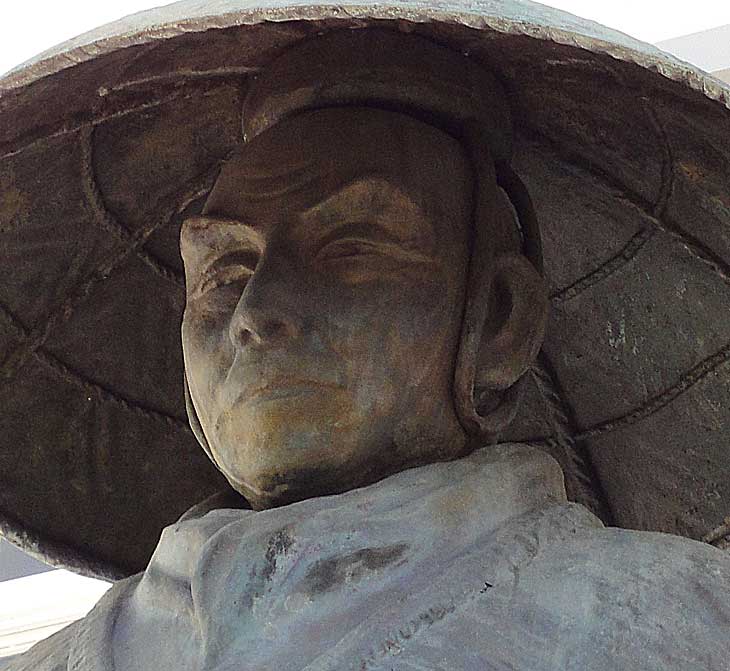
The New York Buddhist Church and its statue of Shinran Shonin
The New York Buddhist Church, 331 – 332 Riverside Drive, is a Japanese “True Pure Land” (Japanese Jodoshinshu) Buddhist temple, founded in 1938.
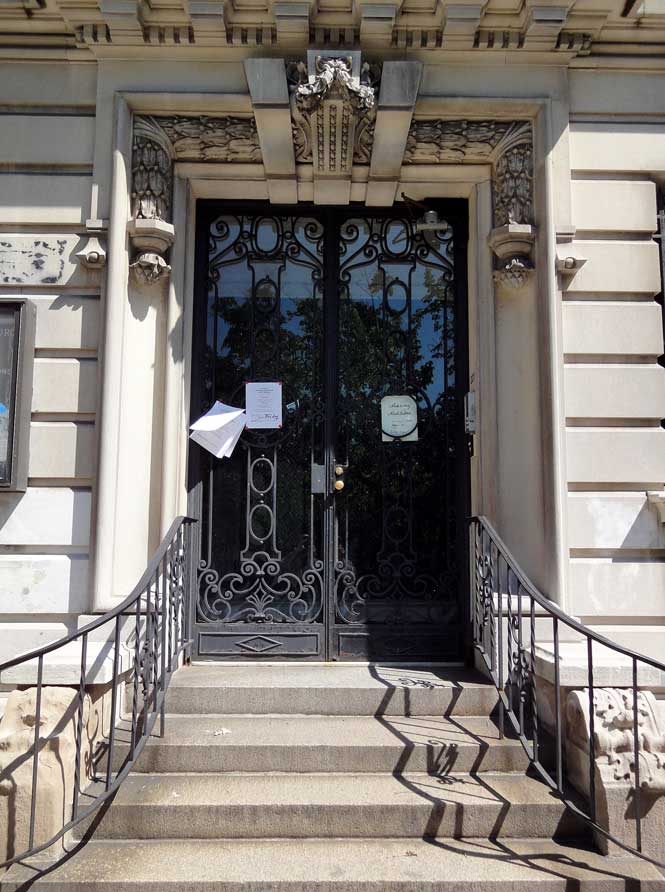
– photo by the Hermetic Hungarian
331 Riverside Drive, the main building, was formerly the Marion Davies House, built in 1902 in the Beaux Arts style by architects Janes & Leo. 332 Riverside Drive, the annex and social center, was built in 1963 in the then-popular International Style by architects Kelley & Gruzen.
Standing in front of the annex, looking out across the Hudson River, is a tall bronze statue of Shinran Shonin (1173 – 1262), the founder of the Japanese True Pure Land school. Statues like this one grace the entrances of Pure Land Buddhist temples worldwide. However, this particular statue was originally in Hiroshima and survived the atomic bomb.
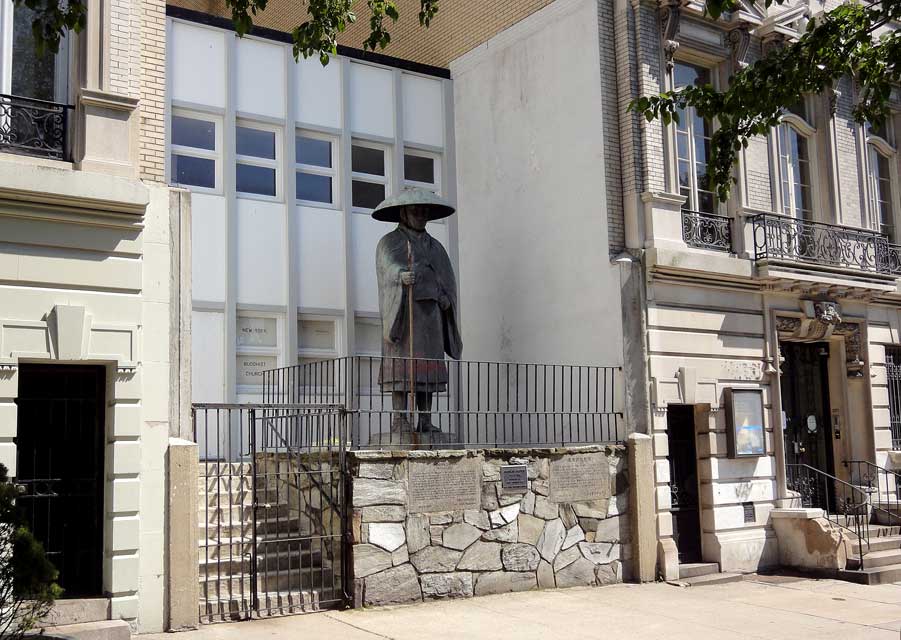
– photo by the Hermetic Hungarian
This statue originally stood about 8,000 feet from Hiroshima’s ground zero. It was one of the few cultural artifacts to survive the blast from that close distance. The statue was brought to the United States and installed in its its current location in 1955. Besides being a symbol of the founder of the Pure Land School, it is a reminder of both the terrible devastation wrought by atomic weapons and of fervent hopes for world peace.
Every August 5th at 7:15pm – corresponding to 8:15am August 6th, Hiroshima time — the temple bell is sounded, and the Buddhist and local communities gather around the statue, silently commemorating the Hiroshima bombing.
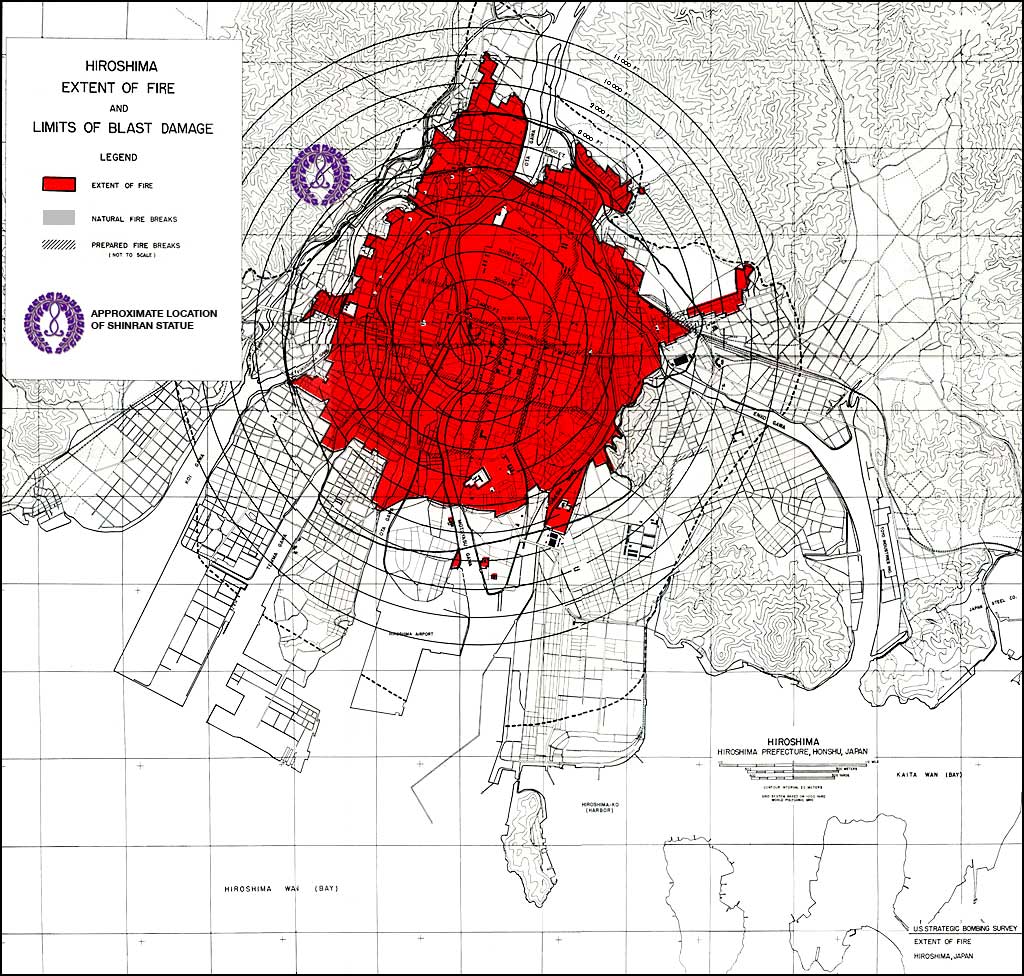
Shinran was born into a powerful Regent family in 1173. Shinran was inducted into the Imperial Court-sponsored Esoteric (Japanese Tendai ) Buddhist community. This esoteric school had been brought from China in the 8th century, and was a favorite among the nobility and educated classes. It was a complex, intellectual, esoteric, and demanding school which required difficult practices of its adherents. For 20 years Shinran tried without success to follow the practices. He became disillusioned, and wanted to leave the monastery to study a simpler Buddhism being taught in Kyoto.
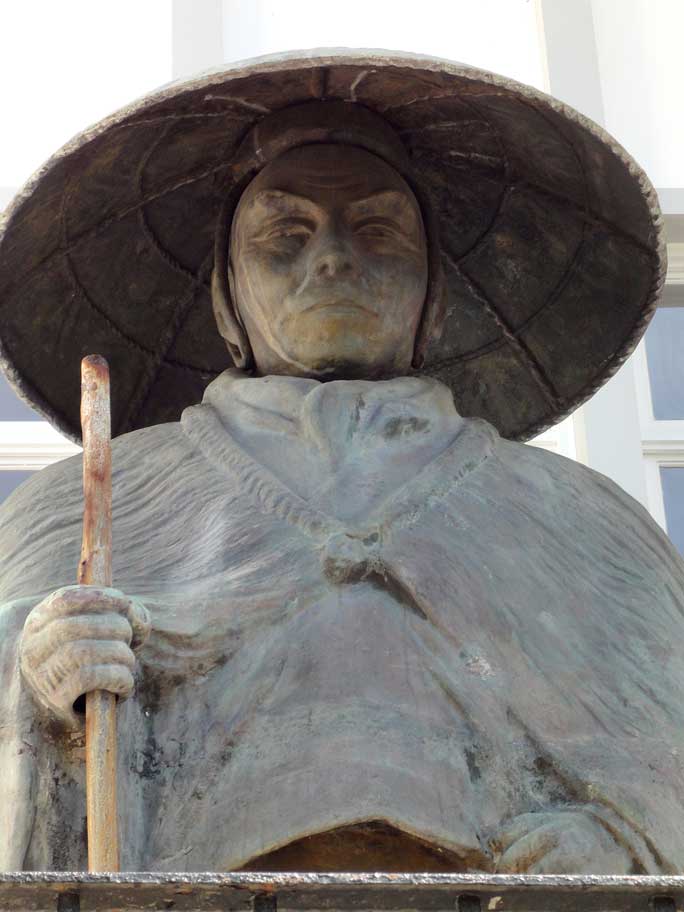
– photo by the Hermetic Hungarian
Because of his abandonment of the Court-supported school, Shinran was exiled to the provinces to live as a commoner, with farmers, merchants, fishermen, and artisans. Living away from the heady atmosphere of the monastery, Shinran soon realized that if he himself was unable to perform the difficult practices required by the Buddhist schools of the nobility, surely people with little education who were busy eking out a living from day to night had little chance of achieving enlightenment through the then-accepted means. He felt strongly that there must be another way – after all the Buddha’s original teaching was one of universal enlightenment.
Having studied with earlier teachers of Pure Land, Shinran was familiar with the teachings which detailed the Buddha Amida’s (Sanskrit Amitabha) vows not to become a fully enlightened Buddha until everyone who had relied upon him had become enlightened.
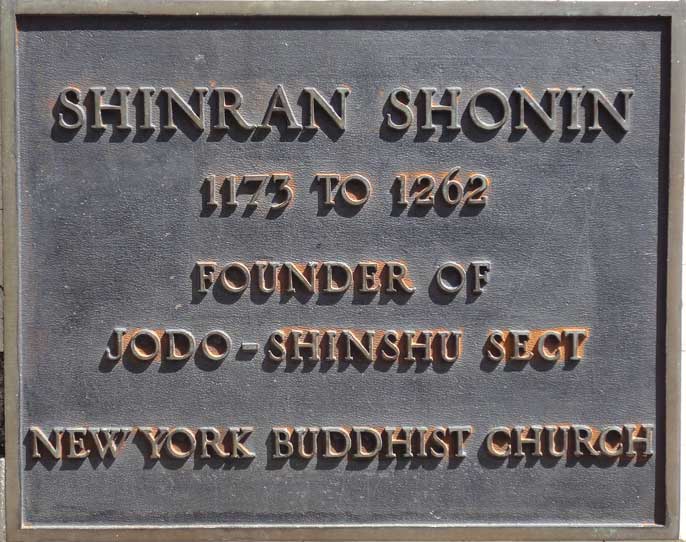
– photo by the Hermetic Hungarian
The primary practice of Pure Land Buddhists, whether Japanese, Chinese, Vietnamese, or Korean, is chanting the name of Amida Buddha. In Japanese the chant is “Namu Amida Butsu”, translated as “I humbly bow to Amida Buddha”.
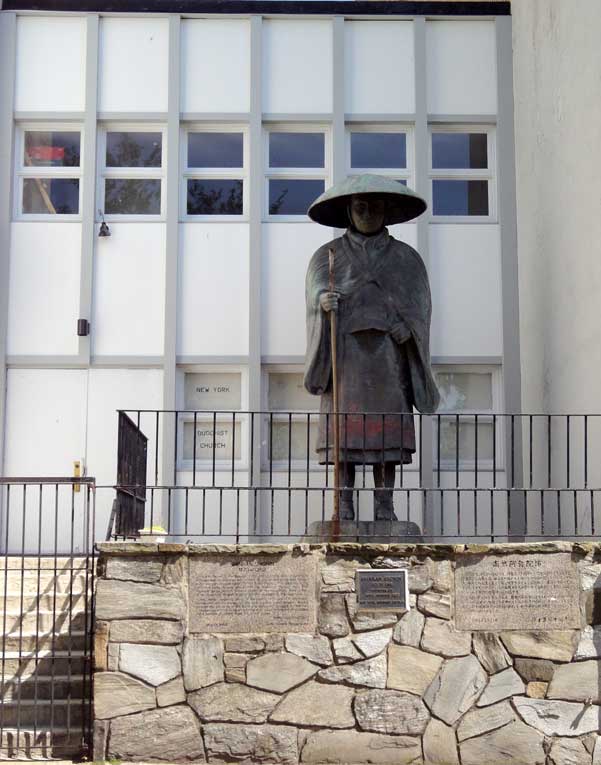
– photo by the Hermetic Hungarian
The external manifestation of this practice is that if one chants with sincerity and respect, asking for Amida Buddha’s help and guidance, then one will be reborn in the Pure Land in the West from which enlightenment is possible for ordinary people.
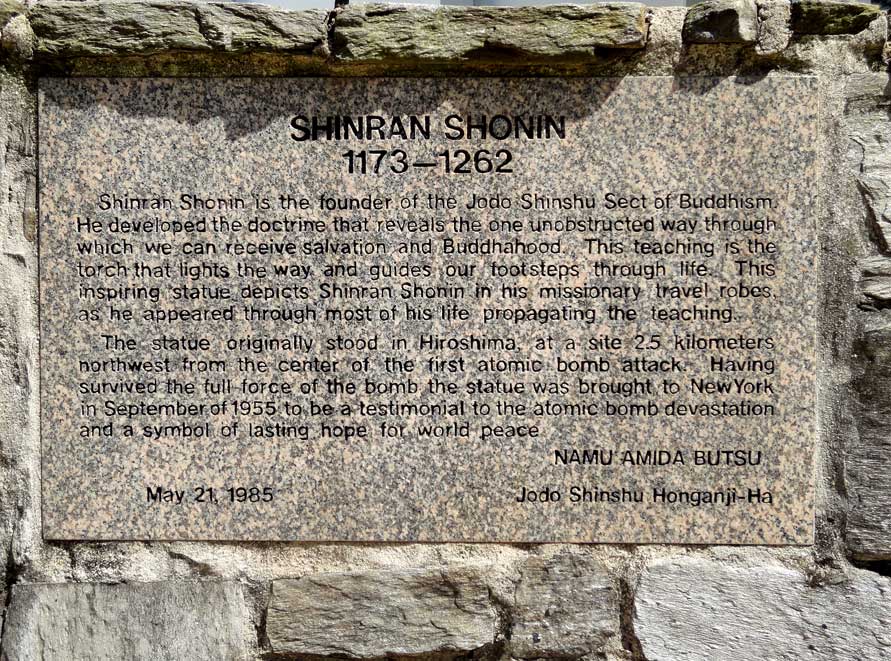
– photo by the Hermetic Hungarian
The corollary is that no matter how difficult and rigorous the practices undertaken in this life, it is almost impossible for ordinary people to transcend mundane existence. Pure Land practitioners place not just their faith but their hopes for eventual enlightenment in the hands of Amida Buddha.
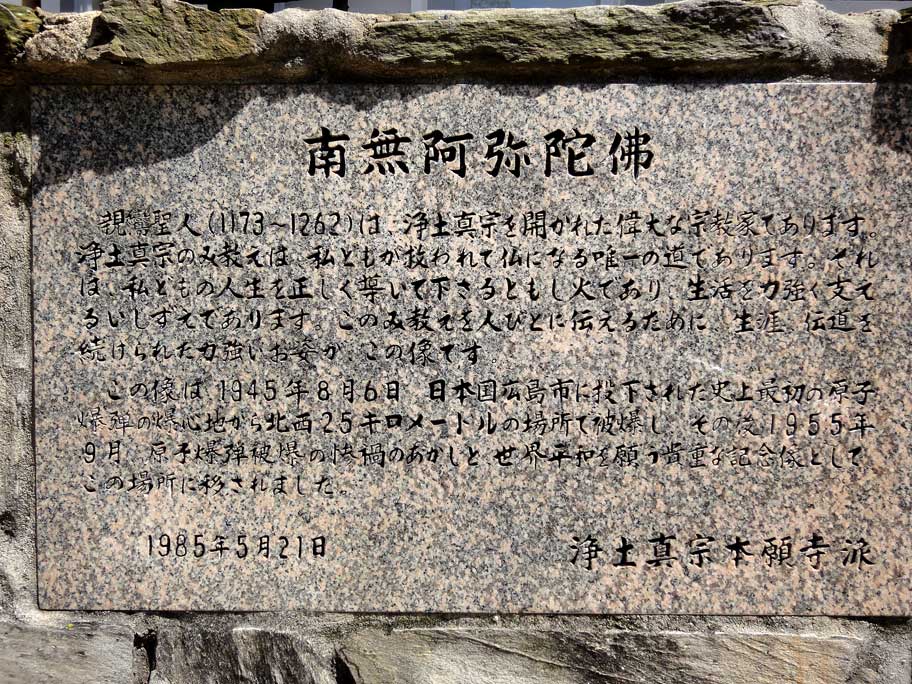
– photo by the Hermetic Hungarian
The internal manifestation of Pure Land practice is that chanting name of Amida Buddha helps practitioners realize that the Pure Land is here and now, within ourselves. Faith in Amida Buddha awakens a deep spirituality, gratitude, and humility in the practitioner. This in turn allows the practitioner to live in the Pure Land while living in the world. And the physical act of chanting slowly leads the practitioner to inner calmness and fosters insight into true reality.
– photo by the Hermetic Hungarian
Pure Land Buddhism has the largest number of adherents of any Buddhist school in the world. In Japan alone there are over 10,000 Pure Land temples. Throughout China and Vietnam there are an unknown number of Pure Land temples, due to historic governmental suppression of religion; however, Pure Land is the largest Buddhist school in both countries. Pure Land has also greatly influenced Korean and Tibetan Buddhist practices. Buddhist practice is heterogenous, and different schools adapt each others’ practices when appropriate.
The members of the New York Buddhist Church, and their leader Rev. T. Kenjitsu Nakagaki, serve the Japanese community of Manhattan with Sunday services, Japanese dharma classes, and special events. They also warmly welcome welcome anyone seeking to understand more about Pure Land, offering services, classes, and discussions in English, hoping to embrace the wider community. They have been enthusiastically welcoming anyone interested for the last 72 years.
Madison Avenue Bridge Centennial

– photo by Mitch Waxman
The last of the bridge centennial parades was held on Wednesday, May 12, 2010. The Madison Avenue Bridge spans the Harlem River and connects Manhattan with the Bronx.
from wikipedia
The Madison Avenue Bridge crosses the Harlem River connecting Madison Avenue in Manhattan with East 138th Street in the Bronx in New York City. The bridge is operated and maintained by the New York City Department of Transportation. It was designed by Alfred P. Boller and built in 1910 to replace and double the capacity of another earlier swing bridge dating from 1884.

– photo by Mitch Waxman
It rained, at this parade.
from nycroads.com
The Madison Avenue Bridge, which today is maintained by the New York City Department of Transportation (NYCDOT), provides two lanes of eastbound and two lanes of westbound traffic between Manhattan and the Bronx. On the Bronx approach, the bridge directly connects to the Major Deegan Expressway (at EXIT 3). On the Manhattan approach, motorists must take side streets to connect to the Harlem River Drive. According to the NYCDOT, the bridge carries approximately 45,000 vehicles per day (AADT).

– photo by Mitch Waxman
American Bridge Company? That was J.P. Morgan, wasn’t it?
from wikipedia
The Harlem River is a navigable tidal strait in New York City, USA that flows 8 miles (13 km) between the Hudson River and the East River, separating the boroughs of Manhattan and the Bronx. Part of the current course of the Harlem River is the Harlem River Ship Canal, which runs somewhat south of the former course of the river, isolating a small portion of Manhattan (Marble Hill) on the Bronx side of the river.

– photo by Mitch Waxman
The indomitable DOT crew that provided electricity and made sure that tents were in place to shield the dignitaries and speakers from the weather. Notice their high visibility safety gear.
from wikipedia
The New York City Department of Transportation (NYCDOT or DOT) is responsible for the management of much of New York City’s transportation infrastructure. Janette Sadik-Khan is the current Commissioner of the Department of Transportation, and was appointed by Mayor Michael Bloomberg on April 27, 2007.
The department’s responsibilities include day-to-day maintenance of the city’s streets, highways, bridges and sidewalks. The Department of Transportation is also responsible for installing and maintaining the city’s street signs, traffic signals and street lights. The DOT supervises street resurfacing, pothole repair, parking meter installation and maintenance, and the management of a citywide network of municipal parking facilities. The DOT also operates the Staten Island Ferry.

– photo by Mitch Waxman
The bridge itself is a rather straightforward swing bridge, with trusses and box girders forming the superstructure for the busy roadway.
from wikipedia
Harlem stretches from the East River west to the Hudson River between 155th Street; where it meets Washington Heights—to a ragged border along the south. Central Harlem begins at 110th Street, at the northern boundary of Central Park; Spanish Harlem extends east Harlem’s boundaries south to 96th Street, while in the west it begins north of Upper West Side, which gives an irregular border west of Morningside Avenue. Harlem’s boundaries have changed over the years; as Ralph Ellison observed: “Wherever Negroes live uptown is considered Harlem.”

– photo by Mitch Waxman
Two young fellows opened a large box and revealed this cake. As soon as I saw it, I knew what must happen next, for I know a secret about politicians…
from wikipedia
Cake is a form of food that is usually sweet and often baked. Cakes normally combine some kind of flour, a sweetening agent (commonly sugar), a binding agent (generally egg, though gluten or starch are often used by lacto-vegetarians and vegans), fats (usually butter, shortening, or margarine, although a fruit purée such as applesauce is sometimes substituted to avoid using fat), a liquid (milk, water or fruit juice), flavors and some form of leavening agent (such as yeast or baking powder), though many cakes lack these ingredients and instead rely on air bubbles in the dough to expand and cause the cake to rise. Cake is often frosted with buttercream or marzipan, and finished with piped borders and crystallized fruit.

– photo by Mitch Waxman
All Politicians love cakes and cameras, and are magnetically attracted to them from wherever they may be in the city.
from wikipedia
To balance local authority along with the centralization of government, the Office of Borough President was established with a functional administrative role derived by having a vote on the New York City Board of Estimate, which was responsible for creating and approving the city’s budget and proposals for land use. The Board of Estimate consisted of the Mayor, the Comptroller and the President of the New York City Council, each of whom were elected citywide and had two votes, and the five Borough presidents, each having one vote.
In 1989, the Supreme Court of the United States, in Board of Estimate of City of New York v. Morris (489 U.S. 688) declared the New York City Board of Estimate unconstitutional on the grounds that the city’s most populous borough (Brooklyn) had no greater effective representation on the board than the city’s least populous borough (Staten Island), this arrangement being an unconstitutional violation of the Fourteenth Amendment’s Equal Protection Clause pursuant to the high court’s 1964 “one man, one vote” decision.
The city charter was revised in 1990 and the Board of Estimate was abolished. The Office of Borough President was retained but with greatly reduced power. The borough budget reverted to the mayor or the New York City Council. A Borough President has a small discretionary budget to spend on projects within the borough. The last significant power of the borough presidents — to appoint a member of the New York City Board of Education — was abolished, with the board, on June 30, 2002.
The two major remaining appointments of a Borough President are one member of the city Planning Commission and one member of the Panel for Educational Policy. Borough Presidents generally adopt specific projects to promote while in office; but, since 1990, Borough Presidents have been seen mainly as the ceremonial leaders of their boroughs. Officially, they advise the Mayor on issues relating to each borough, comment on all land-use items in their borough, advocate borough needs in the annual municipal budget process, appoint Community Boards, chair the Borough Boards, and serve as ex officio members of various boards and committees They generally act as advocates of their boroughs at the mayoral agencies, the city council, the New York State government, public corporations and private businesses.

– photo by Mitch Waxman
Borough President of Manhattan Scott Stringer arrived first, and seemed pleased with the confection.
from wikipedia
Scott Stringer (born 1960) is a New York Democratic politician and the current Borough President of Manhattan. His mother, Arlene Stringer-Cuevas, is a cousin of Bella Abzug and served on the New York City Council. Stringer grew up in the Washington Heights/Lower Inwood neighborhood of Upper Manhattan, attended Manhattan public schools and graduated from the John Jay College of Criminal Justice. In 1983, he became a legislative assistant to Assemblyman, and future Congressman, Jerrold Nadler. During these years, he supported Democratic candidates such as Governor Mario Cuomo. In 1992, Stringer ran for Nadler’s Assembly seat representing the Upper West Side when Nadler replaced deceased Congressman Ted Weiss.

– photo by Mitch Waxman
Bronx Borough President Ruben Diaz, Jr. arrived in a nearly simultaneous fashion, and the two exchanged pleasantries- while eyeing the pastry.
from wikipedia
Ruben Diaz, Jr. (born April 26, 1973) is a Democratic Party politician from the Bronx in New York City, and the son of New York State Senator Rubén Díaz.
Diaz became the Bronx Borough President in April 2009 after representing the 85th Assembly District in the New York State Assembly. When first elected in 1996 he became, at age 23, the youngest member of the New York State Legislature since Theodore Roosevelt.

– photo by Mitch Waxman
The two BP’s electrified the crowd of well wishers, reporters, and invited guests. Diaz also maintained a certain vigil on the cake.
from wikipedia
On February 18, 2009, U.S. President Barack Obama appointed Bronx Borough President Adolfo Carrión, Jr. to the position of Director of the White House Office on Urban Affairs.
When Mayor Michael Bloomberg declared a special election to choose his successor,[64] Diaz was considered the leading candidate for the position of Bronx Borough President.
The special election was held on April 21, 2009. Diaz defeated Republican Party candidate Anthony Ribustello by an overwhelming 87% of the vote, to become the 13th Borough President of the Bronx.
On July 1, 2009 Diaz appointed Delores Fernandez to the reconstituted New York City Board of Education. Fernandez is anticipated to be the sole member of the Board that will have a perspective independent of mayor Michael Bloomberg.
Diaz ended his first summer as borough president by recommending that the New York City Council reject Related Companies’ proposal to turn the Kingsbridge Armory into a shopping mall. In an editorial in the New York Daily News, Diaz wrote he is “fighting to make sure that this development includes ‘living wage’ jobs that offer health insurance.” Related’s proposal is still going through the city’s review process.

– photo by Mitch Waxman
The ceremonies began with the national anthem as sung by members of (I believe) the Choir Academy of Harlem.
from wikipedia
Samuel I. Schwartz, a.k.a. Gridlock Sam, is one of the leading transportation engineers in the United States, and is widely believed to be the man responsible for popularizing the phrase gridlock. Educated at Brooklyn College and the University of Pennsylvania, he originally worked as a cabbie. He eventually held the second-in-command post of Deputy Commissioner in New York City’s transportation department for many years and now operates as a private consultant. One of Gridlock Sam’s newest developments is that of a plan to enhance truck traffic along the Detroit-Windsor border. Today he gives advice in his own column in New York City’s Daily News. He answers questions by mail and alerts readers about traffic patterns.

– photo by Mitch Waxman
Master of ceremonies Sam Schwartz.
from gridlocksam.com
Some thirty-seven years ago I began my professional career as a New York City taxi driver. This provided basic training for maneuvering through the city’s streets. Though trained in science, I switched majors to transportation engineering in graduate school. I thought I would save the subways, but the Transit Authority wouldn’t offer me a job. I ended up as a junior engineer at the old Traffic Department.
Initially I worked developing neighborhood one-way plans but soon I was moved to “Special Projects”. John Lindsay was mayor and proposed many innovative and bold schemes to reduce traffic in Midtown. I spent a lot of time on these plans, working with an old-time traffic engineer named Roy Cottam. One day, Roy spoke of his fears if we closed the streets in the Theater District, the grid system would “lock-up” and all traffic would grind to a halt. Soon we simply juxtaposed the word, and the term gridlock was born.

– photo by Mitch Waxman
There was a general feeling of happiness, despite the wet and cold. Of course, we were all under the tent.
from nycbridges100.org
In the spring of 2007, a group of civic minded individuals realized that several of New York City’s bridges were approaching their 100th anniversary. In order to commemorate the significance of these magnificent spans and their role in making New York City the greatest metropolis in the world, the group formed the NYC Bridge Centennial Commission, a 501 (c) 3 corporation.
The aim of the Commission is to promote the 100th year anniversary of six historic New York City bridges, to educate the public about the bridges’ role in the life of the city, to encourage respect for the history of New York City; to heighten the public’s awareness of the City’s infrastructure and the need to maintain it; and to stimulate the interest of the public in celebrating the centennial of these six bridges.

– photo by Mitch Waxman
Out of nowhere, the Kevin C. Kane, NYFD Marine 6 appeared.
from limarc.org
Kevin C. Kane, N2MEI, was a New York City Firefighter, and a member of LI-MARC. Early on the morning of September 12, 1991, Kevin responded with Engine Com-pany 236 to a fire in at an abandoned apartment house in the East New York section of Brooklyn. Despite the knowledge that there might not be enough hose to reach all parts of the house, Kevin and his fellow firefighters entered the building in search of victims. Shortly thereafter, a section of burning ceiling fell on Kevin. Despite the frantic efforts of his colleagues, they were not able to reach him. Eventually he managed to jump from a window, into the bucket of a fire truck. Having been burned over most of his body, he died the next day. In his honor, The NYFD named a fireboat The Kevin C. Kane, and created the Kevin C. Kane Medal for bravery.

– photo by Mitch Waxman
The kids from the Harry S Truman High School band, and I mean all of them, were just jumping with personality and enthusiasm.
from wikipedia
Marching band is a sport consisting of a group of instrumental musicians and usually dance teams / color guard who generally perform outdoors and incorporate some type of marching (and possibly onto other movements) with their musical performance. Instrumentation typically includes brass, woodwinds, and percussion instruments. Most marching bands use some kind of uniform (often of a military style) that include the school or organization’s name or symbol, shakos, pith helmets, feather plumes, gloves, and sometimes gauntlets, sashes, and/or capes.

– photo by Mitch Waxman
Suddenly, all the spectators were looking south while I was looking west.
from wikipedia
Harry S. Truman High School is a public high school at 750 Baychester Avenue, in the Bronx, New York City, United States. The school is designated as an Empowerment School by the New York City Department of Education, which allows it more autonomy in choosing a curriculum.
Truman High School is one of the remaining large high schools in the Bronx that has not been broken up into a number of small schools. This trend which has been popular in the city has seen South Bronx High School, Evander Childs High School as well as Roosevelt High School split into a number of smaller schools that are still located in the same building.
Truman High is located in the Co-op City section of the Bronx, yet many of the students commute to school from areas as far away as the South Bronx.
The size of Truman High School (over 3000 students) does give it the benefit of having many sports programs and extracurricular activities.

– photo by Mitch Waxman
Marine 6 was starting its own performance.
from wikipedia
Types of Apparatus:
MARINE or Fireboat is a specialized boat outfitted specifically for firefighting capabilities. Its responsibilities include suppression of all fires that occur on water, such as boat fires, pier fires, etc. A Marine Unit also assists land based companies with securing a water supply, as they have the ability to “draft” water from the rivers they operate in.

– photo by Mitch Waxman
Red and blue colorant is added to two of the firehoses…
from wikipedia
The first bridge on this site was constructed by the New York and Harlem Railroad in 1841. It was composed of four 90-foot (27 m)-long box truss spans, three of which were fixed iron spans, while the remaining span was a wooden swing span. In the closed position, the bridge had a clearance of only seven feet above mean high water. Masonry piers supported the four box-truss spans.
In 1867, the wooden drawbridge was replaced with an iron one that gave a clearance of fifty feet. It was very busy. By the 1880s, the bridge was crossed by more than 200 trains a day.
The bridge was soon made obsolete by heavy traffic and dredging of the Harlem River Ship Canal. Alfred P. Boller worked with the railroad to create a new four-tracked swing bridge. The railroad and the city split the cost.
The new bridge was built in conjunction with the Army Corps of Engineers’ project to build the Harlem River Ship Canal. The Park Avenue railroad viaduct was also extended north of 115th Street at the same time. While the bridge was being built, a temporary bridge was built and the old span was demolished.
When the new bridge was finished, it had a 300-foot (91 m)-long steel truss span supported by masonry piers. The new span had a vertical clearance of 25 feet (7.6 m).

– photo by Mitch Waxman
… and a patriotic display is manufactured.
from nycroads.com
During the 1960’s and 1970’s, the Park Avenue Railroad Bridge passed through the hands of several financially ailing railroads, ranging from the New York, New Haven and Hartford Railroad to the Penn Central Railroad. Today, the lift span is operated by the MTA Metro-North passenger railroad.
Recently, the MTA Metro-North Railroad announced a $10 million project to rehabilitate the Park Avenue Railroad Bridge. The bridge control, power and lift systems are now beyond their useful life, and will not be replaced. Instead, the project will remove the moveable elements of the bridge (such as the wire rope and counterweight), and will rehabilitate the foundation. The MTA Metro-North Railroad currently is seeking approval from the U.S. Coast Guard to make this a fixed bridge in order to minimize the cost of rehabilitation.

– photo by Mitch Waxman
The announcement was made that the rest of the ceremony would be kicking off “Bronx Week”, so the entire crowd began to lurch toward the Bronx shoreline.
from wikipedia
In a marching band or a drum & bugle corps, the colorguard is a non-musical section that provides additional visual aspects to the performance. The marching band and colorguard performance generally takes place on a football field while the colorguard interprets the music that the marching band or drum & bugle corps is playing via the synchronized spinning of flags, sabres, rifles, or through dance. The color guard uses different colors and styles of flags to enhance the visual effect of the marching band as a whole. The number of members in a colorguard can vary- some only having a few members while others may have 41 or more. Within the band, colorguard is often referred to as flagline or simply guard.

– photo by Mitch Waxman
The Truman kids led the march off the Madison Avenue Bridge toward the Bronx side.
from wikipedia
The size and composition of a marching band can vary greatly. Some bands have fewer than twenty members, and some have over 500. American marching bands vary considerably in their instrumentation. Some bands omit some or all woodwinds, but it is not uncommon to see piccolos, flutes, clarinets, alto saxophones, and tenor saxophones. E♭ clarinets, alto clarinets, bass clarinets, and baritone saxophones are less common, but can be found in some bands. Bassoons and oboes are very seldom found on a field due to the risk of incidental damage, the impracticality of marching with an exposed double reed, and high sensitivity to weather.
The brass section usually includes trumpets or cornets, mellophones or E♭ alto horns (instead of horns), tenor trombones, baritone horns or euphoniums, and Tubas or sousaphones. E♭soprano cornets are sometimes used to supplement or replace the high woodwinds. Some especially large bands use flugelhorns and bass trombones.
Marching percussion (often referred to as the drumline, battery, or back battery) typically includes snare drums, tenor drums, bass drums, and cymbals and are responsible for keeping tempo for the band. All of these instruments have been adapted for mobile, outdoor use. Marching versions of the glockenspiel (bells), xylophone, and marimba are also rarely used by some ensembles. Historically, the percussion section also employed mounted timpani that featured manual controls.
For bands that include a front ensemble (also known as the pit or auxiliary percussion), stationary instrumentation may include orchestral percussion such as timpani, tambourines, maracas, cowbells, congas, wood blocks, marimbas, xylophones, bongos, vibraphones, timbales, claves, guiros, and chimes or tubular bells,concert bass drums, and gongs, as well as a multitude of auxiliary percussion equipment. Drum sets, purpose-built drum racks, and other mounted instruments are also placed here. Until the advent of the pit in the early 1980s, many of these instruments were actually carried on the field by marching percussionists by hand or on mounting brackets. Some bands also include electronic instruments such as synthesizers, electric guitars, and bass guitar, along with the requisite amplification. If double-reed or string instruments are used, they are usually placed here, but even this usage is very rare due to their relative fragility. Unusual percussive instruments are sometimes used, including brake drums, empty propane tanks, trashcans, railroad ties, stomping rigs, and other interesting sounds.

– photo by Mitch Waxman
Word went around that refreshments could be found, and other entertainments offered, upon our arrival in Deegan Rock Park.
from wikipedia
For parades, bands usually line up in a marching block composed of ranks (rows) and files (columns). Typically, each member tries to stay within his or her given rank and file, and to maintain even spacing with neighboring musicians. It is usually the responsibility of the people at the end of each rank and the front of each file to be in the correct location; this allows other band members to guide to them.
Band members also try to keep a constant pace or step size while marching in parade. This usually varies between 22 and 30 inches (56–76 cm) per stride. A step size of 22.5 inches is called 8-to-5 because the marcher covers five yards (about 4.6 m) in eight steps. A step size of 30 inches is called 6-to-5 because five yards are covered in six steps. Because yard lines on an American football field are five yards apart, exact 8-to-5 and 6-to-5 steps are most useful for field shows.
A drum cadence (sometimes called a walkbeat or street beat) is usually played when the band is marching, sometimes alternating with a song. This is how the band keeps time. Alternately, a drum click or rim shot may be given on the odd beats to keep the band in step. Between songs and cadences, a roll is usually given to indicate what beat in the measure the band is at. Cadence tempo varies from group to group, but is generally between 112 and 144 beats per minute.

– photo by Mitch Waxman
The band played on, as the crowd crossed safely over the flow of Harlem River.
from wikipedia
A musical instrument is constructed or used for the purpose of making the sounds of music. In principle, anything that produces sound can serve as a musical instrument. The history of musical instruments dates back to the beginnings of human culture. The academic study of musical instruments is called organology.
The date and origin of the first device of disputed status as a musical instrument dates back as far as 67,000 years old; artifacts commonly accepted to be early flutes date back as far as about 37,000 years old. However, most historians believe determining a specific time of musical instrument invention to be impossible due to the subjectivity of the definition.
Musical instruments developed independently in many populated regions of the world. However, contact among civilizations resulted in the rapid spread and adaptation of most instruments in places far from their origin. By the Middle Ages, instruments from Mesopotamia could be found in the Malay Archipelago and Europeans were playing instruments from North Africa. Development in the Americas occurred at a slower pace, but cultures of North, Central, and South America shared musical instruments.

– photo by Mitch Waxman
Apparently, the syncopated footsteps of marching bands cause bridge engineers no small amount of worry, but the sturdy old girl didn’t shake a bit.
from wikipedia
The Bronx is divided by the Bronx River into a hillier section in the west, closer to Manhattan, and the flatter East Bronx, closer to Long Island. The West Bronx was annexed to New York City (then largely confined to Manhattan) in 1874, and the areas east of the Bronx River in 1895. The Bronx first assumed a distinct legal identity when it became a borough of Greater New York in 1898. Bronx County, with the same boundaries as the borough, was separated from New York County (afterwards coextensive with the Borough of Manhattan) as of January 1, 1914. Although the Bronx is the third-most-densely-populated county in the U.S., about a quarter of its area is open space, including Woodlawn Cemetery, Van Cortlandt Park, Pelham Bay Park, the New York Botanical Garden and the Bronx Zoo in the borough’s north and center, on land deliberately reserved in the late 19th century as urban development progressed northwards and eastwards from Manhattan with the building of roads, bridges and railways.

– photo by Mitch Waxman
Word was that the cake had already been transported down to Deegan Rock Park, and somehow- Diaz knew it.
from wikipedia
In 1997, the Bronx was designated an All America City by the National Civic League, signifying its comeback from the decline of the 1970s. In 2006, The New York Times reported that “construction cranes have become the borough’s new visual metaphor, replacing the window decals of the 1980s in which pictures of potted plants and drawn curtains were placed in the windows of abandoned buildings.” The borough has experienced substantial new building construction since 2002. Between 2002 and June 2007, 33,687 new units of housing were built or were under way and $4.8 billion has been invested in new housing. In the first six months of 2007 alone total investment in new residential development was $965 million and 5,187 residential units were scheduled to be completed. Much of the new development is springing up in formerly vacant lots across the South Bronx.

– photo by Mitch Waxman
Other Bronx politicos also eagerly followed the charms of the baked goods.
from ilovethebronx.com
Saturday, May 15th through Sunday, May 23rd, 2010
Throughout Bronx Week, residents of the Bronx and visitors from the tri-state region come together to celebrate the people, places, history and businesses of the Bronx. Outdoor performances, trolley tours, health fairs, a salute to volunteers and business workshops are just some of the events in store.
The grand finale is on Sunday, May 23rd, when famous sons and daughters of the borough will return home for induction to the Bronx Walk of Fame on the Grand Concourse, followed by our annual Parade, Food & Art Festival and Concert on Mosholu Parkway.
Bronx Week is the ideal time to remind all New Yorkers that The Bronx is a great place to live, work and play. Don’t Miss The Fun!
For more information on fun Bronx Week events happening in our borough, check back with us using our Bronx Week Calendar page or call 718.590.BRONX

– photo by Mitch Waxman
The lady who was holding this sign was chided by your humble narrator for hiding her face. That was the Madison Avenue Bridge Centennial Parade.
from nypost.com
Bronx Week 2010 kicked off yesterday, May 12, but fear not — all you’ve missed so far was a press conference.
This year’s festive celebration of the borough will include 22 events in only 12 days and culminate in a busy, exciting Grand Finale on Sunday, May 23.
“This time we have organized even more events, while keeping the traditional ones, to celebrate the beauty, culture, talent and development of our neighborhoods,” said Borough President Ruben Diaz, Jr. “No Bronxite should stay home during these many days full of activities.”
Doris Quiñones, executive director of the Bronx Tourism Council, said that this year, for the first time, Bronx Week has been moved up one month earlier.
“We moved it from June to May to make it easier for schools to participate,” she said. “Eighty schools are already scheduled to march in the parade on Sunday, May 23.”
That day is the Grand Finale, which is the big culmination of Bronx Week. In addition to the parade, which starts at noon on Mosholu Parkway, that night will be the famous Bronx Ball, at which the borough’s best and brightest show up in formal attire to dance the night away. This year the ball is under a huge tent at Orchard Beach at 6 p.m. and, as in the past, will have a red carpet, Bronx high school cheerleaders, and will kick off when Borough President Diaz honors a special few.
Circumnavigation 4

– photo by Mitch Waxman
After sliding past the Williamsburg Bridge, the Circle Line narrator began to talk about Queensboro (he called it 59th street bridge- grrrr) and didn’t mention the Newtown Creek. Tourists wouldn’t want to hear about that story, I guess. One thing that really annoyed your humble narrator were the constant references to pop culture icons like the Seinfeld sitcom and the Spiderman movies. Realization that that’s what tourists have as touchstones for NYC is obviated, but still… blurring the line between fantasy and reality is a real issue in the modern world.
from wikipedia
George Louis Costanza is a fictional character in the American television sitcom Seinfeld (1989–1998), played by Jason Alexander. He has variously been described as a “short, stocky, slow-witted, bald man” (by Elaine Benes and Costanza himself), “Lord of the Idiots” (by Costanza himself), and as “the greatest sitcom character of all time”. He is friends with Jerry Seinfeld, Cosmo Kramer, and Elaine Benes. George appears in every episode except for “The Pen” (third season). The character was originally loosely based on Seinfeld co-creator Larry David, but surnamed after Jerry Seinfeld’s real-life New York friend, Mike Costanza.

– photo by Mitch Waxman
The power of cinema and television to present a cogent and absorbing telling of historical events is actually a dangerous thing. Again, I realize that the tourists aboard the Circle Line aren’t looking for hardcore history, but there’s a lot to say about the Queensboro bridge that doesn’t involve the Green Goblin or George Costanza. History is made not by accurate or cogent catalogs of events, but by distribution. The reason we know about Aristotle or Voltaire is that MANY copies of their work were made, distributed across a wide area, and were quoted by others. This means that distaff copies of their work survived the fires and floods. This means that to future eyes, the surviving copies of Spiderman and Goodfellas might be all they have.
Which makes me wonder if Pliny the Younger might have been the Dean Koontz of his time.
from wikipedia
As they watch over May in the hospital, Mary Jane tells Peter she has a crush on Spider-Man, and Peter expresses his own feelings for her. Harry catches them holding hands and tells his father about their love for each other. Now knowing that Spider-Man has feelings for Mary Jane, the Goblin lures him to the top of the Queensboro Bridge by taking Mary Jane and a Roosevelt Island Tramway car full of children hostage, then drops both at the same time. Spider-Man saves them all, but the Goblin takes him to an abandoned building for a fight. Spider-man eventually defeats and unmasks the Goblin, and Norman dies after asking Peter not to tell Harry that he (Norman) was the Goblin.

– photo by Mitch Waxman
As the boat passed Roosevelt Island, the looming hotel construction sites of Queens Plaza rise behind it. Within a few years, tens of thousands of Queens Plaza and Dutch Kills hotel rooms will be serving the self same tourist trade which is satisfied by attractions like these Circle Line cruises. Perhaps this is what we New Yorkers are destined to become, apes in a steel and glass cage put on display for foreigners as we live out our funny lives. Just like on Seinfeld.
from wikipedia
Tourism in New York City includes nearly 47 million foreign and American tourists each year. Major destinations include the Empire State Building, Ellis Island, Broadway theatre productions, museums such as the Metropolitan Museum of Art, and other tourist attractions including Central Park, Washington Square Park, Rockefeller Center, Times Square, the Bronx Zoo, South Street Seaport, New York Botanical Garden, luxury shopping along Fifth and Madison Avenues, and events such as the Tribeca Film Festival, and free performances in Central Park at Summerstage and Delacorte Theater. The Statue of Liberty is a major tourist attraction and one of the most recognizable icons of the United States. Many New York City ethnic enclaves, such as Jackson Heights, Flushing, and Brighton Beach are major shopping destinations for first and second generation Americans up and down the East Coast.

– photo by Mitch Waxman
Of course, the folks whose lives are a little too funny can be found on Ward’s Island at the psychiatric hospitals that serve the City of Greater New York. I’m never quite sure which building is which in this complex, as your humble narrator is convinced that getting too close to a madhouse would be injurious to his freedoms, but this is either the 509 bed Manhattan Psychiatric Center (I lean toward this) or the maximum security Kirby Forensic Psychiatric Center. The Circle Line narration didn’t mention either.
from soundportraits.org
There seem to be two constants to life on Ward 2-West. One of these is violence. The state considers the staffers who work on the ward to hold the single most dangerous job in New York, with the highest injury rate of any profession. The other constant on the ward is noise. There is nowhere to escape it, although there is one patient who seems to have adapted to it quite well. His name is Peter, and you can always find him at the front of the dayroom, hunched over a table peacefully drawing with yellow plugs stuffed deep into his ears. He is about 50 years old, has curly brown hair and a graying beard, gentle eyes behind thick glasses. Before committing his crime, Peter was a successful commercial artist. Today he’s working on a still life with pastels.

– photo by Mitch Waxman
Amongst the more pleasant realities of the trip was this view of the Hell’s Gate with its two spans- the Triborough Bridge(s) and the Hellgate railroad Bridge. The plane taking off from nearby LaGuardia airport was pure serendipity.
from wikipedia
Hell Gate is a narrow tidal strait in the East River in New York City in the United States. It separates Astoria, Queens from Randall’s Island/Ward’s Island (formerly two separate islands that are now joined by landfill).
It was spanned in 1917 by the New York Connecting Railroad Bridge (now called the Hell Gate Bridge), which connects the Ward’s Island and Queens. The bridge provides a direct rail link between New England and New York City. In 1936 it was spanned by the Triborough Bridge (now called the Robert F. Kennedy Bridge), allowing vehicular traffic to pass between Manhattan, the Bronx, and Queens.

– photo by Mitch Waxman
The Hellgate Bridge has long graded approaches which sprawl out all the way to the Sunnyside Yards on one side and continental North America on the other, providing a freight and rail link between the archipelago of islands which form this City-State of ours. Triborough’s approaches and ramps are almost too numerous for me to count.
from wikipedia
The Robert F. Kennedy Bridge, better known as the Triborough or Triboro Bridge, is a complex of three separate bridges in New York City, United States. Spanning the Harlem River, the Bronx Kill, and the Hell Gate (part of the East River), the bridges connect the boroughs of Manhattan, Queens, and The Bronx via Randall’s Island and Ward’s Island, which are joined by landfill.
Often historically referred to as simply the Triboro, the spans were officially named after Robert F. Kennedy in 2008.

– photo by Mitch Waxman
As the boat motored past Ward’s Island, where the Canadian theatrical provocateur’s called Cirque du Soleil had set up a circus tent, the Amtrak Acela rumbled over the Hellgate tracks. The last part of this trip that I can claim intimacy with until we returned to the Hudson, the Circle Line continued Northward.
Venturing into the “not part of my beat” areas of the City of Greater New York which your humble narrator is least familiar with- specifically the northeast sections of Manhattan and La Bronx, I actually got see a few things I didn’t even suspect…
from wikipedia
Acela Express (often simply Acela) is Amtrak’s high-speed rail service along the Northeast Corridor (NEC) in the Northeast United States between Washington, D.C., and Boston via Baltimore, Philadelphia, and New York. It uses tilting technology which allows the train to travel at higher speeds on the sharply curved NEC without disturbing passengers, by lowering lateral centrifugal forces, based on the concept of banked turns.
Acela Express trains are the only true high-speed trainsets in the United States; the highest speed they attain is 150 mph (240 km/h), though they average less than half of that. Acela has become popular with business travelers and by some reckoning has captured over half of the market share of air or train travelers between Washington and New York. Between New York and Boston the Acela Express has up to a 37% share of the train and air market.
Circumnavigation 3

– photo by Mitch Waxman
Hailing from the Brooklyn neighborhoods of first Flatbush, then Flatlands and Canarsie, my driving into “the City” habits always focused on the red haired step child of the Brooklyn Bridge- the Manhattan Bridge- which was the next great structure that the Circle Line passed.
from wikipedia
The Manhattan Bridge is a suspension bridge that crosses the East River in New York City, connecting Lower Manhattan (at Canal Street) with Brooklyn (at Flatbush Avenue Extension) on Long Island. It was the last of the three suspension bridges built across the lower East River, following the Brooklyn and the Williamsburg bridges. The bridge was opened to traffic on December 31, 1909 and was designed by Leon Moisseiff, who later designed the infamous original Tacoma Narrows Bridge that opened and collapsed in 1940. It has four vehicle lanes on the upper level (split between two roadways). The lower level has three lanes, four subway tracks, a walkway and a bikeway. The upper level, originally used for streetcars, has two lanes in each direction, and the lower level is one-way and has three lanes in peak direction. It once carried New York State Route 27 and later was planned to carry Interstate 478. No tolls are charged for motor vehicles to use the Manhattan Bridge.
The original pedestrian walkway on the south side of the bridge was reopened after forty years in June 2001.[3] It was also used by bicycles until late summer 2004, when a dedicated bicycle path was opened on the north side of the bridge, and again in 2007 while the bike lane was used for truck access during repairs to the lower motor roadway.
Main span: 1,470 ft (448 m)
Length of suspension cables: 3224 ft (983 m)
Total length: 6,855 ft (2,089 m)
The neighborhood near the bridge on the Brooklyn side, once known as Fulton Landing has been gentrified and is called DUMBO, an acronym for Down Under the Manhattan Bridge Overpass.
To celebrate the bridge’s centennial anniversary, a series of events and exhibits were organized by the New York City Bridge Centennial Commission in October 2009. These included a ceremonial parade across the Manhattan Bridge on the morning of October 4th and a fireworks display in the evening. In 2009, the bridge was also designated as a National Historic Civil Engineering Landmark by the American Society of Civil Engineers.

– photo by Mitch Waxman
Your humble narrator was honored to serve as a Bridge Parade Marshall for the aforementioned Centennial Parade, and attended the Landmarking ceremony on March 5th.
Here’s the Newtown Pentacle Posts on the Centennial Parade on October 4th-
Manhattan Bridge Centennial Parade 1
Manhattan Bridge Centennial Parade 2
Manhattan Bridge Centennial Parade 3
Here’s the NP post on the Ceremony in March- Exhausted
And for my personal take on the Manhattan Bridge- DUMBO… or missing my Dad

– photo by Mitch Waxman
Beneath the Bridge, small clots of citizenry were cleaning the shoreline of wind blown refuse and whatever washed up out of the East River over the long and severe winter that New York endured in 2010. It was Earth Day eve, after all.
I wish I could point you to a link about this effort, but the Brooklyn Blogosphere is an impenetrable fortress of noise and self importance which defies even the might of Google. If anybody associated with this effort is reading this, please fill the rest of us in on the particulars.

– photo by Mitch Waxman

– photo by Mitch Waxman
Moving north, ever north, midtown Manhattan’s iconic Chrysler Building rises behind the recently upgraded East River Station cogeneration power plant at 14th street and Ave. D.
The East River Generating Station, one of Consolidated Edison Co. of New York Inc.’s largest and most significant combined-cycle power stations, will be repowered by Slattery Skanska and its subsidiary Gottlieb Skanska.
Located on the east side of Lower Manhattan, the 43,000-sq.-ft. facility produces electricity and steam for homes and businesses throughout New York City. The project was completed May 2004.

– photo by Mitch Waxman
I still owe you, lords and ladies, a proper workup of the Williamsburg bridge. I’m still collecting material research and photography for this posting, so don’t expect it anytime soon. One of my summer projects is “The Grand Walk”, which will start in Manhattan and follow Grand Ave. through Williamsburg and Greenpoint, across the Grand Ave. Bridge into Queens and onto (former Grand Avenue) 30th avenue through Astoria to Hallet’s Cove. An open call for experts on the various phases of the route is being made, by the way, and hopefully I can get a few of you to come along for the first Newtown Pentacle meetup and photowalk at the end of the summer. Bring ID, and a camera.
from wikipedia
Construction on the bridge, the second to cross this river, began in 1896, with Leffert L. Buck as chief engineer, Henry Hornbostel as architect and Holton D. Robinson as assistant engineer, and the bridge opened on December 19, 1903 at a cost of $24,200,000. At the time it was constructed, the Williamsburg Bridge set the record for the longest suspension bridge span on Earth. The record fell in 1924, when the Bear Mountain Bridge was completed.


 The Newtown Pentacle