Archive for the ‘Manhattan’ Category
Circumnavigation 2

– photo by Mitch Waxman
Onboard the Circle Line, as it passed the Lower Manhattan Financial District, I spotted a couple of interesting things. The Meagan Ann tugboat was pulling a barge of shredded autos, which were reduced to their basic components at an industrial location found along that canalized exemplar of municipal neglect called the Newtown Creek, just up the river.
Here’s a shot of that Newtown Creek auto shredding operation which I took last year:

– photo by Mitch Waxman

– photo by Mitch Waxman
Meagan Ann is a twin-engine, 2,250 HP coastal towing tug, built in 1975 and rebuilt in 1988, approximately 81 feet long and formerly known as the Scorpius. It is owned and operated by Donjon Marine towing, Inc.
from donjon.com
Since its incorporation in 1966, Donjon Marine has established and continues to seek long-term client relationships in a world where limited business resources demand a constant balancing of expenditures. Beginning with its foundation in the New York area as a pioneer in marine salvages services, Donjon has grown to become a leader in both conventional and environmental dredging. Our areas of expertise also include recycling, land and marine demolition, pollution control and remediation, heavy lift transport, marine transportation and landfill remediation/site management. Donjon and its affiliates maintain offices, assets and personnel throughout the Northeast, with operations spanning the globe.

– photo by Mitch Waxman
Also witnessed by your humble narrator were regular comings and goings of Helicopter flights from the East River Piers found alongside the Financial District. It’s a Eurocopter AS-350B-2 Ecureuil, based at the West 30th street Heliport and operated by Liberty Helicoptors.
The largest helicopter sightseeing and charter service in the Northeast. Liberty Helicopters is currently the only authorized helicopter sightseeing company in New York City. We began in the charter business on April 22, 1986 and added sightseeing tours of New York City originating from the VIP heliport on September 6th, 1990. At that time, Liberty had begun an aggressive plan selling in both the domestic and international markets. Using our strong customer base afforded us the opportunity to open a second location at the downtown Manhattan heliport in 1995. Liberty Helicopters was not only the first company to operate sightseeing tours from this multi-million dollar facility, but also the first to offer our customers the convenience of two Manhattan locations. On May 1, 2004, we opened a third heliport at the Paulus Hook Pier located in the newly developed area of the Colgate section of Jersey City, N.J. In addition to our “once in a lifetime” helicopter tours, this facility operates both commuter and sightseeing ferry services, making it a very accessible facility to Manhattan.

– photo by Mitch Waxman
Of course, once we reached the grandest structure in the entire megalopolis (if you consider New York City to be composed of individual parts as opposed to being one gigantic system of transit, power, and satellite cities that stretches for hundreds of miles in every direction) your humble narrator forgot all about Sludge boats, Tugs, and aircraft. I’m always amazed at the scale and classical proportions of the Brooklyn Bridge.
from wikipedia
The Brooklyn Bridge is one of the oldest suspension bridges in the United States. Completed in 1883, it connects the New York City boroughs of Manhattan and Brooklyn by spanning the East River. At 5,989 feet (1825 m), it was the longest suspension bridge in the world from its opening until 1903, and the first steel-wire suspension bridge.
Originally referred to as the New York and Brooklyn Bridge, it was dubbed the Brooklyn Bridge in an 1867 letter to the editor of the Brooklyn Daily Eagle, and formally so named by the city government in 1915. Since its opening, it has become an iconic part of the New York skyline. It was designated a National Historic Landmark in 1964.

– photo by Mitch Waxman
If it hasn’t been recommended to you yet, by me or others, I have to sing the praises of “The Great Bridge by David McCullough” which details the design and construction of the Brooklyn Bridge as well as providing a real “slice of life” about 19th century New York City. My preference for audiobooks is satisfied by the version available at apple’s iTunes store, and you could do worse things with your hard earned money than pick up the print edition at amazon.
from wikipedia
Born and raised in Pittsburgh, McCullough attended Yale University, earning a degree in English literature. His first book, The Johnstown Flood, was published in 1968; he has since written seven more on topics such as Harry S. Truman, John Adams, and the Brooklyn Bridge. McCullough has also narrated multiple documentaries, as well as the 2003 film Seabiscuit; he also hosted American Experience for twelve years. Two of McCullough’s books, Truman and John Adams, have been adapted into a TV film and mini-series, respectively, by HBO. McCullough’s next work, about Americans in Paris between the 1830s to the 1930s, is due out in 2010.

– photo by Mitch Waxman
I don’t remember who the quote is attributed to, but the Ken Burns PBS documentary “Brooklyn Bridge” embedded a notion into me a while back that “all of modern heroic New York began with the building of the Brooklyn Bridge”. I tend to agree with this maxim.
from endex.com
After sixty years of political, financial and technical discussions (including a 6 lane tunnel proposal in the 1830’s), John Roebling’s plan was approved, the New York Bridge Company was formed and, in 1869, construction of the bridge finally began.
The bridge was built over 14 years in the face of enormous difficulties. Roebling died as a result of an accident at the outset; a fire in the Brooklyn Caisson smoldered for weeks; Roebling’s son, Washington, who took over as chief engineer, suffered a crippling attack of the bends during the construction of the Manhattan Caisson, and continued to direct operations, sending messages to the site by his wife, Emily. After the towers were built, a cable parted from its anchorage killing two people; there was fraud perpetrated by the cable contractor.
In the end, John Roebling’s prediction that the promenade above the deck will be “of incalculable value in a crowded commercial city” was justified, together with his perhaps most noted statement, claiming that “the great towers…will be ranked as national monuments. …As a work of art, and a successful specimen of advanced bridge engineering, this structure will forever testify to the energy, enterprise, and wealth of that community which shall secure its erection.”
On May 24, 1883, with schools and businesses closed, the Brooklyn Bridge, also referred to as the “Great East River Bridge”, was opened. Scores of people attended this spectacular ribbon cutting event. Over 100 years later, its renowned beauty & stature is still admired by many New Yorkers & tourists alike.

– photo by Mitch Waxman
The shot above is actually from last year (2009), but gives a good sense of the intricate series of roads and onramps that allow Manhattan traffic egress to the bridge.
from pbs.org
- Although he was physically able to leave his apartment, Washington Roebling refused to attend the opening celebration honoring his remarkable achievement.
- The bridge opened to the public on May 24, 1883, at 2:00 p.m. A total of 150,300 people crossed the bridge on opening day. Each person was charged one cent to cross.
- The bridge opened to vehicles on May 24, 1883, at 5:00 p.m. A total of 1,800 vehicles crossed on the first day. Vehicles were charged five cents to cross.
- Today, the Brooklyn Bridge is the second busiest bridge in New York City. One hundred forty-four thousand vehicles cross the bridge every day.
Circumnavigation 1

– photo by Mitch Waxman
The reason that I was in Manhattan on Saturday the 24th of April, rather than wandering about the dystopian hillocks of Western Queens (as usual), was that a friend was gathering a group of photographers and urban explorer types together on- of all things- a tourist boat. Coupons for a discount trip, and the offer of fraternal companionship, drew me to the west side of Manhattan to ride along for the three hour circumnavigation of the Shining City. The boat left from Pier 83, lately known as “the Circle Line” pier, on the Hudson River. That’s the John J. Harvey fireboat, incidentally- for more on the Harvey- click here, and here, and here.
from wikipedia
The Circle Line is the collective name given to two sightseeing ferry operations in Manhattan:
Circle Line Sightseeing Cruises at 42nd Street which circles Manhattan from its base at Pier 83 in Manhattan
Circle Line Downtown operates out of Pier 16, South Street Seaport. The company name is Circle Line Harbor Cruises, LLC. It is a wholly owned subsidiary of Circle Line Statue of Liberty.
- The two companies split in 1981 from the parent Circle Line company and now have different officers and directors.
- Circumnavigation of Manhattan became possible in 1905 with the construction of the Harlem Ship Canal, the first regularly scheduled trip being the Tourist captained by John Roberts in 1908.
- On June 15, 1945 Frank Barry, Joe Moran and other partners merged several sightseeing boats to form the Circle Line operating out of Battery Park.
- In 1955 it began operating at its current Pier 83 location. In 1962 it bought the Hudson River Day Line.

– photo by Mitch Waxman
River traffic was at a minimum, and the relict gems that dot the coastlines were glittering in the morning sunlight. Pictured above is the Erie-Lackawanna ferry terminal in Hoboken, New Jersey.
check out this fascinating post at Hoboken411.com which details the reconstruction of this historic structure’s clock tower in recent years.

– photo by Mitch Waxman
As the behemoth tourist ship entered into NY Harbor proper from the Hudson, along came the Marie J. Turecamo tugboat- a 2,250 HP twin screw tug operated by Moran Towing. It was originally built as the Traveller in 1968, by Tangier Marine Transport which operated out of the Main Iron Works facility in Houma, LA.
from morantug.com
Moran is a leading provider of marine towing and transportation services, a 150-year-old corporation that was founded as a small towing company in New York Harbor and grew to preeminence in the industry. The cornerstone of our success has been a long-standing reputation for safe, efficient service, achieved through a combination of first-rate people and outstanding vessels and equipment.
Over the course of its history Moran has steadily expanded and diversified, and today offers a versatile range of services stemming from its core capabilities in ship docking, contract towing, LNG activities and marine transportation. Our tug fleet serves the most ports of any operator in the eastern United States, and services LNG terminals along the U.S. East and Gulf Coasts and the West Coast of Mexico. The Moran barge fleet serves the U.S. Atlantic and Pacific Coasts, the Great Lakes, the inland waters of the U.S. eastern seaboard, and the Gulf of Mexico. We also provide worldwide marine transportation services, including operations in the Caribbean and periodic voyages to South America and overseas waters.

– photo by Mitch Waxman
Playing at the serious business of being a tourist is no easy job. The Circle Line narration points out interesting features observed along its route, making frequent mention of “the sights they came to see”. An image of the Statue of Liberty is a popular and desired memory for visitors to the Shining City to acquire, and I couldn’t let it pass without a cursory shot. The events of September 11, 2001 received repeated mention in the script as well.
from wikipedia
The statue is made of a sheathing of pure copper, hung on a framework of steel (originally puddled iron) with the exception of the flame of the torch, which is coated in gold leaf (originally made of copper and later altered to hold glass panes). It stands atop a rectangular stonework pedestal with a foundation in the shape of an irregular eleven-pointed star. The statue is 151 ft (46 m) tall, but with the pedestal and foundation, it is 305 ft (93 m) tall.
Worldwide, the Statue of Liberty is one of the most recognizable icons of the United States.[11] For many years it was one of the first glimpses of the United States for millions of immigrants and visitors after ocean voyages from around the world.
The statue is the central part of Statue of Liberty National Monument, administered by the National Park Service. The National Monument also includes Ellis Island.

– photo by Mitch Waxman
Speaking of 911, one of the newer Coast Guard patrol boats was busily speeding by. This is a “response boat small” I believe, and it was quick and seemed ready to become deadly at any moment.
from uscg.mil
Response Boat-Small (RB-S) was developed in a direct response to the need for additional Homeland Security assets in the wake of the September 11th terrorist attacks. The Defender-class boats were procured under an emergency acquisition authority.
With a contract option for up to 700 standard response boats, the Defender-class acquisition is one of the largest boat buys of its type in the world.
The 100 boat Defender A -class (RB-HS) fleet began arriving at units in May 2002 and continued through August 2003. After several configuration changes, most notably a longer cabin and shock mitigating rear seats, the Defender B-class RB-S boats were born.
This fleet was first delivered to the field in October 2003, and there are currently 457 Defender-class boats in operation assigned to the Coast Guard’s Maritime Safety and Security Teams (MSST), Maritime Security Response Team (MSRT), Marine Safety Units (MSU), and Small Boat Stations throughout the Coast Guard.
Mission Capability:
With an overall length of 25 feet, two 225 horsepower outboard engines, unique turning radius, and gun mounts both forward and aft, the Defender-class boats are the ultimate waterborne assets for conducting high speed maneuvering tactics in a small deployable package. This is evidenced by the fact that several Defender-class boats are already in operation at other Homeland Security Department agencies, as well as foreign military services for homeland security missions.

– photo by Mitch Waxman
As the Circle Line crossed into the East River, nearing the Brooklyn and Manhattan bridges, however, a ship that’s familiar to long time readers of this Newtown pentacle appeared- the M/V Red Hook.
from wnyc.org
When the city invited a select few reporters aboard the Sludge Boat Red Hook, we figured it would reek, naturally enough. But, despite all that human waste and other organic cargo sloshing about, the boat smells just fine.
This is a nice, clean, next-generation sludge vessel: 350 feet long, cruising speed 10 knots. Inside the cabin, it’s all fancy gadgets, everywhere.

– photo by Mitch Waxman
The Red Hook is actually one of the newer Sludge Boats in the City’s fleet, built to modern specifications and environmental regulations.
from ny1.com
The $30 million boat, named Red Hook, is the latest addition to the marine fleet.
It will cart tons of sludge every day to waste water treatment plants. The plant on Wards Island processes about 200 million gallons a day of waste water; the sludge is the solid part of that waste.
“They are removing more of the solids from the water, we’re returning cleaner water to the harbor, but producing more sludge, and that’s a good news thing. But it also requires us to increase our capacity,” said acting DEP Commissioner Steven Lawitts. “This one is higher capacity. It has a capacity for 150,000 cubic feet of sludge, so it’s about 50 percent larger than previous boats.”
The Red Hook was built over a period of three years by a manufacturing company in Texas.
unchangeable power

– photo by Mitch Waxman
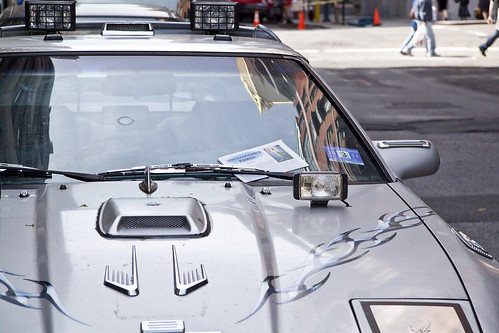
Found this auto on east 24th street, right after leaving a parade of (maybe) Sikhs on Madison Ave on Saturday the 24th. Categorically, this is the world’s coolest car, despite the jersey license plates. Seriously customized, it’s a Toyota of some kind under all the “bling”.
from wikipedia
Toyota has factories in most parts of the world, manufacturing or assembling vehicles for local markets. Toyota has manufacturing or assembly plants in Japan, Australia, India, Sri Lanka, Canada, Indonesia, Poland, South Africa, Turkey, Colombia, the United Kingdom, the United States, UAE, France, Brazil, Portugal, and more recently, Argentina, Czech Republic, Mexico, Malaysia, Thailand, Pakistan, Egypt, China, Vietnam, Venezuela, the Philippines, and Russia.

– photo by Mitch Waxman
The exhaust pipes that adorn it, beneath the doors, are actually a weird combination of duct tape and pipe. The whole vehicle had a sense of “hand” to it, and a certain charm. Your humble narrator, of course, was drawn to the flyer tucked under the drivers side windshield wiper. I just can’t resist a good flyer.
from nylp.com
New York City Administrative Code
Sanitation
§ 16–118
5. No person shall throw, cast or distribute, or cause or permit to be thrown, cast or distributed, any handbill, circular, card, booklet, placard or other advertising matter whatsoever, in or upon any street or public place, or in a front yard or courtyard, or on any stoop, or in the vestibule of any hall in any building, or in a letter box therein; provided that nothing herein contained shall be deemed to prohibit or otherwise regulate the delivery of any such matter by the United States postal service, or prohibit the distribution of sample copies of newspapers regularly sold by the copy or by annual subscription. This section is not intended to prevent the lawful distribution of anything other than commercial and business advertising matter.
6. No swill, brine, offensive animal matter, noxious liquid, or other filthy matter of any kind, shall be allowed by any person to fall upon or run into any street, or public place, or be taken to or put therein.

– photo by Mitch Waxman
Unchangeable Power, it says, and I like to believe that whoever was pamphleteering the neighborhood- locally dominated by a National Guard armory, made it a special point to drop their booklet on this car. They must be attracted to fog lights and soldiers.
from wikipedia
The 69th Regiment Armory located at 68 Lexington Avenue, New York, New York, is a historical building completed in 1906. It still houses the U.S. 69th Infantry Regiment.
The building, which runs from 25th to 26th Streets on the west side of Lexington Avenue, was declared a National Historic Landmark in 1965.
– photo by Mitch Waxman
The pamphlet, which is a screed published by Tony Alamo’s Christian Ministries- a Texas based church- is available online here. Pastor Alamo’s congregation is a familiar one to New Yorkers due to constant printed proselytizing, and the local meeting house is found at the Vincci Hoteles, 16 east 32nd street.
from hotelstravel.com
Vincci Avalon Hotel
Located off Madison Avenue, the Vincci Avalon Hotel incorporates European grandeur, boutique intimacy, and top of the line business amenities. The Avalon is situated three blocks from Penn Station and two blocks from the Empire State Building. Located in Midtown, the hotel is three blocks from Madison Square Garden, half a mile from Jacob Javits Center, three miles from the site of the World Trade Center, and eight miles from LaGuardia Airport.Rates include full buffet complimentary breakfast, morning newspapers, and complimentary access to Boom Fitness. The business center is also freeMore than half of the rooms are non-smoking, and the bathrooms are all marble with brass and chrome fixtures. All rooms have complimentary wifi high-speed Internet access and ihomes of ipods. The guestrooms feature desk chairs designed specifically for comfort and functionality, luxurious bath amenities, Egyptian Cotton linens, velour bathrobes, the Avalon signature body pillows, dual-line phones with voicemail, hairdryers and irons.

– photo by Mitch Waxman
Pastor Alamo is a controversial figure, for those of you not in the know. Check out this 2007 page at the Southern Poverty Law Center’s Hatewatch for more info on him and his group. Nevertheless, this was a very cool car.
from wikipedia
Tony Alamo (born Bernie LaZar Hoffman; September 20, 1934) is an American preacher, singer, entrepreneur, religious evangelist, and convicted child sex offender. He and his late wife Susan are best known as the founders of an organization currently known as Tony Alamo Christian Ministries. The organization is based in and around Fouke and Alma, Arkansas, United States. It has been referred to as a cult. On July 24, 2009 Alamo was convicted in the Federal District Court for the Western District of Arkansas, sitting in Texarkana, Arkansas, on 10 counts of Interstate Transportation of Minors for Illegal Sexual Purposes, Rape, Sexual Assault and Contributing to the Delinquency of Minors. On November 13, 2009, he was sentenced to the maximum punishment of 175 years in prison.
merry sounds

– photo by Mitch Waxman
Wandering through Manhattan on Saturday the 24th of April, your humble narrator suddenly found himself in a throng of colorfully dressed people. Willfully, I denied myself the opportunity to ask anyone what was going on, and instead preferred total ignorance of the significance of such a gathering.
Why?
Because sometimes it’s important to let New York show you what it wants you to see and not ask too many questions.

– photo by Mitch Waxman
Ethnographic assumptions suggested to me that this crowd most likely had its origins on the mysterious subcontinent of India, based on observable physical features and style of dress. Also, many people were eating what I recognized as Indian food. Further trespass into the unknown would assert that these folks are most likely Sikh’s. Such ideations of national specificity hatch from the particular head wrappings and sheer physical size of the men.

– photo by Mitch Waxman
Crowded, with what seemed to be thousands of children dashing about in panics of joy, there was a cacophony of conversation and color all around me. Spoken in some foreign tongue, foreign to me at least, their language carried a certain lilting and almost musical tone in utterance- which, I noted- were backed up by a seemingly simultaneous stream of information manifested by a secondary language of hand postures. I have noted that Indian people “speak with their hands” in the past, a cherished tradition of all New Yorkers here in the Shining City.

– photo by Mitch Waxman
On 25th street, this enigmatic fellow was intently focused on what seemed to be either religious devotions or preparation of a ceremonial space. The little palace had flowers pinned to it, and seemed to a be a focal point for many of the men to gather and greet each other. On the corner of Madison, the female percentage of the crowd fell off somewhat. That’s when I realized this was a parade of some kind.

– photo by Mitch Waxman
Scuttling to an out of the way spot, your humble narrator wondered if the variegated colors of the garb had any significance, and whether it denoted society or affiliation or caste. Musing about whether or not these might be gang colors in some far away place or time, a magnificent cast of characters then passed by- reminding me of a costumed group of super heroes.

– photo by Mitch Waxman
Sikh’s, if Sikh’s these folks be, are known to exhibit great physical size- which distinguishes them from their more economically built Asian neighbors. This isn’t scientific, just a personal observation- if I see an Indian Guy who’s over 6 foot and well over 200 pounds, I always think “Sikh”. Afghans also are quite stoutly built, but Sikh men are huge.

– photo by Mitch Waxman
Your humble narrator continued his long scuttle back to Queens, where- odds are- many of these people likely dwell. There are several Sikh temples near and in Astoria, and I’ve been trying to work up the courage to visit one. I’m intrigued, but I like churches best from the outside. Always… I must remain outside.

– photo by Mitch Waxman
If anyone can identify this event, or positively assess the identity of the crowd, please share.
St. Patrick’s Cathedral

– photo by Mitch Waxman
A trappist abbot named de LeStrange, hiding in New York from the oppressions of the Corsican antichrist- Bonaparte- in 1813, purchased this land on 5th avenue between 50th and 51st streets from the Jesuits for $10,000.
from saintpatrickscathedral.org
While her cornerstone was laid in 1858 and her doors swept open in 1879, it was over 150 years ago, when Archbishop John Hughes announced his inspired ambition to build the “new” Saint Patrick’s Cathedral.
In a ceremony at Old Saint Patrick’s Cathedral, Archbishop Hughes proposed “for the glory of Almighty God, for the honor of the Blessed and Immaculate Virgin, for the exaltation of Holy Mother Church, for the dignity of our ancient and glorious Catholic name, to erect a Cathedral in the City of New York that may be worthy of our increasing numbers, intelligence, and wealth as a religious community, and at all events, worthy as a public architectural monument, of the present and prospective crowns of this metropolis of the American continent.”
Ridiculed as “Hughes’ Folly,” as the proposed, near-wilderness site was considered too far outside the city, Archbishop Hughes, nonetheless, persisted in his daring vision of building the most beautiful, Gothic Cathedral in the New World in what he believed would one day be “the heart of the city.” Neither the bloodshed of the Civil War, nor the resultant lack of manpower or funds, would derail the ultimate fulfillment of Hughes’ dream and Architect, James Renwick’s bold plan.
Through the generosity of 103 citizens who pledged $1,000 each and the collective “pennies” of thousands of largely Irish, immigrant poor, Hughes’ vision became a shining reality.

– photo by Mitch Waxman
After the Trappists returned to France, following the downfall of Napoleon, the land lay feral and abandoned- and was set aside for future usage as a cemetery. The Archbishop of New York, an Irishman named John Joseph Hughes (who also created the Parochial School System, I would add) decided in 1853 to replace the “old” St. Patrick’s on Mulberry Street with something a little finer.
from wikipedia
He was consecrated bishop on January 7, 1838 with the titular see of Basileopolis. He succeeded to the bishopric of the diocese of New York on December 20, 1842 and became an archbishop on July 19, 1850, when the diocese was elevated to the status of archdiocese. He campaigned actively on behalf of Irish immigrants, and attempted to secure state support for religious schools. He protested against the United States Government for using the King James Bible in public schools, claiming that it was an attack on Catholic constitutional rights of double taxation, because Catholics would need to pay taxes for public school and also pay for the private school to send their children, to avoid the Protestant translation of the Bible. When he failed to secure state support, he founded an independent Catholic school system which was taken into the Catholic Church’s core at the Third Plenary Council of Baltimore, 1884, which mandated that all Parishes have a parochial school and that all Catholic children be sent to those schools.
He founded Manhattan College, St. John’s College (now Fordham University), the Academy of Mount St. Vincent {now (College of Mount Saint Vincent)and Marymount College. and began construction of St. Patrick’s Cathedral. He served until his death. He was originally buried in old St. Patrick’s Cathedral and was exhumed and reinterred in the crypt under the altar of the new cathedral.

– photo by Mitch Waxman
Prominent and favored by the powers that were, an engineer and architect named James Renwick Jr. designed the Cathedral. It is virtually impossible for the New Yorkers of this 21st century to understand the prestige of building a cathedral (primarily) for the Irish in the 19th century. A brogue was the price of admission to city government back then, and the stereotypical Irish cop, fireman, and politician were manifest archetypes.
from wikipedia
Renwick was born into a wealthy and well-educated family. His mother, Margaret Brevoort, was from a wealthy and socially prominent New York family. His father, James Renwick, was an engineer, architect, and professor of natural philosophy at Columbia College, now Columbia University. His two brothers were also engineers. Renwick is buried in Green-Wood Cemetery in Brooklyn, New York, with his wife and father.
Renwick was not formally trained as an architect. His ability and interest in building design were nurtured through his cultivated background, which granted him early exposure to travel, and through a broad cultural education that included architectural history. He learned the skills from his father. He studied engineering at Columbia, entering at age twelve and graduating in 1836. He received an M.A. three years later. On graduating, he took a position as structural engineer with the Erie Railroad and subsequently served as supervisor on the Croton Reservoir, acting as an assistant engineer on the Croton Aqueduct in New York

– photo by Mitch Waxman
Many additions have been made to Renwick’s original design, including a dwelling for the Archbishop and Rectory. Every generation has found some reason to alter and magnify the structure, which is the seat of the Archdiocese of New York. The Archdiocese of New York is a larger Catholic organization than exists in many countries.
from wikipedia
Work was begun in 1858 but was halted during the Civil War and resumed in 1865. The cathedral was completed in 1878 and dedicated on May 25, 1879, its huge proportions dominating the midtown of that time. The archbishop’s house and rectory were added from 1882 to 1884, and an adjacent school (no longer in existence) opened in 1882. The towers on the west façade were added in 1888, and an addition on the east, including a Lady chapel, designed by Charles T. Mathews, was begun in 1901. The stained-glass windows in the Lady Chapel were designed and made in Chipping Campden, England by Paul Vincent Woodroffe between 1912 and 1930. The cathedral was renovated between 1927 and 1931 when the great organ was installed and the sanctuary enlarged.

– photo by Mitch Waxman
The Roman Catholic Archdiocese of New York, Archidioecesis Neo-Eboracensis, covers some 480 parishes and ministers to the roughly 2.5 million believers in its territory. St. Patrick’s is the ceremonial center of the organization.
from wikipedia
The Roman Catholic Archdiocese of New York covers New York, Bronx, and Richmond counties in New York City (coterminous with the boroughs of Manhattan, The Bronx, and Staten Island, respectively), as well as Dutchess, Orange, Putnam, Rockland, Sullivan, Ulster, and Westchester counties in New York state. There are 480 parishes. The Archdiocese of New York is the metropolitan see of the ecclesiastical province of New York which includes the suffragan dioceses of Brooklyn, Albany, Buffalo, Syracuse, Rochester, Ogdensburg, and Rockville Centre.

– photo by Mitch Waxman
Major renovations to the structure, particularly the altars happened during the tenure of Cardinal Francis Spellman. Spellman was a firebrand priest and political operator cast in the Medici mold, with a long list of foes and allies, and an anti-communist. He also figures into the history of Calvary Cemetery, prominently.
from wikipedia
Vehemently anti-Communist, Spellman once said that “a true American can neither be a Communist nor a Communist condoner” and that “the first loyalty of every American is vigilantly to weed out and counteract Communism and convert American Communists to Americanism”. He was firm supporter of Joseph McCarthy. In 1949, when gravediggers at Calvary Cemetery in Queens went on strike for a pay raise, the Cardinal accused them of being Communists and recruited seminarians from St. Joseph’s Seminary as strikebreakers. He described the actions of the gravediggers, who belonged to the Food, Tobacco, Agricultural, and Allied Workers Union of America, as “an unjustified and immoral strike against the innocent dead and their bereaved families, against their religion and human decency”. The strike was supported by such figures as Dorothy Day and Ernest Hemingway, who wrote a scathing letter to Spellman. Spellman defended Senator Joseph McCarthy’s 1953 investigations of Communist subversives in the federal government, stating at an April 1954 breakfast attended by the Senator that McCarthy had “told us about the Communists and about Communist methods” and that he was “not only against communism—but … against the methods of the Communists”.

– photo by Mitch Waxman
It was actually the Old St. Patrick’s Cathedral people from the Five Points who founded Calvary Cemetery in Queens, but it’s the New Cathedral’s offices that have dominion over the marble heart of the Newtown Pentacle today.
The Trustees also displayed a keen foresight in acquiring property for cemetery use and also great diligence and prudence in caring for and managing the cemeteries. In 1829, a tract of land was purchased, on what is not 50th Street, for use as a cemetery.
The purchased gave rise to much criticism because the property was so far beyond the city limits. This property was later used as the site of St. Patrick’s Cathedral.
Property closer to the city limits was acquired in 1832. Located between 11th and 12th Streets, from Avenue A to 1st Avenue, this parcel of land known as the 11th Street Cemetery, was opened for interments in 1833 and was used for the burial of Catholics until the year 1848.
Before that date, the Trustees came to the conclusion that the rapidly growing Catholic population of New York made necessary the acquisition of more cemetery property. It was decided that a large parcel of land would be necessary to satisfy the cemeteryrequirements of a growing population and so in 1845, the Trustees purchased the ALSOP Farm, consisting of 115 acres in Newtown Township, Long Island.

– photo by Mitch Waxman
The center of Manhattan’s urban life lay far south of 50th street when the Cathedral was built. What Times and Herald Square are to modernity, Union Station was. The great press and tumult of tenement New York, where the “old” St. Patrick’s Cathedral still stands, did not appeal to the Irish who had “made it” into the bourgeois class via the seeming experiment in social Darwinism which was called the Five Points.
from wikipedia
The neighborhood took form by about 1820 next to the site of the former Collect Pond, which had been drained due to a severe pollution problem. The landfill job on the Collect was a poor one, and surface seepage to the southeast created swampy, insect-ridden conditions resulting in a precipitous drop in land value. Most middle and upper class inhabitants fled, leaving the neighborhood completely open to the influx of poor immigrants that started in the early 1820s and reached a torrent in the 1840s due to the Irish Potato Famine. It was situated close enough for a walking commute to the large mercantile employers of the day in and around the dockyards at the island’s southern tip, but it was far enough away from the built-up Wall Street area to allow a total remake of character.
At Five Points’ “height,” only certain areas of London’s East End vied with it in the western world for sheer population density, disease, infant and child mortality, unemployment, prostitution, violent crime, and other classic ills of the urban destitute. However, it was the original American melting pot, at first consisting primarily of newly emancipated African Americans (gradual emancipation led to the end of slavery in New York on July 4, 1827), and newly arrived Irish.
The rough and tumble local politics of “the ould Sixth ward” (The Points’ primary municipal voting district), while not free of corruption, set important precedents for the election of non-Anglo-Saxons to key offices. Although the tensions between the African Americans and the Irish were legendary, their cohabitation in Five Points was the first large-scale instance of volitional racial integration in American history. In the end, the Five Points African American community moved to Manhattan’s West Side and to the then-undeveloped north of the island.

– photo by Mitch Waxman
When first built, St. Patrick’s towered over the surrounding area’s building stock. The 20th century put an end to that, especially when the Rockefellers built their 22 acre “center” around it. Rockefeller center represents a composite eight million square feet of commercial real estate, spread out amongst 19 skyscrapers.
from wikipedia
Rockefeller Center is a complex of 19 commercial buildings covering 22 acres (89,000 m2) between 48th and 51st streets in New York City. Built by the Rockefeller family, it is located in the center of Midtown Manhattan, spanning the area between Fifth Avenue and Sixth Avenue. It was declared a National Historic Landmark in 1987.

– photo by Mitch Waxman
Eight Archbishops of the Roman Catholic church are entombed in St. Patrick’s, 6 of whom held the office of Cardinal. 4 other officers of the See are entombed here as well- including the Haitian “venerable” Pierre Toussaint who is on the road to being declared a Saint.
from wikipedia
Venerable Pierre Toussaint (1766 – June 30, 1853) was born in Haïti. He learned to read and write and he came to New York from Haiti in 1787. In New York, he became an apprentice to one of the city’s leading hairdressers.
Pierre Toussaint quickly became a popular abolitionist. He was freed from slavery when his owner died in 1807 and later became quite wealthy. He fell in love with another slave, Juliette Noel, and purchased her freedom when she was only fifteen years old. Noel married Toussaint and together they set out to help those in need in New York City. They opened their home as a shelter for orphans, a credit bureau, an employment agency and refuge for priests and poverty stricken travelers. Toussaint also funded money to build a new Roman Catholic church in New York, which became Old St. Patrick’s Cathedral on Mulberry Street.

– photo by Mitch Waxman
I was in the area, having met with a new advertising client- a rare thing in the last few years due to the “Great Recession”- and was thunderstruck by the quality of the light hitting St. Patrick’s. The mirror surfaces of the hideous internationalist style office buildings- expressions of anti republic quasi fascism to my opinion- act as enormous “gelled’ light sources illuminating the Neo-Gothic structure they surround.

– photo by Mitch Waxman
An observation and opinion:
I rail against “LeCorbusier” and the “International Style” a lot. My opinion is that of a consumer, not an architect or engineer. Life as a freelance commercial artist in New York City has taken me to a lot of places and office buildings over the years, and the worst ones are those where only the bosses get to look out a window every now and then. I’ve worked for ad agencies or corporate graphics operations in:
- World Trade Center (which swayed uncomfortably, was huge and drafty, and difficult to get lunch)
- Empire State (cramped and dark, with lousy bathrooms)
- Chrysler Building (same complaints as Empire)
- Worldwide Plaza (not too bad, although environmental ventilation sucks)
- Rockefeller Center itself (in one of the original 19 and one of the Internationals on sixth avenue… there’s an enormous underground complex down there, by the way- guys ride around in little carts with flashing lights- looks just like you’d think Area 51 would)
- Saatchi Building (aces! and I used to watch Fireboats training on the Hudson from my desk)
The best buildings to work in are generally below 23rd street, however, the ones whose former lighting system- gas pipes- are still visible. Today, many of those gas pipes carry high speed fiber optic cables. Windows are openable, you are close to the street, and lunch options are abundant. There’s a real mix of people on the sidewalks, and such intercourse between strangers is critical to democracy and identification of one’s self as being part of a community.


 The Newtown Pentacle