Archive for the ‘Maritime Sunday’ Category
average specimens

– photo by Mitch Waxman
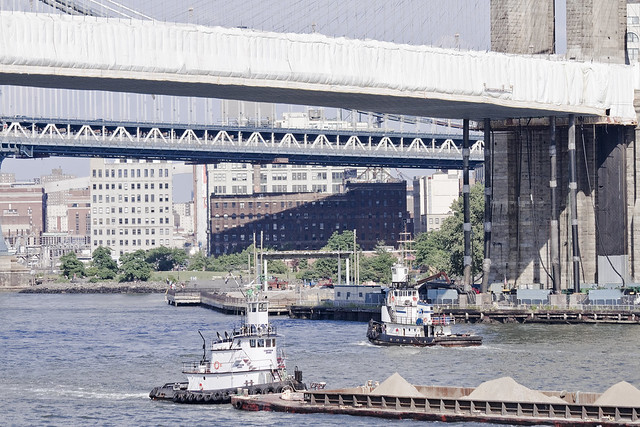
Captain Zeke is an 88 ton tug owned and operated by the White Near Coastal Towing Corp. of Syosset, and was built as the Lady Ora for Falgout Marine at Houma Shipbuilding in Louisiana back in 1980. Unfortunately, neither the company nor the tug have much information available about them, so there’s little more that can be said beyond its size- which is 30 m x 8 m, and its maximum recorded speed of 6.4 knots versus its average of 5.5 knots.
– photo by Mitch Waxman
Captain Zeke ran into a bit of trouble just a few years ago, on the Hudson River.
Spontaneous combustion involving paint rags in a fidley opening may have been the origin of the Aug. 31, 2008, fire aboard the Capt. Zeke, a Coast Guard investigator said. When their fire extinguishers proved inadequate, the tug crew fled to one of the barges.

– photo by Mitch Waxman
Speaking from a position of strictly deductive reasoning at this point, due to a lack of available information about this tug and its owners- Captain Zeke has been personally observed about the harbor moving small loads of a decidedly non volatile nature, as in the previous shot wherein the cargo seems to be sand.
It would be logical to assume that this role is well suited to the relatively small tug, which can most likely get into narrower spaces than the mated tug and barge gargantua which are employed by large players like Reinauer, Moran, or K-Sea (whose vessels specialize in the handling of volatiles) for the transport of various fuels and the handling of cargo vessels.
This theory is contradicted though, by this posting at the blog tuglife, which shows Captain Zeke tethered “on the hip” to a fuel barge.

– photo by Mitch Waxman
In the shots above and below, which were captured on the Kill Van Kull, Captain Zeke is tied to the sort of barge one regularly observes at Newtown Creek handling the SimsMetal trade in bulk metal. It is damnably odd, in the opinion of this humble narrator, that so little information is available online about this vessel. Normally, commercial maritime activity is copiously documented by a variety of private and government entities.
Regardless of this information vacuum, Newtown Pentacle’s “Maritime Sunday” nevertheless recognizes and sends a hearty greeting to Captain Zeke and its crew.
wild dances

– photo by Mitch Waxman
It’s Maritime Sunday again, here at your Newtown Pentacle, a weekly post which focuses in on and examines some aspect of NY Harbor- or the Sixth Borough as our friends from Tugster call it.
As many of you know, your humble narrator is quite the enthusiast for such matters, and serves as a Steering Committee member for the Working Harbor Committee. This role and set of interests often puts me in a position to witness and photograph interesting circumstance around the harbor, which these “Maritime Sunday” postings endeavor to share.
Today’s spotlight is cast upon the Moran Towing Tug “Kimberly Turecamo”.

– photo by Mitch Waxman
There are quite a few tugs with the surname Turecamo that are operated by Moran Towing, the result of a merger between two towing companies in the age of corporate expansion and conglomeration. The founder of Turecamo Coastal was born on an island in the Tyrrhenian Sea called Isola Lipari, part of the Aeolian Archipelago that straddles the distance between Mount Vesuvius and Mount Etna in fabled Italy. Lipari has a long and sordid history, a story which stretches back in time to the Estruscans, Greeks, and the Romans. The Island was once conquered by Arab Pirates, after all.
This of course, has nothing to do with the Tugboat Kimberly Turecamo, its just nice to know where certain folks hail from. The guy from Cake Boss on the TLC Channel, and Natalie Imbruglia- their dads come from Isola Lipari as well.
Turecamo Coastal and Harbor Towing Corporation was foundeded by Bartholdi Turecamo, who immigrated from Isola Lipari, a small island between the northern coast of Sicily and the southern tip of Italy. As an immigrant Turecamo found work in road construction around New York.

– photo by Mitch Waxman
Kimberly Turecamo, the tug, is from Louisiana. She also was one of the ships which assisted in the evacuation of lower Manhattan on September 11, 2001. One of the great stories from that day, it’s only the persistent modesty of those sailors who managed to move more than a quarter million people out of harms way that prevents this story from pervading the popular imagination.
Sailors are a different breed, and immodest only amongst themselves.
from morantug.com
It is reported that as many as 300,000 people were evacuated from lower Manhattan during an eight hour period following the attacks. When the evacuation first began, Moran had 11 tugs on the scene, each taking as many as 100 people to designated sites around the port, and to New Jersey. “After the initial surge of evacuation, we went down to about five boats on the scene, still working around the clock, and after four or five days we still had two boats working there at the end,” said Keyes. “As soon as the people were taken off, the boats were used for moving emergency crews, equipment and supplies.”
Moran tugs logged a total of 256 hours during the operation, according to Keyes. The tug Turecamo Boys was on the scene longest, with 84 hours logged, followed by Marie J. Turecamo with 51 hours and Margaret Moran with 49 hours. Other tugs involved with the evacuation were Nancy Moran, Brendan Turecamo, Kathleen Turecamo, Diana Moran, Kimberly Turecamo, Miriam Moran, Turecamo Girls and Catherine Turecamo.

– photo by Mitch Waxman
The iconic white “M” on their black stacks, coupled with the scarlet hull and white detailing, make Moran tugs the easiest craft to spot in NY Harbor. As mentioned in the past, there is just something iconic about them, and if you were to ask someone to describe a tugboat blindly- they would probably craft an image of something not unlike the Kimberly Turecamo.
Built in 1980, by McDermott Shipyard of Morgan City, Louisiana (hull #255) as the Rebecca P.
The tug was later acquired by Turecamo Maritime where she was renamed as the Kimberly Turecamo .
In 1998, Turecamo Maritime was acquired by the Moran Towing Corporation where the tug retained her name.

– photo by Mitch Waxman
Kimberly Turecamo is at work in the shot above, guiding a fuel tanker through the narrow Kill Van Kull waterway. The Kill Van Kull at it’s narrowest point, between New Jersey and Staten Island, is a scant thousand feet wide and might boast a depth of merely 40-45 feet above the soft bottom. The cargo ships which come here in pursuit of trade are ocean going vessels whose titan engines would provide a lack of subtlety in handing such conditions.
The Kill Van Kull is a tidal straight, incidentally.
from morantug.com
Moran commenced operations in 1860 when founder Michael Moran opened a towing brokerage, Moran Towing and Transportation Company, in New York Harbor. The company was transformed from a brokerage into an owner-operator of tugboats in 1863, when it purchased a one-half interest in the tugboat Ida Miller for $2,700.
At the time, the Harbor was alive with ships – many of them still sail-powered – and Moran’s enterprise soon grew into a fleet of tugboats. It was Michael Moran himself who painted the first white “M” on a Moran tugboat stack, reportedly around 1880.

– photo by Mitch Waxman
An interesting bit of trivia about the harbor of New York is that its natural depth is a mere 17 feet, but was deepened by the actions of dredging to 24 feet before the end of the 19th century. The large ships of modernity utilize shipping channels which are deeper than the surrounding area, in particular the Ambrose Channel- a 1914 construct.
Ambrose leads the way in from a spectacular natural formation, a depression on the continental shelf called the New York Bight.
The Bight is clove by the terrifying depths of the Hudson Canyon.
from wikipedia
The western edge of Newark Bay was originally shallow tidal wetlands covering approximately 12 square miles (31 km2). In 1910s the City of Newark began excavating an angled shipping channel in the northeastern quadrant of the wetland which formed the basis of Port Newark. Work on the channel and terminal facilities on its north side accelerated during World War I, when the federal government took control of Port Newark. During the war there were close to 25,000 troops stationed at the Newark Bay Shipyard.
dreamless sleep

– photo by Mitch Waxman
Another of the so called “Black Arts” of the 19th century, sugar refining was one of the great industries which distinguished New York City and its neighboring municipalities.
The sole survivor of this once omnipresent occupation is found in Yonkers. Raw sugar is barged to this facility for processing, which makes it a neat item to highlight for “Maritime Sunday” here at this, your Newtown Pentacle.
from wikipedia
Yonkers is the fourth most populous city in the state of New York (behind New York City, Buffalo and Rochester), and the most populous city in Westchester County, with a population of 195,976 (according to the 2010 Census). Yonkers borders the New York City borough of The Bronx and is 2 miles (3 km) north of Manhattan at the cities’ closest points.
– photo by Mitch Waxman
These shots were captured in the November, while onboard a Riverkeeper vessel which was performing a regular survey of the downstate waterways, and the good folks at that estimable organization were gracious enough to let a humble narrator ride along.
The Sugar Refinery in Yonkers is relict, a late 19th century mill which is still engaged in its trade.
from wikipedia
The raw sugar is stored in large warehouses and then transported into the sugar refinery by means of transport belts. In the traditional refining process, the raw sugar is first mixed with heavy syrup and centrifuged to wash away the outer coating of the raw sugar crystals, which is less pure than the crystal interior. Many sugar refineries today buy high pol sugar and can do without the affination process.

– photo by Mitch Waxman
American Sugar Refining operates this factory, engaging in what seems to be a quite hazardous industrial process.
It seems that sugar dust can be highly explosive, requiring equipment that is “spark proof” to safeguard against detonation.
Who knew?
from wikipedia
American Sugar Refining Company (ASR). The ASR was incorporated in the state of New Jersey on January 10, 1891, with $50 million in capital. By 1907, it owned or controlled 98% of the sugar processing capacity in the United States and was known as the Sugar Trust. The United States Supreme Court declared in United States v. E. C. Knight Company that its purchase of the stock of competitors was not a combination in restraint of trade. By 1901, the company had $90 million in capital. The company became known as Domino Sugar in 1900.

– photo by Mitch Waxman
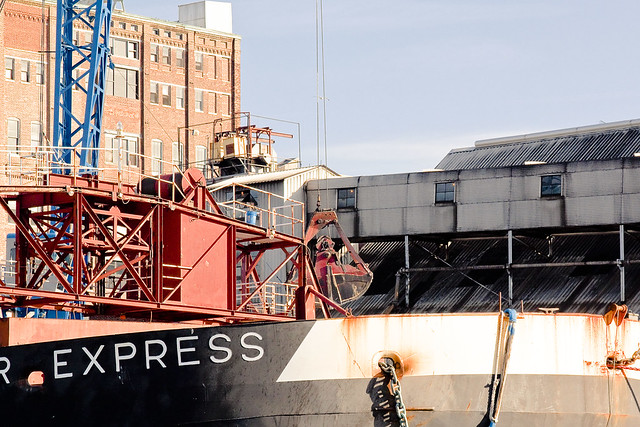
The tug Heron was present, tending to a barge labeled “Sugar Express”. Heron is middle aged, like myself, and has gone by several different aliases during its long career- unlike myself.
A surprising observation for me was that the raw product was being unloaded from the barge in the same manner that one would unload rock or gravel.
Built in 1968, by McDermott Shipyard of Morgan City, Louisiana (hull #151) as the tug Progreso .
In 1972, the tug was acquired by Dixie Carriers where she was renamed as the Dixie Progress .
In 2002, she was acquired by Allied Transportation of Norfolk, Virginia where she was renamed as the Heron.

– photo by Mitch Waxman
The industrial process of sugar refining uses powerful acids to purify and process the sweet stuff, and in 2005 the plant came under the scrutiny of regulators when it was revealed that they had released a large quantity of powerful acid into the water.
As with everything else in our world, it seems that nature must pay a price for our desires, even when it’s just a teaspoon of sugar to help the medicine go down.
from sawmillrivercoalition.org
In January 2005, American Sugar Refining Inc., a company that produces sugar for Domino Sugar and located on the Saw Mill River, pled guilty to a criminal pollution charge for spilling hydrochloric acid into the Hudson River in Yonkers in 2003.


 The Newtown Pentacle