Archive for the ‘Maspeth’ Category
Searching for Gilman

– photo by Mitch Waxman
For several months I have been searching Calvary Cemetery in a non systematic manner for 2 particular locations. Thwarted time and again by false leads and incorrect addressing, both sites have remained elusive. One grave is the final resting place of Tess Gardella– the actress who portrayed Aunt Jemima- and the other is that of an enigma from the early 20th century whose name was Gilman.
from wikipedia
Aunt Jemima is a trademark for pancake flour, syrup, and other breakfast foods currently owned by the Quaker Oats Company. The trademark dates to 1893, although Aunt Jemima pancake mix debuted in 1889. The Quaker Oats Company first registered the Aunt Jemima trademark in April, 1937.
The name “Jemima” is biblical in origin. Jemima is the King James Version’s rendering of the feminine Hebrew name יְמִימָה (Yəmīmā), the first of Job’s daughters born to him at the end of his namesake book of the Bible.
The term “Aunt Jemima” is sometimes used colloquially as a female version of the derogatory label “Uncle Tom”. In this context, the slang term “Aunt Jemima” falls within the “Mammy archetype”, and refers to a friendly black woman who is perceived as obsequiously servile or acting in, or protective of, the interests of whites. The 1950s television show Beulah came under fire for depicting a “mammy”-like black maid and cook who was somewhat reminiscent of Aunt Jemima. Today, the terms “Beulah” and “Aunt Jemima” are regarded as more or less interchangeable as terms of disparagement in popular discourse.

– photo by Mitch Waxman
Somewhere in the viridian depths of Calvary Cemetery lies an unremarked merchant from Massachusetts, who died in an accident along the delirious Newtown Creek in 1931. No obituary I can find discusses him, and Gilman slid unnoticed into the hallowed loam of Calvary’s charitable sections. His anonymity came to an end when, according to neighborhood sources and contemporary diarists, a relict 3 masted schooner arrived at the Penny Bridge docks and ordered an eccentric monument be erected on Gilman’s resting place. The captain of that black ship, a leathery bastard named Marsh, collected Gilman’s belongings and sailed via Newtown Creek to the East River, turning North toward Hell Gate- ultimately disappearing into the mists of Long Island Sound heading for New England.
from noaa.gov
Click here for : Hell Gate and Its Approaches
This nautical chart depicts Hell Gate, a narrow channel on the East River, at the confluence of the Harlem River, which connects Long Island Sound with New York Harbor. The chart shows Hell Gate in 1851, which is the year that the U.S. Army began blasting ledges and rocks within Hell Gate to ensure safe passage through the channel.

– photo by Mitch Waxman
Rumors that this man was the same Gilman mentioned by members of the Boston Police Department in 1920, in connection with investigations into a string of sensational murders and for connections to a certain group of anarchists thought to be operating within the city. The Back Bay area of Boston, of course, is associated with the illustrious architect Arthur Delevan Gilman– but there doesn’t seem to be any involvement with Calvary’s mysterious Gilman other than a tangential coincidence of names.
from wikipedia
The Back Bay neighborhood was created when a parcel of land was created by filling the tidewater flats of the Charles River. This massive project was begun in 1857. The fill to reclaim the bay from the water was obtained from Needham, Massachusetts. The firm of Goss and Munson, railroad contractors, built 6 miles (9.7 km) of railroad from Needham, and their 35-car trains made 16 trips a day to the Back Bay. The filling of present-day Back Bay was completed by 1882; filling reached the existing mainland at Kenmore Square in 1890, and finished in the Fens in 1900. The project was the largest of a number of land reclamation projects, beginning in 1820, which, over the course of time, more than doubled the size of the original Boston peninsula. It is frequently observed that this would have been impossible under modern environmental laws.
Back Bay’s development was planned by architect Arthur Gilman with Gridley James Fox Bryant. Strict regulations produced a uniform and well-integrated architecture, consisting mostly of dignified three- and four-story residential (or once-residential) brownstones.

– photo by Mitch Waxman
Both saint and sinner alike can be found in the emerald devastations of First Calvary- governors, mayors, and priests share in the loam with common laborer and notorious gangster. There are multitudes here, vast tomb legions awaiting only the advent of their messiah to rise and walk the earth. Gilman is amongst the many, lost in the crowd. I will find him, and the notable monument raised in his honor- it is just a matter of time.
from wikipedia
While the Christian doctrine of resurrection conforms to Jewish belief, there is, however, a minority point of view, held by certain Jewish mystics and others,[who?] which asserts that those Jewish beliefs are in contradiction with the resurrection as taught by Isaiah (Isaiah 8:16 and 26:19) and Daniel (12:1 and 13) in which the resurrection was understood as being a doctrine of physical ‘Rebirth’.
Jesus appears to have been in general agreement with the position held by the Pharisees, as illustrated by his response to a question regarding marriage at the resurrection (Matthew 22:23-32, Mark 12:18-27 and Luke 20:27-40).
Most Christian churches continue to uphold the belief that there will be a general resurrection of the dead at “the end of time”, as described Paul when he said, “…he hath appointed a day, in the which he will judge the world…” (Acts 17:31 KJV) and “…there shall be a resurrection of the dead, both of the just and unjust.” (Acts 24:15 KJV).
Many of the early Church Fathers cited the Old Testament examples listed in the Judaism section above as either foreshadowing Jesus’s resurrection, or foreshadowing or prophesying a future resurrection of all the dead.

– photo by Mitch Waxman
Gilman, I have no first name or exact date of interment- which intensifies the difficulty in locating him- was supposedly a dealer in far eastern art. What his purpose was in coming to the Newtown Pentacle remains shadowed. Veiled references to the illegal importation of statuettes from the south Pacific, and distribution of these items to radical theosophists and heretic Masons in the Greenpoint and Maspeth neighborhoods can be gleaned from antiquarian sources but nothing definite enough for the consideration of the Lords and Ladies of Newtown has emerged. The statuettes it is said, are the product of the lost Saudeleur culture from Nan Madol found on fabled Pohnpei, and an item of particular interest to certain occultists.
from wikipedia
Nan Madol was the ceremonial and political seat of the Saudeleur dynasty, which united Pohnpei’s estimated 25,000 people. Set apart on the main island of Pohnpei, it was a scene of human activity as early as the first or second century AD. By the 8th or 9th century islet construction had started, but the distinctive megalithic architecture was probably not begun until perhaps the 12th or early 13th century.
Little can be verified about the megalithic construction. Pohnpeian tradition claims that the builders of the Lelu complex on Kosrae (likewise composed of huge stone buildings) migrated to Pohnpei, where they used their skills and experience to build the even more impressive Nan Madol complex. However, this is unlikely because radiocarbon dates have placed the construction of Nan Madol prior to that of Lelu. Like Lelu, one major purpose of constructing a separate city was to insulate the nobility from the common people.
A local story holds that when Nan Madol was being built a powerful magician living in the well inhabited region on the northwest of the island was solicited, and that his help was a major factor in completing the buildings. In particular, he was responsible for supplying the huge stone “logs” used in much of Nan Madol by “flying” them from their source to the construction site.
…Supposedly there was an escape tunnel beginning at the center of Nan Madol and boring down through the reef to exit into the ocean. Scuba divers continue to look for this “secret” route, but so far a complete tunnel has yet to be discovered.

– photo by Mitch Waxman
Gilman is meant to have been killed in a curious accident on the Queens bank of Newtown Creek in Blissville, when a bail of paper fell from a second story warehouse window along the negligent shoreline of the Newtown Creek. Crushed, the peculiar condition of his body was remarked on by several hardened Detectives used to such sights. Speculations that he had been previously deformed by Polio or some other childhood disease were made, but before our era of “antigenic vaccination as public policy” was enacted, monstrous alterations of the human form by disease organisms were a common sight. Disfigurements caused by Smallpox and Leprosy or the ravages of Tertiary Syphilis are seldom observed by we happy few that enjoy the luxury of western modernity.
from wikipedia
Tertiary syphilis usually occurs 1–10 years after the initial infection, however in some cases it can take up to 50 years. This stage is characterized by the formation of gummas, which are soft, tumor-like balls of inflammation known as granulomas. The granulomas are chronic and represent an inability of the immune system to completely clear the organism. They may appear almost anywhere in the body including in the skeleton. The gummas produce a chronic inflammatory state in the body with mass effects upon the local anatomy. Other characteristics of untreated tertiary syphilis include neuropathic joint disease, which is a degeneration of joint surfaces resulting from loss of sensation and fine position sense (proprioception). The more severe manifestations include neurosyphilis and cardiovascular syphilis. In a study of untreated syphilis, 10% of patients developed cardiovascular syphilis, 16% had gumma formation and 7% had neurosyphilis.
Neurological complications at this stage can be diverse. In some patients manifestations include generalized paresis of the insane, which results in personality changes, changes in emotional affect, hyperactive reflexes and Argyll-Robertson pupil. This is a diagnostic sign in which the small and irregular pupils constrict in response to focusing the eyes, but not to light. Tabes dorsalis, also known as locomotor ataxia, a disorder of the spinal cord, often results in a characteristic shuffling gait.

– photo by Mitch Waxman
Somewhere, amongst those who eternal lie, is Gilman. The disturbing detail that troubled the Detectives who investigated the reports of his death, the one that made for saloon conversation and idle speculation by neighborhood wags, was the fact that this deceased dealer in illicit eastern art had six fingers on both hands and that these polydactyl appendages were webbed all the way to the nail beds. Not much could be said about Gilman’s face, for the rodent population of Newtown Creek had discovered him long before the Police did.
Additionally, his shorter than normal legs also bore long healed scars that suggested some intense surgical experience- participation in the Civil War was speculated on by area Police, when Gilman would have been a young man. Amongst his few possessions was a watercolor postcard of some southern Plantation labeled as “Carfax Plantation, James River, Virginia”, which was quite out of place in the pockets of a Massachusetts trader who died alone during the middle of the night along Newtown Creek. Further speculations held out the possibility that Gilman hailed from a degenerate or illegitimate offshoot of the famed Gilman family of Exeter, New Hampshire.
Where and who is he? Where is Gilman?
from wikipedia
Winthrop Sargent Gilman (1808-1884) was head of the banking house of Gilman, Son & Co. in New York City. He was born in Marietta, Ohio to merchant Benjamin Ives Gilman and Hannah (Robbins) Gilman. Benjamin Ives Gilman, born in 1766, was a native of Exeter, New Hampshire, where his ancestors were among the most prominent early settlers and where he graduated in the first class of the Phillips Exeter Academy.
In 1837 Winthrop Sargent Gilman let the abolitionist Elijah Parish Lovejoy hide his printing press in one of Gilman’s warehouses in Alton, Illinois. In the ensuing riot the angry mob burned Gilman’s warehouse to the ground and killed Lovejoy. Following the Alton riots, Gilman moved to New York City and entered the family banking business.
He was married to Abia Swift Lippincott Gilman, who in 1900 narrowly escaped burning to death from a gasoline torch in front of the Charles Scribner mansion at 12 East Thirty-eighth Street.
Winthrop Gilman had an abiding interest in science and built a private observatory at his home ‘Fern Lodge’ at the Palisades, New York, where he frequently observed meteors.
Update on the Calvary Knots

– photo by Mitch Waxman
The first thing I would say is that the name on the card does not match those on the monument. The second would be to ask you to read through this posting- Tales of Calvary 4- Triskadekaphobic Paranoia from November of 2009 which describes this odd arrangement in some detail. In the comments thread at that post, please take note of a former Calvary employee’s possible explanation of what is going on here. Third, here’s the latest addition to the knots, a mass card which has appeared just at the outset of spring.

– photo by Mitch Waxman
Despite the intervening brutalities of a New York winter, the knotted cords and stick persisted in their intended places, as evinced above. Realize, of course, that the equinoxes mark special dates on the magickal calendar and cultic activity is ripe at the quarters of the solar and lunar cycle- both Passover and Easter fall near the equinox, for example. At these times of year, if you seek- ye shall find.

– photo by Mitch Waxman
I’m not certain, however, what significance a mass card carries. Not being an adherent of the Roman Catholic religion, I’ve nevertheless purchased them when friends and associates have suffered a loss, and offered them up to grieving families. My assumption has always been that they represent some sort special devotion or ceremony which will be performed by the priestly caste, but I remain ignorant of their purpose. As mentioned above, however, the names on the monument do not match the one on the mass card.
I’m keeping an eye on this “tree fed by a morbid nutrition” here at the ossified heart of the Newtown Pentacle in Calvary Cemetery.
And don’t miss tomorrow’s post, which discusses additional weirdness found at St. Michael’s Cemetery just this past weekend.
Shoosh… Be Very Quiet… I’m hunting rabbits…

– photo by Mitch Waxman
Hunting for the elusive gravesite of a man called Gilman, one frigid afternoon spent within the 365 acres of First Calvary Cemetery proved the existence here of a race of burrowing things- mud caked groundlings with glowing red eyes.
Somewhere, nearby I would suspect, is a subterranean warren kept warm by the swarming masses of their hairless and blind progeny. Squirming, these sweaty holes dug into the frozen graveyard force the adults to brave the bright dangers of the surface world to forage.
from wikipedia:
The lagomorphs are the members of the taxonomic order Lagomorpha, of which there are two families, the Leporidae (hares and rabbits), and the Ochotonidae (pikas). The name of the order is derived from the Greek lagos (λαγος, “hare”) and morphē (μορφή, “form”).
Though these mammals can resemble rodents (order Rodentia), and were classified as a superfamily in that order until the early twentieth century, they have since been considered a separate order. For a time it was common to consider the lagomorphs only distant relatives of the rodents, to whom they merely bore a superficial resemblance.
The earliest fossil lagomorphs, such as Eurymylus, come from eastern Asia, and date to the late Paleocene or early Eocene. The leporids first appear in the late Eocene, and rapidly spread throughout the northern hemisphere; they show a trend towards increasingly long hind limbs as the modern leaping gait developed. The pikas appear somewhat later, in the Oligocene of eastern Asia.

– photo by Mitch Waxman
Prey by nature, the foragers are fast and smart and alert. The gods of the sky, the claws of the stealth demons, the brutal agonies of the dog- all are found on the surface. Designed to eat the ruggose fibers of grass and seed, quickly and as much as possible in one go, they are swift and nervous. Fed on the morbid nutrition offered up by the loam of Calvary Cemetery, the glowing red eyes of these burrowers scan constantly for danger.
from wikipedia:
The rabbit lives in many areas around the world. Rabbits live in groups, and the best known species, the European rabbit lives in underground burrows, or rabbit holes. A group of burrows is called a warren. Meadows, woods, forests, thickets, and grasslands are areas in which rabbits live. They also inhabit deserts and wetlands. More than half the world’s rabbit population resides in North America. They also live in Europe, India, Sumatra, Japan, and parts of Africa. The European rabbit has been introduced to many places around the world.

– photo by Mitch Waxman
Merely a part of some vast ecosystem occluded by the marble and sorrow, these burrowers are prized game for the higher mammals and avian predators which frequent the bulkheaded shorelines of the Newtown Creek. It is difficult, with modern eyes, to imagine the world of the unspoiled Creek.
Once, this was part of a rich swampy marshland, and abundant game and wildlife drew sportsmen from the great cities of Brooklyn and Manhattan for hunting and fishing to the rural extants of the Newtown Creek. Nearby, aboriginal tribes of Lenape (the Maspeatche) made their camps near Mt. Zion cemetery and when the europeans came- great hunting lodges and hotels were erected along its banks to service the tourist trade from the two island cities. That was before the industries, before the Rural Cemeteries Act, and before the 800 pound gorilla came to town.
from wikipedia:
Jugged Hare (known as civet de lièvre in France), is a whole hare, cut into pieces, marinated and cooked with red wine and juniper berries in a tall jug that stands in a pan of water. It traditionally is served with the hare’s blood (or the blood is added right at the very end of the cooking process) and Port wine.
Jugged Hare is described in the influential 18th century cookbook, The Art of Cookery by Hannah Glasse, with a recipe titled, “A Jugged Hare,” that begins, “Cut it into little pieces, lard them here and there….” The recipe goes on to describe cooking the pieces of hare in water in a jug that it set within a bath of boiling water to cook for three hours. Beginning in the nineteenth century, Glasse has been widely credited with having started the recipe with the words “First, catch your hare,” as in this citation. This attribution is apocryphal.

– photo by Mitch Waxman
Your humble narrator appreciates the irony that New York City’s nature preserves are entirely accidental. The nearby Ridgewood Reservoir, an eidelon of municipal malfeasance and neglect, has transformed into a significant bird sanctuary and houses a teeming ecosystem ranging from rodent to raptor. The cemeteries of Queens similarly house a niche ecology, providing a refuge for ghoulish reprobates and rabbit alike. Some effort has been made at finding a scientific sampling of biota at these locations, but if it exists, my meager skills at the art of detection have been unable to uncover such data.
for a third person perspective on how my encounter with this manifest avatar of the Lepus specie went, please click here- its pretty much the way that the whole thing “went down”.
Tales of Calvary 10- The Hatch

– photo by Mitch Waxman
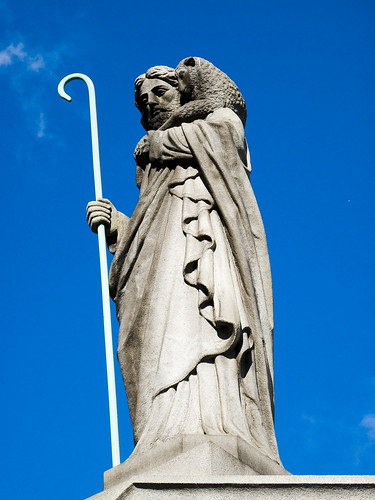
Your humble narrator, amongst other failings, has a certain preference for the grandiose statuary of the late 19th and early 20th century at First Calvary Cemetery here in Queens. Baroque expressions such as these appeal to the comic book fan in me, looking for all the world like a Jack Kirby or Jim Steranko rendering. One half expects a concrete angel to… well, I stray…
– photo by Mitch Waxman
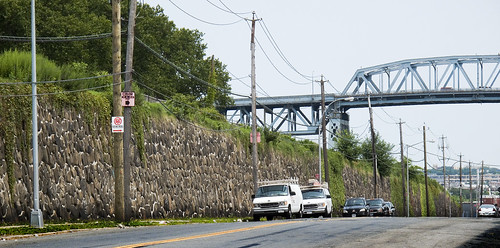
The southern section of First Calvary, found atop the cyclopean masonry observed on Review Avenue, offers glimpses of the Newtown Creek and panoramic views of industrial Brooklyn. Framing the open horizon of marshy western Queens and the forges of Brooklyn is the Kosciuszko Bridge, heroically carrying a vehicular river called the Brooklyn Queens Expressway over the infamous cataract. The elevation of these walls is actually quite high, an arcing and non euclidean structure which must be 2 to 3 stories at its apogee.
Am I overestimating? Check out this shot from the “street level” declination, aimed at the downward slope from halfway down Review Ave.–
And the shots below are from the other side of it, the topside of the wall.

– photo by Mitch Waxman
You won’t find the grandiose tombs or obsequious monuments to the famous on this side of First Calvary. This is where the “regular people” are buried- in their multitudes- in neatly defined rows of plots. The northwestern sections of Calvary, where the main gates are, and the northeastern- along Laurel Hill Blvd.- (both “High Ground”) are where you can find the princes of the 19th century city. Here, along Review Avenue, is where the middle and working class rest.

– photo by Mitch Waxman
My reasons for coming to this section must remain hidden, for now, suffice to say that I am still hunting for the grave of a man named Gilman (see “Tales of Calvary 7” for more speculation on this mysterious merchant from Massachusetts). Enjoying the relative quiet, I noticed one of the concrete pillboxes which I’ve also alluded to in earlier posts. These structures are all over Calvary, are often padlocked, and have aroused no small amount of curiosity in your humble narrator.

– photo by Mitch Waxman
Several conjectures -an access point to buried family mausoleums, a storage unit for groundskeepers, some sort of equipment shed- have assailed me as I observed these structures with their heavy iron lids and stout cement construction. An avid devotee of the macabre, I’ve often wondered aloud about just what is is that may be down there.

– photo by Mitch Waxman
This particular structure, as you can see, had been left unlocked. In fact, its heavy lid was just resting on the cement and its hinges had long ago stopped functioning.

– photo by Mitch Waxman
Nudging the lid back a few inches, a better than six foot drop was observed, which put its bottom some 4 feet below the surface as observed in the shot above. I activated the camera flash and illuminated quite a bit of airborne dust when the camera performed its intended action. As you can see, there were two modern shopping carts and part of a lamp down there. Puzzling- not for being trash, but… for… why, how, when, etc. You’d expect shovels or spades, but shopping carts and a lamp?

– photo by Mitch Waxman
Were I still the youthful and robust physical specimen I once was, I might have more to say about this, as I would have entered the yawning mystery for a closer look. However, as an aged physical coward and feckless quisling given to emotional stupor and irrational panic, the miasmal odor of the open hatch drove me backwards and I nearly passed into one of my episodes. Fighting off a faint, I labored to close the heavy lid and made for the Penny Bridge gates found on Laurel Hill Blvd. to escape the implications of that smell, which reminded me of an aquarium in need of filtration.
What can it be, that might be down there?
Tales of Calvary 9- A Pale Enthusiast

– photo by Mitch Waxman
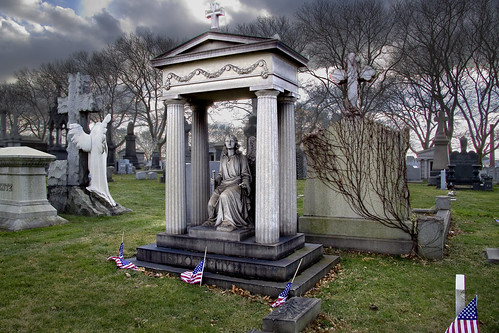
Amateurish and lazy explorations of Calvary Cemetery and the Greater Newtown Pentacle, with associated blog postings foisted upon an unsuspecting public and amplified by a never ending barrage of self promoting debasements of all that is true, have revealed many strange things to your humble narrator, and by extension- to you my gentle lords and ladies of Newtown. Today, the Doherty monument in First Calvary gets its turn. There is nothing “odd” about the monument, in fact the reason I call attention to the thing is the supernal beauty of its working. This is one uncanny bit of carving, and unfortunately these photos do not do it justice (still adjusting to the new camera).
Art school faculty, turtlenecked and smoking french cigarettes, would probably describe it as “Sophia, goddess of wisdom- in the form of a christian angel, sitting within a Roman structure, crowned by a cross- representing an agglutination of civilized democratic-christian progress advancing since the time of the Greeks and the Roman Republic and ultimately manifested as The United States. The angel casts her eye skyward, vigilant, with a sword in her hand. A pacific and expectant expression suggests the nearness of the second coming and resurrection of the dead.”
Such imperious and hyperbolic thinking was very much in vogue in the years between 1900 and the first World War.

– photo by Mitch Waxman
Eugene Doherty and his wife Mary J. Doherty are buried here. Their headstones have bas reliefs of palm fronds draped across them. The little flags are planted at the graves of military veterans in New York Cemeteries on national holidays to honor their service. I found no evidence of Doherty serving in the military, but that probably just means I didn’t know where to look.
After all- I’m just some ‘effed up lunatic who spends his spare time scuttling around trash dumps, toxic waste sites, and cemeteries who gets his kicks bad mouthing the past- Right?
– photo by Mitch Waxman
Mr. Doherty, it seems, was a man of some reknown. He was a leading member of the Irish community on both sides of the Newtown Creek, and stood shoulder to shoulder in prestige alongside Battle-Ax Gleason in the eyes of his countrymen.
A manufacturer of rubber, Doherty specialized in the sort of material demanded by “turn of the 20th century” Dentists for the manufacture of dentures. His heavily advertised (see sample at bottom) Samson Rubber was a standard component for the manufacture of false teeth. The factory, incorporated as Eugene Doherty Rubber Works, Inc., was located at 110 and 112 Kent Avenue which is in Greenpoint (or Williamsburg, depending on whether or not you’re trying to hard sell a building).
rubber, from wikipedia
The major commercial source of natural rubber latex is the Para rubber tree (Hevea brasiliensis), a member of the spurge family, Euphorbiaceae. This is largely because it responds to wounding by producing more latex.
Other plants containing latex include Gutta-Percha (Palaquium gutta),[1] rubber fig (Ficus elastica), Panama rubber tree (Castilla elastica), spurges (Euphorbia spp.), lettuce, common dandelion (Taraxacum officinale), Russian dandelion (Taraxacum kok-saghyz), Scorzonera (tau-saghyz), and Guayule (Parthenium argentatum). Although these have not been major sources of rubber, Germany attempted to use some of these during World War II when it was cut off from rubber supplies. These attempts were later supplanted by the development of synthetic rubbers. To distinguish the tree-obtained version of natural rubber from the synthetic version, the term gum rubber is sometimes used.
A neat image of the the Doherty Rubber Works building late in its heyday (1920) can be found at trainweb.org, if you can believe anything I say, and they have a great description of the whole scene in context here. I warn you though, you’re going to learn about the Brooklyn Eastern District Terminal!
Also, in a completely unrelated coincidence, NAG is located at 110 Kent in modernity. Here’s the place on a google map, click “streetview” to compare to the 1920 shot above

– photo by Mitch Waxman
Eugene Doherty died in 1906, his wife Mary in 1914. Luckily for Mary, the denture business was a lucrative one, and her years of mourning were spent in material comfort. At her death, she bequeathed the staggering sum of $621,148 to her heirs.
$621,148 in 1914, mind you, and federal income tax had just become a reality in 1913. That’s at least $10,000,000 in modern coine.

– photo by Mitch Waxman
Life sized, if you’re a 5 foot tall woman, the statue itself is disarming and has weathered existence in the corrosive atmospheric miasmas extant about the nearby Newtown Creek for 94 years, only losing a thumb. The colour, oddly, doesn’t stain sanctified Calvary. Xanthian skill representative of true artistry went into the shaping of this stone, but I haven’t been able to find the name of the sculptor in public record.
If you see it, stand close and look into its eyes, then leave when the chills begin. Whatever you do, don’t look back over your shoulder at it afterwards, lest an adjusted hand hold on the sword, or the impression that the angle of its head has shifted might be seen. Remain an observer- in Calvary- ever the pale enthusiast- ever an Outsider.
Hey, you never know what you’re going to find at Calvary Cemetery.
Also, just as a note- today, January 13th, is Clark Ashton Smith’s birthday, and St. Knut’s Day as well.
Eugene Doherty Rubber Inc. - Late 19th/Early 20th century Advertising


 The Newtown Pentacle