Archive for the ‘DUGSBO’ Category
obscure and cryptical

– photo by Mitch Waxman
Another “Now and then” posting for you today, Lords and Ladies of Newtown, and today it’s arguably my favorite of all the bridges of Newtown Creek- the atavist Grand Street Bridge spanning the currently undefended border of Brooklyn and Queens. The shot above is from the water, as recreating the 1910 era shot below (from the bulkheads of the eastern brooklyn side) would require probable trespass- which in our modern day age of the Terror War might subject one to legal penalties such as exsanguination or some time spent in “the boot“.
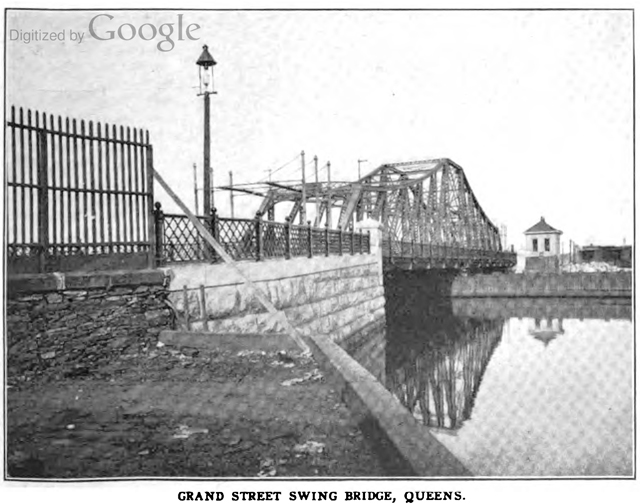
– photo from Engineering magazine, Volume 38, 1910- courtesy google books
While it does seem true that the Grand Street Bridge has changed little in the intervening century, the primary difference between then and now is that it doesn’t function as a swing bridge very often these days. The stalwart engineers and mechanics of the DOT do open it for maintenance periodically, but the City has petitioned the Coast Guard to abandon such actions due to lack of industrial need and expense of operation.
For a prior posting which will tell you literally EVERYTHING about the Grand Street Bridge and environs- an area I call DUGSBO- Down Under the Grand Street Bridge Onramp- click here
Also:

– photo by Mitch Waxman
An NCA event, which I for one am pretty stoked about:
April NCA meeting hosts Dr. Eric Sanderson
Thursday, April 26, 2012 at 6pm
Ridgewood Democratic Club, 6070 Putnam Avenue, Ridgewood, NY 11385
In addition to important updates from our members – in particular the Bioremedition Workgroup has been very busy! – we will be hosting a special presentation on the “Historical Ecology of Newtown Creek”.
Dr. Eric Sanderson, senior conservation ecologist at the Wildlife Conservation Society and author of “Mannahatta: A Natural History of New York City” (Abrams, 2009), will describe recent studies of the historical ecology of Newtown Creek, describing the original wetlands, creek channels, topography and vegetation of the area. He will show a series of 18th and 19th century maps of the watershed of the creek and discuss the process of synthesizing them into an integrated ecological picture that can be used to inform and inspire natural restoration and cultural appreciation of the Newtown Creek watershed. This work is part of the Welikia Project (welikia.org), an investigation into the historical ecology of the five boroughs of New York City and surrounding waters. The Welikia Project on Newtown Creek is funded by The NYCEF Newtown Creek Fund of the Hudson River Foundation.
And this Saturday,

Obscura Day 2012, Thirteen Steps around Dutch Kills
Saturday April 28th, 10 a.m.
Your humble narrator will be narrating humbly at this year’s Obscura Day event on April 28th, leading a walking tour of Dutch Kills. There are a few tickets left, so grab them while you can.
“Found less than one mile from the East River, Dutch Kills is home to four movable (and one fixed span) bridges, including one of only two retractible bridges remaining in New York City. Dutch Kills is considered to be the central artery of industrial Long Island City and is ringed with enormous factory buildings, titan rail yards — it’s where the industrial revolution actually happened. Bring your camera, as the tour will be revealing an incredible landscape along this section of the troubled Newtown Creek Watershed.”
For tickets and full details, click here :
obscuraday.com/events/thirteen-steps-dutch-kills-newtown-creek-exploration
curious heaps

– photo by Mitch Waxman
Like Thoreau, your humble narrator occasionally needs to escape it all and commune with the beasts of the field on their own terms. Journey toward nature and become as one with it, all that. Accordingly, a recent perambulation was embarked upon whose destination would reward me with the presence of creatures for whom freedom is no abstract notion, rather it is their daily experience.
from wikipedia
Walden (first published as Walden; or, Life in the Woods) is an American book written by noted Transcendentalist Henry David Thoreau. The work is part personal declaration of independence, social experiment, voyage of spiritual discovery, satire, and manual for self reliance.
Published in 1854, it details Thoreau’s experiences over the course of two years in a cabin he built near Walden Pond, amidst woodland owned by his friend and mentor Ralph Waldo Emerson, near Concord, Massachusetts.
By immersing himself in nature, Thoreau hoped to gain a more objective understanding of society through personal introspection. Simple living and self-sufficiency were Thoreau’s other goals, and the whole project was inspired by transcendentalist philosophy, a central theme of the American Romantic Period. As Thoreau made clear in his book, his cabin was not in wilderness but at the edge of town, about two miles (3 km) from his family home.

– photo by Mitch Waxman
Unfortunately, despite the unseasonably warm temperatures of recent weeks, it is still winter- limiting my options for observing natures bounties. There will always be birds exploiting safe harborage, it was reasoned, so my steps headed for the shoreline.
There I found my reward as small flocks of birds were exploiting the mud flats typical of estuarine coastlines.
from Walden (1854) by Henry David Thoreau, courtesy en.wikisource.org
What is a country without rabbits and partridges? They are among the most simple and indigenous animal products; ancient and venerable families known to antiquity as to modern times; of the very hue and substance of Nature, nearest allied to leaves and to the ground — and to one another; it is either winged or it is legged. It is hardly as if you had seen a wild creature when a rabbit or a partridge bursts away, only a natural one, as much to be expected as rustling leaves. The partridge and the rabbit are still sure to thrive, like true natives of the soil, whatever revolutions occur. If the forest is cut off, the sprouts and bushes which spring up afford them concealment, and they become more numerous than ever. That must be a poor country indeed that does not support a hare.

– photo by Mitch Waxman
Unlike Thoreau, I have no virginal woodlands with an untouched body of water to retreat to, rather my lot is to yearn for the accursed East Branch of the hated Newtown Creek. Saying that, however, there is a mythology about this body of water which I have become keen to dispel.
This ain’t a dead place, it’s actually teeming with life. Unfortunately, it’s not the cuddly or cute kind of life- instead there are mainly worms, bugs, and other creepy crawlies for whom these anaerobic mudflats are a nutrient rich paradise. The hypoxic state of the water actually reduces the number of potential predators they might encounter.
It’s precisely this sort of critter, who live in the sediment mounds of the Newtown Creek, that the lovely birds in the shots above are feeding on.
from wikipedia
Hypoxia, or oxygen depletion, is a phenomenon that occurs in aquatic environments as dissolved oxygen (DO; molecular oxygen dissolved in the water) becomes reduced in concentration to a point where it becomes detrimental to aquatic organisms living in the system. Dissolved oxygen is typically expressed as a percentage of the oxygen that would dissolve in the water at the prevailing temperature and salinity (both of which affect the solubility of oxygen in water; see oxygen saturation and underwater). An aquatic system lacking dissolved oxygen (0% saturation) is termed anaerobic, reducing, or anoxic; a system with low concentration—in the range between 1 and 30% saturation—is called hypoxic or dysoxic. Most fish cannot live below 30% saturation. A “healthy” aquatic environment should seldom experience less than 80%. The exaerobic zone is found at the boundary of anoxic and hypoxic zones.

– photo by Mitch Waxman
Across the City, State, and even the Nation- engineers are working feverishly on grand designs and byzantine plans whose purpose it is to “fix” Newtown Creek. Many are experts on the place, and can quote a staggering amount of raw data about it from memory, but so few of them have ever actually been here.
It’s as if one can say they understand a neighborhood because they’ve memorized its map and boundaries.
When confronted with the fact that birds, including exotic specimens like egrets, cormorants, and herons are nesting along its banks- to appropriate a term from the British- “they are gob smacked”.
from wikipedia
Tidal flats, along with intertidal salt marshes and mangrove forests, are important ecosystems. They usually support a large population of wildlife, although levels of biodiversity are not particularly high. They are often of vital importance to migratory birds, as well as certain species of crabs, mollusks and fish. In the United Kingdom mudflats have been classified as a Biodiversity Action Plan priority habitat.
The maintenance of mudflats is important in preventing coastal erosion. However, mudflats worldwide are under threat from predicted sea level rises, land claims for development, dredging due to shipping purposes, and chemical pollution.

– photo by Mitch Waxman
Don’t misunderstand, this is an extremely troubled waterway, and the biomass which it should be supporting is exponentially higher than what you’ll find living here today. The early Creek, the one that the Dutch encountered, was known for an abundant biosphere. All of the highest forms of the mammalian, ichthian, and avian species were here in great numbers- everything from pike to bass to shrimp swam in it, deer and bears and wolves were roaming the hills adjoining the salt marshes and coastal wetlands and hawks, owls, and eagles were described as soaring overhead.
Such fauna obviously won’t be coming back, but there are still fish swimming around here. Not big fish, but fish nevertheless. They eat the creepy crawly things too.
from wikipedia
A tidal creek, tidal channel, or estuary is the portion of a stream that is affected by ebb and flow of ocean tides, in the case that the subject stream discharges to an ocean, sea or strait. Thus this portion of the stream has variable salinity and electrical conductivity over the tidal cycle. Due to the temporal variability of water quality parameters within the tidally influenced zone, there are unique biota associated with tidal creeks, which biota are often specialised to such zones.
Creeks may often dry to a muddy channel with little or no flow at low tide, but often with significant depth of water at high tide.

– photo by Mitch Waxman
What chance can such an environment stand with an open sewer the size of an 18 wheeler truck, though?
See, my version of Walden Pond is rent asunder by CSO Outfall NC-083, which discharges an average of 586 million gallons of filth into the East Branch of Newtown Creek per year.
from habitatmap.org
Combined Sewer Outfall NC-083 discharges approximately 586 million gallons of untreated wastewater year into Newtown Creek. This accounts for 2.2% of New York City’s total sewer overflow into the estuary.
This CSO is ranked at #15 out of the 434 permitted outfalls in the city, by volume. It is located alongside a second, smaller, CSO outfall, NC-019.
thickening twilight

– photo by Mitch Waxman
Sickened by weariness and a youth misspent, your humble narrator nevertheless has been tormenting himself lately with regret and guilty nonsense. “Not working hard enough” is omnipresent in my mind these days, and accordingly, the length and depth of my wanderings through the Creeklands have expanded. A lack of physical exercise is deadly to a poor specimen like myself, something which is difficult during the winter months due to that certain allergy to cold which has manifested – and which has become amplified- in recent years.
It’s amazing the ways that your body changes as you grow older, sometimes it seems as if there’s some feeble alien creature within that is pushing and tearing a path to the outside world through your very flesh.
from hplovecraft.com
Y’ha-nthlei was not destroyed when the upper-earth men shot death into the sea. It was hurt, but not destroyed. The Deep Ones could never be destroyed, even though the palaeogean magic of the forgotten Old Ones might sometimes check them. For the present they would rest; but some day, if they remembered, they would rise again for the tribute Great Cthulhu craved. It would be a city greater than Innsmouth next time.

– photo by Mitch Waxman
Carrying forth, however, is something compelled rather than desired. My team of doctors has advised me of decaying homeostasis, entropic processes, and general decline. Their suggestions are to step up, exert more effort, and seek even greater frequency for these long walks while avoiding the pleasures and poisons of the west. Luckily, the ancient pathways and avenues which surround and inform that nearby slick of languid infamy known as the Newtown Creek supply ample locations to inspect, never failing to intimate some hidden meaning or vaguely shadowed terror.
Who can guess, all there is, that might be buried down there?
from hplovecraft.com
“The nethermost caverns,” wrote the mad Arab, “are not for the fathoming of eyes that see; for their marvels are strange and terrific. Cursed the ground where dead thoughts live new and oddly bodied, and evil the mind that is held by no head. Wisely did Ibn Schacabao say, that happy is the tomb where no wizard hath lain, and happy the town at night whose wizards are all ashes. For it is of old rumour that the soul of the devil-bought hastes not from his charnel clay, but fats and instructs the very worm that gnaws; till out of corruption horrid life springs, and the dull scavengers of earth wax crafty to vex it and swell monstrous to plague it. Great holes secretly are digged where earth’s pores ought to suffice, and things have learnt to walk that ought to crawl.
– photo by Mitch Waxman
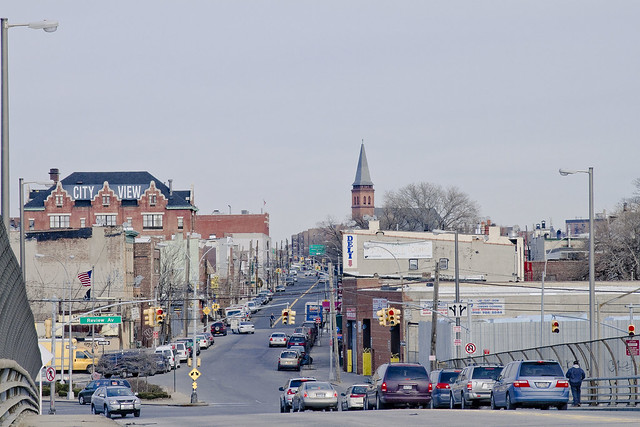
Paranoid wonderings, lunatic ideations, unnameable desires- all haunt me during the seemingly aimless steps. Delusions of self importance, hubris, and vast ennui are my only companions on these often cobbled streets. A discarded landscape with a lost history, this is a place given to the dead, the diseased, the barren… a perfect home for one such as myself. There seems to be a current in the air, a taste of anxiety on the tip of my tongue which is all pervasive, and it feels as if something is about to happen.
Ahh… I’m all effed up.
from hplovecraft.com
I do not recall distinctly when it began, but it was months ago. The general tension was horrible. To a season of political and social upheaval was added a strange and brooding apprehension of hideous physical danger; a danger widespread and all-embracing, such a danger as may be imagined only in the most terrible phantasms of the night. I recall that the people went about with pale and worried faces, and whispered warnings and prophecies which no one dared consciously repeat or acknowledge to himself that he had heard. A sense of monstrous guilt was upon the land, and out of the abysses between the stars swept chill currents that made men shiver in dark and lonely places. There was a daemoniac alteration in the sequence of the seasons—the autumn heat lingered fearsomely, and everyone felt that the world and perhaps the universe had passed from the control of known gods or forces to that of gods or forces which were unknown.


 The Newtown Pentacle