Archive for the ‘newtown creek’ Category
some passages
Kosciuszko Bridge project, Brooklyn side, Q2 2016, in today’s post.
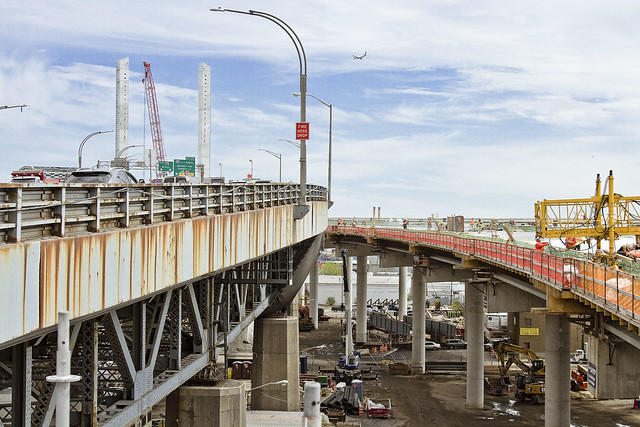
– photo by Mitch Waxman
The invitation went out to all the concerned parties – inclusively referred to as the Stakeholders Advisory Group – from the NYS DOT that an opportunity to observe the progress of the Kosciuszko Bridge replacement project was once again at hand.
Accordingly, a humble narrator collected together the camera and lenses, and set off for Greenpoint’s DUKBO – Down Under the Kosciuszko Bridge Onramp.
Several progress reports have been offered on the NYS DOT’s Kosciuszko Bridge replacement project. I seem to be the only person In New York paying any attention to the project, and there’s been a series of prior posts on the bridge presented at this – your Newtown Pentacle – chronicling the project.
To start – this 2012 post tells you everything you could want to know about Robert Moses, Fiorella LaGuardia, and the origins of the 1939 model Kosciuszko Bridge. Just before construction started, I swept through both the Brooklyn and Queens sides of Newtown Creek in the area I call “DUKBO” – Down Under the Kosciuszko Bridge Onramp. Here’s a 2014 post, and another, showing what things used to look like on the Brooklyn side, and one dating back to 2010, and from 2012 discussing the Queens side – this. Construction started, and this 2014 post offers a look at things. There’s shots from the water of Newtown Creek, in this June 2015 post, and in this September 2015 post, which shows the bridge support towers rising. Additionally, this post from March of 2016 detailed the action on the Queens side.
– photo by Mitch Waxman
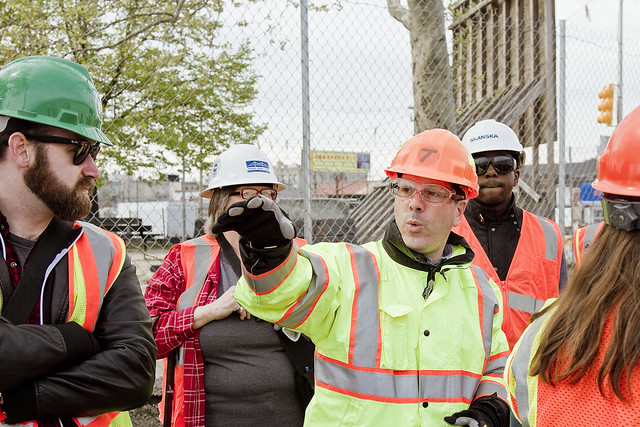
Leading the tour was NYS DOT’s project leader, engineer Robert Adams, who is the fellow pictured above in the stylish (and highly visible) yellow jacket.
Mr. Adams allows me to call him Bob, for which I’m grateful. One such as myself dislikes the usage of extraneous syllables in the spoken form. For the purposes of today’s post, however, I’ll refer to him as Mr. Adams – as the job his team is overseeing has done such an impressive job of staying on or ahead of schedule, he deserves the honorific.
– photo by Mitch Waxman
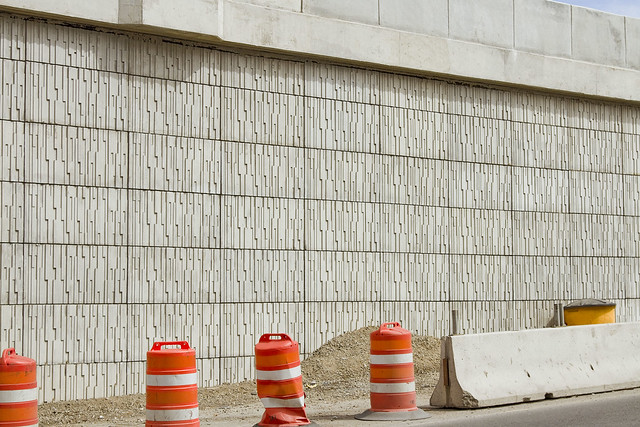
Part of the job, as it were, includes the rerouting of the Brooklyn Queens Expressway section which travels north/south along Meeker Avenue. The new roadway is supported by masonry and steel, and its outer facing is covered in sculptural tiles (which I think are concrete). I asked Mr. Adams if the sculptural motif on the tiles had a particular purpose – diffusing sound, or guiding rain runoff, for instance – but he said that it was purely esthetic, and part of the architectural design.
– photo by Mitch Waxman
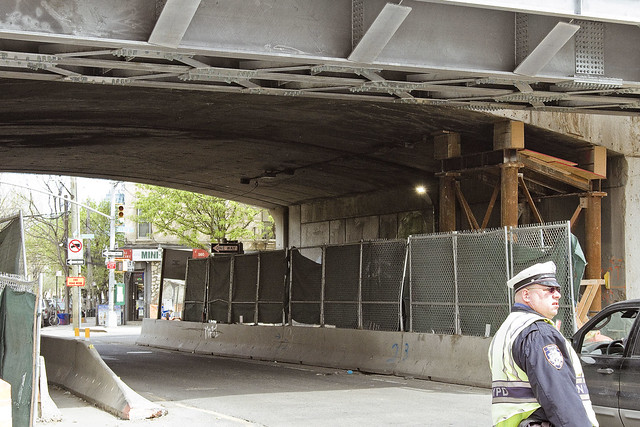
The old overpass abutments on Meeker Avenue are in the process of being dismantled. It’s a fairly chaotic scene down around here – this is the intersection of Vandervoort and Meeker if you’re curious.
Mr. Adams told us that one of the ways in which his team alleviated the impact of construction on traffic flow to the highway above was to build the new abutments “behind” the old ones. When the project is done, this will allow the DOT to add wider pedestrian sidewalks, and to also create an increased amount of space for the required turning radius of trucks as they move under the overpass.

– photo by Mitch Waxman
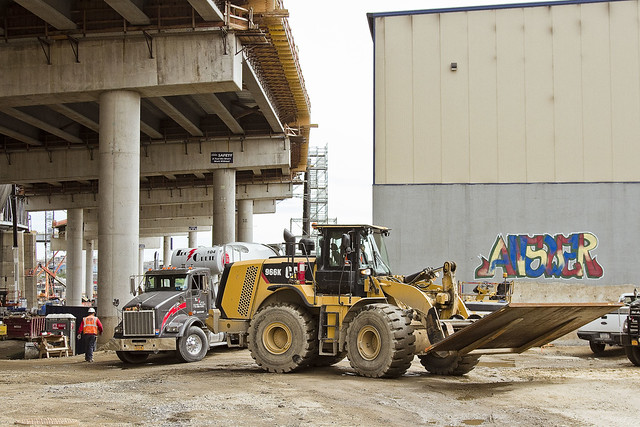
On the actual job site, in a spot which I refer to as “used to be Cherry Street,” is pictured above. Old school Cherry street is found beneath the masonry structure occupying the left side of the shot above, I would mention, and the unpaved access road at bottom right represents the right of way for “New Cherry Street.”
– photo by Mitch Waxman
Getting down to the action, and there’s a lot of it going on down here in DUKBO. This spot is one of the areas where some of that worksite safety training I’ve mentioned before comes into play. The contractors on the job – Skanska, Kiewit, and ECO3 – all subscribe to “safety culture” which is designed to keep laborers from suffering needless injuries. We – as in the civilian visitors Mr. Adams was escorting around the site – were all dressed up in orange vests, safety glasses, hard hats, and work gloves.
– photo by Mitch Waxman
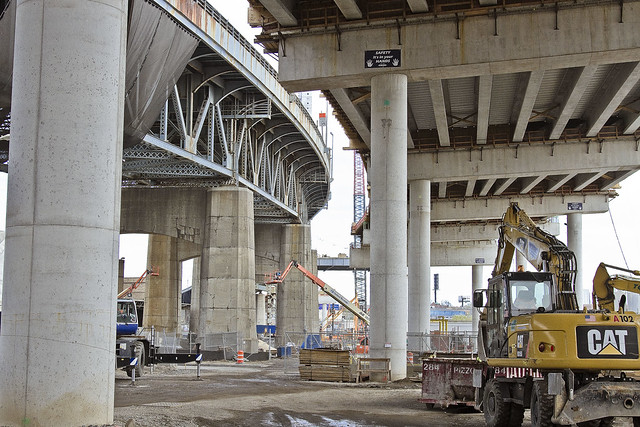
The roadway leading to the new bridge is on the right, with the 1939 vintage Kosciuszko Bridge on the left. We were told that the area down here will actually be available for use as a public space in the post construction era. At a luncheon meeting after the tour, Mr. Adams was petitioning the group for ideas as to what the community might want to happen down here. There will be space available on the Queens side as well.
Speaking of Queens, we were also told that in the early summer, a similar walk-through of the Queens side will be happening. Can’t wait for that one, mainly so I don’t have to walk all the way to Greenpoint from Astoria.
– photo by Mitch Waxman
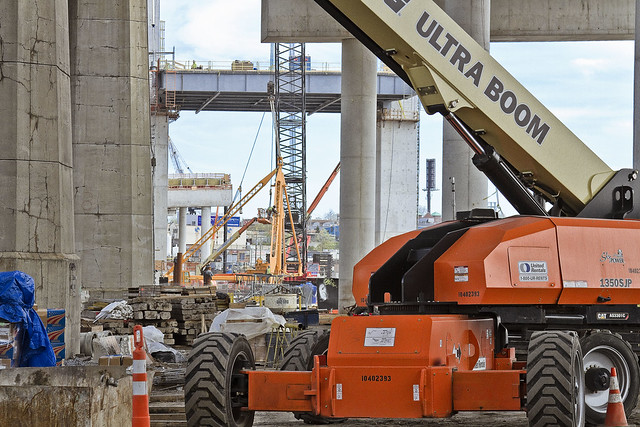
Having crossed Gardiner Avenue, heading south towards the languid waters of Newtown Creek, it was pretty exciting to notice that steel has begun to be affixed to the concrete tower columns of the new bridge – a major milestone. The new Kosciuszko Bridge is going to be of the cable stay variety, and the first of its type in NYC.
– photo by Mitch Waxman
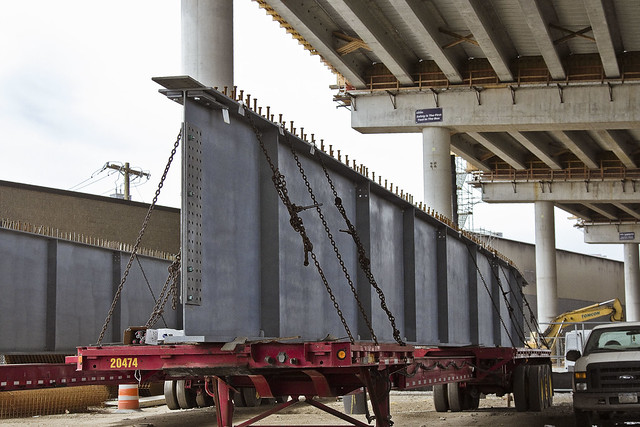
Speaking of steel, there were gigantic chunks of the stuff ready for deployment. These pieces are actually the outward facing sides of the highway. Mr. Adams made it a point of informing us that this was an entirely American produced bridge, with steel coming in from Pennsylvania and concrete sourced from a Queens company that’s called Tek Crete.
– photo by Mitch Waxman
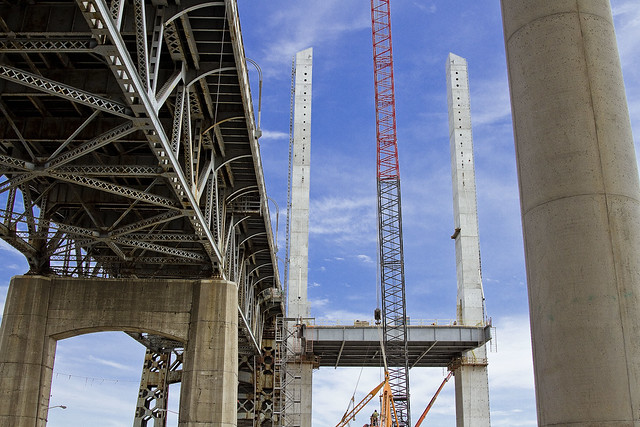
A bit closer to the columns, and rapidly emerging roadway, which will become the easterly half of the new bridge.
The plan from the beginning has been to produce the new span in three distinct stages. First – build the lanes of the eastern side. Second – demolish the 1939 bridge. Third – build the westerly side which will sit in the footprint of the 1939 model. Chatter on the tour indicated that the demolition part of the project will begin in 2017, and that the engineers are still debating as to how best remove the concrete piers which support the steel truss.
The truss itself is actually the easiest part of the job to figure, and the center section is going to be removed in one piece. It will be lowered, by cranes, onto barges which will be towed by tugboats out of Newtown Creek.
– photo by Mitch Waxman
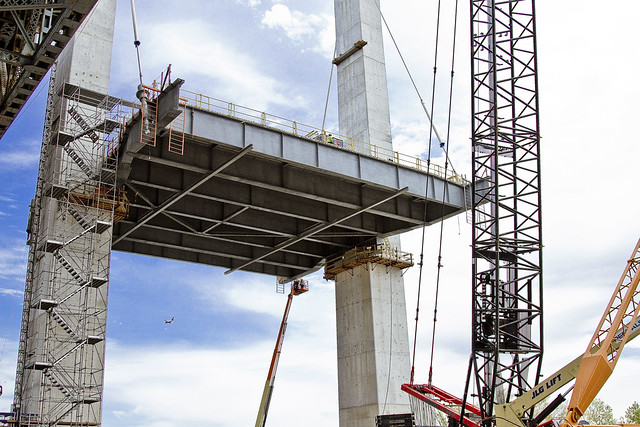
As you can see in the shot above, the first set of cable stays has already been affixed to the new road section. For a sense of scale on how absolutely colossal this project is, take notice the itty bitty construction workers who are on the lift between the two towers.
– photo by Mitch Waxman
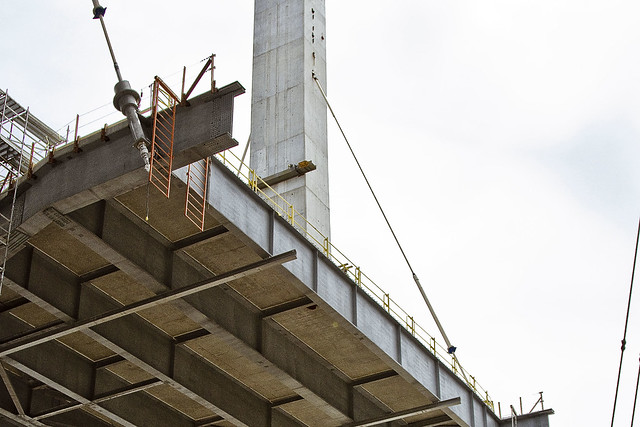
A bit of a better angle showing the cable stays and their anchors on the roadway section. This will be be built out both south – towards Greenpoint and Meeker Avenue – and north, over the water and into Queens.
– photo by Mitch Waxman
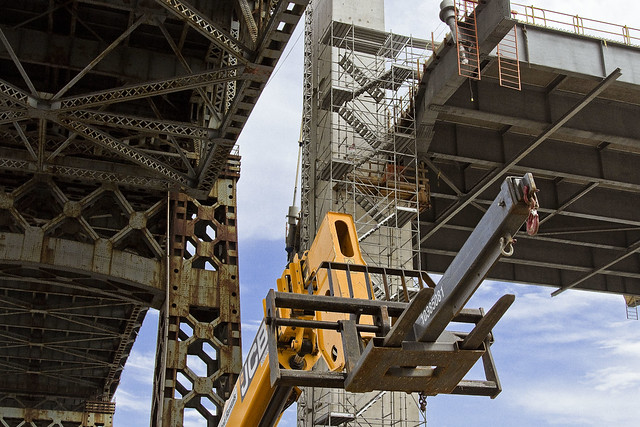
Mr. Adams and his team indicated that we were going to be heading back towards Greenpoint, and climbing a temporary stairway up to the still under construction roadway which will be the north bound lanes of the Brooklyn Queens Expressway. Couldn’t resist one last shot from ground level showing the two structures.
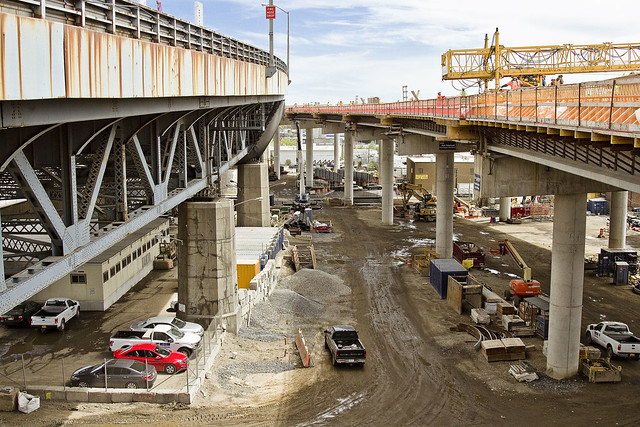
– photo by Mitch Waxman
From the temporary stairway, which was around 4-5 stories worth of climbing, and looking north towards Queens.
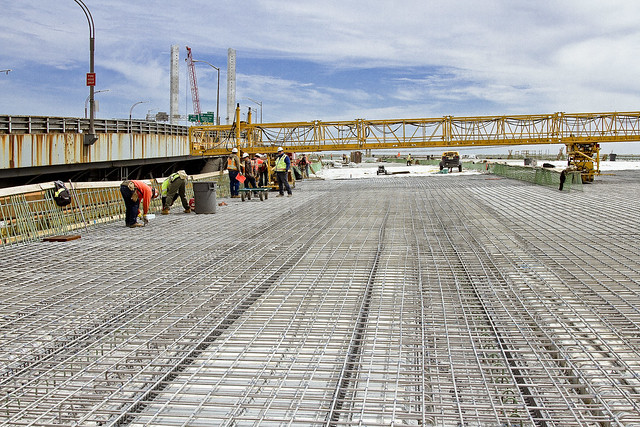
– photo by Mitch Waxman
The roadway itself is still under construction. The views from up here were fairly epic, but I’ll share those in a future post. Suffice to say that were I to attempt the same shots post construction, I’d be thoroughly squished by traffic moving at highway speeds.
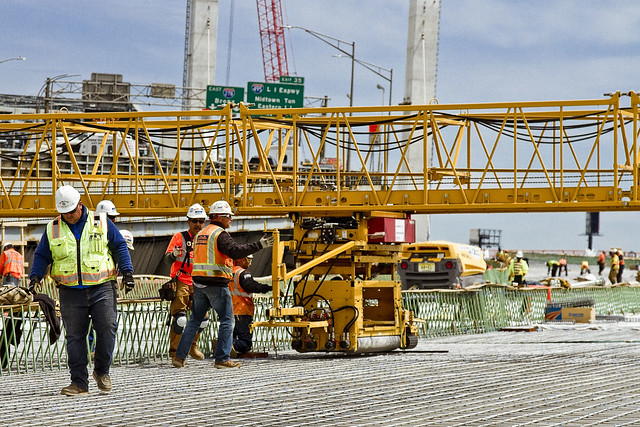
– photo by Mitch Waxman
Not sure which Union these fellows were members of, but they were too busy for me to ask. The Union guys were tying off the structural rebar, in preperation of pouring the concrete which would become the underpinning of the BQE’s roadway.
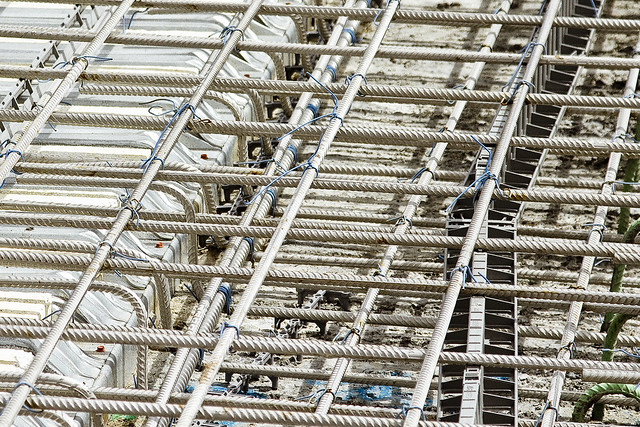
– photo by Mitch Waxman
The rebar that these Union guys are installing is actually stainless steel rather than galvanized iron. The extra expense for the stainless is justified in the name of avoiding corrosion, due to the massive amount of salt which is typically applied to the BQE during the winter months.
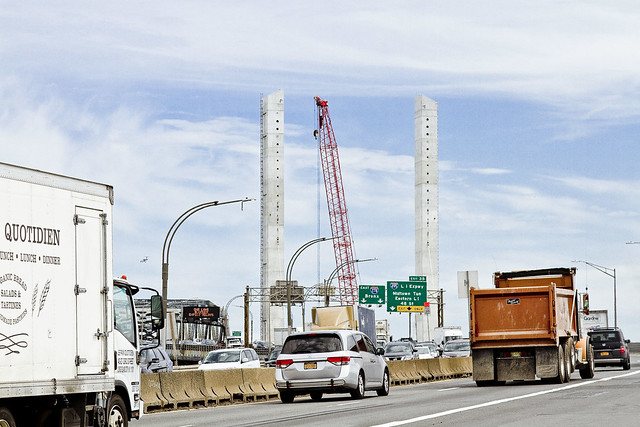
– photo by Mitch Waxman
One last shot looking north along the 1939 version of the Kosciuszko Bridge. What’s truly interesting to me about this project which Robert Adams is supervising is the fact that at no point can traffic along this Robert Moses built highway be impeded or stopped. It’s analogized best as doing a full rebuild of your car’s transmission, while driving at 90 mph in heavy traffic.
Progress on the Kosciuszko Bridge replacement will continue to be documented, at this, your Newtown Pentacle.
Upcoming Events and Tours
Sunday, May 8th at 11 a.m. – North Henry Street Project,
with Municipal Arts Society Janeswalk and Newtown Creek Alliance,
in Greenpoint, Brooklyn. Click here for more details.
“follow” me on Twitter- @newtownpentacle
poised on
Happy Earth Day, from the Poison Cauldron in DUKBO.

– photo by Mitch Waxman
Last week, a humble narrator found himself in Greenpoint over in Brooklyn. One was scuttling along a proscribed route whose intention and path was built around a walking tour conducted for a private group. Given the enormous construction project underway in the area, the NYS DOT’s construction of a replacement for the 1939 vintage Kosciuszko Bridge which carries the Brooklyn Queens Expressway over Newtown Creek, there is little certainty that just because you can move from “point A to point B” via one street or another on one day you can do it on another due to street closures and ongoing construction. From a vehicular POV, it’s actually a bit of a challenge to negotiate the streets hereabouts – there’s detours and so on – but from a pedestrian’s perspective, it’s a real bugbear as you find yourself dodging heavy trucks and moving through an enormous cloud of airborne dust and particulates in this area which are less than desirable to breathe in.
This is the area I describe as “The Poison Cauldron of the Newtown Creek” after all.

– photo by Mitch Waxman
I just got invited to attend a tour of the actual construction site with the DOT show runners next week, so for today I’ll abstain from making a full progress report as by next week I’ll have heard it directly “from the horse’s mouth” and I’ll have shots from within the fence lines to show you.
Saying that, observationally, the project continues to move along at a fast rate, and the roadways of the new bridge are stretching towards the turgid waters of the Newtown Creek.

– photo by Mitch Waxman
For the curious, one would like to reiterate that whereas this area is a photographic wonderland, I cannot describe how dangerous it is and that it’s really best for you to avoid the area for a number of environmental and safety reasons. A humble narrator has received multiple hours of “safety training” from various industrial giants along the Creek (requirements for stepping on several sites around the waterway include a mandatory “union” safety course) and I’m versed in the mores and methods of how to move about safely when the sort of equipment you see above is passing by.
There’s a reason I call it “the Poison Cauldron.” This area in Brooklyn’s DUKBO hosts a startling number of waste transfer stations, and all of that airborne particulate mentioned above is literally just hanging in the air.
“follow” me on Twitter- @newtownpentacle
Walking Tour – Saturday, April 23rd, 2016 –
First Calvary Cemetery Walk.
Join Newtown Creek Alliance historian Mitch Waxman at First Calvary Cemetery, found in LIC’s Blissville neighborhood along Newtown Creek. Attendance limited to 15 people.
Click here for more info and ticketing.
threadbare accoutrement
Yet another bit of meeting reportage, in today’s post.

– photo by Mitch Waxman
A humble narrator seems to be on a lot of “steering committees” these days. I’ve long been associated with Newtown Creek Alliance, although we don’t have a steering committee, and contrary to what many believe – I’m not a board member. I’m the official photographer for, and steering committee member of the Working Harbor Committee. Recently, I joined the steering committee of Access Queens. I’m also a steering committee member of the Newtown Creek CAG (Community Advisory Group) for the Federal Superfund situation on Newtown Creek.
The CAG has a series of steering committee only meetings that occur somewhat frequently, where we review and comment on various bits of policy and announcements from the EPA and the Potentially Responsible Parties who are tasked with the scientific analysis and eventual cleanup of Newtown Creek. There’s business people, community activists, policy makers, and representatives from Riverkeeper on the Steering Committee. There’s also a gaggle of Newtown Creek Alliance people on there as well, but given our overwhelming familiarity with the situation that’s sort of a natural fit. A “general” CAG meeting occurs less frequently, but that’s going to change as we get closer to the next phase of the Superfund process, which will discuss the solution to 150 years of environmental degradation based on a nearly decade long scientific survey. General meetings are open to the public if you’re curious, click the link above to find out when the next one is scheduled. If you want to join the CAG, we have a technical advisor who can guide you through the process (which is mainly writing down your name and email in a legible manner).
A recent Community Advisory Group meeting, which was open to the full membership of the CAG (not just the steering committee) occurred at LaGuardia Community College last month on the 22nd of March.

– photo by Mitch Waxman
Greenpoint’s Mike Schade, who has been operating as the Co Chair of the CAG, stepped down and we voted my colleague from NCA – Will Elkins – to pick up the mantle as co chair and run with it. The other CAG co chair is Ryan Kuonen, who is chair of Greenpoint’s community board’s environmental committee.
The NYC DEP, which is one of the “potentially responsible parties” along with ExxonMobil, National Grid, Phelps Dodge, and a couple of smaller corporate players like BP and Amoco, offered a presentation to the assembly explaining the concept of “ebulition” to us. Ebulition is essentially the release of droplets or blobs of contaminants from the sediment bed up to the surface of the water, and it’s commonly observed in Newtown Creek. They showed some video of coal tar bubbling up in front of the National Grid bulkheads, which was meant to be an “a ha” moment. To the initiated, however, it’s no secret that there’s 30-40 feet of coal tar and petroleum derivates in the sediments. That’s what brought EPA to Newtown Creek in the first place. Problem is that the ugly leave behinds of industry are intermingled with human waste, which is what the DEP supplies.
Long have I used the term “Black Mayonnaise.”
Prepared by their environmental contractor, Louis Berger, the logic DEP offers in their ebultion argument is that since they aren’t responsible for the presence of petroleum or coal tar in the Creek, and that since the chemical footprint of what comes out of their “combined sewer outfalls” or “CSO’s” isn’t specifically named in the Federal CERCLA – or Superfund – legislation – the community shouldn’t be overly concerned by the raw sewage they pump into the waterway every time it rains. The presentation was offered by Dr. Eileen Mahoney, who is DEP’s Superfund manager, and Dr. Ed Garvey of Louis Berger.
Dr. Mahoney and I, it should be mentioned, aren’t exactly in love with each other and she spent most of her time menacingly glaring at me while speaking, waiting for me to speak up and challenge her assertions. She didn’t realize that my colleague Laura Hoffman was in the room, and the “Mother of Greenpoint” didn’t take kindly to DEP saying that the release of raw sewage into Newtown Creek isn’t a problem.

– photo by Mitch Waxman
The Newtown Creek community advisory group is actually one of the best organizations to pay attention to at the moment, superfund wise. Everybody in the room is under some sort of Federal level jurisdiction, PRP wise, and therefore the fibbing is generally kept to a minimum. Even the DEP won’t out and out lie to the Feds, as there would be hell to pay. Another thing I’ve been saying for years about the Superfund is that the most interesting parts of the story will be about NYC’s vertical silos of power slamming into the Feds. Immovable object, meet the irresistible force.
I managed to convince some of my friends from LIC and Sunnyside to come to the meeting, and get the activist community of Newtown Creek’s northern shore to begin to engage in the process by joining the CAG. There’s a perception in Queens that Newtown Creek is Brooklyn’s, and particularly Greenpoint’s, problem.
I’ve long argued that this is most definitely not the case, and I’m glad to see that others are beginning to realize it too.
“follow” me on Twitter- @newtownpentacle
April 16th, Obscura Day 2016 –
“Creek to Creek Industrial Greenpoint Walking Tour” with Mitch Waxman and Geoff Cobb.
Join Newtown Creek Alliance historian Mitch Waxman and Greenpoint historian and author Geoff Cobb for a three-hour exploration of the coastline of Greenpoint. Click here for more info and ticketing.
black coat
Back in session.

– photo by Mitch Waxman
The good news about my recent two week break is that it allowed an interval in which a humble narrator could really drill down and focus in on how lousy a human being I am. Lots of 3 a.m. staring into the bathroom mirror, accompanied by vast introspection and self loathing, has been accomplished.
Unfortunately I didn’t get much done, in terms of getting “out” and doing my “thing” for a variety of reasons. A few Newtown Creek oriented meetings were attended, however. Notably, I was at one with some high ranking DEP officials at the sewer plant in Greenpoint, where presentations on the final stages of construction of that mammoth facility were offered (I also went to the Bronx Zoo, but that’s a different story).
It seems the Nature Walk phases two and three, which will create a corridor between Kingsland Avenue and the current entrance to the NCWWTP Nature Walk on Paidge, are slightly delayed but funded.

– photo by Mitch Waxman
The DEP reported to the Newtown Creek Monitoring Committee – which I’m a member of – that “NCMC” (as it’s called), will continue to exist throughout these final stages of Nature Walk construction and that DEP has renewed the contract for our technical advisor and community liaison – a wonderful and quite clever guy named Steve Fleischacker. This is great news. The DEP then moved on to report on the “Waste to Energy” project they’re doing with National Grid.
The “Waste to Energy” thing, in a nutshell, boils down to DSNY collecting organic (food waste) garbage then delivering it to a waste management facility over at the tripartite border of Greenpoint, Ridgewood, and Bushwick for processing into a “macerated slurry.” This slurry will then be trucked over to the sewer plant, where one eighth of the total capacity of the sewer plant has been committed to the production of methane gas – which the National Grid people will incorporate into their system and then sell to their customers.
Of course, that’s when the lying started, but if you walk out of a meeting with DEP and they haven’t fibbed at least once – then you know something is really wrong. DEP claims that there will only be six truck trips a day between the Waste Management facility and their own, but didn’t count the DSNY truck trips through Greenpoint. When I asked them to define “truck,” they all started leaning in and whispering to each other, and finally admitted that by “truck” they’re mean a semi tractor trailer pulling a massive 50,000 plus gallon tank through mostly residential streets.
That’s for Month one of the “waste to energy” project, by month twelve, they anticipate doubling the number of truck trips. They also haven’t done the math on months thirteen to twenty four yet.

– photo by Mitch Waxman
NYC DEP, which manages both the sweet (drinking) and tainted (sewerage) water systems for the megalopolis, is the very definition of the “permanent government.” There’s a hidden world of “lifers” and bureaucrats who actually run the agency, but the commissioner levels of management are directly tied to the political vagaries of NYC. In the last ten years, I’ve seen four executive teams come and go. They all make promises and commitments to the community, but when a new political order is decided on at City Hall and the Mayor moves someone new into the job – they are not obliged to honor the commitments of their forbears.
The DEP officials assured me that as long as the current Mayoral administration is in place, their promises are exactly that. For what DEP’s promises are worth and the realities of a “politics first” approach to municipal management, and an interesting look at the expediencies of City Hall – I suggest a read of this recent whistleblower NY Times article describing the “Water Tunnel #3” scandal.
Also, tour season is upon us again, so if you want to actually get a read on how repellant a human being I am in person – click the link below and come out to Greenpoint next Saturday for “Obscura Day.”
“follow” me on Twitter- @newtownpentacle
April 16th, Obscura Day 2016 –
“Creek to Creek Industrial Greenpoint Walking Tour” with Mitch Waxman and Geoff Cobb.
Join Newtown Creek Alliance historian Mitch Waxman and Greenpoint historian and author Geoff Cobb for a three-hour exploration of the coastline of Greenpoint. Click here for more info and ticketing.
catenary connections
Just one more from the Creeklands, in today’s post.

– photo by Mitch Waxman
Last weekend, a humble narrator somehow found himself up in Ridgewood on Fairview Avenue off Linden and it was decided that I’d walk home to Astoria since it was a fairly nice afternoon. It’s literally “all downhill,” after all, and not that far. My path carried me down off of the proverbial “ridge” for which the community is named, and down through the valley of tears which the loquacious Newtown Creek flows through.
Once again, my path found me in West Maspeth (or Berlin). Topography is something I notice continually as I wander around Queens, and the area around Newtown Creek is shaped like a sort of soup bowl. Proper Maspeth, as in the Mount Olivette Cemetery area along Grand Avenue, is embedded into the terminal moraine of Long Island – true rock. All of LIC, Astoria – pretty much anything west of the high point in Maspeth, is sitting on a giant pile of glacial till which is supported on the back of a giant underground Boulder called a craton.
Ridgewood literally sits on a rocky ridge which leads north/east to the Maspeth Plateau. Seriously. The British mapped it all out during the Revolutionary war.

– photo by Mitch Waxman
Having a couple of hours of light left before the vampires began to awaken, I decided to wander around a bit after turning up on 48th street. “Up” is apt, as you are climbing away from one of the lowest points in all of New York City which is nearby Maspeth Creek on 49th street. 48th street continues to rise until it meets the Long Island Expressway near Third Calvary Cemetery and crests at Queens Blvd. in Sunnyside (which is built on another elevation, but an elluvial one).
The best way I can describe the up and down nature of the hills leading from Ridgewood to Astoria would be ripples in stone rather than water with Newtown Creek at the center. There’s a conflicting set of ripples leading away from the East River and Bowery Bay which apparent in Ravenswood/Dutch Kills and Astoria, respectively. Hunters Point is flat as a pancake.

– photo by Mitch Waxman
Turning onto 55th avenue, carven into what was once known as “Berlin Hill,” this little house was encountered at 46th street. Before you ask, I have no idea what’s up with the office chair tied to the pole. There are just some things you don’t want to inquire into too deeply. It always amazed me – here in the middle of what can only be described as a “post industrial and apocalyptic” landscape defined by cemeteries and highways and a nearby superfund site – here – people actually live here. Funny thing is, it used to be worse, when the acid factory was still up and running a couple of blocks away.
The people who live here must… have to be some of the most resilient folks on the earth.

– photo by Mitch Waxman
This is DUKBO – Down Under the Kosciuszko Bridge Onramp. A couple of hundred thousand vehicle trips a day rumble through here on the highway alone. There’s heavy trucking businesses, like UPS, and other huge warehouse operations that are busily at work here twenty four hours a day, and there’s nearby freight rail tracks operating at street grade. Enormous fleets of concrete trucks are based here, and the number of light trucks and automobiles that roll through the local streets are uncountable.
And people live here.

– photo by Mitch Waxman
44th street near 54th road, and a line of 20th century row homes which are spectacularly well kept. Acros the street is a yard hosting tower cranes, and a block away is the LIE interchange ramp with the BQE. This is about midpoint on Berlin Hill, and 44th street used to called Locust Street hereabouts.
Locust continued north back then, heading for Sunnyside, before the “House of Moses” first landed on the neighborhood back in the 1930’s. Moses kept coming back to this neighborhood, smashing his roads and bridges into it, until the early 70’s.

– photo by Mitch Waxman
The border between Newtown and Long Island City was just a block away – the Kosciuszko Bridge sits atop it. On the LIC side is Laurel Hill (Calvary Cemetery) in Blissville.
This section of West Maspeth was formally part of Newtown (prior to NY City consolidation) – the municipal entity which had evolved from Dutch colonial to British and later American governance. Newtown county was once enormous and contained a good chunk of what is now Nassau County, but in the context of which I’m speaking – it’s the municipality which was centered in Elmhurst near the intersection of Queens Blvd. and Broadway.

– photo by Mitch Waxman
The first time I wandered through this area, many years ago, I had a very odd conversation with a very skinny and somewhat disheveled fellow standing in front of the home on the corner of 44th and the Queens Midtown Expwy. service road that is pictured above.
He insisted that “he knew that I knew that he knew that I know, and that he knew things which I didn’t know nor could I understand what he knew, but he knew that I knew that he knew and he was ok with that.” I thanked him and moved on, after affirming that he didn’t want me to take his picture.

– photo by Mitch Waxman
The high point of this hill/ripple once called “Berlin” is up on 46th street. As a point of interest, there is no 45th street found between 44th and 46th hereabouts – no doubt to confuse invaders.
As opined endlessly in prior posts, the DOB records for western Queens are spotty, but as far as I’ve been able to determine – the house pictured above and below on 54th avenue dates back to 1915.

– photo by Mitch Waxman
On other rambles through this section, kid’s bicycles and toys have been noticed on both porch and staircase. Not sure if it’s still occupied, but there’s a car parked in the driveway on the other side of this home. Notice how there are no side windows? It’s the last survivor of a series of old row houses – a type of working man’s quarters which folks from New Orleans might call a “shotgun.”

– photo by Mitch Waxman
Passing under the Kosciuszko Bridge, via “used to be 43rd street” I made my way towards 43rd street and headed back to Astoria.
Next week – something completely different!
“follow” me on Twitter- @newtownpentacle


