Archive for the ‘newtown creek’ Category
abominable iniquity

– photo by Mitch Waxman
The “Psalm 53, verse 3” which is referred to in the graffiti scrawl above, as recently observed, is offered by the King James variant of the Bible as: “Every one of them is gone back: they are altogether become filthy; there is none that does good, no, not one.”
A passing truck blotted out the background of the scene, and although it is a little hard to make out, the writer included an affirmation of love for the christian godhead just below the main credo.
from readersandrootworkers.org
Hoodoo psychic readers, spirit workers and root doctors who recite Psalms on behalf of clients may work with Psalm 53 during altar work and prayers to protect the client from enemies, both known and unknown. If the client is beset by enemies, this Psalm can be used to keep them safe.

– photo by Mitch Waxman
After the truck passed, it becomes- to careful observers- obvious that this lamp post is on Greenpoint Avenue in Brooklyn, and one begins to wonder about an intended contextual meaning for the scrawl.
Just for the heck of it, here’s the way that the whole 53rd Psalm reads, and most biblical scholars indicate that the legendary King David was the author- although most agree that David probably just got credit for it.
To him that presides upon Machalath; an instructive Psalm of David.
- The fool has said in his heart, There is no god. They are corrupt, they have done abominable iniquity; there is none that does good.
- God has looked down from heaven upon the sons of man, to see if there were any that is intelligent, that seeks god.
- Every one is gone back; together are they become corrupt: there is none that does good, not even one.
- Have the workers of iniquity no knowledge, who eat up my people as they eat bread, and call not upon god?
- Then shall they, who had no fear, be greatly afraid; for god will scatter the bones of them that encamp against you; you shall put them to shame, because god has rejected them.
- O that the salvation of Israel were come out of Zion! When god shall bring back the captivity of his people, Jacob shall rejoice, and Israel shall be glad.
from over at bible.cc, where they’ve got a few different interpretations of what these apparent song lyrics mean, as well as differing translations of the thing.
53:1-6 The corruption of man by nature. – This psalm is almost the same as the 14th. The scope of it is to convince us of our sins. God, by the psalmist, here shows us how bad we are, and proves this by his own certain knowledge. He speaks terror to persecutors, the worst of sinners. He speaks encouragement to God’s persecuted people. How comes it that men are so bad?

– photo by Mitch Waxman
As mentioned, this missive adorned a lamp post on Greenpoint Avenue, one which is directly across the street from the high temple of Cloacina, known to most as the Newtown Creek Wastewater Treatment Plant.
One wonders, and more than wonders…
from jamesbradfordpate.wordpress.com
What does “Mahalath” (or, actually, “Machalath”) mean? It could be an instrument, or even a dance, for E.W. Bullinger associates the term with the Hebrew word mecholoth, which refers to dances (Judges 21:21; Psalm 149:3; 150:4), and Bullinger speculates that this Psalm relates to David’s dance after God had brought David through difficulties. Jewish and Christian interpreters have related the term to the Hebrew word machalah, which means “sickness”
An Oil spill… in Queens

– photo by Mitch Waxman (February 16, 2009)
Sadly, oil is seeping out of a bulkhead on the Queens side of the Newtown Creek.
Famously, the Greenpoint Oil Spill (click here for a link to newtowncreekalliance.org for more) occurred just across the water from this spot, but every indication points to this as being a separate event. The former site of Charles Pratt’s Queens County Oil Works, which was an approximately 18 acre parcel which would later be called the “Standard Oil Blissville works”, the sites occupation in modernity has little or nothing to do with petroleum.
Welcome, by the way, to Newtown Creek- and to the “Blissville Oil Spill”.
Just a note: For the purposes of this posting, I’m departing from the normal formatting, and the photos are presented along with the dates upon which they were captured.

– photo by Mitch Waxman (September 14, 2008)
My practice for the last several years has been to shoot everything I see along the Newtown Creek, whether or not it seems significant at the time. This practice evolved out of the paucity of photographic documentation of the place which survived the 20th century, and the effort has been made with the notion of leaving behind something for future researchers to work with. As time has gone by, and my technological capabilities have expanded, I’ve developed quite a library of shots.
The photo above depicts the site in question during the autumn of 2008, and shows the historic condition of the bulkheads.

– photo by Mitch Waxman (September 14, 2008)
A standard codex for interpreting what one sees along the Newtown Creek states that wooden bulkheads are 19th century, reinforced concrete dates from the early to mid 20th, and steel plating is late 20th and early 21st century. This rule is not “scientific” but allows one to approximate the manufacture of these fallen docks to a relative time period. As you can observe in the shot above, the risible decay of the wooden bulkheads, and their manner of construction, speak to a long period of disuse and lack of maintenance as far as September of 2008.

– photo by Mitch Waxman (February 20, 2010)
In the winter of 2010, a crew began to install modern steel plating along this frontage, which drew my interest. Again, anything that is in a state of flux along the waterway is a point of interest for me. This project went on for several months, and was conducted from a barge with a small crane installed on it.

– photo by Mitch Waxman (February 4, 2011)
By the same period a year later, in February of 2011, the modern installation was complete. Conflicting reports on this style of bulkhead are often heard. The older wooden structures offer a structure for biological organisms to nest and shelter, but “slow” the already tepid flow of water through the narrow passages of the Creek. The steel ones “quicken” the flow, but offer no toeholds for organic life.
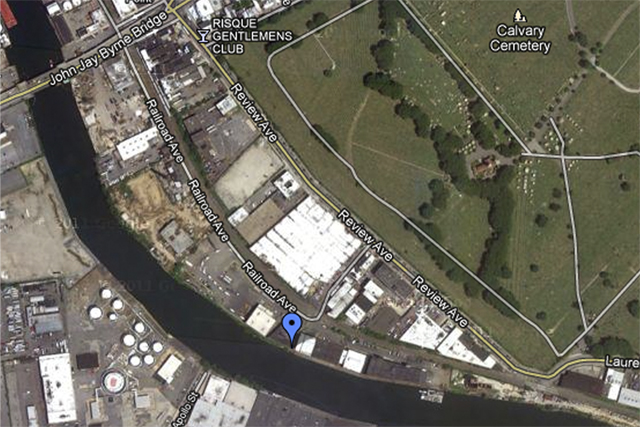
Modern day, (December 2011) google maps screen capture, click here or the image above for the dynamic google map. This is an industrial cul de sac today, accessed by a private driveway. The companies which use this space are largely waste management oriented, warehouse operations, furniture refinishing, or other truck based businesses. Despite the presence of freight tracks through the middle of the site, few of these companies utilize their sidings. Calvary Cemetery and the Kosciuszko Bridge loom large and distinguish the area.

1924 view of the area, screen capture from “NYCityMap” at nyc.gov.
The oil tanks in the center of the site betray the presence of the “Queens County Oil Works” of Charles Pratt, which were also known as the “Standard Oil Blissville Works”. Blissville, of course, is the historic name of this part of Queens which was once a residential area.

Clear plans of the area in 1936 overlaid with the 1924 aerial projection from NYCityMap. Click here to see a large version of the overlay.

Detail view of the area, click here for larger incarnation. The works were here as late as 1951, but at this point, I still haven’t been able to confirm the date they were closed down.

– photo by Mitch Waxman (August 6, 2011)
In the summer of 2011, I was tasked with photographing a “Bulkhead Survey” which members of the Newtown Creek Alliance were conducting. The good folks at Riverkeeper volunteered to take our party out on the Newtown Creek onboard their patrol boat, and when we were passing by the former Queens County Oil Works, we noticed the presence of both containment booms on the water and petroleum product flowing freely from the shoreline itself.

– photo by Mitch Waxman (August 6, 2011)
The theory which has been advanced by knowledgeable sources is that when the steel bulkheads were installed, a process in which the plating is slid down into place and then secured, and that a sealed chamber or buried pipeline was likely ruptured during the construction process which freed “the product”.
I have been asked to mention (by Newtown Creek Alliance and Riverkeeper itself) that investigation of the situation is underway, and the State and City officials responsible for policing this sort of thing are fully and enthusiastically engaged in the process.

– photo by Mitch Waxman (August 6, 2011)
The story of Charles Pratt, his “Astral Oil”, and their involvement with John D. Rockefeller’s Standard Oil Trust will be discussed in a later posting on this subject, as the lengthy history would divert attention from this otherwise serious issue. Suffice to say that the Blissville works were some 18 acres in size, and suffered several “total loss” fires in the late 19th century.
Note that this is a distinct property (and event) from the adjacent State Superfund site which is referred to as the Quanta Resources site.

– photo by Mitch Waxman (November 19, 2011)
Again onboard a Riverkeeper patrol, this time in November of 2011, the overt visual presence and subtle aroma of petroleum was encountered. The black and yellow structure is what is known as a hard boom, and is designed to contain surface contamination and “floatables”. It extends to a few inches below the surface.

– photo by Mitch Waxman (November 19, 2011)
The steel plating at the site is painted with oil, undoubtedly splashed up by wave action during storms at high tide. The white objects which are saturated with petroleum products are absorbent booms, designed to wick up the free floating product.

– photo by Mitch Waxman (November 19, 2011)
The leaves in the shot above are literally stuck into the gluey residues of the oil. You can see the high tide mark left by the water on the cleaner bulkhead which is just beyond the hard boom. Perhaps this is the source of oil, which many have reported to me over the course of the last year, which has been witnessed as it floats toward the East River.

– photo by Mitch Waxman (November 19, 2011)
It is not news that there are environmental contaminants floating freely in this troubled waterway, nor is there any revelation to be found in the fact that petroleum products are commonly observed pooling and flowing about the Newtown Creek watershed.
What is news is that this is in Queens.

– photo by Mitch Waxman (August 6, 2011)
Much of the attention, and deservedly so because of the large and growing population of Greenpoint and Williamsburg, which Newtown Creek receives is all about Brooklyn. The north shore of the Creek in Queens is often left out of discussion (and from both remediation and environmental benefits funding) because of its relatively tiny population and industrial character. One of the questions which this blog has asked since day one has been “Who can guess all there is, that might be buried down there?”.
In the case of the Blissville Oil spill, the question might as well be “How much there might be?”.

– photo by Mitch Waxman (November 19, 2011)
This is just the beginning of a new Newtown Creek story, the tale of the Blissville Oil Spill. I fear it will be the first of many such stories, as we move into the Superfund era.
foetid darkness

– photo by Mitch Waxman
On Monday the 5th of December, the Newtown Creek Alliance had drawn me from the safety of Astoria to the wild streets of Brooklyn and far off Williamsburg’s Graham Avenue. I decided to walk, as the mists had begun to swirl. When the meeting ended, certain Greenpoint based members of the Alliance offered me a lift as far they were going and I gladly took their offer.That’s how I ended up on the Pulaski Bridge in the middle of an astounding weather event.
In the photo above, what is missing from the shot of Newtown Creek is Manhattan.
from wikipedia
Fog is a collection of water droplets or ice crystals suspended in the air at or near the Earth’s surface. While fog is a type of stratus cloud, the term “fog” is typically distinguished from the more generic term “cloud” in that fog is low-lying, and the moisture in the fog is often generated locally (such as from a nearby body of water, like a lake or the ocean, or from nearby moist ground or marshes).

– photo by Mitch Waxman
Even the nearby spires of Tower Town in Long Island City were obscured, lost in some primal soup. The sound was eerie, as well, and our Lady of The Pentacle (who is British) informs me that her countrymen would often remark that sound doesn’t travel the same way through fog as it does in clear air and great caution should be exercised when moving around in it.

– photo by Mitch Waxman
Looking toward Dutch Kills along Borden Avenue, which trails along the malefic Newtown Creek, the enormous advertising sign mounted upon the “Fresh Direct” facility (which recently was, but I’m not sure if it still is, the nations largest illuminated sign) was creating quite a lightshow in the mist.

– photo by Mitch Waxman
This thing plays through several advertisements for the Internet green grocer, and spotlights key products and offers to passing drivers on the Long Island Expressway, which it towers above. Depending on when in the repeating reel of ads you were, the mist either looked like this…

– photo by Mitch Waxman
…Or like this!

– photo by Mitch Waxman
Additionally, here’s one from earlier in the day, at Maspeth Creek, looking toward the Kosciuszko Bridge.
a Newtown Creek Alliance meeting

– photo by Mitch Waxman
Newtown Creek Alliance Meeting – 12/5
When: Monday, December 5th, 6:00pm
Where: Williamsburg Community Center, 195 Graham Ave, Brooklyn
The Newtown Creek Alliance will be meeting to to discuss Creek matters. Everyone is welcome. We will be discussing the next steps in the Superfund cleanup process, the progress of the Brownfield Opportunity Area plan, NCA’s educational programming, green infrastructure and green jobs at Martinez Playground, and forming working groups on bioremediation, solid waste, and education.

metempsychoses and shudders

– photo by Mitch Waxman
Abjurations of fealty to self interest aside, your humble narrator is suffering some sort of delirium these days. Wandering thoughts and an inability to maintain focus plague my waking hours, and certain hallucinatory visions experienced during the nocturne haunt. Conversation has become difficult to follow or respond to, and paranoid imaginings or unheralded agitations at obviously minor issues color my days with fear, aggression, and anxiety. All I can see lying before me is devastation, hopelessness, and a slouching path leading to destruction.
I’m all ‘effed up.

– photo by Mitch Waxman
Were it possible that I could just be like the humans who infest this great hive, satisfied with loping along the streets whilst spouting colorful aphorisms, pronouncing vainglorious affirmations of personal worth. If only adorning myself with gaudy baubles or tailored garments, reflecting the height of current taste and fashion, could allow surcease from the diabolical internal dialogues which torment and disabuse. Such adolescent fury and desire is unacceptable in an adult, let alone one whose beard has gone white.
The waste meadows are where I belong, their devastating loneliness and abandonment mirror my own.

– photo by Mitch Waxman
Apotheosis finds a home here, along the tributaries of the Newtown Creek. Artifice is struck down by the concretized reality of hubris, and the shape of the future can be discerned in studying the past. Notions such as this force me into a separate form of existence which is ruled by the dark emotions of fear, resentment, and anger. Such is my lot then, to exist as the broken, the barren, and at the dazed and disappointed edge of man’s world.
I must find contentment in my role as Outsider, it would seem.


