Archive for the ‘newtown creek’ Category
curious ears

– photo by Mitch Waxman
Newtown Creek Alliance HQ is hidden away somewhere on, near, or under the Creek- I’m not allowed to say where or which. I can tell you that it bears an astounding resemblance to the “Hall of Justice” that appeared on the 1970’s cartoon “Super Friends”.
We’ve got the whole thing- a hangar for the invisible (and intangible) jet, full garage for the Creekmobile, and several submersible vehicles equipped with advanced Riverkeeper technology (which they reclaimed from a sunken U.S.O.- an unknown submersible object). There’s a big red phone with a single button under a glass bell, and while it’s not the only place in these parts where you can get away with wearing a mask and cape it is certainly the friendliest. We have no wonder twins, however.
One day recently, whilst on duty at the Troublealert console, your humble narrator received word that the powers that be from the world beyond Newtown Creek would be gathering and had requested that a representative of NCA make a statement.

from wikipedia
The Hall appeared in the very first episode of the Super Friends series, which premiered on September 8, 1973. It was originally drawn by Al Gmuer, background supervisor for Hanna-Barbera for more than 30 years. Gmuer modeled the fortress after the famous Union Terminal in Cincinnati, Ohio, train station turned museum. The Hall, located in Metropolis, serves as the central meeting point for the Super Friends. The Hall contains the Trouble Alert, a computerized monitoring station that would warn the heroes of a new threat. The Hall also houses a giant computer that the Super Friends use to analyze clues.

– photo by Mitch Waxman
Specific need for a certain grasp of the totality of the situation around the Creek, not the expert legal and environmental knowledge or community outreach and organization which the Newtown Creek Alliance normally shares with the powers that are, was requested. Since the big guns were out of town or otherwise busy, it was decided that I should go.
In this collection of Super Friends- I’m, of course, Gleek the super monkey.
from wikipedia
Gleek is a blue “space monkey” and the pet of Zan and Jayna, the Wonder Twins. Gleek is often used as comic relief for the series, as the character often gets into mischief. A joke involving Gleek often ends episodes of the Super Friends in which he appears. Gleek has a stretchable, prehensile tail which can be quite useful. Gleek is also highly intelligent, as he clearly understands spoken English, even somewhat complicated concepts such as the various stages of simple strategic planning. He communicates through the use of sign language, acting out scenes, and chattering in an unintelligible alien tongue. Gleek also helps the Twins when they need to travel: Jayna becomes an eagle, Zan becomes water, and Gleek produces a bucket to hold Zan while Jayna carries them both

– photo by Mitch Waxman
Luckily, my perennial and nervous need to arrive early paid off, and I was able to bend the ear of a member of the House of Representatives! Carolyn Maloney also arrived a few minutes early and we discussed the situation along Newtown Creek- during which I pointed out certain landmarks, quoted from a few official studies, and we both marveled at the enormous number of blue collar jobs which are provided by businesses along the waterway.
Rep. Maloney opened the event, invited me to the microphone, and I read the following prepared statement on behalf of the Newtown Creek Alliance:
“My name is Mitch Waxman and I am representing the Newtown Creek Alliance. We welcome Representative Maloney’s concern for Dutch Kills. The waterway is a major arm of Newtown Creek. A cleanup of the local waterways would be incomplete if this body of water does not receive full attention during the testing process.”
from wikipedia
Carolyn B. Maloney (born February 19, 1946) is the U.S. Representative for New York’s 14th congressional district, serving since 1993. She is a member of the Democratic Party. The district, popularly known as the “silk stocking district”, includes most of Manhattan’s East Side; Astoria and Long Island City in Queens; and Roosevelt Island.

– photo by Mitch Waxman
The Borough President of Queens, Helen Marshall next came to the microphones. The genesis of this event is a concern amongst the political leaders of Queens that a historical pattern which dictates that Queens gets a lesser share of Government allocations and funding, the “short end of the stick” so to speak, doesn’t repeat itself during the cleanup phase of the ongoing EPA Superfund process. This is no paranoid fantasy, incidentally, for despite being the largest borough with the most sizable population- Queens is often left with a half empty plate when the roast is carved up amongst the Boroughs. Manhattan and Brooklyn always seem to get the biggest portion, and the Bronx and Staten Island are going back for seconds, before Queens is even served.
from wikipedia
Helen Marshall was elected Queens Borough President in 2001 succeeding the term-limited Claire Shulman. Prior to being elected Borough President, Marshall served on the New York City Council from 1992 to 2001, an office she vacated due to term limits. Prior to being a city councilwoman, Marshall served for nine years in the New York State Assembly. In both the City Council and State Assembly, Marshall represented Queens.
As Borough President, Marshall has made marketing Queens as a tourist destination one of her priorities.In 2005 Marshall won a second term, defeating her Republican and Conservative challenger Philip T. Sica with 75% of the vote to his 25%. She was inaugurated to her second term as President of the Borough of Queens on January 3, 2006 in a ceremony held at Terrace on the Park in Flushing Meadows Corona Park. Marshall outlined her plans for the next four years including health care, education, housing and new park projects.
On July 1, 2009 she appointed Dennis M. Walcott to the reconstituted New York City Board of Education. The Board then voted to name Walcott as president of the board.

– photo by Mitch Waxman
As the press conference proceeded, various political players filtered in. State Assemblyman Michael Gianaris, as pictured above was the first to arrive.
from wikipedia
Michael N. Gianaris (born 1970) is a New York Assemblyman representing District 36, which comprises Astoria, Long Island City, Queensbridge and Ravenswood, among other neighborhoods located in the New York City borough of Queens. He is the first Greek-American to be elected to office from New York City. Gianaris has been mentioned as a possible candidate for New York’s 14th congressional district.

– photo by Mitch Waxman
Also on hand were members of the Dutch Kills Civic Association, and in all the excitement I missed the name of the gentleman with the glasses and blue shirt but I can tell you that the fellow at the microphone is Gerald Walsh- President of DKCA.

– photo by Mitch Waxman
Assemblywoman Cathy Nolan spoke next. This was the first time I met her, but she seemed nice.
from wikipedia
Catherine Nolan (born March 12, 1958) is an New York Assemblywoman, elected in 1984 to represent the 37th district (covering the Sunnyside, Ridgewood, Astoria, Woodside, Long Island City, Maspeth, Queensbridge, Ravenswood, Dutch Kills and Blissville neighborhoods).
A resident of the district for most of her life, she is a graduate of St. Aloysius R.C. School and Grover Cleveland High School. Ms. Nolan graduated from New York University cum laude with a BA degree in Political Science.
She was first elected to the Assembly in 1984. Assemblywoman Nolan is a member of the Democratic leadership in the Assembly and has served as Chair of both the Labor and Banking Committee during her career. Although no longer on the Labor Committee, Nolan has continued to push legislation which protects workers rights in New York State.In January 2006, Assemblywoman Nolan was appointed as Chair of the Assembly Standing Committee on Education. Nolan is also a member of the highly influential Rules and Ways & Means Committee.

– photo by Mitch Waxman
The press conference concluded after City Council Member Jimmy Van Bramer spoke.
Note: I should mention that I’ve had a couple of instances, concerning Astoria business, that have brought me into contact with his office. Limited experience with both his staff and the Councilmember himself have left me a BIG Jimmy Van Bramer fan.
from wikipedia
Jimmy Van Bramer is a member of the New York City Council. He was elected to the New York City Council to represent the 26th district on November 3, 2009. He represents Woodside, Sunnyside, Long Island City, Astoria, and Maspeth.
previous recollections

– photo by Mitch Waxman
Recently, I was obliged to meet up with a couple of guys from Williamsburg when they asked me to guide them through some of the Newtown Creek’s less well known attractions. My pithy reply was that I would be straddling the border of Brooklyn and Queens, and they should just meet me there- at the venerable Grand St. Bridge. I walked there from Astoria in record time, arriving quite a bit earlier than I had anticipated.
Luckily the morning was crisp, my coffee was hot, and the burning thermonuclear eye of god itself was shining strongly- which afforded me with a nice opportunity me to do a little shooting.
Note: I’m never sure how to describe the actual act of photography. Shoot, capture, take- all somewhat violent terms which don’t really fit the action. Sniper techniques do transfer neatly into telephoto work, exhaling while triggering the shutter and all that, but… it’s all rather soldier sounding isn’t it?
from wikipedia
Photography is the process, activity and art of creating still or moving pictures by recording radiation on a radiation-sensitive medium, such as a photographic film, or electronic image sensors. Photography uses foremost radiation in the UV, visible and near-IR spectrum.[1] For common purposes the term light is used instead of radiation. Light reflected or emitted from objects form a real image on a light sensitive area (film or plate) or a FPA pixel array sensor by means of a pin hole or lens in a device known as a camera during a timed exposure. The result on film or plate is a latent image, subsequently developed into a visual image (negative or diapositive). An image on paper base is known as a print. The result on the FPA pixel array sensor is an electrical charge at each pixel which is electronically processed and stored in a computer (raster)-image file for subsequent display or processing. Photography has many uses for business, science, manufacturing (f.i. Photolithography), art, and recreational purposes.
As far as can be ascertained, it was Sir John Herschel in a lecture before the Royal Society of London, on March 14, 1839 who made the word “photography” known to the whole world. But in an article published on February 25 of the same year in a german newspaper called the Vossische Zeitung, Johann von Maedler, a Berlin astronomer, used the word photography already. The word photography is based on the Greek φῶς (photos) “light” and γραφή (graphé) “representation by means of lines” or “drawing”, together meaning “drawing with light”

– photo by Mitch Waxman
Surreal, the waters around the Grand Street Bridge teem with that alien colour which typifies and describes the industrial hinterlands of that annihilation of innocence which is called the Newtown Creek. For an extensive description and history of this spot, a busy automotive and truck crossing in modernity, click the following for the Newtown Pentacle posting “a Grand Journey in DUGSBO”
from nyc.gov
Grand Street is a two-lane local City street in Queens and Kings Counties. Grand Street runs northeast and extends from the Brooklyn Queens Expressway in Brooklyn to Queens Boulevard in Queens. The road is known as Grand Street west of the bridge and Grand Avenue east of the bridge. The bridge is located between Gardner Avenue in Brooklyn and 47th Street in Queens. The Grand Street Bridge is a 69.2m long swing type bridge with a steel truss superstructure. The general appearance of the bridge remains the same as when it was opened in 1903. The bridge provides a channel with a horizontal clearance of 17.7m and a vertical clearance, in the closed position, of 3.0m at MHW and 4.6m at MLW. The bridge structure carries a two-lane two-way vehicular roadway with sidewalks on either side. The roadway width on the bridge is 6.0m and the sidewalks are 1.8m wide. The height restriction is 4.1m. The approach roadways are wider than the bridge roadway. For example, the width of Grand Avenue at the east approach to the bridge (near 47th Street) is 15.11m.
The first bridge on this site, opened in 1875, quickly became dilapidated due to improper maintenance. Its replacement, opened in 1890, was declared by the War Department in 1898 to be “an obstruction to navigation.” Following a thorough study, a plan was adopted in 1899 to improve the bridge and its approaches. The current bridge was opened on February 5, 1903 at a cost of $174,937.

– photo by Mitch Waxman
While pondering the atypical number of 19th century suicides which occurred here, a flock of geese happened along in this so called urban desert and distracted me from my usual morbid soliloquy. They were pecking at the manmade bulkheads, skimming for waterline plant life.
from wikipedia
The Canada Goose was one of the many species described by Linnaeus in his 18th-century work Systema Naturae. It belongs to the Branta genus of geese, which contains species with largely black plumage, distinguishing them from the grey species of the Anser genus. The specific epithet canadensis is a New Latin word meaning “from Canada”. According to the Oxford English Dictionary, the first citation for the ‘Canada Goose’ dates back to 1772. The Cackling Goose was formerly considered to be a set of subspecies of the Canada Goose.

– photo by Mitch Waxman
Nearby was this enormous creature, balancing on one foot . Unfortunately, it wasn’t disposed toward looking my way, despite my best Brooklyn exclamation of “hey, boid, overs here’s”. When a tractor trailer blew by, it suddenly exploded upward.
from wikipedia
New York dialect is predominantly characterized by the following sounds and speech patterns:
Vowels
- The low back chain shift The /ɔ/ vowel sound of words like talk, law, cross, and coffee and the often homophonous /ɔr/ in core and more are tensed and usually raised more than in General American. Labov (1966) describes this pattern as varying on a scale from [ɔ] to [ʊ]. An inglide typically accompanies higher variants giving [oə] or [ʊə]. /ɑ/ in father and /ɑr/ in car are backed, diphthongized, and sometimes rounded to [ɑə] or [ɒə]. The result is that card in New York can be similar to cod in parts of New England. In addition, a subset of words with /ɒ/ as in lot feature a lengthened and diphthongized variant, [ɑə]. This variant may appear before a word final voiced stop, /dʒ/, or /m/ (e.g., cob, cod, cog, lodge, bomb). It also occurs variably before voiced fricatives (e.g., bother), /ʃ/ (e.g., wash), and in the words on, John, and doll (Wells 1982: 514).
- The short-a split There is a class of words, with a historical short-a vowel, including plan, class, and bad, where the historical /æ/ is raised and tensed to an ingliding diphthong of the type [eə] or even [ɪə]. This class is similar to, but larger than, the BATH lexical set, in which Received Pronunciation uses the so-called broad A. Other words, such as plaque, clatter, and bat, retain a lax, low-front [æ], with the result that bad and bat have different vowels. A related (but slightly different) split has occurred in the dialect of Philadelphia. Although the lax and the tense reflexes of /æ/ are separate phonemes in these dialects, their distribution is largely predictable. See Phonemic æ-tensing in the Mid-Atlantic region for more details.
- /oʊ/ as in goat does not undergo fronting; instead, it remains [oʊ]. This groups New York with the “North” class of dialects rather than the “Midland”, in which /oʊ/ is fronted. Relatedly, /uː/ as in goose is not fronted and remains a back vowel [uː] or [ʊu]. This lack of fronting of /oʊ/ and /uː/ also distinguishes New York from nearby Philadelphia. Some speakers have a separate phoneme /ɪu/ in words such as tune, news, duke (historically a separate class). The phonemic status of this vowel is marginal. For example, Labov (1966) reports that New Yorkers may contrast [duː] do with [dɪu] dew though they may also have [dɪu] do. Still, dew is always [dɪu] and never [duː].
- Diphthongs The nucleus of the /aɪ/ diphthong is a back and sometimes rounded vowel [ɑ] or [ɒ] (right as [ɹɑɪt]) and the nucleus of the /aʊ/ diphthong is a front vowel [æ] (rout as [ɹæʊt]). The sociolinguistic evidence (Labov 1966) suggests that both of these developments are active changes. The fronted nucleus in /aʊ/ and the backed nucleus in /aɪ/ are more common among younger speakers, women, and the working and lower middle classes.
- pre-r distinctions New York accents lack most of the mergers before medial /r/ that many other modern American accents possess:
- The vowels in marry [mæri], merry [mɛri], and Mary [meri] ~ [mɛǝri] ~ [mɛri] show either a two- or three-way contrast.
- The vowels in furry /fɜri/ and hurry /hʌri/ are distinct.
- Words like orange, horrible, Florida and forest are pronounced /ɑrəndʒ/ and /fɑrəst/ with the same stressed vowel as pot, not with the same vowel as port as in much of the rest of the United States.
- Merger of /ɜr/ and /ɔɪ/: One of the stereotypes of New York speech is the use of a front-rising diphthong in words with /ɜr/ (e.g., nurse). This stereotype is popularly represented in stock phrases like “toity toid” for thirty-third. The phonetic reality of this variant is near [ɜɪ]. This variant may also appear in words with /ɔɪ/ (e.g., choice), resulting in verse and voice as homophones. The diphthongal variant for /ɜr/ is highly stigmatized. Labov’s data from the mid-1960s indicated the form was recessive then. Only two of his 51 speakers under age 20 used the form as compared with those over age 50 of whom 23 out of 30 used the form. Items with /ɔɪ/ may occur with [ɜr] (e.g., [tɜrlət] toilet), apparently as a result of hypercorrection. Younger New Yorkers (born since about 1950) are likely to use a rhotic [ɜr] in bird even if they use non-rhotic pronunciations of beard, bared, bard, board, boor, and butter.

– photo by Mitch Waxman
Turns out it’s a heron. Go figure, a heron at Newtown Creek.
from wikipedia
The herons are wading birds in the Ardeidae family. There are 64 recognised species in this family. Some are called egrets or bitterns instead of herons. Within the family, all members of the genera Botaurus and Ixobrychus are referred to as bitterns, and—including the Zigzag Heron or Zigzag Bittern—are a monophyletic group within the Ardeidae. However, egrets are not a biologically distinct group from the herons, and tend to be named differently because they are mainly white and/or have decorative plumes. Although egrets have the same build as the larger herons, they tend to be smaller.
The classification of the individual heron/egret species is fraught with difficulty, and there is still no clear consensus about the correct placement of many species into either of the two major genera, Ardea and Egretta. Similarly, the relationship of the genera in the family is not completely resolved. However, one species formerly considered to constitute a separate monotypic family Cochlearidae, the Boat-billed Heron, is now regarded as a member of the Ardeidae.
Although herons resemble birds in some other families, such as the storks, ibises and spoonbills, they differ from these in flying with their necks retracted, not outstretched. They are also one of the bird groups that have powder down.
Some members of this group nest colonially in trees; others, notably the bitterns, use reedbeds.

– photo by Mitch Waxman
That’s it for today, over the weekend I’ll be thrilling you with recent encounters your humble narrator has had with the political class who rule over New York City.
Also, please buy a copy of our book- Newtown Creek, for the vulgarly curious- here. Every copy sold contributes directly to sustaining and maintaining this- your Newtown Pentacle.
from wikipedia
Grand Street is a street in Williamsburg, Brooklyn, New York City, United States. The Grand Street (BMT Canarsie Line) subway station serves the corner of Grand Street and Bushwick Avenue. Crossing English Kills into Queens, Grand Street becomes Grand Avenue, continuing through Maspeth where it is a main shopping street, to Elmhurst. Its northern end is at Queens Boulevard. Broadway continues the thoroughfare north and west.
History
In the 19th century, before the construction of the Williamsburg Bridge, the Grand Street Ferry connected Grand Street, Brooklyn to Grand Street, Manhattan. The Grand Street Line was a streetcar line along the road.
shocking, unlighted, and fear haunted abysses

– photo by Mitch Waxman
Ennui of a nearly narcotic character has paralyzed your humble narrator for an interval of several weeks, a period which is at an end. Stumbling in the manner of some morphine or hashish addict across the masonry clad streets, my mood has been affected by both growing poverty and certain darker influences. Applications of various substances- derivates of the cocoa or coffee bean- have been ineffective in forcing me into a bright and waken state. Reduced to a quivering and passive “experiencer”, a cancerous nugget of self hatred grows in my heart, and has shocked me back to the waking world. Anger is an energy, as Johnny Rotten pointed out in his seminal “rise” ditty, and I walk amongst you once more.
New perspectives are called for, if the antiquarian mysteries which haunt our communities are ever to be revealed, and I no longer care about the consequences.
Let “them” quiver and tremble, for we are beginning the winter session, Lords and Ladies, at this- your Newtown Pentacle.
from wikipedia
A sett, usually the plural setts and in some places called a Belgian block, often incorrectly called “cobblestone”, is a broadly rectangular quarried stone used originally for paving roads, today a decorative stone paving used in landscape architecture. A sett is distinct from a cobblestone by being quarried or shaped to a regular form, whereas a cobblestone is generally naturally occurring. Streets paved with setts are highlights in several cycling competitions such as the final Champs-Élysées stage of the Tour de France and the Paris–Roubaix road race as riding upon them is technically more challenging than riding on asphalt. Notable roads paved with setts include Vicars’ Close, Wells, much of Edinburgh’s Royal Mile and the set of Coronation Street. In New York City the meat-packing district retains such streets.

– photo by Mitch Waxman
Those of you who have been following this periodical recognize the descriptions of these moody moments of navel gazing which a humble narrator is unable to forestall or avoid, and which curiously seem tied to seasonal variance in light and temperature. During these intervals, postings become scarce and difficult to perform, as despite the richness of environment and staccato nature of events- I cannot summon the motivation to write and become as everyone else- ordinary and voiceless. Professional writers describe this vacuity as becoming “written out”, and prescribe a period of reading and research to reignite the hearth. I’ve been following this prescription, and just this morning- the hellish green flame of wonderment has once again been kindled.
As I said: “Back in session”.
from wikipedia
The Pennsylvania Railroad (PRR) completed construction of the yard in 1910. At that time Sunnyside was the largest coach yard in the world, occupying 192 acres (0.78 km2) and containing 25.7 mi (41.4 km) of track. The yard served as the main train storage and service point for PRR trains serving New York City. It is connected to Pennsylvania Station in Midtown Manhattan by the East River Tunnels. The Sunnyside North Yard initially had 45 tracks with a capacity of 526 cars. The South Yard had 45 tracks with a 552 car capacity.

– photo by Mitch Waxman
Presented for your amusement today, this shot is from the Newtown Creek Cruise of October 24th, which ended up being quite well attended.
Bernard Ente (of Working Harbor Committee, Newtown Creek Alliance) and your humble narrator handled the narration. A small coterie of guest speakers (including Jeffrey Kroessler, Tom Outerbridge, and others) allowed us infrequent breaks from the microphone- during one of which I snuck away and captured this image. Fairly close to the Brooklyn coastline of the Newtown Creek, it was nevertheless captured from the water- that’s the Pulaski Bridge dividing the horizon, with Empire State and Chrysler Buildings framing the sky in the manner of some enormous tuning fork.
from wikipedia
Before the nineteenth century urbanization and industrialization of the surrounding neighborhoods, Newtown Creek was a longer and shallower tidal waterway, and wide enough that it contained islands. It drained parts of what are now the neighborhoods of Bushwick, Williamsburg and Greenpoint in Brooklyn; and Maspeth, Ridgewood, Sunnyside and Long Island City in Queens. During the second half of the nineteenth century it became a major industrial waterway, bounded along most of its length by retaining walls, the shipping channel maintained by dredging. The Montauk Branch of the Long Island Rail Road, mainly a freight line, runs along the North bank. A liquid natural gas port is under construction on the South bank, between Kingsland and Greenpoint Avenues, Whale Creek, and the main stream of Newtown Creek.
In 2007, residents of Greenpoint, Brooklyn and the New York State Attorney General’s Office filed lawsuits regarding the Greenpoint Oil Spill that contained more than twice the oil of the Exxon Valdez oil spill.
On September 27, 2010, the United States Environmental Protection Agency designated Newtown Creek as a Superfund site, preparing the way for evaluation and environmental remediation of the stream. Environment advocacy groups supported the decision.
from some point in space

– photo by Mitch Waxman
Recent travels and travails, which I’ll be describing in some detail in the coming days, have been consuming me. Antiquarian studies, which normally bring joy and excitement to one such as myself, are instead feeding a black dog nipping at my heels. The arrival of seasonally appropriate cold weather shatters the illusion I project of vigor and health, and instead reveals a weakened and tired old man whose ease of movement and comfort is shattered by lower temperatures. A huddled mass of insulating garments, what you perceive as a windblown pile of rag and filth often reveals itself to be me.
I’m all ‘effed up.
from nytimes.com
The Roswell P. Flower estate sold last week to the Borden Realty Company, a subsidiary concern of the Degnon Terminal Improvement Company, 362 lots in the sunken meadows south of Jackson Avenue, in Long Island City, and extending to Dutch Kills Creek and Newtown Creek, at prices ranging, it is said, from $1,000 to $1,500 each.
The Degnon Terminal Company has already invested from $2,500,000 to $3,000,000 in Long Island City meadows and meadows at the head of Flushing Bay, in the towns of Flushing and Newtown.
The meadows are to be filled in with the earth taken from the Belmont tunnel, and the Dutch kills Canal and Flushing Bay are to be dredged.

– photo by Mitch Waxman
Recent opportunities and accesses to certain locations normally forbidden to the general public have drawn me out from HQ, however, and that which I have witnessed is the terrible spectacular of those sky flung monoliths and hybrid pestilences which typify the City of Greater New York in these dawning years of the 21st century. Gaze in despair upon the waste meadows of Dutch Kills, from high above.
from trainsarefun.com
Just south of Sunnyside Yards is Degnon Terminal, operated by the Degnon Realty & Terminal Improvement Company. A subsidiary, Degnon Terminal Railroad Corporation operated a switching terminal. It received and delivered cars from and to connections and switched them to the various industries, also the reverse operation. This carrier’s only railroad connection was with the Montauk Cutoff of the Long Island Rail Road at Pearson Street [Hunterspoint Avenue], Long Island City. Degnon constructed its tracks about 1919, although land reclamation and grading began about 1907.

– photo by Mitch Waxman
My vantage was from within the cyclopean Degnon Terminal, a once mighty industrial center and railhead which has been transmogrified into a community college. The occasion which brought me here will be explored in later postings, but since the ennui under which your humble narrator currently suffers precludes any notion of positive thought, it was decided to just display these images for your consideration and not engage in some some long winded and depressing monolog about it.
from nydesigns.org
The NYDesigns staff know that summer’s truly over when, after two introspective weeks in a silent fructarian monastery in Appalachia, we spy the godzilla-sized, tomato-red IDCNY sign halfway through the 7-minute walk from the trains at Courthouse Square. We share the building with LaGuardia College CUNY and E. Gluck Corporation, a watch manufacturing company.
In 1908, however, the “Thousand Window Bakery,” a best practice factory showcase for the Loose-Wiles Biscuit company originally of Kansas City was the building’s sole tenant. All 10 stories of the building housed production, sales and management as well as 2500 employees in a Fabian, sun-infused proletarian paradise, complete with a lending library and a clubhouse. Trading under the name Sunshine Biscuits, the cookies were baked in the shape of Popeye, Olive, Swee’pea, Wimpy, etc. and distributed in tin boxes which are now modestly priced collectibles. Animal crackers originated here. Now a subsidiary of Keebler, Sunshine is now best known for producing the Cheez-It brand of snack crackers.
The “Thousand Window Bakery” was one piece within the larger industrial park of Degnon Terminal, the brainchild of Michael Degnon, entrepreneur and railyard contractor for the Sunnyside Yards, which abut the building’s northwestern facade. Degnon Terminal was attractive to companies including the Packard Auto Company, Ever Ready, and Chicle (of Chiclets gum) because of the ease in shipping just-manufactured goods via rail straight to distributors.The Sunnyside rail lines haven’t seen any traffic since 1989 and the industrial occupants have long moved on to more affordable real estate climes. Sunshine left in the mid ’60s.

– photo by Mitch Waxman
The water you see in the center of these photographs is the logical end of Dutch Kills, a tributary of the oft maligned Newtown Creek. The first bridge you see is the Hunter’s Point Avenue Bridge, which nears its 100th year of service to the municipality in uncommented anonymity (not if I have anything to say about that), and the large white structure is the Queens Midtown Expressway section of the Long Island Expressway which hurtles high over the empty corridor of long Island City.
Beyond is infinite Brooklyn, with the Newtown Creek Wastewater Treatment Facility just left of center in centuried Greenpoint.
from nyc.gov
Long Island City is comprised of five separate neighborhoods: Ravenswood, Astoria, Steinway, Sunnyside, and Hunter’s Point. Engine Company No. 258 is located on 47th Street in Hunter’s Point, about halfway between Newtown Creek and the Queensboro Bridge. Though someearly nineteenth-century legal documents refer to the area as Long Island Farms or Long Island City, it was not until the 1850s that the current name was widely used. Popularized by a local newspaper, the Long Island Star, when the five villages were incorporated as an independent municipality in 1870, the neighborhood was officially named. Hunter’s Point became the commercial and political center of the new city, served by the Long Island Railroad at 2nd Street, near the East River, and multiple ferries to Manhattan. The seat of Queens County moved here from Jamaica, and two years later, in 1872, the New York Supreme Court Building for Queens County (reconstructed 1904-8, a designated New York City Landmark) was built on Jackson Avenue, now called Court Square. Long Island City grew quickly and the population tripled between 1875 and 1900. Among the various houses built in the area, a fine group survives on 45th Avenue, between 21st and 23rd Streets, in the Hunter’s Point Historic District. Faced in brick, brownstone, and Tuckahoe marble, these Italianate, Second Empire,and Neo-Grec structures, were collectively known as “White Collar Row.” Hunter’s Point had nearly 18,000 residents in 1905, a number that has never been exceeded.
Queens became a borough of Greater New York in 1898 and Long Island City became theseat of the borough president, with offices in the Hackett Building (c. 1885) on Jackson Avenue until 1916. Various transit projects that proved critical to real estate development in Queens were completed during this period, including the opening of the Queensboro Bridge (1909, a designated New York City Landmark), tunnels linking Manhattan with the vast Sunnyside Yards (1910), and the beginning of regular IRT subway service (1915) to Corona, and later, Flushing. Access to the general area was greatly improved, attracting large factories and warehouses that benefited from spur lines that allowed freight cars to travel directly to the loading docks. Various examples can be found in the Degnon Terminal area, along Thomson Avenue, where the Adams Chewing Gum and Loose Wiles Sunshine Biscuit companies located in the 1910s. These improvements, however, had a downside, creating barriers that isolated Hunter’s Point from the rest of the borough, while making it easier for commuters to reach new residential districts to the east, in Sunnyside, Jackson Heights, and other neighborhoods.
No Necronomicon, but…
Here’s why so many posts in the last few weeks have been late, Lords and Ladies.
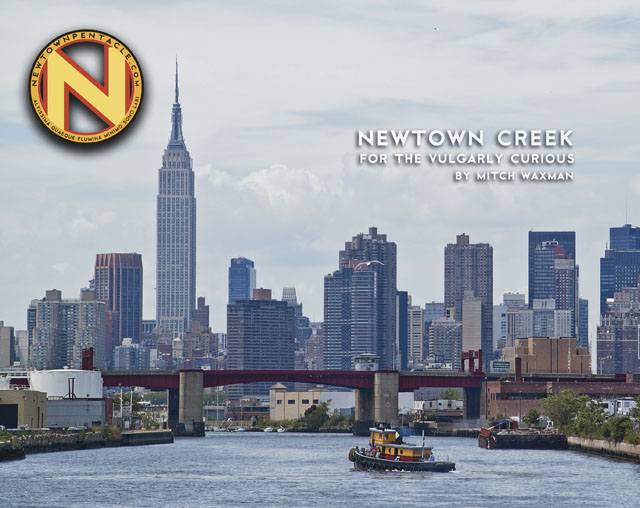
“Newtown Creek for the Vulgarly Curious” is a fully annotated 68 page, full-color journey from the mouth of Newtown Creek at the East River all the way back to the heart of darkness at English Kills.
Check out the preview of the book at lulu.com, which is handling printing and order fulfillment, by clicking here.
Every book sold contributes directly to the material support and continuance of this, your Newtown Pentacle.
“Newtown Creek for the Vulgarly Curious” by Mitch Waxman- $25 plus shipping and handling.


