Archive for the ‘Pickman’ Category
metempsychoses and shudders

– photo by Mitch Waxman
Abjurations of fealty to self interest aside, your humble narrator is suffering some sort of delirium these days. Wandering thoughts and an inability to maintain focus plague my waking hours, and certain hallucinatory visions experienced during the nocturne haunt. Conversation has become difficult to follow or respond to, and paranoid imaginings or unheralded agitations at obviously minor issues color my days with fear, aggression, and anxiety. All I can see lying before me is devastation, hopelessness, and a slouching path leading to destruction.
I’m all ‘effed up.

– photo by Mitch Waxman
Were it possible that I could just be like the humans who infest this great hive, satisfied with loping along the streets whilst spouting colorful aphorisms, pronouncing vainglorious affirmations of personal worth. If only adorning myself with gaudy baubles or tailored garments, reflecting the height of current taste and fashion, could allow surcease from the diabolical internal dialogues which torment and disabuse. Such adolescent fury and desire is unacceptable in an adult, let alone one whose beard has gone white.
The waste meadows are where I belong, their devastating loneliness and abandonment mirror my own.

– photo by Mitch Waxman
Apotheosis finds a home here, along the tributaries of the Newtown Creek. Artifice is struck down by the concretized reality of hubris, and the shape of the future can be discerned in studying the past. Notions such as this force me into a separate form of existence which is ruled by the dark emotions of fear, resentment, and anger. Such is my lot then, to exist as the broken, the barren, and at the dazed and disappointed edge of man’s world.
I must find contentment in my role as Outsider, it would seem.
vague stones and symbols

– photo by Mitch Waxman
A caprice which your humble narrator enjoys, long have I referred to this part of the Newtown Creek as “DUGABO” – an abbreviation for “Down Under the Greenpoint Avenue Bridge Onramp“. Historically, this has always been home to companies who deal in the refining and distribution of fuel- whether it was spermaceti oil, coal, natural gas, or petroleum. Standard Oil had a base here, and it’s modern day incarnation as Exxon Mobil is still very much present in the locale.
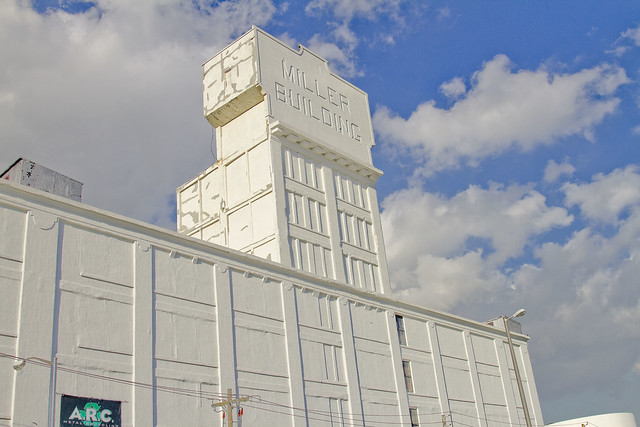
A long history of fires and industrial accidents surround DUGABO, from the Locust Hill and Sone and Fleming refinery fires in the 1880’s to a 1919 immolation which consumed the bridge itself. Standing in the middle of this area of concentrated wealth and industry, however, is a 9 story tall enigma.

– photo by Mitch Waxman
425 Greenpoint Avenue is the address of this structure, and its bold face designates itself as “The Miller Building”.
Like many of the enormous factory structures which grace the Newtown Creek Watershed, its original purpose has been lost to changing economic times and in modernity it serves as a self storage warehouse. The building is visible from great distance, and for those of involved in the history of Newtown Creek- something of a mystery. Even my departed friend Bernard Ente, whose encyclopedic knowledge of Newtown Creek was legendary, was stumped as to its original purpose. It looks for all the world like a grain terminal. It’s not.

– photo by Mitch Waxman
First hand accounts from current occupants of the building offered few clues to its origins, although descriptions of an ad hoc pet cemetery located on its grounds tantalize with their wild suggestions. It is located in a petrochemical center, a poured concrete structure which is at a minimum 90 years old and some 9 stories in height (which is remarkable in itself), and stands on some of the most valuable real estate (from a early to mid 20th century point of view) in New York City.

– photo by Mitch Waxman
All the usual sources, including the estimable database maintained by the NYC Department of Buildings, return few if any results on its origins. this is often the case with older structures that were built in the so called outer boroughs around the time of “consolidation” and I’m sure that somewhere in the Brooklyn Borough Hall there must exist a record of the place in the atavist files of the City of Brooklyn- but I have not been able to find them. Accordingly, an attempt has been made to “beat the brush” amongst the many historical enthusiasts I have been fortunate enough to meet over the last few years.
T.J. Connick, a scholar who I’ve never met in person and know only from the vast interwebs, has been immensely helpful in the endeavor and is singled out for generously adding to the research effort.

– photo by Mitch Waxman
Modern cohorts who run a large petro chemical business based on Kingsland Avenue responded to my queries about the Miller Building with “it used to be a glue factory” as late as the 1970’s. In fact, many Greenpointers will repeat this, as a 20th century glue and varnish factory was housed here which was legendary for its effluent smells. The earliest mention I’ve been able to find about the place, and which surely discusses the antecedent of the modern structure, is in a 1911 trade journal.
From Paint, oil and drug review, Volume 52 , courtesy google books
Unknown cause, Tuesday, July 11, destroyed the plant of the Charles Miller varnish works, at Greenpoint avenue and Newtown Creek, Brooklyn. The flames threatened surrounding factories, but the firemen kept the blaze confined to the doomed building. At the time there were but few employes in the place, and they escaped without injury. The damage was estimated at $3,000.

– photo by Mitch Waxman
Logically- the modern Miller Building must have been erected sometime in the eight years between the 1911 fire and a conflagration in 1919 known as “The Standard Oil fire”. “The Miller building” discussed in the link below is obviously the modern structure.
From 1919’s Insurance newsweek, Volume 20, courtesy google books
Across the street from this plant is the Miller Building, which is fireproof and has wired glass windows. This building was undamaged, and prevented the fire from reaching the buildings of the Green Point Storage Co., in which are stored naval supplies such as resin and tar. The New York fire insurance companies also had lines on this risk. A remarkable fact was that no one was killed. This was probably due to the fact that exploding oil does not have the force of powders, and also much less concussion. The tanks that were blown, however, were twisted and torn as if some colossal force had thrown them down from a great height. The blazing oil which ran about in rivulets was a constant menace to the other tanks. The office of the Standard Oil Co., which was supposed to have been of fireproof construction, was destroyed, but most of the important records were saved.
Additionally, the 1919 fire was explored here at your Newtown Pentacle, in the posting “Tales of Calvary 11- Keegan and Locust Hill“.

– photo by Mitch Waxman
T.J. Connick, in answer to my queries about the Miller Building, sent along these fascinating tidbits which are presented as received:
- Charles A. Miller appears, as described in my previous email, as father to Charles Clifford Miller.
- It appears that Charles A Miller and Mrs. raised family at 128 Kent Street. Mr. & Mrs. were active in the Third Church (Universalist). Daughter Hattie was Sunday school teacher. Florence I. Miller appears at the address, class of 1903 at Pratt Institute. Maybe it’s Hattie, maybe some other relation.
- Mrs. Charles A Miller’s obit appears in July 2, 1901 Brooklyn Eagle (p.2). Her name was Justice Liberty Miller – no joke. She died at 43.
- Oct 26, 1913 Brooklyn Daily Eagle (page 2) reports on marriage of Charles Clifford Miller. He married Hazel Walrath of Fort Plain, NY in Universalist Church ceremony in her home town. He was described as head of Eclipse Box & Lumber Company (this located 425 Greenpoint), member of Northport Yacht Club (his yacht the 30-foot Dutchess), and motorist.
- The couple planned to make their home at 13 Greenway Terrace, Forest Hills (Queens)
- Subdued affair due to recent death of his father Charles Miller “prominent manufacturer of Brooklyn and a widely known Universalist.”
- Advertisement appeared in New York Lumber Trade Journal of May 1, 1921
“FOR SALE or LEASE Planing Mill & Lumber Yard
Tel. 1803 Greenpoint Charles C. Miller
425 Greenpoint Ave. Brooklyn NY - I also found description of Charles C. Miller where the author states that he Miller had recently joined Eclipse Box after association with Eclipse Oil Works.
- Charles A Miller (presumably his father) appears in 1911 Directory of Directors in City of New York: Miller, Charles A. with Standard Oil Co., 425 Greenpoint Ave., Brooklyn
- Charles Clifford Miller died in Fall of 1945 at home in Forest Hills.
- Miller’s a common name; makes searches tough. Eclipse Box & Lumber a definite, and Charles Clifford Miller’s association established in the wedding report in the Eagle, and by industry items in some trade journals from 1904 onwards. As regards “varnish” connection, Miller was flexible with his operation. A 1904 report indicated that his business was providing wood shavings to the gaslight industry in the neighborhood. The leftovers were used to make boxes, hence Eclipse Box & Lumber. Boxes were varnished, why not make your own? Same for Glue, etc.
– photo by Mitch Waxman
Connections with the Universalist sect track- in 1913, as the 425 Greenpoint Avenue address was given in a Universalist journal for a “Recording Secretary” named Ida Ritter East at the address. My bet would be that old man Miller was listing his office address, and that Ida was his actual secretary- but that’s idle supposition.
Connick’s postulations are also confirmed by this link which offers the address of Eclipse Box and Lumber at the selfsame 425 Greenpoint.
Eclipse seemed to have been sharing the space with other companies as early as 1917, if one believes the testimony of one Charles M. Bopp. Manhattan Briar Pipe Co. was on site as late as 1919, according to this scanned newspaper.

– photo by Mitch Waxman
A fairly reliable source, in 1912’s THE EASTERN DISTRICT of BROOKLYN, Eugene Armbruster listed:
“Eclipse Oil Works, Newtown Creek. The Eclipse Box & Lumber Company, Greenpoint Avenue. American Varnish Company, Greenpoint Avenue” as having occupied this part of the Newtown Creek waterfront.
Additionally, the Universalist creed of Charles A. Miller seems to be confirmed in this outtake from a Brooklyn Citizens Almanac of 1894:
Third Universalist of Reconciliation— North Henry st., near Nassau av.; org. 1857; Pastors. Alice Kinney Wright and Alfred Ellsworth Wright, 206 North Henry St.; Chas. A. Miller, Sec, 128 Kent St.; membership, 33; sittings. 300; S.S. Supt, C. H. Palmateer, 159 Dupoht St ; S.S. membership, 146; value of property, 88,000; Trustees: C. H. Palmateer, C. A. Miller, A. P. Howard, J. W. Moore, Chas. E. Lund and Jas. English.

– photo by Mitch Waxman
Connick, it seems, is a force to be reckoned with. Thank you, T.J.
Personally speaking, I’m still not satisfied, and feel as if the Miller Building has defeated me. How, exactly, does an obviously significant structure such as this escape the historical record so successfully? Newtown Creek is in many ways a black hole as far as the aforementioned record goes, but this is frankly ridiculous… Grrr.
My hope would be that one of you, the knowledgeable lords and ladies of Newtown, will read this post and have some mercy upon a humble narrator- sharing some anecdote or family history that will put a face of some kind on this place. I can always be reached at this address.

– photo by Mitch Waxman
Thanks, again, to T.J. Connick. At least have an idea who “Miller” was, and some of the texture of what happened in and around this mysterious structure which rises high above the Newtown Creek.
As far as the latter day history of the building, I think the picture says it all.
dark and stern

– photo by Mitch Waxman
Just the other day, one observed this crow walking down the center median of the Greenpoint Avenue Bridge. For the purposes of nomenclature, we’ll refer to him as the Grey Crow. Even by the standards of their kind, this particular Crow seemed seedy and more than a little “off”. For those of you new to the ongoing story of the Crows- if a piece of metal, or a mattress, or anything shiny- finds its way to the sidewalk anywhere in western Queens or North Brooklyn, itinerant metal collectors like this gentleman sweep in and grab it. Soiled and blackened by their occupation, these foot soldiers of recycling then make their way to one of the several scrap metal dealers in the neighborhood, where they sell the materials at market rates and by the pound. Often, these fellows won’t wait for metals to reach the curbside midden, and they will harvest whatever metals they might happen across- as recently documented by Ms. Heather at NY-shitty.com.

– photo by Mitch Waxman
While one applauds the industry of the Crows, for they are a hard working bunch who operate in an invisible and unspoken economy at the absolute bottom of the economic spectrum, they are often the proverbial “rats in the walls” of our community. One need only walk through one of the 22,000 square acres of cemetery which distinguish western Queens to see the effects of their actions. Monument and mausoleum are part of their harvest, and the valuable white bronze and copper adornments which have been pried loose from century old graves are testament to their actions. Of late, manhole and gas main covers have been part of their harvest. The Grey Crow didn’t seem to be carrying any of this illicit cargo, but these sullen and solitary men (they are almost always men) are opportunist scavengers nibbling in at the edges of civilization.

– photo by Mitch Waxman
Dark in aspect and mood, existing at the edge of law and society, the Crows are growing in population- no doubt due to the worsening economic conditions which have been felt by all. This Grey Crow drew my attention due to the reckless manner in which he crossed the busy Greenpoint Avenue Bridge, walking down the center median of the traffic choked span which crosses the malign Newtown Creek between Blissville in Queens and Greenpoint in Brooklyn. Like many of his kind, when he observed a shabby man in a black trench coat pointing a camera at him, sneering commentary and verbal threats were offered to that photographic mendicant, who remains as always- your humble narrator.
crowned with withers

– photo by Mitch Waxman
Apologies for the paucity of communique offered this week, as catching up with sundry and mundane details of both personal and professional incarnation has been all consuming. The Creek tours of last month, in addition to psychologically exhausting a humble narrator famous for his delicate constitution and frail health, caused a surfeit of t’s to miss their crosses and undotted i’s proliferate. For the next few days, expect a few pretty pictures but nothing too hardcore until I’ve caught up. Thanks to all who have written inquiring as to my status, everything is fine.
Remember, Remember, the 6th of November

– photo by Mitch Waxman
Five score and seventeen years ago today, the greatest swindle in the history of mankind was pulled off.
A cadre of super predators in Manhattan rigged an election which destroyed two cities in the name of a third. The decline of Brooklyn and Long Island City began when the notion of “the City of Greater New York” was concretized by the Tammany men, all nice and legal like.
from “Queens Borough, New York City, 1910-1920: the borough of homes and industry“, courtesy google books
At the election held November 6, 1894, the question of consolidating with the City of New York was voted upon by the residents of Queens County. The majority of votes in favor came from the Long Island City section whose inhabitants, because of their proximity to New York, had been in favor of the project for many years. The western part of the county therefore became part of the City of New York, and is known as Queens Borough; while the eastern part of the county was erected into a separate county, known as Nassau, taking its name from the early name for Long Island.

– photo by Mitch Waxman
This is one of my opinions which inspires credulity in folks from the Manhattan establishment, a group which to this day believes that the unsustainable “Shining City” is the rightful top dog of the five boroughs. Largely, this point of view ignores the fact that Manhattan has spent the last 117 years exporting its factories, garbage, and other problems to the so called outer boroughs. The decline of Newtown Creek, for instance, began when Peter Cooper was compelled to remove his glue works from midtown (vicinity of modern day Grammercy Park) to (formerly) greener pastures in Brooklyn.
In 1851, 10% of the wealth of the entire Untied States was found in Brooklyn.
Today- not so much.
from nytimes.com
John Purroy Mitchel, the Fusion candidate for Mayor, brought a new charge last night against Edward E. McCall. He asserted that Tammany’s nominee for Mayor and the other Tammany members of the Public Service Commission had turned the borough of Queens over to the Consolidated Gas Company and had given that concern a monopoly of not only the gas but the electric light and power business there under franchises which were perpetual in many cases.

– photo by Mitch Waxman
An interesting genre of historical speculation is the fictional genre of “alternate history”. “What if Hitler had won ww2” or “what if Hannibal and Carthage had conquered Rome instead of the other way around”.
Imagine if the alpha partner in the consolidation of New York City had been Brooklyn or Long Island City… Would Manhattan have become the home of the Dickensian mills and factories? Would it now be begging for scraps like Brooklyn and Queens? Would its hospitals be underfunded and shuttered as oligarchal Brooklyn real estate powers wiped away ancient Manhattan neighborhoods in the name of progress? Would the site of the Empire State building host a garbage transfer facility? Would Battleax Gleason or John McCooey be remembered as the father of this great metropolitan city, with Boss Tweed and Richard Croker relegated to footnotes?
It is important to ask, when new “development projects” are announced by Tammany’s admiring children – is this good for Brooklyn, Queens, Richmond, or the Bronx- or is this good for Manhattan.
from wikipedia
The earliest example of an alternate history is Book IX, sections 17–19, of Livy’s Ab Urbe condita. Livy contemplated an alternative 4th century BC in which Alexander the Great expanded his empire westward instead of eastward; Livy asked, “What would have been the results for Rome if she had been engaged in war with Alexander?”
Joanot Martorell’s 1490 epic romance Tirant lo Blanc, written when the loss of Constantinople to the Turks was still a recent and traumatic memory to Christian Europe, tells the story of the valiant knight Tirant The White from Brittany who gets to the embattled remnant of the Byzantine Empire, becomes a Megaduke and commander of its armies, and manages to fight off the invading Ottoman armies of Mehmet II, save the city from Islamic conquest, and even chase the Turks deeper into lands they had conquered before.


