Archive for the ‘Pulaski Bridge’ Category
gentle manner

Combined Sewer Outfall BB-013, from the Pulaski Bridge – photo by Mitch Waxman
To begin- I warn you- this post will most likely “gross you out”.
In 1674, Boyle said: “I have often suspected, that there may be in the Air some yet more latent Qualities or Powers differing enough from all these, and principally due to the Substantial Parts or Ingredients, whereof it consists. For this is not as many imagine a simple and elementary body, but a confused aggregate of ‘effluviums’ from such differing bodies, that, though they all agree in constituting by their minuteness and various motions one great mass of fluid matter, yet perhaps there is scarce a more heterogeneous body in the world”.
When the pithy observation was recorded, “effluviums” were the central notion behind the miasmatic theory of disease.

CSO Outfall NC-077, Maspeth Creek, discharges 288.7M gallons per year into English Kills – photo by Mitch Waxman
The viewpoint of the learned classes in prior ages held that when certain noxious vapors produced by a mingling of soil with that standing water typically found about marsh, swamp, and sewer- then mixed with the cool night air- form so called miasmas (which is an ancient greek for pollution, I’m told).

CSO Outfall NC-077, Maspeth Creek, Tier 2 outfall – photo by Mitch Waxman
These miasmas- or “epidemic influences”- were believed to be the cause of Cholera and Typhus– and all the other plagues which would one day scythe through the crowded 18th and 19th century cities of the Industrial Revolution.
Vitruvius, in the 1st century BCE, said: “For when the morning breezes blow toward the town at sunrise, if they bring with them mist from marshes and, mingled with the mist, the poisonous breath of creatures of the marshes to be wafted into the bodies of the inhabitants, they will make the site unhealthy.”

CSO Outfall NC-077, Maspeth Creek, Ranked 25 out of over 400 in terms of volume – photo by Mitch Waxman
The air produced by, in, and around a sewer is typically an aerosol of whatever liquid solution might be floating through it. Hydroden sulfide, carbon dioxide, methane, ammonia and a host of other constituent compounds mingle and form what is generically known as “Sewer Gas”. Typically, this gas has the sulfurous smell commonly associated with rotten eggs. Otherwise lacking and poor, the average human’s sense of smell can discern this odor when its concentration in the surrounding air is minor- which speaks to an evolutionary quirk.
Obviously- our ancestors who could not detect this aerosol, or miasma, died off while while those who could detect them passed on these sensitivities on to future generations.

CSO Outfall BB-026, Dutch Kills – photo by Mitch Waxman
If you suffer from Obsessive Compulsive Disorder, this would probably be a good time to stop reading this post, incidentally. Things are about to get ugly.
As an example- When a toilet is flushed, and there is scientific evidence to back this, a plume of microscopic droplets- an aerosol– erupts from the water. These droplets carry microbes and virus particles, which then settle on surfaces around the commode facilitating the “surface to hand to mouth” vector of infection. Modern plumbing does its best to minimize this bioaerosol in the house, but routine antimicrobial maintenance with bleach and other chemicals is necessary to sterilize the potential infections which might otherwise occur.
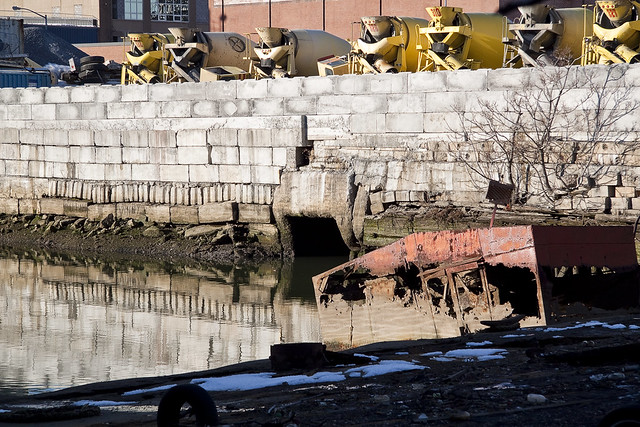
CSO Outfall BB-026, Dutch Kills – photo by Mitch Waxman
Of course, these cleaning chemicals- along with non neutralized microbes- end up in the wastewater flow, and make their way into the sewers… just like the petroleum products, volatile organic chemicals, and everything else that the human hive produces… where they swirl about beneath the streets and follow gravity to low lying areas. A properly designed system intercepts these waters, but in the case of a “CSO”, a lot of the poison makes it into the mud.

CSO Outfall BB-026, Dutch Kills – photo by Mitch Waxman
A classic example of a bacterium whose spread is defined by such aerosol dissemination is Legionella, but heavy metals and other contaminants may also find a pathway into the human body via such aerosols (let’s just call it vapor or fog). Additionally, fibers of toxic manmade substances- Asbestos for instance- are left behind during evaporation. Such deposits are then picked up on the wind, as are the dusty remains of the putrescent particulates which escape treatment by wastewater industries like the Newtown Creek Wastewater Treatment plant in Greenpoint or the Bowery Bay facility in Astoria.
During heavy rain events, some untreated sewage reaches the rivers, but a large percentage of it- the lion’s share- oozes out from the bulkheads of that assassination of joy called the Newtown Creek.

CSO Outfall NCB-632 – photo by Mitch Waxman
The Newtown Creek and its tributaries are indeed waterways, but no one ever discusses this plume of disease and contamination in the air. Fingers are pointed at certain chimneys and infamous underground lakes of petroleum and chemicals, heated discussions of when it might be safe to kayak or swim in the water are offered by interested parties, and odd admissions that there are some who actually fish in and consume the catch from these waters (which according to the EPA, are offering this catch for sale in area restaurants) both shock and titillate area wags- but what about the miasmas?

CSO Outfall NCB-632 – photo by Mitch Waxman
The sewer system of New York City is a composite beast, marrying together the municipal infrastructure of multiple communities into a single system. The cities of Brooklyn, Queens, and Manhattan (the historically agrarian and until modernity- lightly populated – Bronx has almost always been ruled over by Manhattan) each had their own standard, staring elevation, and set of regulations governing the sewers.
This NYTimes.com article from 2008 discusses recent attempts to consolidate and digitize the municipal record, and make sense out of the byzantine network of pipes which underlie the city.

CSO Outfall NCB-632 – photo by Mitch Waxman
Who can guess, all there is, that might be buried down there?
Who can speculate, all there is, which might be wafting out from these deep channels of filth and what strange aerosols are carried upon the gentle breeze- here in the Newtown Pentacle?
The Pulaski Bridge
– photos by Mitch Waxman
Shots from, on, and around the Pulaski Bridge over Newtown Creek. For a more in depth profile of the bridge, click here and visit DUPBO (Down Under the Pulaski Bridge Onramp).
confines of our kingdom
“Newtown Creek for the Vulgarly Curious” is a fully annotated 68 page, full-color journey from the mouth of Newtown Creek at the East River all the way back to the heart of darkness at English Kills, with photos and text by Mitch Waxman.
Check out the preview of the book at lulu.com, which is handling printing and order fulfillment, by clicking here.
Every book sold contributes directly to the material support and continuance of this, your Newtown Pentacle.
Sewer Berries

– photo by Mitch Waxman
Another of the vast inadequacies that Our Lady of the Pentacle must endure is the vast ignorance of vegetable taxonomy exhibited by your humble narrator. Seldom can I distinguish common supermarket species from each other, bay from basil leaves for instance, let alone the multitude of indigenous and untamed forms which are routinely observed as they erupt from the cemented loam of this- your Newtown Pentacle.
One day, recently, my path brought me to Provost Street, a two lane artery which adjoins the Temple of Cloacina in storied Greenpoint.
from nyc-architecture.com
The Praa’s and Volchertsen’s, together, with the Mesorole’s, Calyer’s, Provoost’s, and Bennet’s formed the core of settler farmer families that lived and flourished on the land consisting of Green Point. They and their ancestors would do so for almost 200 years. The fertile land provided enough to supply the needs of the families that toiled on the land, and an abundant excess to trade at nearby markets. Each family kept a large row boat on the river to transport their harvest to the markets downstream in the emerging cities of Williamsburg and Brooklyn, and across the river in New York. Thus, Green Point became a major agricultural center and breadbasket for the area. It’s grains, cereals, fruits, vegetables and livestock made it possible for others to take up other trades in the New World, and contributed to the overall success of the pioneer efforts of that era.

– photo by Mitch Waxman
Fiercely industrial, the Whale Creek side of Greenpoint is remarkable for many things, but mention of the place often omits the tenacity of lifeforms which colonize and find an anchor here in the tiny ribbons of soil that form around depressions and cracks in the otherwise concrete veneer.
Ever wonder why this tributary of the Newtown Creek is known as “Whale Creek”?
Think Kingsland Avenue, from wikipedia
Ambrose Cornelius Kingsland (May 24, 1804 – October 13, 1878)[1] was a wealthy sperm oil merchant who served as mayor of New York from 1851 to 1853. In 1851 he initiated the legislation that eventually led to the building of Central Park.Kingsland’s home was at 114 Fifth Avenue (southwest corner at 17th Street), now the site of a Banana Republic store.In 1864, Kingsland purchased Hunter Island, now in Pelham Bay Park, Bronx for $127,501.00. He later purchased a sizeable country home north of the city along the Hudson River, in present day Sleepy Hollow, New York. His sale of this land to the early steam-engine automotive company, Stanley Steamer, helped pave the way for Sleepy Hollow’s awakening as a major automotive production hub for much of the 20th century. A waterfront park in the Westchester County suburb still bears Kingsland’s name, as does Kingsland Avenue in the Greenpoint neighborhood of Brooklyn, which he helped survey.

– photo by Mitch Waxman
These berries, growing around a utility pole, were unfamiliar to me. Perhaps they are a speciation of grape, thought your humble narrator, although they really resembled a blueberry more than anything else. The curious side of my nature was impressed by their implacable attempt at germination, however, and an attempt was made at photographing them despite a condition of high wind which caused them to whip about in the manner of some tentacled beast.
from wikipedia
Spermaceti (from Greek sperma, seed, and Latin cetus, whale) sometimes erroneously called parmaceti is a wax present in the head cavities of the sperm whale (Physeter macrocephalus). Spermaceti is extracted from sperm oil by crystallisation at 6 °C, when treated by pressure and a chemical solution of caustic alkali. Spermaceti forms brilliant white crystals that are hard but oily to the touch, and are devoid of taste or smell, making it very useful as an ingredient in cosmetics, leatherworking, and lubricants. The substance was also used in making candles of a standard photometric value, in the dressing of fabrics, and as a pharmaceutical excipient, especially in cerates and ointments. Originally mistaken for the whales’ sperm (hence the name), spermaceti is created in the spermaceti organ inside the whale’s head and connected to its nasal passage, among other functions.

– photo by Mitch Waxman
They certainly clung to their stems in the manner of a grape, although color and hue suggested otherwise. Having a near total ignorance of wild plants however, I decided not to hazard a taste- which was probably wise given that the water table in this area is defined and nourished by that nearby extinction of hope known as the Newtown Creek.
To avoid potentially poisonous plants, stay away from any wild or unknown plants that have–
- Milky or discolored sap.
- Beans, bulbs, or seeds inside pods.
- Bitter or soapy taste.
- Spines, fine hairs, or thorns.
- Dill, carrot, parsnip, or parsleylike foliage.
- “Almond” scent in woody parts and leaves.
- Grain heads with pink, purplish, or black spurs.
- Three-leaved growth pattern.
Using the above criteria as eliminators when choosing plants for the Universal Edibility Test will cause you to avoid some edible plants. More important, these criteria will often help you avoid plants that are potentially toxic to eat or touch.

– photo by Mitch Waxman
The small ring of dendritic structures on the underside of the fruit would most likely assist a botanist with identification, and some effort was made to achieve a clear shot of them.
Incidentally, this image actually contains a hint of that otherworldly “colour” which is oft mentioned in postings here, an otherworldly iridescence that seems like something “from out of space”.
from dec.ny.gov
The northeast area of Greenpoint, between North Henry Street, Norman Avenue, and Newtown Creek, has been heavily industrialized and the site of various petroleum industries for over 140 years. Oil refining operations date back to 1834 with the refining of whale oil. Petroleum refining operations began in approximately 1860, with kerosene the major product of interest, as naptha and gasoline were considered by-products of the refining process. By 1870 over 50 refineries were located along the banks of Newtown Creek and by 1892, the majority of the area refineries were purchased and consolidated into the Standard Oil Trust.

– photo by Mitch Waxman
Can any of you, Lords and Ladies, identify these enigmatic Sewer Berries? If so, please contact a humble narrator here. I’m leaning toward Pokeweed.
from wikipedia
Since pioneer times, pokeweed has been used as a folk remedy to treat many ailments. It can be applied topically or taken internally. Topical treatments have been used for acne and other ailments. Internal treatments include tonsillitis, swollen glands and weight loss. Grated pokeroot was used by Native Americans as a poultice to treat inflammations and rashes of the breast. Independent researchers are investigating phytolacca’s use in treating AIDS and cancer patients. Especially to those who have not been properly trained in its use, pokeweed should be considered dangerous and possibly deadly.
Ingestion of poisonous parts of the plant may cause severe stomach cramping, nausea with persistent diarrhea and vomiting, sometimes bloody, slow and difficult breathing, weakness, spasms, hypertension, severe convulsions, and death. However, consuming fewer than 10 uncooked berries is generally harmless to adults. Several investigators have reported deaths in children following the ingestion of uncooked berries or pokeberry juice. Severe poisonings have been reported in adults who ingested mature pokeweed leaves and following the ingestion of tea brewed from one-half teaspoonful of powdered pokeroot.
Pokeweed berries yield a red ink or dye, which was once used by aboriginal Americans to decorate their horses. Many letters written home during the American Civil War were written in pokeberry ink; the writing in these surviving letters appears brown. The red juice has also been used to symbolize blood, as in the anti-slavery protest of Benjamin Lay. A rich brown dye can be made by soaking fabrics in fermenting berries in a hollowed-out pumpkin.
Superfund me

– photo by Mitch Waxman
LO, BEHOLD, and TREMBLE… for the Newtown Pentacle is back in session…
Over several of the last few years, agents and officials of the Federal Government have conducted a strange and secretive investigation into certain conditions within and around the ancient New York waterway called the Newtown Creek.
The public first learned of it in 2009, when a vast series of public meetings and pronouncements were offered by agents of the Environmental Protection Agency which confirmed and introduced the news that the ancient corridor of industry and forbidden history called the Newtown Creek was being considered for inclusion on the Federal Superfund list.
This listing would bestow extraordinary powers over the waterway, and ultimate authority, to the Federal Government. Effectively, the 3.8 mile long border of Brooklyn and Queens with its enormous number of crumbling bulkheads, worm eaten piers, and supposedly empty warehouses are now the responsibility of the G-Men. Uninquiring souls let the occurrence pass as one of the major developments in a spasmodic war on environmental pollution and the toxic legacy of the industrial revolution.
from epa.gov
Release date: 09/27/2010
Contact Information: John Senn (212) 637-3667, senn.john@epa.gov
(New York, N.Y.) The U.S. Environmental Protection Agency (EPA) today added Newtown Creek in New York City to its Superfund National Priorities List of the country’s most hazardous waste sites. The final listing will allow EPA to conduct a comprehensive evaluation of the creek to determine what remedial actions need to be implemented. Various sediment and surface water samples have been taken along the creek. Potentially harmful contaminants such as pesticides, metals and polychlorinated biphenyls (PCBs) have been detected in Newtown Creek along with volatile organic compounds (VOCs). VOCs are potentially harmful contaminants that can easily evaporate into the air.
“The toxic pollution in Newtown Creek is more than a century in the making. EPA is placing Newtown Creek on the Superfund list to ensure the creek receives a thorough cleanup,” said EPA Regional Administrator Judith Enck. “Newtown Creek is a key urban waterway, which provides recreational and economic resources to many communities. Throughout the investigation and cleanup, we will work closely with the communities along the creek to achieve a revitalization of this heavily-contaminated urban waterway.”
EPA proposed Newtown Creek be added to the Superfund NPL list in September 2009. EPA received and considered public comments on its proposal before making its final decision.

– photo by Mitch Waxman
On Monday the 27th of September in this year of 2010, the EPA announced the Superfund listing of Newtown Creek would be moving forward.
Interesting coincidences abound for this date:
The first Ford Model T rolled off the assembly line in 1908 in Detroit, Einstein had his E=MC2 formula published for the first time in 1905, Crete fell to the Turks in 1669, and the Jesuits were granted a Papal charter in 1540. The Warren Commission released its report on the assassination of President John F. Kennedy in 1964, the Ottoman Siege of Vienna began in 1529, the Taliban captured Kabul in 1996, and Thomas Nast was born in 1840.
It is also 110 years and 19 days after this report appeared in the NY Times, and some 122 years and 11 days since this report appeared in the same publication.
also from epa.gov
EPA had previously responded to requests by members of Congress to evaluate specific sites along Newtown Creek by publishing a September 2007 report that contained a review of past and ongoing work being conducted to address the Greenpoint oil spill as well as recommendations regarding future work to assist with the spill response. The state of New York referred the site to EPA due to the complex nature of the contamination in the creek. EPA’s Superfund study and cleanup are expected to focus on the sediments in the creek and on identifying and addressing sources of pollution that continue to contribute to the contamination.
Newtown Creek is part of the core area of the New York-New Jersey Harbor Estuary, which has been designated by EPA as an “estuary of national significance.” Despite the ongoing pollution problems, some residents currently use the creek for recreational purposes such as kayaking, while others eat the fish they catch from the creek.

– photo by Mitch Waxman
According to statements rendered by Government representatives, the actual work on the remediation project is not scheduled to begin in earnest for several months (if not years), as a period of further study and evaluation of the endemic situation before the final formulation of their plans to ferret out and eradicate all that there is which may be buried down there.
The government plans on removing hundreds of metric tons of the sediment which lines the bottom of the Newtown Creek. Privileged to have been included on the conference call during which EPA announced their decision to the third estate, your humble narrator queried EPA personnel as to the methodology of its removal (terrestrial industries versus maritime) and whether they had determined a probable destination for the contaminant laced material they intend to dredge out.
Both questions seemed to have been unexpected, and they reported that answers will be readily uncovered when the final action plan is unveiled sometime in the near future.
additionally, from epa.gov
In the mid -1800s, the area adjacent to the 3.8-mile Newtown Creek was one of the busiest hubs of industrial activity in New York City. More than 50 industrial facilities were located along its banks, including oil refineries, petrochemical plants, fertilizer and glue factories, sawmills, and lumber and coal yards. The creek was crowded with commercial vessels, including large boats bringing in raw materials and fuel and taking out oil, chemicals and metals. In addition to the industrial pollution that resulted from all of this activity, the city began dumping raw sewage directly into the water in 1856. During World War II, the creek was one of the busiest ports in the nation. Some factories and facilities still operate along it, and various adjacent contaminated sites have contributed to its contamination. Today, as a result of its industrial history, including countless spills, Newtown Creek is badly polluted.
In the early 1990s, New York State declared that Newtown Creek was not meeting water quality standards under the Clean Water Act. Since then, a number of government-sponsored cleanups of the creek have taken place. The New York City Department of Environmental Protection has sampled sediment and surface water at a number of locations along the creek since 1980. In early 2009, EPA sampled the sediment throughout the length of Newtown Creek and its tributaries. EPA will review existing information about Newtown Creek to develop a plan for further investigation.

– photo by Mitch Waxman
The professional press also on the call seemed more interested in the Gowanus Canal, how the Mayor felt about the announcement, and grew fixated on the cost of the cleanup effort. EPA clearly spelt out that its budgeting process has barely begun, and they can neither supply a final cost estimate or time table at this early date. This is actually the logical course, as the secrets of the Newtown Creek must- as always- bubble up and reveal themselves to those who stare deeply into its occluded depths.
And, in their own time, all the poisons in the mud will leach out.
and also, from epa.gov
EPA conducted an Expanded Site Investigation (ESI) of Newtown Creek in 2009 as part of the Hazard Ranking System scoring process for NPL listing under Superfund. Based on the ESI, which was focused on Newtown Creek itself and not its tributaries, EPA concluded that metals, volatile organic compounds, and semi-volatile organic compounds (including polycyclic aromatic hydrocarbons and polychlorinated biphenyls) were present in Creek sediments at elevated concentrations. The variety and distribution of the detected contaminants suggests that they originated from a variety of sources. Previous environmental investigations of Newtown Creek, or specific portions of the Creek, also disclosed that sediments in Newtown Creek are contaminated by a wide variety of hazardous substances. Environmental investigations of upland parcels adjacent to or nearby the Creek have disclosed contamination of those parcels by hazardous substances similar to hazardous substances found in sediments in Newtown Creek.


 The Newtown Pentacle