Archive for the ‘Roosevelt Avenue’ Category
microcosmic bonds

– photo by Mitch Waxman
Another of the locations which recent efforts assisting the estimable Kevin Walsh in his “2nd Saturdays” series of walking tours brought me to was the Woodside LIRR station.
For an infrastructure geek like myself, this facility offers an immersion in total joy. The MTA elevated lines which follow Roosevelt Avenue soar above, while on a lower level sits a separate system of trussed steel- the east and west tracks of the LIRR shuttle commuters back and forth between Shining City and crowded suburbs in an easterly suburbia.
Mr. Walsh himself was to arrive on one of these LIRR trains, and I humbly awaited the master.
from wikipedia
Woodside is a neighborhood in the western portion of the New York City borough of Queens. It is bordered on the south by Maspeth, on the north by Astoria, on the west by Sunnyside and on the east by Elmhurst and Jackson Heights. Some areas are widely residential and very quiet, while others (especially closer to Roosevelt Avenue) are more urban. The neighborhood is located in Queens Community Board 1 and Queens Community Board 2.
In the 19th century the area was part of the Town of Newtown (now Elmhurst). The adjacent area of Winfield was largely incorporated into the post office serving Woodside and as a consequence Winfield lost much of its identity distinct from Woodside.
With large scale residential development in the 1860s, Woodside became the largest Irish American community in Queens. In the early 1930s, the area was approximately 80% Irish. Even as the neighborhood has seen growth in ethnic diversity today, the area still retains a strong Irish American presence. There are a number of Irish pubs and restaurants scattered across Woodside.

– photo by Mitch Waxman
While pacing nervously, I was keenly aware of interested glances from local constable and fellow citizen alike.
That shabby man, unshaven and clad in a filthy black raincoat… What is he doing? He looks nervous and occluded, that sweaty fellow who is avoiding eye contact with others. Why is he pacing back and forth like that, and what might he be carrying in that enormous black bag? Doesn’t he seem anxious, as if waiting for something to happen?
Being noticed by the conservative and bourgeois is something that has plagued me always- even as a schoolchild, in auditorium assemblies populated by a thousand maniacs- fellow younglings screaming and dancing about while your humble narrator was quietly reading… I would be singled out for excoriation by certain factions of the school administration which always displayed open hostility to me.
Even today, coworkers might be snorting a line of amphetamines off their desks and I will be called to task for an empty coffee cup left too long untended.
from wikipedia
The Mythological Cycle, comprising stories of the former gods and origins of the Irish, is the least well preserved of the four cycles. The most important sources are the Metrical Dindshenchas or Lore of Places and the Lebor Gabála Érenn or Book of Invasions. Other manuscripts preserve such mythological tales as The Dream of Aengus, The Wooing Of Étain and Cath Maige Tuireadh, The (second) Battle of Magh Tuireadh. One of the best known of all Irish stories, Oidheadh Clainne Lir, or The Tragedy of the Children of Lir, is also part of this cycle.
Lebor Gabála Érenn is a pseudo-history of Ireland, tracing the ancestry of the Irish back to before Noah. It tells of a series of invasions or “takings” of Ireland by a succession of peoples, the fifth of whom was the people known as the Tuatha Dé Danann (“Peoples of Goddess Danu”), who were believed to have inhabited the island before the arrival of the Gaels, or Milesians. They faced opposition from their enemies, the Fomorians, led by Balor of the Evil Eye. Balor was eventually slain by Lug Lámfada (Lug of the Long Arm) at the second battle of Magh Tuireadh. With the arrival of the Gaels, the Tuatha Dé Danann retired underground to become the fairy people of later myth and legend.
The Metrical Dindshenchas is the great onomastic work of early Ireland, giving the naming legends of significant places in a sequence of poems. It includes a lot of important information on Mythological Cycle figures and stories, including the Battle of Tailtiu, in which the Tuatha Dé Danann were defeated by the Milesians.
It is important to note that by the Middle Ages the Tuatha Dé Danann were not viewed so much as gods as the shape-shifting magician population of an earlier Golden Age Ireland. Texts such as Lebor Gabála Érenn and Cath Maige Tuireadh present them as kings and heroes of the distant past, complete with death-tales. However there is considerable evidence, both in the texts and from the wider Celtic world, that they were once considered deities.
Even after they are displaced as the rulers of Ireland, characters such as Lug, the Mórrígan, Aengus and Manannan appear in stories set centuries later, betraying their immortality. A poem in the Book of Leinster lists many of the Tuatha Dé, but ends “Although [the author] enumerates them, he does not worship them”. Goibniu, Creidhne and Luchta are referred to as Trí Dé Dána (“three gods of craftsmanship”), and the Dagda’s name is interpreted in medieval texts as “the good god”. Nuada is cognate with the British god Nodens; Lug is a reflex of the pan-Celtic deity Lugus, the name of whom may indicate “Light”; Tuireann may be related to the Gaulish Taranis; Ogma to Ogmios; the Badb to Catubodua.

– photo by Mitch Waxman
Such persecution, coupled to my own antisocially vicious nature and bizarre mannerisms, has resulted in a very thin skinvelope surrounding your humble narrator. Paranoid, socially crippled, and hostile, in order to stave off madness a decision was made long ago to hide in public. Scuttle about the edges of this vile infestation and gross exaggeration of the human hive, and avoid all but topical contact with it’s residents. A cocoon was spun, and happily occupied.
In recent years, however, novel philosophies and aspirations have motivated me to move in different and delusional directions and to scuttle forth and walk the earth.
from wikipedia
According to an Irish dinsenchas (“place-lore”) poem in the 12th century Book of Leinster, Crom Cruach’s cult image, consisting of a gold figure surrounded by twelve stone figures, stood on Magh Slécht (“the plain of prostration”) in County Cavan, and was propitiated with first-born sacrifice in exchange for good yields of milk and grain. Crom is said to have been worshipped since the time of Eremon. An early High King, Tigernmas, along with three quarters of his army, is said to have died while worshipping Crom on Samhain eve, but worship continued until the cult image was destroyed by St. Patrick with a sledgehammer.
This incident figures prominently in medieval legends about St. Patrick, although it does not appear in his own writings, nor in the two 7th century biographies by Muirchu and Tírechán. In the 9th century Tripartite Life of Saint Patrick the deity is called Cenn Cruach, and his cult image consists of a central figure covered with gold and silver, surrounded by twelve bronze figures. When Patrick approaches it he raises his crozier, the central figure falls face-down, with the imprint of the crozier left in it, and the surrounding figures sink into the earth. The “demon” who inhabits the image appears, but Patrick curses him and casts him to hell. Jocelin’s 12th century Life and Acts of St. Patrick tells much the same story. Here the god is called Cenncroithi, interpreted as “the head of all gods”, and when his image falls the silver and gold covering it crumble to dust, with the imprint of the crozier left on bare stone.

– photo by Mitch Waxman
Childish and puerile, my pedantic credos include “what would Superman do?”, “do what you say, and say what you do”, “the world only makes sense when you force it to”, and the recently added gem “make no assumptions”. Accordingly, while walking this strange path that I’ve found myself on, an attempt to maintain an open mind and absorb as much knowledge as possible from the best sources available has been underway.
Which brings me back to why I was attracting so much interest from gentry and security personnel alike while waiting for Mr. Walsh at the LIRR station in Woodside, Queens.
from wikipedia
In Irish and Scottish mythology, the Cailleach (Irish pronunciation: [ˈkalʲəx], Irish plural cailleacha [ˈkalʲəxə], Scottish Gaelic plural cailleachan /kaʎəxən/), also known as the Cailleach Bheur, is a divine hag, a creatrix, and possibly an ancestral deity or deified ancestor. The word simply means ‘old woman’ in modern Scottish Gaelic, and has been applied to numerous mythological figures in Scotland, Ireland and the Isle of Man.
In Scotland, where she is also known as Beira, Queen of Winter, she is credited with making numerous mountains and large hills, which are said to have been formed when she was striding across the land and accidentally dropped rocks from her apron. In other cases she is said to have built the mountains intentionally, to serve as her stepping stones. She carries a hammer for shaping the hills and valleys, and is said to be the mother of all the goddesses and gods.
The Cailleach displays several traits befitting the personification of Winter: she herds deer, she fights Spring, and her staff freezes the ground.

– photo by Mitch Waxman
Of course, I seldom go anyplace in Queens these days without reading up on it, and this station was at the edge of the John Andrew Kelley property (Woodside takes it’s name from that of his mansion) near the Snake Woods- which popular aphorism in the 19th century referred to as “Suicide’s Paradise”.
The actual spot that the LIRR station occupies was first (european) occupied by the Puritan Wiliam Sackett, who later sold the property to a man named Levirich. The LIRR arrived in the 1860’s and occupied several locations in Woodside until settling into the familiar layout of our modern tracks in 1917.
The ancient Sackett farmhouse was scourged in a mysterious fire which occurred in 1890.

– photo by Mitch Waxman
Pictured above is Woodside Court, which the informed opine as being the oldest apartment house in the neighborhood, dating from 1916. Often have I wondered what it must be like to live in this place along the tracks. When this building was constructed, Woodside was an Irish enclave housing- along with Elmhurst- a substantial percentage of the refugees who fled from the 19th century holocausts, and their American born children.
from wikipedia
In Irish mythology, the aos sí (Irish pronunciation: [iːs ˈʃiː], older form aes sídhe [eːs ˈʃiːə]) are a supernatural race comparable to the fairies or elves. They are said to live underground in the fairy mounds, across the western sea, or in an invisible world that coexists with the world of humans. This world is described in “The Book of Invasions” (recorded in the Book of Leinster) as a parallel universe in which the aos sí walk amongst the living.
In the Irish language, aos sí means “people of the mounds” (the mounds are known in Irish as “the sídhe”). In Irish literature the people of the mounds are also referred to as the daoine sídhe ([‘diːnʲə ‘ʃiːə]), and in Scottish Gaelic literature as the daoine sìth. They are said to be the ancestors, spirits of nature, or goddesses and gods.

– photo by Mitch Waxman
The story which microbiological experts transmit describes the Famines as being caused ultimately by the pathogenic organism known as Phytophthora infestans. Water based, this microscopic menace didn’t follow the immigrants to North America, as Phytophthora infestans is native to the place- just like the Potato.
Originating in the mist shrouded highlands of central Mexico, Phytophthora infestans arrived in Ireland via a batch of potato seedlings sent to Belgium in 1845. Additionally, several modern states including the United States have made attempts at weaponizing the oomycete.
from wikipedia
A Fuath (pronounced foo-ah) (Fuathan pl.) is an evil, Gaelic mythological water spirit. In Irish Gaelic, the word “fuath” means “hate”.
Its name is sometimes used as a regional variance for Kelpie or Uisges in Northern Ireland or the Bean-Nighe. The Scottish use the name to refer to generic water spirits who inhabit the sea, rivers, fresh water, or sea loches. Sometimes, this name is even given to highland or nature spirits, but all forms with the name are evil.
Their appearance ranges from covered in shaggy, yellow fur to just having a mane down its back, webbed toes, tails with spikes, and no nose. They are prone to wearing green, whether it be a dress, robe, or kirtle, as it is the color of faeries.
They sometimes intermarry with human beings (typically the female), whose offspring will share a mane, tail, and/or webbed digits. Their banes include sunlight and cold steel, which will kill them instantly. They grow restless upon crossing a stream.
An alternative name for this class of monsters is Arrachd.
these realms

– photo by Mitch Waxman
Occasion called for me to meet up with Our Lady of the Pentacle deep in the far eastern (from the perspective of Astoria, at least) neighborhood of Flushing over the last weekend. The obviate path would demand navigating and enduring the exquisite ironies visited upon the hapless weekend customer of the MTA here in western Queens, and though my patience was thin- my wallet is thinner so a cab was out of the question and… it was a really nice day.
Hence, I walked… and walked… and walked… from Astoria to Flushing.
The master, Kevin Walsh over at Forgotten-NY offered a “slice” of Roosevelt Avenue in 2008

– photo by Mitch Waxman
This isn’t one of the “deep history” or “occluded past” kind of posts by the way- it’s more a series of surface observations made on a very long walk.
Roosevelt Avenue is a very, very interesting place and not just because of the elevated subway tracks which dominate its experience. Roosevelt starts off at the East River in Brooklyn as “Greenpoint Avenue” and transforms into “Roosevelt” as it hurtles over Queens Blvd and ultimately ending at Northern Blvd. way out in Flushing.
My route out of Astoria followed Broadway southeasterly toward Jackson Heights, and then East on Roosevelt.
The inestimable and inexhaustable Mr. Walsh of Forgotten-NY presented a post detailing the Woodside to Greenpoint side of things, which be accessed here

– photo by Mitch Waxman
Aforementioned, the elevated tracks of the 7 line really do make you understand why Manhattan tore down its elevated tracks as soon as it was feasible. Loud, the structure is a shadowy and dripping mess, providing a home to what must be entire nations of pigeons. Sidewalk and crosswalk intersections resemble the mad excesses of certain Abstract Expressionist painters popular during the 20th century, and the vast structure dominates and demands an oppressive pall over the street.
The Woodside section of Roosevelt Avenue was given a short and sweet “once-over” a while back in this May of 2010 posting, at this, your Newtown Pentacle.
Additionally, the Flushing River just beyond Roosevelt Avenue was explored from the water in this November 2009 posting, and intriguing municipal machinery was observed along Roosevelt Avenue at Flushing’s Corona Yard in this posting from February of 2010.
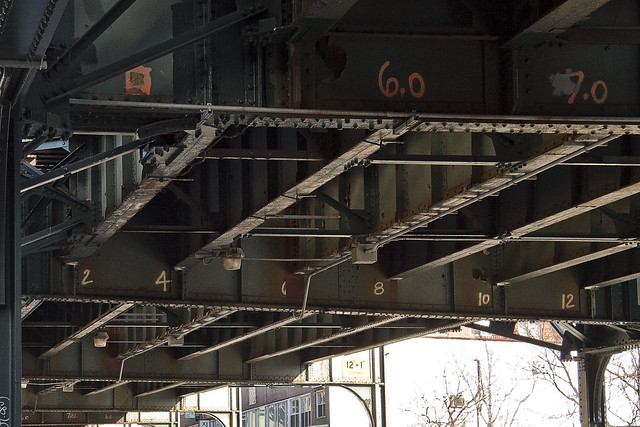
– photo by Mitch Waxman
Roosevelt Avenue, and a few of the neighborhoods it passes through are a subject of much conversation amongst area wags. The whole stretch is home to such a vast agglutination of nationalities and ethnicities, representing what seems like a statistical sampling of every variation which the planetary human infestation might take, that it’s hard to say exactly who lives here.
In the section between Woodside and Flushing though, a LOT of people speak Spanish.

– photo by Mitch Waxman
There’s a lot of controversy surrounding these neighborhoods, with long time Queens residents pointing accusing fingers and offering dire prophecies for the future of the borough based on the presumed moral and legal failings of this new population. The spanish speaking community has exploded in the last decade along Roosevelt Avenue, growing by an astounding estimation of 450% since the last Census. That number, of course, is the official one. There is probably a larger number of people extant, but hazy immigration patterns and reticent newcomers leery of government officials contribute to a less than full accounting.
I can tell you from observation, however, that the economic doldrums affecting other commercial streets (like Steinway Street in Astoria, for instance) in the so called “more affluent” sections of Queens does not seem to be affecting this area.

– photo by Mitch Waxman
Perhaps its because the folks who live here will do just about anything they can to make a few bucks, often working multiple shifts, starting work at a lumber yard in the morning and busing a table in a restaurant at night for instance. A buddy of mine lives around here who came to New York from Ecuador, allows himself only 4 hours of sleep a day at the dormitory like and quite illegal rooming house which serves as his address in Corona. He’s sending money back home when he can, and trying to save what he has left over to do “something” with when opportunity presents itself to him.
I’m not going to gloss over the crime and gang life that is here, it’s just that I don’t know too much about it, and thankfully haven’t had any experience with that side of these neighborhoods.

– photo by Mitch Waxman
The newer buildings you see along Roosevelt Avenue are slapdash affairs, and would seem to fit the term “Queenscrap” coined by our friends over at the blog of the same name. The charming early 20th century detached 2 and 3 story homes which were familiar to multiple generations of…
What is the term for Queens natives anyway? Is it “Queensites” or “Queensipolitans” or “Queensicans” or something? If you’re from Brooklyn or Manhattan it’s “ites”, but what about Queens?
At any rate, the newer structures have one governing principle, and it’s that form follows function. The function seems to be a desire to use every square inch of the property lot and build to maximum height allowable by zoning regulations (and often beyond all law). In a lot where one or possibly two families historically declared their address, there can be as many as 10 or 12 today.

– photo by Mitch Waxman
The effect that this huge surge in population has had on area institutions like schools and hospitals has been profound. The usual problems arising from urban life are compounded by the fact that these are a “working class” group of people- often the so called “working poor”, who suffer from a well known and commented upon series of cultural “Gotcha’s” as it is- many amplified by speaking a different language and differing expectations for the future than those born to the culture they’ve joined.
The largely “middle class” (and often college trained) population of surrounding neighborhoods sneer at the Roosevelt Avenue corridor as being populated by illegal immigrants, call everyone here the “Mexicans“; the males of which are all gangsters- and accusing their women as scheming to spawn “anchor babies” in order to guarantee citizenship in “El Norte” and then allowing their lawless spawn to run wild in the streets. It’s blatant, more than a little racist, and I hear it all the time- even from sources you wouldn’t expect. One neighbor recently opined that “mexicans shit in the street”.
And that’s crap, Lords and Ladies. I’m tired of hearing it, frankly, and that’s what this post is really about.

– photo by Mitch Waxman
In no uncertain terms, understand this- what the “Lower East Side” and “Five Points” were to the Irish, Italians, Germans, and Jews 125 years ago is what Roosevelt Avenue is to this “immigrant wave”. As you’re reading this, a future President of the United States is eating Churros in her baby carriage somewhere on Roosevelt Avenue around 100th street. A Supreme Court Justice is kicking a ball around with a future incarnation of Al Capone in some dusty lot near Linden Park. Roosevelt Avenue is where America is being retooled, and you can safely watch it happening from the sidewalk, while the cowboys and arabs draw down on each other in the cool dusty air of some faraway land.
For reasons I can’t really attribute, the necessity of saying this out loud and in public is important to me.

– photo by Mitch Waxman
Running late, it was decided that to save a few steps and cut through Flushing Meadow Corona Park instead of continuing down Roosevelt Avenue, and I was forced to make a right turn instead of my usual left. Some interesting sights were had, which will be discussed and presented in some future (and less grandstandlingly Progressive!) posting of this- your Newtown Pentacle.
Roosevelt Ave.

– photo by Mitch Waxman
Explorations of the more distant areas of the Newtown Pentacle are consuming. Of late, I find myself wandering the vast corridor of Roosevelt Avenue, which of course connects to the historic Greenpoint Avenue- running across the seldom commented border of Brooklyn and Queens- crossing that shunned strait referred to as the Newtown Creek, and heading for the distant East River. The view above is far from that storied waterway, as Roosevelt Avenue follows the Great Machine toward Flushing, and was shot in Woodside.
from wikipedia
Woodside is a neighborhood in the western portion of the New York City borough of Queens. It is bordered on the south by Maspeth, on the north by Astoria, on the west by Sunnyside and on the east by Elmhurst and Jackson Heights. Its ZIP code is 11377. Some areas are widely residential and very quiet, while others (especially closer to Roosevelt Avenue) are more urban. The neighborhood is located in Queens Community Board 1 and Queens Community Board 2.
In the 19th century the area was part of the Town of Newtown (now Elmhurst). The adjacent area of Winfield was largely incorporated into the post office serving Woodside and as a consequence Winfield lost much of its identity distinct from Woodside.
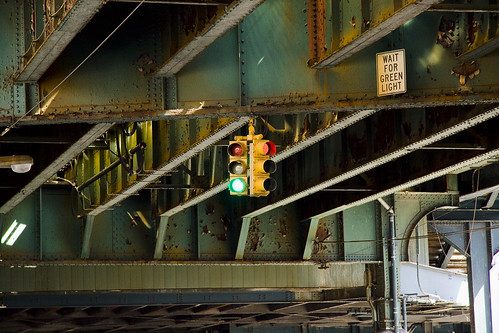
– photo by Mitch Waxman
Not too far away is the Broadway intersection in Jackson Heights, near the very model of a major modern intermodal transportation hub at the Roosevelt Avenue 74th Street station.
from subwaynut.com
The Roosevelt Avenue-Jackson Heights is the one intermediate express station on the Queens Blvd Line, one of the most heavily used and crowded subway trunk lines. The station in addition to serving the large surrounding shopping district of Jackson Heights is also a major transfer point for passengers between express and local trains, to the number 7 line, whose local station at 74 Street-Broadway is located on its elevated structure above the station, as well as to six bus routes to surrounding areas without subway service, most of which begin and end in the station’s covered bus loop and layover area just outside the main station building entrance at street level. To facilitate this the station has two relatively narrow by IND standards for a busy transfer point island platforms for the four track line and a full length mezzanine that is almost still completely open with the exception of a small section of it at the extreme eastern end, albeit only the portion above the Manhattan-bound platform. Here some sort of non-public area has been carved out of the mezzanine and has been fully tiled over as part of the stations recent renovations. The mezzanine also has a number of glassed off areas along it, that were built probably to entice a shopping concourse to open within fare control, although the only stores there so far are some Bank of America ATMs and what looks like a record store.

– photo by Mitch Waxman
Ethnographic scholars treasure this corridor, serving as a cutaway of immigration and sociological patterns. One end of the street is the high modernity of Queens Blvd. in Sunnyside just a few blocks from 2nd and 3rd Calvary Cemeteries, and as it travels through Woodside, Jackson Heights, Elmhurst, Corona, past Citifield, and into Flushing- one sees a cross section of the entire planet’s human infestation. North American, South American, European, African, Asian, Polar- all the tribes of man are here.
Incidentally, a surprising number of psychics, storefront healers, and ethno-religious peasant magick suppliers are observed along its route.
from wikipedia
A botánica (often written botanica and less commonly known as a hierbería or botica) is a retail store that sells folk medicine, religious candles and statuary, amulets, and other products regarded as magical or as alternative medicine. They also carry oils, incense, perfumes, scented sprays (many of which are thought to have special properties) and various brand name health care products.
These stores are common in many Hispanic American countries and communities of Latino people elsewhere. As such:
Botánicas now can be found in any U.S. city that has a sizable Latino/a population, particularly those with ties to the Caribbean. The number of botánicas found outside of New York and Miami has grown tremendously in the last ten years.
The name botánica is Spanish and translates as “botany” or “plant” store, referring to these establishments’ function as dispensaries of medicinal herbs. Medicinal herbs may be sold dried or fresh, prepackaged or in bulk.
Botánica almost always feature a variety of implements endemic to Roman Catholic religious practice such as rosary beads, holy water, and images of saints. Among the latter, the Virgin of Guadalupe and other devotional figures with a Latin American connection are especially well-represented. In addition, most have products associated with other spiritual practices such as candomblé, curanderismo, espiritismo, macumba and santeria.


 The Newtown Pentacle