Archive for the ‘Things to do’ Category
OHNY
Open House New York Weekend is upon us once again, the 10th and 11th of October.
check out http://www.ohny.org/ for details on their various offerings, many of which are free but require regsitration. Of special interest to Newtown Pentacle fans and Creek enthusiasts will be the Bernard Ente and Dave Frieder led tour of the Manhattan Bridge, and the tour of the Newtown Creek Waste Water Treatment Plant.
Saturday the 3rd, Forgotten NY is conducting a walking tour in Ridgewood. Kevin Walsh himself will be leading the walk.
from forgotten-ny.com
Ridgewood is NYC’s latest neighborhood to be recognized by the Landmarks Preservation Commission! Ease into fall with a guided tour of the Onderdonk House, a rebuilt version of an early 18th Century farmhouse, a walk on one of NYC’s most beautiful blocks, Stockholm Street, and a trip to see the gorgeous Gustave X. Mathews flats that inspired the latest Landmark.
Also, I’ll be helping out at the Manhattan Bridge Centennial Parade this Sunday (the 4th). You might still be able to participate. Click here for details.
Leave the 27th of September open, if you’re an Astorian

St. Joseph’s Church 30th avenue bet 44 and 45 streets, Astoria – photo by Mitch Waxman
Founded in 1878 by German Catholics, St. Josephs is clad in the yellow Kreischer brick so typical of this part of Astoria. A massive complex, the church also maintains a school and (or, used to maintain) domestic residences for both Priests and Nuns. On the 27th of September, at 1 in the afternoon, they will enacting the procession of San Pio. This is not dissimilar to the Orsogna Society Parade I was lucky enough to catch last month, but on a grander scale. In past years, I observed Catholic offices as high as Deacon represented and in attendance at this marching of the Saint’s statue. This parade will kick off a sequence of celebratory events at St. Joseph’s- which I’ll be covering in some detail- as it’s around the corner from my house.
from wikipedia
St. Pio of Pietrelcina (May 25, 1887 – September 23, 1968), also known as Saint Padre Pio, was a Capuchin priest from Italy who is venerated as a saint in the Roman Catholic Church. He was born Francesco Forgione, and given the name Pio when he joined the Capuchins; he was popularly known as Padre Pio after his ordination to the priesthood. He became famous for his stigmata.

St. Joseph’s Church parade- 2006, Astoria – photo by Mitch Waxman
Here’s a short Queens Tribune report on the 2006 event. Pio was renowned as an exorcist and stigmatic, which is kind of interesting all on its own. More to come…
NYC Marathon, 2008
When advised by medical practitioners that I should run, I admonish them. I am from Brooklyn, and without someone or indeed- something- chasing me, I walk at my own pace. Thus, I am fascinated by the NYC marathon, which crosses the ancient heart of the Newtown Pentacle on its course. All of the coverage you see of this event is usually manhattan centric, but it actually rolls through some interesting places.

Pulaski Bridge, NYC Marathon 2009, corner of Jackson ave. and 49th ave. – photo by Mitch Waxman
The Pulaski Bridge is the 13.1 mile point in the New York Marathon, for which it is closed to vehicular traffic annually. Runners exit Greenpoint, speed over the Newtown Creek, and head for the Queensboro bridge. They spend 2.5 miles in Queens.
From wikipedia
The New York City Marathon (ING New York City Marathon for sponsorship reasons) is a major annual marathon (42.195 km (26.219 mi) whose course runs through all five boroughs of New York City. It is one of the largest marathons in the world, with 37,850 finishers in 2006. Along with the Boston Marathon and Chicago Marathon, it is among the pre-eminent long-distance annual running events in the United States and is one of the World Marathon Majors.

Down Under the Queensboro Bridge Onramp- DUQBO- during the 2007 NYC marathon. – photo by Mitch Waxman
When they hit Queensboro, relief for the 2.5 miles of pain that the runners remember as Long Island CIty becomes intellectually closer, and most of the runners redouble their determination and effort. There is a significant Police Dept. muster, in DUQBO, including auxiliary and cadet officers. The cops are involved, from their point of view, in a 25 mile long rerouting of vehicular and pedestrian traffic across multiple municipal and jurisdictional districts. Rerouting the millions of vehicles denied easy access to Manhattan, ensuring that FDNY can move ambulance and fire units seamlessly around the event, mustering and deploying the hundreds of traffic officers- as well as dozens of specialized units ranging from Equestrian to Aviation… This is no marathon, this is a military operation.
Come to think of, so was the story which inspired all future marathons, and lent them its name- in Greece.
from wikipedia
The Battle of Marathon (Greek: Μάχη τοῡ Μαραθῶνος, Māche tou Marathōnos) took place in 490 BC during the first Persian invasion of Greece. It was fought between the citizens of Athens, aided by Plataea, and a Persian force commanded by Datis and Artaphernes. It was the culmination of the first attempt by Persia, under King Darius I, to subjugate Greece. The first Persian invasion was a response to Greek involvement in the Ionian Revolt, when Athens and Eretria had sent a force to support the cities of Ionia in their attempt to overthrow Persian rule. The Athenians and Eretrians had succeeded in capturing and burning Sardis, but was then forced to retreat with heavy losses. In response to this raid, the Persian king Darius I swore to have revenge on Athens and Eretria.
Once the Ionian revolt was finally crushed by the Persian victory at the Battle of Lade, Darius began to plan to subjugate Greece. In 490 BC, he sent a naval task force under Datis and Artaphernes across the Aegean, to subjugate the Cyclades, and then to make punitive attacks on Athens and Eretria. Reaching Euboea in mid-summer after a successful campaign in the Aegean, the Persians proceeded to besiege and capture Eretria. The Persian force then sailed for Attica, landing in the bay near the town of Marathon. The Athenians, joined by a small force from Plataea, marched to Marathon, and succeeded in blocking the two exits from the plain of Marathon. Stalemate ensued for five days, before the Athenians (for reasons that are not completely clear) decided to attack the Persians. Despite the numerical advantage of the Persians, the hoplites proved devastatingly effective against the more lightly armed Persian infantry, routing the wings before turning in on the centre of the Persian line.
The defeat at Marathon marked the end of the first Persian invasion of Greece, and the Persian force retreated to Asia. Darius then began raising a huge new army with which he meant to completely subjugate Greece; however, in 486 BC, his Egyptian subjects revolted, indefinitely postponing any Greek expedition. After Darius died, his son Xerxes I re-started the preparations for a second invasion of Greece, which finally began in 480 BC.
And, yeah, I know- the “in greece” link is the Battle of Thermopylae, and is highly stylized.

Queens Plaza – photo by Mitch Waxman
The interesting part of the marathon, to my eye, is what’s happening around it. Queens Plaza devoid of vehicular traffic, for instance. But NYC has been making great effort and spending big money on Physical Education and Culture since the early days of Progressivism.
from nycgovparks.com (this goes to a really cool page, click this link)
Recreation in Parks
Since the ancient Greeks (or even earlier) there has been a strong link between physical health and general wellbeing. For nearly 100 years, the Parks Department has been at the forefront in supporting a healthy city and putting the “recreation” in “Parks & Recreation.” From the early bathhouses to the anti–obesity programs of today, the Parks Department’s focus on active recreation has supported the goal of a healthy citizenry and positive social and moral conduct…

Near Queens Plaza – photo by Mitch Waxman
Volunteers and well wishers, of both corporate and individual stripe, line the streets. This is actually a dangerous place to be, as at any moment, 200 pounds of human meat may accidentally run into you. Accordingly, NYPD aggressively enforces a margin of safety between runners and crowd, as is their stated mandate and mission- protect and serve.
from wikipedia
The physical culture movement of the 1800s owed its origins to several cultural trends.
As a result of the Industrial Revolution, there arose a perception that members of the middle classes were suffering from various “diseases of affluence” that were partially attributed to their increasingly sedentary lifestyles. In consequence, numerous exercise systems were developed, typically drawing from a range of traditional folk games, dances and sports, military training and medical calisthenics. Many of these systems drew inspiration from the classical Greek and Roman models of athletic training and were organized according to more-or-less scientific methods.
Physical culture programs were promoted through the education system, particularly at military academies, as well as via public and private gymnasiums.
Increasing levels of literacy, the increasing democratization of printing and the relative affluence of the middle classes spurred the growth of a genre of magazines and books detailing these systems of physical culture. Mass production techniques also allowed the manufacture and commercial sale of various items of exercise equipment. During the early and mid-1800s, these printed works and items of apparatus generally addressed exercise as a form of remedial physical therapy.
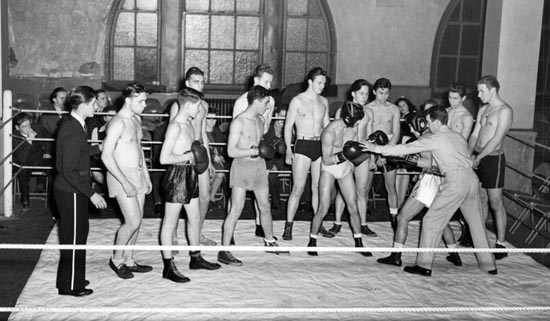
Certain items of equipment and types of exercise were common to several different physical culture systems, including exercises with Indian clubs, medicine balls, wooden or iron wands and dumbbells. Combat sports such as fencing, boxing and wrestling were also widely practiced in physical culture schools, and were touted as forms of physical culture in their own right.
By the later 19th century, the ethos of physical culture had expanded to include exercise as recreation, education, as preparation for competitive sport and as an adjunct to various political, social, moral and religious causes. The Muscular Christianity movement is an example of the latter approach, advocating a fusion of energetic Christian activism and rigorous physical culture training.

NYC Marathon – photo by Mitch Waxman
A neverending stream of humanity, emblazoned with signage and logotypes, course past. Many are in the final stage of enacting some personal and tragic journey, or running to memorialize the name of a lost loved one, or to celebrate some event. Many have charitable contributions tied to the miles and miles of pavement they cross. Most just run for the human challenge presented by the concrete realities of New York City. At least that’s what the messages were in a series of Nike and Footlocker ads that I worked on for a major metropolitan ad agency just a few years ago.
Like I said at the beginning of this post, I walk (scuttle, actually). These people are nuts.
from wikipedia
The terms to jog and jogging as referring to a form of exercise, originated in England in the mid seventeenth century. This usage became common throughout the British Empire and in his 1884 novel My Run Home the Australian author Rolf Boldrewood wrote “your bedroom curtains were still drawn as I passed on my morning jog”.
In the United States jogging was also called “roadwork” when athletes in training, such as boxers, customarily ran several miles each day as part of their conditioning. In New Zealand during the 1960s or 1970s the word “roadwork” was mostly supplanted by the word “jogging”, promoted by coach Arthur Lydiard, who is crediting with popularizing jogging. The idea of jogging as an organised activity was mooted in a sports page article in the New Zealand Herald in February 1962, which told of a group of former athletes and fitness enthusiasts who would meet once a week to run for “fitness and sociability”.

NYC Marathon – photo by Mitch Waxman
As they progress, cheering crowds villify the thought of surrender, admonish fatigue, and buoy the athletes to further exertion.
from nycmarathon.org
Around the world, the word “marathon” evokes images of New York City. Before the New York race began, marathons were modest events run by a few athletes and followed by a few fans interested in the limits of human endurance. New York Road Runners and marathon co-founder Fred Lebow changed that. Today many marathons are huge media events that take over entire cities around the globe. None is as prominent as the ING New York City Marathon, but all city marathons are modeled on it. Modern marathoning owes its start — and its world-class status — to New York.
The first New York City Marathon, though, was a humble affair. In 1970, 127 runners paid the $1 entry fee to NYRR to participate in a 26.2-mile race that looped several times within Central Park. Fifty-five runners crossed the finish line

NYC Marathon, Dead by Choice band – photo by Mitch Waxman
All along the route, bands were assembled and were allowed to play both amplified music and drums- normally a violation of the city’s strictly enforced Cabaret Law. Entertainers, street performers, and representatives of the local Ethnic Societies all had their spots staked out early.
from nycmarathon.org
Music
More than 100 live bands stationed at regular intervals along the course will motivate and entertain participants and spectators alike. A special stage at Columbus Circle sponsored by Continental Airlines will provide inspiration for the final .2 mile, and there will be live entertainment at the finish line as well.

NYC Marathon, accordion man – photo by Mitch Waxman
Long Island City’s longtime residents always seem to have a good natured chuckle when one of these “City” events rolls through. This gentleman and his wife set up chairs, and he was playing the “toura loura loura” brand of music on his accordion to the runners. He also played an instrumental version of “eleanor rigby“, which was both ironic and funny.
The winners of the 2008 marathon were-
the male champion Brazilian Marílson Gomes dos Santos, who ran the course in 2 hours, 8 minutes and 43 seconds-
and British Paula Radcliffe won the female prize for her 2 hour, 23 minute, and 56 second run.

NYC Marathon – photo by Mitch Waxman
In 2008, the New York City Marathon was only thought to have killed two. Reports were later revised to three.
from wikipedia
The 2008 marathon events were marred by the deaths of three marathon participants:
Carlos Jose Gomes, 58, of Brazil fell unconscious shortly after completing the race in 4:12:15. An autopsy revealed that he had a pre-existing heart condition and died of a heart attack.
Joseph Marotta, 66, of Staten Island, N.Y. succumbed to a heart attack hours after he completed his fourth New York City Marathon. He walked the course in 9:16:46.[
An unidentified 41-year-old man who collapsed at the marathon died on 15 November.

NYC Marathon – photo by Mitch Waxman
The official website for the Marathon is found here. They are currently gearing up for the annual incarnation of the event- scheduled for November 1st, All-Saints Day 2009.
The way other cultures will be celebrating the day are ingenious, and varied. Incidentally, Nov 1st is also called Samhain, by some, but I would be surprised at any bonfires lit in the Newtown Pentacle.
from wikipedia
In Portugal and Spain, ofrendas (offerings) are made on this day. In Spain, the play Don Juan Tenorio is traditionally performed. In Mexico, All Saints coincides with the celebration of “Día de los Inocentes” (Day of the Innocents), the first day of the Day of the Dead(Dia de los Muertos) celebration, honoring deceased children and infants.
In Austria, Belgium, France, Hungary, Italy, Malta, Portugal and Spain people bring flowers to the graves of dead relatives.
In Poland, the Czech Republic, Sweden, Finland, Slovenia, Slovakia, Lithuania, Croatia, Austria, Romania, Moldova, Hungary and Catholic parts of Germany, the tradition is to light candles and visit the graves of deceased relatives.
In the Philippines, this day, called “Undas”, “Todos los Santos” (literally “All Saints”), and sometimes “Araw ng mga Namayapa” (approximately “Day of the deceased”) is observed as All Souls’ Day. This day and the one before and one after it is spent visiting the graves of deceased relatives, where prayers and flowers are offered, candles are lit and the graves themselves are cleaned, repaired and repainted.
In English-speaking countries, the festival is traditionally celebrated with the hymn “For All the Saints” by William Walsham How. The most familiar tune for this hymn is Sine Nomine by Ralph Vaughan Williams.

NYC Marathon – photo by Mitch Waxman
November 1st is, incidentally, also the anniversary of the abdication of the last Ottoman Sultan in 1922- Mehmed VI, which was the end of a 25 century struggle between east and west that truly began at The Battle of Marathon. It’s also World Vegan Day.
For the whole marathon series in a slideshow click here. I was down there shooting between 12 and 2, if you’re one of the runners, contact me for access to full resolution shots.

NYC Marathon – photo by Mitch Waxman
Going to be in Newtown on Labor Day weekend?
Just received from working harbor committee-
Labor Day Weekend
Fun for the Family at the Annual Tugboat Race!
Tugboat Race & Competition
6 September at Pier 84
Ride on a Circle Line 42 Spectator Boat

Or go to www.WorkingHarbor.Org
Also available A special ride on a tug in the race!!! All proceeds to benefit Working Harbor Committee Maritime Educational Programs for at-risk High School students in the NY/NJ area.
To order tickets direct for tug race spectator boat or special tugboat ride in the race- Click Here
I’m going to be helping out at this event, and it promises to be nothing but fun.
Astoria to Calvary 5- the bitter end
Altissima quaeque flumina minimo sono labi
The deepest rivers flow with the least sound

47th avenue – photo by Mitch Waxman
In the first installment of this photowalk–
we scuttled through western Queens – descending from Astoria down to Northern Blvd.
In the second,
we lurked, fearfully, down vestigial 37th avenue – past an anomalous municipal building and fortress church.
In the third,
we marched defiantly into the Sunnyside, and were thunderstruck by the colossus Sunnyside Rail Yard.
In the fourth,
ruminated on the Boulevard of Death, and gazed upon Aviation High School.
Today, we arrive at Calvary, and suddenly connect with several other posts. Witness…

47th avenue Street Sign – photo by Mitch Waxman
Leaving Aviation High School behind you, Newtownicans, continue up the hill that 36th street transverses. Look to your right, where the western end of 47th avenue is blocked by the Sunnyside Yard – and you will collide with an older post here at the Newtown Pentacle- “Dutch Kills- or let the photos do the walking“.

47th Avenue – photo by Mitch Waxman
The nearby corner of 47th st. and Van Dam St., which skirts the shadowed valley of that great hill in which Calvary Cemetery is embedded, is where the New York State Queensboro Correctional Facility is located. Just a few blocks beyond the gaol at 29th street is the Dutch Kills tributary of the Newtown Creek.
A spectacular riot played out here and in many other New York City Jails in 1970, in response to the poor conditions found in the State and City corrections systems of the 1960’s presaging the Attica riot in upstate New York. This event (and other problems he had in Queens) foreshadowed the jaundiced legacy that Mayor John V. Lindsay‘s political career would be remembered by, and the riots were organized and led by the Black Panther Party and Young Lords.
There are many jails here on the Queens side of the Newtown Pentacle, notably Rikers Island, a seething asp caged just off the shoreline of ptolemaic Astoria.
from time.com
The worst jail crisis in the city’s history began at lunchtime four days earlier at the 95-year-old Branch Queens House of Detention for Men. Inmates snatched keys from unarmed guards and made a frantic dash through the halls, unlocking cells all the way. The rioters turned on faucets to flood several floors, set fire to furniture and bedding, heaved debris and an eight-foot wooden bench out of broken cell windows. In a new political twist, they also hung the flag of the black liberation movement from a top-floor window. Over the next three days, more riots flared at other city jails, including the Tombs. In all, more than 2,500 inmates joined the rampage and seized 32 hostages—all for the sake of airing their grievances.

36th street, moving up toward Laurel Hill – photo by Mitch Waxman
The proclivity of the ground will take a sharp upturn here, and one becomes increasingly cognizant of the natural lay of the land- with its boulderized hillocks rising from sand and muddy clay- and its formation by the glacial actions of the Wisconsin Ice Age.
from geo.hunter.cuny.edu– An intriguing description of the strata found in the New York Bight.
from wikipedia
The island’s tallest natural point is Jayne’s Hill near Melville, with an elevation of 400.9 feet (122.2 m) above sea level. Long Island is separated from the mainland by the East River, which is actually not a river, but a tidal strait. Long Island Sound forms the northern boundary of the island.

48th Avenue – photo by Mitch Waxman
48th avenue terminates at 30th street, a block from the Dutch Kills. 36th street is about to end too, when we reach the top of the hill. A forbidding stretch of unlettered warehouses describes 48th avenue as it slopes down the morraine carved declination, barren and treeless.

36th street, Antennae- photo by Mitch Waxman
Between 48th and Hunters Point Avenue- you will find more warehouses, a very impressive broadcast antennae, and a gigantic charismatic church operating out of an altered workhouse.

36th street, St. Raphael on Horizon – photo by Mitch Waxman
At the corner of 48th street, St Raphael’s comes into view. Ahem, sorry but now’s when I reveal a few more of our hidden connections:
Cross 36th street at Hunters Point Avenue and Continue all around Calvary Cemetery in “Walking Widdershins to Calvary“
excerpt from July 31, 2009

-photo by Mitch Waxman
Click here to preview this photowalk in a google map
Hunters Point avenue intersects with the ancient course of Greenpoint Avenue at the degenerate extant of Long Island City. The Queens Midtown Expressway also comes back down to earth here, feeding Manhattan vehicular traffic to all points east. This is a very busy intersection, so be mindful of traffic, as fellow pedestrians are rare.
As with anyplace else in Queens you’d want to see, Forgotten-NY has been through here before. Click here for their page on Blissville and Laurel Hill.

-photo by Mitch Waxman
St. Raphael’s R.C. Church is on Greenpoint Avenue in a neighborhood called (atavistically) Blissville. A wooden frame building was built for St. Raphael’s in 1867, and served as the mortuary chapel for the newly built Calvary Cemetery. The current gothic influenced structure was completed in 1885, and has served both Calvary and the surrounding community since. This is one of the highest points in these parts, and the church steeple often acts as a reference point when negotiating the byzantine tangle of streets around the Newtown Creek. The architect is rumored to have been Patrick Keeley.
Enter Calvary Cemetery in “Calvary Cemetery Walk“
excerpt from August 5, 2009

-photo by Mitch Waxman
Just across the street from the site of the former LIRR Penny Bridge station. Easily accessed via the street, upon crossing the gates of Calvary, one will find a staircase carven into the hill by whose ascent the Newtown acropolis may be obtained. Cresting over the surrounding neighborhoods, and soaring over theNewtown Creek’s former wetlands, Calvary Cemetery keeps its secrets buried in centuried silence. Looking south toward Brooklyn, the Kosciuszko bridge approach of the Brooklyn Queens Expressway looms over its passage, carrying millions of vehicles over and across the necropolis of New York City.

-photo by Mitch Waxman
Phantoms of what could have been haunt Calvary, roaming in soliloquy amongst the avenues of nitredripping marble. The 1918 superflu and an earlier cholera epidemic staffed the ranks here with both the sacred and the profane. St. Patrick’s in Manhattan used this place for the interment of New York’s best and brightest. This is where the ossified remnants of the men who died battling the traitorous slavers of theConfederate South can be found in the Newtown mud. In subterranean vaults of marble and basalt, and within leaden coffins, these gentlemen– the ultimate product of an age of victorian aspirations- lie in putrid splendor, alongside the occasional merchant and immigrant whose life savings were traded to purchase their final resting place.
Pass by Calvary Cemetery and into Maspeth and the Newtown Creek in “Dead Ends, A short walk from Maspeth to Calvary“
excerpt from July 29, 2009
However, we are on the industrial side of town- down by the Newtown Creek- where the sins of our fathers continue to haunt modernity.
This is where we left off on July 16th- at the corner of 56th road, between 48th and 50th streets in Queens. This is an insanely dangerous patch of road running through a literal industrial backwater, so be careful. Last time we walked down the Maspeth Plank Road toward Brooklyn, today we’re going another way- tracing the course of the Newtown Creek on the Queens side for a while.

-photo by Mitch Waxman
From the vantage point above, look to your right, and you’ll see the Kosciuszko bridge. Head in that direction, which is roughly northwest and toward Manhattan. You’ll be walking down 56th rd. for a little while. The sidewalk on the Creek side is fairly non-existent, so cross the street. Watch out for trucks. Why was I here on foot, you ask?


 The Newtown Pentacle