confined wholly
A garbage post today.

– photo by Mitch Waxman
One makes a point of photographing the things which other people do not. Partially, this stems from my fascination with the vast municipal machinery of New York City. I know a lot of people who work in the boiler room of the great hive, from executive to laborer, and what I’ve gleaned from conversation with them over the years is how complicated and byzantine the “system” is. Many have opined about the proverbial situation of “replacing the carburetor while driving down a dark highway at ninety miles an hour” they encounter at work. There’s holdover labor agreements which were arrived at prior to the Second World War, political compromises made by Mayors who have been dead for fifty years, and legal or regulatory issues which randomly arrive from Albany or Washington that can upend an otherwise smoothly functioning operation.
I’m particularly interested, on the subject of recording things few others notice, with the muni services that nobody really wants to think about that revolve around human and animal cadavers, sewage, and especially garbage.

– photo by Mitch Waxman
Intricate. That’s how I’d describe the system in NYC which gathers up waste and moves it out of the City. Originally a wholly owned arm of the Dept. of Health, the Deparment of Sanitation is a “Reports directly to the Mayor Commissioner” level operation in modernity, although it’s still organized as part of the Health Dept.
As Wikipedia will tell you – The New York City Department of Sanitation is the largest sanitation department in the world, with 7,201 uniformed sanitation workers and supervisors, 2,041 civilian workers, 2,230 general collection trucks, 275 specialized collection trucks, 450 street sweepers, 365 salt and sand spreaders, 298 front end loaders, and 2,360 support vehicles. It handles over 12,000 tons of residential and institutional refuse and recyclables a day.

– photo by Mitch Waxman
As a boy in blue collar Brooklyn, the conventional wisdom passed on to a young but already humble narrator as far as success in life was to “take the civil service exam” and become a garbageman as they had a strong union with great benefits and you’d basically never be out of work. There was also a contingent who recommended becoming affiliated with the court system as a Bailiff, as a note. Almost nobody recommended becoming a Cop, but it was the 1970’s.

– photo by Mitch Waxman
There’s a private carting industry in NYC, of course, which handles commercial and restaurant waste. That side of waste handling has a decidedly checkered past, whereas the DSNY is generally considered above any reproach.
Part of the reason I’m fascinated by services like DSNY or the DEP is that people would rather not think about their personal waste stream, so they’re seldom aware of the budgets or sending practices of either agency. Anything municipal that operates in shadow is something that should very much be paid attention to, in my opinion. All of the classified stuff that NYPD gets up to involving terrorists is a subject which should receive a lot more introspection than it gets, as “black box” spending is where a lot of dirty laundry can be found.

– photo by Mitch Waxman
DSNY handles residential recycling collections, passing the material pulled off the curbs to private companies like SimsMetal, or in the case of black bag garbage – Waste Management. I’ve written a whole lot over the years about how this system operates and the intricate web of waste transfer stations and maritime industrial transport of the stuff which occurs invisibly all around us. It’s made me highly aware of my own contributions to the “flow” and quite conscious of my own culpabilities as far as destroying the planet.

– photo by Mitch Waxman
As you may have guessed, this is another one of my “archive posts,” but if all goes to plan and I manage to process the shots I have cooking on my hard drive today, you’ll see some of what I saw over the last few days in tomorrow’s post at this – your Newtown Pentacle.
“follow” me on Twitter- @newtownpentacle
honest bourgeoise
Street Furniture, in today’s post.

– photo by Mitch Waxman
A humble narrator is still a bit behind in his schedule, and a series of peregrinations over the weekend diverted one from producing new posts or putting the finishing touches on any new shots, so I reached into the archives for today’s post. It’s one of my favorite subjects – street furniture. Normally that term applies to fire hydrants or lamp posts or benches, but in my little world it can also be used for the cast off furnishings that the humans who inhabit this urban hive position on the street in the hope that some one, anyone in fact, might lessen their burden and take the unwanted thing.
Interesting thing about street furniture is that it often speaks to the economic status of the neighborhood you encounter it in. To wit – this rather expensive looking chair encountered along the sidewalks of the Upper East Side of the Shining City of Manhattan, pictured above. That’s some high class trash, yo.

– photo by Mitch Waxman
“Brooklyn rules” state that if something has been abandoned on the sidewalk, it’s yours for the taking. Before the reemergence of bed bugs (or “vantzem,” as my Grandma would have said) in NYC in recent years, it was fairly commonplace for young folks and college students to furnish their entire apartment with found furniture.
Not so much anymore, I’m told.

– photo by Mitch Waxman
One is always impressed with the material wealth of our culture. The amount of usable and fairly well conditioned furniture cast aside in the pursuit of redecorating is kind of staggering. Often it seems that you could fill an entire apartment with stuff you’d find after a bit of leg work on bulk pickup days.
I’d need to buy a new mattress, as a note. There are certain items which I categorize as “personal” – hats, shoes, underwear, bedding. Items that might spend a lot of its time absorbing bodily fluids like spit or sweat are things you really want in “virgin” condition, in my opinion.

– photo by Mitch Waxman
There are a few non profits out there, beyond the morally circumspect Salvation Army people, who will take your “good condition, used” category furniture items and see that they find a new home with somebody in need. There’s “Build it Green” here in Queens, for instance. I’ve always wondered why the Sanitation Department doesn’t do something similar with good condition furniture left on the curb.
I would guess that the logistics of redistribution rather than disposal would be too expensive and complicated to be feasible.

– photo by Mitch Waxman
A complaint often offered at this – your Newtown Pentacle – centers around the lack of public lavatories in NYC.
This sidewalk find in LIC suggests that all things are possible if a little imagination is utilized.

– photo by Mitch Waxman
This fellow is a hero to all Astorians, having dragged his reclining “dad chair” into his minivan and then deploying it at Astoria Park. Thusly, the very best definition of street furniture is submitted for your approval.
“follow” me on Twitter- @newtownpentacle
certain conflicts
Uhhhhhnnnnnnk, Manhattan… in today’s post.

– photo by Mitch Waxman
One had reason to visit that island hive of villainy and runaway political ambitions called Manhattan a few weeks ago, and found myself climbing to the concretized street level of that accursed complex via the stairs leading out of that badly ventilated subterrene concrete bunker which the children of NYC refer to simply as the “34th street/Herald Square” subway station.
Emerging from the hellish heat of that cavern lurking squamously beneath the streets, one was suddenly beset by throngs of disturbingly heterogenous tourists aimlessly clinging to those shadows provided by the high flung towers, blotting out the sky, which was a scene somehow inhuman and banal simultaneously. These creatures bounced and bumped into each other, careening between the merchant carts selling noxious smelling foodstuffs of uncertain origin, locomoting in a manner betraying that using their own feet was a somewhat alien concept.
On the filth caked pavement lay inebriates, madmen, and addicts – the latter proudly displaying their gangrenous abcesses in pursuance of soliciting currency, from both the native born and quite pitiless passerby, and foreign born tourist. The air itself was contaminated with vehicle exhaust, an abundant cacophony of stink was emanating from mounds of rotting garbage, and the greasy puddles swirled sickly along the curbs. All was pestilential.
Nearby the intersection of 34th street and 8th avenue, the fellow above was observed sitting in the ruinations offered by the omnipresent real estate industrial complex. The Manhattan people have become concerned in recent years about “gentrification,” since now it’s happening to them. I really, really hate going into the City these days, that’s what I guess I’m trying to say, but since I was already there I decided to visit Dyre Avenue.

– photo by Mitch Waxman
I’m told that Dyer Avenue was named for General George Rathborne Dyer, a chairman of the board of the Port Authority of New York and New Jersey, who died in 1934 while the Lincoln Tunnel was under construction (the tunnel was finished in 1937). Although I’ve noticed the street hundreds if not thousands of times, never have I decided to walk its truncated length.
After conducting a transaction with the camera shop people on the next corner, a humble narrator decided to put that right, on his way back to the train which would carry me to the rolling hills of Astoria, back in Queens. The less time spent in Manhattan the better, I say, so I try to get a lot done whenever I’m stuck going there.
– photo by Mitch Waxman
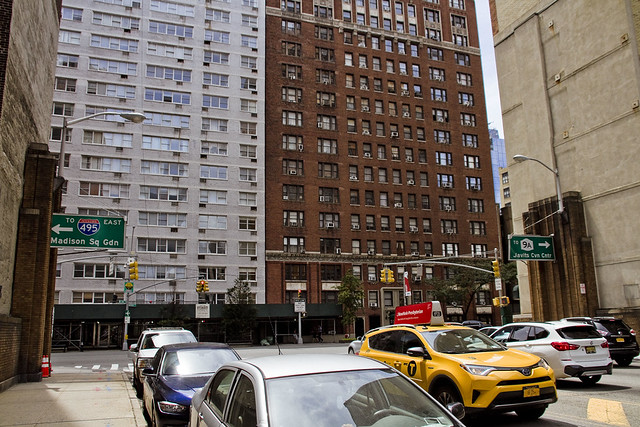
Dyer Avenue diverges northwards off of W 34th street between 9th and 10th avenue, and continues along to W42nd street. Along the way, you’ll find a complicated series of entrance and exit schemes for the Lincoln Tunnel and the Port Authority Bus Terminal. I suppose you could describe it as passing through Hells Kitchen, although I usually associate that cognomen with a neighborhood found in the west 40’s.
NYC City Planning, the NYC EDC, and the Related Companies would appreciate it if we all just referred to the zone surrounding 34th street and Dyre Avenue as “Hudson Yards,” but they’re heavily invested in calling it that.

– photo by Mitch Waxman
“Manhattan is the problem, not the solution,” that’s what I tell all the people who work for the entities mentioned in the last paragraph who would prefer you to refer to this section as Hudson Yards, and nowhere is my statement better proven than in this area.
Inhuman streetscape given over entirely to the exigencies of the automobile? Check! A complete lack of trees? Check! A sterile post industrial streetscape with zero ground level retail activity or areas for residents or workers to congregate? Check! Pedestrian safety an afterthought? Check!

– photo by Mitch Waxman
There’s a comical little “green space” on Dyer, found between W 35th and W 36th, with a few potted treelings. What makes it “green space” is that the City has painted the concrete traffic island’s paving stones green.
Better than nothing, I guess.

– photo by Mitch Waxman
High overhead, the gleaming vainglory of the Hudson Yards mega project looms.
Want to know what Sunnyside Yards would do to Queens? What sort of buildings make it financially justifiable to build a deck over a rail yard? Take a walk around the west side in the 30’s, that’ll show you the solution which the Mayor has been searching to find a problem for. That’s the “Manhattan solution” for the puzzle of Western Queens, incidentally.
What Queens people think about Sunnyside Yards and all of this mega development is incidental. It’s the people who gave you Dyer Avenue – their opinions matter, not yours. They live in Manhattan.
So, what are you going to do about that?
“follow” me on Twitter- @newtownpentacle
aroused about
A storm’s a coming.

– photo by Mitch Waxman
Depressing, that’s how I usually describe it. Shortly after taking this photo in the Court Square/Queens Plaza area of Long Island City, where the sidewalk was actually blocked off by this enormous midden of residential tower garbage, I sat in one of the high priced cafes installed into one of those residential towers (the kind that offers fare best described as a single perfect tomato served on a big white artisinal plate) and listened to a group of activists telling me that all this real estate development was just peachy and that they’d like to see more of it. My spiel about opposing the Sunnyside Yards fell on fairly deaf ears, and I inquired about how long the folks I was chatting with had lived here in LIC. The answer was pretty much encapsulated by De Blasio’s term in office, and I realized that these folks hadn’t been here for a transit strike, or a blackout, or had the Mayor turn a hotel on their block into a homeless shelter yet. Give it time folks, and remember the Borough Motto – “Welcome to Queens, now go fuck yourself.”
They didn’t mind the fact that they were living on the site of a 19th century chemical factory, and in fact didn’t care.

– photo by Mitch Waxman
Another sit down with a group whom I would describe as “hard left” was also somewhat dismaying, as their plan for the future involved collapsing one of the legs of the economic stool which the City’s economy stands upon. I’ve said this a million times, it seems, but one is not “anti-development” as macro economic forces such as our current building boom need to be managed, and the job of government is to manage and eke concessions or “buy-in’s” from the real estate industrial complex which both current and future populations will need. Transit improvements, green infrastructure, medical facilities, supermarkets and laundromats, school space, street level urban furniture like benches and garbage cans. Instead, our government still operates as if it’s the 1970’s and they need to beg developers to begin projects in NYC. The Real Estate people are awash in the “LLC” money that often malign foreigners are laundering through our local economy, so let’s demand that they share the wealth just a little bit and design some ameliorations of the City’s many needs into their towers – that’s what I say. It’s called “good old fashioned graft” in case anyone has forgotten that term. Why isn’t there still any place to take a piss, amidst all this new construction?
Is Long Island City going to function as a “city,” or is it instead just destined to be a dormitory for Manhattan’s job base. Why aren’t we talking about office space and commercial construction here? As the old adage offers – if you build it, they will come. That’s how Queens was originally developed a hundred years ago – they built the Subways, and the people came.

– photo by Mitch Waxman
Walking these not so mean streets as I do, I can tell you that vast stretches of Queens are unfriendly, forbidding, and barren of any of the things you’d expect to find in Brooklyn or Manhattan. We’re starved for hospital beds, school desks, street trees. Our commercial strips are bare as far as street benches and everything else you’d expect to find in the “fastest growing community” in the northeastern United States, and Queens has less park land acreage per person than anywhere else in NYC except for Greenpoint in Brooklyn and the South Bronx.
While all of this is going on, or not going on, everybody continues to snipe and gripe and fight over an ever smaller piece of the pie. They’re fighting battles that they’ve already lost, which seems to be the Queensican way.
“follow” me on Twitter- @newtownpentacle
rambling accounts
The compositional virtues of the Umbrella, in today’s post.

– photo by Mitch Waxman
A thousand years ago, when a humble narrator was still a boy and a young Joe Piscopo was teaching America how to laugh, one of the classes I took in art school involved the finer points of composition and drawing perspective. The perspective part of this, as taught by cartoonist Sal Amendola, was highly technical and involved the underlying theories behind the physical representation of three dimensional spatial relationships on a two dimensional plane. Composition, alternatively, was discussed as how to break up the illustration in the name of forcing the viewer’s eye to go where you wanted it to. One of the bits of advice offered by Amendola, and by legendary cartoonist Gene Colan as well, is to stick an umbrella into the shot.
There’s something about the shape of an umbrella that’s “interesting.”

– photo by Mitch Waxman
I’m not drawing comics anymore, but as I’m waving the camera around at the various sections of the City of Greater New York which suffer my periodic habitations, I keep that old set of rules in mind. You really just can’t go wrong with an umbrella in the shot, framing the subjects with an interesting shape and subdividing it.

– photo by Mitch Waxman
Historical records suggest that the first folding umbrellas were a product of the Chinese culture, and there’s direct evidence of them dating back some 2,400 years. Umbrellas are related to, but distinct from, parasols (designed for sun protection, not rain). They were even used in ancient Ninevah by the Persian kings, parasols were. The umbrella spread from east to west, and there’s evidentiary material suggesting that the Romans and Greek cultures used them. The democratization of Umbrellas to the masses began in 1710, when a french merchant named Jean Marius began selling a folding model not dissimilar to the sort of thing we carry today.
Looks like tomorrow will be a good day to carry one, as a note, so now you have some small talk about the things to offer. Such conversational fodder and minutiae is a public service – as offered by this – your Newtown Pentacle.
“follow” me on Twitter- @newtownpentacle


