attic realm
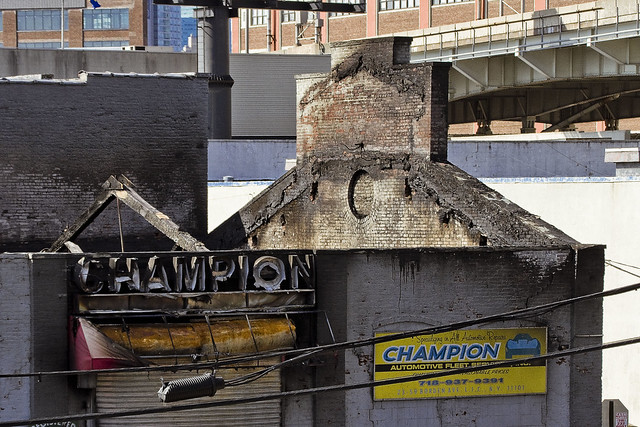
Aftermath, LIC.
– photo by Mitch Waxman
You may have heard that there was a rather large fire in Long Island City over the weekend, which saw an auto body shop consumed in what ended up being a five alarm blaze. Multiple FDNY units were sent to LIC from other boroughs, and despite their efforts the fire raged for hours and hours. The roof of the structure collapsed, and I’d be willing to bet that it’s going to be declared a total loss somewhere down the line by insurers.
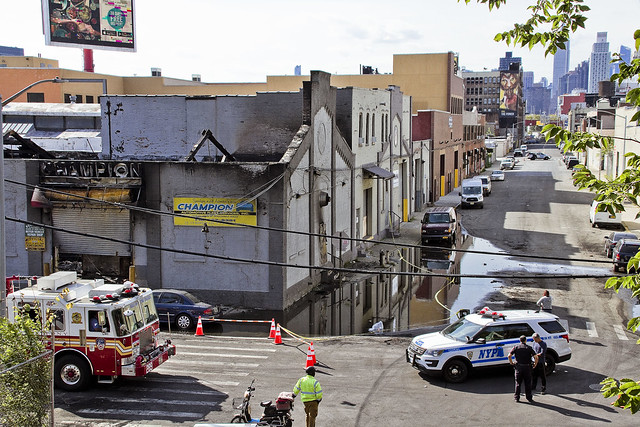
On Sunday I walked over to get some shots of the scene, and given that this area is kind of “my stomping grounds,” knew where to go for an efficacious angle.
– photo by Mitch Waxman
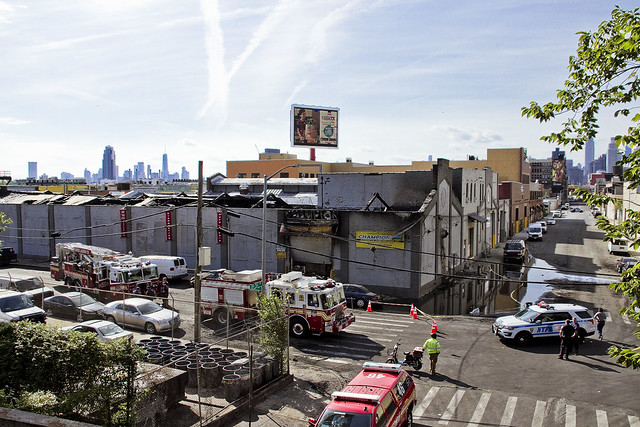
The FDNY had two units on hand in case anything flashed back to life, and NYPD was also on hand controlling the intersection and keeping “lookie-loos” like me from getting into trouble. FDNY had Rockaway’s Tower Ladder 155 unit, as well as Engine unit 289 from Corona, on point. The coppers were from the 108 pct.
– photo by Mitch Waxman
I say it all the time, “Newtown Creek has a history of large industrial site fires.” When I say that, I’m thinking of actual history – the 1882 and 1919 Standard Oil refinery fires in Greenpoint or the Pratt Varnish works fire just down the block here in LIC. Just in the last decade there’s been two major fires, both in Greenpoint, which took nearly a week to put out. Also in Greenpoint, there was the Greenpoint Terminal Market fire about 15 years ago which saw the largest FDNY deployment since 911.
“follow” me on Twitter- @newtownpentacle
villainous looking
Happy 77th Birthday, Gowanus Expressway!
– photo by Mitch Waxman
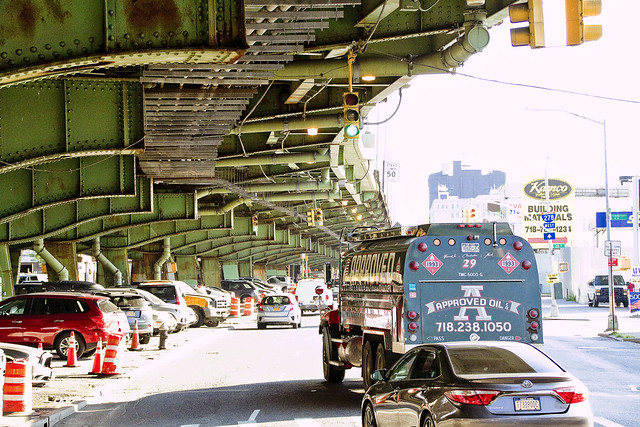
Today is the day that all the children of infinite Brooklyn emerge into the streets and lanes to gambol and celebrate, reveling in a common heritage. October 1st signals to them not just the arrival of “sweater weather,” but also jogs an ancestral memory of the opening of a branch of the House of Moses in South Brooklyn along the fabled Gowanus Canal (Robert Moses, that is). They don’t celebrate the Hamilton Avenue Vampires of course, but… really… who celebrates exsanguinators on the first of October? That’s for the end of the month on Halloween.
The Vampires known to infest this section of the larger Brooklyn Queens Expressway were discussed in two posts from 2017 – “unsigned letter” and “decisive steps.” Read them and take the message of their presence to heart. We’ve got the same problem in Queens Plaza, I’m sorry to say. The City suppresses NYPD statistics on this subject.
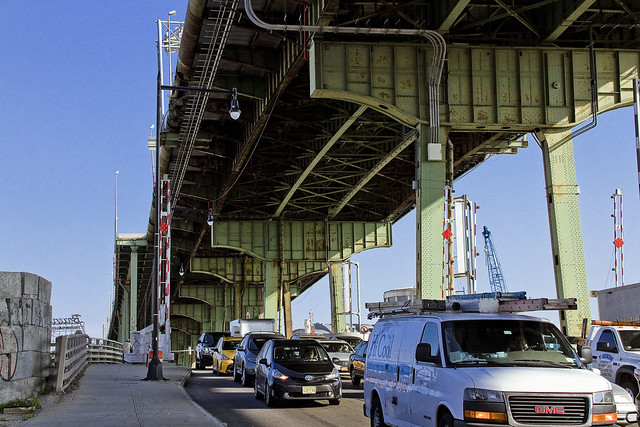
– photo by Mitch Waxman
The House of Moses landed heavily in South Brooklyn, and stole the sky. It blighted the ground and blocked the emanations of the burning thermonuclear eye of God itself from ever directly warming the pavement set squamously about the Gowanus. As above, so below – automotive traffic is everpresent and flows heavily in these parts. The exigent needs of pedestrians in the area were abrogated, ignored, and arrogantly discarded.
I seem to recall that – sometime in the late 1980’s or early 90’s – a decades long season of deferred maintenance on the elevated Gowanus Expressway resulted in a truck plunging through it to the streets below. Same thing happened in the City, over on the West Side Highway.
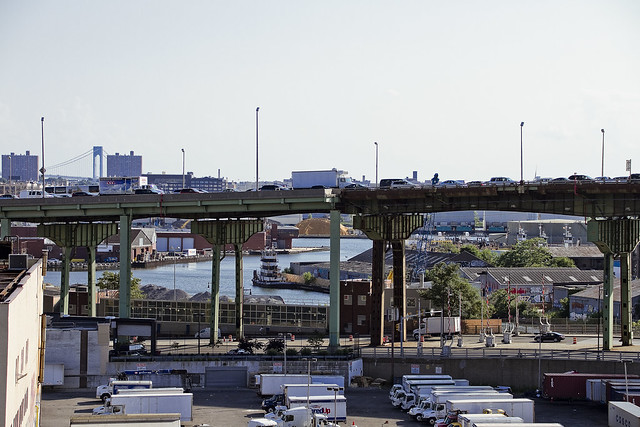
– photo by Mitch Waxman
Construction on this wonder of the Brooklyn world began in 1939, and the consequences for the neighborhood below were dire. If you lived, or worked, in the pathway chosen by Mr. Moses for his marvel… well… you couldn’t stand in the way of progress. The needs of the many outweigh the needs of the few, and you can’t make an omelette without breaking a few eggs. This was called “progress.”
As a note, this is why I argue about semantics with my political friends when they call themselves “progressives” in the 21st century. I usually refer them to a dictionary, because “progressive” doesn’t actually mean what they think it does. Robert Moses was a progressive.
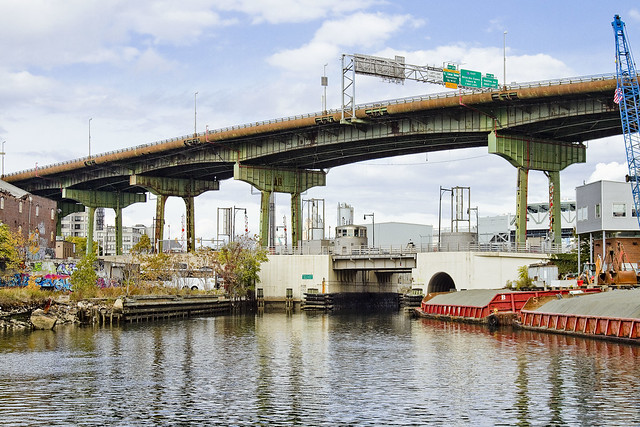
– photo by Mitch Waxman
The Gowanus Expressway as viewed from the turgid water of Gowanus Bay, in the shot above. Gowanus Expressway was designed to connect the corridors of Ocean Parkway, Sunset Park, and Bay Ridge with the Brooklyn Battery Tunnel. Concurrently built, the Koscisuzcko Bridge over in North Brooklyn was meant to provide egress to extant sections of Queens, notably the new Grand Central Parkway which fed into the Triborough Bridge. Mr. Moses then made the case that it would all be wasted effort were a connecting highway not created between the structures. He called it the Brooklyn Queens Connecting Highway, which, in the years following the Second World War was widened and improved into becoming the Brooklyn Queens Expressway. The BQE was then extended a bit to the south to meet and join with the Belt Parkway, which – coincidentally – also provided an eastern connection to Triborough via the Van Wyck and Interborough Parkways to the Grand Central.
That’s the Hamilton Avenue Bridge just below the Gowanus Expressway, if you’re curious, and it was discussed in this Newtown Pentacle post from 2014.
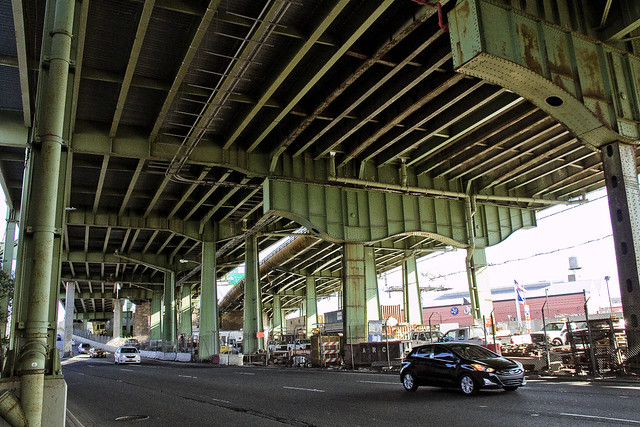
– photo by Mitch Waxman
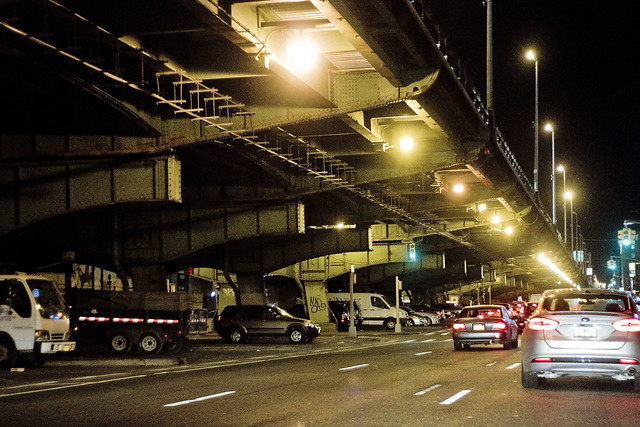
The sections of Brooklyn found under the Gowanus Expressway, in addition to being lousy with vampires, are pretty horrible. The elevated road drips, it hums, it overshadows and overwhelms. It’s not a pleasant experience either driving or walking down here. All is shadowed by the best intentions of the exigencies of the past.
One of the less salubrious corridors of the “House of Moses,” this.
– photo by Mitch Waxman
It’s especially horrible at night.
Anywho – Happy Birthday Gowanus Expressway, you vampire infested nightmare.
Upcoming Tours and Events
Monday, October 1st, 6:30 p.m. – Infrastructure Creek – with Atlas Obscura.
Join Newtown Creek Alliance Historian Mitch Waxman as he leads an exploration of the city’s largest sewer plant, tunnels, draw and truss bridges, rail yards, and a highway that carries 32 million vehicle-trips a year over flowing water.
Tix and more details here.
“follow” me on Twitter- @newtownpentacle
forbidden tithing
Rhapsodic ecstasy, that’s what it’s all about.

– photo by Mitch Waxman
Just the other day, a humble narrator needed to get to the financial district in Lower Manhattan and soon found himself in hell’s third circle, which is my pet name for the 59/Lex subway interchange. Hell’s ninth circle, where you’ll find Satan chewing on Judas Iscariot, is the 34th street Herald Square complex – in case you were wondering (that’s why it’s always ninety degrees in there, even during the winter, as it’s literally a portal to hell.) If you’re a Queensican, however, there really is no way to avoid the third circle. My habit is to ignore the wailing desires of those ghastly entities who run the system found below, and not ride the local R line from Astoria all the way to lower Manhattan. Instead, a quick transfer to the Lexington line express is accomplished, which gets me to lower Manhattan in short order. The former journey, using the oft delayed Broadway line local service can take up to an hour, whereas my composited route and transfer only takes about a half hour.
The “A” in MTA is for “adventure,” lords and ladies, so live a little and transfer often. The less time spent in the sweating concrete bunkers below the better, I say. Also, take MTA’s route suggestions for what they are, and be nimble. Dante had Virgil, you’re stuck with me.
– photo by Mitch Waxman
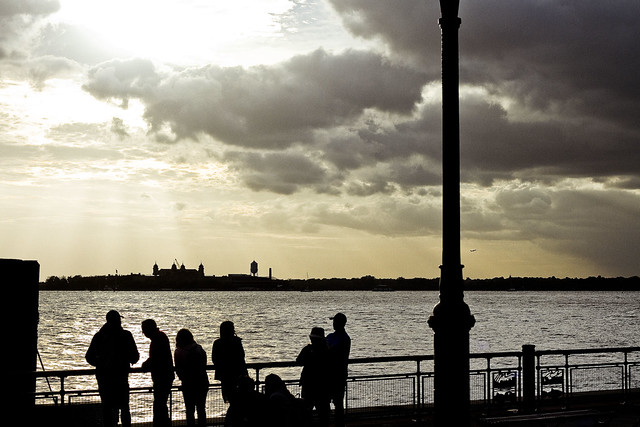
My preference would have been to take a ferry, but the United Nations General Assembly was underway, and the Coast Guard had interrupted service due to security concerns. Given that I had to go “adventuring” through the circles of Hell, I padded out my time of arrival in Lower Manhattan. My obligation was to do a short talk about Newtown Creek for a group of esthetes and intellectuals, which is a task gladly embraced. Unfortunately, it involved the chore of going into the City.
Since I had arrived about forty five minutes ahead of my scheduled arrival time, a short walk about Battery Park and Castle Clinton ensued. The weather has been absolute junk for what seems like weeks now, but all that atmospheric activity has at least been producing dramatic and enigmatic skies.

– photo by Mitch Waxman
A quiet weekend is ahead for a humble narrator, during which I hope to be brandishing the camera about. Monday the 1st is an “Infrastructure Creek” walking tour I’ll be conducting for Atlas Obscura (ticketing link below). On Thursday, I have an actual adventure scheduled, which will unfortunately mean that I have to repeat my journey through the Third Circle at something like seven in the morning… but as mentioned – the “A” in MTA is, in fact, for “adventure.”
There’s also a couple of big projects I’m working on at the moment, as a note, which I’ll let y’all know about next month.
Upcoming Tours and Events
Monday, October 1st, 6:30 p.m. – Infrastructure Creek – with Atlas Obscura.
Join Newtown Creek Alliance Historian Mitch Waxman as he leads an exploration of the city’s largest sewer plant, tunnels, draw and truss bridges, rail yards, and a highway that carries 32 million vehicle-trips a year over flowing water.
Tix and more details here.
“follow” me on Twitter- @newtownpentacle
rotting ossuaries
A dollar short and a day late…

– photo by Mitch Waxman
I seem to be about twelve hours behind on my scheduling today, due to a very busy week. Thusly, a single image of a DonJon Tug moving barges about on Newtown Creek greets you in this very late post. Back tomorrow with something decidedly meatier for you to sink your teeth into, lords and ladies.
Upcoming Tours and Events
Monday, October 1st, 6:30 p.m. – Infrastructure Creek – with Atlas Obscura.
Join Newtown Creek Alliance Historian Mitch Waxman as he leads an exploration of the city’s largest sewer plant, tunnels, draw and truss bridges, rail yards, and a highway that carries 32 million vehicle-trips a year over flowing water.
Tix and more details here.
“follow” me on Twitter- @newtownpentacle
stifled oaths
A bit more Creekery, in today’s post.

– photo by Mitch Waxman
Middle part of last week, I had to get together with some of my colleagues at Newtown Creek Alliance to discuss and strategize about a project we’re involved with over in Long Island City, and we decided to do the meeting in the early evening at the NCA offices at 520 Kingsland Avenue over in Greenpoint.
It was a misty day, with crazy dark clouds blowing through the sky, which made for nice atmospherics and a couple of times during the meeting I excused myself and headed out onto the green roof to shoot some shots.

– photo by Mitch Waxman
Our topic of focus was the Montauk Cutoff project, which is a whole other story.
Me? I was fascinated by the contrast being offered by the illuminations of the burning thermonuclear eye of God itself setting to west and the restless clouds rolling through the sky.

– photo by Mitch Waxman
To the east, and looking towards the Metro Fuel facility, you could see some sort of fiery industrial process at work.
I had an urge to find a really long stick and try to toast a marshmallow.

– photo by Mitch Waxman
Walking home afterwards via the Greenpoint Avenue Bridge, on the Blissville side of the Newtown Creek, I noticed that the NY & Atlantic outfit were getting busy with the whole garbage train business. Shot this through a convenient hole in the fence on the bridge, and noticed that the train set was sitting there in a static position so I quickened my pace and got down to the dangerous intersection of Review Avenue and Van Dam street as quickly as possible.
Didn’t have the time to slip on my reflective safety vest, which is kind of stupid but I’ve always been fairly lucky as far as not getting killed by trains and trucks – so far.

– photo by Mitch Waxman
For some reason, whenever I seem to get into position for this sort of shot, I instantly need to pee. I’m talking dancing around, shifting weight from foot to foot like a five year old need. Didn’t have an inkling of it on the bridge, and took care of business prior to leaving the offices not fifteen minutes prior.
Biology… it affects us all. Me moreso than others.

– photo by Mitch Waxman
Luckily, the NY&A folks didn’t keep me waiting too long before the signal arms came down and they advanced along the tracks of the Lower Montauk branch, exiting the Blissville Yard and heading eastwards a short distance to the Waste Management company’s transfer station found a short distance away.
WM handles the curbside black bag, or putrescent, waste collected by the Sanitation Department.

– photo by Mitch Waxman
For short distance hauling, the NY&A folks use this “critter” which is a slow moving but powerful engine unit. It’s job is to move empty cars into loading position at the waste transfer station and then move the full ones back to the Blissville Yard where they’ll be coupled to other full boxes. At some indeterminate time in the late night, a “proper” locomotive engine will arrive and haul the train set away.
Our garbage goes on quite a scenic journey, through the Fresh Pond Yard and over the Hell Gate Bridge via the NY Connecting Railroad. It heads up the Hudson after visiting the Bronx, and eventually crosses over onto the continent.

– photo by Mitch Waxman
By this point, it felt as if my bladder was about to explode, but I had to get in a couple more shots.
Exigent prioritization of such matters are the razors edge of a humble narrator’s existential experience.

– photo by Mitch Waxman
Luckily, the operator of the train set moved out of eyeshot shortly, and a misdemeanor or two occurred.
At least there’s now a semi clean spot on the Blissville side of the Greenpoint Avenue Bridge, albeit one that smells slightly of urine.
Upcoming Tours and Events
Monday, October 1st, 6:30 p.m. – Infrastructure Creek – with Atlas Obscura.
Join Newtown Creek Alliance Historian Mitch Waxman as he leads an exploration of the city’s largest sewer plant, tunnels, draw and truss bridges, rail yards, and a highway that carries 32 million vehicle-trips a year over flowing water.
Tix and more details here.
“follow” me on Twitter- @newtownpentacle


