on toward
The Hamilton Avenue Bridge, in today’s post.

– photo by Mitch Waxman
“The truth of our times, as told in graphic narrative” requires a lot of “boots on the ground” time.
To wit, last weekend, a rare Sunday afternoon with no obligations presented a humble narrator with an opportunity to visit the hellish expanses of the Gowanus Canal onboard a tour boat chartered by the Open House NY group.
from nyc.gov
The Hamilton Avenue Bridge is a bascule bridge with two parallel leafs, one carrying the northbound roadway and the other carrying the southbound roadway. Most of the length of Hamilton Avenue runs below the elevated portion of the Gowanus Expressway, including the bridge. The bridge connects Smith Street and Second Avenue over the Gowanus Canal and is the first canal crossing north of the Gowanus Bay.

– photo by Mitch Waxman
The tour utilized a NY Waterways Ferry, leaving from Manhattan’s World Financial Center Ferry Terminal on the Hudson River, nearby Vesey Street. After transiting through Gowanus Bay, which is a whole other story, the vessel arrived at the somewhat unique Hamilton Avenue Bridge – a skew bascule type drawbridge.
a fascinating discussion of this “knee-girder bascule bridge,” and its recent reconstruction, by the actual engineers that performed the rehabilitation, can be found at heavymovablestructures.org
The rarely seen Hanover skew bascule, also known as a knee-girder bascule bridge is a unique and complex movable structure in terms of both design and construction. The replacement of a movable bridge during an accelerated construction period is also an incredibly difficult task to engineer and construct. Either one of these constraints would make a project difficult to execute. For the Hamilton Avenue Bridge project in New York City, however, these two levels of complexity combined to create a one-of-a-kind project that would challenge the owner, designers and constructor to achieve a near impossible goal: to replace a skewed bascule bridge with a new, fully operational span in sixty-four days.

– photo by Mitch Waxman
The bridge’s horns sounded, and its traffic gates were deployed, and employees of the NYC DOT thereupon activated the electrical systems that drew the roadway up and away from its piers. An obtuse angle was achieved, relative to the waters level, which opened an aperture and allowed navigation.
from 1863, ay nytimes.com
THE RAILROAD ACCIDENT AT HAMILTON-AVENUE BRIDGE — CONCLUSION OF THE CORONER’s INVESTIGATION, AND VERDICT OF THE JURY. — The investigation relating to the circumstances connected with the deplorable accident on Wednesday night, upon which occasion car No. 119 of the Greenwood and Fulton Ferry line was precipitated into Gowanus Creek, in consequence of the opening of the draw of Hamilton-avenue Bridge, was concluded before Coroner BENNETT and a jury, yesterday afternoon.

– photo by Mitch Waxman
In the distance, the Smith 9th street elevated Subway station and the Ninth Street lift bridge glitter.
from 1892’s United States Congressional serial set, Issue 2914, courtesy google books

– photo by Mitch Waxman
SuperfunD. That’s how people refer to both Gowanus Canal and my beloved Newtown Creek. That’s superfun with a capital D following it. The more you learn about these places, however, the less fun they are.
from epa.gov
The Gowanus Canal is a 100-foot wide,1.8-mile long canal located in the New York City borough of Brooklyn, Kings County, New York. Connected to Gowanus Bay in Upper New York Bay, the canal borders several residential neighborhoods including Gowanus, Park Slope, Cobble Hill, Carroll Gardens, and Red Hook. The adjacent waterfront is primarily commercial and industrial, currently consisting of concrete plants, warehouses, and parking lots. There are five east-west bridge crossings over the canal, located at Union Street, Carroll Street, Third Street, Ninth Street, and Hamilton Avenue. The Gowanus Expressway and the IND Culver Line of the New York City Subway, an aboveground section of the original Independent Subway System, pass overhead.

– photo by Mitch Waxman
A winter time shot of the bridge’s roadway, which is overflown by the hurtling viridian of the Gowanus Expressway, high overhead. I’m told it’s close to a 300 feet drop from top to bottom.
from nycroads.com
Beginning in 1939, Robert Moses oversaw construction of the Gowanus Parkway, an elevated highway placed on top of the pillars of the old 3rd Avenue BMT Elevated Line through the Sunset Park and Gowanus sections of Brooklyn. It would eventually become part of a limited-access parkway loop encircling four of the five boroughs. Since the Gowanus Parkway was to be constructed atop a pre-existing elevated facility, Moses had little trouble getting his project approved by the New York City Council.
However, the Gowanus Parkway would require more land for a wide roadway and entrance-exit ramps. This required the demolition of many homes and businesses along Third Avenue, a tightly knit block of Northern and Western European immigrants. In his 1974 biography The Power Broker, Robert A. Caro argued that Moses’ highway created a “Chinese wall” that accelerated the process of deterioration that began two blocks west, along the waterfront terminals. He also points out that residents fought to have the highway placed closer to the waterfront to protect the neighborhood.

– photo by Mitch Waxman
Another wintertime shot, this one from the Ninth Street Bridge looking back at the entrance – the front door, if you would – of the Gowanus Canal.
from nyc.gov
The construction of the Canal began in 1849 and was accomplished by deepening and widening the Gowanus Creek and creating bulkheads along the waterfront. The Canal was fully built out by 1869.
Even before it was complete, the Canal was attracting foundries, shipyards, gas manufacturing plants, coal yards and paint and ink factories to the waterfront and adjacent lots. By 1870, the surrounding area, with its natural marshlands and freshwater streams, had been fully urbanized and industrialized.

– photo by Mitch Waxman
Back to last Sunday, and the approach to the Hamilton Avenue Bridge on the NY Waterways Ferry’s return trip. The closest analogy I can use to describe the Gowanus experience, for those of us who live along the currently undefended border of Brooklyn and Queens, is visiting one of the tributaries of Newtown Creek – specifically Dutch Kills. (tour this weekend! scroll down for details)
also from nyc.gov
The Canal was the one of the prime catalysts in shaping the industrial nature of the area, as foundries, gas manufacturing plants, coal yards, paint and ink factories and other businesses flocked to the waterfront and adjacent lots.

– photo by Mitch Waxman
We’ve got the LIE on Dutch Kills, multiple drawbridges, and a similar historical tale.
Both waterways began the industrial age as the home of tidal mill ponds, but Dutch Kills was spared a lot of the early and quite dirty industries which called the Gowanus home as early as the 1860’s. What happened to Dutch Kills largely occurred in the late 19th and especially early 20th centuries (the bad stuff was happening further up the Creek in those days, in Blissville, along English Kills, and especially on Furmans Island).
from riverkeeper.org
After almost 150 years of industrial use and decades of raw sewage discharges from New York City’s sewers, the Gowanus Canal has become one of the nation’s most contaminated bodies of water. The putrid sediments at the bottom of the canal contain PCBs, heavy metals, pesticides, volatile organic compounds, sewage solids and coal tar wastes. Adding to this toxic legacy, the manufactured gas plants (MGP), cement factories, oil refineries, tanneries, chemical plants and other industries that have called the canal home also have left behind underground plumes of pollution and contaminated the land and the groundwater, which continues to leach toxins into the canal.

– photo by Mitch Waxman
That’s the Hamilton Avenue Bridge, gateway to the notorious Gowanus Canal, lords and ladies.
from wikisource.org
That same June evening, without having heard a word from the sea, Malone was desperately busy among the alleys of Red Hook. A sudden stir seemed to permeate the place, and as if apprised by ‘grapevine telegraph’ of something singular, the denizens clustered expectantly around the dance-hall church and the houses in Parker Place. Three children had just disappeared—blue-eyed Norwegians from the streets toward Gowanus—and there were rumours of a mob forming among the sturdy Vikings of that section.
“follow” me on Twitter- @newtownpentacle
There’s a Newtown Creek walking tour, and a Magic Lantern show, coming up.
Saturday, June 7th, 13 Steps around Dutch Kills with Atlas Obscura.
Click here for tickets and more info.
Wednesday, June 11th, Newtown Creek Magic Lantern Show with Brooklyn Brainery.
Click here for tickets and more info.
old native
The Carroll Street Bridge, in today’s post.

– photo by Mitch Waxman
I’ve said it so many times on the Newtown Creek “Dutch Kills” tours that I’ve conducted – “The Borden Street Bridge is one of just two retractable bridges in NYC, the other is on Carroll Street over the Gowanus.” Then I go on to talk about Chicago and what a retractable bridge does and why its special, but it occurred to me that I’ve never done a post on the Carroll Street span. Today, the remedy.
Also, just as a note, I’ll be repeating the above quotation on this coming Saturday’s tour, see the link at the bottom of this post for details.
from nyc.gov
The Carroll Street Bridge is a retractile bridge crossing the Gowanus Canal in Brooklyn. The bridge, which was opened to traffic in 1889, supports a 17 foot wide roadway and two 4.5 foot sidewalks.

– photo by Mitch Waxman
What’s super cool about the Carroll Street span is the wooden road surfacing that allows vehicular egress over this section of the Gowanus Canal. There’s still one more bridge before the Gowanus reaches its inevitable conclusion, Union Street Bridge, but Carroll is where the industrial canal seems to shallow out and is one of the places where its entire “raison d’être” seems to have been forgotten.
from wikipedia
Retractable bridges date back to medieval times. Due to the large dedicated area required for this type of bridge, this design is not common. A retractable design may be considered when the maximum horizontal clearance is required (for example over a canal).
Two remaining examples exist in New York City (the Carroll Street Bridge (built 1889) in Brooklyn and the Borden Avenue Bridge in Queens).
– photo by Mitch Waxman
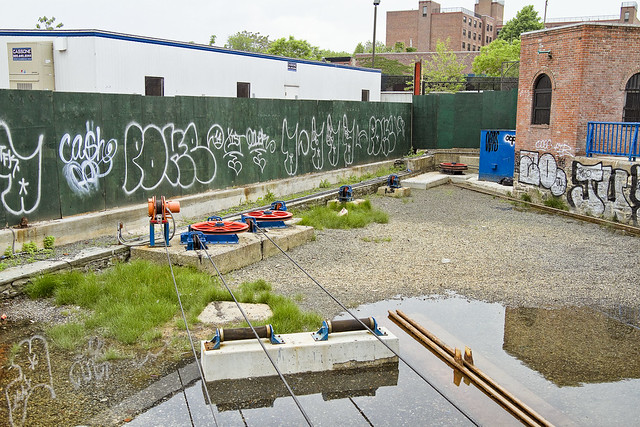
Pictured above are the pulleys and gears which provide locomotive force to the structure, and the aperture into which the roadway actually retracts to allow theoretical maritime egress. The Gowanus Dredgers boat club is nearby, and I suspect that they can tell you everything you’d want to know about the mores and habits exhibited by the NYC DOT engineers who care for and maintain the structure. Business has called me to South Brooklyn all year, and one of the more interesting “Gowanus People” I’ve met is a fellow named Joseph Alexiou, who provides a satisfying historical narrative for the Gowanus.
from tedxgowanus.com
A journalist and history buff, Joseph Alexiou is writing a book about the Gowanus Canal. He is the author of Paris for Dummies and contributing author to Frommer’s Paris 2012 and has written for New York, the New York Press, New York Observer, Gothamist and Paper Magazine. He is a former associate editor at Out magazine and has a master’s degree from the Graduate School of Journalism at Columbia University.

– photo by Mitch Waxman
Somebody else from the Gowanus crew that has impressed the heck out of me is Eymund Diegel. His knowledge of the Gowanus and its hydrology, history, and personality is staggering. Be forewarned and forearmed though, for if you seek his wisdom, bring a notepad or recording device with you – as the cascade of information he offers can be a bit overwhelming.
also from tedxgowanus.com
Eymund Diegel is the chair of Public Laboratory, a citizen science group partnered with the Gowanus Canal Conservancy’s Grassroots Aerial Photography program, where local citizen’s insights help improve Google Earth and City mapping of the neighborhood. As a Gowanus resident, he also helps out at the Hall of the Gowanus, a community historic research resource. Trained as an urban planner with a focus on watershed and environmental planning, he works with other local residents who have been tying digital cameras to kites and balloons to map and reconstruct the Gowanus Canal’s “ghost stream” network.
“follow” me on Twitter- @newtownpentacle
There’s a Newtown Creek walking tour, and a Magic Lantern show, coming up.
Saturday, June 7th, 13 Steps around Dutch Kills with Atlas Obscura.
Click here for tickets and more info.
Wednesday, June 11th, Newtown Creek Magic Lantern Show with Brooklyn Brainery.
Click here for tickets and more info.
odd sense
Here’s some of yer vibrant diversity right over dere.

– photo by Mitch Waxman
Spotted this Frankenstein monster on Broadway, at the angle between Woodside and Astoria, recently. That’s an electric delivery motorcycle, although legally speaking it’s a bicycle or moped, with two supermarket shopping carts that are welded together and forming a caboose hitched to a homemade hinge on the back of the bike. Seriously speaking, the engineering of this arrangement is staggeringly competent, and this is a precise example of “American Ingenuity” parked on the sidewalk.

– photo by Mitch Waxman
Friends in Manhattan, some of whom work for the City in regulatory positions, always make accusations that your humble narrator has a vivid imagination. That the circumstances and inventions witnessed on the streets of Queens, improvised by those who don’t have two pennies to rub together and which are cobbled together from available materials, cannot possibly exist. I remind them that a future president of the United States is sitting in a carriage on Roosevelt Avenue eating a Churrasco, and that her parents came here as undocumented immigrants.
“follow” me on Twitter- @newtownpentacle
There’s a Newtown Creek walking tour, and a Magic Lantern show, coming up.
Saturday, June 7th, 13 Steps around Dutch Kills with Atlas Obscura.
Click here for tickets and more info.
Wednesday, June 11th, Newtown Creek Magic Lantern Show with Brooklyn Brainery.
Click here for tickets and more info.
kneel before
Mister or Master, Softee is a cad.

– photo by Mitch Waxman
I say this every time that the Mister rings his bells: Mrs. Softee is lonely during the torrid nights of a New York summer, wondering for whom her man plays his song. Mister Softee is no damn good, and she’s sure of it.
Pictured above is a proper “Mister Softee” truck, found on its rounds in Astoria one night, doing exactly what he told the Mrs. that he’d be up to.
Still, the Mrs. hears stories. It might be that people are describing the romantic misadventures of Master Softee, who is single, and unapologetic about it.
from wikipedia
Mister Softee is a United States-based ice cream truck franchisor popular in the Northeast. It was founded by William and James Conway (Oct. 30, 1927 – May 28, 2006) in 1956 in Philadelphia. It is one of the largest franchisor of soft ice cream in the United States. It has about 350 franchisees operating 600 trucks in 15 states. The company is headquartered in Runnemede, New Jersey. It is still run by the Conway family; James Conway, Jr. is now President.

– photo by Mitch Waxman
Simone Weichselbuam wrote a fantastic piece over at nydailynews.com back at the beginning of May, describing the conflict between the long running “Mister Softee” Ice Cream Truck empire (based in NJ) and the upstart “Master Softee” operation which runs its business out of LIC. Check it out below.
from nydailynews.com
Mister Softee is anything but soft when it comes to safeguarding his cherished name.
The New Jersey-based owner of the ubiquitous ice cream trucks is suing a rogue Queens vendor, charging he opened his depot in Long Island City to peddle a knockoff version.
A mix of about two dozen nearly identical Master Softee and Mister Softee trucks are lined up inside and outside Dimitrios Tsirkos’s 11th St. garage.
The fledgling business has soured tempers throughout Mister Softee headquarters in South Jersey and its franchisees across Queens and the Bronx.

– photo by Mitch Waxman
One has been observing the “Master” variant with increasing frequency during recent forays across the concrete devastations. So many so that I might have to start offering the following statement:
Mistress Softee is lonely during the torrid nights of a New York summer, wondering for whom her man plays his song. Master Softee is no damn good, and she’s sure of it.
from law360.com
“All Triskos did was change the ‘i’ in ‘Mister’ to an ‘a,’ [and] Tsirkos continues to use all of Mister Softee’s trade dress and the Mister Softee truck design and [jingle],” the injunction request said. “Clearly, changing just one letter in the mark and using it in conjunction with the other Mister Softee marks constitutes trademark infringement that continues to cause Mister Softee irreparable harm.”
Mister Softee says that customers buying ice cream from Tsirkos’ rogue trucks “may believe they are dealing with an authorized Mister Softee franchisee, who is storing and dispensing Mister Softee food products in a sanitary manner … when in fact, they are not.”
“follow” me on Twitter- @newtownpentacle
There are two Newtown Creek walking tours, and a Magic Lantern show, coming up.
Saturday, May 31st, Plank Road with Newtown Creek Alliance.
Click here for tickets and more info.
Saturday, June 7th, 13 Steps around Dutch Kills with Atlas Obscura.
Click here for tickets and more info.
Wednesday, June 11th, Newtown Creek Magic Lantern Show with Brooklyn Brainery.
Click here for tickets and more info.
native form
The native art form of Queens, NY.

– photo by Mitch Waxman
Illegal dumping is more than just an artform here in Astoria, Queens. It’s more of a design competition, wherein participants attempt to out do each other in composition, theme, and or sourcing of materials. To wit, this tableau discovered on a Sunday morning (which is locally described as “the aftermath of Saturday Night”) along Broadway at its intersection with 43rd street.

– photo by Mitch Waxman
One is fairly sure that municipal regulation forbids the disposal of a perfectly recyclable bicycle in this manner. Are you supposed to put the bike in a blue bag or a clear one? Also, shouldn’t this sort of trash get its own lane?
“follow” me on Twitter- @newtownpentacle
There are two Newtown Creek walking tours, and a Magic Lantern show, coming up.
Saturday, May 31st, Plank Road with Newtown Creek Alliance.
Click here for tickets and more info.
Saturday, June 7th, 13 Steps around Dutch Kills with Atlas Obscura.
Click here for tickets and more info.
Wednesday, June 11th, Newtown Creek Magic Lantern Show with Brooklyn Brainery.
Click here for tickets and more info.


