Posts Tagged ‘Astoria Park’
Tugboat transit at Hells Gate

– photo by Mitch Waxman
Hanging out at Astoria Park, waiting for the Greater Astoria Historical Society‘s “Haunted East River” tour to start, what did I spy crossing under mighty Triborough?
The John Reinauer tugboat- that’s what- moving a fuel barge north on the East River, through the bright passage at Hells Gate.
from wikipedia
Liquid cargo barges are barges that transport petrochemicals, such as styrene, benzene and methanol; liquid fertilizer, including anhydrous ammonia; refined products, including gasoline, diesel and jet fuel; black oil products, such as asphalt, No. 6 fuel oil and coker fuel; and pressurized products, such as butane, propane and butadiene, which are transported on the waterways from producers to end users.

– photo by Mitch Waxman
The John Reinauer was built at Main Ironworks in 1969, and was christened the Esso Crystal River. (Esso, is of course, the brand name for Standard Oil -S.-O- Esso, later Exxon) The now Exxon Crystal River went to Reinauer Transportation in 1993. A 2,600 horsepower, 86 foot long steel hulled towing vessel, the J.R. is 27 feet wide and has a draw of 9 feet.
Check out the company’s J.R. page for photos of the ship in its various incarnations here.
from wikipedia
The terms “Tonnage” and “Ton” have different meanings and are often confused. Tonnage is a measure of the size or cargo capacity of a ship. The term derives from the taxation paid on tuns of wine, and was later used in reference to the weight of a ship’s cargo; however, in modern maritime usage, “tonnage” specifically refers to a calculation of the volume or cargo volume of a ship. The term is still sometimes incorrectly used to refer to the weight of a loaded or empty vessel.
Measurement of tonnage can be less than straightforward, not least because it is used to assess fees on commercial shipping.

– photo by Mitch Waxman
Like many other tugboats, the John Reinauer participated in the evacuation of Lower Manhattan necessitated by the September 11 attacks.
(The John J. Harvey Fireboat, which was discussed in some detail in 2 prior posts- here… and here, similarly served the city that day).
from wikipedia
Immediately after the first attack, the captains and crews of a large number of local boats steamed into the attack zone to assist in evacuation and provide supplies and water.Water became urgently needed after the Towers’ collapse severed downtown water mains. The size of the dust and debris cloud following the collapse of the Twin Towers was such that it necessitated that many of these trips were navigated by radar alone. Estimates of the number of people evacuated by water from Lower Manhattan that day in the eight hour period following the attacks range from 500,000 to 1,000,000. As many as 2,000 injured people in the attacks were reportedly evacuated by this means through there were no reported injuries resulting from the evacuation itself.
Sludge Boats, baby, Sludge Boats

M/V Red Hook DEP Sludge Vessel – photo by Mitch Waxman
After processing at a water treatment facilities, which the City of New York’s DEP manages 14 of (including the vast Temple of Cloacina called the Newtown Creek Wastewater Treatment Plant), the concentrated sludge distillate produced by municipal sewage plants requires “dewatering” – it must be reduced into a semi solid called “cake”. Not every one of the 14 wastewater treatment plants has a dewatering facility, so the sludge needs to get from point A to point B via a the fleet of Sludge Vessels.
Pictured above is the sludge dock in Greenpoint, with the M/V Red Hook at dock, at the mouth of the Newtown Creek. Flowing from that aforementioned temple of “the Venus of the Sewers” to a gigantic holding tank via mechanical means, it is then pumped out to the dock and the waiting sludge boat.
from nyc.gov
Preliminary treatment
Several stories underground, wastewater flows into the plants from sewers connected to New York City’s homes and businesses. The incoming wastewater, called influent, passes through screens consisting of upright bars, spaced one to three inches apart. These bars remove large pieces of trash including rags, sticks, newspaper, soft drink cans, bottles, plastic cups and other similar items. This protects the main sewage pumps and other equipment. The garbage is transported to landfills. The main sewage pumps then lift the wastewater from the screening chamber to the surface level of the plant.
Primary treatment
Next, the wastewater enters primary settling tanks, also called sedimentation tanks, for one to two hours. The flow of the water is slowed, allowing heavier solids to settle to the bottom of the tank and the lighter materials to float. At the end of the process, the floatable trash, such as grease and small plastic material, rises and is skimmed from the top of the tanks surface.
The settled solids, called primary sludge, are then pumped through cyclone degritters — devices that use centrifugal force to separate out sand, grit (such as coffee grinds) and gravel. This grit is removed, washed and taken to landfills.
The degritted primary sludge is pumped to the plant’s sludge handling facilities for further processing. The partially treated wastewater from the primary setting tanks then flows to the secondary treatment system.

M/V North River DEP Sludge Vessel – photo by Mitch Waxman
The 1.3 billion gallon a day flow of New York City’s sewage should be defined as a third river. That’s 1,300,000,000 gallons a day or 474,500,000,000 gallons of night soil a year. 1.3 billion is the population of China.
Pictured above is the DEP Sludge Vessel M/V North River, a veteran, she was launched at Maryland Shipbuilding in 1974. Just under 324 foot long, North River can carry 102,000 cubic feet of evil juice and weighs in at 2,557 gross tons.
from nyc.gov
Secondary treatment
Secondary treatment is called the activated sludge process. This is because air and “seed” sludge from the plant treatment process are added to the wastewater to break it down further. Air pumped into large aeration tanks mixes the wastewater and sludge that stimulates the growth of oxygen-using bacteria and other tiny organisms that are naturally present in the sewage. These beneficial microorganisms consume most of the remaining organic materials that are polluting the water and this produces heavier particles that will settle later in the treatment process.Wastewater passes through these bubbling tanks in three to six hours.
The aerated wastewater then flows to the final settling tanks which are similar to the primary settling tanks. Here the heavy particles and other solids settle to the bottom as secondary sludge. Some of this sludge is re-circulated back to the aeration tanks as “seed” to stimulate the activated sludge process. The returned sludge contains millions of microorganisms that help maintain the right mix of bacteria and air in the tank and contribute to the removal of as many pollutants as possible.
The remaining secondary sludge is removed from the settling tanks and added to the primary sludge for further processing in the sludge handling facilities.Wastewater passes through the settling tanks in two to three hours and then flows to a disinfection tank.
Disinfection
Even after primary and secondary treatment, diseasecausing organisms may remain in the treated wastewater. To disinfect and kill harmful organisms, the wastewater spends a minimum of 15-20 minutes in chlorine-contact tanks mixing with sodium hypochlorite, the same chemical found in common household bleach. The treated wastewater, or effluent, is then released into local waterways. Disinfection is an essential step because it protects the health of people who use local beaches and enjoy other recreational activities on or near the water.

M/V Newtown Creek DEP Sludge Vessel – photo by Mitch Waxman
Identical in dimension and capacity to the North River, the 1967 vintage DEP Sludge Vessel M/V Newtown Creek passed under mighty Triborough and crossed Hells Gate. M/V Newtown Creek was laid down by the Wiley Manufacturing Co. Back in the days of ocean dumping, these ships were amongst a small fleet of tugs, barges, and older sludge boats that would “do the deed“.
from nyc.gov
Sludge treatment
The following are typical stages of the sludge treatment process.
Thickening
The sludge produced by primary and secondary treatment is approximately 99% water and must be concentrated to enable its further processing. Thickening tanks allow the sludge to collect, settle and separate from the water for up to 24 hours. The water is then sent back to the head of the plant or to the aeration tanks for additional treatment.
Digestion
After thickening, the sludge is further treated to make it safer for the environment. The sludge is placed in oxygenfree tanks, called digesters, and heated to at least 95 degrees Fahrenheit for between 15 to 20 days. This stimulates the growth of anaerobic bacteria, which consume organic material in the sludge. Unlike the bacteria in the aeration tanks, these bacteria thrive in an oxygen-free or “anaerobic” environment. The digestion process stabilizes the thickened sludge by converting much of the material into water, carbon dioxide and methane gas. The black sludge that remains after digestion has the consistency of pea soup and has little odor. This is called digested sludge.
Methane gas is often used as an energy source at the City’s wastewater treatment plants. The gas may be used in engines to produce electricity or directly drive plant equipment. Gas is also used in boilers to provide heat for digestion and plant-wide buildings. Currently, DEP and the New York Power Authority (NYPA) have jointly installed fuel cells at four of the City’s water pollution control plants; 26th Ward, Red Hook, Oakwood Beach and Hunts Point. Fuel cells convert the methane gas and carbon dioxide into heat and electricity that is then used to operate the plants. This technology contributes to New York City’s efforts to enhance clean air operations at its facilities. There is a significant reduction in air emissions as a result of using fuel cells.
Digester sludge is pumped from sludge storage tanks to a dewatering facility. At some treatment plants, where there are no dewatering facilities on site, the sludge is transported for processing through a pipeline or by a sludge boat to a plant that has a dewatering facility.

M/V Newtown Creek DEP Sludge Vessel, close-up – photo by Mitch Waxman
Once requiring a crew of as many of 20, the City now runs these ships with a mere 6. Semiautomated, M/V Newtown Creek and North River are nevertheless more than twice the size of the original model Sludge Vessels like the Owl’s Head.
from nyc.gov
Dewatering reduces the liquid volume of sludge by about 90%. New York City operates dewatering facilities at eight of its 14 treatment plants. At these facilities, digested sludge is sent through large centrifuges that operate like the spin cycle of a washing machine. The force from the very fast spinning of the centrifuges separates most of the water from the solids in the sludge, creating a substance knows as biosolids. The water drawn from the spinning process is then returned to the head of the plant for reprocessing. Adding a substance called organic polymer improves the consistency of the “cake”, resulting in a firmer, more manageable product. The biosolids cake is approximately 25 to 27 percent solid material.
Astoria Predator

– photo by Mitch Waxman
Hawk at Astoria Park, Halloween day 2009. I believe it’s a Red Tail Hawk, but I’m not qualified to genotype the avian specie.
from wikipedia
The Red-tailed Hawk (Buteo jamaicensis) is a bird of prey, one of three species colloquially known in the United States as the “chickenhawk,” though it rarely preys on chickens. It breeds throughout most of North America, from western Alaska and northern Canada to as far south as Panama and the West Indies, and is one of the most common buteos in North America. Red-tailed Hawks can acclimate to all the biomes within its range. There are fourteen recognized subspecies, which vary in appearance and range. It is one of the largest members of the genus Buteo in North America, typically weighing from 690 to 1600 grams (1.5 to 3.5 pounds) and measuring 45–65 cm (18 to 26 in) in length, with a wingspan from 110 to 145 cm (43 to 57 in). The Red-tailed Hawk displays sexual dimorphism in size, with females averaging about 25% heavier than males.
According to sources in the ornithological community, two red tail hawks nest in the rafters of the Triborough Bridge. Accordingly with the Hellenic character of the neighborhood, these hawks are named Atlas and Athena. Perhaps this is one of them.
The bird people are all over this, check out urbanhawks, and nycgovparks.com has a neat overview on “The Atlantic Flyway”.
The Bright Passage

Hell Gate Bridge, Astoria – photo by Mitch Waxman
Some Context about the patch of the East River called Hells Gate,
quoting from the Newtown Pentacle posting of June 5, 2009- The River of Sound
“…christened the eddies and whirlpools of this widow making area “The Bright Passage”. In Dutch- Hellegat, in English- Hela’s Gate- or Hells Gate.”
“Common Dutch seafaring terminology for any whirlpool was Hellegat. Sailors in that time had an expansive vocabulary that was passed man to man for water and weather- not unlike the famous 64 words used to describe different kinds of snow conditions used by the Esquimaux in their polar wastelands. (esquimaux is an archaic and somewhat racist french term. apologies for usage, the tribes prefer to be referred to as Inuit, Yupik, or Aleut and to be greeted with smiles).
Incidentally, Hel is the goddess of Death to those of the Norse way of thinking. She was the daughter of Loki– the trickster god who was born of the Jotun (giants) and adopted by Odin. Her silent mead hall was where those who died peacefully waited for Odin to climb Yggdrasil and sacrifice himself physically (he gave his right eye to the well of protean Mimir as payment) in return for revelations of Ragnarok– which would bring about Valhalla. This of course is a standard grain king/matriarchal queen of life-birth-death sort of myth, same as some… more modern stories. –I’m kind of a mythology geek too-
By the 1890’s- hundreds of ships had gone down at Hell Gate and the US Army Corps of Engineers Major General John Newton was tasked with fixing Hell Gate.

Irregular reefs and whirlpools have claimed dozens of ships in this part of the river and the commercial interests of New York City demanded that the Corps of Engineers render the area navigable. After the efforts of the French engineer, M. Benjamin Maillefert failed in 1856, the task of taming Hells Gate fell to John Newton, lieutenant- colonel of engineers, brevet major-general of the Army Corps of Engineers. His men dug tunnels branching downwards from a coffer dam and under the river itself. These tunnels were packed with explosives and the reefs were detonated from below. The work was made manifest in two detonations. The latter, 1885 event was the largest manmade explosion in human history. The explosion was heard as far away as Princeton, New Jersey- and was unsurpassed in destructive intensity (by WW1 and WW2 mind you) until the explosion of the atom bomb over Hiroshima, Japan in 1945.”

Hell Gate Bridge, Viaduct in Astoria – photo by Mitch Waxman
The New York Connecting Railroad Bridge, aka the East River Arch Bridge- or commonly the Hell Gate Bridge- is estimated to be the most permanent of all the structures garlanding Manhattan- according to Discover Magazine’s Feburary 2005 issue- it would take a millennium of environmental decay for Hell Gate to fail and collapse as compared to a mere 300 years for the other East River crossings. A target of no small strategic importance, Hell Gate was a mission objective for the Nazi saboteurs who were landed in Amagansett, Long Island by a Submarine (U-Boat 202– the Innsbruck) during the second World War’s Operation Pastorius. The legal consequences of Pastorius, by the way, are the precedent setting United States Supreme Court decision of Ex Parte Quinn.
Ex Parte Quinn is the legal pretext that underpins the detention of and trial by military tribunals of “foreign combatants” in the United States, a central tenet of our modern Terror War.

Hell Gate Bridge, Viaduct in Astoria – photo by Mitch Waxman
The viaduct structures that allow egress to the river crossing, when combined with the 1,017.5 foot span of the actual river crossing, complete a 3.2 mile rail transit between the Bronx (which leads to the rest of America) and Queens (leads to Sunnyside Yard, and ultimately Long Island through the New York Connecting Railroad).
Click here for a Google map, offered in the name of providing some sort of scale for this structure, whose size is suggestive more of a geologic formation than a manmade object.
Gustavus Lindenthal and Henry Hornbostel were the designers and architects of this bridge complex, and began construction of it in 1902. Hell Gate was built from a new technology, carbon steel, and from a new perspective- intellectually speaking.
from nycroads.com
Mr. Lindenthal conceived the bridge as a monumental portal for the steamers that enter New York Harbor from Long Island Sound. He also realized that this bridge, forming a conspicuous object that can be seen from both shores of the river and from almost every elevated point of the city, and will be observed daily by thousands of passengers, should be an impressive structure. The arch, flanked by massive masonry towers, was most favorably adapted to that purpose.
A great bridge in a great city, although primarily utilitarian in its purpose, should nevertheless be a work of art to which science lends its aid. An elaborate stress sheet, worked out on a purely economic and scientific basis, does not make a great bridge. It is only with a broad sense for beauty and harmony, coupled with wide experience in the scientific and technical field, that a monumental bridge can be created. Fortunately, the Hell Gate Bridge was evolved under such conditions, and therefore may be said to be one of the finest creations of engineering art of great size that this century has produced.
For a just the facts and photos biography of Gustav Lindenthal, who is also the designer of the Queensboro and Bayonne bridges-
check out this page at en.structurae.de.
Or this one from the American Society of Civil Engineers at asce.org
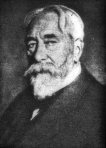
This is Lindenthal, here’s a picture of his grandaughter in 2009 at the Queensboro Centennial event.

Hell Gate Bridge, Viaduct Arches in Astoria – photo by Mitch Waxman
The Hell Gate is primarily an artery, these days, for Amtrak and CSX rail lines but many smaller companies also traverse it. The Bridge itself is Amtrak property.
from wirednewyork.com
The massive beauty and advanced technology of the Hell Gate Bridge (more properly the New York Connecting Railroad Bridge) contrast sharply with nineteenth-century descriptions of the channel that it spans. Named for the dangerous rocks and perilous waters at the confluence of the East and the Harlem Rivers, Hell Gate is surrounded by Manhattan, Queens, and three islands: Wards, Randalls, and Roosevelt (formerly called Blackwell’s, then Welfare). Philip Hone (1780 -1851), writing of an 1844 visit there, described “the delightful scene: the clumps of fine old trees clothed in the gorgeous foliage of autumn, the lawn still bright and green, the mild, refreshing breeze, the rapid waters of Hell Gate covered with sailing vessels and steamboats -all combined to present a picture of consummate beauty.”
The construction of the Pennsylvania Railroad tunnel under the Hudson River and into Pennsylvania Station replaced the time-consuming and expensive water route for New York -bound passengers and freight from New Jersey and points south. Hell Gate Bridge -from the Sunnyside Yards in Queens across the Hell Gate to Wards Island, then across the Little Hell Gate to Randalls Island, and then over the Bronx Kill to the Bronx -was built to complete the linkage of the New York, New England, and Long Island rail lines with the Hudson River crossing. Together, tunnel and bridge created a direct route over the Bronx Kill to the Bronx.
The longest, heaviest, strongest steel arch bridge in the world at that time and the only four-track long-span railroad bridge ever built, Hell Gate Bridge marks the apogee of American railroad power and prosperity. Government regulation, poor management, and a proliferation of alternative methods of transportation -private cars, trucks, buses, and airplanes -eventually undercut the railroad’s primacy

Hell Gate Bridge – photo by Mitch Waxman
Astoria Park provides the setting for the Queens side of the Hell Gate. Its looming masonry and gigantic presence are impossible to ignore, and watching a baseball game being played with the bridge as backdrop is a unique sight. A lot of people love this bridge.
Check out a pdf at trains.com detailing the building of a scale model Hell Gate Bridge for Lionel model railroad enthusiasts that has a 28 foot arch.
from nycgovparks.org
Throughout the centuries the stunning natural beauty of this location has attracted visitors and settlers. Before the arrival of European colonists, a trail passed by the site, and an Indian village flourished at Pot Cove. Local inhabitants grew maize on the shores, fished in Hell Gate, and drew water from Linden Brook, a small stream that still flows under Astoria Park South. In the mid-1600s the Dutch parceled out this land to various owners, including William Hallet whose grant embraced hundreds of acres. During the American Revolution, several British and Hessian regiments were stationed in the area. On November 25, 1780 the frigate Hussar and its five-million-dollar cargo sank to the bottom of Hell Gate, where despite some removal of cannons, the treasure still remains.
During the 19th century, fashionable families like the Barclays, Potters, Woolseys, and Hoyts located their country houses on the heights along the shore. Although attempts were made to remove the dangerous rocks in Hell Gate in the 1850s and 1870s, the waters were the site of New York City’s worst maritime disaster on June 15, 1904. En route to Long Island’s North Shore with the congregation of St. Mark’s German Lutheran Church on board, the steamer General Slocum caught fire. At least 1,021 passengers out of 1,300 burned to death on the ship or drowned in the turbulent waters of the East River before the ship grounded on North Brother Island.

Hell Gate Bridge – photo by Mitch Waxman
The southern tracks carry the Amtrak traffic- which is seen hurtling through the shot above on its way to the Bronx and beyond. It is also one of the few official landmarks in Queens.

Hell Gate Bridge – photo by Mitch Waxman
Click this link, and go nypl.org, where a nearly identical photo to the one above (shot in 2009, late summer), from the early 20th century (my guess would be the late 1920’s or early 1930’s) can be accessed.

Hell Gate Bridge – photo by Mitch Waxman
Municipal indifference and neglectful shortsightedness have taken their toll on the Bridge. Declining rail traffic and budgetary constraints have forced the managers of the bridge to allow 2 of the bridge’s tracks to fall into disrepair. 9/26/09- ERRATA: Incorrect! There are 4 tracks on the bridge, not 6, which is a transposed number that appeared solely in my head. One of the 4 tracks is not used, not 2 of the 6. Thanks to the better angels of the Pentacle for the editorial notations. Said angels prefer to remain confidential.
Local politicians offer complaints about falling debris and accumulations of storm water runoff, ice, and other windblown debris.
from nycroads.com
In the late 1980’s and early 1990’s, Senator Daniel Patrick Moynihan, who spent his childhood near the bridge in Astoria, lobbied to have the Hell Gate Bridge refurbished. Although the nearby Triborough Bridge was being maintained and repainted constantly, the Hell Gate Bridge had not been painted since it opened in 1916 except by the skillful hands of graffiti artists. Since the bridge was deemed structurally sound by Amtrak president W. Graham Claytor, Jr., he saw little need for spending money for “cosmetic purposes.” Buttressed by a 1991 article in The New Yorker on what Moynihan called “a great engineering miracle,” Congress appropriated $55 million to repair and refurbish the Hell Gate Bridge. A unique color was even selected for the bridge paint: “Hell Gate Red.” The restoration project was completed in 1996.
In 2008, Amtrak began a $10 million project to refurbish the concrete viaducts on both sides of the main arch span. The project, which was delayed by two years and cost reviews (it originally had been estimated to cost $3 million), seeks to remedy water leaks and falling concrete that had endangered pedestrians and damaged vehicles underneath the viaducts. It is scheduled for completion in mid-2009, at which time a new coat of paint will be applied to the main arch span under a separate contract.

Hell Gate Bridge – photo by Mitch Waxman
It is a juggernaut, which at the time it was erected, was one of the largest manmade objects on earth. Of course, that would mean divorcing it from the far larger object it serves, which is the megalopolis called Greater New York.
Here’s a video from “acelafella” I found at youtube, which rides along in the engine of a train going over Hell Gate, moving east

Hell Gate Bridge and Randalls Island Viaduct- photo by Mitch Waxman
Any interesting perspective on the Bridge can be found at ltvsquad.com (these guys are urban explorers, and are in serious trouble if caught by Amtrak security while in pursuit of kicks. Remember, the Newtown Pentacle way is to never trespass)
Growing up in astoria in the 1970s, it was impossible to not hear the ghost stories and urban legends – the tales of kids going up there, seeing lights of trains that just never seemed to come, and when they did, they were filled with the lost souls of the Spanish and Dutch explorers who’s boats legend has it sank in the turbulent currents directly below the bridge for which it was named after. It is here that long island sound, as well as the east and Harlem rivers converge – making for currents that have claimed many a live and made the location an ideal dumping ground for victims of the Mafia over the decades. An occasional skull or bone has been known to wash ashore…
And while not drowning in the water below the bridge or being chased by demons on the bridge span itself, there were legends of a child molesting homeless rapist, who would grab kids and drag them into the massive chamber in the base of the bridge blindfolded. According to legend, when the police finally figured out where he was dragging the kids to and stormed the place, they found areas covered wall to wall of photos of said kids being raped. The sickly smell sent investigators out to the park to throw up in the nearest trash can.

Hell Gate Bridge – photo by Mitch Waxman
Carnegie Steel fabricated most of the steel used in the Hell Gate, and found many problems transporting the oversized loads all the way from Pittsburgh. Click for a nytimes.com article from 1912.
Andrew Carnegie was, of course, the second richest man in all of recorded history, right after John D. Rockefeller. He also, incidentally, was the owner of the Keystone Bridge Company. Keystone, when it was absorbed into US Steel, was the contractor for the construction of the Hell Gate Bridge.
quoting from an earlier post on John D. Rockefeller– just for context
…is also the year that John D. Rockefeller founded Standard Oil. For those of you who are young-ins and unfamiliar with the original archetype for “American Villainy”, John D. was a real life combination of Mr. Potter from “its a wonderful life”, Mr. Burns from “the simpsons”, and Daniel Day Lewis’s character in “there will be blood“- and he made Dick Cheney look like a cuddly old man. Fifteen years after he started Standard, John D. Rockefeller was the dominant player- in North America- in the fields of railroads, natural gas production, oil drilling, oil refining, and copper refining. He created, and controlled what would become “Big Oil“.
His buying power and predatory instincts were such that he controlled the price of industrial commodities nation wide. His fortune was so large when he died that he is considered to have been the richest person in recorded history. In 1902 an audit showed his personal fortune was worth nearly 5% of the Gross Domestic Product of the United States. Standard Oil would eventually become known as Exxon, and the bank account grew into Chase Manhattan Bank…

Hell Gate Bridge and Randalls Island Viaduct – photo by Mitch Waxman
Andrew Carnegie was no John D. Rockefeller, mind you, but he did have a bit of a dark side.
from pbs.org
Carnegie was unusual among the industrial captains of his day because he preached for the rights of laborers to unionize and to protect their jobs. However, Carnegie’s actions did not always match his rhetoric. Carnegie’s steel workers were often pushed to long hours and low wages. In the Homestead Strike of 1892, Carnegie threw his support behind plant manager Henry Frick, who locked out workers and hired Pinkerton thugs to intimidate strikers. Many were killed in the conflict, and it was an episode that would forever hurt Carnegie’s reputation and haunt the man.
Still, Carnegie’s steel juggernaut was unstoppable, and by 1900 Carnegie Steel produced more of the metal than all of Great Britain. That was also the year that financier J. P. Morgan mounted a major challenge to Carnegie’s steel empire. While Carnegie believed he could beat Morgan in a battle lasting five, 10 or 15 years, the fight did not appeal to the 64-year old man eager to spend more time with his wife Louise, whom he had married in 1886, and their daughter, Margaret.
Carnegie wrote the asking price for his steel business on a piece of paper and had one of his managers deliver the offer to Morgan. Morgan accepted without hesitation, buying the company for $480 million. “Congratulations, Mr. Carnegie,” Morgan said to Carnegie when they finalized the deal. “you are now the richest man in the world.”

Triborough Bridge and Hell Gate Bridge Stitched Panorama- photo by Mitch Waxman
Right next door to the Hell Gate Bridge is mighty Triborough. You may want to call it the Robert F. Kennedy Bridge, were you a politically weakened Governor who was trying to cozy up to the Kennedy’s and convince an unqualified and inexperienced daughter of a former President to fill a vacant Senate seat in order to shore up his positioning in the national party via association with the “Kennedy Mystique“, but I won’t. I am not a fan, and I believe that in their own way, the Kennedy‘s are as profoundly dangerous to the Republic as are the Bushes. Feh.
It’s Triborough, mighty Triborough, as far as the Newtown Pentacle is concerned. Because that’s what Bob Moses said it was called.

Triborough Bridge – photo by Mitch Waxman
As seems to be the case with the last several posts, this one ends with a promise of more to come, as Triborough and its champion- Robert Moses– form a very BIG story.
here’s a taste, from nycroads.com
Here was a project to kindle the imagination In size, its proportions were heroic. For all Moses’ previous construction feats, it dwarfed any other single enterprise he had undertaken. Its approach ramps would be so huge that houses – not only single-family homes but also sizable apartment buildings – would have to be demolished by the hundreds to give them footing. Its approaches, the masses of concrete in which its cables would be embedded, would be as big as any pyramid built by an Egyptian Pharaoh, its roadways wider than the widest roadways built by the Caesars of Rome. To construct those anchorages and to pave those roadways (just the roadways of the bridge proper itself, not the approach roads) would require enough concrete to pave a four-lane highway from New York to Philadelphia, enough to reopen Depression-shuttered cement factories from Maine to the Mississippi. To make the girders on which that concrete would be laid, Depression-banked furnaces would have to be fired up at no fewer than fifty separate Pennsylvania steel mills. To provide enough lumber for the forms into which that concrete would be poured, an entire forest would have to crash on the Pacific Coast on the opposite side of the American continent Triborough was not really a bridge at all, but four bridges which, together with 13,500 feet of broad viaducts, would link together three boroughs and two islands.
Triborough was not a bridge so much as a traffic machine, the largest ever built. The amount of human energy that would be expended in its construction gives some idea of its immensity: more than five thousand men would be working at the site, and these men would be putting into place the materials furnished by the labor of many times five thousand men; before the Triborough Bridge was completed, its construction would have generated more than 31,000,000 man-hours of work in 134 cities in twenty states. And the size of the bridge is also shown by the amount of money involved. With $5,400,000 already contributed by the city and $44,200,000 promised by the PWA (Public Works Administration), the amount promised for its construction was almost equal to the combined cost of all the projects Robert Moses had built on Long Island during the previous ten years.


 The Newtown Pentacle