Posts Tagged ‘Astoria’
from Hells Gate, loosed upon the world

– photo by Mitch Waxman
The Friday of memorial day weekend, your humble narrator stumbled into the wilds of Astoria, headed for Astoria Park. Astoria Park is at the western end of Queens, and adjoins the East River, hosting parts of both the mighty Triboro Bridge and the sublime exemplar of bridge engineering called Hellgate. Named for the section of the East River it crosses, Hellgate was my intended destination and subject, and I was hoping for some visually interesting rail traffic to be crossing the great bridge. Frustrated by a gray and humid day, the Acela and other Amtrak traffic was observed, as well as a curious CSX double engine. Then…
from nycgovparks.org
Astoria Park, on the west shore of Queens, extends from south of the Triborough Bridge to north of the Hell Gate Bridge. With a panoramic view of the skyscrapers of midtown Manhattan in the south to the Hell Gate channel in the north, the scenery presents the diverse landscape of New York City. The Hell Gate channel, formed by faults deep underground, contains some of the deepest water in New York Harbor. Its treacherous reefs bear picturesque names such as “Hen and Chickens,” “Pot Rock,” “Bread & Cheese,” and “Bald Headed Billy.”
Throughout the centuries the stunning natural beauty of this location has attracted visitors and settlers. Before the arrival of European colonists, a trail passed by the site, and an Indian village flourished at Pot Cove. Local inhabitants grew maize on the shores, fished in Hell Gate, and drew water from Linden Brook, a small stream that still flows under Astoria Park South. In the mid-1600s the Dutch parceled out this land to various owners, including William Hallet whose grant embraced hundreds of acres. During the American Revolution, several British and Hessian regiments were stationed in the area. On November 25, 1780 the frigate Hussar and its five-million-dollar cargo sank to the bottom of Hell Gate, where despite some removal of cannons, the treasure still remains.

– photo by Mitch Waxman
I’ve become pretty familiar with NY Harbor in the last year, and can identify some of the common types of ships that cross its waters. Every now and then, however, a mysterious craft- an unidentified floating object or UFO if you will- crosses in front of me. Proceeding south, this catamaran (actually a trimaran) was nearly devoid of markings- which is remarkable in itself- and moving at a tremendous clip. Its “colorway” and hull shape instantly said “military” to me, but I could not recognize its specie.
from wikipedia
The first trimarans were built by indigenous Polynesians almost 4,000 years ago, and much of the current terminology is inherited from them. Multihull sailboats (catamarans and trimarans) gained favor during the 1960s and 1970s. Modern recreational trimarans are rooted in the same homebuilt tradition as other multihulls but there are also a number of production models on the market. A number of trimarans in the 19–36-foot lengths (5.8–11 m) have been designed over the last 30 years to be accommodated on a road trailer. These include the original Farrier – Corsair folding trimarans – and original John Westell swing-wing folding trimaran (using the same folding system later adopted also on Quorning Dragonfly) and like trimarans. Many sailboat designers have also designed demountable trimarans that are able to be trailered (like the SeaCart 30 by Oceanlake Marine).
The trimaran design is also becoming more widespread as a passenger ferry. In 2005 the 127-metre trimaran (417 ft) Benchijigua Express was delivered by Austal to Spanish ferry operator Fred. Olsen, S.A. for service in the Canary Islands. Capable of carrying 1,280 passengers and 340 cars, or equivalents, at speeds up to 40 knots, this boat was the longest aluminum ship in the world at the time of delivery. The trimaran concept has also been considered for modern warships. The RV Triton was commissioned by British defence contractor QinetiQ in 2000. In October 2005, the United States Navy commissioned for evaluation the construction of a General Dynamics Littoral Combat Ship (LCS) trimaran designed and built by Austal.

– photo by Mitch Waxman
Evocative, as on one hand it resembled a radar dodging stealth aircraft for the odd angles and aerodynamic shape, on the other it suggested a modern combat tank with its armor designed to deflect rather than defeat ballistic weapons.
The ship, nevertheless, was kicking up a huge wake and was shooting water behind it- some 10-20 feet high- as it rocketed down the East River.
from wikipedia
The littoral zone refers to that part of a sea, lake or river that is close to the shore. In coastal environments the littoral zone extends from the high water mark, which is rarely inundated, to shoreline areas that are permanently submerged. It always includes this intertidal zone and is often used to mean the same as the intertidal zone. However, the meaning of “littoral zone” can extend well beyond the intertidal zone.
There is no single definition. What is regarded as the full extent of the littoral zone, and the way the littoral zone is divided into subregions, varies in different contexts (lakes and rivers have their own definitions). The use of the term also varies from one part of the world to another, and between different disciplines. For example, military commanders speak of the littoral in ways that are quite different from marine biologists.
The adjacency of water gives a number of distinctive characteristics to littoral regions. The erosive power of water results in particular types of landforms, such as sand dunes, and estuaries. The natural movement of the littoral along the coast is called the littoral drift. Biologically, the ready availability of water enables a greater variety of plant and animal life, and the additional local humidity due to evaporation usually creates a microclimate supporting unique types of organisms.
The word “littoral” is used both as a noun and an adjective. It derives from the Latin noun litus, litoris, meaning “shore”. (The doubled ‘t’ is a late medieval innovation and the word is sometimes seen in the more classical-looking spelling ‘litoral’.)

– photo by Mitch Waxman
The “colorway” and camouflage of the craft suggested that the futurists of Britain still have modern adherents, long after the last of the “dazzle ships” were launched.
For those of you not in the know, the Dazzle Ships were an experiment in “breaking up the shape” of large combat vessels against the horizon, an attempt to reduce the visual profile of capital ships and reduce the ability of submariners to target vital areas of said ships. Dazzle works best at distance, which is what modern naval combat is all about.
from wikipedia
At first glance Dazzle seems unlikely camouflage, drawing attention to the ship rather than hiding it, but this technique was developed after the Allied Navies were unable to develop effective means to disguise ships in all weather.
Dazzle did not conceal the ship but made it difficult for the enemy to estimate its type, size, speed and heading. The idea was to disrupt the visual rangefinders used for naval artillery. Its purpose was confusion rather than concealment. An observer would find it difficult to know exactly whether the stern or the bow is in view; and it would be equally difficult to estimate whether the observed vessel is moving towards or away from the observer’s position.
Rangefinders were based on the co-incidence principle with an optical mechanism, operated by a human to compute the range. The operator adjusted the mechanism until two half-images of the target lined up in a complete picture. Dazzle was intended to make that hard because clashing patterns looked abnormal even when the two halves were aligned. This became more important when submarine periscopes included similar rangefinders. As an additional feature, the dazzle pattern usually included a false bow wave to make estimation of the ship’s speed difficult.

– photo by Mitch Waxman
As mentioned, my computer was down for the holiday weekend, but Our Lady of the Pentacle allowed me to use her laptop and I managed to get a few of these images out to that clandestine and anonymous network of maritime enthusiasts and quasi governmental experts who advise, comment, or offer corrections to your Newtown Pentacle. Credit for identifying this craft goes out to them, and I wish that they would allow me to sing praise publicly, but certain conflicts of interest or oaths of secrecy demand that they must always be referred to as “anonymous sources”. In this case, the ultimate sources will be referred to as Daidalos and Icaros (hey, it is Astoria Park).
from wikipedia
It is in images, not in texts that Daedalus is seen with wings; many Greek myths appear to have been invented to make sense of known but inexplicable images. The most familiar literary telling explaining Daedalus’ wings is a late one, that of Ovid: in his Metamorphoses (VIII:183-235) Daedalus was shut up in a tower to prevent his knowledge of his Labyrinth from spreading to the public. He could not leave Crete by sea, as the king kept strict watch on all vessels, permitting none to sail without being carefully searched. Since Minos controlled the land and sea routes, Daedalus set to work to fabricate wings for himself and his young son Icarus. He tied feathers together, from smallest to largest so as to form an increasing surface. The larger ones he secured with thread and the smaller with wax, and gave the whole a gentle curvature like the wings of a bird. When the work was done, the artist, waving his wings, found himself buoyed upward and hung suspended, poising himself on the beaten air. He next equipped his son in the same manner, and taught him how to fly. When both were prepared for flight, Daedalus warned Icarus not to fly too high, because the heat of the sun would melt the wax, nor too low, because the sea foam would soak the feathers.

– photo by Mitch Waxman
Daidalos was actually stumped when the photos arrived, and neither of us could make any sense of the only marking- a string of tiny numbers on the hull- of this unidentified floating object. High flying, Icaros received the shots from the latter, and contacted high ranking members of a certain governmental entity. This entity- let’s just say that they have lots of boats and planes, and boats that are airports, and boats that carry nuclear missiles and stay underwater for months at a time, and a lot of the people who work for it wear white dress uniforms– claimed the ship as theirs!
from wikipedia
From the time of its inception, the military played a decisive role in the history of the United States. A sense of national unity and identity was forged out of the victorious Barbary Wars, as well as the War of 1812. Even so, the Founders were suspicious of a permanent military force and not until the outbreak of World War II did a large standing army become officially established.
The National Security Act of 1947, adopted following World War II and during the onset of the Cold War, created the modern U.S. military framework; the Act merged previously Cabinet-level Department of War and the Department of the Navy into the National Military Establishment (renamed the Department of Defense in 1949), headed by the Secretary of Defense; and created the Department of the Air Force and National Security Council.
The U.S. military is one of the largest militaries in terms of number of personnel. It draws its manpower from a large pool of volunteers; although conscription has been used in the past in various times of both war and peace, it has not been used since 1972. As of 2010, the United States spends about $692 billion annually to fund its military forces, constituting approximately 43 percent of world military expenditures. The U.S. armed forces as a whole possess large quantities of advanced and powerful equipment, which gives them significant capabilities in both defense and power projection.

– photo by Mitch Waxman
What you have just seen, lords and ladies, shooting down the East River at high speed was described as a (JHSV) Joint High Speed Vessel.
A JHSV can comfortably carry 300 fully armed MARINES, or up to 600 in a pinch. Alternatively, it can move multiple main battle tanks- the astounding M1 Abrams. Just so you understand, 600 is near the low end of Battalion strength, and 600 U.S. Marines could probably claim a beachhead in Hell itself if they were asked to. It also has a landing pad for a helicoptor.
This ship is huge… but a helicoptor pad?
from navy.mil
Description
The JHSV program is procuring high-speed transport vessels for the Army and the Navy. These vessels will be used for fast intra-theater transportation of troops, military vehicles and equipment. The JHSV program merges the previous Army Theater Support Vessel (TSV) and the Navy High Speed Connector (HSC), taking advantage of the inherent commonality between the two programs.
JHSV will be capable of transporting 600 short tons 1,200 nautical miles at an average speed of 35 knots. The ships will be capable of operating in shallow-draft ports and waterways, interfacing with roll-on/roll-off discharge facilities, and on/off-loading a combat-loaded Abrams Main Battle Tank (M1A2). Other joint requirements include an aviation flight deck to support day and night air vehicle launch and recovery operations.
JHSV is a commercial-design, non-combatant transport vessel, and does not require the development of any new technology. JHSV is being built to American Bureau of Shipping (ABS) High Speed Naval Craft Guide. Systems onboard will be based on commercial ABS steel vessel rules. As such, it does not require the survivability and ability to sustain damage like the LCS. It has no combat system capability and no ability to support or use LCS mission modules. It will leverage non-developmental or commercial technology that is modified to suit military applications. Select military features include Aviation; Command, Control, Communications, Computers, and (Military) Intelligence; and Firefighting for the Mission Bay. NVR does not apply to any part of JHSV.
As a non-combatant sealift ship, the Navy variant of JHSV will be crewed by civilian mariners, either employed by or under contract to the Navy’s Military Sealift Command. U.S. Army vessels will be crewed by Army craft masters. Both versions will require a crew of approximately 22-40 people, but will have airline style seating for more than 300 embarked forces and fixed berthing for approximately 100 more.
However… This is not a JHSV!!!
This here is the M80 Stiletto.

– photo by Mitch Waxman
Check out this video at youtube which explains the Stiletto’s potential in great detail, and supplies 3D animation for operational scenarios.
With the formal roll-out of the 88-foot Stiletto stealth ship and its cutting-edge “M-Hull” wave-damping design, that legacy takes another step forward. The Stiletto is part of Project WolfPac, which aims to test new concepts of shallow-water and riverine warfare organized around swarms of smaller, affordable ships linked by communications. The Stiletto can slip into shallow waters, launching inflatable boats and even UAVs while serving as a communications hub via its “electronic keel.” Best of all, the M-Hull significantly reduces the pounding its occupants take from waves – poundings that often result in back injuries that cut careers short, or leave sailors with lingering disabilities in later life.
and from wikipedia
The 88-foot (27 m) long vessel has a notable hull design, an M-shaped hull that provides a stable yet fast platform for mounting electronic surveillance equipment or weapons, or for conducting special operations. The hull design does not require foils or lifting devices to achieve a smooth ride at high speeds in rough conditions. Its shallow draft means the M80 Stiletto can operate in littoral and riverine environments and potentially allows for beach landings.
The M80 Stiletto is equipped with four Caterpillar, Inc. C32 1232 kW (1652 HP) engines yielding a top speed in excess of 50 knots (90 km/h) and a range of 500 nautical miles (900 km) when fully loaded. It can be outfitted with jet drives for shallow water operations and beaching.
It has a topside flight deck for launching and retrieving UAVs and a rear ramp that can launch and recover an 11-meter rigid-hull inflatable boat (RIB) or Autonomous Underwater Vehicle (AUV).
It weighs 45 tons unloaded, light enough that it can be hoisted onto a cargo ship, while still able to carry up to 20 tons of cargo in the 1,996 square feet (200 m2) of usable interior space. The ship is 88.6 feet (27.0 m) in length, with a width of 40 feet (12 m) and a height of 18.5 feet (5.6 m), yet has a draft of only 2.5 feet (0.8 m).
The M80 Stiletto is the largest U.S. naval vessel built using carbon-fiber composite and epoxy building techniques, which yields a very light but strong hull. The prototype M80 Stiletto is expected to be in use in less than one year. Ships are expected to cost between $6 and $10 million
Project Firebox 4

Project Firebox, 4430 – photo by Mitch Waxman
This curiously intact specimen, untrammeled despite its industrial location, was observed on the corner of 49th street and Astoria Blvd. near the witch crossed St. Michael’s cemetery.
from nydailynews.com
Mayor Bloomberg wants to extinguish fire alarm boxes from city streets.
Bloomberg pitched the fiery move this week as part of his budget for fiscal year 2011, saying it would save FDNY $2.5 million.
Since 85% of calls made through the street boxes are false alarms, Bloomberg said, “In the days where everybody has cell phones … the city would be just as safe without them.”
Only 140 structural fires last year out of 26,666 were first called in through an alarm box – and phone calls on those fires came in after the boxes were pulled, according to the FDNY.
But a change in the law is needed to scrap the 15,000 boxes because in 1997 a federal judge said such a move violates the civil rights of the deaf.
Project Firebox 3

Project Firebox, 6551 – photo by Mitch Waxman
Northern Blvd., battered and apparently out of order. Also, just as a note- the numbers assigned to the fireboxes have NOTHING to do with FDNY numerical assignations.
from forgotten-ny.com
A road runs from the East River to the tip of the North Fork of Long Island, running through Long Island City, Woodside, Jackson Heights, Flushing, Auburndale, Bayside, Douglaston, Little Neck, Great Neck, Munsey Park, Port Washington, Muttontown, East Norwich, Oyster Bay Cove, Cold Spring Harbor, Huntington, Northport, Smithtown, Stony Brook, St. James, Port Jefferson, Rocky Point, East Shoreham, Wading River, Calverton, Riverhead, Aquebogue, Jamesport, Mattituck, Cutchogue, Southold, Greenport, Orient and Orient Point, and would go further were an ocean not in the way. It is a precolonial trace used by Native Americans before Verrazano and the Dutchmen who followed him caught sight of the lengthy island along whose north shore it limns. It’s Jackson Avenue, North Hempstead Turnpike, Lawrence Hill Road, Fort Salonga Road, North Country Road, Main Road, Route 25A, Route 25, and in NYC and Nassau County, it’s Northern Boulevard.
A little experiment…

– photo by Mitch Waxman
As you may have noticed, lords and ladies, your humble narrator has been struggling with deadlines and various other problems for the last couple of months which has resulted in a rather less than daily schedule here at your Newtown Pentacle. Part of the reason that postings have become somewhat sporadic is the enormous amount of research that goes into a 1-3 thousand word posting illustrated with photos. Fear not, long winded exposition is not going out of style around these parts, but I’m going to be experimenting a little bit with the format in the next few weeks- bear with me.
The first thing you’ll notice will be that rather than abbreviate the posting schedule- I’m going to be accelerate it. You very well might want to subscribe to the RSS feed for the next several weeks, as there will be multiple posts per day. There will still be the mega posts, and anything newsworthy will get the “full treatment”, but I’m going to bombard you with shorter postings for a bit.
My reasoning is twofold, first- it’s the time of year when I need to be outside, wandering the Newtown Pentacle itself and photographing its subtle implications. The shorter posts will allow me a little more freedom of movement, as they are simpler to accomplish and the photographic assets are extant- second- well… I’ll tell you that one in a little while…
Let me know what you think… Next post will be in a few hours.
the king in yellow, brick

Matthews Model Flats, Astoria – photo by Mitch Waxman
As mentioned in the past, Newtown Pentacle HQ is embedded within one of the few corner to corner blocks of Matthews Model Flats remaining in Astoria, Queens. This is also one of the postings where I’m thinking out loud, so if your humble narrator is in error, let me know.
Yellow bricks, which once distinguished much of western Queens, compose the street faces of these buildings. This particular stretch of Matthews flats in Astoria is just about a hundred years old (1911), as is a lot of the building stock in what I’ve been told was called “the German Section”- “back in the day”. Model tenements, as they were known, and while walking my little dog Zuzu one morning I began to ponder those bricks. Those yellow bricks.
Everywhere you go, from Ridgewood to Greenpoint, Maspeth and Astoria- you see those bricks.
from an EXCELLENT illustrated history of Brick manufacturing in the New World at brickcollecting.com
The first bricks in the English colonies in North America were probably made in Virginia as early as 1612. New England saw its first brick kiln erected at Salem, Massachusetts in 1629. The Dutch colonists in New Amsterdam imported yellow bricks from Holland, which imparted a Dutch character to the architecture of the city. The excellent quality and abundance of local clays in the colonies made it unnecessary to import bricks from across the Atlantic. Brick-making centers developed in Fort Orange (what is now Albany), New York; near Philadelphia, Pennsylvania; and Burlington and Trenton, New Jersey, as well as along the Raritan River.

Grand 30th avenue, Astoria – photo by Mitch Waxman
One of the real pleasures encountered when working on postings for this, your Newtown Pentacle, are the moments when I suddenly have to research something mundane because I realize that I actually know nothing about the subject. In this case, it’s bricks.
A couple of years ago, I pursued knowledge of industrial Honey production– How, exactly, do all those millions of gallons of honey get to the little bottles in your supermarket? What can the industrial process be, I asked. The answers are pedantic, complex, and suffice to say that China is the world’s Honey superpower and that Honey was arguably the first industrial commodity.
The story of these yellow Kriescher bricks however, has something for everyone.
also from brickcollecting.com
The Manhattan Fire Brick and Enameled Clay Retort Works (as described in New York Illustrated (New York: D.Appleton & Co., 1876) was located on East 15th Street near the East River. Henry Maurer learned the fireclay manufacturing business in his uncle’s firm, Maurer & Weber, and then established his own firm which relocated from New York and Staten Island to Maurer, New Jersey, in 1874
There were several firms in New York City that took advantage of the nearby deposits of fire clay and manufactured both clay retorts and fire bricks. In 1845 Balthazar Kreischer established a fire-brick works in Manhattan, later known as the New York Fire Brick and Clay Retort Works; Kreischer acquired a fire-clay deposit on Staten Island in 1852 and established a works there which eventually replaced the Manhattan factory (his son’s house, the Charles Kreischer House and the workers’ houses for the company, the Kreischerville Worker’s Houses are both designated New York City Landmarks). Joseph K. Brick established the Brooklyn Clay Retort and Fire Brick Works in 1854. The Maurer & Weber Company later known as the Manhattan Fire Brick and Enameled Clay Retort Works, opened in 1863.
In 1868 John Cooper established a business, later known as the Greenpoint Fire Brick and Sewer Pipe Works, at 413-421 Oakland Street, Brooklyn. While there were 350 fire brick manufacturers in the United States in 1895, the New York-New Jersey area remained one of the major fire brick manufacturing centers.
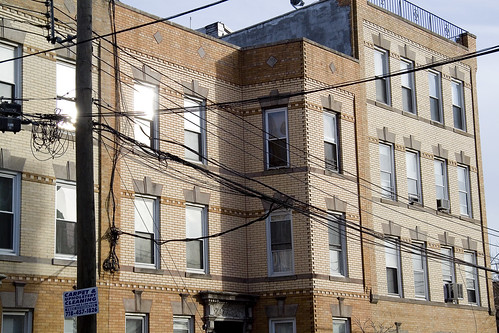
Matthews Houses – photo by Mitch Waxman
19th century businessmen were either merchant princes or robber barons, depending on your point of view. Both are accurate, but suffice to say that communities of labor would cluster around the industrialist, corollary industry would arise to support growing populations around the main mill, and even competitors would often locate in their vicinity to take advantage of locale and the skilled worker population. This is why you find financial, garment, and flower districts in Manhattan and its also why Astoria is visually distinct from the neighborhoods around it.
William Steinway was here, and his interests were larger than just pianos. Steinway was a primal force in digging the first Subway Tunnel from Queens to Manhattan (completed by Michael Degnon, of course), and was a major player in the Queens Trolley business. Wealthy, philanthropic, and well regarded by all reports- Steinway’s Piano mill pulled a population to it. Out on Staten Island, Balthazar Kreischer worked a somewhat coarser but technologically sophisticated operation that made… Bricks.
from boards.ancestry.com
…trying to find the descendants of Balthasar KREISCHER (3.13.1813-8.15.1886) of the Kreischer & Sons Brick Company of Staten Island, and interred in The Green-Wood Cemetery of Brooklyn, New York.
Descendants/Family include his 4 daughters Catherine KREISCHER-WEBER, Fredricka P. KREISCHER, Louisa Albertina KREISCHER-STEINWAY and Caroline L. KREISCHER-ELLIS and his 3 sons: Charles C. KREISCHER, Edward B. KREISCHER and George F. KREISCHER. Some Kreischers settled into Brooklyn.
Louisa Albertina KREISCHER-STEINWAY (d. 6.30.1926) married Albert STEINWAY (b. 6.10.1849- d. 5.14.1877), the youngest son of of Steinway & Sons Piano Mfgr. of Astoria, New York, and had 2 daughters: Henrietta Julia STEINWAY and Ella Frederica STEINWAY. Louisa, Albert and Frederick P. Kreischer are interred in the Steinway mausoleum in Green-Wood Cemetery of Brooklyn, NY.

Maspeth Matthews Houses – photo by Mitch Waxman
Both great men were successful and accepted, rich beyond avarice, and had children. Steinway’s son Albert married Kreischer’s daughter Louisa, connecting the two families in business and standing. Both men also had holdings and interests in the burgeoning railroad business, Kreischer an investor in the Vanderbilt’s Staten Island Railroad and Steinway a rail mogul in Queens. Many of these yellow brick homes, so typical of ancient Queens, lie along the route that trolley tracks once followed.
My supposition is that Kreischer received a family discount for moving his product around on Steinway’s rails, and use of Kreischer Brick in a new project bought some good will from the Steinways- known for their generous nature and political connections in New York, Newtown, and the upstart Long Island City with its scandalous political class.
This is theory, of course, but sounds kind of like the way things worked in 19th century New York when the “old boys” club ruled. Again- theory.
from astorialic.org
“It was reported on the street on Friday that Gleason had sold his railway interests to the Steinway syndicate for $275,000. It has been reported for a long time that the Gleason roads did not pay. The road up Borden Avenue to Calvary Cemetery [in Woodside] was not well patronized. There are not many people who go to Blissville [Sunnyside] unless it is to visit the dead. The Blissville people as a rule do not travel much and when they do they patronize the Greenpoint line in preference to Gleason’s, thus his exchequer has suffered, and again the cars to the cemetery are cold this winter, and the conductors lugubrious on account of the scarcity of pennies and passengers, and a traveler after a survey of one of the cars, is tempted to foot it in preference to riding in an open car, as they had to do on Christmas Day.”

St. Joseph’s RC Church, Grand 30th avenue, Astoria – photo by Mitch Waxman
Louisa’s brother Edward, it seems, met a tragic end.
Check out this page at thecabinet.com, which tells a detailed story of that Kreischer Mansion where Edward lost his life, which describes ghostly phenomena and the violent history experienced by those who have inhabited it since.
Also, don’t miss forgotten-ny’s page on the Steinways and Kreischer’s


 The Newtown Pentacle