Posts Tagged ‘Astoria’
Things you learn from being a ghoul

St. Michael’s Cemetery- photo by Mitch Waxman
As has been mentioned in the past, your humble narrator suffers from a serious health condition, which necessitates regular physical exercise be performed as a curative. These long walks around the Newtown Pentacle, prescriptive in their origins, have made me curious about the things I encounter. Notwithstanding the industrial wonders of Newtown Creek or that clockwork malevolence of marching progress evidenced in Long Island City, desire arises in my heart for quiet… peace… and the company of some semblance of nature.
Here in northwestern Queens, the closest thing to a sylvan glade available to the public for peaceful perambulation are graveyards.

St. Michael’s Cemetery- photo by Mitch Waxman
Despite my great affection for the viridian devastation of Calvary Cemetery, it is quite a long walk from ruby lipped Astoria to the blighted hillocks of Blissville, and in these days of approaching winter- the sun’s journey ends in late afternoon. Calvary will consume you, if you stray too far from the light, and the wise visit it early in the day.
A mere half mile from Newtown Pentacle HQ, however, can be found St. Michael’s. 88 acres of manicured grounds, St. Michael’s is an island of calm in the middle of Astoria. Unlike Calvary, St. Michael’s is a nonsectarian burial ground, and exhibits the legendary diversity of populations for which Queens is renowned worldwide within its loamy depths.
(we’ll be exploring St. Michael’s more thoroughly in future posts, but for now…)
Recently, on one of my ghoulish walks around the place, I encountered strange fruit.
from St. Michael’s
St. Michael’s Cemetery is situated in the borough of Queens in New York City. Established in 1852, St. Michael’s is one of the oldest religious, nonprofit cemeteries in the New York City metropolitan area which is open to people of all faiths. It is owned and operated by St. Michael’s Church, an Episcopal congregation located on the Upper West Side of Manhattan.
The original property for St. Michael’s Cemetery was purchased in 1852 by the Rev. Thomas McClure Peters and occupied seven acres. Over the years St. Michael’s gradually acquired additional land to its present size of approximately eighty-eight acres. Because it was Dr. Peters intention to provide a final dignified resting place for the poor who could not otherwise afford it, areas within the cemetery were assigned to other free churches and institutions of New York City. These areas are still held for the institutions they were assigned. As a service to its diverse constituency, St. Michael’s continues to this day provide burial space for individuals and families from all classes, religions and ethnicities. St. Michael’s reflects the demographic and historical trends of New York City. Walking through the older sections of the cemetery, you will find burials representing the 19th and early 20th century immigrants.
In the late 1980’s St. Michael’s began building community mausoleums in order to more efficiently utilize the remaining unoccupied space and offer attractive, affordable final resting places. Currently, we are planning a new mausoleum complex at 49th Street and Grand Central Parkway Service Road.

St. Michael’s Cemetery- photo by Mitch Waxman
About the size of an orange, or large apple, the ruggose skin of the fruit had a sickly yellow-green coloration. Abundant, the fallen spores were obviously in season. Ignorant of the specificities of arborial lore, nocturnal researches of North American cultivars suggested that this sort of ovum was typical of an Osage Orange- Maclura pomifera to those in the know.
from wikipedia
Osage-orange, Horse-apple, Bois D’Arc, or Bodark (Maclura pomifera) is a small deciduous tree or large shrub, typically growing to 8–15 metres (26–49 ft) tall. It is dioeceous, with male and female flowers on different plants. The fruit, a multiple fruit, is roughly spherical, but bumpy, and 7–15 cm in diameter, and it is filled with a sticky white latex sap. In fall, its color turns a bright yellow-green and it has a faint odor similar to that of oranges.
Maclura is closely related to the genus Cudrania, and hybrids between the two genera have been produced. In fact, some botanists recognize a more broadly defined Maclura that includes species previously included in Cudrania and other genera of Moraceae.
Osajin and Pomiferin are flavonoid pigments present in the wood and fruit, comprising about 10% of the fruit’s dry weight. The plant also contains the flavonol morin.
Recent research suggests that elemol, another component extractable from the fruit, shows promise as a mosquito repellent with similar activity to DEET in contact and residual repellency.

St. Michael’s Cemetery, Maclura pomifera, or Osage Orange fruit – photo by Mitch Waxman
An important plant to the native american cultures, the Osage Orange tree produces wood which is dense and fibrous, ideal for the body of a Bow and it is one of the highest rated “fuel woods“. Resistant to insect and fungus, Osage wood is also prized for use in fenceposts. It grows in the form of a dense thorned thicket surrounding the central trunk, and produces the “orange” which is largely passed over by mammalian scavengers like Squirrels and Raccoons. Prized by Horses and Mules (horse apples), the original range of the tree was confined to the southwest, but its value as a hedge plant and naturally replenishing cattle fence was instrumental in it being planted all over North America.
from horticulture and home pest news
The Osage-orange is native to a small area in eastern Texas, southeastern Oklahoma, and southwestern Arkansas. This region was also the home of the Osage Indians, hence the common name of Osage-orange. White settlers moving into the region found that the Osage-orange possessed several admirable qualities. It is a tough and durable tree, transplants easily, and tolerates poor soils, extreme heat, and strong winds. It also has no serious insect or disease problems. During the mid-nineteenth century, it was widely planted by midwest farmers, including those in southern Iowa, as a living fence. When pruned into a hedge, it provided an impenetrable barrier to livestock. The widespread planting of Osage-orange stopped with the introduction of barbed wire. Many of the original hedges have since been destroyed or died. However, some of the original trees can still be found in fence rows in southern Iowa. Trees have also become naturalized in pastures and ravines in southern areas of the state.
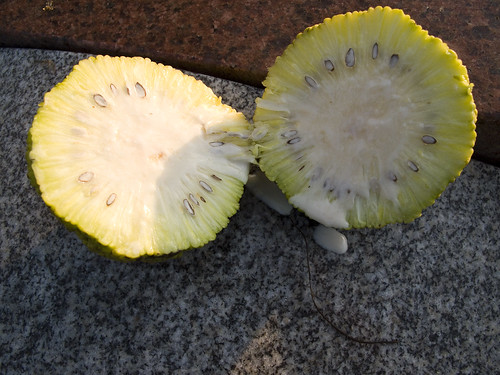
St. Michael’s Cemetery, Maclura pomifera, or Osage Orange fruit – photo by Mitch Waxman
Like all fruiting plants, an animal conspirator is required to complete the life cycle of the Osage Orange, expanding its range via the digestive processes of a ranging forager. Ever efficient, nature would not waste its time producing an energy rich fruit that attracts no living animal to it. Theories abound as to the identity of this partner organism, and an extinct equine is one of the evolutionary vectors theorized to have played this role for the Osage (thought likely due to the browsing preferences of modern Horse and Mule), but an intriguing notion is put forth by Connie Barlow of Harvard’s Arnold Arboretum who offers the theory that the anachronistic fruit of the Osage Orange’s partner animal was in fact a long extinct North American Elephant- the Mammoth.
Practicers of the left handed path of forbidden knowledge prize Osage wood for usage in wands, believing it to be useful when invoking mysterious spirits emanating from the bowels of the earth- those never human elemental intelligences, and the spirit animal guides associated with Native American Shamanic beliefs.
Osage-Orange is a native tree coming from a relatively small area in eastern Oklahoma, portions of Missouri, Texas and Arkansas. While used for centuries by native Americans in its original area for war clubs and bows, it was the first tree Lewis and Clark sent back east from St. Louis in 1804. Yet, with that modest beginning, the Osage-Orange probably has been planted in greater numbers throughout the United States in the 19th and early 20th century than almost any other tree species in North America. Because of its value as a natural hedgerow fence, it made agricultural settlement of the prairies possible, it then led directly to the invention of barbed wire in 1874, and then provided most of the posts for the wire that fenced the West. It is still considered the best wood for making archer’s bows. The Osage-Orange is one of America’s more interesting natives. It has at least two Internet web sites dedicated to keeping Osage-Orange enthusiasts informed (see www.osageorange.com and www.hedgeapple.com).
Happy Thanksgiving.
misty water colored memories… but with blood

Long Island City, mouth of Newtown Creek, Greenpoint stitched panorama – photo by Mitch Waxman
Note- I’ve got a turmoil in me right now.
Your humble narrator is pissed off, and this ape is standing at the edge of his personal forest, hurling invective at an unfamiliar thing hanging in the sky called Moon. Rambling ahead, with a few reminisces of New York in “the good old days”.
The disturbing incongruity of modern skyscrapers in the Newtown Pentacle’s panoramic skies, whether commercial spire or residential tower, is horrifying to the residents of victorian relicts such as Long Island City and Greenpoint. All along the rotting infrastructure of the malodorous Newtown Creek, nearly the geographic center of the City of Greater New York, the arrival of a pregnant moment is apparent.
“A river of federal money will wash out the Newtown Creek, and all the poisons in the mud will be hatched out, or so say the G-Men” is my take on the EPA superfund listing of the Creek for now.
I still haven’t parsed everything, that was said in the November 5, 2009 Newtown Creek Alliance meeting at St. Cecilia’s. I made an audio recording of the presentation, and will be listening to it again. Its just that the EPA… the feds… gaining absolute control over a 4 long by half mile wide chunk of New York City for as long as 50 years… that’s 12.5 presidential administrations. 12.5 administrations ago was FDR’s first term.
Speaking of FDR, did you know that his second term Vice President- Henry A. Wallace (responsible for the very successful transformation of dustbowl era agri-businesses from rural homestead into their somewhat modern form) was a well known and public occultist?

Looking east from Newtown Creek Wastewater Treatment Plant catwalk stitched panorama – photo by Mitch Waxman
The New York that my father knew, the one built up in the late 30’s, 40’s, and 50’s, is the one that began crumbling in the 70’s and came crashing down during the 1980’s. Contrary to what you may have read, the Reagan years were not a very nice time, and a soggy malaise hung over both the great city and the nation that exists because of it. Disillusioned by the failures of utopian city planners and those shambolic ideologies which were popularized by academic and journalist alike, the population of New York turned on each other in those days.
Here’s a few of my “new york stories”- I was there, I saw them.

Looking southwest from Queensboro Bridge stitched panorama – photo by Mitch Waxman
A tragedy of Russian scale and tone, “good old days” New York saw violent encounters between strangers became commonplace in a city always on the edge. Back then (late 80’s, early 90’s)- Williamsburg was a blasted out brick lot, blighted, and an island of extreme poverty.

West from Pulaski Bridge facing Manhattan, stitched panorama – photo by Mitch Waxman
Naked hookers plied their trade in Williamsburg on Bedford and Grand, while just beyond- a Motorcycle Club’s shanty was lit by oil drums filled with castaway lumber and litter. The Lower East Side (then known as Alphabet city) was where you spent your time, then, or way uptown above 96th street on the west side- and both neighborhoods had borderlines and “DMZ” areas.
The City belonged to the rats, and you either fought them or ran away. Cowardice was considered an intelligent option back then, just run away- don’t try to fight “them”.

East on Newtown Creek, Kosciuszko Bridge stitched panorama – photo by Mitch Waxman
Once, I saw a businessman 2 blocks north of Grand Central Station on Park Avenue, wearing an expensive vested suit which was the fashion at the time. He walked between two cars, dropped his suit pants, and defecated in the street. You used to pee wherever you wanted to, as well, “back in the day”.
You could smoke tobacco, in designated areas, within New York City hospital wards. There was a magical danish called the Bearclaw, which has since gone extinct in New York City, best quaffed with bitter black coffee. The last Bearclaw I had was in the “New York New York” casino in Las Vegas.

Skillman Avenue, Sunnyside Railyard fence line – photo by Mitch Waxman
Once, I saw a homeless guy junkie- during the early AIDS years- get hit by a cab. His head shot forward toward the asphalt in a parabolic arc with his knees acting as a fulcrum, shattering his face and killing him. This happened on 21st street and 3rd, down the block from the Police Academy. They left him there for 2-3 hours waiting for the morgue to show up because nobody wanted to get AIDS blood on themselves. The bulls set up traffic cones around him.

Sunnyside, Barnett Avenue looking west stitched panorama – photo by Mitch Waxman
That New York City- the one that was a national disaster long before it became the scene of a national disaster, a lamentable metropolis of blood, hate, and too much damn noise- is being built over and carted away. But this is the way of things, here.
Those farms and mills obliterated by rapacious rail barons and their quest to build Sunnyside Yards, do you know who the Payntars were, or their story?

Queensbridge Park, looking west toward Manhattan stitched panorama – photo by Mitch Waxman
The mansions of Ravenswood, gothic palaces built for the ultra rich who made their fortunes on Newtown Creek and in Long Island City, were casually eradicated to make way for mill and dock, and later bridge and housing project. Do you know the story of the Terracotta House?

From George Washington Bridge looking south on upper Manhattan and New Jersey stitched panorama – photo by Mitch Waxman
Once, back in ’93, on 99th and Broadway- some guy was talking on a pay phone in the middle of the night, during an ice storm. You know the kind- the sort of weather that coats every surface in a half inch of clear, slick ice. Urban misery, but quite beautiful.

Astoria 31st Avenue stormy sky stitched panorama- photo by Mitch Waxman
Unfortunately for this fellow on the phone, someone shot him a few times and he must have slumped forward with the phone in his hand. I walked by on my way to the 2 train the next morning and the wind had pushed him backwards, his frozen hand around the receiver and his corpse was swaying stiffly in the february wind. There were bloodcicles.

Long Island City, Hunters Point, mouth of Newtown Creek, Greenpoint stitched panorama – photo by Mitch Waxman
For more on this lost and forgotten civilization, buy an early Ramones album and play it very loud.
Tugboat transit at Hells Gate

– photo by Mitch Waxman
Hanging out at Astoria Park, waiting for the Greater Astoria Historical Society‘s “Haunted East River” tour to start, what did I spy crossing under mighty Triborough?
The John Reinauer tugboat- that’s what- moving a fuel barge north on the East River, through the bright passage at Hells Gate.
from wikipedia
Liquid cargo barges are barges that transport petrochemicals, such as styrene, benzene and methanol; liquid fertilizer, including anhydrous ammonia; refined products, including gasoline, diesel and jet fuel; black oil products, such as asphalt, No. 6 fuel oil and coker fuel; and pressurized products, such as butane, propane and butadiene, which are transported on the waterways from producers to end users.

– photo by Mitch Waxman
The John Reinauer was built at Main Ironworks in 1969, and was christened the Esso Crystal River. (Esso, is of course, the brand name for Standard Oil -S.-O- Esso, later Exxon) The now Exxon Crystal River went to Reinauer Transportation in 1993. A 2,600 horsepower, 86 foot long steel hulled towing vessel, the J.R. is 27 feet wide and has a draw of 9 feet.
Check out the company’s J.R. page for photos of the ship in its various incarnations here.
from wikipedia
The terms “Tonnage” and “Ton” have different meanings and are often confused. Tonnage is a measure of the size or cargo capacity of a ship. The term derives from the taxation paid on tuns of wine, and was later used in reference to the weight of a ship’s cargo; however, in modern maritime usage, “tonnage” specifically refers to a calculation of the volume or cargo volume of a ship. The term is still sometimes incorrectly used to refer to the weight of a loaded or empty vessel.
Measurement of tonnage can be less than straightforward, not least because it is used to assess fees on commercial shipping.

– photo by Mitch Waxman
Like many other tugboats, the John Reinauer participated in the evacuation of Lower Manhattan necessitated by the September 11 attacks.
(The John J. Harvey Fireboat, which was discussed in some detail in 2 prior posts- here… and here, similarly served the city that day).
from wikipedia
Immediately after the first attack, the captains and crews of a large number of local boats steamed into the attack zone to assist in evacuation and provide supplies and water.Water became urgently needed after the Towers’ collapse severed downtown water mains. The size of the dust and debris cloud following the collapse of the Twin Towers was such that it necessitated that many of these trips were navigated by radar alone. Estimates of the number of people evacuated by water from Lower Manhattan that day in the eight hour period following the attacks range from 500,000 to 1,000,000. As many as 2,000 injured people in the attacks were reportedly evacuated by this means through there were no reported injuries resulting from the evacuation itself.
Sludge Boats, baby, Sludge Boats

M/V Red Hook DEP Sludge Vessel – photo by Mitch Waxman
After processing at a water treatment facilities, which the City of New York’s DEP manages 14 of (including the vast Temple of Cloacina called the Newtown Creek Wastewater Treatment Plant), the concentrated sludge distillate produced by municipal sewage plants requires “dewatering” – it must be reduced into a semi solid called “cake”. Not every one of the 14 wastewater treatment plants has a dewatering facility, so the sludge needs to get from point A to point B via a the fleet of Sludge Vessels.
Pictured above is the sludge dock in Greenpoint, with the M/V Red Hook at dock, at the mouth of the Newtown Creek. Flowing from that aforementioned temple of “the Venus of the Sewers” to a gigantic holding tank via mechanical means, it is then pumped out to the dock and the waiting sludge boat.
from nyc.gov
Preliminary treatment
Several stories underground, wastewater flows into the plants from sewers connected to New York City’s homes and businesses. The incoming wastewater, called influent, passes through screens consisting of upright bars, spaced one to three inches apart. These bars remove large pieces of trash including rags, sticks, newspaper, soft drink cans, bottles, plastic cups and other similar items. This protects the main sewage pumps and other equipment. The garbage is transported to landfills. The main sewage pumps then lift the wastewater from the screening chamber to the surface level of the plant.
Primary treatment
Next, the wastewater enters primary settling tanks, also called sedimentation tanks, for one to two hours. The flow of the water is slowed, allowing heavier solids to settle to the bottom of the tank and the lighter materials to float. At the end of the process, the floatable trash, such as grease and small plastic material, rises and is skimmed from the top of the tanks surface.
The settled solids, called primary sludge, are then pumped through cyclone degritters — devices that use centrifugal force to separate out sand, grit (such as coffee grinds) and gravel. This grit is removed, washed and taken to landfills.
The degritted primary sludge is pumped to the plant’s sludge handling facilities for further processing. The partially treated wastewater from the primary setting tanks then flows to the secondary treatment system.

M/V North River DEP Sludge Vessel – photo by Mitch Waxman
The 1.3 billion gallon a day flow of New York City’s sewage should be defined as a third river. That’s 1,300,000,000 gallons a day or 474,500,000,000 gallons of night soil a year. 1.3 billion is the population of China.
Pictured above is the DEP Sludge Vessel M/V North River, a veteran, she was launched at Maryland Shipbuilding in 1974. Just under 324 foot long, North River can carry 102,000 cubic feet of evil juice and weighs in at 2,557 gross tons.
from nyc.gov
Secondary treatment
Secondary treatment is called the activated sludge process. This is because air and “seed” sludge from the plant treatment process are added to the wastewater to break it down further. Air pumped into large aeration tanks mixes the wastewater and sludge that stimulates the growth of oxygen-using bacteria and other tiny organisms that are naturally present in the sewage. These beneficial microorganisms consume most of the remaining organic materials that are polluting the water and this produces heavier particles that will settle later in the treatment process.Wastewater passes through these bubbling tanks in three to six hours.
The aerated wastewater then flows to the final settling tanks which are similar to the primary settling tanks. Here the heavy particles and other solids settle to the bottom as secondary sludge. Some of this sludge is re-circulated back to the aeration tanks as “seed” to stimulate the activated sludge process. The returned sludge contains millions of microorganisms that help maintain the right mix of bacteria and air in the tank and contribute to the removal of as many pollutants as possible.
The remaining secondary sludge is removed from the settling tanks and added to the primary sludge for further processing in the sludge handling facilities.Wastewater passes through the settling tanks in two to three hours and then flows to a disinfection tank.
Disinfection
Even after primary and secondary treatment, diseasecausing organisms may remain in the treated wastewater. To disinfect and kill harmful organisms, the wastewater spends a minimum of 15-20 minutes in chlorine-contact tanks mixing with sodium hypochlorite, the same chemical found in common household bleach. The treated wastewater, or effluent, is then released into local waterways. Disinfection is an essential step because it protects the health of people who use local beaches and enjoy other recreational activities on or near the water.

M/V Newtown Creek DEP Sludge Vessel – photo by Mitch Waxman
Identical in dimension and capacity to the North River, the 1967 vintage DEP Sludge Vessel M/V Newtown Creek passed under mighty Triborough and crossed Hells Gate. M/V Newtown Creek was laid down by the Wiley Manufacturing Co. Back in the days of ocean dumping, these ships were amongst a small fleet of tugs, barges, and older sludge boats that would “do the deed“.
from nyc.gov
Sludge treatment
The following are typical stages of the sludge treatment process.
Thickening
The sludge produced by primary and secondary treatment is approximately 99% water and must be concentrated to enable its further processing. Thickening tanks allow the sludge to collect, settle and separate from the water for up to 24 hours. The water is then sent back to the head of the plant or to the aeration tanks for additional treatment.
Digestion
After thickening, the sludge is further treated to make it safer for the environment. The sludge is placed in oxygenfree tanks, called digesters, and heated to at least 95 degrees Fahrenheit for between 15 to 20 days. This stimulates the growth of anaerobic bacteria, which consume organic material in the sludge. Unlike the bacteria in the aeration tanks, these bacteria thrive in an oxygen-free or “anaerobic” environment. The digestion process stabilizes the thickened sludge by converting much of the material into water, carbon dioxide and methane gas. The black sludge that remains after digestion has the consistency of pea soup and has little odor. This is called digested sludge.
Methane gas is often used as an energy source at the City’s wastewater treatment plants. The gas may be used in engines to produce electricity or directly drive plant equipment. Gas is also used in boilers to provide heat for digestion and plant-wide buildings. Currently, DEP and the New York Power Authority (NYPA) have jointly installed fuel cells at four of the City’s water pollution control plants; 26th Ward, Red Hook, Oakwood Beach and Hunts Point. Fuel cells convert the methane gas and carbon dioxide into heat and electricity that is then used to operate the plants. This technology contributes to New York City’s efforts to enhance clean air operations at its facilities. There is a significant reduction in air emissions as a result of using fuel cells.
Digester sludge is pumped from sludge storage tanks to a dewatering facility. At some treatment plants, where there are no dewatering facilities on site, the sludge is transported for processing through a pipeline or by a sludge boat to a plant that has a dewatering facility.

M/V Newtown Creek DEP Sludge Vessel, close-up – photo by Mitch Waxman
Once requiring a crew of as many of 20, the City now runs these ships with a mere 6. Semiautomated, M/V Newtown Creek and North River are nevertheless more than twice the size of the original model Sludge Vessels like the Owl’s Head.
from nyc.gov
Dewatering reduces the liquid volume of sludge by about 90%. New York City operates dewatering facilities at eight of its 14 treatment plants. At these facilities, digested sludge is sent through large centrifuges that operate like the spin cycle of a washing machine. The force from the very fast spinning of the centrifuges separates most of the water from the solids in the sludge, creating a substance knows as biosolids. The water drawn from the spinning process is then returned to the head of the plant for reprocessing. Adding a substance called organic polymer improves the consistency of the “cake”, resulting in a firmer, more manageable product. The biosolids cake is approximately 25 to 27 percent solid material.
Astoria Predator

– photo by Mitch Waxman
Hawk at Astoria Park, Halloween day 2009. I believe it’s a Red Tail Hawk, but I’m not qualified to genotype the avian specie.
from wikipedia
The Red-tailed Hawk (Buteo jamaicensis) is a bird of prey, one of three species colloquially known in the United States as the “chickenhawk,” though it rarely preys on chickens. It breeds throughout most of North America, from western Alaska and northern Canada to as far south as Panama and the West Indies, and is one of the most common buteos in North America. Red-tailed Hawks can acclimate to all the biomes within its range. There are fourteen recognized subspecies, which vary in appearance and range. It is one of the largest members of the genus Buteo in North America, typically weighing from 690 to 1600 grams (1.5 to 3.5 pounds) and measuring 45–65 cm (18 to 26 in) in length, with a wingspan from 110 to 145 cm (43 to 57 in). The Red-tailed Hawk displays sexual dimorphism in size, with females averaging about 25% heavier than males.
According to sources in the ornithological community, two red tail hawks nest in the rafters of the Triborough Bridge. Accordingly with the Hellenic character of the neighborhood, these hawks are named Atlas and Athena. Perhaps this is one of them.
The bird people are all over this, check out urbanhawks, and nycgovparks.com has a neat overview on “The Atlantic Flyway”.


 The Newtown Pentacle