Posts Tagged ‘Blissville’
open place

– photo by Mitch Waxman
As mentioned in yesterday’s posting, an effort was made to get out and survey the various parts of the Newtown Creek and her tributaries which are normally focused upon at this, your Newtown Pentacle. Luckily, a friend- Hank the Elevator Guy– offered to drive me around. This simplified my life immensely and allowed me to cover several of the rather further flung sections which one would normally have to walk to.
Pictured above, for instance, are workers pumping out the Queens Midtown Tunnel on the corner of Vernon and Borden.
from jimmyvanbramer.com
Along both Center and Vernon Boulevards I visited businesses that experienced significant flooding damage as a result of Hurricane Sandy. In an effort to help them recover and reopen. I will be delivering FEMA Disaster Assistance forms to businesses. This information will help those affected on their way toward a full recovery.

– photo by Mitch Waxman
This post will concern what was witnessed along Borden Avenue, and subsequent postings for the next few days will highlight other sections of the Newtown Creek. All along Borden, a flurry of activity was underway, and nearly every street level door was opened and featured a flexible pipe carrying water out to the curb. The good news is that Long Island City seems to have rolled up its sleeves and is getting back to work, something which will act as a “force multiplier” for those sections of the City which weren’t so lucky.
from dnainfo.com
A storm surge that flooded “hundreds of properties” with Newtown Creek’s water carries intense economic and environmental repercussions, advocates warned.
“All waterfront properties took water, hundreds of properties,” said the Newtown Creek Alliance’s director Kate Zidar after surveying the scene by the highly polluted creek Tuesday. “The standing water and residue that came from the creek should not be considered clean.”

– photo by Mitch Waxman
The Borden Avenue Bridge, as you’d imagine, survived the hurricane in apparently fine fettle, although the lots surrounding it showed signs of flooding and wash outs. WCBS, today, reported that Newtown Creek breached its bulkheads in LIC flooding the surrounding area- including the Midtown Tunnel.
Based on what I’ve seen and heard here though, the surge was as severe in LIC as it was over in residential Greenpoint over in Brooklyn.
Sandy Flooding Impacts Waterfront Properties on Newtown Creek
During the peak of the storm, Newtown Creek flooded throughout Zones A, B and C, and some waterfront areas experienced several feet of water. Luckily, waters receded quickly for the most part. Check out our photos from the storm, and our brief recap from Wednesday. If you are looking to volunteer with cleanup, send us an email at info@newtowncreekalliance.org.

– photo by Mitch Waxman
Unfortunately there was quite a bit of petroleum in the water, as evinced by not just olfactory evidence, but the presence of a rainbow sheen on the water. Instruction offered by officials of the DEC in the past has opined that the presence of such multicolored refraction indicates a fresh spill of “product”. Quite obviously, however, the sheer number of submerged automobiles and home heating oil tanks in the greater New York area means that there are literally tens of thousands of “non point” sources for such pollution.
from huffingtonpost.com
According to the Office of Response and Restoration at the National Oceanic and Atmospheric Administration, the U.S. Coast Guard had requested scientific support from NOAA’s Emergency Response Division for three separate oil spills in Arthur Kill, as well as “reports of several orphan containers, and many potential hazmat targets.”
The so-called “products of concern” include 8,300 barrels — or about 349,000 gallons — of diesel, bio-diesel and slop oil, according to NOAA.

– photo by Mitch Waxman
Speaking of the smell, the ineffable odor of raw sewage was omnipresent, also an expected consequence of the disaster. As mentioned in prior postings, your humble narrator has grown quite inured to the smell over the years, and it was pointed out by Hank the Elevator Guy as his eyes began to water. Such inability to perceive environmental factors is known as “adaptation”, which is something I think we are all going to be getting familiar with in the coming months and years.
from petervallone.com
·Tap water is safe to drink.
·Do not use generators or grills indoors. Carbon monoxide poisoning is a serious threat when these devices are used indoors. They should only be used outside and kept away from windows and vents. Everyone should possess and use battery-operated carbon monoxide alarms. Test the batteries if possible.
·If someone experiences sleepiness, dizziness, headaches, confusion, weakness, or if the carbon monoxide alarm sounds, they should immediately seek fresh air and call the poison control center at 212–POISONS (212-764-7667). They can also call 911, since poisoning is life threatening.

– photo by Mitch Waxman
The water in Dutch Kills was actually quite active, but it was still fairly windy when these shots were taken. Under normal circumstance, this tributary of Newtown Creek is an unbroken mirror- surreal. There were tons of “floatables” in the water, flotsam and jetsam and wind blown trash and debris. I didn’t witness many birds, other than a seagull (a bird which is not commonly observed at the Creek, they like Astoria Park on Hell Gate, don’t ask me why) which was loudly announcing itself.
The chemistry in the air, which as mentioned was tainted by sewage, smelled not unlike the shop floor of any mid sized automobile mechanic.
SAVE THE DATE! Assemblyman Joe Lentol and District Dog will be partnering for a hurricane relief event on Sunday November 11th to collect goods for Brooklyn residents and animal rescue organizations that have suffered as a result of Hurricane Sandy.

– photo by Mitch Waxman
Under emergency conditions such as those which have shattered New York City, unthinkable things are now essential to recovery. Under normal circumstances, visible “product” floating around in any amount- let alone the enormous volume in these shots- would engender an enormous response from environmental watchdogs inside and outside of government. What you see here is unimportant right now, from a big picture pov.
There are kids out there- in the dark and cold.

– photo by Mitch Waxman
Saying that, it will be a long haul to “get back to normal”, or it was so called eleven years ago – the “new normal”. Also, I cannot imagine how tired the same folks who always take it on the chin for the rest of us – cops, firemen, ambulance emt- must be. I’m sure it’s no joke for all the other services, who must have been “on” non stop for the last week with no end in sight.
For the rest of us, NYC will soon be operating under an entirely new rule book.
from greenpointers.com
At this point, there’s not a whole lot that can be done to prevent the Newtown Creek from overflowing. I was down there at noon today and the bulkhead at GMDC was already under water, and the water was a couple of feet short of overflowing onto Manhattan Ave. We are expecting a high tide tonight to coincide with the storm surge and that could mean a storm surge of 8-11 feet at Newtown Creek, which would obviously put Manhattan Ave under water.

– photo by Mitch Waxman
The Blue Crow’s shack, a homeless shanty which been encamped on the Borden Avenue Bridge for several years that has withstood blizzards and storms, is smashed. I called out to him in English and Spanish, but there was no answer. Hopefully, the fellow found some sort of alternative shelter before the winds took his home.
from observer.com
“As long as you stay indoors, you’re probably safe,” Mayor Bloomberg told the reporters at this evening’s latest press conference. But what about the people for whom it isn’t that simple? The Observer is getting reports that even as Sandy roars our way, some of the city’s most vulnerable–the homeless–are still outside.
As late as this evening, an Observer source found a group of people at Eighth Street and Second Avenue with no plans to leave for a drop-in or emergency center. ”We got shelter right here,” one man told her.

– photo by Mitch Waxman
I’m sort of worried about the situation of the various homeless camps around the Newtown Creek. There are a substantial number of people who exist in the cracks and narrow spaces here, sleeping along fence lines and along industrial sidewalls. One cannot imagine their lives during normal circumstance, let alone Hurricane Sandy.
from housingworks.org
With the mess of Hurricane Sandy in New York City over the last few days, we have been hearing a lot about mandatory evacuations for people in Zone A: areas in Staten Island, lower Manhattan, and eastern Brooklyn (Red Hook and Greenpoint especially). To meet the needs of these Sandy evacuees, Bloomberg opened 65 additional shelters across the five boroughs, stocking these makeshift shelters—high schools, middle schools, etc.—with food, water, blankets, and pet food.
The strongest part of this evacuation plan is that it’s a piece of a larger puzzle, and that these shelters are only a detour until these people can return to their homes. But for the 50,000 people in New York City who are homeless and need shelter every night, they simply are not given the same thought-out consideration or planning, at least not outside of weather emergencies. Certainly, we must commend those who were on the front line of the storm over the last few nights, reaching out to the homeless across New York City and even into New Jersey (well done, Cory Booker) and encouraging them to seek shelter, but where’s the same outreach and energy on an average NYC night? Where is the long-term solution for the population that is the same as Hempstead, NY?

– photo by Mitch Waxman
Having thoroughly documented the area around the Borden Avenue Bridge, Hank the Elevator Guy and I got back in his truck and headed off for points east. More tomorrow at this, your Newtown Pentacle.
from riverkeeper.org
In addition to the extraordinary impacts to our homes and public infrastructure, Superstorm Sandy also had an extraordinary impact to our environment. Riverkeeper has sounded the alarm about widespread pollution in the Hudson River and New York Harbor by a variety of toxic chemicals, including petroleum and fluids from cars and boats; contaminants from flooded subways, roads, parking lots and tunnels; and contaminants washed from shoreline industrial sites, as well as commercial and residential buildings. Our message is being heard, as the press reports on widespread pollution, as well as specific waterways, from the Gowanus Canal to the Rondout Creek.
You can do a service for our water by helping Riverkeeper to document this pollution. Where possible, we will take action with environmental agencies to remedy pollution. In all instances, documenting pollution will help us understand the impacts of this extraordinary storm surge, so we can advocate for actions that will lessen or eliminate impacts from the next storm. When you see something, take photos, and note the location, time and conditions, as well as any other necessary information.
old manor

– photo by Mitch Waxman
It may have been noticed, lords and ladies, that several shots of the loquacious Newtown Creek from an odd angle have appeared at this- your Newtown Pentacle- in the last few days. Your humble narrator recently found himself coerced into a bird watching expedition, by canoe, by certain powers and potentates of the Newtown Creek Alliance. It should be explained, as it has been mentioned in the past, that if the leadership of NCA can be analogized as the “Super Friends“- your humble narrator plays the role of Gleek the super monkey in the group.
Accordingly, when they ask me to go bird watching on Newtown Creek in a canoe with the North Brooklyn Boat Club, I go.
Hey, look, we saw an Osprey.
from wikipedia
The Osprey (Pandion haliaetus), sometimes known as the sea hawk, fish eagle or fish hawk, is a diurnal, fish-eating bird of prey. It is a large raptor, reaching more than 60 cm (24 in) in length and 180 cm (71 in) across the wings. It is brown on the upperparts and predominantly greyish on the head and underparts, with a black eye patch and wings.
The Osprey tolerates a wide variety of habitats, nesting in any location near a body of water providing an adequate food supply. It is found on all continents except Antarctica although in South America it occurs only as a non-breeding migrant.
As its other common name suggests, the Osprey’s diet consists almost exclusively of fish. It possesses specialised physical characteristics and exhibits unique behaviour to assist in hunting and catching prey. As a result of these unique characteristics, it has been given its own taxonomic genus, Pandion and family, Pandionidae. Four subspecies are usually recognised. Despite its propensity to nest near water, the Osprey is not a sea-eagle.

– photo by Mitch Waxman
Personal preference for motorized transport on the water aside, the folks from the North Brooklyn Boat House took great care of us and the afternoon went pretty well. Aside from the Osprey, we witnessed several other avian critters- including the Great Blue Heron which I’ve been chasing around the Creek all year. Unfortunately, the camera rig I carry isn’t purpose built for this sort of thing. The images in today’s post are pretty close to “actual pixels”, a 100% crop of a larger image, and look a bit rougher than my normal photos accordingly.
Bird photography, done properly, requires a powerful and expensive lens to get right.
from nytimes.com
Ospreys — large birds with dramatic brown and white markings and four-foot wing spans — occupy the top of the food chain, eating all kinds of fish, and are thus important indicators of the health of their environment. Along with other birds of prey, they were decimated by the widespread use of the pesticide DDT in the 1950s and ’60s, which led to a thinning of eggshells. Once DDT was banned in 1972, however, ospreys began a remarkable comeback, especially in the Northeast.

– photo by Mitch Waxman
Even those of us familiar with the Creeklands have been startled by the diversity of specie observed during these surveys. Your humble narrator, as an omnivore consumer of visual data, has little to no expertise in such matters- but those well versed with ornithological endeavors have been left slack jawed at the thriving ecosystem observed around the so called “dead sea” of the Newtown Creek.
from dec.ny.gov
The osprey is probably the longest studied and monitored raptor in New York. The New York State Department of Environmental Conservation (NYSDEC) monitors the status and productivity of the majority of New York’s population. Each year, both ground and aerial surveys are conducted by NYSDEC to document osprey nests in the state.
From 1980-1987, the NYSDEC released 36 young ospreys taken from nests on Long Island in an attempt to establish a third or “satellite” population in southwestern New York. During the seven years of the project, 30 young ospreys were released into the wild. This has lead to successful nests in the area, including nine nesting pairs in 1998. There are also close to a dozen breeding pairs in central New York and one in Southeastern New York in Sullivan County.
central chamber

– photo by Mitch Waxman
Recently, while out on the Newtown Creek on a Newtown Creek Alliance mission, the inestimable Executive Director of the group – Kate Zidar- gestured toward a certain structure on the Queens side and asked me what I knew about it. My mandate in the organization is to act as historian, as well as photographer, and the building in question is known to modernity as the “Lukoil Getty Terminal”. It’s waterfront is categorized by Dock Code 616, a 300 foot frontage, and it sits in plain view of the Greenpoint Avenue Bridge.
To me, it will always be referred to as Tidewater.
from wikipedia
Tidewater Oil Company (also rendered as Tide Water Oil Company) was a major petroleum refining and marketing concern in the United States for more than 80 years. Tidewater was best known for its Flying A–branded products and gas stations, and for Veedol motor oil, which was known throughout the world.
Tidewater was founded in New York City in 1887. The company entered the gasoline market just before World War I, and by 1920 was selling gasoline, oil and other products on the East Coast under its Tydol brand. In 1931, Tidewater expanded its reach into the midwestern U.S. by purchasing Northwestern Oil Company of Superior, Wisconsin.
Soon thereafter, Standard Oil Company of New Jersey (now ExxonMobil) gained control of Tidewater, and set up the subsidiary Mission Corporation to operate it. J. Paul Getty’s purchase of Mission in 1937 set the stage for the birth of Tidewater as a major national player in the oil industry.
In 1938, Getty merged Tidewater with Associated Oil Company, based in San Francisco with a market area limited to the Far West. Associated, founded in 1901, had created the prominent Flying A brand for its premium-grade gasoline in 1932.
With the merger and creation of Tidewater Associated Oil Company, Flying A became the primary brand name for the company, though the Tydol and Associated names were also retained in their respective marketing areas. Tydol During the 1950s, the Associated and Tydol brands gradually fell into disuse, and were dropped entirely in 1956. That same year, “Associated” was removed from the corporate name. The Veedol trademark was retained for motor oils and lubricants. BP acquired the Veedol brand when it bought Burmah-Castrol (who then owned the Veedol brand). In February 2011 announced that they wished to sell the Veedol Brand. Tidewater operated refineries on both the Atlantic and Pacific coasts, as well as a small fleet of West Coast-based tankers.

– photo by Mitch Waxman
In the early years of the American Oil industry, it seems, there were literally hundreds of small players who drilled or refined petroleum. A behemoth which emerged from the crowded field, that would dominate the sector in one way or another to this very day, was John D Rockefeller’s Standard Oil. Standard controlled the means of delivery, whether it be defacto control of the rail lines leading from oil rich regions (which were in Pennsylvania, back then) to refinery, or through ownership of the local pipelines which supplied their refined product to end use customers.
This allowed Standard to fix prices at a certain level, manipulate supply and demand in its own favor, or to keep competitors from getting their goods to market.
from 1919’s “Platts power, Volume 50“. courtesy google books
N.Y., Long Island City – The Tidewater Oil Co., 11 Broadway New York City, awarded the contract for the construction of a 2 story 30 x 140 ft warehouse on Greenpoint Ave and Newtown Creek, to H.D. Best, 949 Broadway, New York City. A steam heating system will be installed in same

– photo by Mitch Waxman
Unfair and underhanded, the Standard Trust went out of its way to destroy or stifle its competition and before long it controlled 90-95% of the oil business in the United States. Competitors came along as the years passed, most of which fell before the attentions of the Rockefellers. Some, like Charles Pratt, sold their operations to Standard and joined with it. Others were driven into bankruptcy. Technological advances and invention offered an opportunity to bypass the rail system dominated by the trust, and the dream of a pipeline which would feed oil to the independent refineries on the Atlantic coast of the United States became feasible.
The company that crystallized this challenge to Standard was the Tidewater Oil Company.
from 1889’s “Stoddart’s Encyclopaedia Americana: a dictionary of arts, sciences, and general literature“, courtesy google books

– photo by Mitch Waxman
For many years, Rockefeller and his Standard men (with their armies of bought and paid for politicians and local officials) ridiculed and fought against the pipeline company, but when his independent competitors banded together under the Tidewater brand in the 1870’s – he knew that Standard must innovate. In one of the first business moves of its kind, Standard began purchasing common stock in Tidewater, and by 1883 controlled a majority share in it.
Rather than using the well honed “breaking” techniques of industrial monopoly on the rival company, Rockefeller simply purchased his competition.
from “Harper’s magazine, Volume 72“, courtesy google books
– photo by Mitch Waxman
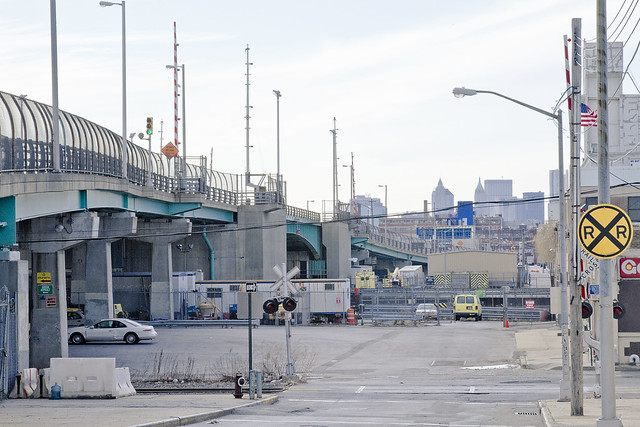
As an aside, it should be noted that the path Greenpoint Avenue takes, in modernity, as it crosses the Newtown Creek is slightly eastward of its ancient footprint. The modern bridge, which replaced an older swing bridge that carried LIRR and light rail tracks as well as vehicles, actually pulls traffic away from the ancestral road. In the early 20th century LUNA image linked to below, which is the inverse of my recent shot above, notice that only the bridge and rail tracks are still in place.
The Tidewater building would be to the left in the historic shot below.

X

– photo by Mitch Waxman
A recommended primer for anyone interested in the story of the early American Oil industry is “The History of the Standard Oil Company, By Ida Minerva Tarbell“, an admittedly biased and muckraking account told by the daughter of an oil pioneer whose business was wiped out by the Standard Trust. Tarbell disliked the term muckraker, and considering that she was a pioneering female journalist and investigative reporter in an age not exactly known for either- let’s just respect her wishes.
from “The History of the Standard Oil Company, Volume 2 By Ida Minerva Tarbell” courtesy google books

– photo by Mitch Waxman
Like most who opposed Rockefeller, who would die as the richest man in human history (in fact, adjusting for inflation- Rockefeller died richer than Augustus of Rome, and all the Pharoahs of Egypt, and all the kings of England- put together) Tidewater ended up a footnote, and being used as an instrument by which Standard could further dominate the competition.
Standard was broken up by the actions of the federal government in the early 20th century, shattered into several smaller corporations. Standard Oil Company of NY (SOCONY) was one of these, and it would become Mobil. Standard Oil Company of NJ (SOCONJ) would become Exxon.
Rockefeller’s bank account would one day attain sentience and become Chase Manhattan bank.
from wikipedia
In 1904, Standard controlled 91% of production and 85% of final sales. Most of its output was kerosene, of which 55% was exported around the world. After 1900 it did not try to force competitors out of business by underpricing them. The federal Commissioner of Corporations studied Standard’s operations from the period of 1904 to 1906 and concluded that “beyond question… the dominant position of the Standard Oil Company in the refining industry was due to unfair practices—to abuse of the control of pipe-lines, to railroad discriminations, and to unfair methods of competition in the sale of the refined petroleum products”.
something singular

– photo by Mitch Waxman
The good news is that the fragmented vernal season wherein required sleep was denied a humble narrator has ended, and one can reliably pass into unconsciousness again. The bad news is that the hallucinations which tear through my mind during these biologically mandated times reveal bizarre and disturbing psychological concerns. Likely, this is all due to the upcoming equinox and accordingly one must go to where one belongs to sort such matters out. All roads, after all, lead to Calvary…

– photo by Mitch Waxman
The great working of Dagger John, scratched into the Newtown soil in 1848, First Calvary (as it is known) is the polyandrion of the Roman Catholic Church of New York City. Millions are interred here, princes and paupers, governors and gangsters. Upon entering the gates of the 365 acre property adjoining the Newtown Creek, one shortly realizes that the ephemeral analogies of the spiritual world are a tangible reality in this place. Encountered recently, one of the lagomorphs known to inhabit this section, representative of a population of groundling burrowers.

– photo by Mitch Waxman
The burrowers, according to aboriginal mythologies, carry messages between the bright world of the surface and the fuligin grottoes of the subterrene. Prey animals, the Lagomorpha fear all things- experience has taught them of the brutal indignities of the canine, stealth and pursuit of the feline, and the overarching horror of the high flying raptors. Vulnerable on the surface, and revealed beneath the burning thermonuclear eye of god itself, the burrowers normally bolt when one nears.

– photo by Mitch Waxman
What message the lagomorphs reveal to those who consult them is not to be shared, as it emanates from a place where no light shines. As above, so below- the saying goes, and one who walks in the middle does not wish to anger or prejudice either. As far as the odd dreams and premonitions which occur to a humble narrator during those hated intervals of unconsciousness- nothing transmitted by the red eyed messenger seemed to pertain to current fantasies. Instead, dire warnings of an uncertain future and intimations of seasonal horror were hinted at. More to come on these topics, as we pass through the autumnal equinox, at this- your Newtown Pentacle.
bland face

– photo by Mitch Waxman
A lot of this Newtown Creek thing involves going to meetings in Greenpoint- this monitoring committee or that alliance or just some gathering at which an unelected official or designated regulator will speak at. This consumes quite a bit of time, which is amplified in my case, as I walk to the place from Astoria. Not a long walk by any stretch, roughly 3 miles, but sometimes it feels as if I spend all my time walking to and from the Greenpoint Avenue Bridge.

– photo by Mitch Waxman
Long have I been intrigued by this little fix a flat building which sits at the cross roads of Greenpoint Avenue, Van Dam St., and Review avenue on the Queens side in Blissville. Run down, it seems to be held together with tape and tacks, but there has always been something about the structure which has caught my eye. “Something” seems significant about it, given its location. Despite efforts at finding that something, it has always remained an enigma. Until now, thanks to the NYC Municipal Archives LUNA website.

– photo by Mitch Waxman
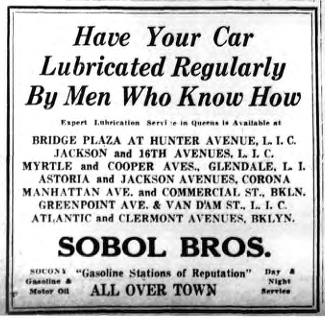
This shot, of the Sobol Brothers SOCONY station at the intersection of Greenpoint and Van Dam, is from August 20, 1930- roughly 82 years ago. SOCONY, of course, stands for Standard Oil Company of New York. Standard used to franchise out filling stations, in the same manner as its modern day incarnation ExxonMobil does. The name SOCONY indicates that the signage went up after 1911 when the Standard Trust was broken up, incidentally.
click here for the giant sharp version of the NYCMA image.
Also, at the ever reliable fultonhistory.com, I found this ad for the company, which seems to have had several locations in Queens.


 The Newtown Pentacle