Posts Tagged ‘Borden Avenue Bridge’
ponderous and forbidding

– photo by Mitch Waxman
As mentioned in a post the other day, an opportunity arose for me to accompany a representative of Riverkeeper on a survey mission to Newtown Creek recently.
Demanded by the top leadership of the Newtown Creek Alliance itself, this was an expedition whose agenda would require the photographic documentation of bulkheads and shoreline conditions all along the Creek. Of special interest to those involved in the renewal and resuscitation of brownfield sites, the mission as put forward was to get a shot of everything possible. This survey would include observation of the lesser known tributaries of the Creek- Dutch and English Kills, as well as Maspeth Creek, and the East and West Branches which lie beyond the Grand Street Bridge.

– photo by Mitch Waxman
The barriers which guard the secrets of Dutch Kills, which branches from the main body of Newtown Creek just .8 of a mile from it’s locus point with the East River, are two rail bridges. As mentioned in the past, I am no expert on the intricacies of the trackways which snake around the Queens side of the Creek. The expert on this subject was Bernard Ente, who recently passed away, and I wouldn’t offend his memory by pretending to know more than the following:
Neither Bridge (both are moveable) has opened for some time, and it is my understanding that they are part of the “Montauk Cutoff”.

– photo by Mitch Waxman
The survey team was small, as we were in a tiny craft. Hardly more than a rowboat with an outboard motor, three of us sat less than a few inches above the water. There was a mist hanging in the air, as it was early morning, which was quite invisible to the eye but will occasionally become visible in these shots (when I fired off the flash).
Our plan was to take advantage of high and low tides to gain access to the various sections which we were mandated to record, and the low ceiling of the swing bridge at Dutch Kills demanded we make our attempt at ebb tide and exit the tributary before it again flooded.

– photo by Mitch Waxman
I will admit to prayer that a train might pass overhead, for this would be a prize photo for your humble narrator, but alas- no such luck. I don’t know very much about the rails, but I do like taking pictures of trains from odd angles. There was a ghastly sensation afoot in me as well, as I knew that the very air which we were breathing was a hideous miasma of vapor emissions rising from the poison sediments which line the bed of Dutch Kills.
Everywhere, there were tiny bubbles erupting to the surface of the water, and as we disturbed them- mephitic smells swirled about and enveloped the boat.

– photo by Mitch Waxman
Many times have I been down Newtown Creek on the water, but it has always been in nothing smaller than a NY Water Taxi. Additionally, Dutch Kills is “mine”, a branch of the Creek that has received extensive study and historical analysis here at Newtown Pentacle as well as having been thoroughly catalogued photographically. No surprises in store here thought I, English Kills is a bit more “unknown territory” and would likely yield something to hang my hat on.
That is what I thought at the start of this trip.

– photo by Mitch Waxman
To start, the first rail bridge seems to be in a deep state of corrosion, which would make sense given its century long existence. I am no engineer, of course, but this thing hasn’t seen a paint brush in a very long time.
Witnessing the rust and metal fatigue on this bridge actually made me glad that a train wasn’t passing by overhead. The works and motors which power this bridge’s swing action have been burnt out for some time I am told.

– photo by Mitch Waxman
I have never seen it happen (as you would have seen a photo of it here by now) but word is that if the bridge needed to be opened, rail workers would utilize the sort of tow trucks known as “wreckers”, situated at both banks, to winch the thing open.
Sounds bizarre, but the aforementioned Bernard Ente told me that one, and “Bernie was always right” about this sort of thing. Can’t tell you how many crazy stories he would tell me about the history and lore of this place, which my own research would prove him to have been purposely understating.

– photo by Mitch Waxman
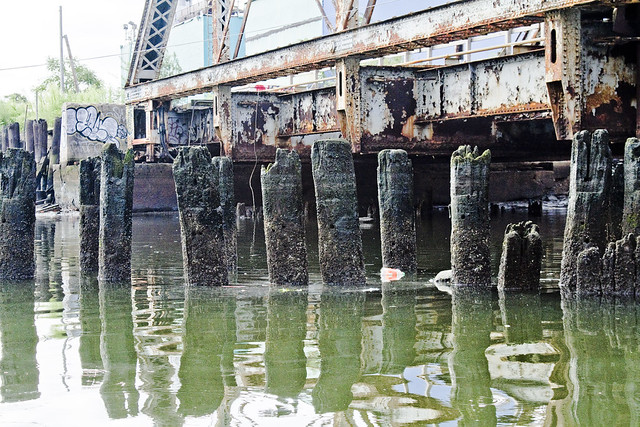
All across Dutch Kills, everything bore that unmistakable colour which typifies the lament and sickness of the Newtown Creek watershed. Iridescent, it is neither black nor white nor any normal color, rather it’s is like something alien coating everything in rotten decay. Metal corrodes, wood molders, stone and cement simply crumble away.
The swampy wetlands which existed here in aboriginal times were known as the Waste Meadows in the 19th century, and perhaps this is still the appropriate terminology for them.
– photo by Mitch Waxman
Pilings and structural elements squamously protrude from the water, whose surface seems thicker than expectation would predict. Normal fluid dynamics apply of course, but the turgid waves behaved in the manner of a broth or syrup as opposed to the more wholesome (but still polluted) water found on the nearby East River.
Additionally, high tide was not marked by invertebrate communities of barnacles or mussels here, but rather by tree ring like deposits of sediment.

– photo by Mitch Waxman
Looking back toward the swing bridge, in the direction of infinite Brooklyn, a long walkway is attached to the pier which the bridge is anchored into.
One thing which I can categorically show in these “bulkhead survey” shots of the Newtown Creek, is that much of the so called land along the Queens bank of the Creek (and large parts of English Kills in Brooklyn) is actually an engineered surface of pilings intermixed with fill and capped with a cement slab- reclaimed land.
One of the scarier ramifications of this, and again– not an engineer- is witnessed in the deleterious condition of these century old wood pilings visible from the water’s edge.

– photo by Mitch Waxman
Next up on this trip is the truss rail bridge, which is built quite a bit higher in elevation than the initial structure and is found at the other side of the pier and walkway which connects to the Swing Bridge. It’s a drawbridge, and the elevated height must have been part of a plan to reduce the need to open the span for water traffic on the once busy Dutch Kills.

– photo by Mitch Waxman
Apologies are offered for vagueness, lords and ladies, as I fear that I’ve spoiled you over the last several years with vulgar displays of “info-porn”. Normally, you’d be reading stats and figures, hearing the name of engineers and learning of long forgotten disasters. Unfortunately, as these two bridges are not publicly accessible, and to study them in any real detail would mean trespassing and demand mandatory jail time… these are the bridge structures which I can describe in the least detail anywhere along Newtown Creek.
Railfans of NYC, anonymous LIRR employees, please leave a comment below and share the wisdom.
As mentioned in the past- I never trespass- like a Vampire your humble narrator needs to be invited inside to do his best work and in the age of terror- no one is invited to look too closely at railroad infrastructure.

– photo by Mitch Waxman
Others, however, are not as constrained as I.
A garish banner caught my eye as we passed beneath the truss bridge. My mind concocted that I was seeing just another windblown tarp or plastic container bag at first, but then as we approached… I realized that it was some kind of painting.

– photo by Mitch Waxman
Hung at a level which allows it to interact with the high tide level, this painting seems to depict- to my eye- a middle eastern city withering in flame beneath the burning thermonuclear eye of god.
What’s more, for once, I can brag to Ms. Heather, over at ny-shitty.com, that I finally got something before she did.
Note: as always, clicking the photo will open a new window at Flickr. Clicking the view all sizes option under the “actions” tab will take you to ever larger incarnations of the shot for closer examination. If anyone knows who the artist is, or what this situation is about, I’d love to hear about it.

– photo by Mitch Waxman
It would seem that someone has set up camp under here, or perhaps it is just a studio space. The undocumented men and women who live in both these “Waste Meadows” -and the Newtown Creek watershed as a whole- are too numerous to count. Many are exactly where they belong, while others are trapped by circumstance and ill omen.
All need to be coaxed away from this place, before the Creek does to them what it has to so many others in Greenpoint and Long Island City.

– photo by Mitch Waxman
No human being should be living in this place, except as part of a penal sentence for an especially heinous offense. Trolls live under bridges, not Americans. Additionally, in the age of terror, how exactly does this go unnoticed by the gendarme?
I cannot stress how often I ask this question as I wander across the Creeklands.

– photo by Mitch Waxman
Despite the fearful atmospherics and forbidding appearance of the water, we pressed on. Our steward from Riverkeeper kept a steady hand on the outboard motor and the tiny boat slid forward across Dutch Kills. This shot is looking back at the two rail bridges of the Montauk Cutoff which we had just passed beneath.
Still no trains.

– photo by Mitch Waxman
Dead ahead was the Borden Avenue Bridge and the high flying Long Island Expressway, the experiencing of which which will be discussed tomorrow at this- your Newtown Pentacle.
bafflingly homogeneous

– photo by Mitch Waxman
Quivering in some hellish and noisome pool of spreading horror, the sprawling obstructions of Long Island City lay between myself and the East River- after having had several surprising experiences at First Calvary Cemetery. Greenpoint Avenue at Borden is where the titan architecture of the Queens Midtown Expressway returns to grade from the arching heights it attains over the mutagenic sediments of an ancient canal called the Dutch Kills, eventually terminating at the East River’s junction with Newtown Creek at Hunters Point.
Seeking- instinctually- running water, your humble narrator found himself in a fine state of panic.
from psychcentral.com
…Their excessive suspiciousness and hostility may be expressed in overt argumentativeness, in recurrent complaining, or by quiet, apparently hostile aloofness. Because they are hypervigilant for potential threats, they may act in a guarded, secretive, or devious manner and appear to be “cold” and lacking in tender feelings. Although they may appear to be objective, rational, and unemotional, they more often display a labile range of affect, with hostile, stubborn, and sarcastic expressions predominating. Their combative and suspicious nature may elicit a hostile response in others, which then serves to confirm their original expectations.

– photo by Mitch Waxman
Bogeyman, bump in the night, or the sure knowledge of an invisibly malign presence- it doesn’t take much to set a crazed ape like myself into howling melancholies of dread. Mundane and wholesome experiences terrify and insulate my fragile persona, and merely interacting with fellow members of the citizenry often results in days of fevered weakness and endless self recrimination. The gentlest of surprises- a small child laughing suddenly, or the appearance of a feral cat or dog- any environmental deviation which could be ascribed to be “sudden”- is enough to rob me of any aspiration of societal posture. Retreat to the hideous slime coated abysses of the megalopolis are called for, where one might hide and blend in amongst all hideousness.
I’m all ‘effed up.
from wikipedia
A person with low self-esteem may show some of the following symptoms:
- Heavy self-criticism, tending to create a habitual state of dissatisfaction with oneself.
- Hypersensitivity to criticism, which makes oneself feel easily attacked and experience obstinate resentment against critics.
- Chronic indecision, not so much because of lack of information, but from an exaggerated fear of making a mistake.
- Excessive will to please: being unwilling to say “no”, out of fear of displeasing the petitioner.
- Perfectionism, or self-demand to do everything attempted “perfectly” without a single mistake, which can lead to frustration when perfection is not achieved.
- Neurotic guilt: one is condemned for behaviors which not always are objectively bad, exaggerates the magnitude of mistakes or offenses and complains about them indefinitely, never reaching full forgiveness.
- Floating hostility, irritability out in the open, always on the verge of exploding even for unimportant things; an attitude characteristic of somebody who feels bad about everything, who is disappointed or unsatisfied with everything
- Defensive tendencies, a general negative (one is pessimistic about everything: life, future, and, above all, oneself) and a general lack of will to enjoy life.

– photo by Mitch Waxman
It is simpler to believe ones mind has cracked wide open, than it is to believe the truth of those dark undercurrents which seethe just below the surface which have been observed in the Newtown Pentacle. Madness is preferable- I suppose- to those Malthusian truths which govern over this place. It is easier to embrace some swirling chaotic, marry oneself to a “very bad idea” than to accept that some sort of shadow had followed me on my long walk through a cemetery. I mean… that’s just… not… scientific…
Perhaps it’s just paranoia…
from wikipedia
Malthus thought that the dangers of population growth would preclude endless progress towards a utopian society: “The power of population is indefinitely greater than the power in the earth to produce subsistence for man”. As an Anglican clergyman, Malthus saw this situation as divinely imposed to teach virtuous behaviour. Believing that one could not change human nature, Malthus wrote:
- “Must it not then be acknowledged by an attentive examiner of the histories of mankind, that in every age and in every State in which man has existed, or does now exist
- That the increase of population is necessarily limited by the means of subsistence,
- That population does invariably increase when the means of subsistence increase, and,
- That the superior power of population is repressed, and the actual population kept equal to the means of subsistence, by misery and vice.

– photo by Mitch Waxman
The air is clear, and not a poisonous fume. Broadcast antennas connected to powerful transmitters do not form wavefront cascades of airborne radiation which are known to create the vast static and electrical charges experienced on sky flung metal structures like these advertising signs or the Kosciuszko Bridge. The water in Newtown Creek is free of pharmaceutical residues, and there has not been some sort of cult operating at St. Michael’s Cemetery in Astoria.
I did not see a man climb over the side of the Borden Avenue Bridge and disappear under the roadway as I drew close to the ancient structure.
from wikipedia
The terror of absolute annihilation creates such a profound—albeit subconscious—anxiety in people that they spend their lives attempting to make sense of it. On large scales, societies build symbols: laws, religions, cultures, and belief systems to explain the significance of life, define what makes certain characteristics, skills, and talents extraordinary, reward others whom they find exemplify certain attributes, and punish or kill others who do not adhere to their cultural worldview. On an individual level, how well someone adheres to a cultural worldview is the same concept as self-esteem; people measure their own worth based on how well they live up to their culture’s expectations.

– photo by Mitch Waxman
There is no Black Crow living alongside this bridge, in a windblown shanty. It’s my imagination- wild fantasies and exaggerations concocted by a diseased and fever struck mind… the very progeny of failed ambitions and underwhelming talents.
There was only one shadow cast by your humble narrator since having stumbled out of First Calvary…
from about.com
Flight of Ideas: a nearly continuous flow of rapid speech that jumps from topic to topic, usually based on discernible associations, distractions, or plays on words, but in severe cases so rapid as to be disorganized and incoherent. It is most commonly seen in manic episodes but may also occur in other mental disorders such as in manic phases of schizophrenia.

– photo by Mitch Waxman
After all… the Black Crow? Who makes this kind of stuff up? A man living on Dutch Kills, at Borden Avenue Bridge of all places, in this day and age…
from wikipedia
Oneirophrenia is a hallucinatory, dream-like state caused by several conditions such as prolonged sleep deprivation, sensory deprivation, or drugs (such as ibogaine). From the Greek words “ὄνειρο” (oneiro, “dream”) and “φρενός” (phrenos, “mind”). It has some of the characteristics of simple schizophrenia, such as a confusional state and clouding of consciousness, but without presenting the dissociative symptoms which are typical of this disorder.
Persons affected by oneirophrenia have a feeling of dream-like unreality which, in its extreme form, may progress to delusions and hallucinations. Therefore, it is considered a schizophrenia-like acute form of psychosis which remits in about 60% of cases within a period of two years. It is estimated that 50% or more of schizophrenic patients present oneirophrenia at least once.
Guess what

– photo by Mitch Waxman
So, I went out for a walk today. My only intention was to begin carving off some of the lard which has been quickly accumulating about my midsection during the gluttonous holiday season, but found my steps drawn toward the flat marshlands of Hunters Point and Long Island City as I descended from the swollen hills of Astoria. Following my shadow, it wasn’t long before I started seeing… the Cats… again. My odd habit of turning left whenever a feline shape presents itself led me directly to the Borden Avenue Bridge…
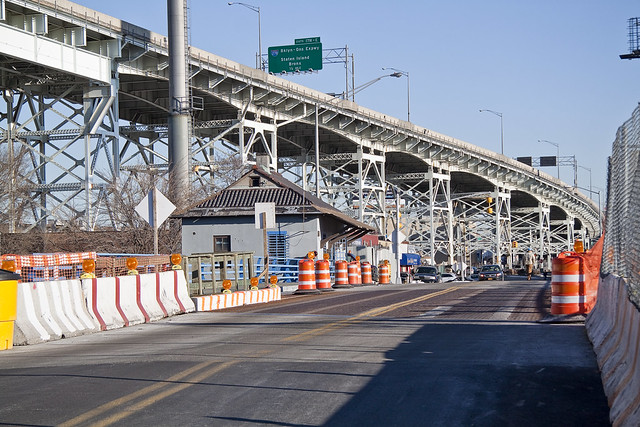
WHICH WAS OPEN TO TRAFFIC!!!
– photo by Mitch Waxman
There was still construction activity going on, but a quick check with one of the guys in high visibility colors revealed that the structure’s roadway was available. The sidewalks were still being worked on, and safety barriers were present- but the long running project seems to be nearing an end. I’m not sure if the bridge is “officially open”, but at least today it was.
Thank you, weird Cats of the Creeklands.

– photo by Mitch Waxman
I should mention that this structure is one of my favorite locations along the Dutch Kills tributary, from a photographic point of view, and an uncharacteristic giddiness seems to be filling me at the near return of a long cherished vantage point. Check out what I mean here.

– photo by Mitch Waxman
The official truth, from the NYC DOT site is:
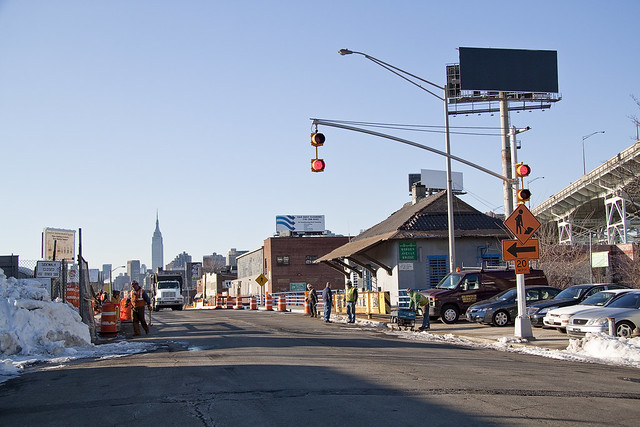
Borden Avenue is a two-lane local City street in Queens. Borden Avenue runs east-west extending from Second Street at the East River to Greenpoint Avenue. The Borden Avenue Bridge over Dutch Kills is located just south of the Long Island Expressway between 27th Street and Review Avenue in the Sunnyside section of Queens. Borden Avenue Bridge is a retractile type moveable bridge. The general appearance of the bridge remains the same as when it was first opened in 1908. The bridge structure carries a two-lane two-way vehicular roadway with sidewalks on either side. The roadway width is 10.5m and the sidewalks are 2.0 m. The west approach and east approach roadways, which are wider than the bridge roadway, are 15.3m and 13.0m respectively. The bridge provides a horizontal clearance of 14.9m and a vertical clearance in the closed position of 1.2m at MHW and 2.7m at MLW.
As part of the construction of Borden Avenue in 1868, a wooden bridge was built over Dutch Kills. This bridge was later replaced by an iron swing bridge, which was removed in 1906. The current bridge was opened on March 25, 1908 at a cost of $157,606. The deck’s original design consisted of creosote-treated wood blocks, with two trolley tracks in the roadway. Character-defining features of this bridge include the stucco-clad operator’s house, four pairs of rails, and a rock-faced stone retaining wall. The gable-on-hip roof of the operator’s house retains the original clay tile at the upper part. Although alterations have been made, the bridge is a rare survivor of its type and retains sufficient period integrity to convey its historic design significance.
The Department of Transportation has identified a pocket of contaminated soil which has been classified as “contaminated non-hazardous”. As such, it poses no significant health risk to workers or the surrounding community. However, precautionary measures will be taken and every effort is being made to remove and dispose of the contamination quickly, yet safely, within all New York City and State guidelines. A Corrective Action Plan (CAP) for the removal and disposal of the contamination has been submitted to the NYS Department of Environmental Conservation (NYSDEC) for review and approval. Upon receipt of the NYSDEC approval, the contractor will prepare a new construction schedule and commence work under the terms of the permits. At this time, a date for the resumption of work is unknown which precludes an accurate prediction of a new anticipated completion date, although every effort will be made to complete the project in the late Fall of 2010. All posted detours will remain in effect until further notice.
– photo by Mitch Waxman
Further official truth is found in the DOT’s Weekly Traffic Advisory of Saturday January 1, 2011 to Friday January 7, 2011
Borden Avenue Bridge over Dutch Kills (at 27th Street): This Bridge was closed December 31st 2008 for emergency reconstruction and reopened December 24, 2010 to two-way traffic. This closure was to necessitate NYCDOT Bridge major construction activity. Single lane closures will resume after January 2, 2011 to complete sidewalk and punch list work.


 The Newtown Pentacle