Posts Tagged ‘Calvary Cemetery’
raptured vision

– photo by Mitch Waxman
My habit is to be early to appointments, public meetings, or gatherings. On this particular day, a Newtown Creek Alliance meeting was set to occur in hoary Greenpoint at the modern Newtown Creek Wastewater Treatment Plant, and a humble narrator decided to make use of being better than an hour early by strolling through the engineered hillocks of First Calvary Cemetery here in Queens.
Late afternoon was giving way to sunset, and my path took me from the secondary gates near the former Penny Bridge toward the main entrance at Greenpoint Avenue.

– photo by Mitch Waxman
Unlike many of my sojourns around the place, no goal governed my steps- I wasn’t “looking for someone”. Instead, a peaceful and contemplative mood governed my steps and allowance was made for serendipity. That’s the spire of St. Raphael’s on Greenpoint Avenue in the distance, by the way.
Amongst the marble and granite, however, a surprising monument was discovered.

– photo by Mitch Waxman
Weathered and unmarked, this anonymous cruciform was found. Appearing to be a wooden cross with white bronze worked onto its surface, it was frankly a stunning moment for me to discover this artifact here. Partially because of its modest and quite staid appearance- understatement and tasteful discretion hardly define the monuments at Calvary- but mostly because of the incredible value that the metal would bring to the Crows (metal collectors and scrappers) who harvest such materials for sale to the scrap industry.
It was stunning to find such a thing can remain hidden in this place which has suffered so much from their attentions.
lashing waves

– photo by Mitch Waxman
Frustration marks this posting, which focuses in on the Moore Newman monument at First Calvary Cemetery here in Queens, at the very heart of the Newtown Pentacle. Stylish even after a century has passed, the monument consists of a central obelisk with figurative statuary at its apex and a series of foot stones demarcating the borders of the family plot.
It was also here in 1876, long before its two principal occupants ended their New York stories in the early 20th century.
from The visitor’s guide to Calvary cemetery, with map and illustrations (1876), courtesy archive.org
This is a most substantial double monument, the shaft being divided by a deeply cut line, as is also the die. It presents with the inclosure a very neat and pleasing appearance, displaying much taste in its design andi construction. It stands about twenty-one feet in height, is of Egyptian order of architecture, and of the best Quincy granite.
On the shaft, inclosed in palm wreaths, are the monograms ” M.— N.”

– photo by Mitch Waxman
Obviously people of certain means and social standing- the tenement poor of New York City didn’t get 21 foot granite monuments- there seems to be little or no record of Mary A. Moore or Michael James Newman. Passing references to a Tammany functionary named Michael J. Newman offer hints that this might be the fellow buried here, but nothing definitive can be ascertained. Additionally, a Mary A. Moore, referred to as “a widow” have popped up here and there.
Unfortunately, these were very common Irish names in the 19th century.
from Wikipedia
Granite is classified according to the QAPF diagram for coarse grained plutonic rocks and is named according to the percentage of quartz, alkali feldspar (orthoclase, sanidine, or microcline) and plagioclase feldspar on the A-Q-P half of the diagram. True granite according to modern petrologic convention contains both plagioclase and alkali feldspars. When a granitoid is devoid or nearly devoid of plagioclase, the rock is referred to as alkali granite. When a granitoid contains less than 10% orthoclase, it is called tonalite; pyroxene and amphibole are common in tonalite. A granite containing both muscovite and biotite micas is called a binary or two-mica granite. Two-mica granites are typically high in potassium and low in plagioclase, and are usually S-type granites or A-type granites. The volcanic equivalent of plutonic granite is rhyolite. Granite has poor primary permeability but strong secondary permeability.

– photo by Mitch Waxman
The usage of Quincy Granite for construction of the stelae also indicate the social standing of the couple, as this particular mineral is the gold standard for permanence and has always been an expensive option as far as building materials goes. Quincy is a famous quarry town in Massachusetts, and the mining of Quincy Granite gave rise to one of the first industrial uses of rail in the United States.
from Wikipedia
The Granite Railway was one of the first railroads in the United States, built to carry granite from Quincy to a dock on the Neponset River in Milton. From there boats carried the heavy stone to Charlestown for construction of the Bunker Hill Monument. The Granite Railway is popularly termed the first commercial railroad in the United States, as it was the first chartered railway to evolve into a common carrier without an intervening closure. The last active quarry closed in 1963; in 1985, the Metropolitan District Commission purchased 22 acres, including Granite Railway Quarry, as the Quincy Quarries Reservation.

– photo by Mitch Waxman
Enormous effort was undertaken to discover the identity of the Moore-Newman’s, who seem to have disappeared into history. The antecedents on the Moore side of the family are listed here, but it is doubtful that their remains lie in Calvary. A standard practice of Irish New Yorkers in the 19th century was to list long lost family members as an “In memoriam” on their own stone. Often the parents were buried at one of the churchyards or private cemeteries which Manhattan once hosted, like the 9th street Catholic Cemetery, at their own plots after Calvary was established in Blissville in 1848.
from wikipedia
Taphophilia is a passion for and enjoyment of cemeteries. The singular term is a taphophile.
Taphophilia involves epitaphs, gravestone rubbing, photography, art, and history of (famous) deaths. An example of an individual’s expression of taphophilia is the character Harold in the movie Harold and Maude (1971).
Taphophilia should not be confused with necrophilia, which is a sexual attraction to corpses.

– photo by Mitch Waxman
An understandable lack of documentation exists about the process by which, after the Rural Cemeteries Act was passed, the exhumation of thousands of internments and concurrent transportation of the remains to Calvary were accomplished. Understand that the somewhat tribal nature of New York City in the mid 19th century, marked by internecine warfare between religious denomination and nationalist creeds, made for a lack of record keeping. If the church offered a public record of its activities, the Protestant Anglophiles at newspapers like the NY Times would have pilloried them for one reason or another. Catholics were a favorite target of that culture, which still considered protestant England the apogee of civilization, and viewed the “Papists” as a fifth column to be feared and despised.

– photo by Mitch Waxman
Oddly, given other societal norms which we 21st century New Yorkers would find odious- specifically the role and rights of females- it’s the voice of Mary A. Moore which persists through time. An obituary notice preserves her grief over the loss of her husband, whom she would shortly follow into the emerald devastations of Calvary Cemetery.
from ancestry.com
In ever present sorrow of my devoted husband, Michael James Newman, who passed away Sept. 17, 1903. “Not gone from memory, not gone from love.”
mural history

– photo by Mitch Waxman
Wandering around Calvary Cemetery is often a revelatory experience, and while perambulating through the hallows of Section 9 the other day, the shock of sudden recognition nearly laid me low. While scanning the monolith studded landscape for certain things which cannot be mentioned, the name of one of history’s most famous New Yorkers suddenly appeared before me.
Steve Brodie… The man who jumped from the Brooklyn Bridge and lived to talk about it.

Steve Brodie, photo courtesy Wikipedia
also from wikipedia
Steve Brodie (December 25, 1861 – January 31, 1901) was an American from New York City who claimed to have jumped off the Brooklyn Bridge and survived on July 23, 1886. The resulting publicity from the supposed jump, whose veracity was disputed, gave Brodie publicity, a thriving saloon and a career as an actor.
Brodie’s fame persisted long past his death, with Brodie portrayed in films and with the slang terms “taking a Brodie” and “Brodie” entering the language for “taking a chance” and “suicidal leap.”

– photo by Mitch Waxman
There weren’t just three major newspapers in 1886, there were hundreds, and the proto “media” ate up Steve Brodie’s story, turning him into a celebrity. From all accounts, Brodie found every advantage offered by fame- opening a swank saloon on the Bowery and starring in a popular play about his exploits.
He would always be known as the “bridge jumper”.
from nytimes.com
A tall, slim man, who looked very much like an overgrown street boy, stood talking to a young woman at the New-York end of the Brooklyn bridge a little after 2 o’clock yesterday afternoon. He bade her good-bye and kissed her.

– photo by Mitch Waxman
The scourge of the 19th century was “consumption”, or as we call it “tuberculosis”, and Brodie took ill. Like other “lungers”, it was thought that the dry air of the southwest would aid him in fighting the affliction and he packed off for San Antonio in Texas.
That’s where he died.
from nytimes.com
The body was taken to Calvary Cemetery for burial. A crowd of 500 or 600 men, women, and children, attracted by curiosity remained in the streets during the services at the house, and many of them followed the funeral cortege to Ninety Second Street Ferry on its way to the cemetery.

– photo by Mitch Waxman
It is a real shame that someone has decided to pry the probable white bronze marker from the monument, which would have occurred in the empty oval space directly above the names and dates which remain. Such is the case though, and there are many instances of such theft not just at Calvary but at all the cemeteries which comprise the cemetery belt of western Queens.
It’s pretty low to steal from the dead, in one humble narrators opinion.
An interesting analysis of whether or not Mr. Brodie actually made his jump was published by “The Day” in 1986. Click here for the article by Larry McShane.

Steve Brodie, photo courtesy Wikipedia
ALSO, this Friday:

My own attempt at presenting a cogent narrative and historical journey “up the creek” is up coming as well-
Your humble narrator will be narrating humbly on Friday, February 24th at 7:30 P.M. for the“Ridgewood Democratic Club, 60-70 Putnam Avenue, Ridgewood, NY 11385” as the “Newtown Creek Magic Lantern Show” is presented to their esteemed group. The club hosts a public meeting, with guests and neighbors welcome, and say that refreshments will be served.
The “Magic Lantern Show” is actually a slideshow, packed with informative text and graphics, wherein we approach and explore the entire Newtown Creek. Every tributary, bridge, and significant spot are examined and illustrated with photography. This virtual tour will be augmented by personal observation and recollection by yours truly, with a question and answer period following.
For those of you who might have seen it last year, the presentation has been streamlined, augmented with new views, and updated with some of the emerging stories about Newtown Creek which have been exclusively reported on at this- your Newtown Pentacle.
For more information, please contact me here.
What: Newtown Creek Magic Lantern Show
When: Friday, February 24th at 7:30 P.M.
Where: Ridgewood Democratic Club, 60-70 Putnam Avenue, Ridgewood, NY 11385
Project Firebox 30

– photo by Mitch Waxman
It lives on the corner of Van Dam and Review, and clearly remembers when the self storage place across the street was a pickle factory. Like all long time residents of Queens, it can barely recognize the place these days, but carries on and sallies forth on the daily round. It’s not old enough to remember the Greenpoint Avenue Bridge burning down, twice. Neither does it remember Gleason’s trolleys nor the vast funeral cortèges that emptied the Five Points as they proceeded to Calvary. Memory is not a strong point for its kind, for as a watchman, the sole function it must serve is to raise the alarum.
disjointed jargon

– photo by Mitch Waxman
Whilst marching past the sky flung and quite cyclopean walls of First Calvary Cemetery, which form the border between life and death along Review Avenue here in Queens, your humble narrator found himself stricken with certain longings for times past. Not the usual longings, borne of long nocturnal studies into the occluded and dim history of the fabled Newtown Creek and environs, but instead a desire to return to that moment in time when it was all new to me- just a few years ago. Far have my solitary marches across the concrete desolations of the Newtown Pentacle taken me from that original path.

– photo by Mitch Waxman
When that hellish green flame of revelation was first lit, before I found out about Conrad Wessel and Cord Meyer and had no idea who Michael Degnon or Dagger John might be, the wonderland of Newtown Creek was merely another industrial area which had fallen on hard times and the sort of place which I always found myself wandering through. As a kid, it was south Brooklyn and the maritime era leave behinds which adorn Jamaica Bay. These days I’m conducting tours of the area for academic and political crowds, and speaking extemporaneously on the historic ramifications of it. Fear has risen in me that I’m losing my focus.
I almost walked past this glob of risible decay without photographing it, for instance.

– photo by Mitch Waxman
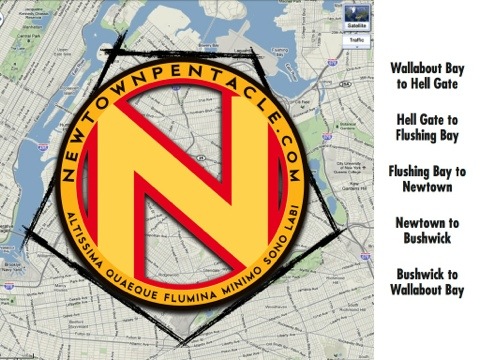
Recent inundation, which has been typical for the storm addled year of 2011, has saturated the low lying alluvial plain around the Creek and betrayed its past as wetlands. Accordingly, anything lying on an open patch of dirt immediately becomes soaked. I couldn’t tell you what this glutinous mass with a vaguely fibrous texture once was, but I am oh so glad I was still capable to notice it. The thing about the Newtown Pentacle, a term coined to describe the pentangular geographic distribution of the early European colonies in western Queens and Northern Brooklyn, is that the devil is always in the details.

– photo by Mitch Waxman
Microscopy upon any subject often obscures the larger themes surrounding it, in essence when you follow Alice down the rabbit hole, you forget that the shire still lies without. The pile of discarded newspapers in the shot above, which are curiously and analogously arranged in the shape of a fallen man, obscured a bag of pots and pans. Repulsively filthy, one of the cooking pans was filled with human excrement.
Curiously, the pans were in the approximate location that a pelvis might be found on a human.

– photo by Mitch Waxman
It has been painful to stand in public, as to be seen by so many diminishes me. Duty, however, demands that I tell the story of this place, no matter the personal cost.
This Sunday, the public tours of Newtown Creek will be departing from Pier 17 at South Street Seaport. The afternoon session is already sold out, but a few tickets are still available for the morning one. Heavily discounted (and I would point out that I have zero financial interest in the tours) at $10, due to a grant from NYCEF fund of the Hudson River Foundation, these will most likely be the last chance for the general public to see the Newtown Creek by boat until the spring.
And your humble narrator is anxious to get back out on the streets and find more mystery globs of risible decay, altars of unknown and foreign gods, and the graves of both Battle Ax Gleason and “he who must not be named”…


 The Newtown Pentacle