Posts Tagged ‘cemetery’
Tales of Calvary 11- Keegan and Locust Hill

– photo by Mitch Waxman
The monument to Charles Keegan is a familiar one to those who visit First Calvary Cemetery with any regularity. Close to the gates on Greenpoint Avenue, one does not need to penetrate too deeply into the viridian devastations of the place to find it. Keegan was a firefighter, a Foreman of Hook and Ladder No. 4 who was killed during the pursuit of his duties on the 15th of September in 1882 at the conjunction of Meeker Avenue and the loathsome Newtown Creek.
nytimes.com has an article on the Locust Hill Refinery Fire, which presents the grisly details of that night and describes the tragic death of both Keegan and Captain Stuart Duane (whose death counts as one of the most horrible exits from this mortal coil I’ve ever encountered)

– photo by Mitch Waxman
Before the night was over and the vast fire contained, oil barges set aflame by the terrific explosions and spreading flames had been carried all the way to the Penny Bridge, which ended up being consumed itself by fire. The far larger Standard Oil works up the Creek were protected from this spreading conflagration by an ad hoc boom deployed by Firefighters across the Creek, said boom was composed of empty barges and logs. The entire blaze began when lightning struck the petroleum reservoir tanks of Sone & Fleming at the Locust Hill Refinery sparking a fire which spread insidiously across the 18th ward, during a severe thunderstorm.
arrts-arrchives.com has many fascinating images for the antiquarian community to marvel over, but of interest for readers of this posting will be this shot from 1852 (that’s the Newtown Creek, kids, see Calvary in the upper right corner- click image for a larger view at the arrts-archives.com site) showing the Penny Bridge that was burned away.


– photo by Mitch Waxman
By 1929, the independent oil companies around the Newtown Creek were absorbed by the Standard Oil Trust, parent of the modern Exxon and Mobil corporations. Standard Oil, of course was the guilty party concerning the Greenpoint Oil Spill.
William DONALD, proprietor of the Locust Hill Oil Works, where the fire originated, testified that when he reached the fire he saw the only way to save anything was to draw off the oil. By five o’clock in the morning one-half had been drawn off. About twenty minutes later the tank boiled over and filled the yard with burning oil. KEEGAN was near the tank at the time, with several men employed in the works and some firemen. They ran and escaped except KEEGAN, whom the witness afterwards heard was missing. There was about six hundred barrels of crude oil in the tank.
Shoosh… Be Very Quiet… I’m hunting rabbits…

– photo by Mitch Waxman
Hunting for the elusive gravesite of a man called Gilman, one frigid afternoon spent within the 365 acres of First Calvary Cemetery proved the existence here of a race of burrowing things- mud caked groundlings with glowing red eyes.
Somewhere, nearby I would suspect, is a subterranean warren kept warm by the swarming masses of their hairless and blind progeny. Squirming, these sweaty holes dug into the frozen graveyard force the adults to brave the bright dangers of the surface world to forage.
from wikipedia:
The lagomorphs are the members of the taxonomic order Lagomorpha, of which there are two families, the Leporidae (hares and rabbits), and the Ochotonidae (pikas). The name of the order is derived from the Greek lagos (λαγος, “hare”) and morphē (μορφή, “form”).
Though these mammals can resemble rodents (order Rodentia), and were classified as a superfamily in that order until the early twentieth century, they have since been considered a separate order. For a time it was common to consider the lagomorphs only distant relatives of the rodents, to whom they merely bore a superficial resemblance.
The earliest fossil lagomorphs, such as Eurymylus, come from eastern Asia, and date to the late Paleocene or early Eocene. The leporids first appear in the late Eocene, and rapidly spread throughout the northern hemisphere; they show a trend towards increasingly long hind limbs as the modern leaping gait developed. The pikas appear somewhat later, in the Oligocene of eastern Asia.

– photo by Mitch Waxman
Prey by nature, the foragers are fast and smart and alert. The gods of the sky, the claws of the stealth demons, the brutal agonies of the dog- all are found on the surface. Designed to eat the ruggose fibers of grass and seed, quickly and as much as possible in one go, they are swift and nervous. Fed on the morbid nutrition offered up by the loam of Calvary Cemetery, the glowing red eyes of these burrowers scan constantly for danger.
from wikipedia:
The rabbit lives in many areas around the world. Rabbits live in groups, and the best known species, the European rabbit lives in underground burrows, or rabbit holes. A group of burrows is called a warren. Meadows, woods, forests, thickets, and grasslands are areas in which rabbits live. They also inhabit deserts and wetlands. More than half the world’s rabbit population resides in North America. They also live in Europe, India, Sumatra, Japan, and parts of Africa. The European rabbit has been introduced to many places around the world.

– photo by Mitch Waxman
Merely a part of some vast ecosystem occluded by the marble and sorrow, these burrowers are prized game for the higher mammals and avian predators which frequent the bulkheaded shorelines of the Newtown Creek. It is difficult, with modern eyes, to imagine the world of the unspoiled Creek.
Once, this was part of a rich swampy marshland, and abundant game and wildlife drew sportsmen from the great cities of Brooklyn and Manhattan for hunting and fishing to the rural extants of the Newtown Creek. Nearby, aboriginal tribes of Lenape (the Maspeatche) made their camps near Mt. Zion cemetery and when the europeans came- great hunting lodges and hotels were erected along its banks to service the tourist trade from the two island cities. That was before the industries, before the Rural Cemeteries Act, and before the 800 pound gorilla came to town.
from wikipedia:
Jugged Hare (known as civet de lièvre in France), is a whole hare, cut into pieces, marinated and cooked with red wine and juniper berries in a tall jug that stands in a pan of water. It traditionally is served with the hare’s blood (or the blood is added right at the very end of the cooking process) and Port wine.
Jugged Hare is described in the influential 18th century cookbook, The Art of Cookery by Hannah Glasse, with a recipe titled, “A Jugged Hare,” that begins, “Cut it into little pieces, lard them here and there….” The recipe goes on to describe cooking the pieces of hare in water in a jug that it set within a bath of boiling water to cook for three hours. Beginning in the nineteenth century, Glasse has been widely credited with having started the recipe with the words “First, catch your hare,” as in this citation. This attribution is apocryphal.

– photo by Mitch Waxman
Your humble narrator appreciates the irony that New York City’s nature preserves are entirely accidental. The nearby Ridgewood Reservoir, an eidelon of municipal malfeasance and neglect, has transformed into a significant bird sanctuary and houses a teeming ecosystem ranging from rodent to raptor. The cemeteries of Queens similarly house a niche ecology, providing a refuge for ghoulish reprobates and rabbit alike. Some effort has been made at finding a scientific sampling of biota at these locations, but if it exists, my meager skills at the art of detection have been unable to uncover such data.
for a third person perspective on how my encounter with this manifest avatar of the Lepus specie went, please click here- its pretty much the way that the whole thing “went down”.
Tales of Calvary 10- The Hatch

– photo by Mitch Waxman
Your humble narrator, amongst other failings, has a certain preference for the grandiose statuary of the late 19th and early 20th century at First Calvary Cemetery here in Queens. Baroque expressions such as these appeal to the comic book fan in me, looking for all the world like a Jack Kirby or Jim Steranko rendering. One half expects a concrete angel to… well, I stray…
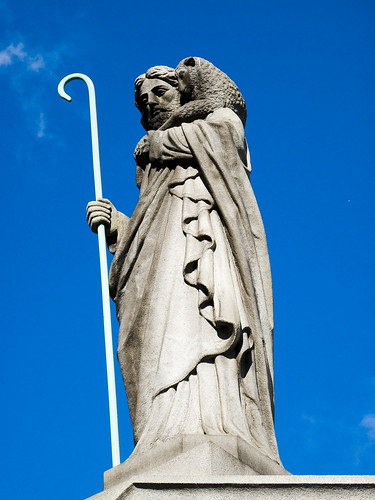
– photo by Mitch Waxman
The southern section of First Calvary, found atop the cyclopean masonry observed on Review Avenue, offers glimpses of the Newtown Creek and panoramic views of industrial Brooklyn. Framing the open horizon of marshy western Queens and the forges of Brooklyn is the Kosciuszko Bridge, heroically carrying a vehicular river called the Brooklyn Queens Expressway over the infamous cataract. The elevation of these walls is actually quite high, an arcing and non euclidean structure which must be 2 to 3 stories at its apogee.
Am I overestimating? Check out this shot from the “street level” declination, aimed at the downward slope from halfway down Review Ave.–
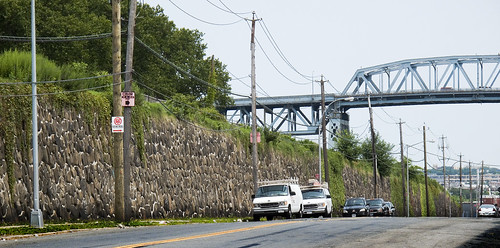
And the shots below are from the other side of it, the topside of the wall.

– photo by Mitch Waxman
You won’t find the grandiose tombs or obsequious monuments to the famous on this side of First Calvary. This is where the “regular people” are buried- in their multitudes- in neatly defined rows of plots. The northwestern sections of Calvary, where the main gates are, and the northeastern- along Laurel Hill Blvd.- (both “High Ground”) are where you can find the princes of the 19th century city. Here, along Review Avenue, is where the middle and working class rest.

– photo by Mitch Waxman
My reasons for coming to this section must remain hidden, for now, suffice to say that I am still hunting for the grave of a man named Gilman (see “Tales of Calvary 7” for more speculation on this mysterious merchant from Massachusetts). Enjoying the relative quiet, I noticed one of the concrete pillboxes which I’ve also alluded to in earlier posts. These structures are all over Calvary, are often padlocked, and have aroused no small amount of curiosity in your humble narrator.

– photo by Mitch Waxman
Several conjectures -an access point to buried family mausoleums, a storage unit for groundskeepers, some sort of equipment shed- have assailed me as I observed these structures with their heavy iron lids and stout cement construction. An avid devotee of the macabre, I’ve often wondered aloud about just what is is that may be down there.

– photo by Mitch Waxman
This particular structure, as you can see, had been left unlocked. In fact, its heavy lid was just resting on the cement and its hinges had long ago stopped functioning.

– photo by Mitch Waxman
Nudging the lid back a few inches, a better than six foot drop was observed, which put its bottom some 4 feet below the surface as observed in the shot above. I activated the camera flash and illuminated quite a bit of airborne dust when the camera performed its intended action. As you can see, there were two modern shopping carts and part of a lamp down there. Puzzling- not for being trash, but… for… why, how, when, etc. You’d expect shovels or spades, but shopping carts and a lamp?

– photo by Mitch Waxman
Were I still the youthful and robust physical specimen I once was, I might have more to say about this, as I would have entered the yawning mystery for a closer look. However, as an aged physical coward and feckless quisling given to emotional stupor and irrational panic, the miasmal odor of the open hatch drove me backwards and I nearly passed into one of my episodes. Fighting off a faint, I labored to close the heavy lid and made for the Penny Bridge gates found on Laurel Hill Blvd. to escape the implications of that smell, which reminded me of an aquarium in need of filtration.
What can it be, that might be down there?
Tales of Calvary 9- A Pale Enthusiast

– photo by Mitch Waxman
Amateurish and lazy explorations of Calvary Cemetery and the Greater Newtown Pentacle, with associated blog postings foisted upon an unsuspecting public and amplified by a never ending barrage of self promoting debasements of all that is true, have revealed many strange things to your humble narrator, and by extension- to you my gentle lords and ladies of Newtown. Today, the Doherty monument in First Calvary gets its turn. There is nothing “odd” about the monument, in fact the reason I call attention to the thing is the supernal beauty of its working. This is one uncanny bit of carving, and unfortunately these photos do not do it justice (still adjusting to the new camera).
Art school faculty, turtlenecked and smoking french cigarettes, would probably describe it as “Sophia, goddess of wisdom- in the form of a christian angel, sitting within a Roman structure, crowned by a cross- representing an agglutination of civilized democratic-christian progress advancing since the time of the Greeks and the Roman Republic and ultimately manifested as The United States. The angel casts her eye skyward, vigilant, with a sword in her hand. A pacific and expectant expression suggests the nearness of the second coming and resurrection of the dead.”
Such imperious and hyperbolic thinking was very much in vogue in the years between 1900 and the first World War.

– photo by Mitch Waxman
Eugene Doherty and his wife Mary J. Doherty are buried here. Their headstones have bas reliefs of palm fronds draped across them. The little flags are planted at the graves of military veterans in New York Cemeteries on national holidays to honor their service. I found no evidence of Doherty serving in the military, but that probably just means I didn’t know where to look.
After all- I’m just some ‘effed up lunatic who spends his spare time scuttling around trash dumps, toxic waste sites, and cemeteries who gets his kicks bad mouthing the past- Right?
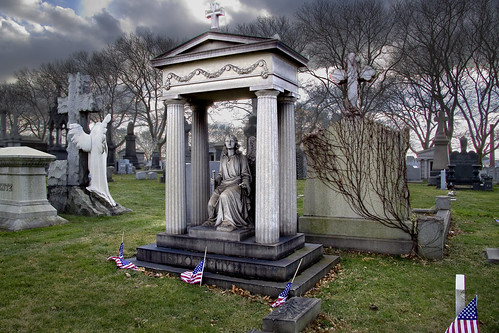
– photo by Mitch Waxman
Mr. Doherty, it seems, was a man of some reknown. He was a leading member of the Irish community on both sides of the Newtown Creek, and stood shoulder to shoulder in prestige alongside Battle-Ax Gleason in the eyes of his countrymen.
A manufacturer of rubber, Doherty specialized in the sort of material demanded by “turn of the 20th century” Dentists for the manufacture of dentures. His heavily advertised (see sample at bottom) Samson Rubber was a standard component for the manufacture of false teeth. The factory, incorporated as Eugene Doherty Rubber Works, Inc., was located at 110 and 112 Kent Avenue which is in Greenpoint (or Williamsburg, depending on whether or not you’re trying to hard sell a building).
rubber, from wikipedia
The major commercial source of natural rubber latex is the Para rubber tree (Hevea brasiliensis), a member of the spurge family, Euphorbiaceae. This is largely because it responds to wounding by producing more latex.
Other plants containing latex include Gutta-Percha (Palaquium gutta),[1] rubber fig (Ficus elastica), Panama rubber tree (Castilla elastica), spurges (Euphorbia spp.), lettuce, common dandelion (Taraxacum officinale), Russian dandelion (Taraxacum kok-saghyz), Scorzonera (tau-saghyz), and Guayule (Parthenium argentatum). Although these have not been major sources of rubber, Germany attempted to use some of these during World War II when it was cut off from rubber supplies. These attempts were later supplanted by the development of synthetic rubbers. To distinguish the tree-obtained version of natural rubber from the synthetic version, the term gum rubber is sometimes used.
A neat image of the the Doherty Rubber Works building late in its heyday (1920) can be found at trainweb.org, if you can believe anything I say, and they have a great description of the whole scene in context here. I warn you though, you’re going to learn about the Brooklyn Eastern District Terminal!
Also, in a completely unrelated coincidence, NAG is located at 110 Kent in modernity. Here’s the place on a google map, click “streetview” to compare to the 1920 shot above

– photo by Mitch Waxman
Eugene Doherty died in 1906, his wife Mary in 1914. Luckily for Mary, the denture business was a lucrative one, and her years of mourning were spent in material comfort. At her death, she bequeathed the staggering sum of $621,148 to her heirs.
$621,148 in 1914, mind you, and federal income tax had just become a reality in 1913. That’s at least $10,000,000 in modern coine.

– photo by Mitch Waxman
Life sized, if you’re a 5 foot tall woman, the statue itself is disarming and has weathered existence in the corrosive atmospheric miasmas extant about the nearby Newtown Creek for 94 years, only losing a thumb. The colour, oddly, doesn’t stain sanctified Calvary. Xanthian skill representative of true artistry went into the shaping of this stone, but I haven’t been able to find the name of the sculptor in public record.
If you see it, stand close and look into its eyes, then leave when the chills begin. Whatever you do, don’t look back over your shoulder at it afterwards, lest an adjusted hand hold on the sword, or the impression that the angle of its head has shifted might be seen. Remain an observer- in Calvary- ever the pale enthusiast- ever an Outsider.
Hey, you never know what you’re going to find at Calvary Cemetery.
Also, just as a note- today, January 13th, is Clark Ashton Smith’s birthday, and St. Knut’s Day as well.
Eugene Doherty Rubber Inc. - Late 19th/Early 20th century Advertising
Tales of Calvary 8- the Abbot

– photo by Mitch Waxman
While wandering through Calvary Cemetery recently, I came upon a curious monument whose sculptural elements included a life sized portrait, and whose dedication was meant to honor a man named Florence Scannell. The stone additionally bore a curious screed- “The Abbot”. “Dedicated to the memory of Florence Scannell by his brother John J.” is displayed prominently on its face. This stirred a sleeping memory, and I tried to remember why the name Scannell is so important. I said it out loud- John J. Scannell?
Wait a minute… John J. Scannell was the first chief of the NYFD, grand sachem of Tammany Hall, and a notorious turn of the century raconteur who became “king of the hill” in the often violent political world of 19th century New York City politics.
Bare knuckled, the electoral system back then resembled modern gang wars. Bearded men were paid to vote, taken to a barber shop for a shave and a shot of whiskey, and then paid to vote again. Paid armies of volunteers rousted saloons and bars that supported their political enemies. With political bosses paying the tab, taverns became organizing points for local “get out the vote” efforts. The poor didn’t care, for a day they could drink enough to forget and even eat a real meal- with meat, and all they had to do was vote the way they were told. The bosses were the bosses, and your place in “the line” could be revoked at any time if you fell out of favor with them. There was no “safety net”, so you had to just “go along”. Sometimes the other party would send gangs of street toughs into their opponents establishments- “bar busting”.
For more on the milieu of political life for the working class of the 19th century, I would suggest a gander at “The Jungle” Upton Sinclair’s “progressive” propaganda piece, or taking a peek at Jacob Riis’s “How the Other Half Lives“.
The Scannell brothers are described as having been engaged in such “bar busting” activities in 1869, when brother Florence ran for Alderman from the 18th ward against a Tammany candidate. At 23rd st. and second avenue, on Dec. 3rd, a Tammany man named Thomas Donaghue ran afoul of the Scannells, who were employed to “clean out” and “bust” the saloon he owned and operated.
from pbs.org
The year 1898 ushered in a new era of firefighting. On midnight of January 1, 1898, Greater New York was formed by uniting the five boroughs, Manhattan, Brooklyn, Queens, the Bronx, and Staten Island. The Board of Fire Commissioners was replaced by a single Commissioner, John J. Scannell, who had been head of the Board since 1894 and was appointed by Mayor R.A. Van Wyck. All of the area’s volunteer departments were to be replaced by the FDNY, and Chief Hugh Bonner assumed control of three paid departments: New York, Brooklyn, and Long Island; 121 engines, 46 trucks, one horse wagon, and a water tower; in all, 309 square miles of firefighting territory.

– photo by Mitch Waxman
The Scannells and a dozen of their men produced weapons and engaged in a fierce battle with Donaghue’s own crew of toughs. Gunfire erupted and Florence Scannel was shot in the back, the bullet embedding itself in his spinal column. Rushed to the nearby Bellevue Hospital, Florence suffered a lingering death, finally passing on July 10, 1870, with his brother John at his side. John J. Scannell swore an oath to avenge his brother, and kill the man who shot him in the back– the Tammany man, Thomas Donaghue.
Donaghue’s handlers fixed things up with the courts, and he returned to his familiar Saloon on 23rd st. and second avenue.
On Sept. 19th, at the corner of 17th and third, an odd looking man wearing a slouched hat and fake beard stepped out of the shadows and blasted a hole in Donaghue’s chest with a derringer pistol. Donaghue ultimately survived this attempt on his life, and Scannell discarded his disguise as he escaped his pursuers fleeing through Irving Place and Union Square. John J. later surrendered to a Police Sgt. after taking refuge on Long Island, and was indicted by a Grand Jury for the crime, but was never charged and released on $10,000 bail.
That’s $10,000 in 1870…
In November of 1872, Donaghue was attending an auction at the Apollo Theatre on 28th street, and a man wearing a cloak and slouch hat approached him. A large caliber pistol was produced and the middle of Donaghue’s face disappeared. Four more shots, three in the face, were pumped into the now prostrate Donaghue. The killer fled and was apprehended by a Police Captain named McElwain, who immediately identified the assassin as John J. Scannell. Such quick identification of Scannell was possible only because the arresting officer had been the one who arrested him for the the earlier attempt on Donaghue, when he was a Sgt.
The event was seminal, for as John J. Scannell sat in a gaol called “The Tombs”, another sat beside him. That night, John J. Scannell met Richard Croker. Someday, they would become “The Big Two” at Tammany Hall and rule over New York City.

– photo by Mitch Waxman
John J. Scannell was born on the lower East Side of Manhattan and found early work as a horse dealer- moving on to Saloon Keeper and then Professional Gambler. Charged with the murder of Donaghue, he pled insanity, and after a 3 month stint in an asylum in Utica, returned to local politics. He owned horses and raced them on the national circuit, as did Richard Croker. Rising in Tammany with his partner Croker, Scannell ran the 25th electoral district in Manhattan for many years, and desired the post of NYFD commissioner in that newly unified pile of gold called “the City of Greater New York”. Protests were recorded citywide, but Mayor Van Wyck appointed him chief of the newly unified citywide firefighting brigades. He served in that capacity until 1901, and fought corruption charges associated with his appointment until 1906 in court. At 67, in 1907, Scannell was sued for $15,000 for kissing the daughter of his housekeeper 3 times without consent.
Scannell died at 78 in Jamaica, Queens- far from his retirement estate in Freeport, L.I.
The Abbot, as it turns out, is a Horse.

– photo by Mitch Waxman
Scannell paid the scandalous amount of $26,500 at a Madison Square auction, the highest ever paid for a single Horse to that time, to purchase the Abbott.
That’s $26,500 in 1900…
The obituary for the Horse is actually longer than the one for the owner. The fact that Scannell engraved a Horse’s name on the monument to his dead brother, and his own eventual grave marker, shows the esteem felt by Scannell himself for the animal. Oddly enough, and this is a rare thing for Calvary Cemetery, The NYTimes once did an article on the raising of this monument which happened in 1914.
Hey, you never know what you’re going to find at Calvary Cemetery.


 The Newtown Pentacle