Posts Tagged ‘Greenpoint’
warm and fragrant

– photo by Mitch Waxman
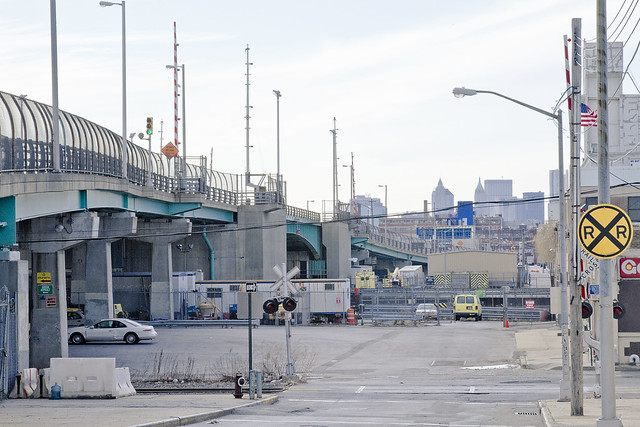
An appointment in Greenpoint carried me across the Greenpoint Avenue Bridge last Tuesday, and as my habit is to be early to meetings, some time was available for photography. It was an unusual and foggy day, and the mists were creating an enormous depth of field atmospherically. Always a visual pleasure, the GPA bridge offers views of the former Tidewater pumping station on the Queens bank as well as the tank farms of Lukoil and Metro fuel on the Brooklyn bank- which are pictured above.
That’s when I noticed something disturbing.

– photo by Mitch Waxman
We are lucky that we live in the age we do, when an oil slick moving down the languorous Newtown Creek is a remarkable sight. Once upon a time, such visualizations were commonly extant and regularly observed. Luckily, due to regulation and improved industrial practices, such events happen far less frequently than they once did.

– photo by Mitch Waxman
The standard protocol to follow when you observe an oil slick on the Newtown Creek, or anywhere in New York Harbor, is to first document it by taking a picture using your cell phone or digital camera. Make a note of your location and the time. Next, call 311 to alert city authorities, followed by a call to the State DEC spill hotline- 1 (800) 457-7362.
They take these matters quite seriously.

– photo by Mitch Waxman
Take note of whether the tide is coming in or going out, as this will help authorities to pinpoint the source of the contaminants. On this day, the tide was ebbing and the oil slick was flowing toward the East River along the tepid current. It should be mentioned that the obvious petroleum industry presence found alongside the Greenpoint Avenue Bridge is maintained by fairly responsible parties in modernity, and the shot above is not meant to indite or should be viewed as indicative of being responsible for the event depicted in this post.
The slick was coming from the other direction, flowing east to west and traveling beneath the bridge toward them.

– photo by Mitch Waxman
Later that afternoon, after having accomplished my intended goals in Greenpoint, and returning home via the Pulaski Bridge to Queens- a new feature on the lower Creek was noticed. A temporary or floating dock installed nearby the Vernon Avenue Street End, and one of two “work boats” was traveling eastward from it and moving under the Pulaski.
It moved too fast for me to ready the camera, but it bore the screed “spill response boat” upon it.

– photo by Mitch Waxman
Everybody’s friends at Riverkeeper, whom I informed of my observations upon returning home, made inquiries with DEC officials about the nature and extent of this possible spill event. DEC sent back word that the slick was no spill, rather it was likely a result of sediment sampling efforts being carried out by the Federal EPA as part of the ongoing discovery phase of the Superfund process. It seems that while dredging up small quantities of the so called “Black Mayonnaise” which lines the bed of the creek for study, some effluent might have been released into the waterway.
shocking moan

– photo by Mitch Waxman
Amongst the shocking grotesques of Brooklyn’s DUKBO, or Down Under the Kosciuzscko Bridge Onramp, one such as myself finds confirmation of all those things I wish I didn’t know. Following my nose, as it were, an odiferous cloud drew me to this particular corner seeking to investigate whether some cauldron of ichor might have been overturned or to discover whatever it might be that could produce such a miasmic stink.

– photo by Mitch Waxman
A pile of industrial site runoff ran lugubriously toward the sewers, obeying gravity. The effluent carried with it some odd and somewhat fibrous substance. The smell intensified as I neared the fence line, and the runoff was clearly organic, shimmering beneath the thermonuclear eye of god itself with a greasy iridescence.

– photo by Mitch Waxman
Close inspection revealed the presence of avian feathers in the runoff, betraying the origin of the brownish gray liquid. This was clearly chicken feces, running in a rivulet toward the oil stained streets which adjoin and parallel the gargantuan thoroughfare known as the Brooklyn Queens Expressway that is carried by the pendulous Kosciuzscko Bridge.

– photo by Mitch Waxman
The variegated texture exhibited by the pavement is coincidental, and due to the habits of local concrete contractors who cleanse their machinery on the street, dumping what washes from their trucks wherever it may fall. There are large sections of this neighborhood whose sidewalks and streets exhibit the appearance of volcanic flow, where tons of waste concrete cured while seeking those self same drains which a feather laden stream of poultry feces was attempting to enter on this day.
Choked with cement, the sewers become the center of a fetid lagoon, but such sights are common in DUKBO.

– photo by Mitch Waxman
The operation which plies its trade at this corner is a poultry merchant, one which trucks the hapless birds to this warehouse. My understanding is that they are involved in the wholesale section of the business, supplying neighborhood Halal abattoirs, “Pollo Vivo” dealers, and certain Asiatic Restaurants which are scattered around Brooklyn and Queens with fresh stock. Unlike the native born’s habit of purchasing a familiar and largely inoffensive carcass- a plucked, butchered, and often steamed or bleached cadaver- on sale at chain supermarkets and “traditional” Yankee butcher shops- many newer immigrants in the area prefer to inspect their food animals while still alive.
Prosaic, the practice is regarded as barbaric by area wags who prefer to maintain some insulation from the bloody business of supplying industrial quantities of animal protein to an ever growing human infestation.

– photo by Mitch Waxman
Urban sophisticates tend to overlook these sort of details, forgetting that every “organic” or “factory farm” chicken may not have been a healthy bird before it was roughly extinguished. Recent immigration from the queer foreign courts of Asia and other more southernly latitudes has carried with it a certain skepticism about such matters. Inspection of eye, beak, and feet is paramount in certain circles- especially when it concerns the food laid out for children.
They have no trust in the USDA, it’s curious marks and unintelligible grading system for food quality- all of which were codified by bureaucrats.

– photo by Mitch Waxman
Of course, what stretch of the imagination could conjure for them the image of that prize bird stacked in crates ten deep just 3 blocks from the Newtown Creek, imprisoned in those exhaust clouds which bubble and froth invisibly down from the BQE? Could they understand that this is a neighborhood of scrap yards, garbage depots, oil tank farms, and former home to oil refineries, bone boilers, and chemical refineries? Can anyone imagine what these birds are breathing in?
A question often asked of your humble narrator these days concerns the status of those who might engage in subsistence fishing on the Newtown Creek, and the consequences of consuming such a catch.

– photo by Mitch Waxman
The question which is offered as an answer in itself is “do you have any idea how much of the food you buy as “organic” moves through the shadowed warehouses and poison atmospherics of the Newtown Creek?” and “what makes you think you’re any different than those fishermen”?
Seldom do I receive an answer, for when faced with considering such realities about their own food supply, even the clear eyed and prosaic will reveal themselves to be chicken shit.
verdant valley

– photo by Mitch Waxman
While preparing the slideshow which was recently presented at the Ridgewood Democratic Club, which is one of two updated versions of the thing (differing lengths), I’ve been churning the content waters deeply. One of the little collections of images which I pulled together was called “Kosciuszko Bridge”.

– photo by Mitch Waxman
For awhile now, special attention has been paid to this decaying structure, due to those plans held by State employees and agencies to replace it with a modern bridge designed to overcome many of the flaws exhibited by the 1939 era “Meeker Avenue Bridge” – which was later renamed as the Kosciuszko Bridge in 1940.

– photo by Mitch Waxman
It’s a lumbering and brutish design, inelegant, undistinguished, and strictly utilitarian. Which sort of makes sense given its construction during the latter half of the Great Depression.

– photo by Mitch Waxman
Literally, and figuratively, this is Down Under the Kosciuszko Bridge Onramp, DUKBO. This is on the Brooklyn side, incidentally.

– photo by Mitch Waxman
This post isn’t intended to carry any deep insight or reveal some historical truth. To confess, I’m showboating a bit today, and featuring something that won’t be here too much longer.

– photo by Mitch Waxman
One thing you will notice in these shots is the horrific amount of corrosion which the bridge displays. This is, of course, why the State plans on replacing it in a few years time.

– photo by Mitch Waxman
Naked, the bridge shows the lines of force which it’s engineered around, and for a structure that carries something like 200,000 vehicle crossings a day- that’s a lot of force. The Kosciuszko Bridge trusses are just so damned ugly about it, unlike the graceful curvilinear shaping of the Hellgate or Bayonne arches.

– photo by Mitch Waxman
The reason it’s so high, around 150 feet of clearance at low water, is that ocean going ships used to come all the way back here. Not sail, although that was a consideration in 1939, but the smokestacks of ocean liners were what it was flung into the sky to accommodate.

– photo by Mitch Waxman
Sliding over to the Queens bank, where the piles are driven into compacted mud and sand instead of bedrock, the legs of the bridge straddle the former home of Phelps Dodge. The neighborhood around these parts formed the border between the villages of Berlin and Blissville.

– photo by Mitch Waxman
From what I’ve been told, the former Phelps Dodge site is in private hands, but parts of it will house the new bridge which will replace the 1939 model. From the planning statements I’ve read, the new Kosciuszko Bridge won’t be quite so high.

– photo by Mitch Waxman
It seems that the needs of the trucking industry will be acknowledged in the design of the onramps, which will not present quite as steep a grade to the angle of their approaches. I’ll miss the scale of the current bridge, I fear.

– photo by Mitch Waxman
Like the nearby Megalith at Court Square in Long Island City, the Kosciuszko Bridge provides a geographical frame of reference for miles around. The only other bridges of sufficient scale to provide such service span the East River or provide connection to… Staten Island…

– photo by Mitch Waxman
The Kosciuszko Bridge, on the Queens side, follows the shallow valley between Laurel and Berlin Hills, both of which are graded down shadows of their former selves. There must have been dense woods here once, bisected by a shallow stream that fed into the Newtown Creek.

– photo by Mitch Waxman
The Maespetche Indians who lived here were mostly wiped out by Smallpox by the 1700’s, and by that time the Dutch had already established a few homesteads here. When the English arrived, often overland from Eastern Long Island, they mocked the degenerate Dutch with their old fashioned customs and bizarre beliefs.

– photo by Mitch Waxman
The English had plenty of controversies in this area themselves, with the bizarre adherents of the “Friends” cult showing up time and again from New England via the Long Island Sound, the presence of accused witches, and all sorts of odd religious experimentation by commoner and courtier alike going on.

– photo by Mitch Waxman
All that sort of nonsense ended in the early 1800’s, when the post revolutionary industrial boom got started here in DUKBO. General Chemical came in the 1840’s, and joined with the distilleries and fat renderers who had been here for years to participate in what we would call “the industrial revolution”.
Things really kicked into gear when the Long Island Railroad laid down track in the 1860’s and 70’s.

– photo by Mitch Waxman
Of course, in 1848, Dagger John Hughes buried Esther Ennis and consecrated Calvary Cemetery as the official burying ground of the Roman Catholic Church. Construction of the cemetery on Laurel Hill was largely finished by the late 1850’s, which removed approximately 360 million tons of topsoil from the hill and installed an enormous drainage system within it to dry the swampy land.

– photo by Mitch Waxman
In the 1890’s, there were still homes and saloons, schools and churches here. Calvary grew by land acquisition and donation, and industrial pursuits rendered the whole area around these parts a smoky, soot stained mess.
And then, there was the smell.

– photo by Mitch Waxman
The smell is legendary in the historical record, it seems that it’s all that the riders of the Long Island Railroad could talk about. Health Department records preserve complaints presented by residents of Manhattan who opined that the stink actually extended all the way to Turtle Bay (approximately 34th street).

– photo by Mitch Waxman
All that is gone now, although on humid days after heavy rains, the stink is still more than just a memory.
As are the chemicals in the ground and water which all that industrial growth left behind for the future.

– photo by Mitch Waxman
Definitely. I’m going to miss the big K when it’s gone, wonder what interesting things will be found in DUKBO when the shovels hit the dirt.
After all- who can guess, all there is, that might be buried down there?
sitting alone

– photo by Mitch Waxman
All ‘effed up.
In one of those odd moments which often cause my steps to falter, whilst walking down hoary Kingsland Avenue in ancient Greenpoint, this discarded workman apparel seemed to be trying to tell me something.
Clearly, it was pointing at something.
from wikipedia
Ideas of reference and delusions of reference involve people having a belief or perception that irrelevant, unrelated or innocuous phenomena in the world refer to them directly or have special personal significance: ‘the notion that everything one perceives in the world relates to one’s own destiny’.
In psychiatry, delusions of reference form part of the diagnostic criteria for psychotic illnesses such as schizophrenia, delusional disorder, or bipolar disorder during the elevated stages of mania. To a lesser extent, it can be a hallmark of paranoid personality disorder. Such symptoms can also be caused by intoxication, especially with hallucinogens or stimulants like methamphetamine.

– photo by Mitch Waxman
For a moment, the ridiculous notion that its missing owner was in mid gesture and then suddenly dissolved away struck me. The fence seen behind the glove is laden with signs that promise electrocution to those who might attempt trespass of the property it surrounds, and I thought that perhaps its owner had ignored these warnings and had been consumed by torrents of voltage and the sole survivor of the man was this garment.
That’s when I thought “perhaps it’s trying to tell me to look behind me, and offering a warning”.
People suffering from persecutory delusions believe that they are being conspired against or persecuted in some way. Common manifestations include the belief that one is being followed, that one’s mail is being opened, that one’s room or office is bugged, that the telephone is tapped, or that police, government officials, neighbors, or fellow workers are harassing the subject.

– photo by Mitch Waxman
Luckily, nothing was amiss, and your humble narrator remained the lord of his near vicinity.
“I’m all ‘effed up” was all I said, out loud, and then continued walking back to Queens.
also from movementdisorders.org
The subject’s behavior is unusual, bizarre, or fantastic. For example, the subject may urinate in a sugar bowl, paint the two halves of his body different colors, or kill a litter of pigs by smashing their heads against a wall. The information for this item will sometimes come from the subject, sometimes from other sources, and sometimes from direct observation. Bizarre behavior due to the immediate effects of alcohol or drugs should be excluded. As always, social and cultural norms must be considered in making the ratings, and detailed examples should be elicited and noted.
wildly luminous

– photo by Mitch Waxman
In yesterday’s posting, a object d’art was found along Laurel Hill Blvd. At the foot of that ancient byway lies an intersection with Greenpoint Avenue, and the bridge named for it. The street lamps are often utilized by your humble narrator as “something to hide from oncoming traffic behind” and recently I’ve noticed some odd graffiti popping up on them.
Not your usual “gangsta” braggadocio or “tags” nor “ironic hipster commentary”, these involve the bible.

– photo by Mitch Waxman
The scrawl I’m referring to on this pole, which is on the western corner, is not the interesting tidbit about people of Korean abstraction which is written on the masking tape holding the pen- instead it’s the “Sin is the Devil” which caught my attention.
In the American King James version, at least, this correlates to 1 John 3:8
“He that commits sin is of the devil; for the devil sins from the beginning. For this purpose the Son of God was manifested, that he might destroy the works of the devil.”
Hmm.

– photo by Mitch Waxman
Maybe I’m just stupid, but Psalms 141.6 doesn’t include the quotation above, which most likely comes from “Romans 5:13- For until the law sin was in the world: but sin is not imputed when there is no law.”
The Psalms quotation would be “Their rulers will be thrown down from the cliffs, and the wicked will learn that my words were well spoken“.
– photo by Mitch Waxman
DUGABO (or Down Under the Greenpoint Avenue Bridge Onramp), it would seem, can now boast of hosting a foe of evil.
Wonder what might happen should they spy the Blissville Banshee as she floats down the Newtown Creek, spy the occultists who make altars in area cemeteries, or wonder at the tales of an antique and quite spectral locomotive passing the Bliss Tower on its way to Deadman’s Curve at Berlin Hill?
Would we see an exorcism in DUGABO?
ALSO, this Friday:

My own attempt at presenting a cogent narrative and historical journey “up the creek” is up coming as well-
Your humble narrator will be narrating humbly on Friday, February 24th at 7:30 P.M. for the“Ridgewood Democratic Club, 60-70 Putnam Avenue, Ridgewood, NY 11385” as the “Newtown Creek Magic Lantern Show” is presented to their esteemed group. The club hosts a public meeting, with guests and neighbors welcome, and say that refreshments will be served.
The “Magic Lantern Show” is actually a slideshow, packed with informative text and graphics, wherein we approach and explore the entire Newtown Creek. Every tributary, bridge, and significant spot are examined and illustrated with photography. This virtual tour will be augmented by personal observation and recollection by yours truly, with a question and answer period following.
For those of you who might have seen it last year, the presentation has been streamlined, augmented with new views, and updated with some of the emerging stories about Newtown Creek which have been exclusively reported on at this- your Newtown Pentacle.
For more information, please contact me here.
What: Newtown Creek Magic Lantern Show
When: Friday, February 24th at 7:30 P.M.
Where: Ridgewood Democratic Club, 60-70 Putnam Avenue, Ridgewood, NY 11385


 The Newtown Pentacle