Posts Tagged ‘H.P. Lovecraft’
cryptical books

– photo by Mitch Waxman
Just to affirm that your humble narrator is a multi disciplinary geek, whose nerd credentials cross into multiple devotions and subjects, today’s post takes us to the Hudson River and specifically- Esopus Island. An unremarkable spit of rock sticking out of the water not far from Kingston, Esopus nevertheless is a touchstone for high weirdness.
If these shots were taken in 1918 rather than 2010- one would have seen a bizarre Englishman crawling along the shorelines painting “Do What Thou Wilt Shall be the Whole of the Law” and “Every Man and Every Woman is a Star” on the stony outcrops in red.
from wikipedia
Crowley began another period of magical work on an island in the Hudson River after buying large amounts of red paint instead of food. Having painted “Do what thou wilt” on the cliffs at both sides of the island, he received gifts from curious visitors. Here at the island he had visions of seeming past lives, though he refused to endorse any theory of what they meant beyond linking them to his unconscious. Towards the end of his stay, he had a shocking experience he linked to “the Chinese wisdom” which made even Thelema appear insignificant.

– photo by Mitch Waxman
The self proclaimed “Great Beast” himself, Aleister Crowley spent much of the First World War in New York City, and the wild speculations that he was acting as an agent of British Intelligence during this time just might hold some water. In 1918, that horrible man decided on a “great magical retirement” (he had run out of money and driven at least two women to alcoholism and madness), shaved his head, and borrowed a tent and canoe from one of the many friends whom he cuckolded.
Here’s an image from a postcard depicting Esopus Island in 1907. In his diaries, Crowley called it Oesopus.
from wikipedia
Aleister Crowley (/ˈkroʊli/ kroh-lee; 12 October 1875–1 December 1947), born Edward Alexander Crowley, and also known as both Frater Perdurabo and The Great Beast, was an influential English occultist, astrologer, mystic and ceremonial magician, responsible for founding the religious philosophy of Thelema. He was also successful in various other fields, including mountaineering, chess and poetry. In his role as the founder of the Thelemite philosophy, he came to see himself as the prophet who was entrusted with informing humanity that it was entering the new Aeon of Horus in the early twentieth century.

– photo by Mitch Waxman
Crowley arrived on the island with scant supplies, and was known to have made a trip back to New York at least once to secure needed items. Local farmers, concerned and curious about their new neighbor, brought comestibles to the odd fellow- a charming and neighborly Yankee tradition. Curiously, the hermit spent his time mediating and translating an ancient Chinese text for his own amusement.
Crowley reported that he experienced an epiphany here, something that would overshadow even his own mystical revelations. Which brings us back to H.P. Lovecraft. For two people who are never supposed to have met, Lovecraft and Crowley had a LOT of friends in common.
from dec.ny.gov
Atlantic sturgeon are the stuff of myth and legends. They are the largest fish to regularly inhabit the Hudson River, reaching 10-12′ in length and weighing in excess of 350 lb. They are a primitive-looking and wonderfully adapted estuarine creature belonging to an order of fishes whose evolutionary origins reaches back at least 100 million years. Sturgeon grow very slowly, taking as long or longer than humans to reach maturity, and rivaling us in longevity, surviving 50 years or more in the wild. The river channel around Esopus Island, up to 60 feet deep, is a known congregation area for adult Atlantic sturgeon.

– photo by Mitch Waxman
Supposedly-
It would seem that one of the simple Yankee farmers who brought Crowley food and provisions was one Paul Rhodes, who would later become a correspondent and friend of Mr. Lovecraft. Rhodes created the only contemporaneous cinematic adaptation of one of Lovecraft’s tales- “The Other Gods” which was screened just once in 1924 for Mdm. Blavatsky’s Theosophical Society.
This should be taken with a grain of salt, as I haven’t been able to find independent confirmation of this timeline and it might be modern imposture. Regardless, witness the short film at the links below- if you dare.
candlemas

– photo by Mitch Waxman
Today is Candlemas, a station of fire on the wheel of the year which marks the equidistant point between winter and spring solstices. Our pagan antecedents would have gathered today, and exchanged candles of beeswax to mark the occasion. The entire month of February is named for a Roman feast held on or near the 15th, called Februa, a purification ritual.
The pre Christian Irish called this time of the year “faoilleach”, the wolf month.
In modern times, it’s mainly known as “groundhog day“.
from wikipedia
The Presentation of Jesus at the Temple, which falls on 2 February, celebrates an early episode in the life of Jesus. In the Eastern Orthodox Church and some Eastern Catholic Churches, it is one of the twelve Great Feasts, and is sometimes called Hypapante (lit., ‘Meeting’ in Greek). Other traditional names include Candlemas, the Feast of the Purification of the Virgin, and the Meeting of the Lord.

– photo by Mitch Waxman
At least three thousand years of tradition say that today is a good day to cleanse the body and home, and tradition states that your Christmas decorations must be torn away by tonight or death will come to your house. Additionally, one is expected to eat pancakes.
Farmers begin turning the soil today, and their wives are expected to put baked goods on the windowsill as an offering to the fertility goddess Brigid (later latinized as St. Brigid).
Our Lady of the Pentacle and your humble narrator look forward to evening pancakes. It has been too long.
from wikipedia
Imbolc (also Imbolg), or St Brigid’s Day (Scots Gaelic Là Fhèill Brìghde, Irish Lá Fhéile Bríde, the feast day of St. Brigid), is a Celtic festival marking the beginning of spring. Most commonly it is celebrated on 1 or 2 February (or 12 February, according to the Old Calendar) in the northern hemisphere and 1 August in the southern hemisphere. These dates fall approximately halfway between the Winter Solstice and the Spring Equinox.
The festival was observed in Gaelic Ireland during the Middle Ages. Reference to Imbolc is made in Irish mythology, in the Tochmarc Emire of the Ulster Cycle. Imbolc was one of the four cross-quarter days referred to in Irish mythology, the others being Beltane, Lughnasadh and Samhain. It has been suggested that it was originally a pagan festival associated with the goddess Brigid, who should not be confused with St Brigit of Kildare.

– photo by Mitch Waxman
In the fictional clade of H.P. Lovecraft’s mythos, Candlemas is a day oft mentioned, and is most prominently the birthday of both Wilbur Whately and his twin brother. The brother had no name, but was said to resemble their father more strongly than Wilbur.
from hplovecraft.com
It was in the township of Dunwich, in a large and partly inhabited farmhouse set against a hillside four miles from the village and a mile and a half from any other dwelling, that Wilbur Whateley was born at 5 A.M. on Sunday, the second of February, 1913. This date was recalled because it was Candlemas, which people in Dunwich curiously observe under another name; and because the noises in the hills had sounded, and all the dogs of the countryside had barked persistently, throughout the night before.
frightful pull

– photo by Mitch Waxman
During the hot part of the summer of 2011, Kevin Walsh was planning one of his Second Saturday tours, and as your humble narrator had agreed to assemble the tour booklet for the outing- I was along for the ride, which is how I ended up in in Brooklyn (the “lands of my boit”). My mom used to refer to this intersection of Flatbush and Church Avenues at “flatboosh and choich” when I was a kid, spoke in hushed tones about “the shawpping dat uzed to be dere”, and my dad avoided it like the plague because of the traffic.
The highlight of my trip to Brooklyn that day was that I was going to Lovecraft Country.
Here’s what Mr. Kevin Walsh of forgotten-ny said about the place
Flatbush Dutch Reformed has had three incarnations: a wood structure built on orders from Governor General Peter Stuyvesant in 1654, a stone building in 1699, and the current one built from Manhattan schist dating to 1798. The churchyard goes back to the church’s very beginnings and contains stones inscribed in both English and Dutch. Among the many stained glass windows are a few by Louis Comfort Tiffany. The tower contains a clock and bell that are dated 1796, plus a 10-bell chime that was cast by the Meneely Foundry of Troy, N.Y., and installed in 1913.

– photo by Mitch Waxman
For those of you who are not enormous nerds, H.P. Lovecraft was a writer who lived in Brooklyn for awhile, but he always longed for his New England homeland. Weird Fiction was his bag, and his work survived him. H.P was a dedicated long distance walker, and an amateur historian who made the best of his time in New York visiting significant and historically interesting sites all over the City.
“Lovecraft Country” is a fan term for the fictional locations and mythic locales described so vividly by the author, and refers to coastal Massachusetts more often than not. In Brooklyn though, things are real, and so is “Lovecraft Country”.
from wikipedia
Flatbush Dutch Reformed Church Complex, also referred to more simply as the Flatbush Reformed Church, is a historic Dutch Reformed church (now a member of the Reformed Church in America) at 890 Flatbush Avenue and 2101-2103 Kenmore Terrace in Flatbush, Brooklyn, New York. The complex consists of the church, church house, parsonage, and cemetery. The congregation was founded in 1654. The 2 1⁄2-story stone church building was constructed in 1796 and features a stone tower with stone belfry. The stained glass windows are by Tiffany studios and commemorate the descendants of many early settlers of Flatbush. The church house is a 2 1⁄2-story red brick and limestone building. The parsonage is a 2 1⁄2-story wood-frame house moved to its present site in 1918. The cemetery is the last resting place of most of the members of the early Dutch families of Flatbush. The earliest legible grave marker dates to 1754.

– photo by Mitch Waxman
While exploring the place for myself, as Kevin (and Newtown Pentacle’s Far Eastern Correspondent Armstrong) was dying from heat exhaustion and taking cover in the shade of a venerable oak, one thing that gained my attention were the names on the stones. Suydam, Martense… These are character names from some of Lovecraft’s stories. Lovecraft saw evil in New York City, and was terrified by the tight quarters and crowded streets which distinguished the immigrant era. (He was of course, kind of a racist, very much a product of his time- don’t forget how common such tribalism was, and how novel and new the non ethnocentric and very all inclusive “progressive politique and so called meritocracy” is).
Kevin and Armstrong both guzzled water, but I was not parched and required only further explorations.
H.P. Lovecraft said
My coming to New York had been a mistake; for whereas I had looked for poignant wonder and inspiration in the teeming labyrinths of ancient streets that twist endlessly from forgotten courts and squares and waterfronts to courts and squares and waterfronts equally forgotten, and in the Cyclopean modern towers and pinnacles that rise blackly Babylonian under waning moons, I had found instead only a sense of horror and oppression which threatened to master, paralyse, and annihilate me.
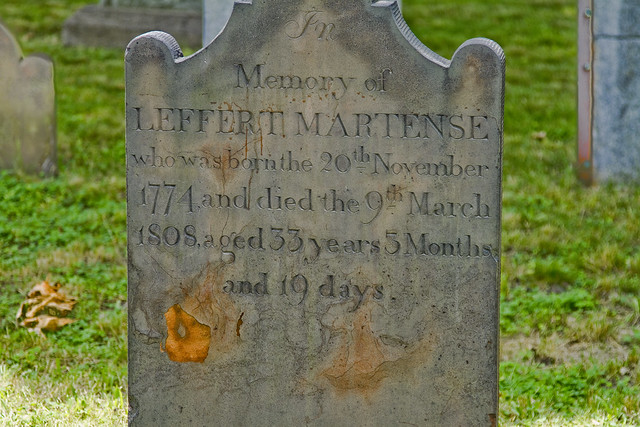
– photo by Mitch Waxman
One of the places which comes up again and again in his writings is this very churchyard, apparently it left quite the impression upon Lovecraft, and inspired his story “The Hound”. He confessed to desecrating this graveyard, incidentally, which is strictly against Newtown Pentacle policy.
This is also why I don’t guzzle water while in graveyards, as such quaffing will inevitably result in the need for urination, which might lead to desecration.
(First Calvary in Queens has two well maintained and world class public lavatories at the entrance gates, btw.)
H.P. Lovecraft was actually here in 1922
On September 16, 1922, Lovecraft toured the Flatbush Reformed Church in Brooklyn with his friend Rheinhart Kleiner, writing about the visit in a letter:
Around the old pile is a hoary churchyard, with internments dating from around 1730 to the middle of the nineteenth century…. From one of the crumbling gravestones–dated 1747–I chipped a small piece to carry away. It lies before me as I write–and ought to suggest some sort of horror-story. I must place it beneath my pillow as I sleep… who can say what thing might not come out of the centuried earth to exact vengeance for his desecrated tomb? And should it come, who can say what it might not resemble?[

– photo by Mitch Waxman
This particular parcel of “Lovecraft Country” has an awful lot of New York City history associated with it, Peter Stuyvesant and the “Degenerate Dutch” and all that. Road extensions of a toll road called Flatbush Avenue past a watch tower… Frankly, the sort of “historian history” which your humble narrator always bolloxes up. I’ve had the pleasure of meeting Rob Schweiger, Brooklyn’s borough historian, and he can offer a far more cogent history of this place than I can. So can the oft mentioned Kevin Walsh.
I can tell you a lot about Newtown Creek and it’s locale, but this part of colonial Brooklyn ain’t my bag.
from “the Lurking Fear”, courtesy hplovecraft.com
No one outside the backwoods had believed these varying and conflicting stories, with their incoherent, extravagant descriptions of the half-glimpsed fiend; yet not a farmer or villager doubted that the Martense mansion was ghoulishly haunted. Local history forbade such a doubt, although no ghostly evidence was ever found by such investigators as had visited the building after some especially vivid tale of the squatters. Grandmothers told strange myths of the Martense spectre; myths concerning the Martense family itself, its queer hereditary dissimilarity of eyes, its long, unnatural annals, and the murder which had cursed it

– photo by Mitch Waxman
I don’t know why I’m always drawn to cemetery trees, a humble narrator will confess, but there’s always something about these vegetable growths fed by an obvious and morbid nutrition. An ominous portent, a spooky resonance, a dissonant note. For some reason, my perception leads me to see shapes in their whorls and crags, shapes which form into recognizable “things”- much like searching for the shape of a dragon in cloud formations.
The scientifically minded call it Pareidolia.
from “The Horror at Red Hook”, courtesy hplovecraft.com
Suydam was a lettered recluse of ancient Dutch family, possessed originally of barely independent means, and inhabiting the spacious but ill-preserved mansion which his grandfather had built in Flatbush when that village was little more than a pleasant group of colonial cottages surrounding the steepled and ivy-clad Reformed Church with its iron-railed yard of Netherlandish gravestones.

– photo by Mitch Waxman
I don’t think I get enough sleep, that’s what it is. It renders me highly suggestible, and perhaps I should drink some more water, and follow Mr. Walsh’s example when visiting “Lovecraft Country“.
from wikipedia
Oneirophrenia is a hallucinatory, dream-like state caused by several conditions such as prolonged sleep deprivation, sensory deprivation, or drugs (such as ibogaine). From the Greek words “ὄνειρο” (oneiro, “dream”) and “φρενός” (phrenos, “mind”). It has some of the characteristics of simple schizophrenia, such as a confusional state and clouding of consciousness, but without presenting the dissociative symptoms which are typical of this disorder.
Persons affected by oneirophrenia have a feeling of dream-like unreality which, in its extreme form, may progress to delusions and hallucinations. Therefore, it is considered a schizophrenia-like acute form of psychosis which remits in about 60% of cases within a period of two years. It is estimated that 50% or more of schizophrenic patients present oneirophrenia at least once.
Cool Air

– photo by Mitch Waxman
One of the many startling things about H.P. Lovecraft’s unhappy life in New York, during which he suffered dire poverty, was that his favorite pass time seemed to have been wandering the streets tracking down antiquarian treasures- and He spent quite a bit of his time looking for artifacts of times gone by. Many of the locations mentioned in his fiction remain extant to this day, and sometime over the next couple of months your humble narrator will be journeying to Brooklyn to find the “Horror at Red Hook”.
Today, however, we’re on West 14th street in Manhattan- where “Cool Air” is set.
from wikipedia
The building that is the story’s main setting is based on a townhouse at 317 West 14th Street where George Kirk, one of Lovecraft’s few New York friends, lived briefly in 1925. The narrator’s heart attack recalls that of another New York Lovecraft friend, Frank Belknap Long, who dropped out of New York University because of his heart condition. The narrator’s phobia about cool air is reminiscent of Lovecraft himself, who was abnormally sensitive to cold.

– photo by Mitch Waxman
Lovecraft scholar S.T. Joshi has christened Kirk, Lovecraft, Long and a small group of others as “The Lovecraft Circle” and this is where they would meet up and carouse late into the night. In the 1920’s, this was a “Bachelor’s Boarding House”, and from the description of the modern establishment quoted below- it still is.
from chelseapinesinn.com
Chelsea Pines Inn is located in a five story walk-up row house that was built as a private home in the 1850s. In the 1980s, the building was transformed into a charming gay owned and operated hotel, where everyone has always been welcome. All guest rooms and common areas are decorated with original film posters from the Golden Age of Hollywood. Unique stores, galleries, restaurants, and clubs are within walking distance, and the world’s largest mass transit system is just a few steps away, so you can get anywhere in the city quickly and economically.
Originally built as a private home back when 14th Street was the northern end of the city, our building has gone through many exciting changes over the years. As the City grew around us it became a fashionable rooming house and was used as the setting in Cool Air, a short story about air conditioning, written well before air conditioning was invented, by the celebrated horror author H.P. Lovecraft. (Just as a note, Chelsea Pines Inn has central air.)
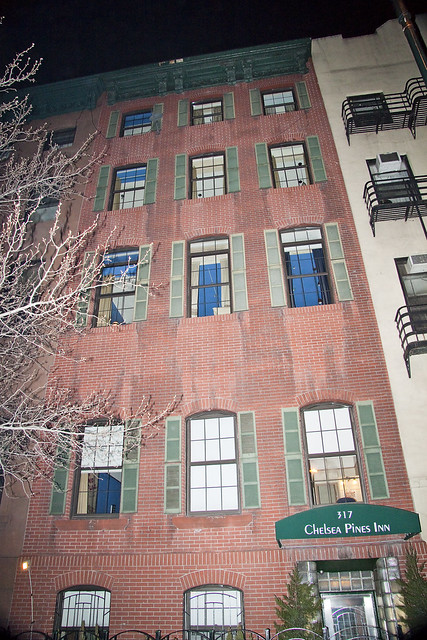
– photo by Mitch Waxman
The action in the story would have taken place on the third floor, where the narrator’s rooms were located. Dr. Muñoz would have been at the summit.
from H.P. Lovecraft’s “Cool Air”
It is a mistake to fancy that horror is associated inextricably with darkness, silence, and solitude. I found it in the glare of mid-afternoon, in the clangour of a metropolis, and in the teeming midst of a shabby and commonplace rooming-house with a prosaic landlady and two stalwart men by my side. In the spring of 1923 I had secured some dreary and unprofitable magazine work in the city of New York; and being unable to pay any substantial rent, began drifting from one cheap boarding establishment to another in search of a room which might combine the qualities of decent cleanliness, endurable furnishings, and very reasonable price. It soon developed that I had only a choice between different evils, but after a time I came upon a house in West Fourteenth Street which disgusted me much less than the others I had sampled.
The place was a four-story mansion of brownstone, dating apparently from the late forties, and fitted with woodwork and marble whose stained and sullied splendour argued a descent from high levels of tasteful opulence. In the rooms, large and lofty, and decorated with impossible paper and ridiculously ornate stucco cornices, there lingered a depressing mustiness and hint of obscure cookery; but the floors were clean, the linen tolerably regular, and the hot water not too often cold or turned off, so that I came to regard it as at least a bearable place to hibernate till one might really live again. The landlady, a slatternly, almost bearded Spanish woman named Herrero, did not annoy me with gossip or with criticisms of the late-burning electric light in my third-floor front hall room; and my fellow-lodgers were as quiet and uncommunicative as one might desire, being mostly Spaniards a little above the coarsest and crudest grade. Only the din of street cars in the thoroughfare below proved a serious annoyance.
H.P. Lovecraft’s “The Festival”

– photo by Mitch Waxman
text quoted from H.P. Lovecraft’s “The Festival”, courtesy wikisource, where you can read the whole story
I was far from home, and the spell of the eastern sea was upon me. In the twilight I heard it pounding on the rocks, and I knew it lay just over the hill where the twisting willows writhed against the clearing sky and the first stars of evening. And because my fathers had called me to the old town beyond, I pushed on through the shallow, new-fallen snow along the road that soared lonely up to where Aldebaran twinkled among the trees; on toward the very ancient town I had never seen but often dreamed of.

– photo by Mitch Waxman
It was the Yuletide, that men call Christmas though they know in their hearts it is older than Bethlehem and Babylon, older than Memphis and mankind. It was the Yuletide, and I had come at last to the ancient sea town where my people had dwelt and kept festival in the elder time when festival was forbidden; where also they had commanded their sons to keep festival once every century, that the memory of primal secrets might not be forgotten. Mine were an old people, and were old even when this land was settled three hundred years before. And they were strange, because they had come as dark furtive folk from opiate southern gardens of orchids, and spoken another tongue before they learnt the tongue of the blue-eyed fishers. And now they were scattered, and shared only the rituals of mysteries that none living could understand. I was the only one who came back that night to the old fishing town as legend bade, for only the poor and the lonely remember.

– photo by Mitch Waxman
Then beyond the hill’s crest I saw Kingsport outspread frostily in the gloaming; snowy Kingsport with its ancient vanes and steeples, ridgepoles and chimney-pots, wharves and small bridges, willow-trees and graveyards; endless labyrinths of steep, narrow, crooked streets, and dizzy church-crowned central peak that time durst not touch; ceaseless mazes of colonial houses piled and scattered at all angles and levels like a child’s disordered blocks; antiquity hovering on grey wings over winter-whitened gables and gambrel roofs; fanlights and small-paned windows one by one gleaming out in the cold dusk to join Orion and the archaic stars. And against the rotting wharves the sea pounded; the secretive, immemorial sea out of which the people had come in the elder time.

– photo by Mitch Waxman
Beside the road at its crest a still higher summit rose, bleak and windswept, and I saw that it was a burying-ground where black gravestones stuck ghoulishly through the snow like the decayed fingernails of a gigantic corpse. The printless road was very lonely, and sometimes I thought I heard a distant horrible creaking as of a gibbet in the wind. They had hanged four kinsmen of mine for witchcraft in 1692, but I did not know just where.

– photo by Mitch Waxman
As the road wound down the seaward slope I listened for the merry sounds of a village at evening, but did not hear them. Then I thought of the season, and felt that these old Puritan folk might well have Christmas customs strange to me, and full of silent hearthside prayer. So after that I did not listen for merriment or look for wayfarers, kept on down past the hushed lighted farmhouses and shadowy stone walls to where the signs of ancient shops and sea taverns creaked in the salt breeze, and the grotesque knockers of pillared doorways glistened along deserted unpaved lanes in the light of little, curtained windows.


 The Newtown Pentacle