Posts Tagged ‘Hudson River’
chill currents

– photo by Mitch Waxman
Gaze in terror at the ice breaking tug Morro Bay, stalwart arm of the United States Coast Guard, as it maneuvers about the Hudson River. In terror that is, if you mean harm to the mariners or coastlines of the United States. It is maritime Sunday at the Newtown Pentacle once more, and this time around it’s a Coast Guard vessel in the spotlight.
from uscg.mil
USCGC MORRO BAY (WTGB-106)
Abstract
The USCGC MORRO BAY was commissioned 28 March 1981 at the Reserve Training Center in Yorktown, VA and served here until 1998. The MORRO BAY was the sixth of her kind in the Coast Guard. While stationed at Training Center, the MORRO BAY was involved in training and operations on the Chesapeake Bay. The MORRO BAY is currently home ported in New London, CT.
Ship’s History
The 140-foot Bay-class Cutters are state of the art icebreakers used primarily for domestic ice breaking duties. They are named after American Bays and are stationed mainly in Northeast U.S. and Great Lakes. Although specifically desinged for ice breaking duties, they also perform law enforcement, environmental protection, search & rescue operations and support for aids to navigation activities.
WTGBs use a low-pressure-air hull lubrication or bubbler system that forces air and water between the hull and ice. This system improves icebreaking capabilities by reducing resistance against the hull, reducing horsepower requirements.

– photo by Mitch Waxman
While researching this post, an interesting factoid about the Coast Guard emerged: the hull colors of Coast Guard vessels indicate their missions. Black hull- aids to navigation, White hull- maritime law enforcement and other safety-at-sea missions, Red hull- icebreaking.
Who knew?
Of course, the “Response Boat Medium” and “Response Boat Small”– both “SafeBoats“- are orange hulled, but the color scheme indications I found at the Coast Guard website do not discuss this hue.
from uscg.mil
The 140-foot Bay-class Cutters are state of the art icebreakers used primarily for domestic ice breaking duties. They are named after American Bays and are stationed mainly in Northeast U.S. and Great Lakes.
140-foot WTGBs in Service:
- BISCAYNE BAY (WTGB 104) St. Ignace, MI
- BRISTOL BAY* (WTGB 102) Detroit, MI
- KATMAI BAY (WTGB 101) Sault Ste. Marie, MI
- MOBILE BAY* (WTGB 103) Sturgeon Bay, WI
- NEAH BAY (WTGB 105) Cleveland, OH
- MORRO BAY (WTGB 106) New London, CT
- PENOBSCOT BAY (WTGB 107) Bayonne, NJ
- STURGEON BAY (WTGB 109) Bayonne, NJ
- THUNDER BAY (WTGB 108) Rockland, ME

– photo by Mitch Waxman
The Morro Bay, like all members of its class, looks smart and sound. An attractive boat, it nevertheless looks pretty fast and capable. These shots were taken at the Metropolitan Water Alliance’s “Heroes of the Harbor” gala last fall, where Morro Bay was performing the sort of political or parade duty which occupies its time during warm weather. During the cold months, it’s tasked with weightier matters, as a front line warrior battling the winter, and as a life line for stranded mariners.
Greetings to the crew, a hearty thanks is offered for their service, sacrifice, and skill. Stay safe, and hopefully we’ll see you in the City again when it warms up.
from wikipedia
The United States Coast Guard (USCG) is a branch of the United States Armed Forces and one of the seven U.S. uniformed services. The Coast Guard is a maritime, military, multi-mission service unique among the US military branches for having a maritime law enforcement mission (with jurisdiction in both domestic and international waters) and a federal regulatory agency mission as part of its mission set. It operates under the Department of Homeland Security during peacetime, and can be transferred to the Department of the Navy by the President at any time, or by Congress during time of war.
Founded by Alexander Hamilton as the Revenue Cutter Service on 4 August 1790, it is the United States’ oldest continuous seagoing service. As of August 2009 the Coast Guard had approximately 42,000 men and women on active duty, 7,500 reservists, 30,000 auxiliarists, and 7,700 full-time civilian employees.
cryptical books

– photo by Mitch Waxman
Just to affirm that your humble narrator is a multi disciplinary geek, whose nerd credentials cross into multiple devotions and subjects, today’s post takes us to the Hudson River and specifically- Esopus Island. An unremarkable spit of rock sticking out of the water not far from Kingston, Esopus nevertheless is a touchstone for high weirdness.
If these shots were taken in 1918 rather than 2010- one would have seen a bizarre Englishman crawling along the shorelines painting “Do What Thou Wilt Shall be the Whole of the Law” and “Every Man and Every Woman is a Star” on the stony outcrops in red.
from wikipedia
Crowley began another period of magical work on an island in the Hudson River after buying large amounts of red paint instead of food. Having painted “Do what thou wilt” on the cliffs at both sides of the island, he received gifts from curious visitors. Here at the island he had visions of seeming past lives, though he refused to endorse any theory of what they meant beyond linking them to his unconscious. Towards the end of his stay, he had a shocking experience he linked to “the Chinese wisdom” which made even Thelema appear insignificant.

– photo by Mitch Waxman
The self proclaimed “Great Beast” himself, Aleister Crowley spent much of the First World War in New York City, and the wild speculations that he was acting as an agent of British Intelligence during this time just might hold some water. In 1918, that horrible man decided on a “great magical retirement” (he had run out of money and driven at least two women to alcoholism and madness), shaved his head, and borrowed a tent and canoe from one of the many friends whom he cuckolded.
Here’s an image from a postcard depicting Esopus Island in 1907. In his diaries, Crowley called it Oesopus.
from wikipedia
Aleister Crowley (/ˈkroʊli/ kroh-lee; 12 October 1875–1 December 1947), born Edward Alexander Crowley, and also known as both Frater Perdurabo and The Great Beast, was an influential English occultist, astrologer, mystic and ceremonial magician, responsible for founding the religious philosophy of Thelema. He was also successful in various other fields, including mountaineering, chess and poetry. In his role as the founder of the Thelemite philosophy, he came to see himself as the prophet who was entrusted with informing humanity that it was entering the new Aeon of Horus in the early twentieth century.

– photo by Mitch Waxman
Crowley arrived on the island with scant supplies, and was known to have made a trip back to New York at least once to secure needed items. Local farmers, concerned and curious about their new neighbor, brought comestibles to the odd fellow- a charming and neighborly Yankee tradition. Curiously, the hermit spent his time mediating and translating an ancient Chinese text for his own amusement.
Crowley reported that he experienced an epiphany here, something that would overshadow even his own mystical revelations. Which brings us back to H.P. Lovecraft. For two people who are never supposed to have met, Lovecraft and Crowley had a LOT of friends in common.
from dec.ny.gov
Atlantic sturgeon are the stuff of myth and legends. They are the largest fish to regularly inhabit the Hudson River, reaching 10-12′ in length and weighing in excess of 350 lb. They are a primitive-looking and wonderfully adapted estuarine creature belonging to an order of fishes whose evolutionary origins reaches back at least 100 million years. Sturgeon grow very slowly, taking as long or longer than humans to reach maturity, and rivaling us in longevity, surviving 50 years or more in the wild. The river channel around Esopus Island, up to 60 feet deep, is a known congregation area for adult Atlantic sturgeon.

– photo by Mitch Waxman
Supposedly-
It would seem that one of the simple Yankee farmers who brought Crowley food and provisions was one Paul Rhodes, who would later become a correspondent and friend of Mr. Lovecraft. Rhodes created the only contemporaneous cinematic adaptation of one of Lovecraft’s tales- “The Other Gods” which was screened just once in 1924 for Mdm. Blavatsky’s Theosophical Society.
This should be taken with a grain of salt, as I haven’t been able to find independent confirmation of this timeline and it might be modern imposture. Regardless, witness the short film at the links below- if you dare.
dreamless sleep

– photo by Mitch Waxman
Another of the so called “Black Arts” of the 19th century, sugar refining was one of the great industries which distinguished New York City and its neighboring municipalities.
The sole survivor of this once omnipresent occupation is found in Yonkers. Raw sugar is barged to this facility for processing, which makes it a neat item to highlight for “Maritime Sunday” here at this, your Newtown Pentacle.
from wikipedia
Yonkers is the fourth most populous city in the state of New York (behind New York City, Buffalo and Rochester), and the most populous city in Westchester County, with a population of 195,976 (according to the 2010 Census). Yonkers borders the New York City borough of The Bronx and is 2 miles (3 km) north of Manhattan at the cities’ closest points.
– photo by Mitch Waxman
These shots were captured in the November, while onboard a Riverkeeper vessel which was performing a regular survey of the downstate waterways, and the good folks at that estimable organization were gracious enough to let a humble narrator ride along.
The Sugar Refinery in Yonkers is relict, a late 19th century mill which is still engaged in its trade.
from wikipedia
The raw sugar is stored in large warehouses and then transported into the sugar refinery by means of transport belts. In the traditional refining process, the raw sugar is first mixed with heavy syrup and centrifuged to wash away the outer coating of the raw sugar crystals, which is less pure than the crystal interior. Many sugar refineries today buy high pol sugar and can do without the affination process.

– photo by Mitch Waxman
American Sugar Refining operates this factory, engaging in what seems to be a quite hazardous industrial process.
It seems that sugar dust can be highly explosive, requiring equipment that is “spark proof” to safeguard against detonation.
Who knew?
from wikipedia
American Sugar Refining Company (ASR). The ASR was incorporated in the state of New Jersey on January 10, 1891, with $50 million in capital. By 1907, it owned or controlled 98% of the sugar processing capacity in the United States and was known as the Sugar Trust. The United States Supreme Court declared in United States v. E. C. Knight Company that its purchase of the stock of competitors was not a combination in restraint of trade. By 1901, the company had $90 million in capital. The company became known as Domino Sugar in 1900.

– photo by Mitch Waxman
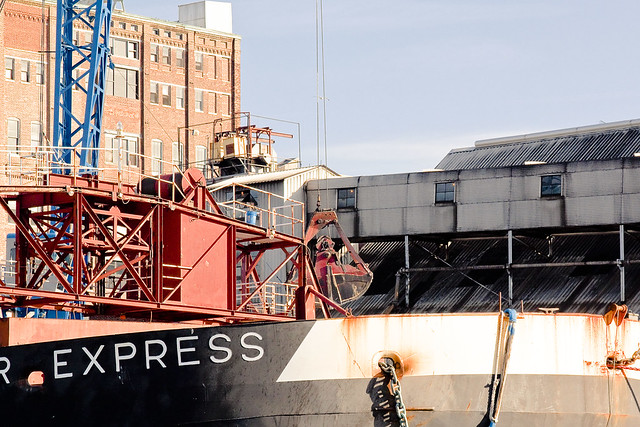
The tug Heron was present, tending to a barge labeled “Sugar Express”. Heron is middle aged, like myself, and has gone by several different aliases during its long career- unlike myself.
A surprising observation for me was that the raw product was being unloaded from the barge in the same manner that one would unload rock or gravel.
Built in 1968, by McDermott Shipyard of Morgan City, Louisiana (hull #151) as the tug Progreso .
In 1972, the tug was acquired by Dixie Carriers where she was renamed as the Dixie Progress .
In 2002, she was acquired by Allied Transportation of Norfolk, Virginia where she was renamed as the Heron.

– photo by Mitch Waxman
The industrial process of sugar refining uses powerful acids to purify and process the sweet stuff, and in 2005 the plant came under the scrutiny of regulators when it was revealed that they had released a large quantity of powerful acid into the water.
As with everything else in our world, it seems that nature must pay a price for our desires, even when it’s just a teaspoon of sugar to help the medicine go down.
from sawmillrivercoalition.org
In January 2005, American Sugar Refining Inc., a company that produces sugar for Domino Sugar and located on the Saw Mill River, pled guilty to a criminal pollution charge for spilling hydrochloric acid into the Hudson River in Yonkers in 2003.
corporeal presence

– photo by Mitch Waxman
Presented today are a few shots of a very common occurrence presented from a fairly uncommon point of view. The Amtrak train above is traveling down the Hudson toward Manhattan, approaching the Spuyten Duyvil bridge, and the vantage point is onboard a small boat bobbing around in the river.
From Wikipedia
The Spuyten Duyvil Bridge is a swing bridge that carries Amtrak’s Empire Corridor line across the Spuyten Duyvil Creek between Manhattan and the Bronx, in New York City. The bridge is located at the northern tip of Manhattan where the Spuyten Duyvil Creek meets the Hudson River, approximately 1,000 feet (300 m) to the west of the Henry Hudson Bridge. It was built to carry two tracks, but now carries only a single track on the east side of the bridge.
A wooden railroad bridge across the Spuyten Duyvil was first constructed by the New York & Hudson River Railroad in 1849. The current steel bridge was designed by Robert Giles and constructed in 1900; the piers rest on pile foundations in the riverbed. Trains stopped running across the bridge in 1982 and the following year the bridge was damaged by a vessel and left stuck in the open position.

– photo by Mitch Waxman
Amtrak runs a passenger line down the Hudson River which occupies a historic corridor of tracks. As is Newtown Pentacle policy on the subject, your humble narrator freely admits to “don’t know much more than squat” status about the rail system, but the Spuyten Duyvil bridge seems to have suffered a lot of bad luck over the years.
From Wikipedia
Spuyten Duyvil Creek (pronounced /ˈspaɪtən ˈdaɪvəl/) is a channel connecting the Hudson River to the Harlem River Ship Canal, and on to the Harlem River in New York City, separating the island of Manhattan from the Bronx and the rest of the mainland. The neighborhood named Spuyten Duyvil lies to the north of the creek.
Spuyten Duyvil Creek originally flowed north of Manhattan’s Marble Hill. The construction of the Harlem River Ship Canal to the south of the neighborhood in 1895 turned Marble Hill into an island, and in 1914, when the original creekbed was filled in, Marble Hill became physically attached to the Bronx, though it remains part of the borough of Manhattan.
Another realignment of the creek occurred in the 1930s, to the west of the original realignment. This had the opposite effect: It separated a portion of the Bronx and resulted in its attachment to Manhattan as a small peninsula where the Inwood Hill Park Nature Center is now situated.
“Spuyten Duyvil” literally means “Devil’s Spout” or Spuitende Duivel in Dutch; a reference to the strong and wild currents found at that location.

– photo by Mitch Waxman
Several times have I encountered the rumors that these tracks are haunted, in both modern and historical accounts. A long history of tragedy, including a ghoulish 1882 collision, seems to be associated with this place. Fires, maritime and vehicular accidents, pedestrians crossing the tracks being struck, even the weather has nearly done this bridge in more than once. There were sightings of spectral locomotives in the 19th century along this stretch (and all up and down the tracks between here and Albany as well).
There has been much speculation concerning the origin of the name “Spuyten Duyvil.” Dutch in origin, Spuyten Duyvil can be translated in two ways, depending on the pronunciation. One translation is “Devil’s whirlpool,” and indeed, sections of the creek were sometimes turbulent during high tide. The second interpretation is “to spite the Devil.” This translation was popularized by Washington Irving’s story in which a Dutch trumpeter vowed to swim across the turbulent creek during the British attack on New Amsterdam “en spijt den Duyvil (in spite of the Devil).”

– photo by Mitch Waxman
Practical, private, and stern- the iron visage of the laborers who captain these locomotives do not discuss such frivolous subjects with outsiders, and instead focus on craft and profession. It is a sad thing to see the rich folklore of the rails fade away from the American mind, since these were once the miracle machines of “progress”.
You don’t hear kids talking about “John Henry” or “Casey Jones” anymore, for instance, or threaten their parents with jumping onto a passing train and living life as a “Hobo“.
From Wikipedia
The National Railroad Passenger Corporation, doing business as Amtrak (reporting mark AMTK), is a government-owned corporation that was organized on May 1, 1971, to provide intercity passenger train service in the United States. “Amtrak” is a portmanteau of the words “America” and “track”.It is headquartered at Union Station in Washington, D.C.
All of Amtrak’s preferred stock is owned by the U.S. federal government. The members of its board of directors are appointed by the President of the United States and are subject to confirmation by the United States Senate. Common stock was issued in 1971 to railroads that contributed capital and equipment; these shares convey almost no benefits but their current holders declined a 2002 buy-out offer by Amtrak.

– photo by Mitch Waxman
Folkloric to the generations of the latter 19th century, rail offers up some of the greatest stories. Here’s a couple:
Express Train to Hell, Lincoln Death Train.
From Wikipedia
With primarily passenger services, the Northeast Corridor is a cooperative venture between Amtrak and various state agencies. Amtrak owns the track between Washington and New Rochelle, New York, a northern suburb of New York City. The segment from New Rochelle to New Haven is owned by the states of New York and Connecticut; Metro-North Railroad commuter trains operate on this segment. North of New Haven, ownership again reverts to Amtrak, whose tracks stretch to the border between Rhode Island and Massachusetts. The final segment from the border north to Boston is owned by the Commonwealth of Massachusetts.
Under Amtrak’s ownership, the Northeast Corridor suffered from several high-profile electric-power failures in 2006 and other infrastructure problems. Intermittent power outages caused delays of up to five hours for Amtrak and commuter trains. Railroad officials have blamed Amtrak’s funding woes for the deterioration of the track and power supply infrastructure, which in places is almost a hundred years old.
Amtrak owns Pennsylvania Station in New York, 30th Street Station in Philadelphia, Pennsylvania Station in Baltimore, and Union Station in Washington.

– photo by Mitch Waxman
Passenger service is remarkably unexciting, of course, what you want to see are long chains of variegated freight cars hauling lumber and coal and who know what else beneath a stretching trail of steam and smoke painted across the sky. Unfortunately, New York isn’t in that kind of business anymore.
From Wikipedia
The tale of how Spuyten Duyvil got its name is said to be that Peter Stuyvesant, then Governor of New Amsterdam, got wind that the British Navy was going to invade the city. He dispatched Anthony Van Corlaer, to ride up to the northernmost point of Manhattan Island and blow his trumpet, a common means of summoning the people. As he neared the shores where the Hudson meets the Harlem River, Van Corlaer couldn’t cross. It was a stormy evening when he arrived at the upper end of the island, and as no ferryman was available he vowed to swim across the river “in spite of the devil” (Dutch: “in spuyt den duyvil”). Halfway across, legend has it that the devil pulled Van Corlaer under, and while he was able to escape his grasp, he was too tired to continue swimming and drowned there despite his escape. From then on, the little area in the Bronx where Van Corlaer would have come to shore is called Spuyten Duyvil.

– photo by Mitch Waxman
This is the first of several postings detailing certain sites and scenes which were observed along the Hudson, Harlem, and East Rivers on a brisk Saturday in the month of November. The small boat I was on is operated by the good folks at Riverkeeper and a hearty thanks is sent for both their good work and for allowing me to ride along on one of their regular patrols.
From Wikipedia
The P32AC-DM locomotive was developed for both Amtrak and Metro-North so it can operate on power generated either by the on-board diesel prime mover or a third rail electrification system at 750 volts direct current. The P32AC-DM is rated at 3,200 horsepower (2,390 kW), 2,900 horsepower (2,160 kW) when supplying HEP, and is geared for a maximum speed of 110 mph (177 km/h)
The Dual Mode P32AC-DM is unique not only because of its third-rail capability, but also because it is equipped with GE’s GEB15 AC (alternating current) traction motors, rather than DC (direct current) motors as used in the other subtypes. The type is confined to services operating from New York City, where diesel emissions through its two fully enclosed main terminals are prohibited. The P32AC-DM are seen only on Amtrak’s Empire Corridor between Penn Station and Buffalo, the Ethan Allen Express, Lake Shore Limited (New York section), Adirondack, and Maple Leaf services, and locomotive-hauled Metro-North Railroad commuter trains to and from Grand Central Terminal. Metro-North Railroad Genesis locomotives have an escape hatch in the nose.
The Amtrak model third-rail shoes are for use on the over-running third-rail in Pennsylvania Station and the Metro-North Model are for under-running third-rail in Grand Central Terminal.

– photo by Mitch Waxman
A proper historical workup of the bridge, with the patented Newtown Pentacle multi view technology in place, will be forthcoming at some point in the future. You’d be doing your inner geek a disservice by not clicking on the diagram rich PDF linked to below.
an in depth analysis of this bridge (with diagrams, plans, and detailed engineering), and the herculean task of maintaining it, can be found in this 2004 PDF at arema.org
The bridge was originally constructed in 1899 by the King Bridge Company for the New York Central Railroad, and served for many years as a key link for freight delivery by rail to the west side of New Y ork City’ s main borough of Manhattan. Freight rail service to Manhattan dwindled in the years after World War II, but continued through the takeover of the line by Conrail in the 1970s, and into the 1980s. In the 1980s, Conrail discontinued all service on the line. Amtrak acquired rights to the line and initiated a program to start passenger service on the line.
The Second… Welcome to Newtown Creek…

– photo by Mitch Waxman
Join me on two Newtown Creek boat tours, both on October 23rd, 2011. I’ll be your tour guide, narrating humbly.
These tours are the co production of the Working Harbor Committee and the Newtown Creek Alliance made possible by funding from the NYCEF Newtown Creek Fund of the Hudson River Foundation. Accordingly, the tours will be heavily discounted, and tickets will cost only $10.
Made possible by funding from the NYCEF Newtown Creek Fund of the Hudson River Foundation

– photo by Mitch Waxman
Two tours are scheduled, both are two hours in length. The first will leave LIC at 10am sharp (returns at noon), the second is at 1pm (returns at 3). A constellation of speakers will be onboard, including your humble narrator, who will be serving as Tour Chairman and MC. We will be onboard vessels provided by NY Water Taxi, which are comfortable and climate controlled boats with great sound systems.

– photo by Mitch Waxman
Our anticipated itinerary will carry you from Hunters Point, and visit nearly all the communities of the Newtown Creek Watershed as we proceed east through Greenpoint, LIC, Blissville, Maspeth, Ridgewood, and finally East Williamsburg when we proceed all the way back to the Metropolitan Avenue Bridge.
Literally a once in a lifetime opportunity, you are invited to come and experience Newtown Creek (for an insubstantial fee- only ten bucks) and I’m hoping to see you onboard.

– photo by Mitch Waxman
As you’d imagine, tickets are going to sell out fast at this price, so please order your tickets expeditiously. An incredible amount of planning has gone into this endeavor, and your ticket price includes a free 8 page booklet describing certain facts and facets of what you will be experiencing onboard. Newtown Creek, from the water, is one of the most incredible sights in New York City and you have never seen anything like it.


 The Newtown Pentacle