Posts Tagged ‘Long Island City’
broad roofs

– photo by Mitch Waxman
On of the many corporate giants which distinguished Long Island City (at the start of the last century) was known as Waldes Koh-I-Noor. Located at the corner of Anable Avenue and Creek Street (which is the modern day 27th street and Austell Pl.), the firm was a manufacturer of dress fasteners (snaps, zippers and the like) and was known to produce all sorts of metallic devices- including war munitions, apparently.
from google books
Henry Waldes New York has leased the factory of the Klndel Bed Co Anable Avenue and Creek Street Long Island City NY comprising a four story reinforced concrete structure for the establishment of a new plant for the manufacture of small metal specialties The lease is for a term of years and aggregates $350,000

– photo courtesy google books, from: Queens Borough, New York City, 1910-1920: The Borough of Homes and Industry
A large employer, the building they were housed in is actually a complex of structures which had a rail spar leading to it. Not to be confused with the mechanical pencil manufacturers, or the legendary diamond which the company named itself after, this was an international company which had to end its operations in Europe because of the Nazi witch hunt for members of the Jewish faith.
from google books
STATEMENT OF WALDES & CO INC LONG ISLAND CITY NY The undersigned is the largest manufacturer of snap fasteners in the world and since 1918 have been established in the United States our plant being located at Long Island City NY. The original factory is located at Prague Czechoslovakia which employs about 4,000 men while our American plant now employs from 150 to 200 men Both these factories are equipped with up to date machinery and each one produces the same finely finished metal snap fasteners These fasteners are made either bright finish or enameled Our system of manufacturing and the articles themselves are our own inventions protected by patents by nearly every country.

– photo by Mitch Waxman
The structure survives, and like many of the gargantuan factories which distinguish the Long Island City landscape, it has been subdivided amongst several smaller tenants in modernity. Part of the building is used an NYPD impounded property facility, another section is used by a doggy day care company.

– photo by Mitch Waxman
From what I’ve been able to discern, the company remained in Waldes family tender for most of the 20th century, and seems to have been dissolved sometime in the latter third. There are literally hundreds of extant patents which were established by both the family and its enormous staff.

– photo by Mitch Waxman
References in historic records describe a late in the game shift to tool and die manufacture, no doubt to exploit this catalogue of patents. The Sears catalog business carried several of their milliners supplies, and I’m told that they innovated the all plastic zippers which came into vogue during the second world war and beyond, largely due to metals shortages.
from nytimes.com
Harry K. Waldes, chairman of the board of Waldes Kohinoor Inc. in Long Island City, Queens, died Tuesday in North Shore University Hospital, Manhasset, L.I., after suffering a stroke. He was 73 years old and a resident of Great Neck, L.I.
Mr. Waldes became executive vice president of the concern, which manufactures fastening devices and tools, in 1950.
He was named board chairman in 1961.

– photo courtesy google books, from: Queens Borough, New York City, 1910-1920: The Borough of Homes and Industry
Local realtors found it a devilish proposition, selling the large structure well after the golden age of American manufacturing had passed, and it was Pinnacle Realty who came up with the notion of subdividing the structure and leasing it piecemeal. Pinnacle is still a familiar name in LIC realty circles today.
from pinnaclereny.com
As the exclusive agent for the 100 year old Waldes Kohinoor Company located in Long Island City; Gary came up with the concept that the parts are worth more than the whole. Early in the marketing campaign Gary focused on selling the 3 buildings totaling 200,000 sq. ft. plus 50,000 sq.ft. of land to a single developer. He was disappointed with the offers being submitted by developers. However, if the property was sold off as 4 separate parcels millions of dollars in additional proceeds for ownership could be generated. The strategy worked extremely well and the Waldes Kohinoor ownership was very satisfied with the results.
oily river

– photo by Mitch Waxman
Recently witnessed, the Reinauer Towing tugboat Matthew Tibbets maneuvering a fuel barge through the languid expanse of the legend choked Newtown Creek.
Just a short one today, still playing catch up from a recent bout with some unknown and untrammeled organism, which is best thought of as some mere virus.
pest gulfs

– photo by Mitch Waxman
Not too long ago, I was crossing an intersection in Long Island City, one which is overtly familiar, and I noticed something which has eluded my interests in the past. At Hunters Point Avenue (which is officially 47th avenue in this decadent age) and 27th street, the sewers bear an interesting screed.

– photo by Mitch Waxman
There was recently a sizable road repair in this spot, perhaps in 2008 or 09, one which cut away the street surface. Observation revealed that the waters of Dutch Kills flow beneath a sort of concrete deck, which appears to be the foundations of the surface street, a structure which sits upon wooden piles.
It must have been around the time of this project that these grates showed up.

– photo by Mitch Waxman
“Dump no waste, drains to waterways” is the motto embossed on the curb surface. What this means, to me at least, is that snowmelt and rain goes directly (and untreated) into the nearest open water- which would be the Dutch Kills tributary of the fabled Newtown Creek.
Just in case you think that this is not a big deal, this is an enormously well travelled intersection with a UPS depot on the opposite corner and one which provides a “short cut” for trucks employed by the Fresh Direct facility on Borden Avenue (amongst others, of course). That’s two very large fleets of trucks.
Trucks are notoriously “drippy” and their exhaust paints the pavement with diesel petroleum residue, all of which flows into the water.

– photo by Mitch Waxman
Another drop in the bucket, you might say, as far the Newtown Creek Watershed goes.
Even so, it’s odd that untreated wastewater is allowed to flow directly into this waterway, already a largely anaerobic place where no fish of similar size might survive long.
gangrenous glare

– photo by Mitch Waxman
Just a short one today, as your humble narrator has recently been laid low by some unknown virus for the last week, and frankly- all I can manage in this state of epidemic weakness and fatigue is another of the “now and then” posts.
Doubt exists in my mind as to the exact location of the shot below, but there were several improvements made to the elevated line on Queens Blvd. over the years, some of which were due to the lengthening of the platforms to accommodate IND as well as IRT to facilitate system wide access to the World’s Fair at what is now Flushing Meadow Corona Park.
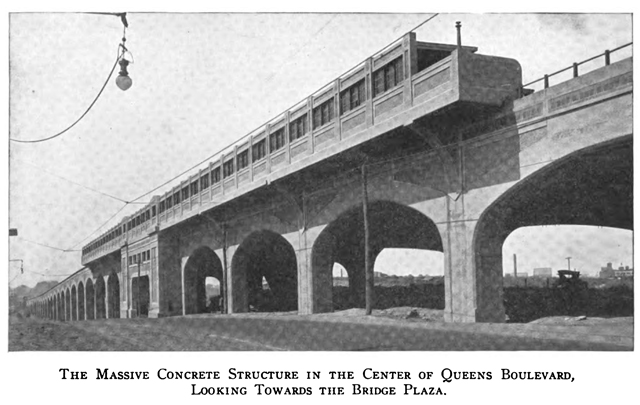
– photo courtesy google books, from: Queens Borough, New York City, 1910-1920: The Borough of Homes and Industry
This very well might be the 46th street station in Sunnyside… but I’ll also point out that the Chrysler Building is missing as well.
Project Firebox 27

– photo by Mitch Waxman
On Ninth Street in Ravenswood lurks this minaret of scarlet assurance, a lonely and stalwart island of municipal succor in an dark and industrial sea of factory and warehouses. Curiously noble, it stands astride 35th Avenue.


 The Newtown Pentacle