Posts Tagged ‘Manhattan’
forbidden tithing
Rhapsodic ecstasy, that’s what it’s all about.

– photo by Mitch Waxman
Just the other day, a humble narrator needed to get to the financial district in Lower Manhattan and soon found himself in hell’s third circle, which is my pet name for the 59/Lex subway interchange. Hell’s ninth circle, where you’ll find Satan chewing on Judas Iscariot, is the 34th street Herald Square complex – in case you were wondering (that’s why it’s always ninety degrees in there, even during the winter, as it’s literally a portal to hell.) If you’re a Queensican, however, there really is no way to avoid the third circle. My habit is to ignore the wailing desires of those ghastly entities who run the system found below, and not ride the local R line from Astoria all the way to lower Manhattan. Instead, a quick transfer to the Lexington line express is accomplished, which gets me to lower Manhattan in short order. The former journey, using the oft delayed Broadway line local service can take up to an hour, whereas my composited route and transfer only takes about a half hour.
The “A” in MTA is for “adventure,” lords and ladies, so live a little and transfer often. The less time spent in the sweating concrete bunkers below the better, I say. Also, take MTA’s route suggestions for what they are, and be nimble. Dante had Virgil, you’re stuck with me.
– photo by Mitch Waxman
My preference would have been to take a ferry, but the United Nations General Assembly was underway, and the Coast Guard had interrupted service due to security concerns. Given that I had to go “adventuring” through the circles of Hell, I padded out my time of arrival in Lower Manhattan. My obligation was to do a short talk about Newtown Creek for a group of esthetes and intellectuals, which is a task gladly embraced. Unfortunately, it involved the chore of going into the City.
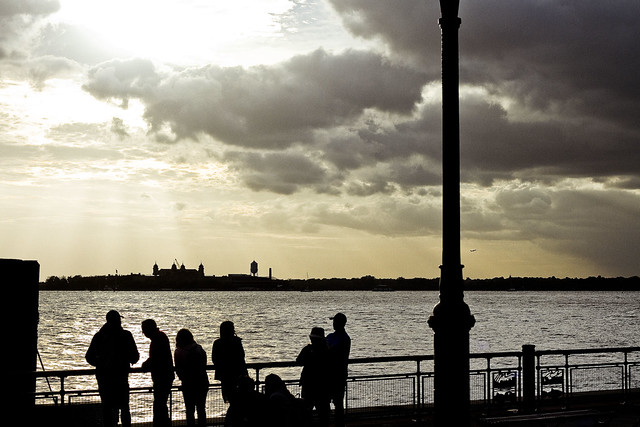
Since I had arrived about forty five minutes ahead of my scheduled arrival time, a short walk about Battery Park and Castle Clinton ensued. The weather has been absolute junk for what seems like weeks now, but all that atmospheric activity has at least been producing dramatic and enigmatic skies.

– photo by Mitch Waxman
A quiet weekend is ahead for a humble narrator, during which I hope to be brandishing the camera about. Monday the 1st is an “Infrastructure Creek” walking tour I’ll be conducting for Atlas Obscura (ticketing link below). On Thursday, I have an actual adventure scheduled, which will unfortunately mean that I have to repeat my journey through the Third Circle at something like seven in the morning… but as mentioned – the “A” in MTA is, in fact, for “adventure.”
There’s also a couple of big projects I’m working on at the moment, as a note, which I’ll let y’all know about next month.
Upcoming Tours and Events
Monday, October 1st, 6:30 p.m. – Infrastructure Creek – with Atlas Obscura.
Join Newtown Creek Alliance Historian Mitch Waxman as he leads an exploration of the city’s largest sewer plant, tunnels, draw and truss bridges, rail yards, and a highway that carries 32 million vehicle-trips a year over flowing water.
Tix and more details here.
“follow” me on Twitter- @newtownpentacle
academic alienists
Something fishy going on?

– photo by Mitch Waxman
A humble narrator is taking a break this week, and single images will be greeting you sans the verbose drivel they’re normally accompanied by. It’s a rather busy week that I have ahead of me, but look for a strange old man wandering about the concrete devastations of the Newtown Creek with a camera. That’ll likely be me.
Tours and Events
Dutch Kills Dérive. Free!
Saturday, September 8, 2018, 9:30 AM – 12:30 PM with Flux Factory
Drowning in our own muck and mire, modern society must transmute its existence into that of an allegorical baptism in order to emerge a society of water protectors. The historic facts of exactly how our civilization has transformed the historic Dutch Kill waterway into a sewershed will act as both a numbing analgesic and a point of illumination. Tickets here.
“follow” me on Twitter- @newtownpentacle
euclidian anomalies
Just another day in Paradise.

– photo by Mitch Waxman
One has been using the current air conditioned hermitage in pursuit of learning a few things completely unrelated to anything relevant to my life or the modern world, specifically the emergence and early history of modern humans. I haven’t been deep diving into this, mind you, it’s been watching a few BBC and PBS documentaries which have led me to some do some reading on the subject. My interest in this boils down, ultimately, to folkloric inheritances. Every culture on the planet tells their children stories about wild men who live in the woods, mountains, deserts – the “Bogie” or “Boogie” man who will kidnap a petulant or disobedient child and carry them off. These boogie men are usually large, muscular, possessed of ape like dentition, and hairy. I’ve often wondered if these boogie monsters are apocryphal remembrances of the days when our specie had competition from other hominids – Neanderthals, Homo Erectus, etc. Both of these other hominid specie, in a straight up fist fight, would clean even an MMA champion’s clock. They were stronger and faster than Homo Sapiens, on an anatomical level, based on observation of skeletal muscle attachment sites. Home Erectus, for instance, was a long distance runner with an incredible olfactory system.
The general scientific consensus states that since our specie had the capacity for language and long memory, we were able to plan into the future better than our competition. This allowed our ancestors to organize, pass the organization down from one generation to the next, and this eventually out competed the other hominids in the quest to hunt game and eventually led to the sort of agriculture that modern day “indigineous” people’s practice in jungle and forest settings. Neanderthal anatomy, in terms of their ability to conceptualize and then throw a spear or some other projectile, seems to have been similar to our own. Erectus, alternatively, was anatomically unable to throw a spear but would have been able to rip a modern human to shreds in close quarters combat with their bare hands.

– photo by Mitch Waxman
Analogizing historical equivalencies is often required when discussing human history. As I often say – if you were a space alien who arrived in orbit at one point in history or another, and were asked to bet which culture which end up dominating the rest of the human hive, you’d almost certainly lose your wager. If it was during “biblical times” 5,000 years ago you’d have bet on the African cultures centered around the Nile Valley, or the Asian ones centered around either the Yangtze or Ganges rivers. A thousand years ago, you’d have probably placed your bets around the middle eastern cultures centered around the Tigris or Jordan River valleys. 500 years ago, it would have been the industrializing Rhine or Seine. For the last century, it’s the Missisippi and Hudson River valley cultures that seem to be the dominar, but it certainly looks like the Yangtze culture is making a comeback. Oddly enough, anatomically primitive hominids like Erectus seem to have persisted in Asia longer and later than originally thought, as late at 30,000 years ago.
Again, speaking from a folkloric point of view, every culture has legends of hulking brutes lurking in the woods ready to carry off disobedient children. There are certain commonalities in all of the legends and religious traditions – the omniscient sky father, the earth mother, the untamable horned adversary, and the wild men of the woods.

– photo by Mitch Waxman
An interesting point of view offered in a BBC documentary of the history of Wales which I encountered offered an intriguing bit of logic. As westerners, our thought patterns are decidedly non metaphorical and quite literal. If you’re discussing the legends of King Arthur “pulling the sword from the stone” it’s literally interpreted as “there’s a forged sword stuck in a stone.” The historians who wrote this particular documentary instead pointed out that Druidic cultures were quite poetic in their speech patterns, and spoke in metaphor. Their supposition was that in pre modern Britain, early Iron Age cultures got their raw material out of the bogs – bog iron as it was called. That limited supply, and the iron found in bogs wasn’t forged, instead it was merely shaped. The “pull the sword from the stone” legend emerged shortly after the Romans vacated Britain, and the theory is that the legend referred to harvesting iron from ore and forging it into swords, rather than the more familiar imagery of a young Arthur removing Uther Pendragon’s fully formed magick sword from a boulder. Literally “pulling” the “sword” from the “stone.”
One wonders about the folkloric inheritances and associations of the “other” which are encoded in modern cultures, and the predilection towards “racism” that culture displays. Racists often use language describing the subjects of their ire as “monkeys, savages, primitives, or apes,” intoning a subhuman character to those they dislike. Such childish preoccupation with the primeval Boogie Man, Sky Father, Earth Mother, or fear of the Horned God is fascinating to me and I often wonder how much of it is and unspoken inheritance from the days when there were actual “others.”
“follow” me on Twitter- @newtownpentacle
malignly silent
Hudson Yards vs. Sunnyside Yards, what’s the difference?

– photo by Mitch Waxman
Last week I was invited to speak to a group of architecture students about the Sunnyside Yards. Part of the presentation involved discussion of the Hudson Yards project over in Manhattan, and how it can provide a model for development of the Sunnyside Yard. This is a false equivalency being offered by the powers that be, for a variety of reasons. The first and foremost thing to mention is that the Hudson Yards sit over an outcropping of Manhattan Schist and Gneiss, which provides for a stable underpinning for mega towers. Foundations are somewhat important, my engineer friends tell me, and the Sunnyside Yards sits on a compacted pile of clay and sand which until quite recently (1909) was a swamp.
Actual rock underpinnings on the northwestern side of a certain Long Island are absent west of Maspeth. If you find yourself in Maspeth, look west at what would appear to be a soup bowl, formed by elluvial deposits left behind by post glacial flooding. The piles which the mega developments of Long Island City sit upon are thus more numerous, and driven far deeper, than those in Manhattan which is technically a ridge of igneous rock. Soil conditions can be “engineered around” of course, since – theoretically speaking – if you possess enough money and technical acumen, you could build a ladder to the Moon if you wanted to. It’s just not practical to build a ladder to the moon, but since when does practical consideration get in the way of our Mayor’s political calculus.

– photo by Mitch Waxman
Hudson Yards was a challenge to the construction and engineering crowd, but a staightforward one inasmuch as the trackage leading out of Penn Station is arranged in parallels as you’ll notice in the shot above. What that means, from a decking perspective, is that you can set out the beams and columns needed to support the above ground structure at regular intervals and you’re essentially constructing a grandiose table or bench supported by multiple legs. The main problem they experienced was how to coordinate the movement of equipment in the cramped quarters of Manhattan.
Sunnyside Yards is defined by a convoluted series of intertwined rights of way which criss cross each other. Some of them, like the “balloon,” or turnaround, track travel over sweeping arches to switches which feed into either tunnels or holding tracks. You’ve even got the busiest railway switch in the entire country in there, the Harold Interlocking. Sunnyside Yards is complicated, and is already the eastern focal point of the largest capital project in the United States – the long delayed and vastly over budget East Side Access project which will allow Long Island Railroad access to Grand Central Terminal via LIC.
Why is it so over budget and so delayed, you ask? Because the MTA didn’t take into account the presence of buried waterways around and in the Sunnyside Yards (which was a big part of the Pennsyvania Railroad’s construction efforts a century ago), which any Queens historian can tell you are the buried remnants of Newtown Creek’s Dutch Kills tributary, and which once flowed to modern day Jackson Avenue and 29th street. Why do you think that section of LIC was called “Dutch Kills,” since it wasn’t named that for shits and giggles?

– photo by Mitch Waxman
The parallel nature of the tracks at Hudson Yards allowed for the usage of an esoteric bit of kit called a Beam Launcher, pictured above. The Beam Launcher facilitated the placement of the deck’s supporting beams onto concrete foundation from above, literally lowering them into place from above. The big yellow thing above is the Beam Launcher, which was about 3/4 the length of a Manhattan block. Steel beams were unloaded from trucks, which in some cases were loaded up from barges, brought to the job site, and then manipulated into position.
The beam launcher dealie is described in some detail, in this post from 2014.
“follow” me on Twitter- @newtownpentacle
nightmare phrase
Midtown, Manhattan.

– photo by Mitch Waxman
A humble narrator is taking a short break this week, and you’ll be greeted with single shots when visiting this – your Newtown Pentacle. Trust that I’m out and about gathering new tales to tell and photographs to display.
Upcoming Tours and Events
June 9th – Exploring Long Island City – with NY Adventure Club.
Long Island City is a tale of two cities; one filled with glittering water-front skyscrapers and manicured parks, and the other, a highly active ground transportation & distribution zone vital to the New York economy — which will prevail?
Tickets and more details here.
“follow” me on Twitter- @newtownpentacle


 The Newtown Pentacle