Posts Tagged ‘Manhattan’
dream breeding

– photo by Mitch Waxman
The Working Harbor Committee will be presenting the annual Tugboat Race this Sunday, and I hope you’ll be able to make it. The shots in this post are from last year’s race, which I had the privilege of attending.
This is a rare opportunity, from a photographic point of view, to witness this sort of thing. Dynamic, colorful, quick moving- a challenge.
from workingharbor.com
19th Annual Great North River Tugboat Race and Competition Set for Sunday, September 4
Hudson River Park Pier 84 at West 44th Street, Manhattan – 9:30 a.m. – 2 p.m.
Events include a tugboat parade, a mile-long tug race, nose-to-nose pushing contests, line-throwing, spinach-eating and tattoo competitions.
Best viewing is from a Circle Line spectator boat that will follow the on-the-water action.
Good viewing from shore along the West Side riverfront, at Pier 84 and at the Intrepid Museum pier.

– photo by Mitch Waxman
To attend the race, one must simply show up at the pier and enjoy, however the best views (and photos) will be available form the Circle Line observer boat which will labor to keep up with the fleet of contestants. Details on ticketing for the Circle Line boat appear at the bottom of this posting.
Note: As a disclaimer, I’m a member of Working Harbor Committee, but strictly as a volunteer (It’s a non profit organization and I receive zero proceeds for promoting the event).
also from workingharbor.com
Schedule of Events – Sunday, September 4, 2011
- 9:30 a.m. – Spectator Boat departs Pier 83 (boarding begins at 9 a.m.)
- 10 a.m. – Tugboat parade heads north from Pier 84
- 10:30 a.m. – Race begins off Pier i at 70th Street and the Hudson River
- 10:45 a.m. (and earlier) Tugs cross the finish line at Pier 84
- 11 a.m. to noon – Nose-to-nose pushing contests and line-toss competition off Pier 84
- 11:30 a.m. Spectator boat returns to Pier 83
- Noon to 1 p.m. -Tugboats and crews gather for lunch at Pier 84; public is invited to participate in spinach-eating contest and amateur line-toss and knot-tying events
- 1 p.m. – Crew tattoo contest and awards ceremony
- Public Transportation: Any subway to 42nd Street, westbound 42nd Street crosstown bus to the last stop.

– photo by Mitch Waxman
Working Harbor comes up a lot here at Newtown Pentacle, whether it be in the context of the Newtown Creek boat tours or the many “Hidden Harbor” trips which they produce. What doesn’t get mentioned that much are the groups many efforts at promoting and revealing the harbor as a career choice for kids from the inner city, it’s annual Senior Tours (produced in conjunction with the offices of the Borough President of Manhattan) which offer a free day on the water to senior citizens, and a host of smaller events which go largely unsung.
They’re a good bunch of joes.
also from workingharbor.com
New York, New York, August 30, 2011: The Great North River Tugboat Race and Competition-one of New York City’s most popular Labor Day weekend events-returns for the 19th year on Sunday, September 4.
More than a dozen tugboats, the maritime 18-wheelers that normally dock ships and push barges, will thunder down the Hudson River Sunday morning as they vie to be named the fastest boat in their class.
The race, on a one-nautical-mile Hudson River course that extends from about West 70th to West 44th Streets, typically draws thousands of spectators, some watching from shore; others getting right in the middle of the action aboard a Circle Line spectator boat that travels alongside the tugs.
This year, tugs will range from 100-foot, state-of-the art 5,000-horsepower workhorses to a 25-foot, 200 horsepower workboat, named The Bronx, to a century-old harbor tug, now a museum ship, named Pegasus. Working boats from many of New York Harbor’s major towing companies will also complete, including tugs from McAllister Towing and Transportation, Miller’s Launch and Donjon Marine. A handicap system will give smaller and less powerful boats a chance to win trophies.
The race typically draws thousands to the riverfront, which is one of the reasons the tug companies enjoy participating. “New Yorkers sometimes forget they are surrounded by water, and that there is a whole maritime industry working here. This tug competition is the one time a year people can really see what we do,” explained Craig Rising of McAllister Towing and Transportation, one of the largest and oldest tug companies in the country. It is also a field day for the tug crews, many of whom bring their families aboard.

– photo by Mitch Waxman
This is a great party on the Hudson, and a tremendous boost for the crews of the maritime tugs which seldom get a chance to show off their skills and incredible hardware to the public. In addition the race itself, there are “best maritime tattoo” and “spinach eating contests (Popeye brand spinach, natch)“.
Line throwing contests are scheduled, as well as nautical knot tying classes for kids. Family friendly, the event will be at Pier 84 (just south of the intrepid and just north of 42nd street), and the spectator boat will be boarding at the Circle Line pier at 42nd street and the Hudson River.
Hope to see you there.
also from workingharbor.com
The tug race spectator boat will be a Circle Line Sightseeing Boat. It will depart at 9:30 from Circle Line’s Pier 83 at 43rd Street and 12th Avenue (boarding will begin at 9 a.m.), and it will return at 11:30 a.m., so that passengers can walk just one block north to the events on Pier 84. Tickets are $30 adults; $25 for children under 14. Free for ages 4 and under. Tickets can be purchased in advance online at http://www.workingharbor.org or at the Working Harbor Committee tent on the north side of Pier 83 on the day of the event. Admission to the Pier 84 events is free.
The race is organized by the Working Harbor Committee, a not-for-profit organization dedicated to spreading the word about the rich history, current vitality and future potential of the New York/New Jersey Harbor. The organization also provides Hidden Harbor Tours® and runs an extensive youth educational program.
Full information is available at www.workingharbor.org.
Friends of Hudson River Park and Circle Line 42 are co-sponsors.
unnumbered crimes

– photo by Mitch Waxman
note: despite the title, this a “just the facts” brand posting
Cortlandt Alley is a vestigial connection between Franklin and Canal Streets in Manhattan, crossing White and Walker on its path. If it looks familiar, it should, as many commercial photographers utilize the location for its noir aesthetics and patois of urban decay. One may often observe a shoot going on here, a sharp contrast to the sort of lurid business which one might have seen on this street a mere twenty years ago (which discouraged the presence of cameras).
Today, my focus turns to an enigmatic structure on the corner of Walker Street and Cortlandt Alley.

– photo by Mitch Waxman
According to the best sources I could find, Walker Street was scratched onto the maps of New York sometime in 1810. Pavement came along in 1819, and by the 1870’s a street railway connected the area (via West Broadway) to the far distant East River. This was considered a near suburb in those hoary days of the early middle 19th century, and this was fairly close to if not the actual border of the Bloody Sixth Ward (I’ve seen conflicting accounts describing the borders of the 6th ward).
All accounts agree that this area, known as “Tribeca Historic District” in modernity, served the city as a mercantile center which took advantage of the ample docks on the nearby North (Hudson) River for the importation of foreign goods.

– photo by Mitch Waxman
The intriguing (and officially Landmarked) Latimer Building was raised sometime between 1860 and 1862 for developers Barret Ames and E.D. Hunter. Municipal sources indicate that it stands on land once occupied by a part of the legendary Florence’s Hotel, whose main address was on the confluence of the North side of Walker with Broadway. Supposition is also offered by these selfsame governmental entities that the “Latimer” indicated by the cornice art would have been a fellow named Edward Latimer, a SOHO merchant- although I haven’t been able to confirm this independently.

– photo by Mitch Waxman
The modern occupants of the building follow a historical pattern of tenancy by garment manufacturers, book publishers, and building trade jobbers. A “jobber” is a company or individual who imports and resells manufactured goods, and offers installation and delivery services for the materials they handle.

– photo by Mitch Waxman
Occupying 72-76 Walker Street, the Latimer is a relict and vestige of New York’s industrial past. Single floor factory operations and garment assembly shops- sweat shops as they were and are known- once provided occupation and employment for large numbers of immigrant poor. In my own family, certain individuals who enjoyed an exalted peer status and exhibited financial success were “pattern cutters” and “dock foremen” and employed nearby, while others (like my own grandmother) were “sewers”. One of my Aunts actually worked at Triangle Shirtwaist.
Back then, this was an overwhelmingly jewish industry. Modern day economics seems to favor the presence of Asian and Latino work forces, as the earlier ethnic laborers have moved on to explore other synergies.

– photo by Mitch Waxman
The Cortlandt Alley side of the Latimer exhibits the “fireproof window doors” once common in the days before sprinkler fire suppression systems became mandatory in such structures. Additionally, iron rails and reinforced concrete still extant point out that there was once a loading dock on the Alley side which has disappeared sometime in the intervening decades since the completion of the building in 1860. The fire escapes are a later addition, of course, which were mandated by the precursor of the FDNY sometime in the late 19th or early 20th centuries.

– photo by Mitch Waxman
The grand appearance of the building is somewhat muted at street level, and it blends into the dark melange of relict buildings and ancient tenements which typify the parts of Manhattan just North and West of “Chinatown”. The age of Walker Street is betrayed by not just by its narrow bed, but by belgian blocks bursting through modern asphalt and the occasional stone curbs which still line it.

– photo by Mitch Waxman
The charming ambience of the “old days” has rendered many of these former industrial spaces into mixed use buildings- and many of them are now the exclusive and dearly held apartments of millionaire dilettantes. According to one Forbes magazine report in 2006, this was the most expensive section of New York City in which one might seek domestic housing.
exceeding magnitude

– photo by Mitch Waxman
Recently, an invitation to attend a lecture offered by a prominent maritime scholar drew both myself and the Newtown Pentacle’s far eastern correspondent Armstrong to lower Manhattan. Early for the evenings presentation, we decided to wander aimlessly around the imposing edifices of the municipality and see what we could see. St. Andrew’s Roman Catholic Church drew attention to itself and since I had never visited the celebrated structure, we approached and entered the Georgian Revival church.
from wikipedia
The Church of St. Andrew is a Roman Catholic parish church in the Roman Catholic Archdiocese of New York, located at 20 Cardinal Hayes Place, Manhattan, New York City. It was established in 1842 and has been staffed by the Blessed Sacrament Fathers ever since.
In 1892, the address listed was on Duane Street, and the corner of City Hall Place.
The present building was erected in 1939 through a joint effort involving the famous Boston firm Maginnis & Walsh and Robert J. Reiley of New York. It is one of the best examples of the Georgian Revival architectural style in New York. St. Andrew is the only New York City church to be designed by Maginnis & Walsh.

– photo by Mitch Waxman
Subsequent antiquarian research revealed that the site was originally a “friends” or Universalist meeting house, and had been acquired by the then struggling Roman Catholics for use by the surging tide of congregants arriving into Manhattan, some from war ravaged southern Germany but most were arriving from famine stricken Ireland. The stately appliances and forbidding iconography of lower manhattan were not in place yet, and this neighborhood had an entirely different character. This was the worst slum on earth, more crowded than Bombay and twice as dangerous, according to Charles Dickens.
The Five Points and the infamous Old Bailey were nearby, the legendary Collect Pond was across the street, and despite Dagger John Hughes being a mere Bishop during this period- he had already seen the need for expansion.
from nycago.org
The Roman Catholic parish of St. Andrew was established in 1843 when Father Andrew Byrne transformed Carroll Hall into St. Andrew’s Church. Built in 1818 for the Congregational Society of United Christian Friends, Carroll Hall was, in 1841, the site where Catholics rallied to fight denial of public funding for parochial schools. Father Byrne was the pastor until 1844, when he was named the first bishop of the new Diocese of Little Rock, comprised of the entire State of Arkansas and all of the Indian Territory, and was consecrated that year in St. Patrick’s Cathedral. Cardinal Patrick J. Hayes, for whom the church’s street was renamed, was born in a house next door to St. Andrew’s Church, and was baptized here in 1867.
Tragedy struck the church in 1875 when, during a severe storm, the building next door collapsed, causing the ceiling of the church to drop onto 1,200 who were attending an evening mass during Lent. Many were killed or wounded, and a panic ensued because the main entrance of the church was locked.
In 1900, Father Luke J. Evers began a 2:30 am Mass for night workers who were employed in the nearby Printing House Square, where the Sun, Telegraph, Times, and World newspapers were then published. This tradition continued for more than 50 years, and the church became known as “The Printers’ Church.”

– photo by Mitch Waxman
St. Andrew, according to several variants and doctrinal versions, is meant to have been a disciple of John the Baptist and brother of the apostle (and church founder) Simon Peter. He’s the patron saint of Scotland, and of the Patriarchate of Constantinople. The X shaped device he bears is the instrument of his death by crucifixion, and the legends say that he pleaded with the Romans not to crucify him in the same manner as Jesus (as he was unworthy of the honor) so they used the X or Crux Decussata configuration instead of the T.
It should be pointed out that the Romans were not known for granting last requests in those days, and that this iconography emerged only in the late middle ages according to scholarly sources.
from A history of the churches, of all denominations, in the city of New York 1846, courtesy google books
St. Andrew’s Church.
In the year 1840, another Catholic Church was formed, called ” St. Andrew’s Church,” under the pastoral charge of the Rev. John Maginnis. A house of worship, originally built by a Universalist Society, situated on Duane street, near Chatham, was purchased, and here they remain.

– photo by Mitch Waxman
The interior of the church was staid and tasteful, and there were a couple of people praying so I kept to the side. There were beautiful confessional booths set into the walls, exquisitely carven and tastefully placed, but as the light was quite dim within the church – and not wanting to disturb the parishioners- I decided against setting up a tripod to do a long exposure shot.
The image above and below were gathered by merely laying my camera down on the pews instead to accomplish the long shutter speed’s need for stabilization.
There was a feeling of emptiness, a quiet void, within the building- it was the quietest corner of Lower Manhattan I’ve experienced to date. The thick walls and heavy doors insulated the place from all but the loudest exhalations of the constant outside tumult.
from A brief sketch of the early history of the Catholic Church on the island of New York, 1870, courtesy google books
The year 1841 was made famous in the history of Catholicity in New York by the agitation of the “School Question,” as it was called. Previous to that time, the public instruction had been in the hands of a close corporation, under the title of the Public School Society, which administered and distributed, according to its own good pleasure, the funds provided by the city for the purpose of education.
The books used in these schools abounded with the usual stereotyped falsehoods against the Catholic religion, and the fnost vexatious and open system of proselytism was carried on in them. The evil became finally so great, that no alternative was left for Catholic parents but either to prevent their children from attending the schools at all, or to cause an entire change to be made in the system; under the advice and active leadership of the Bishop, a systematic attempt was made to call the attention of the community and public authorities to the subject, and after a severe contest it resulted in the establishment of the present Common School system.
The Bishop delivered two lectures upon the subject in Carroll Hall, but one of the most triumphant defences of the principle contended for by the Catholics was made by him in a speech before the Common Council of New York, in which he replied to the arguments of Messrs. Ketchum and Sedgwick, who had been employed by the Public School Society as their counsel, and also to Dr. Bond, Dr. Spring, and others who had volunteered in its support.
Experience has since shown, however, that the nw system, though administered with as much impartiality and fairness as could be expected under the circumstances, is one which, as excluding all religious instruction, is most fatal to the moral and religious principles of our children, and makes it evident that our only resource is to establish schools of our own, where sound religious knowledge shall be imparted at the same time with secular instruction. If we needed any evidence upon the matter, it would be found in the conduct and behavior of those of our children who are educated under the Christian Brothers, when contrasted with those who are exposed to the pernicious influences of a public school.

– photo by Mitch Waxman
Dagger John Hughes, through no fault of his own, is the reason why education in the City of New York is both secular and overseen by a municipal agency. His determination to have anti Catholic rhetoric removed from the curricula of the Public School Society, and the controversy surrounding the issue, resulted in an 1842 decision by the State Government in Albany to form the Board of Education of the City of New York.
from Harper’s magazine, Volume 40 1870, courtesy google books
The Public School Society ceased to be the almoner of the public moneys.
Principle forbade that the State should become tributary to the hierarchy. Policy forbade that it should leave the grievances of the Church, real or imaginary, wholly unredressed. A middle course was adopted. Once, at least, in the history of legislation a compromise has resulted in the adoption of a permanent and beneficent principle.
A Board of Education was appointed for the city of New York.
All public funds were placed in their hands for distribution. The schools of the Public School Society were among those named in the act as entitled to share in the distribution of this fund. No school in which any religious sectarian doctrine or tenet should be taught might have the same privilege. Such, in a sentence, was the school law of 1842. For its existence the State owes an incalculable debt of gratitude to two ecclesiastics, either of whom would have bitterly opposed it to the last.
That the school system of New York city is a system, that education is no longer doled out as a charity to the poor, either by the Churches or by philanthropic societies, but is awarded to all, as a right, by the State, is due largely, if not chiefly, to the unintentional offices of Rev. Jonathan Chase and Archbishop Hughes, who succeeded in promoting the very legislation which they were most desirous to prevent.

– photo by Mitch Waxman
Anti Catholic bigotry is what Dagger John called it, and it was decided that the Catholic Church would need to set up its own schools- parochial schools- where Doctrine would be part and parcel of the lesson plan. Great Universities and thousands of schools would be founded within just a few years, but the soon to be Archbishop Hughes already had his gaze fixed upon his next great project.
A large parcel of land in Queens would be acquired to house the mortal remains of his ever expanding flock. This land- found along the Newtown Creek- he would consecrate it as his Calvary Cemetery.
from wikipedia
He was consecrated bishop on January 7, 1838 with the titular see of Basileopolis. He succeeded to the bishopric of the diocese of New York on December 20, 1842 and became an archbishop on July 19, 1850, when the diocese was elevated to the status of archdiocese.
Hughes, influenced by the reactionary stance of Pope Pius IX, was a staunch opponent of Abolitionism and the Free Soil movement. In 1850 he delivered an address entitled “The Decline of Protestantism and Its Causes,” in which he announced as the ambition of Roman Catholicism “to convert all Pagan nations, and all Protestant nations . . . Our mission [is] to convert the world—including the inhabitants of the United States—the people of the cities, and the people of the country . . . the Legislatures, the Senate, the Cabinet, the President, and all!”
He also campaigned actively on behalf of Irish immigrants, and attempted to secure state support for religious schools. He protested against the United States Government for using the King James Bible in public schools, claiming that it was an attack on Catholic constitutional rights of double taxation, because Catholics would need to pay taxes for public school and also pay for the private school to send their children, to avoid the Protestant translation of the Bible. When he failed to secure state support, he founded an independent Catholic school system which was taken into the Catholic Church’s core at the Third Plenary Council of Baltimore, 1884, which mandated that all Parishes have a parochial school and that all Catholic children be sent to those schools.
irrepassable gate
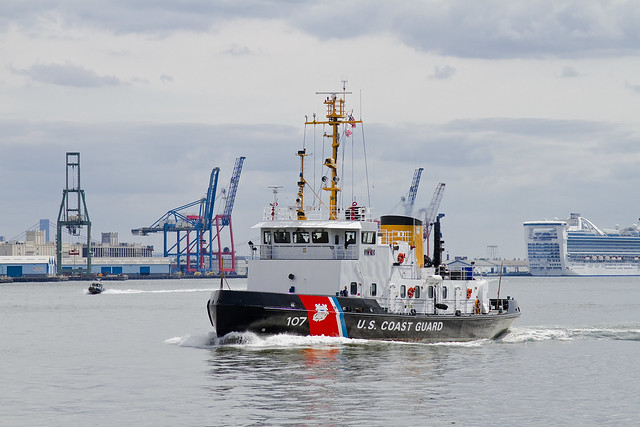
– photo by Mitch Waxman
Awhile back, I posted this series of shots to Flickr, and an enigmatic shipping enthusiast from the vast interweb hive mind immediately commented “140′ Bay Class Icebreaking Tug USCGC PENOBSCOT BAY WTGB-107 homeport Bayonne, NJ.”.
From wikipedia
The USCG Bay-class icebreaking tug is a class of 140-foot (43 m) icebreaking tugs of the United States Coast Guard, with hull numbers WTGB 101 through to WTGB 109.
They can proceed through fresh water ice up to 20 inches (51 cm) thick, and break ice up to 3 feet (0.91 m) thick, through ramming. These vessels are equipped with a system to lubricate their progress through the ice, by bubbling air through the hull.

– photo by Mitch Waxman
When focusing in on this ship, I just thought it looked cool. Turns out that this class of vessels has a long and storied past.
Here’s a Coast guard shot of Penobscot Bay in action during the winter…
Here’s the official story, courtesy United States Coast Guard:
from uscg.mil
The 140-foot Bay-class Cutters are state of the art icebreakers used primarily for domestic ice breaking duties. They are named after American Bays and are stationed mainly in Northeast U.S. and Great Lakes.
WTGBs use a low-pressure-air hull lubrication or bubbler system that forces air and water between the hull and ice. This system improves icebreaking capabilities by reducing resistance against the hull, reducing horsepower requirements

– photo by Mitch Waxman
Note: I should mention that members of the USCG have offered me very good, yet unofficial, advice on appropriate maritime footwear in the past- which may render some personal bias on my part for the organization.
The USCG also maintains a short history page on this ship, which can be accessed here.
mottled blossoms

– photo by Mitch Waxman
Continuing the “Grand walk” whose beginnings on the Lower East side of Manhattan at St. Patrick’s Old Cathedral were discussed in two prior postings… And as a note, the external shots of the Williamsburg Bridge were photographed on a separate occasion from the afore described narcoleptic perambulation and are included for the sake of “establishing shots”.
I quite obviously didn’t find myself bodily whirling around the Bridge, in the manner of a superhero.
from wikipedia
This bridge and the Manhattan Bridge are the only suspension bridges in New York City that still carry both automobile and rail traffic. In addition to this two-track rail line, connecting the New York City Subway’s BMT Nassau Street Line and BMT Jamaica Line, there were once two sets of trolley tracks.
The Brooklyn landing is between Grand Street and Broadway, which both had ferries at the time. The five ferry routes operated from these landings withered and went out of business by 1908.
The bridge has been under reconstruction since the 1980s, largely to repair damage caused by decades of deferred maintenance. The bridge was completely shut down to motor vehicle traffic and subway trains on April 12, 1988 after inspectors discovered severe corrosion in a floor beam. The cast iron stairway on the Manhattan side, and the steep ramp from Driggs Avenue on the Williamsburg side to the footwalks, were replaced to allow handicapped access in the 1990s.

– photo by Mitch Waxman
Oh- would that I had born capable of such superhuman feats- stronger, more robust of mind and spirit, and not incarnated as the least of men. Were it not my lot to disappoint, discourage, and disabuse myself of opportunities to please others. When I stare in the mirror, an assassin of joy gazes back. I’m all ‘effed up.
Unfortunately, when “one of my states” comes upon me, any notion or pretense I might have of manhood goes out the window and a screeching ape like coward inhabits my mind. Full conviction is evinced that were I magically transported back to the New York City which saw this bridge go up in 1903, I would be consumed by its inmates within minutes.
from nyc.gov
The Williamsburg Bridge has served New York for over 100 years, but in 1988, age, weather, traffic volume increases and deferred maintenance finally caught up with the Bridge and it had to be temporarily closed. At that time, a technical advisory committee formed to decide the fate of the Williamsburg Bridge proposed three options:
- Permanently close the bridge, which would shift traffic through local communities to one of the other already congested East River crossings.
- Build a new bridge, which require locating bridge approaches, possibly through the acquisition of stores and residences. Plus, the existing bridge would still require repairs while the new bridge was being built.
- Repair the existing bridge
Of those three options, the one with the least impact on drivers and local communities was the third. And in 1988, the decision was made to repair the Williamsburg Bridge while keeping it open. The Williamsburg Bridge Reconstruction Project is one of the most ambitious projects undertaken by the New York City Department of Transportation-Division of Bridges.

– photo by Mitch Waxman
The tales of the “Fin de siècle” “Lower East Side” and it’s counterpart communities in Brooklyn, as transmitted by doting grandparents who sought to conceal the darker side of things from their fat American born families, are lost to time.
The New York City of the late 19th and early 20th century was peopled by a specie of predators according to published anecdote and municipal statistic alike, a population hardened and formed by harsh experience and ill fortune. They didn’t emigrate to the United States, they escaped to America.
Routine physical hardship, sickness, and unfairness were their lot upon arriving, and the gentle mannerisms so common to the 21st century were a luxury few could afford.
from Handbook of cost data for contractors and engineers By Halbert Powers Gillette, 1910, courtesy google books
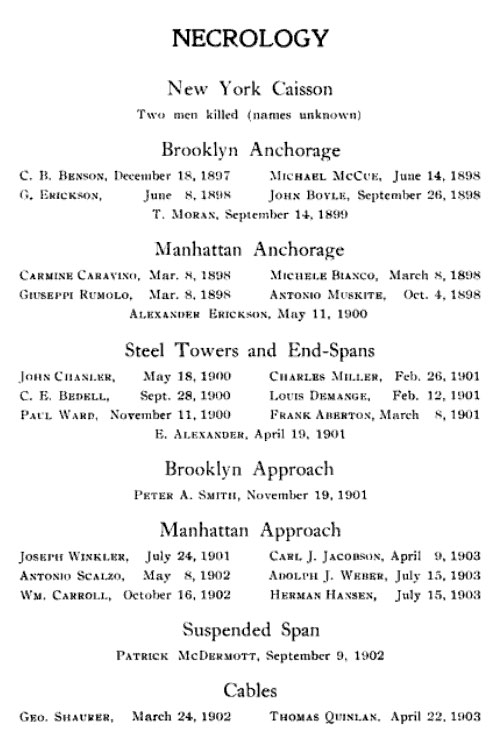
The work here described consisted of sinking two large caissons. 63 x 79 ft. In size on the Brooklyn side of the Williamsburg Bridge to bed rock. In one case 86 ft. and in the other 110 ft below mean high water, filling same with concrete and building masonry piers upon this foundation inside of coffer dams up to elevation plus 23 ft. above M. H. W. All work was done by contract during the years 1897 to 1899.
The caissons were constructed of yellow pine timber at the site of the work, launched, floated Into place and sunk to the river bottom, which was about 55 ft. below M. H. W., by filling them with concrete.
Compressed air was then turned on, and the caissons were sunk to bed rock. The material encountered, consisting of river mud, sand, clay and rock, was excavated either by means of Moran patent material locks or by wet blow out; finally the working chamber was filled with concrete. While the caissons were being sunk, the coffer dams, which were attached to the caissons, were added in order to keep their tops above water, and inside of these coffer dams the masonry piers were built. During the sinking process the masonry was built only In sufficient quantity to give the weight necessary for sinking the caissons. After the caissons were sealed and the air taken off. the shafting and piping were removed, the spaces occupied by them filled with concrete, and the pier carried up to Its final elevation. The coffer dams were then removed.

– photo by Mitch Waxman
The working people, whether they came from Sicilian village or the Jewish Shtetl, understood that America was a choice they made which would have to be lived with. There was no going back, at a time when the new political and economic theory called Capitalism could be best described as “predatory”.
The mills and factories were hellish, but reliably put bills to rest and provided a meager but steady series of meals for their families. The poorest of the poor were in Manhattan, a smoky warren of tenements and factories entirely ringed by the busiest waterfront on Earth. When and if savings were available, the aspiration of every tenement family was to move away and go live in the country- which was Brooklyn or Queens back then.
from Architecture: Volumes 7-8 – Page 104, 1903, courtesy google books
The Mayor appointed a Board of expert Bridge Engineers to examine the new plans, and their approval, together with that of the Municipal Art Commission, having been obtained, the city has accomplished something of which tew municipalities can boast.
Considering the Williamsburg Bridge first, its comparison with the old Brooklvn Bridge suffices to show how7 inartistic and reallv uglv it is, and how graceful and beautiful the older bridge appears. It is interesting to note that professional opinion has severely criticised the appearance of the Williamsburg Bridge, and that the city was willing to, and did, appropriate money to beautify this bridge.
Now, this sort of architectural padding or embellishment is the popular idea of an architect’s function in beautifying an engineering structure. “The bridge is built, happens to be ugly, employ an architect, and add some fancy features.” Or, the engineer makes the design, hands it to the architect to add a lantern or two, makes it fancy, and the artistic conscience of the interested community is at rest. The Williamsburg Bridge can never be made to look well, no matter how much it is padded; its angular lines may possiblv be softened, but that is about all that can be done.

– photo by Mitch Waxman
Remember, the America which so many members of the body politic wistfully pine for was a divided society.
What has always struck your humble narrator comically, however, is that the division was not so simple as we believe in our comfortable and streamlined modernity. Efforts of mid 20th century educators, social reformers, and political factions defined the notion of an America divide that was simply “black or white”.
The reality was that it was the Protestant gentry (of strict Anglo Saxon, or Germanic descent with a pre Civil War arrival date) and everybody else. Even the French were seen as sub human, and you can just forget about what was said about the Irish, Italians, and Jews. In my readings, Eugenics comes up a lot, and those Protestant mission houses in the “Five Points” and “Jewtown” weren’t exactly benign entities- rather they were colonialist appendages of the upper class hoping to create better servants from the lesser breeds.
from Mayor Low’s administration in New York By City Club of New York, 1903, courtesy google books
The general plan of the bridge was adjopted by the East River bridge commission on August 19th, 1896, and filed in the department of public works of each of the two cities. In May, 1897, an amended plan was adopted and filed. The first actual work on the bridge was begun on the Manhattan tower foundation on October 28th, 1896.
The tower foundations on both sides of the river rest on solid rock. The north pier on the Manhattan side sinks to a depth of 56 feet below high water and the south pier 66 feet below high water. On the Brooklyn side the north pier extends to a maximum depth of about 101 feet below high water and the south pier to a maximum depth of about 90 feet below high water. The Manhattan anchorage rests on 3,500 piles driven through clay to a bed of sand overlying the rock. The Brooklyn anchorage rests on natural sand.

– photo by Mitch Waxman
What is interesting to me (and as a son of Brooklyn- beautiful) is the way in which the imperious bourgeois (called the Knickerbocracy at the time) ending up being supplanted in power and position by these lesser breeds.
A combination of luck, hard work, and business acumen resulted in vast fortunes agglutinating amongst the immigrant hordes. The reactionary “establishment” responded with tightened immigration laws, progressive movements whose goal was “slum clearance”, and in the case of the Five Points itself- physical eradication of the neighborhood. The Public Schools were not established out of municipal altruism, rather they were a reaction to the Roman Catholic church offering free education (what would someday be the Parochial Schools) to all who wished to attend, regardless of affiliation.
Contemporary opinion rendered this as a “Papish attempt to inculcate, infiltrate, and infect the Republic with the poisons of Europe”.
also from from Mayor Low’s administration in New York By City Club of New York, 1903, courtesy google books
Transportation on the Williamsburg bridge, especially the movement of trolley cars, will not have to contend with some of the obstacles that now conspire to impede traffic on the Brooklyn bridge. The roadways for vehicles on the Williamsburg bridge will be entirely separated from the railway tracks, both trolley and elevated. This will allow the trolley cars ample space, unobstructed by vehicular traffic. The terminals will also have adequate facilities for the trolley and elevated tracks and passengers, thus avoiding the congestion now witnessed at the Brooklyn bridge terminals.

– photo by Mitch Waxman
By the period which saw the East River bridges rise, the Dutch were largely gone save for a few hold outs from ancient times. The vast majority of their population was either bred out into English lines, or had gone into the west and north. New York was firmly in the hands of the Irish empowered Tammany Hall, and the landlords of the City had realized that they could earn more by illegally subdividing existing housing stock into smaller units called “tenements”.
Manhattan was dangerously overcrowded, and everybody agreed that someone should do something about it.
from The Williamsburg Bridge: an account of the ceremonies attending the formal opening of the structure, December the nineteenth, MDCCCCIII : together with an illustrated historical and descriptive sketch of the enterprise, courtesy google books
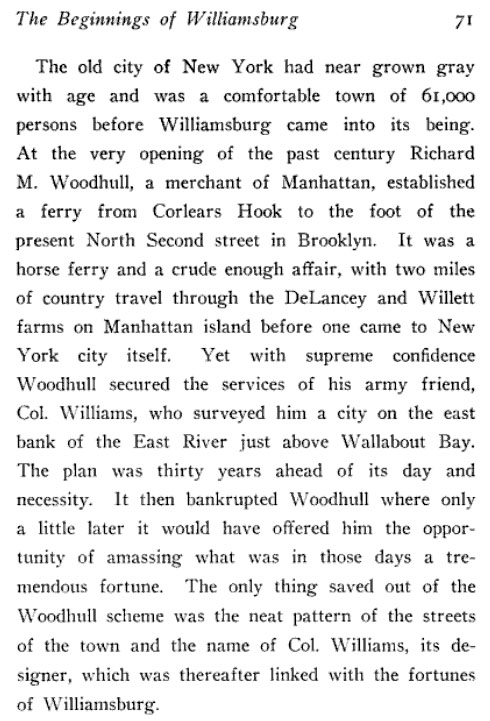

– photo by Mitch Waxman
The Brooklyn Bridge, first of the East River bridges, had proven to be a great generator of wealth on both sides of the river despite it’s outlandish cost and efforts. Modern documents emanating from municipal sources and persoanlly witnessed have referred to the modern day “Williamsburg Bridge Financial Corridor”, an attempt to explain the rejuvenation of the neighborhood from the Bowery to East River along Delancey Street as a direct consequence of the new affluence that current day Williamsburg has come to represent due to its darling status for the Real Estate industry.
In a sense, it was the original “Brooklyn Bridge Financial Corridor” which ultimately put an end to the slums of lower Manhattan, and allowed it’s occupants a chance to escape into Brooklyn. Queens came later, of course.
also from The Williamsburg Bridge: an account of the ceremonies attending the formal opening of the structure, December the nineteenth, MDCCCCIII : together with an illustrated historical and descriptive sketch of the enterprise, courtesy google books
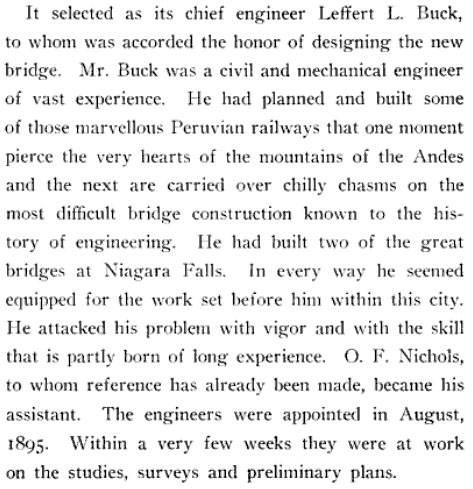

– photo by Mitch Waxman
Prior to the Williamsburg Bridge, there were two scheduled ferries one might utilize to transit from Manhattan to Williamsburg.
One was Robert Fulton’s “Grand Street Ferry”, which crossed between the Brooklyn and Manhattan roads of the same name, and a Houston street ferry made the trip albeit less frequently and with a smaller capacity of passengers. Additionally, hundreds of smaller vessels made the trip carrying some passengers, but mainly shuttling manufactured cargo or agricultural product between the coasts. An unpredictable eddy of currents and inclement weather often stranded passengers on one or the other sides of the river, sometimes for a day or more.
also from The Williamsburg Bridge: an account of the ceremonies attending the formal opening of the structure, December the nineteenth, MDCCCCIII : together with an illustrated historical and descriptive sketch of the enterprise, courtesy google books
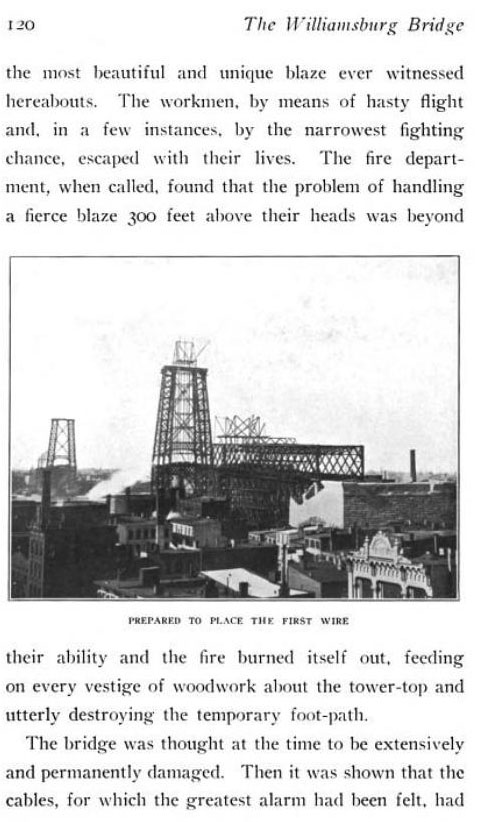

– photo by Mitch Waxman
After the 2nd East River Bridge was completed, Brooklyn’s population began to grow exponentially. Always the junior member of the two great cities on the harbor, it nevertheless absorbed millions while Manhattan began to transform- transmogrify in fact- into the Shining City we know today. Blocks of tenements were cleared away, deep pilings sunk, and the office towers began to rise and scrape the sky. The 3rd and 4th bridges were already underway and discussion of crossing the Narrows was beginning.
Bridge Commissioner Lindenthal commented on the age he lived in as being unique, knowing that the resources to conceptualize and build projects of this size only come along once or twice in the history of any city, and described himself as living in “The Age of Iron”.
also from The Williamsburg Bridge: an account of the ceremonies attending the formal opening of the structure, December the nineteenth, MDCCCCIII : together with an illustrated historical and descriptive sketch of the enterprise, courtesy google books

– photo by Mitch Waxman
As mentioned at the beginning of this post, your humble narrator is composed of lesser stuff than most and certainly does not exhibit any of the qualities of iron besides corrosion. While examining the contents of my camera card, which bore hundreds of shots I did not remember taking, my hands began to shake as I saw this familiar scene…
…I had entered the truest place, and the ultimate reality…
…that pole of consciousness and latent possibility which all other locations are mere reflections of…
…the one place where “do or die” actually means something…
from wikipedia
Williamsburg is a neighborhood in the New York City borough of Brooklyn, bordering Greenpoint to the north, Bedford-Stuyvesant to the south, Bushwick to the east and the East River to the west. The neighborhood is part of Brooklyn Community Board 1. The neighborhood is served by the NYPD’s 90th Precinct. In the City Council the western and southern part of the neighborhood is represented by the 33rd District; and the eastern part of the neighborhood is represented by the 34th District.
Many ethnic groups have enclaves within Williamsburg, including Hasidic Jews, Italians, Puerto Ricans, and Dominicans. It is also an influential hub for indie rock, hipster culture, and the local art community, all of which are associated with one of its main thoroughfares, Bedford Avenue. The neighborhood is being redefined by a growing population and the rapid development of housing and retail space.

– photo by Mitch Waxman
…I had come to Infinite Brooklyn…
also from wikipedia
In 1638 the Dutch West India Company first purchased the area’s land from the local Native Americans. In 1661, the company chartered the Town of Boswijck, including land that would later become Williamsburg. After the English takeover of New Netherland in 1664, the town’s name was anglicized to Bushwick. During colonial times, villagers called the area “Bushwick Shore.” This name lasted for about 140 years. Bushwick Shore was cut off from the other villages in Bushwick by Bushwick Creek to the north and by Cripplebush, a region of thick, boggy shrub land which extended from Wallabout Creek to Newtown Creek, to the south and east. Bushwick residents called Bushwick Shore “the Strand.” Farmers and gardeners from the other Bushwick villages sent their goods to Bushwick Shore to be ferried across the East River to New York City for sale via a market at present day Grand Street. Bushwick Shore’s favorable location close to New York City led to the creation of several farming developments. In 1802, real estate speculator Richard M. Woodhull acquired 13 acres (53,000 m²) near what would become Metropolitan Avenue, then North 2nd Street. He had Colonel Jonathan Williams, a U.S. Engineer, survey the property, and named it Williamsburgh (with an h at the end) in his honor. Originally a 13-acre (53,000 m2) development within Bushwick Shore, Williamsburg rapidly expanded during the first half of the nineteenth century and eventually seceded from Bushwick and formed its own independent city.


 The Newtown Pentacle