Posts Tagged ‘Manhattan’
gazing back

– photo by Mitch Waxman
Following a friend around last week, I ended up in a shop on 9th avenue in Manhattan which sold all manner of spice and grain (as well as a few interesting cheeses and a nice variety of olives). Struck by the palette of flavor and the alien smell of unknown colors, I pulled out the camera and started shooting. Just a block from the “ass end” of the Port Authority Bus Terminal, this part of the City has always struck me as a mean section, rife with danger and lurking predators which frightens one who suffers from timidity- such as myself.
As I scanned the market, the spice began to work on me in the manner of some exotic drug, and your humble narrator’s thoughts began to whirl in the manner of a dervish…
from wikipedia
The spice trade is a commercial activity of ancient origin which involves the merchandising of spices, incense, hemp, drugs and opium. Civilizations of Asia were involved in spice trade from the ancient times, and the Greco-Roman world soon followed by trading along the Incense route and the Roman-India routes. The Roman-Indian routes were dependent upon techniques developed by the maritime trading power, Kingdom of Axum (ca 5th century BC–AD 11th century) which had pioneered the Red Sea route before the 1st century. By mid-7th century the rise of Islam closed off the overland caravan routes through Egypt and the Suez, and sundered the European trade community from Axum and India.
Arab traders eventually took over conveying goods via the Levant and Venetian merchants to Europe until the rise of the Ottoman Turks cut the route again by 1453. Overland routes helped the spice trade initially, but maritime trade routes led to tremendous growth in commercial activities. During the high and late medieval periods Muslim traders dominated maritime spice trading routes throughout the Indian Ocean, tapping source regions in the Far East and shipping spices from trading emporiums in India westward to the Persian Gulf and the Red Sea, from which overland routes led to Europe.
The trade was transformed by the European Age of Discovery, during which the spice trade, particularly in black pepper, became an influential activity for European traders. The route from Europe to the Indian Ocean via the Cape of Good Hope was pioneered by the Portuguese explorer navigator Vasco Da Gama in 1498, resulting in new maritime routes for trade.
This trade — driving the world economy from the end of the Middle Ages well into the modern times — ushered in an age of European domination in the East. Channels, such as the Bay of Bengal, served as bridges for cultural and commercial exchanges between diverse cultures as nations struggled to gain control of the trade along the many spice routes. European dominance was slow to develop. The Portuguese trade routes were mainly restricted and limited by the use of ancient routes, ports, and nations that were difficult to dominate. The Dutch were later able to bypass many of these problems by pioneering a direct ocean route from the Cape of Good Hope to the Sunda Strait in Indonesia.

– photo by Mitch Waxman
Lost in aromatic reverie and pedantic observations, the timeless nature and ubiquity of this sort of shop intruded rudely into my gentle musings. The presence of markets like this, with variegated imports from foreign lands presented gaily… Oh, the “historicity” of it.
After all, weren’t shops like this a large part of the original organizing principal behind cities, and the formation of what we call “civilization“?
from wikipedia
Some grains are deficient in the essential amino acid lysine. That is why a multitude of vegetarian cultures, in order to get a balanced diet, combine their diet of grains with legumes. Many legumes, on the other hand, are deficient in the essential amino acid methionine, which grains contain. Thus a combination of legumes with grains forms a well-balanced diet for vegetarians. Common examples of such combinations are dal (lentils) with rice by South Indians and Bengalis, dal with wheat in Pakistan and North India, and beans with corn tortillas, tofu with rice, and peanut butter with wheat bread (as sandwiches) in several other cultures, including Americans. The amount of crude protein found in grain is measured as Grain Crude Protein Concentration.

– photo by Mitch Waxman
Versions of this place have existed in every city in every time period since the beginning of the agricultural revolution, and trade in dried foodstuffs was the original economy. The comestibles offered here represent an enormous supply chain, as well, one which perverts the “feel good” concept of “organic” marketing. These “imported lentils from France” may satisfy some desire to be close to the earth, but they were shipped to Manhattan via a petroleum powered steel ship and delivered by a diesel truck.
In a lot of ways, the “greener” product would actually be found in a commercial supermarket, where a large conglomerate’s “economy of scale” can put food on the table spending far fewer “carbon dollars” and often at a significantly lower retail price- but that doesn’t sound good at cocktail parties.
from wikipedia
A pulse (Latin “puls”, from Greek “πόλτος” – poltos, “porridge” is an annual leguminous crop yielding from one to twelve seeds of variable size, shape, and color within a pod. Pulses are used for food and animal feed. The term “pulse”, as used by the Food and Agricultural Organization (FAO), is reserved for crops harvested solely for the dry seed. This excludes green beans and green peas, which are considered vegetable crops. Also excluded are crops that are mainly grown for oil extraction (oilseeds like soybeans and peanuts), and crops which are used exclusively for sowing (clovers, alfalfa). However, in common use these distinctions are not clearly made, and many of the varieties so classified and given below are also used as vegetables, with their beans in pods while young cooked in whole cuisines and sold for the purpose; for example black eyed beans, lima beans and Toor or pigeon peas are thus eaten as fresh green beans cooked as part of a meal. Pulses are important food crops due to their high protein and essential amino acid content. Like many leguminous crops, pulses play a key role in crop rotation due to their ability to fix nitrogen.
Just like words as “bean” and “lentil”, the word “pulse” may also refer to just the seed, rather than the entire plant.
of antique workmanship

– photo from “King’s views of New York City, A.D.1903” a public domain ebook courtesy Google Books

– photo by Mitch Waxman
Perusing the catalogs of historic photos which I routinely harvest from antiquarian sources such as the “google books” service over the holidays, I came across this image of the Stern Brothers store on 23rd street between 5th and 6th avenues in a 1903 photo survey of New York. For one reason or another, I’ve spent a lot of time marching up and down 23rd street and have always been curious about the structure (which currently houses a largish “Home Depot”).
from wikipedia
Stern Brothers was founded in 1867 by Issac, Louis and Benjamin Stern, sons of German Jewish immigrants. In 1867 they began selling dry goods in Buffalo, New York. From these humble beginnings the Stern Brothers became an important merchandising family in New York City.
In 1868 they moved to New York City and opened a one room store at 367 Sixth Avenue. In 1877 the store was again relocated to larger quarters at 110 West 23rd. Street. Outgrowing the store at 110 West 23rd. Street, Stern Brothers erected a new structure at the same location which became the new flagship store in 1878. It was noted for its cast-iron facade at 32 to 36 West 23rd. Street & 23 to 35 West 22nd. Street.
The building was designed by Henry Fernbach. It was enlarged according to a design by W.M. Schickel in 1892. The enormous, six story building was executed in the Renaissance Revival style. W.M. Schinckel’s typically 19th. century addition tripled the dimensions of the original structure on the eastern portion of the site. The tall central section of this addition animates the long and delicately detailed facade. The company’s monogram is still located above the central arch. (This structure is still in use today. The first floor houses a Home Depot, while the upper floors are showrooms.) The entire Sterns family worked in this store, which carried both luxury goods and merchandise the working classes. It was an elegant store noted for its fashionable clothes. Ladies from all over the city came to Stern Brothers for their Paris fashions. This enterprise was distinguished by its elegant door men in top hats and the generous and friendly service of the Sterns themselves.

A “longer” version of the same subject – photo by Mitch Waxman
On Tuesday, on my way to a client’s office on 23rd street to pick up a job, I made it a point of trying to find a similar vantage point to the one in the historic photo- although the 1903 version is clearly shot from the elevated landing of a staircase, or perhaps, the first story window of some long gone structure.
What remains in Manahattan these days is corporatized, commercialized, bland, and privatized- who would blame these stalwart titans of economic might for shunning and denying the requests of some shabby man with a camera who is unprofitably seeking the past?
with palpitant heart

– photo by Mitch Waxman
Startlingly interesting is the only way to describe the experiences of the preceding year. Attempts have been made to cogently describe and colorfully illustrate the encounters your humble narrator has enjoyed in this 10th year of the millennium. For those of you who have just recently started to read this, your Newtown Pentacle, this is your chance to check out some of the highlights of 2010 (according to me), and for the veteran Lords and Ladies of the Pentacle an opportunity to review.
If you’ll indulge me…
January, 2010- The Abbot

The sort of posting which satisfies me deeply, “The Abbot” monument found at Calvary focused my attentions on certain realities of 19th century New York, and proved my theory that Calvary Cemetery is the single greatest historical resource in Queens. Obviation of my satisfaction with the posting is provided by the admission that I had noticed the stone peripherally, found it interesting, and started shooting it with no idea at all about its meaning. Only at home, when reviewing the photos did the whole story come together. Al Smith is buried at Calvary as well (he’s the fellow who built the skyscraper seen in the night shot at the head of this post) but this paragraph is about January 2010 and Governor Smith’s story was told in 2009.
January, 2010- The Great Machine

Also in January, a pet ideation was advanced, one not of theory but of perception. The notion of the megalopolis figures heavily in my thinking- a concept that sees the eastern seaboard of the United States not as a series of cities, but rather one vast urban zone of varying densities with New York City at the titular center of a web of industry, transport, and agricultural systems. The center of the web has a center itself, which is Manhattan- specifically where it connects to “the Great Machine” of the Queensboro bridge and it’s corollaries.

– photo by Mitch Waxman
February 2010– Affordable Housing Development on Borden Avenue

This post, “Affordable Housing Development on Borden Avenue“, is included in the year end wrap up simply because it ended up being one of the more widely read and commented upon endeavors presented in 2010. Most likely, it was the linking shout out from Queenscrap that made it so, rather than any subjective quality or incisive observation. Homeless camps abound in the Newtown Pentacle, hidden away on seldom trodden lanes and along backwater pathways- in this case it’s alongside the oft delayed construction project at the Borden Avenue Bridge which spans Dutch Kills.
February 2010– horrible and unearthly ululations…

A lot of time was spent in 2010 trying to wrap my head fully around the story of the Newtown Creek (which culminated ultimately in the late October release of the first Newtown Pentacle book- Newtown Creek for the vulgarly curious) and “horrible and unearthly ululations…” was the first of several posts which attempted to boil complicated and obscure snippets of historical lore into a cohesive and accessible form. So much is made of the Greenpoint Oil Spill and the Meeker Avenue Plumes by the legal community, whose hungry jowls slaver and shake at the financial possibilities offered by the EPA’s superfund designation and various court decisions, that the true and terrible wonder of the Newtown Creek is often overlooked. This post and several others of its ilk attempt to present a fuller version of things, and act as reminders that what was may once again be.

– photo by Mitch Waxman
March 2010– The Shadow over Sunnyside

The St. Pat’s Day for All parade in Sunnyside is a yearly event which draws in a citywide coterie of political entities, all desperate for attention and attribution as being friendly to the GLTG members of the electorate. The parades origins are a reaction against the banning of outwardly gay marchers in the RC church’s own St. Patricks day parade in Manhattan. Despite its politically contentious birthing, the Sunnyside parade is actually a fun and light hearted event, and signals the coming of springtime in the Newtown Pentacle. While there principally to get shots of the political master race which rules over us, amongst the crowd I noticed small clots of dire intent armed with ugly signage. Research into this group, which was clearly coordinated and queerly ominous, revealed them to be adherents to a bastardized form of Catholic fundamentalism which has been outlawed and defined as a dangerous cult by several Nation-states. A shadow over Sunnyside indeed.
March 2010– Exhausted
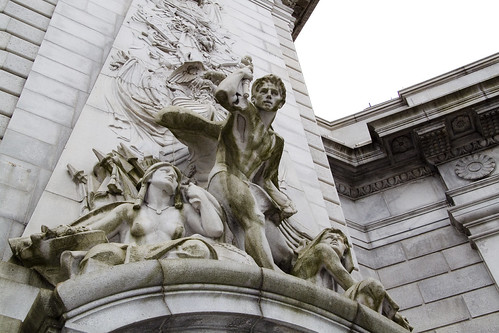
A brighter experience for your humble narrator was the Manhattan Bridge Centennial Time Capsule event, on March 5. Interactions and conversations were enjoyed by the least of men with certain powers and potentates of the City of Greater New York and entry to the interior space of the Manhattan Bridge was obtained. One of the high points of my year, “Exhausted” detailed the embedding of a time capsule in the East River Bridge #2- aka the Manhattan Bridge. Remarkable self control was exercised when I met the DOT Commissioner, Jeanette Sadik-Khan. My sincerest desire was to bend her ear with my alleged wisdom about bike lanes and bridge safety- but self control was ascendent that day and only congratulations were offered to both her and the other staffers at DOT.

– photo by Mitch Waxman
April 2010– City of Marble and Beryl
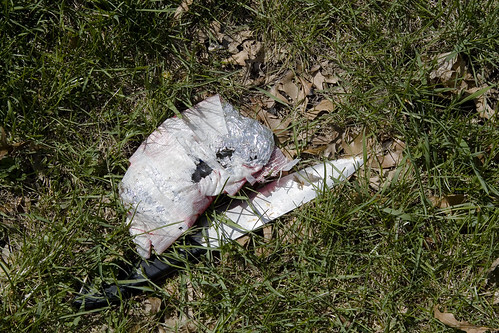
Odd shenanigans were observed at St. Michael’s Cemetery here in Astoria, which were of a decidedly magickal nature. A ritual site that your humble narrator stumbled across was examined and evidentiary examination suggested that certain third world cults were extant here in the old village of Astoria, conducting midnight bacchanals concurrent with the lunar cycle. “City of Marble and Beryl” was but the first of many moons which witnessed a working of will amongst the desolations of our kind.
April 2010– Searching for Gilman

A good part of 2010 was spent “Searching for Gilman” at First Calvary Cemetery, which I am doing as you are reading this, assuming it’s the start of 2011 whenever you do. Gilman is the source of no small amount of pain and financial hardship around these parts, as your humble narrator has become dangerously obsessive and paranoid around the subject. A psychotic need to find Gilman’s grave torments me, coloring my days and painting my dreams a dull yellow.

– photo by Mitch Waxman
May 2010– the king in yellow, brick
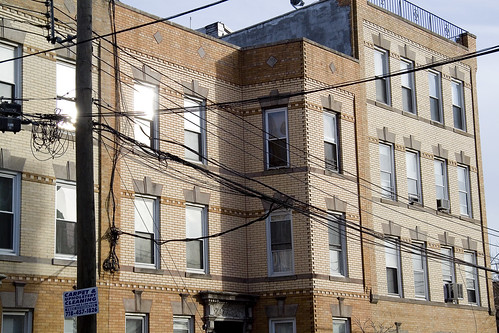
Remiss would be apparent were I to not mention the “Madison Avenue Bridge Centennial” but “the king in yellow, brick” advanced another of my pet theories and served up a fascinating (to me at least) sequence of events and relationships which attempts to explain why those yellow Kreischer bricks are all over the older sections of Queens.
May 2010– after cycles incalculable

“After cycles incalculable” is another one of those perfect posts, from a personal perspective. Wandering around with a friend, which is a disturbing trend which developed over the course of 2010, at Skillman Avenue’s start we observed the Lemuria hatching in concordance with the anniversary of the Roman festival of Lemuralia in Long Island City.

– photo by Mitch Waxman
June 2010– from Hells Gate, loosed upon the world

When I set out on my little walks, there is seldom a destination in mind. Literally wandering, obscure symbols and pseudo occultism guide my steps- I’ll follow a black cat, or merely adopt a roughly heliotropic path using my own shadow as compass. At the very end of May, my feet carried me toward Astoria Park and the notorious section of the East River known as Hells Gate. The odd craft, an “unidentified floating object” if you would, which sped past my lens required more than a small bit of detective work to identify- which was detailed in “from Hells Gate, loosed upon the world“.
June 2010– Gods Gift to Pain

English Kills, which is the logical and modern end of Newtown Creek, is a heavily industrialized and largely anaerobic tributary of the larger waterway and is seldom visited (by me, at least) at its extant. One fine day, while hanging out with another Creek enthusiast (you should not go to this place alone), we decided to enter the largely hidden urban foyer which leads here- despite the fact that we were most likely trespassing- which violates Newtown Pentacle policy. The title of the post- “Gods Gift to Pain” was lifted from an enigmatic and appropriate bit of graffiti observed in this forgotten pace of dissolution and poison.

– photo by Mitch Waxman
The reason for Brooklyn, and Queens- why it was a viable alternative to living in Manhattan in the 19th century was defined by the horrors of tenement life. The grand old buildings with their high ceilings, thick plastered walls, convenient dumbwaiters, and incredibly ornate lobbies- the structures which distinguished and made life desirable in the incalculably distant boroughs, were built as an alternative to the crowded and dangerous tenements of “The City”- especially the warren which was known as the “Five Points“. Additionally, Calvary Cemetery (of particular interest to me, and perhaps, to you) was founded by the parishioners of Old St. Patrick’s Cathedral which is smack dab in the middle of this ancient labyrinth of poverty, crime, and squalor. It was decided that to fully understand what one observes in the remains of the supposed “answer to the problem”, exploration of “the problem” itself is required.
July 2010– Bandits Roost, 2010

Ideal source material for the textural and societal milieu of the Five Points is the admittedly biased “How the Other Half Lives” by 19th century do-gooder Jacob Riis. Speaking the truth that power wants to hear is always a sound move if one considers fiscal realities and historical reputation. Attempts were made to find the modern locale in which Riis shot some of his more famous shots, such as this visit to “Bandits Roost 2010“.
July 2010– The house of Dagger John

Another critical visitation for me, as part of my larger education and study of the early development of the City of Greater New York was occasioned on the day when I went to “The house of Dagger John“. Old St. Patrick’s Cathedral satisfies both my continuing fascination with the counterpoint of sacred and profane in the story of the Megalopolis, and figures largely in the predictions of certain obscure lore which governs the schedule of my researches.

– photo by Mitch Waxman
August 2010– not to harsh anyone’s buzz… but…

August of 2010 brought a posting which garnered a lot of attention, due to curbed.com noticing and linking to it. Simply noticing that a growing proliferation of small boats were berthing illegally at the Vernon Avenue street end, it would be irresponsible of me- given everything that I know about the location not to point out the mortal and existential danger that the operators of these boats were placing themselves in. It’s not even the water, really, its the high pressure natural gas line- the enormous CSO which drains LIC- the omnipresent heavy industrial maritime traffic- which makes the spot so hazardous. Mortal threats were received via email (which I’ve kept private), and the comments thread displayed an angry and accusatory tone. As is the case with all such critique, these comments were presented verbatim- here’s a taste: “i have red your article in which you show a great deal of unger towards me and my friends . i believe that you base your article on many misconceptions that are rooted in a lack of communication”, “Blogger or not, the prudent journalist would make an effort to uncover basic facts before publishing a story full of assumptions”, “are you just the type of little man that tells teacher when the cool kids make you feel inferior. The water is public domain! And according to maritime law it is not illegal to moor a boat as long as it safe and looked after.”, “They are not bothering anyone. And get sick from the canal, come on. They are not living down there as far as I know. Parking your boat in the canal is not going to get them sick! Stop over doing it.” Check out “not to harsh anyone’s buzz… but…“.
August 2010– lively antics

One of the greatest joys of living in Queens are the chance encounters you’ll have with people who hail from the furthest points of the compass, such as this Bouzouki player during another visit to Hells Gate. His “lively antics” added splendor to a brightly lit walk around Astoria.

– photo by Mitch Waxman
September 2010– Lucky Shot

Although veteran photographers caution me against use of this term, I call the photo above my “shot of the year”. The steel structure attached to the bottom of the Brooklyn Bridge was installed as part of a bridge painting and maintenance project, and I was luckily along on a Working Harbor trip just as the sun was setting. Right place, right time, it was a “Lucky Shot“.
September 2010– stronger than fear

The dynamic new Safeboats utilized by NYPD and other entities around the harbor were a frequent subject over several of the Working Harbor expeditions I was lucky enough to attend. The many shapes, colorways, and missions of these quick little patrol boats are a delight to observe- and to those who would work maritime malice upon the metropolis- they are the head of the spear. Check out “stronger than fear“.

– photo by Mitch Waxman
A high of the year was the Newtown Creek Cruise which I had the honor of co-narrating with Bernard Ente on October 24th, of course, but the main topic of conversation amongst the antiquarian and environmental communities of the Newtown Pentacle in October revolved around the EPA’s superfund announcement about Newtown Creek at the very end of September. October is spooky time around these parts, and I spent a little time digging around the area for thrills and chills as well.
October 2010– blurred outlines

As part of series of postings detailing what might be seen in the Brooklyn neighborhood of Greenpoint, “blurred outlines” discusses the alleged appearance of a pyrokinetic at 84 Guernsey Street in January of 1895.
October 2010– scenes familiar, and loved

One of my frequent walks through Calvary Cemetery took me to the curiously empty chapel which enjoys the paramount of Laurel Hill. I will admit that I came here this day seeking two things- one was a likely entrance to a vast subterranean structure which underlies the area- the other was a vain hope that the grave of Gilman might present itself in a section which was, at the time, not terribly familiar to me as I normally stay close to the fringes of the place where the whipporwills wail. I very well might have captured what mass media paranormal media sources describe as a ghost orb in “scenes familiar, and loved“.

– photo by Mitch Waxman
November 2010– peace rests nevermore

One of the goals of this, your Newtown Pentacle, is to provide some sort of documentation about this terrible and wonderful place called the Newtown Creek- and I’m happy to say that I was there when the then Attorney General and Governor Elect Andrew Cuomo announced the settlement of a lawsuit brought by his office on behalf of New York State against Exxon-Mobil which involved the Greenpoint Oil Spill. “Peace rests nevermore” indeed.
November 2010– shocking coruscations

Entertaining maritime folklore from past centuries was offered in “shocking coruscations“, which is told against a series of twilight photos from good old Hells Gate between the two great bridges.

– photo by Mitch Waxman
During the cold, when inclement clime restricts my movements and the black dog nips at my heels, I tend toward shorter postings- and in December of 2010 there were two “Then and Now” postings that really took my fancy. These posts are difficult because of the scarce source material available in the public domain, but fun nevertheless. In my usual fashion “dumb idiot” fashion, I had shot the modern views completely unaware of the original photo. Our friends at the Greater Astoria Historic Society have recently released a book of similar historical views, which is worthy of consideration.
December 2010– Bowery Savings Bank 2010 and 1903

As the title states, this is the iconic shell of a once essential and awesomely powerful institution called the Bowery Savings Bank in Manhattan, with a 1903 photo from a similar perspective.
December 2010– Hunters Point Avenue Bridge Centennial

If you told me a year ago that I’d end up doing a press conference with a United States Congresswoman, I’d have hit you. That’s how I ended up at the Degnon Terminal’s own Sunshine Biscuits (LaGuardia Community College) building though, and by an odd coincidence- found myself standing in nearly the same spot as some unknown photographer did in 1921. This posting was built around the announcement of the “Hunters Point Avenue Bridge Centennial” event.

– photo by Mitch Waxman
Overall, a positive and exciting year, despite the deaths of several members of my family.
For a while, I enjoyed a spot on the board of the nascent Newtown Historical Society as a trustee, which is a position that I’ve had to resign for a variety of personal reasons- but I’d like to thank fellow board members Kevin Walsh, Christina Wilkinson, Steve Garza, and Bob Singleton for an interesting and educational experience. Kevin Walsh of forgotten-ny gets a personal call out, as his support, knowledge, and encouragement has been invaluable. Special thanks also are extended toward Capt. John Doswell and Meg Black of the Working Harbor Committee, all the guys and gals aboard the John J. Harvey fireboat, and everybody else who allowed a piss poor specimen such as myself to come along on adventures. Bernard Ente of the Newtown Creek Alliance, Working Harbor, and others also receives a heartfelt gratitude and shout out from this humble mendicant. Standing on the shoulders of giants is difficult if you suffer from altitude related nosebleeds.
What’s next?
Tell you what, feel like taking a walk?
Meet me at the border of Brooklyn and Queens – bring a camera… and ID… I’ll show you something cool…
viscous obstacles

– photo by Mitch Waxman
A little Xmas business today… but first- I wish it was possible, scientifically and mechanically (and perhaps legally), to move about the city invisibly- to employ what the Star Trek franchise would refer to as “a cloaking device”. Hunters employ what is known as “a blind”, which is a hidden perch or camouflaged spot which offers one an enhanced angle of fire while remaining hidden from the viewpoint of their quarry. I like to pretend that I have several of these spots around the city- blind alleys and hidden culverts mostly. If there’s a manhole cover slightly ajar on Jackson Avenue, might it be that your humble narrator is the man in that hole?
I’m all ‘effed up.
Incidentally, as the Newtown Creek Alliance site has previously announced, there will be a meeting tonight in Greenpoint to discuss the recent developments about boating access from City owned property along the Creek. I’ll most likely attend, and I’m sure that the discussion and panel of municipal representatives will be engaging, lively, and ribald. Here’s the details, from the NCA site:
Boating Access to Newtown Creek in Jeopardy
The NYC Dept. of Environmental Protection will be holding a meeting to address its recent closure of the boat launch at the Newtown Creek Nature Walk. As the Nature Walk is one of the few public access points to the Creek, we encourage everyone to attend the DEP meeting and advocate for the City re-open the boat launch immediately.
When: Thursday, December 16, 6:30pm – 8:30pm
Where: Newtown Creek Visitor Center, 329 Greenpoint Avenue, Brooklyn, NY 11222 [directions]
In their own words “Please join the New York City Department of Environmental Protection, the Department of Parks and Recreation, the Department of Health and Mental Hygiene, the Department of City Planning, and the New York City Economic Development Corporation for a hearing on the feasibility of future access to New York City owned kayak launches on Newtown Creek. The hearing will provide the public an opportunity to testify on the feasibility of future access to New York City-owned kayak launches on Newtown Creek. For more information and to submit written statements in advance for those who cannot attend, please email Matt Mahoney at MMahoney@dep.nyc.gov or call 718-595-6605.

– photo by Mitch Waxman
The Hunters Point Bridge Centennial Event on Saturday the 11th was well attended, despite the blistering cold typical of the period immediately preceding the winter solstice, and the stalwart engineers of the DOT opened the draw bridge for the surprised delight and education of the crowd. The supervisor of the Borden Avenue Bridge reconstruction project (who we kind of bumped into) also gave us a moment of his time, and described the long term project which he described as nearing completion.
Postings and photos will be coming forthwith, expect them soon, here at your Newtown Pentacle.
Speaking of your Newtown Pentacle, and the existential realities and meager finances currently extant for your humble narrator- please consider purchasing a copy of the first Newtown Pentacle book: “Newtown Creek for the Vulgarly Curious” – a fully annotated 68 page, full-color journey from the mouth of Newtown Creek at the East River all the way back to the heart of darkness at English Kills, with photos and text by Mitch Waxman.

– photo by Mitch Waxman
In other news, a rather in depth profile of me was run yesterday at blsciblogs.baruch.cuny.edu, which is the sort of thing I’m afraid I’ll never get used to but which swells my ego nevertheless.
Bowery Savings Bank 2010 and 1903
– photo by Mitch Waxman
The Bowery Savings Bank in Manhattan during the summer of 2010.

– photo from “King’s views of New York City, A.D.1903” a public domain ebook courtesy Google Books
The Bowery Savings Bank in Manhattan in 1903.
Here’s a stitched panorama of the corner in 2010, just for the “longer” view. Click through to Flickr to see the gargantuan original.

– photo by Mitch Waxman


 The Newtown Pentacle