Posts Tagged ‘Maspeth’
previous recollections

– photo by Mitch Waxman
Recently, I was obliged to meet up with a couple of guys from Williamsburg when they asked me to guide them through some of the Newtown Creek’s less well known attractions. My pithy reply was that I would be straddling the border of Brooklyn and Queens, and they should just meet me there- at the venerable Grand St. Bridge. I walked there from Astoria in record time, arriving quite a bit earlier than I had anticipated.
Luckily the morning was crisp, my coffee was hot, and the burning thermonuclear eye of god itself was shining strongly- which afforded me with a nice opportunity me to do a little shooting.
Note: I’m never sure how to describe the actual act of photography. Shoot, capture, take- all somewhat violent terms which don’t really fit the action. Sniper techniques do transfer neatly into telephoto work, exhaling while triggering the shutter and all that, but… it’s all rather soldier sounding isn’t it?
from wikipedia
Photography is the process, activity and art of creating still or moving pictures by recording radiation on a radiation-sensitive medium, such as a photographic film, or electronic image sensors. Photography uses foremost radiation in the UV, visible and near-IR spectrum.[1] For common purposes the term light is used instead of radiation. Light reflected or emitted from objects form a real image on a light sensitive area (film or plate) or a FPA pixel array sensor by means of a pin hole or lens in a device known as a camera during a timed exposure. The result on film or plate is a latent image, subsequently developed into a visual image (negative or diapositive). An image on paper base is known as a print. The result on the FPA pixel array sensor is an electrical charge at each pixel which is electronically processed and stored in a computer (raster)-image file for subsequent display or processing. Photography has many uses for business, science, manufacturing (f.i. Photolithography), art, and recreational purposes.
As far as can be ascertained, it was Sir John Herschel in a lecture before the Royal Society of London, on March 14, 1839 who made the word “photography” known to the whole world. But in an article published on February 25 of the same year in a german newspaper called the Vossische Zeitung, Johann von Maedler, a Berlin astronomer, used the word photography already. The word photography is based on the Greek φῶς (photos) “light” and γραφή (graphé) “representation by means of lines” or “drawing”, together meaning “drawing with light”

– photo by Mitch Waxman
Surreal, the waters around the Grand Street Bridge teem with that alien colour which typifies and describes the industrial hinterlands of that annihilation of innocence which is called the Newtown Creek. For an extensive description and history of this spot, a busy automotive and truck crossing in modernity, click the following for the Newtown Pentacle posting “a Grand Journey in DUGSBO”
from nyc.gov
Grand Street is a two-lane local City street in Queens and Kings Counties. Grand Street runs northeast and extends from the Brooklyn Queens Expressway in Brooklyn to Queens Boulevard in Queens. The road is known as Grand Street west of the bridge and Grand Avenue east of the bridge. The bridge is located between Gardner Avenue in Brooklyn and 47th Street in Queens. The Grand Street Bridge is a 69.2m long swing type bridge with a steel truss superstructure. The general appearance of the bridge remains the same as when it was opened in 1903. The bridge provides a channel with a horizontal clearance of 17.7m and a vertical clearance, in the closed position, of 3.0m at MHW and 4.6m at MLW. The bridge structure carries a two-lane two-way vehicular roadway with sidewalks on either side. The roadway width on the bridge is 6.0m and the sidewalks are 1.8m wide. The height restriction is 4.1m. The approach roadways are wider than the bridge roadway. For example, the width of Grand Avenue at the east approach to the bridge (near 47th Street) is 15.11m.
The first bridge on this site, opened in 1875, quickly became dilapidated due to improper maintenance. Its replacement, opened in 1890, was declared by the War Department in 1898 to be “an obstruction to navigation.” Following a thorough study, a plan was adopted in 1899 to improve the bridge and its approaches. The current bridge was opened on February 5, 1903 at a cost of $174,937.

– photo by Mitch Waxman
While pondering the atypical number of 19th century suicides which occurred here, a flock of geese happened along in this so called urban desert and distracted me from my usual morbid soliloquy. They were pecking at the manmade bulkheads, skimming for waterline plant life.
from wikipedia
The Canada Goose was one of the many species described by Linnaeus in his 18th-century work Systema Naturae. It belongs to the Branta genus of geese, which contains species with largely black plumage, distinguishing them from the grey species of the Anser genus. The specific epithet canadensis is a New Latin word meaning “from Canada”. According to the Oxford English Dictionary, the first citation for the ‘Canada Goose’ dates back to 1772. The Cackling Goose was formerly considered to be a set of subspecies of the Canada Goose.

– photo by Mitch Waxman
Nearby was this enormous creature, balancing on one foot . Unfortunately, it wasn’t disposed toward looking my way, despite my best Brooklyn exclamation of “hey, boid, overs here’s”. When a tractor trailer blew by, it suddenly exploded upward.
from wikipedia
New York dialect is predominantly characterized by the following sounds and speech patterns:
Vowels
- The low back chain shift The /ɔ/ vowel sound of words like talk, law, cross, and coffee and the often homophonous /ɔr/ in core and more are tensed and usually raised more than in General American. Labov (1966) describes this pattern as varying on a scale from [ɔ] to [ʊ]. An inglide typically accompanies higher variants giving [oə] or [ʊə]. /ɑ/ in father and /ɑr/ in car are backed, diphthongized, and sometimes rounded to [ɑə] or [ɒə]. The result is that card in New York can be similar to cod in parts of New England. In addition, a subset of words with /ɒ/ as in lot feature a lengthened and diphthongized variant, [ɑə]. This variant may appear before a word final voiced stop, /dʒ/, or /m/ (e.g., cob, cod, cog, lodge, bomb). It also occurs variably before voiced fricatives (e.g., bother), /ʃ/ (e.g., wash), and in the words on, John, and doll (Wells 1982: 514).
- The short-a split There is a class of words, with a historical short-a vowel, including plan, class, and bad, where the historical /æ/ is raised and tensed to an ingliding diphthong of the type [eə] or even [ɪə]. This class is similar to, but larger than, the BATH lexical set, in which Received Pronunciation uses the so-called broad A. Other words, such as plaque, clatter, and bat, retain a lax, low-front [æ], with the result that bad and bat have different vowels. A related (but slightly different) split has occurred in the dialect of Philadelphia. Although the lax and the tense reflexes of /æ/ are separate phonemes in these dialects, their distribution is largely predictable. See Phonemic æ-tensing in the Mid-Atlantic region for more details.
- /oʊ/ as in goat does not undergo fronting; instead, it remains [oʊ]. This groups New York with the “North” class of dialects rather than the “Midland”, in which /oʊ/ is fronted. Relatedly, /uː/ as in goose is not fronted and remains a back vowel [uː] or [ʊu]. This lack of fronting of /oʊ/ and /uː/ also distinguishes New York from nearby Philadelphia. Some speakers have a separate phoneme /ɪu/ in words such as tune, news, duke (historically a separate class). The phonemic status of this vowel is marginal. For example, Labov (1966) reports that New Yorkers may contrast [duː] do with [dɪu] dew though they may also have [dɪu] do. Still, dew is always [dɪu] and never [duː].
- Diphthongs The nucleus of the /aɪ/ diphthong is a back and sometimes rounded vowel [ɑ] or [ɒ] (right as [ɹɑɪt]) and the nucleus of the /aʊ/ diphthong is a front vowel [æ] (rout as [ɹæʊt]). The sociolinguistic evidence (Labov 1966) suggests that both of these developments are active changes. The fronted nucleus in /aʊ/ and the backed nucleus in /aɪ/ are more common among younger speakers, women, and the working and lower middle classes.
- pre-r distinctions New York accents lack most of the mergers before medial /r/ that many other modern American accents possess:
- The vowels in marry [mæri], merry [mɛri], and Mary [meri] ~ [mɛǝri] ~ [mɛri] show either a two- or three-way contrast.
- The vowels in furry /fɜri/ and hurry /hʌri/ are distinct.
- Words like orange, horrible, Florida and forest are pronounced /ɑrəndʒ/ and /fɑrəst/ with the same stressed vowel as pot, not with the same vowel as port as in much of the rest of the United States.
- Merger of /ɜr/ and /ɔɪ/: One of the stereotypes of New York speech is the use of a front-rising diphthong in words with /ɜr/ (e.g., nurse). This stereotype is popularly represented in stock phrases like “toity toid” for thirty-third. The phonetic reality of this variant is near [ɜɪ]. This variant may also appear in words with /ɔɪ/ (e.g., choice), resulting in verse and voice as homophones. The diphthongal variant for /ɜr/ is highly stigmatized. Labov’s data from the mid-1960s indicated the form was recessive then. Only two of his 51 speakers under age 20 used the form as compared with those over age 50 of whom 23 out of 30 used the form. Items with /ɔɪ/ may occur with [ɜr] (e.g., [tɜrlət] toilet), apparently as a result of hypercorrection. Younger New Yorkers (born since about 1950) are likely to use a rhotic [ɜr] in bird even if they use non-rhotic pronunciations of beard, bared, bard, board, boor, and butter.

– photo by Mitch Waxman
Turns out it’s a heron. Go figure, a heron at Newtown Creek.
from wikipedia
The herons are wading birds in the Ardeidae family. There are 64 recognised species in this family. Some are called egrets or bitterns instead of herons. Within the family, all members of the genera Botaurus and Ixobrychus are referred to as bitterns, and—including the Zigzag Heron or Zigzag Bittern—are a monophyletic group within the Ardeidae. However, egrets are not a biologically distinct group from the herons, and tend to be named differently because they are mainly white and/or have decorative plumes. Although egrets have the same build as the larger herons, they tend to be smaller.
The classification of the individual heron/egret species is fraught with difficulty, and there is still no clear consensus about the correct placement of many species into either of the two major genera, Ardea and Egretta. Similarly, the relationship of the genera in the family is not completely resolved. However, one species formerly considered to constitute a separate monotypic family Cochlearidae, the Boat-billed Heron, is now regarded as a member of the Ardeidae.
Although herons resemble birds in some other families, such as the storks, ibises and spoonbills, they differ from these in flying with their necks retracted, not outstretched. They are also one of the bird groups that have powder down.
Some members of this group nest colonially in trees; others, notably the bitterns, use reedbeds.

– photo by Mitch Waxman
That’s it for today, over the weekend I’ll be thrilling you with recent encounters your humble narrator has had with the political class who rule over New York City.
Also, please buy a copy of our book- Newtown Creek, for the vulgarly curious- here. Every copy sold contributes directly to sustaining and maintaining this- your Newtown Pentacle.
from wikipedia
Grand Street is a street in Williamsburg, Brooklyn, New York City, United States. The Grand Street (BMT Canarsie Line) subway station serves the corner of Grand Street and Bushwick Avenue. Crossing English Kills into Queens, Grand Street becomes Grand Avenue, continuing through Maspeth where it is a main shopping street, to Elmhurst. Its northern end is at Queens Boulevard. Broadway continues the thoroughfare north and west.
History
In the 19th century, before the construction of the Williamsburg Bridge, the Grand Street Ferry connected Grand Street, Brooklyn to Grand Street, Manhattan. The Grand Street Line was a streetcar line along the road.
The Man Who Could Dodge Bullets

– photo by Mitch Waxman
One of the great traditions in the history of fraternal ethnic organizations is the art of storytelling, and a tale often told by those who “belong” is about the Castellamarese War.
It’s an old New York story, full of gun play, revenge, and intrigue. Powerful black sedans with a cadre of Tommy Gun toting racketeers speeding around the streets, innocents getting mowed down, and a cast of legendary characters like Lucky Luciano, Albert Anastasia, Vito Genovese, Meyer Lansky, and Salvatore Maranzano exacting vengeance on their enemies. From the bloody heap, the “commission” was born, a board of directors which governed the various crime families. Nothing new here, you know this story- it was sort of fictionalized in the Godfather movies, and there are any number of books, TV Shows, and movies which describe it in some detail.
At least, they claim to- I don’t believe everything I’m told, and just ask anyone- there’s no such thing as the Mafia.
Anyway, this is First Calvary Cemetery, and pictured above is the grave of Joe Masseria.
from wikipedia
The Five Families are the five major Italian-American Mafia crime families which have dominated organized crime in New York City since the 1930s. Prior to this was the Maranzano Family and the Masseria Family which ended up fighting each other during a period known as the Castellammarese War. The Five Families, under the suggestion of Lucky Luciano and Meyer Lansky, were responsible for the establishment of The Commission, a council which demarcated territory between the previously warring factions and governs American Mafia activities in the United States. The Five Families in New York remain as the powerhouse of the Italian Mafia in the US.

– photo by Mitch Waxman
What I can affirm is that there were fresh flowers inside the Masseria tomb, on an October morning in 2010.
from wikipedia
On April 15, 1931, Joe Masseria was assassinated at one of his favorite restaurants, Nuova Villa Tammaro in Coney Island, Gangland legend has it that Masseria dined with Charles “Lucky” Luciano before his death. While they played cards, Luciano excused himself to the bathroom, when Benjamin “Bugsy” Siegel, Vito Genovese, Albert Anastasia and Joe Adonis rushed in and shot Masseria to death, his four bodyguards having mysteriously disappeared. The New York Daily News reported that the boss died “with the ace of spades, the death card, clutched in a bejeweled paw.”
However, both the New York Times and the New York Herald Tribune paint a different picture. Neither newspaper mentions Luciano being present, although Luciano was brought in for questioning by the police. The Herald Tribune reported that Masseria arrived at the restaurant in his armored steel car in the company of three other men shortly before 3pm. Scarpato’s mother-in-law, Anna Tammaro, waited while they played cards. According to two eyewitnesses, two well-dressed young men drove up and parked their car at the curb. They strolled leisurely into the place, and the shooting began immediately. Some 20 shots were fired. Then the two gunmen came out without any visible signs of haste, entered their automobile and drove away. Masseria was hit with four bullets in the back and one in the back of the head, identified as .32 and .38 caliber, and in an alley next to the restaurant, police recovered two revolvers.

Joe Masseria, photo courtesy Wikipedia
a world yet inchoate
– photo by Mitch Waxman
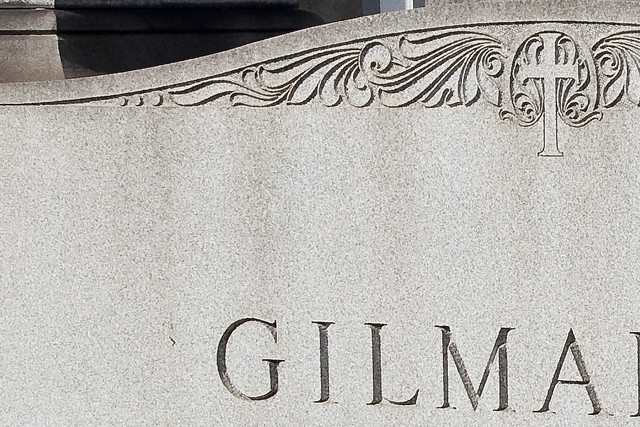
Unutterable, the name which must not be mentioned torments a humble narrator. Sure knowledge that the mortal remains of its bearer lie amongst the emerald devastations of First Calvary Cemetery renders a psychological state in my feeble mind which can only be compared to the plight of Tantalus.
from wikipedia
In mythology, Tantalus became one of the inhabitants of Tartarus, the deepest portion of the Underworld, reserved for the punishment of evildoers; there Odysseus saw him. The association of Tantalus with the underworld is underscored by the names of his mother Plouto (“riches”, as in gold and other mineral wealth), and grandmother, Chthonia (“earth”).
Tantalus was initially known for having been welcomed to Zeus’ table in Olympus, like Ixion. There he is said to have misbehaved and stolen ambrosia and nectar to bring it back to his people, and revealed the secrets of the gods.
Most famously, Tantalus offered up his son, Pelops, as sacrifice. He cut Pelops up, boiled him, and served him up in a banquet for the gods. The gods became aware of the gruesome nature of the menu, so they didn’t touch the offering; only Demeter, distraught by the loss of her daughter, Persephone, absentmindedly ate part of the boy’s shoulder. Clotho, one of the three Fates, ordered by Zeus, brought the boy to life again (she collected the parts of the body and boiled them in a sacred cauldron), rebuilding his shoulder with one wrought of ivory made by Hephaestus and presented by Demeter. The revived Pelops grew to be an extraordinarily handsome youth, so much so that the god Poseidon fell in love with him and abducted him to Mount Olympus. Later, Zeus threw Pelops out of Olympus due to his anger at Tantalus. The Greeks of classical times claimed to be horrified by Tantalus’s doings; cannibalism, human sacrifice and infanticide were atrocities and taboo.
Tantalus’s punishment for his act, now a proverbial term for temptation without satisfaction (the source of the word “tantalise”), was to stand in a pool of water beneath a fruit tree with low branches. Whenever he reached for the fruit, the branches raised his intended meal from his grasp. Whenever he bent down to get a drink, the water receded before he could get any. Over his head towers a threatening stone, like that of Sisyphus.

– photo by Mitch Waxman
Reduced to performing a visual inventory of the multitudes here, I have been walking a search pattern composed of interlocking octagons, trampling across the loam of grief and loss. Several times, disturbing subsidence and vegetation choked ruts have nearly caused severe injury, as I’m not watching out for where I am but rather for where I’m going.
This is a video game technique (shoot where they’re going to be, not where they are), one which can be hazardous to follow in the existential realities which surround that extinction of joy known as the Newtown Creek.
from wikipedia
Søren Kierkegaard and Friedrich Nietzsche were two of the first philosophers considered fundamental to the existentialist movement, though neither used the term “existentialism” and it is unclear whether they would have supported the existentialism of the 20th century. They focused on subjective human experience rather than the objective truths of mathematics and science, which they believed were too detached or observational to truly get at the human experience. Like Pascal, they were interested in people’s quiet struggle with the apparent meaninglessness of life and the use of diversion to escape from boredom. Unlike Pascal, Kierkegaard and Nietzsche also considered the role of making free choices, particularly regarding fundamental values and beliefs, and how such choices change the nature and identity of the chooser. Kierkegaard’s knight of faith and Nietzsche’s Übermensch are exemplars who define the nature of their own existence. These idealized individuals invent their own values and create the very terms under which they excel. Kierkegaard and Nietzsche were also precursors to other intellectual movements, including postmodernism, nihilism, and various strands of psychology.

– photo by Mitch Waxman
Several of the less moribund residents of Calvary were observed, feeding upon the grassy hillside. When queried as to the location of my well hidden foil, they answered with aloof indifference, and the seeming leader of their flock began to extrude bodily waste. They were not startled by my presence, here in this lonely place, but most animals know that I mean them no harm and hardly react to me.
They did seem to be a bit startled when I said the name which is not to be uttered out loud.
from wikipedia
Anthropomorphism is the attribution of human characteristics to animals or non-living things, phenomena, material states and objects or abstract concepts. Examples include animals and plants and forces of nature such as winds, rain or the sun depicted as creatures with human motivations, and/or the abilities to reason and converse. The term derives from the combination of the Greek ἄνθρωπος (ánthrōpos), “human” and μορφή (morphē), “shape” or “form”.It is strongly associated with art and storytelling where it has ancient roots. Most cultures possess a long-standing fable tradition with anthropomorphised animals as characters that can stand as commonly recognised types of human behavior.

– photo by Mitch Waxman
Enigma, my search for the elusive final resting place of the Massachusetts based dealer in far eastern art has taken me to distant and forgotten sections of the City of Greater New York. I have consulted with asiatic mystics in Manhattan’s Chinatown, visited a heretical Kabbalist in Brooklyn, and have drawn the ire of certain extant allies of the dead man whose influence and reach extend into the federal government and modernity itself who wish me to remain silent on the subject.
from wikipedia
Willy Gilligan is a fictional character played by Bob Denver on the 1960s TV show Gilligan’s Island and its many sequels.
Gilligan wears a trademark red shirt, pale trousers and white navy cap. He was the first mate on the S. S. Minnow when, during a storm, he threw an anchor overboard without the line attached, which left the boat shipwrecked on an “uncharted” desert island with all aboard. Gilligan is considered a cultural icon and is frequently seen as the show’s breakout character.
In the U.S. Navy, Gilligan served with The Skipper, and saved the Skipper from being struck and killed by a runaway depth charge. After retirement, The Skipper used his savings to buy the Minnow, and hired his “little buddy” Gilligan as first mate.
Gilligan’s past and family were not mentioned during the series, except for his older brother, from whom he swiped his ever-present red shirt, a sister whose best friend was broken up by her boyfriend, and an uncle who was apparently illiterate. He once mentioned he was born in Pennsylvania, but no city was specified. He would sometimes mention his childhood friends, Skinny Mulligan and Fatso Flannigan, possibly implying that he came from a predominately Irish-American neighborhood.

– photo by Mitch Waxman
This place is called Calvary. The word is derived from several imperial dialects, which translate the aramaic Gûlgaltâ into Greek as Golgotha or alternately as “place of [the] skull” – Κρανίου Τόπος (Kraniou Topos) and then into Latin as Calvariae Locus. However you say it, it indicates the site of the crucifixion of the Christ outside of Jerusalem, and the anticlimax of the New Testament.
Modernity translates the term as Calvary. First Calvary, of course, is the St. Calixtus section of the great necropolis.
from wikipedia
Pope Saint Callixtus I or Callistus I was pope from about 217 to about 222, during the reigns of the Roman Emperors Elagabalus and Alexander Severus. He was martyred for his Christian faith and is a saint of the Roman Catholic Church.His contemporary and enemy, the author of Philosophumena (probably Hippolytus of Rome), relates that Callixtus, as a young slave, was put in charge of collected funds by his master Carpophorus, funds which were given as alms by other Christians for the care of widows and orphans; Callixtus lost the funds and fled from Rome, but was caught near Portus. According to the tale, Callixtus jumped overboard to avoid capture but was rescued and taken back to his master. He was released at the request of the creditors, who hoped he might be able to recover some of the money, but was rearrested for fighting in a synagogue when he tried to borrow money or collect debts from some Jews. Philosophumena claims that, denounced as a Christian, Callixtus was sentenced to work in the mines of Sardinia. He was released with other Christians at the request of Hyacinthus, a eunuch presbyter, who represented Marcia, the favourite mistress of Emperor Commodus. At this time his health was so weakened that his fellow Christians sent him to Antium to recuperate and he was given a pension by Pope Victor I. Callixtus was the deacon to whom Pope Zephyrinus entrusted the burial chambers along the Appian Way. In the third century, nine Bishops of Rome were interred in the Catacomb of Callixtus, now also called the Capella dei Papi. These catacombs were rediscovered by the archaeologist Giovanni Battista de Rossi in 1849.
keenest eagerness

– photo by Mitch Waxman
Oh yes, lords and ladies of Newtown, we have arrived once more at the apex of the autumnal season of spooky here in the Newtown Pentacle. Consequently, attention must once more turn to the cemetery belt, and the fossilized heart of our community known as Calvary Cemetery.
Cherubim, which are actually the most terrifying and thickly fundamentalist of all the angelic race, were representationally presented to your humble narrator at Calvary Cemetery (First Calvary of course) recently. Adorning a recent interment’s monument, this enigmatic statuary wore curious adornment.
from wikipedia
The term cherubim is cognate with the Assyrian term karabu, Akkadian term kuribu, and Babylonian term karabu; the Assyrian term means ‘great, mighty’, but the Akkadian and Babylonian cognates mean ‘propitious, blessed’. In some regions the Assyro-Babylonian term came to refer in particular to spirits which served the gods, in particular to the shedu (human-headed winged bulls); the Assyrians sometimes referred to these as kirubu, a term grammatically related to karabu. They were originally a version of the shedu, protective deities sometimes found as pairs of colossal statues either side of objects to be protected, such as doorways. However, although the shedu were popular in Mesopotamia, archaeological remains from the Levant suggest that they were quite rare in the immediate vicinity of the Israelites. The related Lammasu (human-headed winged lions — to which the sphinx is similar in appearance), on the other hand, were the most popular winged-creature in Phoenician art, and so most scholars suspect that Cherubim were originally a form of Lammasu. In particular, in a scene reminiscent of Ezekiel’s dream, the Megiddo Ivories — ivory carvings found at Megiddo (which became a major Israelite city) — depict an unknown king being carried on his throne by hybrid winged-creatures.

– photo by Mitch Waxman
Spending as much time in graveyards as I do, puzzles often present themselves to me in the shape of ordinary things, but I’ve learned to be cautious as well as curious. “Too smart for my own good” a humble narrator must often remind himself that “a cigar is sometimes just a cigar” and not read significances into odd costume trinkets which fetter the necks of plastic angels.
Note: Brrr… Angels have always scared the shit out of me. Like Demons, they are automatons enforcing a status quo, unreasonable soldiers in a war which has nothing to do with me. They’re also not “cute”. What we refer to as Cherubs are actually “Putto“.
from wikipedia
Angels of the First Sphere work as heavenly guardians of God’s throne.
Seraphim
- Seraphim (singular “Seraph”), mentioned in Isaiah 6:1-7 [6], serve as the caretakers of God’s throne and continuously shout praises: “Holy, holy, holy is the Lord of hosts. All the earth is filled with His Glory.” The name Seraphim means “the burning ones.
- “The Seraphim have six wings; two covering their faces, two covering their bodies (“feet”), and two with which they fly.
- Two of which are named Seraphiel and Metatron, according to some books. Seraphiel is said to have the head of an eagle. It is said that such a bright light emanates from them that nothing, not even other angelic beings, can look upon them. It is also said that there are four of them surrounding God’s throne, where they burn eternally from love and zeal for God.
Cherubim
- They have four faces: one of each a man, an ox, a lion, and an eagle. The ox-face is considered the “true face”, as later on in Ezekiel the ox’s face is called a cherub’s face (Chapter 10). They have four conjoined wings covered with eyes, and they have ox’s feet.
- Cherubim are considered the elect beings for the purpose of protection. Cherubim guard the way to the tree of life in the Garden of Eden (Genesis 3:24) and the throne of God (Ezekiel 28:14-16).
- Modern English usage has blurred the distinction between Cherubim and Putti. Putto (pl. Putti) refers to the winged human baby/toddler-like beings traditionally used in figurative art.
- The Cherubim are mentioned in Genesis 3:24 [7]; Exodus 25:17-22; 2 Chronicles 3:7-14; Ezekiel 10:12–14 [9], 28:14-16[8]; 1 Kings 6:23–28 [10]; and Revelation 4:6-8.
Thrones or Ophanim
- The Thrones (Gr. thronos) or Elders, also known as the Erelim or Ophanim, are a class of celestial beings mentioned by Paul of Tarsus in Colossians 1:16 (New Testament). They are living symbols of God’s justice and authority, and have as one of their symbols the throne. These high celestial beings appear to be mentioned again in Revelation 11:16.
- The Ophanim (Heb. ofanim: Wheels, also known as Thrones, from the vision of Daniel 7:9) are unusual looking even compared to the other celestial beings; They appear as a beryl-coloured wheel-within-a-wheel, their rims covered with hundreds of eyes.
- They are closely connected with the Cherubim: “When they moved, the others moved; when they stopped, the others stopped; and when they rose from the earth, the wheels rose along with them; for the spirit of the living creatures [Cherubim] was in the wheels.” Ezekiel 10:17 NRSV.
No Necronomicon, but…
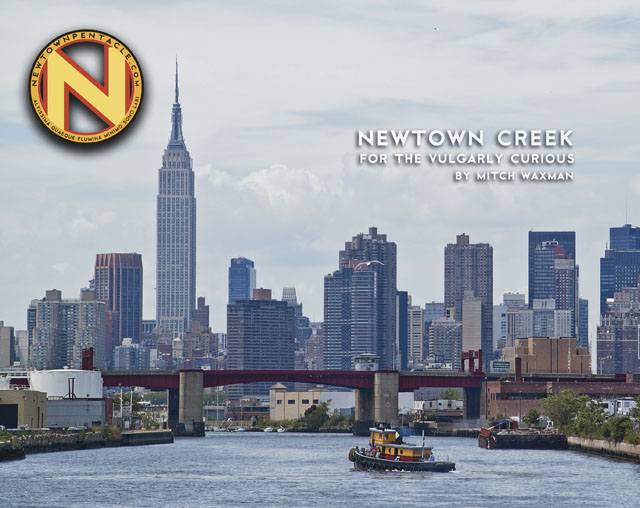
Here’s why so many posts in the last few weeks have been late, Lords and Ladies.
“Newtown Creek for the Vulgarly Curious” is a fully annotated 68 page, full-color journey from the mouth of Newtown Creek at the East River all the way back to the heart of darkness at English Kills.
Check out the preview of the book at lulu.com, which is handling printing and order fulfillment, by clicking here.
Every book sold contributes directly to the material support and continuance of this, your Newtown Pentacle.
“Newtown Creek for the Vulgarly Curious” by Mitch Waxman- $25 plus shipping and handling.


 The Newtown Pentacle