Posts Tagged ‘Maspeth’
Tales of Calvary 8- the Abbot

– photo by Mitch Waxman
While wandering through Calvary Cemetery recently, I came upon a curious monument whose sculptural elements included a life sized portrait, and whose dedication was meant to honor a man named Florence Scannell. The stone additionally bore a curious screed- “The Abbot”. “Dedicated to the memory of Florence Scannell by his brother John J.” is displayed prominently on its face. This stirred a sleeping memory, and I tried to remember why the name Scannell is so important. I said it out loud- John J. Scannell?
Wait a minute… John J. Scannell was the first chief of the NYFD, grand sachem of Tammany Hall, and a notorious turn of the century raconteur who became “king of the hill” in the often violent political world of 19th century New York City politics.
Bare knuckled, the electoral system back then resembled modern gang wars. Bearded men were paid to vote, taken to a barber shop for a shave and a shot of whiskey, and then paid to vote again. Paid armies of volunteers rousted saloons and bars that supported their political enemies. With political bosses paying the tab, taverns became organizing points for local “get out the vote” efforts. The poor didn’t care, for a day they could drink enough to forget and even eat a real meal- with meat, and all they had to do was vote the way they were told. The bosses were the bosses, and your place in “the line” could be revoked at any time if you fell out of favor with them. There was no “safety net”, so you had to just “go along”. Sometimes the other party would send gangs of street toughs into their opponents establishments- “bar busting”.
For more on the milieu of political life for the working class of the 19th century, I would suggest a gander at “The Jungle” Upton Sinclair’s “progressive” propaganda piece, or taking a peek at Jacob Riis’s “How the Other Half Lives“.
The Scannell brothers are described as having been engaged in such “bar busting” activities in 1869, when brother Florence ran for Alderman from the 18th ward against a Tammany candidate. At 23rd st. and second avenue, on Dec. 3rd, a Tammany man named Thomas Donaghue ran afoul of the Scannells, who were employed to “clean out” and “bust” the saloon he owned and operated.
from pbs.org
The year 1898 ushered in a new era of firefighting. On midnight of January 1, 1898, Greater New York was formed by uniting the five boroughs, Manhattan, Brooklyn, Queens, the Bronx, and Staten Island. The Board of Fire Commissioners was replaced by a single Commissioner, John J. Scannell, who had been head of the Board since 1894 and was appointed by Mayor R.A. Van Wyck. All of the area’s volunteer departments were to be replaced by the FDNY, and Chief Hugh Bonner assumed control of three paid departments: New York, Brooklyn, and Long Island; 121 engines, 46 trucks, one horse wagon, and a water tower; in all, 309 square miles of firefighting territory.

– photo by Mitch Waxman
The Scannells and a dozen of their men produced weapons and engaged in a fierce battle with Donaghue’s own crew of toughs. Gunfire erupted and Florence Scannel was shot in the back, the bullet embedding itself in his spinal column. Rushed to the nearby Bellevue Hospital, Florence suffered a lingering death, finally passing on July 10, 1870, with his brother John at his side. John J. Scannell swore an oath to avenge his brother, and kill the man who shot him in the back– the Tammany man, Thomas Donaghue.
Donaghue’s handlers fixed things up with the courts, and he returned to his familiar Saloon on 23rd st. and second avenue.
On Sept. 19th, at the corner of 17th and third, an odd looking man wearing a slouched hat and fake beard stepped out of the shadows and blasted a hole in Donaghue’s chest with a derringer pistol. Donaghue ultimately survived this attempt on his life, and Scannell discarded his disguise as he escaped his pursuers fleeing through Irving Place and Union Square. John J. later surrendered to a Police Sgt. after taking refuge on Long Island, and was indicted by a Grand Jury for the crime, but was never charged and released on $10,000 bail.
That’s $10,000 in 1870…
In November of 1872, Donaghue was attending an auction at the Apollo Theatre on 28th street, and a man wearing a cloak and slouch hat approached him. A large caliber pistol was produced and the middle of Donaghue’s face disappeared. Four more shots, three in the face, were pumped into the now prostrate Donaghue. The killer fled and was apprehended by a Police Captain named McElwain, who immediately identified the assassin as John J. Scannell. Such quick identification of Scannell was possible only because the arresting officer had been the one who arrested him for the the earlier attempt on Donaghue, when he was a Sgt.
The event was seminal, for as John J. Scannell sat in a gaol called “The Tombs”, another sat beside him. That night, John J. Scannell met Richard Croker. Someday, they would become “The Big Two” at Tammany Hall and rule over New York City.

– photo by Mitch Waxman
John J. Scannell was born on the lower East Side of Manhattan and found early work as a horse dealer- moving on to Saloon Keeper and then Professional Gambler. Charged with the murder of Donaghue, he pled insanity, and after a 3 month stint in an asylum in Utica, returned to local politics. He owned horses and raced them on the national circuit, as did Richard Croker. Rising in Tammany with his partner Croker, Scannell ran the 25th electoral district in Manhattan for many years, and desired the post of NYFD commissioner in that newly unified pile of gold called “the City of Greater New York”. Protests were recorded citywide, but Mayor Van Wyck appointed him chief of the newly unified citywide firefighting brigades. He served in that capacity until 1901, and fought corruption charges associated with his appointment until 1906 in court. At 67, in 1907, Scannell was sued for $15,000 for kissing the daughter of his housekeeper 3 times without consent.
Scannell died at 78 in Jamaica, Queens- far from his retirement estate in Freeport, L.I.
The Abbot, as it turns out, is a Horse.

– photo by Mitch Waxman
Scannell paid the scandalous amount of $26,500 at a Madison Square auction, the highest ever paid for a single Horse to that time, to purchase the Abbott.
That’s $26,500 in 1900…
The obituary for the Horse is actually longer than the one for the owner. The fact that Scannell engraved a Horse’s name on the monument to his dead brother, and his own eventual grave marker, shows the esteem felt by Scannell himself for the animal. Oddly enough, and this is a rare thing for Calvary Cemetery, The NYTimes once did an article on the raising of this monument which happened in 1914.
Hey, you never know what you’re going to find at Calvary Cemetery.
Tales of Calvary 7

– photo by Mitch Waxman
I just can’t sit on this one anymore. After a spree of “all cemetery” postings in November and December, I decided to take a step back from the grave, but I just can’t stop myself…
Promises would be offered to you, lords and ladies of Newtown, not to spend too much time amongst the dead in these first days of the new year, but I’d probably break them.
Paper fades, buildings fall, but Calvary is eternal and undying. Dripping in its centuried silence and nitre choked glory, the emerald desolations of Calvary Cemetery offer a pastoral transit between tumultuous neighborhoods in the Newtown Pentacle, and that weird old man in the filthy black raincoat you might glimpse as you drive by is often your humble narrator.

– photo by Mitch Waxman
On this particular day, a sunny Saturday (Thanksgiving weekend in 2009), I wasn’t transiting Calvary.
I had come here with a definite purpose, searching for the grave of a man who died in the early 30’s rumored to have been involved with the illegal smuggling of strange statuettes into the United States in the 1920’s from some impossibly remote pacific island. This man, a Massachusetts merchant named Gilman, was killed in a freak nocturnal accident, apparently by a bale of paper which had fallen out of some warehouse window along the Newtown Creek. His oddly deformed body was found by workmen the next morning, and the Coroner pronounced the death accidental. The victim was buried in Calvary’s public section as an act of charity, and under the assumption that Gilman was an Irish name. His belongings and personal valuables, made from some queer kind of gold sculpted into wild and heretical forms, were collected by a schooner captain whose three masted ship appeared unbidden at the Penny Bridge docks one night during an unnaturally thick fog. The Captain, a Massachusetts trader named Marsh, paid for a custom and eccentric grave marker to be erected for this Gilman fellow somewhere in Calvary. It remains elusive, but I shall find it- I found Al Smith!
As is often the case, my befuddled and inept investigations were swept wildly off course by a highly suggestible and credulous nature which makes me vulnerable to wild flights of shivering cowardice and shameful paranoia. Such timidity does not suit one who stands and stares into whatever abyss happens to be before him, and what I saw chilled me with its wild possibilities. It was Thanksgiving weekend, and Calvary was as quiet as… well… a tomb.

– photo by Mitch Waxman
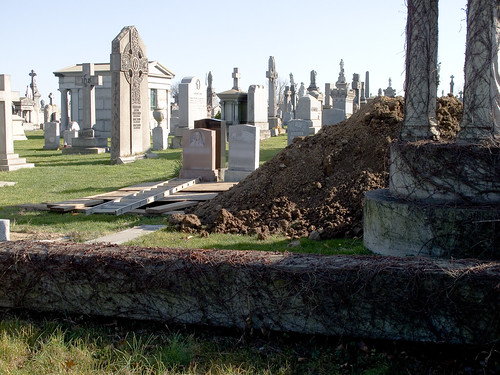
As seen in the above shots, the overgrown monument with its vine covered cupola intrigued and drew my attention. In accordance with usual methods, the object was photographed from many angles, and my path led me widdershins around it. As mentioned in the last paragraph, thanksgiving weekend had evinced a general evacuation of the area surrounding that bulkheaded duct of urban horror called the Newtown Creek, and like their counterparts in the spires of Manhattan it would seem that the workers of Calvary got off early on the previous Wednesday. Just dropped their shovels, as it were.
That’s when I saw it, said “oh. oh… no… just keep walking… don’t take any pictures of…”. Unfortunately, my finger was already depressing the button on my camera. I had lost all control, and still can’t stop myself from posting about it weeks later… I’m all ‘effed up.
– photo by Mitch Waxman
In the interest of full disclosure, the names on the two grave markers are obscured as they were modern burials. If a grave is at least older than me, I feel fine about publishing a photo or talking about who it holds. If it’s an early 1900’s burial- fair game. (note: a cool thing happened recently- a sepulchral portrait, randomly chosen and published in the Mt. Zion series of postings, resulted in a certain Pentacle reader seeing his grandmother’s face for the first time) These interments, however, date from the early 1990’s and later. The context of this post demands some discretion, and censoring the names of the deceased whose graves are seen is definitely the right thing to do.
Now on to something you don’t normally see… and I am cognizant that the presentation of the following is vulgar and in very bad taste. I just can’t stop myself… Its like some alien thing is controlling me…

– photo by Mitch Waxman
There is a limited amount of time that one can tolerate solitary exposure to Calvary Cemetery, as the marble crown of Laurel Hill is a sort of psychic Chernobyl. It preys upon you- this place- in subtle ways, and comes at you in a manner not unlike the gradual stupefaction brought on by liquor. On New Year’s Eve, someone offered me three plots here for free, and withdrew the offer when I explained what a gravesite in Old Calvary is actually worth. Coincidence? hmmm… The place has noticed me, and it is trying to draw me further in…
Like ionizing radiation, whose damage to healthy living flesh is calculated by a multiplex of intensity and duration, whatever it is that lurks in the aether of Calvary is invisible, insidious, and real. Looking into an open grave like this, in this place, carries the comparable psychic risks of unshielded exposure to the thermonuclear eye of god itself.

– photo by Mitch Waxman
What I can’t do, is use my favorite catch phrase. The “who can guess…” one. Horrors too horrible for the graves holding lurk into the abyss, and loathsomeness waits below, but…
That’s what I was thinking as I passed out, again, in a dead faint. Luckily I fell backwards.
Mt Zion 6- Crystal Oblivion

– photo by Mitch Waxman
Awakening from the dead faint which had ended my ruminations on those oppressions suffered by both Jew and Roma in a war torn exemplar of peasant ignorance and malign oligarchy which is the European Peninsula, your humble narrator noticed the gloaming of late afternoon settling upon the centenarian graveyard and realized that one way or another- an escape must be hazarded from the oblivion of Mount Zion cemetery if I ever desired to return to the yellow brick lanes of Astoria.

– photo by Mitch Waxman
The curious singsong chant of those odd children had stopped, and echoing along the tombstones was the sound of wholesome and cheerful laughing. From my vantage, I could discern that the first group of children were fleeing from a second, whose colorful clothing and raven hair marked them as the picturesque crowd I had spotted earlier on 53rd avenue. The flabby jowled, unblinking, scaly group of youths which had been tormenting me- and whose apparent leader was a girl carrying a curiously polydactyl cat whose aspect “I did not like”- were running off in the direction of that stygian cataract called the Newtown Creek.

– photo by Mitch Waxman
Regaining my composure, I realized that I had found the highest spot in Zion, and watched as the group of dark haired and festively adorned children jeered the fleeing “others”. I turned for a moment, looking south toward Brooklyn, along the gates of a Sanitation Dept. Garbage truck depot. This is a lonely spot, tragic and shunned.

– photo by Mitch Waxman
Populated by graves of children, often stillborn, this is the highest point of elevation in Mt. Zion by my estimation. I resolved to make my way for the gates, and felt an eerie tiredness take over me. Cemeteries are uncomfortable places not because of the omnipresent reminders of mortality, but because they remind us that anonymity is the ultimate fate of nearly all of us.

– photo by Mitch Waxman
All they were, and had done, and built- the ultimate meaning of themselves- led to centuried silence and the anonymity of the tomb. I’ve been asking myself, lately, why I’ve been so compelled to spend my time with them, instead of amongst the living. A lot of wise old jewish grandmothers are buried here, and my own would say that this recent pursuit is “no good for you, go see a movie instead”.
She also told me, when I told her I intended to follow a career in visual arts, that “all I wanted was to be a bum in the village with a needle in my arm”.

– photo by Mitch Waxman
Mission Statements – 1 – Breaking character
One of my quasi mystical opinions is that by telling a story, transmitting the lore of civilization from one generation to another, you keep the subject of the story alive- in a sense. We know the story of Beowulf, and Christ, and Churchill. In my ham handed and alliterative patois of pop cultural imagery and historical allusion, this notion of “telling the hero’s story” (with the “hero” being the working class) is part of my motivation behind these explorations. In a sense, I fancy myself as C-3PO telling the story of Luke and Leia to the Ewoks.

– photo by Mitch Waxman
Mission Statements – 2 – Horns and Dilemmas
A vast and shining monument to future archaeology is what I see the Cemetery Belt of western Queens and North Brooklyn as, awaiting the end of living memory and improved imaging technology. Vast dilemmas of conscience often plague me as I make the “selects” from the hundreds of shots I’ll gather at just one of the many locations explored at the Newtown Pentacle. That’s an identifiable face, or corporate trademark, or the ridiculous laws which require the owner of a skyscraper to approve the publication of an image of their structure. The graveyard stuff is touchy, and I attempt to only show graves of those who died well out of “living memory”, which is a flexible topic for me.

– photo by Mitch Waxman
Mission Statements – 3 – Contradictions and Logic
Problematic, because it’s self defined, my “living memory” concept is roughly this- if the stone is older than the second world war- I consider it fair game and part of the public record. Saying that, if you’ve seen a gravestone of a relative in one of my shots that you’d really rather not have public, contact me and it’s pulled (I’m not a dick)- just know that the shot was chosen for either its odd qualities or historical significance (like the O’Brien monument in Old Calvary), or because it’s a beautiful piece of sculpture that was chosen to illustrate the esthetic or political milieu of an era I’m trying to describe. Any editorial implications of the accompanying quoted references (from abc.com, in italics) or “humble narrator” copy should be discarded as the product of a sick, cowardly, and weary man who is “all ‘effed up”. No one will visit my grave, Lords and Ladies of Newtown, except to gloat and defecate.
I also never trespass, enter onto Railroad properties uninvited, or use transportation of any kind other than my feet when I’m out on one of my little missions. Kissing the right posterior and being “nice” offers tremendous access to these places, “legally”, and brings insight and opportunity. Why make trouble?

– photo by Mitch Waxman
Back to the post:
When I passed out of the ancient cemetery, through the western section’s gates, I saw that group of gaily dressed children who had chased off those menacingly mutant urchins that had caused me to faint three times as I hid in the shadows of this garden of obelisks.
One of the oddest moments of the day occurred when a waste hauler’s truck sped down Maurice Avenue at top speed, occluding my view of them for a few seconds, during which they disappeared. Puzzled, I scuttled back to the waiting arms of Astoria, and the entire way I thought I heard the creaking agony of wooden carriage wheels.
Mt Zion 5- Sunken Houses of Sleep

– photo by Mitch Waxman
Steeling myself for the inevitable humiliating encounter with those oddly menacing children who seemed to be waiting for my reemergence on Maurice Avenue, I moved down the hill from the 58th street side of the burial grounds.
Older than my years, vast psychological inadequacies and shameful physical “episodes” render your humble narrator a helpless emotional cripple. Even the thought of direct confrontation with that which may exist around the Newtown Creek- or because of it- is enough to make me lightheaded and coat my skin in cold sweat. Staying out of sight, I broke into a dogtrot instead of my usual scuttle, and continued along the central artery of Mount Zion Cemetery. On the hill is the DSNY’s gargantuan Queens West Garage complex and an accompanying garbage incinerator.

– photo by Mitch Waxman
The counterpoint of a Jewish Cemetery next door to an industrial incinerator is obvious and exhibits poor municipal siting, conversely this is probably an ideal location for such industry. Western Queens is the backbone of New York City, from a metropolitan industrial complex’s point of view.
Airports, railroad yards, maritime facilities, petrochemical storage and processing, illegal and legal dumping, sewer plants, waste and recycling facilities, cemeteries. The borders of the Newtown Pentacle’s left ventricle are festooned with heavy industry and the toll taken on the health of both land and population is manifest. A vast national agglutination of technologies and a sprawl of transportation arteries stretching across the continent are all centered on Manhattan- which is powered, fed, and flushed by that which may be found around a shimmering ribbon of abnormality called the Newtown Creek.
from jhom.com
The lion motif was common in the ancient Middle Eastern civilizations as a battling, fighting and attacking force. In the Bible, the lion is portrayed as both capable of destroying and punishing, and of saving and protecting. In ancient Jewish art we find the lions in this protective role, guarding the Holy Ark or at the entrances to the chapel, as in the sculpture of the ancient synagogues at Sardis (in Asia Minor), Horazin and Bar’am (in Palestine), and in many mosaics dating from the early Byzantine period.

– photo by Mitch Waxman
But that’s the “why” of how these people came to be buried in America, of all places.
They weren’t coming to be free (that’s Roosevelt talking), most of them, except to be free of poverty and warfare.
In 1894, when Mrs. Chasnov, (pictured below) was born, the last Tsar of Russia took his throne succeeding his father Tsar Alexander 3. Anarchists were tossing bombs in European capitals, and in New York City- the “Robert Moses” of the 19th century, Andrew Haswell Green, formed the American Scenic and Historic Preservation Society.
In 1894, the last known antichrist was only 5 years old, and lived near Linz.
from wikipedia
The stele, as they are called in an archaeological context, is one of the oldest forms of funerary art. Originally, a tombstone was the stone lid of a stone coffin, or the coffin itself, and a gravestone was the stone slab that was laid over a grave. Now all three terms are also used for markers placed at the head of the grave. Originally graves in the 1700s also contained footstones to demarcate the foot end of the grave. Footstones were rarely carved with more than the deceased’s initials and year of death, and many cemeteries and churchyards have removed them to make cutting the grass easier. Note however that in many UK cemeteries the principal, and indeed only, marker is placed at the foot of the grave.

– photo by Mitch Waxman
This is the generation that “it” happened to.
Not these people, of course, who were safe in America- but their cousins and parents and friends who had stayed back in ancient Europe. They saw the Great War play out, displacing millions, and thought that at last the eternal struggles between Hapsburgh and Austrian and Turk and Frenchman and Russian had sorted themselves out.
It wasn’t just Jews, or Irish, or Italians- even the Roma came to America to find work. And the skills possessed by the Cunning Folk were older than the narrow streets of Rome, or the impenetrable complexity of the New York of its time- London, or even the lost city of pillared Irem in the pathless deserts of Arabia.
from nytimes.com
Maspeth is named for the Mespat Indians, who originally settled near what is now Mount Zion Cemetery, on the neighborhood’s edge. In 1642, the first formal colony was established in the area, though conflicts with Indians caused settlers to flee east into what is now Elmhurst.
Mount Olivet Cemetery boasts a much-cherished Manhattan view, and Nathanael West, who wrote “Miss Lonelyhearts” and “The Day of the Locust,” is buried at Mount Zion.

– photo by Mitch Waxman
In Europe, hatred of the Hebrew race has some understandable historical underpinnings. The Moorish and Turk governments employed Jews as officials and clerks, often assigning them as tax collectors to the serf and freeman villages of their conquests. After a period of time, when the islamic tide had been pushed back by Russian, German, Pole, and especially the Wallachian and Hungarian states, the Jews were left behind.
When Peter the Great settled Jews in the so-called “Pale”, it was meant to be a punishment for the Szhlactas and Boyars (Barons and Dukes) who had opposed him. Ultimately, anti-semitism is a political thema which took root and transformed into something cultural.
Hatred of the Roma, though, is something else entirely.
from junipercivic.com
In the vicinity of Mount Zion and lower Calvary cemeteries were swamps. Frogs, polywogs, goldfish were plentiful among the tall cattails and were sport for young boys. Punks were plentiful among the cattails, the plump brown ones were cut down, dried in the sun and when lit gave off an aromatic scent that was not only pleasing to the smell, but was said to keep away mosquitoes which were a nuisance.

– photo by Mitch Waxman
Lingering at the suggestively open door of a tomb, trying to ignore the singsong chant of those menacing children, your humble narrator began to once again feel light headed.
also from junipercivic.com
A short distance away along Maurice Avenue, was a Gypsy Camp. A core group of gypsies lived there permanently and others came from far and wide to visit. Colorfully dressed in gypsy regalia, they danced, sang, and partied, cooking suckling pigs on spits over roaring fires and living in ramshackle huts and tents. For them a carefree existence, but I must admit, for the local lads and lassies a somewhat frightening scene and we watched from afar. When a member of the tribe died, the wake was most often held in Vogel’s Funeral Parlor which was located on Grand Avenue opposite the main entrance to Mount Olivet Cemetery. Gypsies from all around the country would come to pay their respects, especially if the deceased was a member of the Royal family.

– photo by Mitch Waxman
Metal working, particularly copper smithing, that’s what the Ludar- or as the modern Croats and Bosnians call them- the Rudari- were famed for and that’s most likely how they ended up in Maspeth. That and their skill in training animals.
Ever wonder why the annual tradition of the Circus trains coming to LIC and Maspeth, with its spectacle of Elephants marching through the Midtown Tunnel, started? The Rudari were animal trainers, as well as being copper workers. The metal shaping work was an inheritance- Rudar means miner- which is what this tribe of Roma was forced to do during their enslavement to the princes of Europe. After their suffrage, they became trainers of bears, monkeys, and horses for circuses.
All this continued in America.
Incidentally, in Romania, the Rudari were known as the Ursari. The royal potentate that ruled over them was the Voivode of the Wallachian Throne, seated high in the Carpathian Mountains, and in the 15th century- that throne was occupied by Vlad Tepes.
Dracula, as known in the west, and the gypsies mentioned in Stoker’s book were the Ursari, or Rudari.
from wikipedia
Following the immigration waves of the 19th century, Maspeth was home to a shanty town of Boyash (Ludar) Gypsies between 1925 and 1939, though this was eventually bulldozed.

– photo by Mitch Waxman
Just what kind of place is this Newtown Pentacle, anyway?
That’s the last thing I thought, another “very bad idea”, before I passed out again in another dead faint.
The Ludar, or “Romanian Gypsies,” also immigrated to the United States during the great immigration from southern and eastern Europe between 1880 and 1914. Most of the Ludar came from northwestern Bosnia. Upon their arrival in the United States they specialized as animal trainers and showpeople, and indeed passenger manifests show bears and monkeys as a major part of their baggage. Most of de Wendler-Funaro’s photographs of this group were taken in Maspeth, a section of the borough of Queens in New York City, where the Ludar created a “village” of homemade shacks that existed from about 1925 to 1939, when it was razed. A similar settlement stood in the Chicago suburbs during the same period.
Mt Zion 4- A Lurid Shimmering of Pale Light

– photo by Mitch Waxman
Befuddled by the sing song chantie evinced by those horrible children, in whose frog like faces your humble narrator found some nameless dread and whose terrible attention initiated his flight into sylvan Mount Zion, I wandered in a haze of unknowable panic through the 72 acre graveyard. Notions of familiar aspect- the smiling face of “our Lady of the Pentacle”, the friendly greeting of my little dog- Zuzu- kept me grounded and allowed me to ignore some of the macabre details of the landscape. Crazed, however, my racing thoughts began to tangentially ruminate…
from wikipedia
Kevura, or burial, should take place as soon as possible after death. The Torah requires burial as soon as possible, even for executed criminals. This means that burial will usually take place on the same day as death, or, if not possible, the next day. Some Reform and other congregations delay burial to allow more time for far-flung family to come to the funeral and participate in the other post-burial rituals.
The traditional practice may have originated from the fact that Israel was, and is, a country with a hot climate. In Biblical times, there were few ways of keeping the dead body from decomposing. Not only would this be generally undesirable, but allowing the dead body of any person to decompose would be showing that person great disrespect. Decomposition would have occurred especially quickly in Israel due to the constant heat. Thus, the custom of burying the body as soon as possible. (Although the practice of embalming and mummification had advanced to a high level in Egypt, this, too, is considered disrespectful, since it involves a great deal of manipulation and the removal of bodily organs.) In addition, respect for the dead can be seen from many examples in the Torah and Tanakh. For example, one of the last events in the Torah is the death of Moses when God himself buries him: “[God] buried him in the depression in the land of Moab, opposite Beth Peor. No man knows the place that he was buried, even to this day.” (Deuteronomy 34:6)

– photo by Mitch Waxman
My eyes shot from side to side, the tombstones led me to a fortified enclosure, and half remembered minutiae nervously filled my mind…
The tiny stones, often adorned with a lamb, are the graves of children.
Vulnerable to a host of infections which have been conquered by modern science (at least in the west), the large families characteristic of the pre World War 2 era were an insurance policy for a bloodline’s future in a world without antibiotics. Don’t forget, even the son of an American President died in 1862, most likely from Typhoid fever after drinking tainted water. As late as 1963, the son of John Kennedy died from a disease whose mortality is reduced to 15% in modernity. In my own family- Great Grandmother had 13 children, of which only 7 survived to adulthood. Of the 7 survivors- all of whom emigrated to the United States prior to 1920, all of their children (with the exception of one gruesome early death due to a malfunctioning boat propellor) lived into -at least- their late 60’s, and almost all of their grand kids are still around. In the developing world, infant mortality figures are consistent, however, with the larger experience of historical record as represented at Mount Zion.
from wikipedia
Some have a custom to visit the cemetery on fast days (Shulchan Aruch Orach Chayim 559:10) and before Rosh Hashanah and Yom Kippur (581:4, 605), when possible, and for a Yahrzeit. During the first year the grave may be visited on the shloshim, and the yartzeit.
Even when visiting Jewish graves of someone that the visitor never knew, he or she may place a small stone at the graveside. This shows that someone visited the graveside, and represents permanence. Leaving flowers is not a traditional Jewish practice. Another reason for leaving stones is tending the grave. In Biblical times, gravestones were not used; graves were marked with mounds of stones, so by placing (or replacing) them, one perpetuated the existence of the site. This was also helpful for Cohanim, who needed to avoid spiritual impurity that could be passed on by corpses/graves.

– photo by Mitch Waxman
Trapped in a thanatic trance… eternally staring ceramic eyes accusing me… if only those nightmare children would stop their singing…
Many of the older headstones at Mount Zion, whose creeds list the age of the deceased, indicate a world where life was short. Men dropped off in their middle 40’s and 50’s with a few remarkable individuals who survived into their 60’s. Women were either longer lived- no doubt due to the domestic captivity they suffered which insulated them from the dangerous industrial milieu that typified the manufacturing and agricultural occupations of the males- or died in childbirth (leading cause of female mortality throughout recorded history) due to septic conditions or uncontrollable bleeding.
It cannot be stressed enough, how different the lives of these generations were from our own- and whatever its flaws are- that our age represents something wonderful, unique, and unheralded in the rich pageant of human history.
from wikipedia
Odor, color changes, and bloating of the body during decomposition are the results of putrefaction. The lower part of the abdomen turns green due to bacteria activity in the cecum. Bacteria break down hemoglobin into sulfhemoglobin which causes the green color change. A formation of gases enters the abdomen which forces liquids and feces out of the body. The gases also enter the neck and face, causing swelling of the mouth, lips, and tongue. Due to this swelling and misconfiguration of the face, identification of the body can be difficult. Bacteria also enter the venous system causing blood to hemolyze. This leads to the formation of red streaks along the veins. This color soon changes to green, through a process known as marbelization. It can be seen on the shoulders, chest and shoulder area, and thighs. The skin can develop blisters containing serous fluid. The skin also becomes fragile, leading to skin slippage, making it difficult to move a body. Body hair comes off easily. The color change of the discoloration from green to brown marks the transition of the early stage of putrefaction to the advanced decompositional stages.
During the putrefaction stage of decomposition the majority of insect activity again comes from members of the Calliphoridae family, and includes Formicidae, Muscidae, Sphaeroceridae, Silphidae, Lepidoptera, Hymenoptera, Sarcophagidae, Histeridae, Staphylinidae, Phalangida, Piophilidae, Araneae, Sepsidae, and Phoridae. As with the fresh stage of decomposition if the body is on the ground or buried in soil there is also considerable insect activity by the soil-inhabiting arthropods.

– photo by Mitch Waxman
The generations born after Napoleon and after the American Civil War- with their legendary corruption, abhorrent wars of genocide, and brutal subjugation of the ancient East- conversely built the edifice of Modernity. The “system”- university education, compulsory literacy, sewer systems, municipal projects of great scope, the elevation of law and finance over heredity and martial prowess, universal suffrage, the corporations. They are the ones who built it, their kids and grandchildren proved it’s efficacy in the second thirty years war (ww1 and ww2), their great grandkids rebelled against it. We are the ones who live in what’s left of it.
from wikipedia
After the body goes through the bloating stage it begins the black putrefaction stage. At this point the body cavity ruptures, the abdominal gases escape and the body darkens from its greenish color. These activities allow for a greater invasion of scavengers, and insect activity increases greatly. This stage ends as the bones become apparent, which can take anywhere from 10 to 20 days after death depending on region and temperature. This period is also dependent on the degree to which the body is exposed.
During the black putrefaction stage of decomposition, insects that can be found living in the body are Calliphoridae larvae, Staphylinidae, Histeridae, Gamasid mites, Ptomaphila, Trichopterygidae, Piophilid larvae, Parasitic wasps, Staphylinid larvae, Trichopterygid larvae, Histerid larvae, Ptomaphila larvae, Dermestes, Tyroglyphid mites, Tineid larvae, and the Dermestes larvae. Some insects can also be found living in the soil around the body such as Isopoda, Collembola, Dermaptera, Formicidae, Pseudoscorpiones, Araneae, Plectochetos, Acari, Pauropoda, Symphyla, Geophilidae, and Protura. The types of insects will differ based on where the body is, although Diptera larvae can be found feeding on the body in almost all cases.
After the body goes through the bloating stage it begins the black putrefaction stage. At this point the body cavity ruptures, the abdominal gases escape and the body darkens from its greenish color. These activities allow for a greater invasion of scavengers, and insect activity increases greatly. This stage ends as the bones become apparent, which can take anywhere from 10 to 20 days after death depending on region and temperature. This period is also dependent on the degree to which the body is exposed.During the black putrefaction stage of decomposition, insects that can be found living in the body are Calliphoridae larvae, Staphylinidae, Histeridae, Gamasid mites, Ptomaphila, Trichopterygidae, Piophilid larvae, Parasitic wasps, Staphylinid larvae, Trichopterygid larvae, Histerid larvae, Ptomaphila larvae, Dermestes, Tyroglyphid mites, Tineid larvae, and the Dermestes larvae. Some insects can also be found living in the soil around the body such as Isopoda, Collembola, Dermaptera, Formicidae, Pseudoscorpiones, Araneae, Plectochetos, Acari, Pauropoda, Symphyla, Geophilidae, and Protura. The types of insects will differ based on where the body is, although Diptera larvae can be found feeding on the body in almost all cases.

– photo by Mitch Waxman
An industrial complex, the purveyors of doomsday tell us that the world is ending, and we greedily consume the news. Our society is failing, and will collapse soon.
A mythology of the “good old days” pervades and poisons, dividing populations over semantic points. A foreign enemy, barbarian savages devoid of mercy, threaten us. Our children are running wild, dispossessed of religious scruple or moral code. All that stands on the line between chaos and order are a self appointed few, lettered oligarchs whose accumen and opinion is never questioned. This environment of fear, a pervasive political meme, is false. It is also quite ancient, as the text above describes Constantinople.
Tonight, both a functional and statistical number of human beings will have food in their bellies when they go to sleep, as opposed to yesterday. More women will survive childbirth today than yesterday. Even the operatic tragedy of modern times, which is the AIDS epidemic in Sub Saharan Africa, is a disease- ultimately- of relative affluence and OVERpopulation. Corpus Mundi, things are not as bad as they seem to be, gentle readers. There’s a lot of bad, but as compared to even a mere 80 years ago, there’s also good.
from wikipedia
After the early putrefaction and black putrefaction phases have taken place, the body begins mummification, in which the body begins to dry out. The human carcass is first mummified, and then goes through adipocere formation. Adipocere (grave wax) formation refers to the loss of body odor and the formation of a cheesy appearance on the cadaver. Mummification is considered a post-active stage because there is less definite distinction between changes and they are indicated by reduced skin, cartilage, and bone. Mummification is also indicated when all of the internal organs are lost due to insect activity.
Insects that can be found on the body during mummification include most of the same insects as in putrefaction stage, but also include Acarina, Nitidulidae, Cleridae, Dermestes caninus, and Trogidae. The main soil-inhabiting arthropods include Dermaptera and Formicidae.

– photo by Mitch Waxman
The leading cause of death in the United States in the first decade of this 21st century is Heart Disease, followed by various forms of Cancer. Your humble narrator has some small experience with the first and has resigned himself to the inevitability of the second, as he lives on a continent where Nuclear Testing was conducted.
note:
If all the Atomic tests are considered together when calculating radiation exposure to the civilian population of North America, a full scale nuclear war might as well have been fought here, and the bell curve of nuclear testing lays neatly into the rates of cancer experienced 25-30 years later. Tourist groups may visit the Frenchman Flats testing site- a “national sacrifice zone” for excursions amongst the cratered sites of Atomic detonations, I’d rather drink a glass of that queerly coloured effluviam which flows lugubriously through a crucible of dictatorial capitalism called the Newtown Creek.
Congenital illness, which medicine hasn’t figured out how to deal with -yet- notwithstanding, that which kills you these days is not an infected mosquito bite- or any of the leading causes of death in the 19th century- Pneumonia, Tuberculosis, and Diarrhea – instead its eating too much of the wrong food… which is plentiful.
Back in 1900, life expectancy was 49. Heart Disease was almost the number 4 killer, and strokes were number 5.
Number 5 is “accidents”, today. Life expectancy is almost 80.
from wikipedia
When the last of the soft-tissue has been removed from the body, the final stage of decomposition, skeletonization, occurs. This stage encompasses the deterioration of skeletal remains, and is the longest of the decomposition processes. Skeletonization differs markedly from the previous stages, not only in length, but in the deterioration process itself.
The strength and durability of bone stems from the unique protein-mineral bond present in skeletal formation. Consequently, changes to skeletal remains, known as bone diagenesis, occur at a substantially slower rate than stages of soft-tissue breakdown. As the protein-mineral bond weakens after death, however, the organic protein begins to leach away, leaving behind only the mineral composition. Unlike soft-tissue decomposition, which is influenced mainly by temperature and oxygen levels, the process of bone breakdown is more highly dependent on soil type and pH, along with presence of groundwater. However, temperature can be a contributing factor, as higher temperature leads the protein in bones to break down more rapidly. If buried, remains decay faster in acidic-based soils rather than alkaline. Bones left in areas of high moisture content also decay at a faster rate. The water leaches out skeletal minerals, which corrodes the bone, and leads to bone disintegration.
At the dry decay stage commonly found insects include Sphaeroceridae, Acarina, Nitidulidae, Cleridae, Dermestes caninus, Trogidae, Tyroglyphid mites, and the Tineid larvae. The soil-inhabiting arthropods are Collembola, Dermaptera, Heteroptera, Coleoptera and their larvae, parasitic Hymenoptera, Formicidae, Diptera larvae, Pseudoscorpiones, Aranae, Plectochetos, Acari, Pauropoda, Symphyla, Geophilidae, Protura, and Aphididae.

– photo by Mitch Waxman
Still lost in those wild reveries as described above, I found myself moving ever higher in elevation. A significant and curious declination is found in Mount Zion, and as one nears the western edge of the cemetery- near the 58th street side- it becomes obvious. This was an excellent instinct which I followed, as the distance from both Maurice and 54th avenues eliminated the malefic influence of the bizarre children’s song.
Another group of children, wholesome looking urchins whose appearance was a marked contrast to that malign gathering on Maurice Avenue, appeared along the fences. They were dark and wholesome in aspect, with masses of wild black curls. Colorfully dressed, they were laughing cheerfully as they ran back and away from the vast iron gates along 53rd avenue. An odd chemical scent hung in the air and seeking a fresh breeze, I penetrated further westward.
from wikipedia
As practiced in the funeral homes of the Western World (notably North America), embalming uses several steps. Modern embalming techniques are not the result of a single practitioner, but rather the accumulation of many decades, even centuries, of research, trial and error, and invention. A standardized version follows below, but variation on techniques is very common.
The deceased is placed on the mortuary table in the supine anatomical position with the head elevated by a head block. The first step in embalming is to check that the individual is in fact deceased, and then verify the identity of the body (normally via wrist or leg tags). At this point embalmers commonly perform basic tests for signs of death, noting things such as clouded-over corneas, lividity, and rigor mortis or by simply attempting to palpate a pulse in the carotid or radial artery. In modern times people awakening on the preparation table is largely the province of horror fiction and urban myth. Any clothing on the corpse is removed and set aside and any personal effect such as jewelry is inventoried. A modesty cloth is sometimes placed over the genitalia. The corpse is washed in disinfectant and germicidal solutions. During this process the embalmer bends, flexes and massages the arms and legs to relieve rigor mortis. The eyes are posed using an eye cap that keeps them shut and in the proper expression. The mouth may be closed via suturing with a needle and ligature, using an adhesive, or by setting a wire into the maxilla and mandible with a needle injector, a specialized device most commonly utilized in North America and unique to mortuary practice. Care is taken to make the expression look as relaxed and natural as possible and ideally a recent photograph of the deceased while still living is used as a template. The process of closing the mouth, eyes, shaving, etc is collectively known as setting the features.

– photo by Mitch Waxman
The aforementioned change in elevation is a morrain feature, whose glaciated sculpting endowed this corner of the Newtown Pentacle with a marshy and swamped character, in its aboriginal form. These were once -what modernity would define as- wetlands, or as the 19th century would define it- waste lands. A muddy filtration system for the Newtown Creek and part of its aquifier, these were once prime hunting grounds for Indian and Dutchman alike.
from wikipedia
Embalming chemicals are a variety of preservatives, sanitising and disinfectant agents and additives used in modern embalming to temporarily prevent decomposition and restore a natural appearance for viewing a body after death. A mixture of these chemicals is known as embalming fluid and is used to preserve deceased (dead) individuals, sometimes only until the funeral, other times indefinitely.
Typically embalming fluid contains a mixture of formaldehyde, methanol, ethanol and other solvents. The formaldehyde content generally ranges from 5 to 29 percent and the ethanol content may range from 9 to 56 percent.
In the United States alone, enough embalming fluid is buried every year to fill eight Olympic-size pools or about 20 million liters.

– photo by Mitch Waxman
That’s when another of my “very bad ideas” came to the fore, when I wondered what it is that might be lurking down there, in the wormy mud of the Newtown Pentacle.
all but one of these links lead to wikipedia, and express just a little bit of the chemical recipe that produces an anaerobic broth like that found in the Newtown Creek
Putrescine (sometimes spelled putrescin) is an organic chemical compound NH2(CH2)4NH2 (1,4-diaminobutane or butanediamine). It is related to cadaverine; both are produced by the breakdown of amino acids in living and dead organisms and both are toxic in large doses.
Cadaverine is a foul-smelling molecule produced by protein hydrolysis during putrefaction of animal tissue. Cadaverine is a toxic diamine with the formula NH2(CH2)5NH2, which is similar to putrescine. Cadaverine is also known by the names 1,5-pentanediamine and pentamethylenediamine.
The industrial form of Putrescine is produced using hydrogen cyanide and a compund called Acrylonitrile, which is on the EPA’s list of Volatile Organic Compounds– or VOC’s. As long time readers will recall, VOC’s are amongst the primary pollutants fouling the waters of a nearby cautionary tale called the Newtown Creek.


 The Newtown Pentacle