Posts Tagged ‘Monongahela River’
Fort Pitt Bridge, part 1
Tuesday

– photo by Mitch Waxman
A man has to have a code, I opine. One of the many points in my personal credo involves getting out every other day to point the camera at things and walk around. Back in NYC, when a spell of ugly weather was being described by the meteorological enthusiasts, I’d often say to Our Lady of the Pentacle that “I’m going to go ride the trains” and I’d take off for the 7 line, and spend a few hours hopping on and off of the train getting shots of NYC’s most photogenic subway. Not an option, now, of course.
Amongst the many other bits of wisdom my code offers is “it’s better to regret something you’ve done than something you didn’t do” and that “if you regret something you’ve done, you can’t take it back or apologize to the party you’ve wounded so don’t feel guilty, just don’t do that thing again.” Also – “stop fucking up.” I do realize how sociopathic that sounds, but it’s true.

– photo by Mitch Waxman
“Nothing matters and nobody cares” was added into the code during the COVID period. “Don’t skimp on shoes, hats, or eyeglasses” is another bit of sage wisdom I can offer. One of my big revelations from the last year involves a concept I call “the conservation of energy.”
Expending energy into fixing a closed system is a waste of effort. You could put all the effort into it you want, but if a closed system is designed to fail, expanding the system with an input of energy isn’t going to change that. Sometimes it’s just best to do or say nothing at all. One of my “things” these days is to listen to people arguing about some hot button political topic of the day and then announce “I’ve got an opinion about that,” whereupon I leave the room without sharing it.

– photo by Mitch Waxman
The Fort Pitt bridge in Pittsburgh, on the other hand, is quite material and doesn’t require a personal code of conduct other than not vandalizing or jumping off of it. The bridge dates back to 1959, and connects downtown Pittsburgh to its southern surroundings via Interstate 376 which is carried on its two decks. The pedestrian walkway is attached to the lower deck, overlooking the confluence of the three rivers. Interstate 376 traffic moves to and from the Fort Pitt Tunnel (opened in 1960) which is punched through the base of Mount Washington. A notable destination on the other side of the tunnel for some of this traffic flow is the Pittsburgh International Airport. This is the third bridge to span the Monongahela River in this spot, and the first one was erected in 1877. According to 2018’s official numbers, the bridge handles about 150,000 vehicle trips a day.
Since I’ve been living here in Pittsburgh, walking over this one has been on my to-do list.

– photo by Mitch Waxman
As you can see, zero effort was made to clear the walkway of snow and ice by its stewards, and the footing was quite treacherous. Couple that with waist high fencing along the drop to your death side of the path, and I made it a point of sticking close to the girders that support this double decked steel bowstring arch bridge should a handhold be required.
My plan for the day, which was mentioned in yesterday’s post, was to leave the car back at home and use the T light rail to get to and from HQ. After crossing the bridge, I’d head towards another stop on the T that’s less than a mile from where the pedestrian walkway would return me to Terra-Pennsylvania.

– photo by Mitch Waxman
While you’re walking along the path, just over your shoulder is an interstate carrying hurtling vehicles. As I’ve mentioned in the past, driving here is very, very different than it is back in NYC. I’ve got a practiced advantage when it comes to merging lanes, parallel parking, and a general obeisance to traffic law. Pennsylvania drivers seem to believe that the speed limit is a mere suggestion, or perhaps a starting point. I’ve driven this path before, and had people shoot past me at 70 while trying to handle a three lane merge within a few hundred feet. Brrrr.
Another one of my sage bits of wisdom is “you’ll get there when you get there, what’s the rush.” I should mention that I’m not at all naturally wise, instead there isn’t a mistake you can make that I haven’t already made. Remember rule number 4 – “stop fucking up.”

– photo by Mitch Waxman
This particular section of the walkway, leading down and away from the bridge towards the Duquesne Incline, was a positive skating rink. Hard packed ice with a layer of dry powder snow sitting loosely atop it. Luckily, I’m used to dealing with uneven, unmaintained, or challenging terrain.
More tomorrow at this – your Newtown Pentacle.
“follow” me on Twitter- @newtownpentacle
Buy a book!
“In the Shadows at Newtown Creek,” an 88 page softcover 8.5×11 magazine format photo book by Mitch Waxman, is now on sale at blurb.com for $30.
Investigating the GAP, part three
Friday

– photo by Mitch Waxman
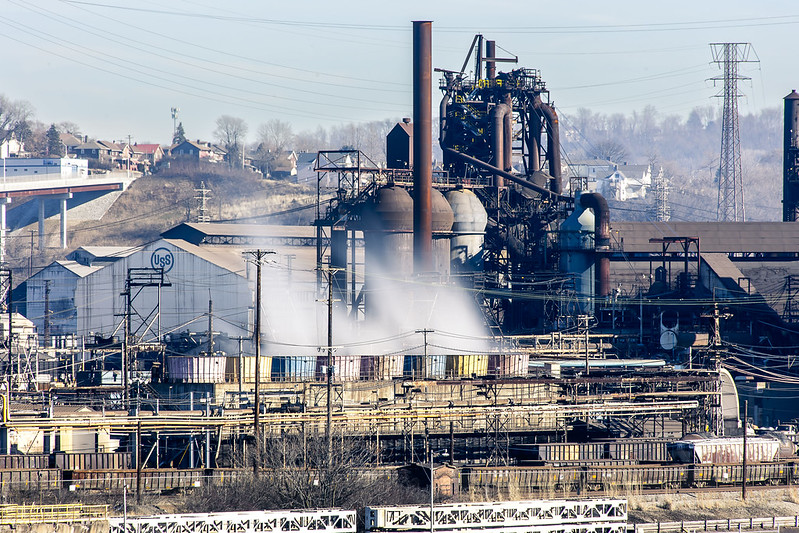
The Mon Valley Works – Edgar Thomson Plant. That’s what the U.S. Steel outfit calls this steel mill, parts of which date back to 1875 and Andrew Carnegie. It’s where the United States’ first Bessemer Converter was installed, and is a cornerstone of our American story.
Having never witnessed this sort of thing in person before, the Mon Valley Works absolutely blows my mind. Wow. I’ve seen Battleships, and Air Craft Carriers, and mega massive sewer plants, and power generating stations, and petroleum refineries, and waste transfer stations, and port infrastructure – but I’ve never seen anything like this before. Blown.

– photo by Mitch Waxman
I had carried all the gear I use with me onto the Great Allegheny Passage trail, and got busy with the tripod and everything else as soon as a decent point of view of the Mon Valley Works appeared. Next time I visit the GAP, I’m planning on entering the trail from the Duquesne side to explore what you can see from that set of angles.
I’m also going to return to this position for early morning and late afternoon light when it warms up a bit, but I fear that spring and summer will create problems for me due to the vegetation being clad with leaves.
– photo by Mitch Waxman
Even across the Monongahela River, and pretty distant, the Mon Valley Works are loud. Massive fans are at work for the heat exchangers, and the furnaces also are beaming out vibration and sound. The plant is also pumping out a terrific amount of sulfur dioxide, as it runs off coke and coal, so there’s a smell of rotten eggs which is omnipresent in the air.
I’m told that air quality in the Pittsburgh area can be awful, largely because of these coal fired heavy industries. So much so that there’s a website which tracks the plumes of pollutants that the three big steel mills pump into the atmosphere. Prevailing wind and economic geography decide who gets to breathe the stuff in. These steel mills, however, form and produce the building blocks for other industrial sectors, and always have. Somebody always pays the price for “progress.” It’s something to remind yourself about as you consume new manufactured products in the manner of a raging wildfire.
– photo by Mitch Waxman
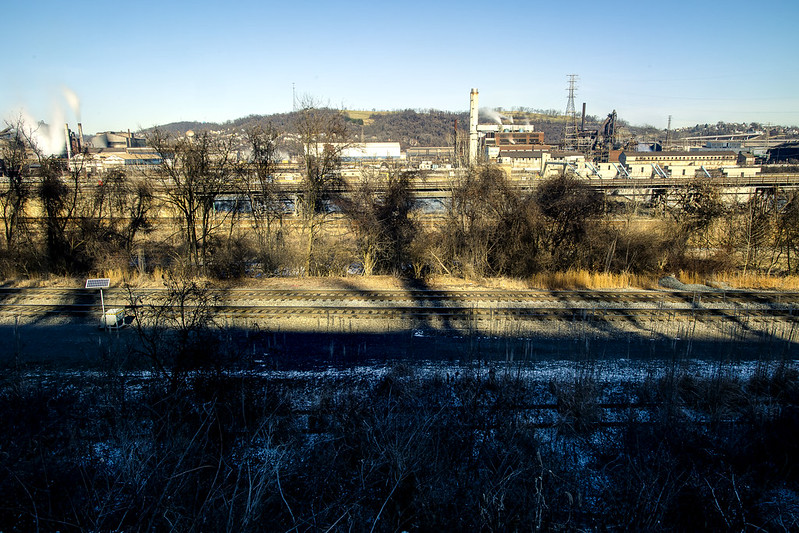
On the side of the Monongahela River that the GAP trail follows, you’re a pretty decent distance away from the shoreline. I did a wide shot to illustrate that, and to pass on the advice that if you want to get shots of the plant, bring a zoom lens with a not insignificant range.
As mentioned, those trees are going to block out the view during the warmer months. This was my turnaround point for this walk, as I’d have about another 4 miles to walk to get back to the Mobile Oppression Platform (my nickname for the car) which was parked at the Homestead Pump House. How did I come up with “Mobile Oppression Platform”? First, I owe a debt to the writers of the Futurama cartoon, secondly… have you ever talked to the bicycle people in Queens? Ever heard a car described as a two ton murder machine? I have, and took inspiration from the bellicose posturing they offered. If “two wheels good, four wheels bad” is your motto, I figured I’d give my car a name to piss you off. I’m a Dick like that.
– photo by Mitch Waxman
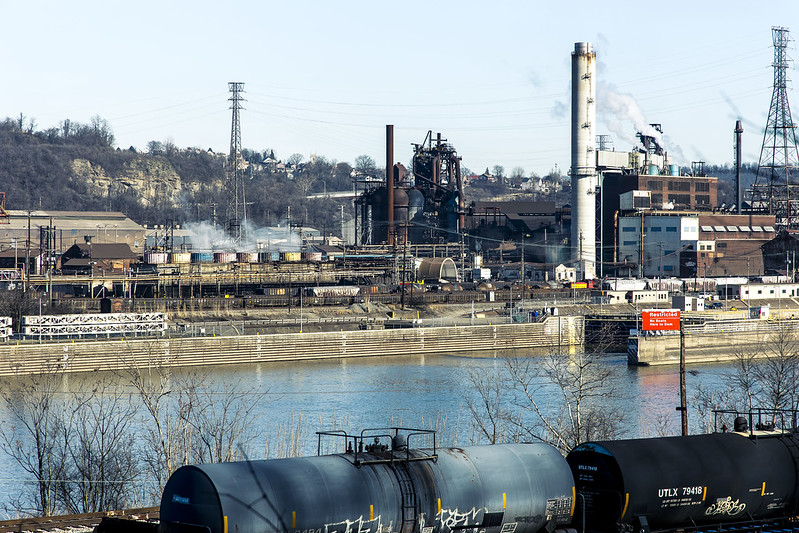
There’s so many things I want to get close up to in the shot above, including the Army Corps of Engineers lock and dam at the right side of the shot. After a disastrous flood in the 1930’s, the USACE installed a series of locks and dams on the rivers leading to Pittsburgh to control the waters. There are multiple USACE lock and dam facilities in the Pittsburgh area which I’m “kvelling” to get closer to.
I packed up my more esoteric gear after this one, reverted back to handheld shooting mode, and started retracing my steps back to the Mobile Oppression Platform in Homestead and my ride back to HQ.

– photo by Mitch Waxman
On my way, I cracked out a few more shots, and was passing by the defunct Carrie Furnace just as the light became a bit kinder. As mentioned in the first of these posts, it was fantastic to walk a fairly long distance again. It’s been a couple of months, what with the move and the setting up of housekeeping and all that, since I’ve had the chance to just scuttle about and see these sort of things.
Next week, something different at this – your Newtown Pentacle.
“follow” me on Twitter- @newtownpentacle
Buy a book!
“In the Shadows at Newtown Creek,” an 88 page softcover 8.5×11 magazine format photo book by Mitch Waxman, is now on sale at blurb.com for $30.
Investigating the GAP, part two
Thursday
– photo by Mitch Waxman
As described yesterday, one parked the Mobile Oppression Platform at the Homestead Pump House’s parking lot and began a longish walk on the Great Allegheny Passage “rail-to-trail” pathway. Rail to trail is one of the options for what to do with the right of way of a railroad line which is no longer active. In the case of the GAP, the rail bed has seen the ties and actual rails removed and the ground either paved or covered with crushed limestone. It’s an easy walk, due to the grading that the rail engineers employed when laying out these right of ways (ROW), which is essentially a change of one foot in elevation for every hundred feet horizontally. The GAP trail in the Pittsburgh area which I was on starts in Homestead and doesn’t re-emerge onto the streets until you reach the community of Duquesne, which is many miles away.
I had a destination and “turn around point” in mind, for this scouting mission, which was more or less equidistant between Homestead and Duquesne. This trail was thereby fairly easy walking, and there was lots to see along the Monongahela River, which the GAP trail follows.

– photo by Mitch Waxman
Back in NYC, I’d often be asked where I’d want to go if time travel were possible. My response is usually “if you stepped out of your time machine into the late 19th century NYC, you’d have a knife slid into you within about 15 minutes.” Here in Pittsburgh, other than dodging freight trains hauling coal and coke at breakneck speeds, you’d have a different time travel problem – breathing. There are still operating steel plants here, but their emissions are a fraction of what would have once been found along the Monongahela Valley. I should mention that the emissions are an ongoing problem, however, and that the U.S. Steel people are often fined for violations of the Clean Air Act.
Mark Twain’s quote about Pittsburgh in 1884 reads “After our show, last night, we visited Mount Washington and took a bird’s eye view of your city by moonlight. With the moon soft and mellow floating in the heavens we sauntered about the mount, and looked down on the lake of fire and flame. It looked like a miniature hell with the lid off. It was a vision. A wonderful vision. It tended to frighten. The view is not as deliciously beautiful as one would suppose. If one can be calm and resolute, he can look upon the picture and still live. Otherwise, your city is a beauty.”
– photo by Mitch Waxman
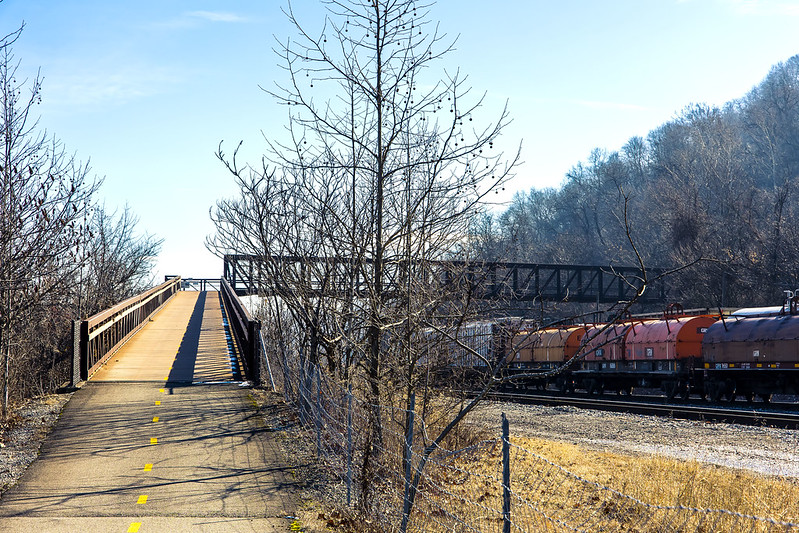
About a mile or so onto the trail, an overpass bridge is encountered, one which I’m told was added to the equation when the GAP trail was created. It allows transit over the active freight tracks the GAP follows from Homestead, and on the other side of the thing the trail continues along on an earthen shelf set in along a steep slope.
This bridge was one of the things which drew me in, what a great place to observe and photograph trains from, huh?

– photo by Mitch Waxman
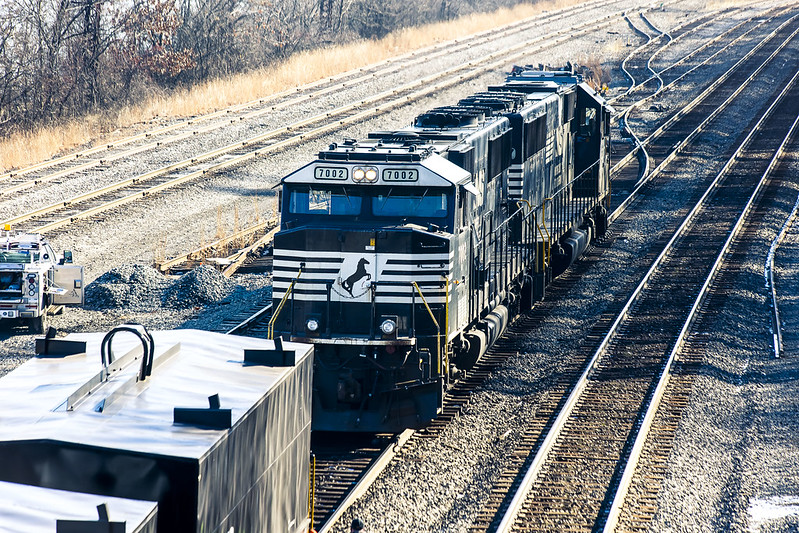
Norfolk Southern, like CSX, emerged as a dominant player in American Rail after the Conrail years and was formed out of several smaller operations. Their rolling stock heraldry is black and white, with a horse rearing up in silhouette acting as their logo. They’re pretty active in this region, and others.
There was a train set just sitting and waiting for its engine to show up, which luckily enough happened just as I surmounted the overpass bridge. A couple of workers were flipping the track switches around, and the engine was moving into position to couple with the train set.
– photo by Mitch Waxman
One could have stood on that overpass all day, photographing the comings and goings of the rail people. I probably will when the weather is warmer and I’ve packed a lunch. For this scouting mission, however, I still had a fairly decent amount of walking to do before I got to what I was actually seeking.
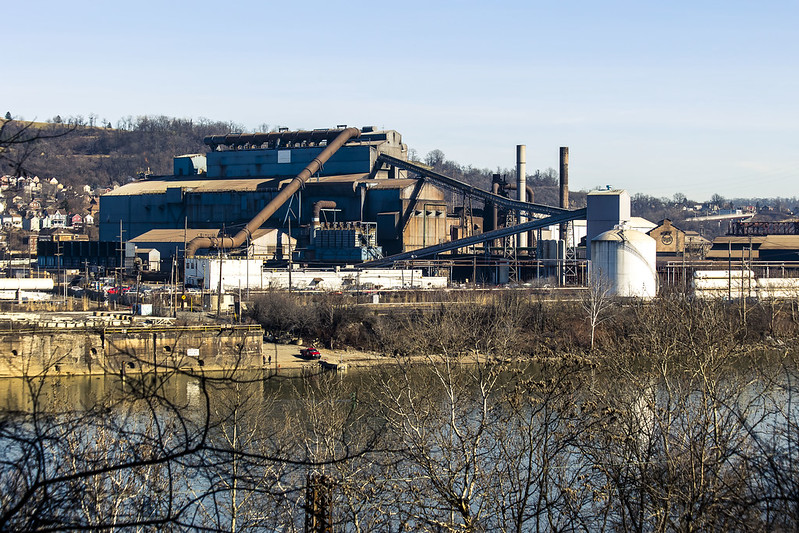
I haven’t been the same since visiting Braddock and seeing the Mon Valley Works steel plant. A need not unlike hunger demanded that I photograph it, which was a difficult thing to do from the landward side in Braddock. I wanted the river in the shot, as well. The GAP is the first location I’ve found so far that allows for this.
– photo by Mitch Waxman
I generally scuttle along at a comfortable pace, covering about two and change miles in an hour. Two hours into this walk, I finally arrived where I wanted to be. I had to find spots where the tree line wasn’t occluding my view of the U.S. Steel Mon Valley Works, but that did it take me long.
Tomorrow, the sort of shots I was looking for.
“follow” me on Twitter- @newtownpentacle
Buy a book!
“In the Shadows at Newtown Creek,” an 88 page softcover 8.5×11 magazine format photo book by Mitch Waxman, is now on sale at blurb.com for $30.
Investigating the GAP, part one
Wednesday
– photo by Mitch Waxman
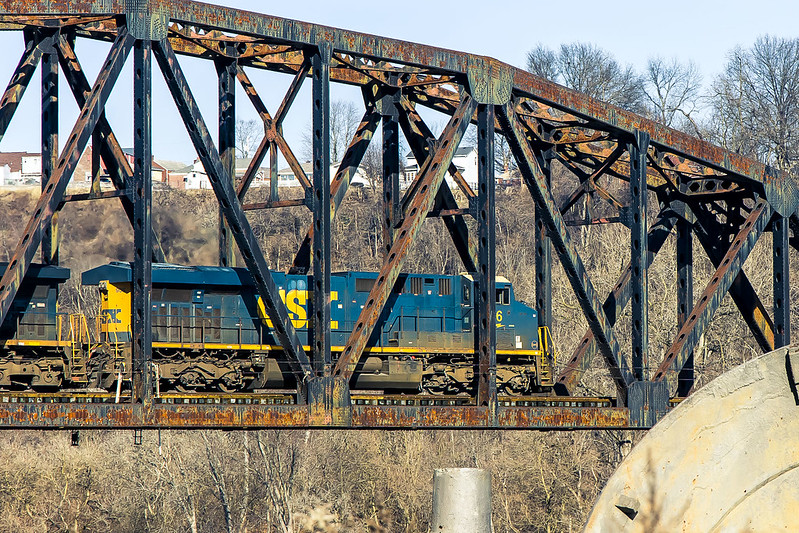
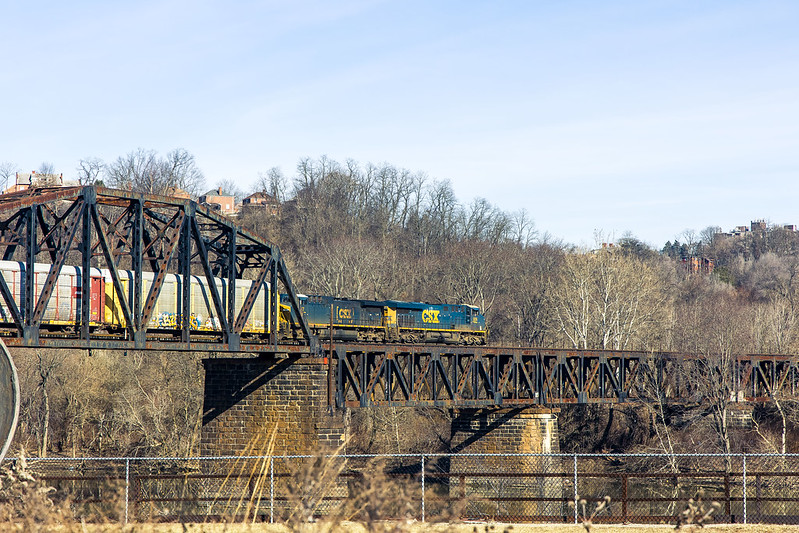
Last week, I showed you what the historic Homestead Pump House site on the Monongahela River looked like when bathed in thick fog. Lament was offered regarding the lack of a freight train transiting over the Pinkerton’s Landing or “Pemickey” Rail Bridge.
The Homestead Pump House is one of the trail heads for The Great Allegheny Passage or “GAP” rail to trail system. 150 miles in length, the rail to trail pathway follows several incorporated rights of way once operated by the B&O Railroad, Lake Erie Railroad, Union Railroad, and the Western Maryland Railway. You could theoretically walk or ride a bike to Washington D.C. on this path, which is paved in asphalt or crushed limestone – depending on where you are – and graded in accordance with the rail standard of one foot of elevation for every hundred feet.
Pictured above, this time around my dreams of a train moving over the bridge came true as a CSX freight train appeared and I was able to get a few shots of its transit across the rail bridge.
– photo by Mitch Waxman
The Homestead site has a parking lot, one which leads to the actual trail after a short walk on a sidewalk. I did all the remote scouting that was warranted, using Google maps and a few other tools as well as watching a YouTube video offered by some bloke who rode the trail on a bike. One still hasn’t purchased a shuttle craft bike which will accompany me in the cargo area of the Mobile Oppression Platform (that’s the nickname I’ve assigned to my Toyota), and be deployed for hyper local transport.
I don’t really keep track of how many miles I walk. Sometimes, after a walk I’ll check my phone to see how many steps it perceived me as taking on an excursion. If there’s any accuracy to that data, I walked on the trail about 4 miles in and 4 miles back. It was an extremely easy walk, thanks to the pavement and the easy grading in elevation. There were even installed park benches for taking a break along the route, but one of my rules involves not sitting down when you’re out. Keep moving until you’re back where you started.
– photo by Mitch Waxman
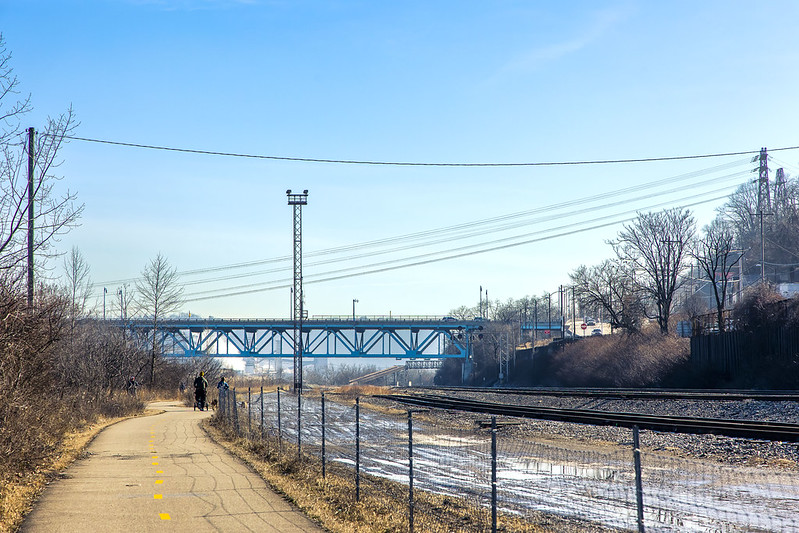
Active rail tracks are visible for the entire section of the GAP I visited. Defunct gas and rail infrastructure was noticed on the water facing shoreline for a good chunk of this distance, and there was a high volume road at the top of a shallow ridge overlooking the whole shebang. The municipality of Homestead was where I entered the trail, and there were markers here and there letting you know what town you were walking through.
That’s how I learned there’s a place called Munhall in Pennsylvania, those signs. There were actually a fair number of people using the trail for running and bike riding for a weekday afternoon in January. A good proportion of the bike riders were wearing the “outfit” – the helmet with the rear view mirror on it and a polyester bike shirt, stretchy shorts, and those special bicycle shoes. Like I said – the outfit. Most of the bikes were road racers, but I spotted a couple of pedal assist electric ones too.
– photo by Mitch Waxman
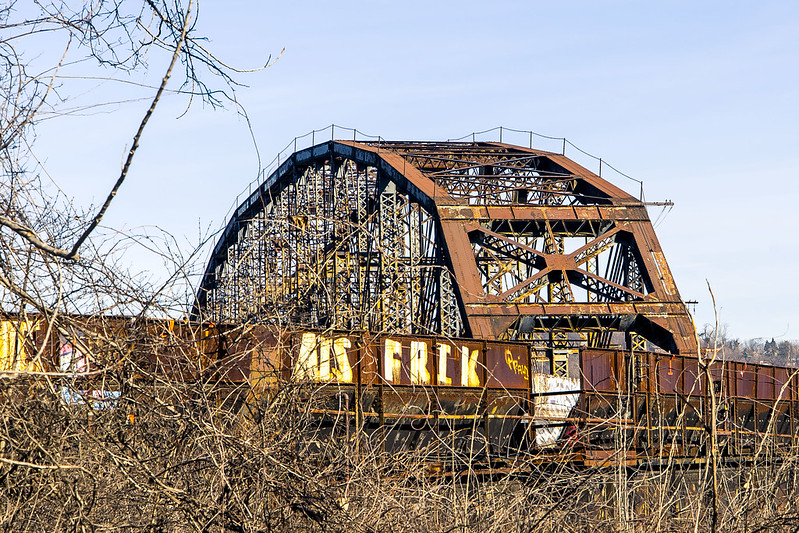
That’s the Carrie Furnace Hot Metal Bridge pictured above, I believe. Before you ask – of course I looked, and yes you can, and no it’s probably not ok but there doesn’t seem to be anybody watching, so of course, but no, not this time around. Next time, maybe.
I continued along the GAP trail, scuttling along at a leisurely pace.
– photo by Mitch Waxman
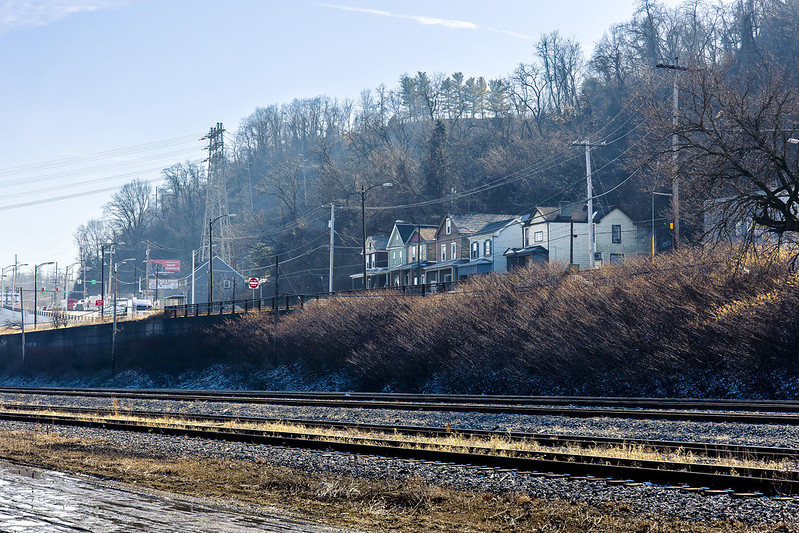
Once you’re a fair bit into the GAP trail, you’re completely separated from the surrounding town and of course – there’s no automobile traffic zipping along at high speeds to worry about.
On a personal note – it’s been a very long time since I’ve had the time to take a very long walk like this one. It felt very good to stretch the legs, kick the heels, and point the toes. Ultimately, this was another scouting expedition. It was mid afternoon, and the light was a ghastly thing to handle. For the ultimate destination I had in mind, this scouting revealed it as an early morning or sunset sort of deal. It’s also a winter thing, as the foliage must obscure all of the cool stuff you can see from this path during the warmer months when the trees are clad.

– photo by Mitch Waxman
The GAP follows under the Rankin Bridge spanning the Monongahela River. The 1951 bridge has a fairly convoluted history, and it once was used to carry Trolley traffic as well as motor vehicular flow, apparently. There’s a few very nice points of view in this section of the trail that I’m going to return to in the future. For this trip, my main interest was in getting close to the Mon Valley works, and I still had a few miles to walk to get there.
More tomorrow, from the GAP.
“follow” me on Twitter- @newtownpentacle
Buy a book!
“In the Shadows at Newtown Creek,” an 88 page softcover 8.5×11 magazine format photo book by Mitch Waxman, is now on sale at blurb.com for $30.
Monongahela, men will call thee
Monday

– photo by Mitch Waxman
One thing I’ve learned about living in Pittsburgh in these first weeks of doing so is that you need to pick your battles, as far as the weather goes. Blue skies and bright sun have been a fairly rare commodity so far, so when the forecast called for those conditions on the 9th of January, I hopped behind the wheel of the Mobile Oppression Platform and set off for several points of interest which had caught my attention along the Monongahela River.
First stop was Clairton, found about 13 miles (as the crow flies) from Downtown Pittsburgh. There’s a “rail to trail” opportunity to be found there which is part of the Montour Trail. What drew me here was U.S. Steel’s Clairton Coke Works, pictured above. I ran into a cop who seemed to be “cribbing” in the parking lot of the Montour Trail, and started a conversation with him about me being a photographer who is new to the area and who wanted to get the skinny on what’s considered ok or not as far as local law enforcement’s point of view is concerned. Best to ask, let the cop know you’re not some freak who’s going to cause trouble, as I always opine.
After telling me to take my hands out of my pockets, the officer informed me that were I to trespass onto the Clairton property he’d have an interest in me due to Patriot Act related security concerns, but his department would otherwise have zero interest in my pursuits and then he even mentioned my First Amendment right to self expression and a lack of desire to interfere with such things. I thanked the officer, cracked out the shot above, and hopped back into the Mobile Oppression Platform and continued with the exploring.
As mentioned in the past, it’s January and the light sucks this time of the year, so I’m largely scouting at the moment.

– photo by Mitch Waxman
I drove through a quite lovely semi-rural area, heading southwards, and crossed the river. There are a series of public boat launches and parklets which are set up in a fairly welcoming fashion on this stretch which had caught my eye while I was scrutinizing Google maps’ satellite views during one of the several rain soaked intervals recently experienced. The shot above and the one below were captured at one of these bits of aforementioned public waterfront access infrastructure found in the community of Speers Borough.
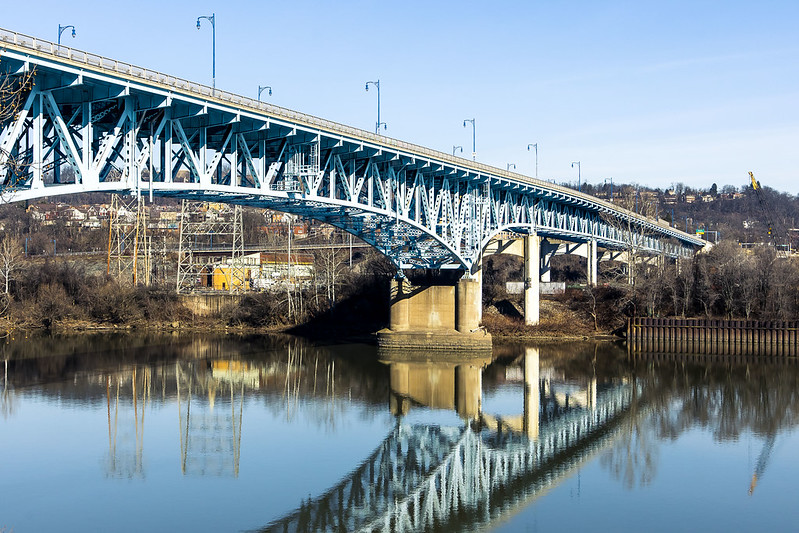
The colossal rail bridge, which was staggering to observe in person, is the Speers Railroad Bridge, whereas the blue colored vehicular crossing with the arch is called the Belle Vernon Bridge.

– photo by Mitch Waxman
The boat launch in Speers Borough allowed me to securely park the Mobile Oppression Platform and head down to the water with my tripod setup to get a bit “artsy fartsy.” The Belle Vernon Bridge is a 1951 vintage span over the Monongahela which once carried trolley service in addition to automotive traffic.
While shooting, some dude was noticed walking towards me while carrying a bucket. “Here we go” thought this long time New Yorker, but as it turned out he was a lovely chap who used to work on the tugs that navigate the Monongahela delivering mineral feedstocks to the the steel mills. The bucket? He didn’t pay his water bill and needed to flush his toilet, hence the visit to a river with a bucket in hand.

– photo by Mitch Waxman
My next stop was Monessan, PA., which is the hometown of cinematic makeup artist Tom Savini. Savini has a program named after him at a business school in Monessan. The Arcelor Mittal Monessen coke plant is pictured above, as seen from a supermarket parking lot bordering the mill. It wasn’t this plant, or Tom Savini (whom I’m a huge fan of, and even have an autographed plaster casting of a human skull he created sitting on my desk), instead it was another boat launch which would offer unimpeded water views which drew me here.
One negotiated the local street grid, as it were, and found his way down to the riverfront and the small park and boat launch ramp hosted there.

– photo by Mitch Waxman
In the distance, that’s the Donora-Monessen Bridge, aka the Stan Musial Bridge, a 1972 addition to the Monongahela River. By this point, I had throughly gotten myself lost. My goals for the day started out with trying to find a few points of view to photograph the Clairton Works from, which ended up being a lot more difficult than you’d think. If there’s a bit of waterfront property anywhere near it, that land is super valuable for commercial exploitation. Get a few miles away from the plant where the valuation of the river facing properties drops and it becomes a liability to the town rather than an asset, and you might as well use the waterfront as a park instead.
I did spot a few locations which I’m going to have to return to on foot, after I figure out someplace convenient to leave the car, and during a season which is a bit less harsh as far as temperature. There’s a number of things which I need to work out, actually. Things are chaotic at the moment.

– photo by Mitch Waxman
I wish I could tell you the name of the rail bridge above, which is about equidistant between Clairton Works and another steel mill called the Irvin Works which I haven’t laid eyes on yet. My understanding is that the teal colored pipeline moving through the shot carries gas generated by the Clairton Works coking operation that will be pumped over to and used to fire the Mon Valley Works over in Braddock.
More exploratory wanderings in tomorrow’s Newtown Pentacle.
“follow” me on Twitter- @newtownpentacle
Buy a book!
“In the Shadows at Newtown Creek,” an 88 page softcover 8.5×11 magazine format photo book by Mitch Waxman, is now on sale at blurb.com for $30.


 The Newtown Pentacle