Posts Tagged ‘newtown creek’
rarest flowers
A number of “Things to do” have materialized of late, so it is time for your Newtown Pentacle calendar of April events and/or fun things to do.

– photo by Mitch Waxman
There are a whole lot of things in the planning phases which I can’t tell you about yet, but suffice to say that this should be an amazing summer. Diversions on land and water will soon be announced, including boat tours of Newtown Creek and the greater harbor beyond.

– photo by Mitch Waxman
First up, today there will be a protest in Manhattan concerning recent City plans- via newtowncreekalliance.org
Rally to oppose Thermal “Waste-to-Energy” Facilities
April 9th, 2012
On Monday, April 9th at 10am, environmental justice groups, environmental organizations, community leaders and elected officials from Brooklyn, the Bronx and Manhattan will rally to oppose the Bloomberg administration’s plan for thermal “Waste-to-Energy” facilities (a.k.a. incinerators). Two of the proposed sites for this facility are on the shores of Newtown Creek, and our communities host 40% of the city’s waste transfer facilities, so we are adding our voice to the cause. Click here for our previous post on the issue, and download two fact sheets on Waste-to-Energy here and here.

– photo by Mitch Waxman
Secondly, from workingharbor.com
All About Tugs—Inside the Tugboat Industry
Tuesday, April 17 at 6.p.m.
Special evening program will feature documentary films with commentary by tug captains and crew presenting an insider’s look at the tugboat industry—its colorful history, present-day work, and vital importance.
Community Church of New York, 40 East 35th Street, Manhattan
Tickets are $25 ($20 for seniors). They can be purchased at www.workingharbor.com and include a reception with food, beer, wine and other beverages.
New York, NY, April 2, 2012 — Everybody loves tugboats, those iconic little workhorses that push ships ten times their size through narrow waterways and tow barges laden with fuel oil through busy harbors. “It is like the “Little Engine That Could,” or the mouse that pulled the thorn out of the lion’s paw,” said filmmaker Tom Garber, whose documentary, Tugging Through Time: The History of New York Harbor Tugboats, will be featured, The Working Harbor Committee (WHC), a not-for-profit organization dedicated to educating the public about the history and present-day importance of the Port of New York and New Jersey, is sponsoring the presentation. Since 2002 WHC has taken more than 20,000 people on Hidden Harbor® boat tours to visit behind-the-scenes waterfront places that most people never get the chance to see. “Tugboats are always the biggest hit,” said Captain John Doswell, the organization’s executive director. WHC also runs the annual New York Harbor Tugboat Race. “People always ask what it is like to be on board. Our ‘All About Tugs’ program will answer that question.”

– photo by Mitch Waxman
Third, also from newtowncreekalliance.org
Earth Day BYO Picnic Lunch at the Newtown Creek Nature Walk
Sunday, April 22nd at 1 p.m.
Come join in for this casual celebration of the victory that is the Newtown Creek Nature Walk. Bring your own brown bag lunch and join the Newtown Creek champions who worked hard for years to win this unique waterfront park.
Sunday, April 22nd at the Newtown Creek Wastewater Treatment Plant Nature Walk between 1pm – 2pm.

– photo by Mitch Waxman
Fourth, another NCA event, which I for one am pretty stoked about:
April NCA meeting hosts Dr. Eric Sanderson
April 26, 2012 at 6pm
Ridgewood Democratic Club, 6070 Putnam Avenue, Ridgewood, NY 11385
In addition to important updates from our members – in particular the Bioremedition Workgroup has been very busy! – we will be hosting a special presentation on the “Historical Ecology of Newtown Creek”.
Dr. Eric Sanderson, senior conservation ecologist at the Wildlife Conservation Society and author of “Mannahatta: A Natural History of New York City” (Abrams, 2009), will describe recent studies of the historical ecology of Newtown Creek, describing the original wetlands, creek channels, topography and vegetation of the area. He will show a series of 18th and 19th century maps of the watershed of the creek and discuss the process of synthesizing them into an integrated ecological picture that can be used to inform and inspire natural restoration and cultural appreciation of the Newtown Creek watershed. This work is part of the Welikia Project (welikia.org), an investigation into the historical ecology of the five boroughs of New York City and surrounding waters.
Finally,

Obscura Day 2012, Thirteen Steps around Dutch Kills
April 28th, 10 a.m.
Your humble narrator will be narrating humbly at this year’s Obscura Day event on April 28th, leading a walking tour of Dutch Kills. The tour is already half booked up, and as I’m just announcing it, grab your tickets while you can.
“Found less than one mile from the East River, Dutch Kills is home to four movable (and one fixed span) bridges, including one of only two retractible bridges remaining in New York City. Dutch Kills is considered to be the central artery of industrial Long Island City and is ringed with enormous factory buildings, titan rail yards — it’s where the industrial revolution actually happened. Bring your camera, as the tour will be revealing an incredible landscape along this section of the troubled Newtown Creek Watershed.”
For tickets and full details, click here :
obscuraday.com/events/thirteen-steps-dutch-kills-newtown-creek-exploration
strange corridors

– photo by Mitch Waxman
Staying current on the story of Newtown Creek involves attending a lot of meetings. Some are private, most public. Often, they came rapid fire and it feels as if every other evening is consumed. One of the many community groups which hold such gatherings is the Newtown Creek Monitoring Committee. I’m a guest at this particular gathering, and as such an attempt is made to remain silent and observe the proceedings.
The group engages in a dialogue with representatives of the NYC DEP, who are offered input from community representatives regarding issues that might arise from the presence of the Newtown Creek Waste Water Treatment Plant.
One of these issues, as you would imagine, is the spread of odors emanating from the vast facility.

– photo by Mitch Waxman
The DEP contract with a company, called “Odor Science and Engineering”, who specialize in the detection and discovery as well as elimination of point sources for malodorous gases. Luckily, an inspection of the plant by the company was scheduled for the following week and Christine Holowacz (DEP community liaison) arranged for a few of us to accompany the effort.
Pictured above is Kate Zidar (Newtown Creek Alliance Executive Director) and Laura Hoffman (Newtown Creek Monitoring Committee), who with myself, showed up bright and early to be fitted with hard hats and vests.

– photo by Mitch Waxman
We were introduced to Dr. Ned Ostojic Ph.D and P.E., Odor Science & Engineering’s Vice President & Director of Engineering.
A tall and dignified fellow, Dr. Ostojic spoke with a barely detectable yet pleasant European accent and was extremely hospitable to us as he described his function at the plant. An engineer, he was tasked with not only finding the sources of odor but describing practical solutions to eliminate them.

– photo by Mitch Waxman
Dr. Ostojic produced a device whose purpose was to combat a human perception bias called environmental adaptation. To describe it simply, the human mind filters out environmental stimuli to create a sense of “normalcy”. If you live on a noisy street, your brain filters out most of that noise and you become inured to the environmental background level. The brain functions in the same way with smell, something I know to be accurate. When I encounter the smell of the Newtown Creek, or of any sewer plant, no reaction is displayed while others openly gag.
My brain has become adapted to Newtown Creek.

– photo by Mitch Waxman
He asked us not to make fun of the devices name, which was a “Nasal Ranger”.
It allows calibrated measurement of smell based on a concentrating chamber which lies behind an aperture dial. The dial allows ever smaller samples to be inhaled into the device, which can then be graded on a subjective and numerical scale. Good science, don’t forget, is all about measurement and objective recording. The Nasal Ranger removes personal interpretation from data records, as its operators are trained according to an empirical standard.

– photo by Mitch Waxman
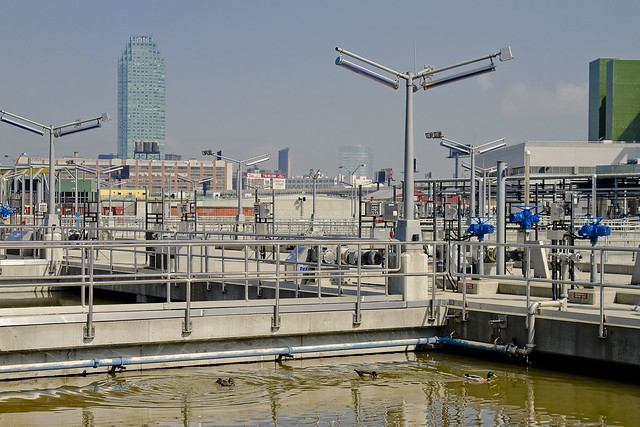
We three accompanied Dr. Ostojic on his walk through of the plant, and his duty this day was the inspection of the settling tanks which allow sewer borne debris to drop out, or be be skimmed from, the wastewater flow before it enters those famous digester eggs which distinguish this plant and betray its location on the skyline of New York City.

– photo by Mitch Waxman
Several times has your humble narrator been allowed to enter and record the grounds of this facility, found along the Newtown Creek, but this side of things has always been off limits because of extreme danger.
One of the curious facts related to me that day was that , were one of us to slip and fall into the highly aerated water and sewage in the tanks surrounding us, the liquid would not display much buoyancy. Because of all the dissolved gas in the liquid, neither would it slow your fall much and you would plummet- as if through air- some two stories to a hard cement floor.
In no uncertain terms, I was told, you would die. This was confirmed by one of my union buddies, who works at another plant in the DEP system.

– photo by Mitch Waxman
This is somewhere around midway through the sewage treatment process, after the larger bits of solute and debris carried in the flow have been removed. When the raw flow hits the plant, it carries wood and boxes and all sorts of garbage and debris with it. This gross matter is removed mechanically at another part of the plant. Next up is grit, which can be sand, soil, or just plain old coffee grounds. The rate of speed at which the wastewater races through the system makes even such innocuous contaminants hazardous to the works, and is removed by more specialized machines housed in separate “grit buildings”.

– photo by Mitch Waxman
Of course, nothing is perfect, and the job of these settling tanks is to skim off any floatable material which has evaded prior filtration. Fats, oils, and a surprising number of cigarette butts, tampon applicators, condoms, and other floatable material is seen at the collection side of the tanks. As they are open to the air, this is one of the spots which Dr. Ostojic regularly inspects and pays a great deal of attention to. He was constantly checking his readings and observations against the prevailing winds.

– photo by Mitch Waxman
Dr. Ostojic wasn’t alone for the inspection and was working with the fellow pictured above, who introduced himself as Gary Grumley. Mr. Grumley was working with a different detection device than Dr. Ostojic, a hydrogen sulfide detector.
Hydrogen sulfide, of course, is a colorless gas which is infamous for the fecund smell of decay commonly referred to as “rotten eggs”. Such emissions are responsible for a lot of community complaints, and are unfortunately part of the complex chemistry which accompanies the disposition of sewage.

– photo by Mitch Waxman
The device itself seemed sturdy, and Mr. Grumley arranged it neatly for photographing. He had begun work several hours prior to our arrival and began transmitting his findings and observations to Dr. Ostojic.

– photo by Mitch Waxman
A graphic map of the plant with its multitude of buildings, service areas, and zones was on Dr. Ostojic’s clipboard.
A running tally of various areas where an unexpected or intense odor was encountered had been kept, and each occurrence was registered with a numerical value or rating. We didn’t encounter anything truly horrible btw.
– photo by Mitch Waxman
An example was offered later in the day by the DEP’s Superintendent of the Plant, Jim Pynn, of Dr. Ostojic’s contributions.
It seems that a problem had developed around the hatches leading to an underground tank, cylindrical in shape, which had been located in a rectangular shaped shaft. An onerous odor was regularly emerging from the shaft, and Dr. Ostojic was called in. He determined that as wind passed over it, a venturi was forming in the space between the cylinder and the right angled walls which suctioned the tainted air from it’s enclosure and into the open air.
Dr. Ostojic’s simple solution, adding chevrons to the sides of the tank which would abort the formation of a vortex, saved the plant a costly redesign of the affected area. The smell stayed where it was meant to, as well.

– photo by Mitch Waxman
Dr. Ostojic was gracious and quite patient with us. A loving nickname for him, which is offered with wide smiles and a wink by those who work at the plant, is “Ned the Nose”.
Usually, when one is invited to attend a meeting at an industrial site in Greenpoint, Brooklyn- with someone named Ned the Nose- the encounter seldom turns out to be as pleasant as this was.

– photo by Mitch Waxman
Newtown Pentacle, we go these places so you don’t have to.
ALSO:
Your humble narrator will be narrating humbly at this year’s Obscura Day event on April 28th, leading a walking tour of Dutch Kills. The tour is already a third booked up, and as I’m just announcing it, grab your tickets while you can.
“Found less than one mile from the East River, Dutch Kills is home to four movable (and one fixed span) bridges, including one of only two retractible bridges remaining in New York City. Dutch Kills is considered to be the central artery of industrial Long Island City and is ringed with enormous factory buildings, titan rail yards — it’s where the industrial revolution actually happened. Bring your camera, as the tour will be revealing an incredible landscape along this section of the troubled Newtown Creek Watershed.”
For tickets and full details, click here :
obscuraday.com/events/thirteen-steps-dutch-kills-newtown-creek-exploration
Veneralia

– photo by Mitch Waxman
Technically speaking, this post is day late and a dollar short, as the holiday of Veneralia was traditionally observed by the Romans on April 1. Given the prankster traditions of our modern culture that revolve around the date, however, it was decided to run an acknowledgement of the holiday today- if the story of Troy has taught us anything, it’s “Don’t mess around with the Goddess of Love”.
from wikipedia
Venus was offered official (state-sponsored) cult in certain festivals of the Roman calendar. Her sacred month was April (Latin Mensis Aprilis) which Roman etymologists understood to derive from aperire, “to open,” with reference to the springtime opening of trees and flowers.
Veneralia (April 1) was held in honour of Venus Verticordia (“Venus the Changer of Hearts”), and Fortuna Virilis (Virile or strong Good Fortune), whose cult was probably by far the older of the two. Venus Verticordia was invented in 220 BC, during the last tears of Rome’s Punic Wars, in response to advice from a Sibylline oracle, when a series of prodigies was taken to signify divine displeasure at sexual offenses among Romans of every category and class, including several men and three Vestal Virgins.

– photo by Mitch Waxman
Veneration… the very root of the word comes from her name, this Roman deity named Venus. She wore many hats, and was worshipped in several aspects. The one which we at Newtown Pentacle HQ revere is the personification of Venus Cloacina, goddess of the main drain. Myrtle adorns the entranceway to that ceremonial room with ceramic tiles which we maintain, and rhyming prayers will be offered before a porcelain altar.
from wikipedia
In Roman mythology, Cloacina (Latin, cloaca: “sewer” or “drain”) was the goddess who presided over the Cloaca Maxima (“Great Drain”), the main trunk of the system of sewers in Rome. She was originally derived from Etruscan mythology. The Cloaca Maxima said to be begun by one of Rome’s Etruscan kings, Tarquinius Priscus, and finished by another, Tarquinius Superbus.
Titus Tatius, who reigned with Romulus, erected a statue to Cloacina as the spirit of the “Great Drain”. As well as controlling sewers, she was also a protector of sexual intercourse in marriage. Despite her Etruscan origins, she later became identified with Venus.

– photo by Mitch Waxman
Towering above the lowest point of New York City in Greenpoint, at the bottom of a geologic soup bowl (as it were), is the greatest temple of this goddess. If fancy strikes, as you drive along the BQE or traverse the streets of our ancient neighborhoods, remember to offer the ancient prayer:
“O Cloacina, Goddess of this place,
Look on thy suppliants with a smiling face.
Soft, yet cohesive let their offerings flow,
Not rashly swift nor insolently slow.
– courtesy sewerhistory.org
ALSO:
Your humble narrator will be narrating humbly at this year’s Obscura Day event on April 28th, leading a walking tour of Dutch Kills. The tour is already a third booked up, and as I’m just announcing it, grab your tickets while you can.
“Found less than one mile from the East River, Dutch Kills is home to four movable (and one fixed span) bridges, including one of only two retractible bridges remaining in New York City. Dutch Kills is considered to be the central artery of industrial Long Island City and is ringed with enormous factory buildings, titan rail yards — it’s where the industrial revolution actually happened. Bring your camera, as the tour will be revealing an incredible landscape along this section of the troubled Newtown Creek Watershed.”
For tickets and full details, click here :
obscuraday.com/events/thirteen-steps-dutch-kills-newtown-creek-exploration
outward course

– photo by Mitch Waxman
The Kimberly Poling was observed recently, as it headed west along the infamous Newtown Creek, and has sailed directly into Maritime Sunday at this- your Newtown Pentacle. The tug is owned by Poling and Cutler, and we recently examined one of their other tugs on this self same stretch of the Creek- the Crystal Cutler.
The name of the game in the shipping industry is to never transport an empty container. As such- after disgorging the petroleum cargo carried by its fuel barge to Newtown Creek, the Kimberly Poling took on another load for transport.
from marcon.com
Marcon International, Inc. is pleased to announce the sale of the US Flag Twin Screw Tug “Jaguar” from Mobro Marine, Inc. to P&C Kimberly Poling, LLC. “Jaguar” was built by Main Iron Works in 1994. She measures 105′ LOA x 34′ beam x 15′ depth. The vessel is powered by two EMD 12-645E2 main engines, producing 3000 total BHP at 900 RPM. Reintjes gears drive two 93″ x 91″ fixed pitch propellers in kort nozzles producing an estimated 40 tons bollard pull. The vessel is fitted with fully air-conditioned accommodations for 7 crew in 4 cabins. “Jaguar” will work for her new owners in the US Northeast. Marcon acted as sole broker in the transaction.

– photo by Mitch Waxman
Within the double walled steel tanks of the fuel barge, which is the Edwin A Poling by the way, can be found several thousand gallons of Diet Coca Cola, no doubt pumped in from the Coca Cola bottling plant on 58th street in Maspeth.
Carbonated beverages can be quite volatile when subjected to the rolling waves of the open harbor and as such precautions must be observed. The Captain of the Kimberly Poling must personally ensure that there are no “Mentos” brand mints onboard, for instance.
Founded in 1995, Poling Cutler began operations near the time the former Poling Transportation went out of business.
The Founders of the new company were Ed Poling, whose grandfather started the former Poling company, and Gary Cutler who spent years working in the financial world before getting involved in Marine Transportation.

– photo by Mitch Waxman
The “Dr. Pepper drama”, which played out over three days off the coast of Nassau Island during the winter of 1997- known as the “Bahamian Belch”- is still quite fresh in the mind of the maritime community. Accordingly, Coast Guard penalties for the improper transportation of and off loading of all soft drinks are quite severe.
The barge is most likely bound for Staten Island, which has been experiencing extreme shortages of the stuff since the spring of 2010.
Newtown Creek was designated a Significant Maritime and Industrial Area (SMIA) in the NYC Department of City Planning ‘s 1992 Comprehensive Waterfront Plan for its characteristic clusters of industrial businesses and water-dependent uses. In the 2010 update of this plan, Vision 2020, Newtown Creek maintains its place as New York City’s largest SMIA in terms of both land area and employment. After losing half its jobs from 1992 to 2008, the number of jobs in Newtown Creek SMIA grew by nearly 1,400 (totaling 15,000 jobs) from 2000 to 2008.

– photo by Mitch Waxman
The carbonation of the cargo is causative rather than coincidental as to why the barge is riding so high in the water, as the frothy action of the pressurized bubbles in the beverage buoy it up. The Maritime Shipping Association sees this sector of the business expanding exponentially and demand for the diet drink doubling within the decade.
It is good to know, on this the 1st of April, that the thirst of Staten Islanders will be satiated.
from wikipedia
Diet Coke (also known as Diet Coca-Cola, Coca-Cola light or Coke Light) is a sugar-free soft drink produced and distributed by The Coca-Cola Company. It was first introduced in the United States on August 9, 1982, as the first new brand since 1886 to use the Coca-Cola trademark. The product quickly overtook the soft drink Tab in sales.
Diet Coke was sweetened with aspartame after the sweetener became available in the United States in 1983; to save money, this was originally in a blend with saccharin. After Diet Rite cola advertised its 100 percent use of aspartame, and the manufacturer of NutraSweet (then, G.D. Searle & Company) warned that the NutraSweet trademark would not be made available to a blend of sweeteners, Coca-Cola switched the formula to 100 percent NutraSweet. Diet Coke from fountain dispensers still contains some saccharin to extend shelf life.
aerial ocean

– photo by Mitch Waxman
Just a short one today, some of the interesting odds and ends observed during my travels over the last few weeks. The shot above is from 58th rd. in Maspeth, once known as the Maspeth Plank road and paved with crushed oyster shells. It led to Furman’s Island, a notorious spit of muddy land that was legendary in its time for the offensive industries located there.

– photo by Mitch Waxman
This curious collection of women’s shoes, singles not pairs, was spotted on Provost in Greenpoint, Brooklyn. The mind boggles at where the mated shoes might have been dumped, but these are found on the street named for one of the “OG’s” – the Original Greenpointers. They were named Provoost rather than Provost, of course, but Dutch words seldom translate unscathed into english.

– photo by Mitch Waxman
Also in Greenpoint, this time nearby Manhattan Avenue. Manhattan is a double wide street because there was a street car or Trolley line that ran down it, which broke off from the East River to Calvary line which plied Greenpoint Avenue. The Manhattan Avenue line went over the Vernon Avenue Bridge and connected with Long Island City. The street art or graffiti depicted in this shot is signed “Mara” and a humble narrator is glad that some of the conclusions I’ve drawn about Newtown Creek are seemingly being noticed by others.


