Posts Tagged ‘newtown creek’
Thrice Damned?

– photo by Mitch Waxman
Several emails arrived today inquiring into why, in yesterday’s posting, the Kosciuszko Bridge is referred to as “thrice damned”. We’ll get into that shortly, but first- a certain anomaly of the information age needs to be mentioned…
from nytimes.com
The association, which handles many of the city’s largest projects, pored through an annual report that the New York State Department of Transportation released earlier this year to develop its list. Researchers looked at the city’s bridges and freeways that were given “red flags” — for everything from weak columns to uneven pavement — to compile the list, which included only those operated by the state.
The association announced the following rankings:
-
- Kosciuszko Bridge
- Gowanus Expressway
- Bronx River Parkway over the Amtrak tracks
- Cross Bronx Expressway viaduct over the Amtrak tracks and the Sheridan Expressway
- Bronx Terminal viaduct carrying the Major Deegan Expressway by Yankee Stadium
- Major Deegan Expressway over Sedgwick Avenue and the Metro-North Railroad tracks
- Bruckner Expressway Service road, northbound
- Bruckner Boulevard viaduct1
- 50th Street over the Belt Parkway
- Major Deegan Expressway ramp to 153rd Street/Cromwell Avenue, southbound

– photo by Mitch Waxman
In 1939, during the Great Depression, arguably the most powerful man in New York City was Robert Moses. Moses had a project he was keen on, the Brooklyn Queens Connecting Highway.
The Meeker Avenue Bridge opened on August 23rd, 1939 (renamed in 1940 as The Kosciuszko Bridge) – some 24,855 days ago- and it was the first link in a chain that eventually metastasized into the Brooklyn Queens Expressway. It was promised to allow easy egress to the World’s Fair, and was a showpiece project for the Great Builder.
Yet, it seems not to have any fanfare associated with it according to online sources…
Q- Who designed it? How long was it under construction? Thinking about the chain of supply, where did the steel come from and how did it get here? Where are the City records? Surely this project was reported on, why doesn’t the NY Times or Brooklyn Daily Eagle have multiple stories in archives about it and attendant scandals?
A- Certain terms, called “tags” or “keywords” attached to every web page allow search engines to classify the content of any given web page. A sort of echo effect forms around these tags, a scalar which wipes out all other interpretations of search terms. The Kosciuszko Bridge is caught up in one of these echo effects, which has caused all other results to be crowded out. The echo surrounding “The Kosciuszko Bridge” search term at the Big G is formed by three or four modern sources and swirls about the replacement of it. This is kind of disturbing…
Andrew Carnegie’s American Bridge Company was the contractor, incidentally.
from nytimes.com
The Kosciuszko Bridge in Brooklyn received 20 yellow flags for corrosion and decay of steel beams and small cracks in beams and welds. The bridge also received eight safety flags for problems that included exposed electrical wires and loose concrete.

– photo by Mitch Waxman
This is mentioned, as it has raised certain misgivings in me about the future of verity and truth. If something like The Kosciuszko Bridge can lose its past and be defined only by its destruction, just how malleable has the historical record become in the age of the Big G? Can a skillful manipulation of Wikipedia or some other major “site of authority” change the past?
Just wondering…
Now- the “thrice damned” part
Damned Once- The Kosciuszko Bridge catches radio frequency emissions from several nearby commercial radio broadcast antennas. A lot of it.
Whatever knows fear burns at The Kosciuszko Bridge’s touch.
Damned Twice- The Kosciuszko Bridge is at extreme risk in the eventuality of a seismic event. The Brooklyn pier actually sits on the Creek bed, some 6 meters below grade, but the Queens side is anchored on piles driven into the mud. The hard soil around Queens Plaza will merely shake, but the land surrounding the Newtown Creek will liquify.
Damned Thrice- The Kosciuszko Bridge once had pedestrian walkways, but they were removed in 1961. Can you imagine what kind of photos would be possible on a pedestrian walkway 124 feet over the Newtown Creek?
from brooklynpaper.com
But the department has bigger fish to fry than the aesthetics — drivers just want the city to get it done. The current bridge is constantly in gridlock, with some 160,000 daily drivers pushing forward — very slowly — at on- and off-ramps, making two impromptu lanes. The new bridge is supposed to cure all these problems.
Luckily, project manager Robert Adams has said that the $1 billion needed to finish construction — which ballooned from $700 million last year due to a longer build-out time — is already lined up through federal funding, and that the tentative completion date is in 2017.
perilous disposition
Notes:
- Don’t miss the Hunter’s Point Avenue Bridge Centennial this weekend, on December 11th, a free event. For more on the HPA Bridge Centennial, click here.
- Also, please consider purchasing a copy of the first Newtown Pentacle book: “Newtown Creek for the Vulgarly Curious” – a fully annotated 68 page, full-color journey from the mouth of Newtown Creek at the East River all the way back to the heart of darkness at English Kills, with photos and text by Mitch Waxman.

– photo by Mitch Waxman
Thrice damned, the Kosciuszko Bridge is scheduled for demolition and replacement, and with it shall go the last of Blissville (or Berlin, or West Maspeth, or Laurel Hill- depends on who you ask to describe this “angle” between neighborhoods).
Recent obligation called on me to enter the historic quarter of Ridgewood, and I embarked on the long walk from Astoria with the intention of “checking in” on the area. Unfortunately, seasonal variance in environmental temperature and atmospheric conditions are taking their usual toll on my delicate physical constitution.
from wikipedia
The Kosciuszko Bridge is a truss bridge that spans Newtown Creek between the New York City boroughs of Brooklyn and Queens, connecting Greenpoint, Brooklyn and Maspeth, Queens. It is a part of Interstate 278, which is also locally known as the Brooklyn-Queens Expressway. The bridge opened in 1939, replacing the Penny Bridge from Meeker Avenue in Brooklyn to Review Avenue and Laurel Hill Boulevard, and is the only bridge over Newtown Creek that is not a drawbridge. It was named in honor of Tadeusz Kościuszko, a Polish volunteer who was a General in the American Revolutionary War. Two of the bridge towers are surmounted with eagles, one is the Polish eagle, and the other the American eagle.

– photo by Mitch Waxman
Numbing begins for me at higher temperatures than most, and even the high 40’s and low 50’s call for woolen hats and gloves, and insulation about the torso is absolutely critical. This ridiculous assortment of threadbare garments forces me to move in a stiff and corpse like fashion, and stepping onto a bathroom scale reveals that my full winter gear (with camera) adds some 30 pounds to my weight. Like one of “Marius’s mules” however, your humble narrator nevertheless endures in his self enforced march across the concrete landscape of the Newtown Pentacle. The awful thing, however, was not the suffering of one sickly and somewhat insane narrator- it was what I could not have seen on 54th avenue.
Also, we’ve been to 43rd street before, in the “Maspeth? Laurel Hill? Where am I?” posting of 9/3/2009.
from forumnewsgroup.blogspot.com
…To accomplish this, the new bridge will be built next to the existing structure, and all six lanes of traffic will be shifted onto what will eventually be the eastbound structure. The existing bridge will be demolished, and a new structure for westbound traffic will then be built in its place.
The current bridge carries three lanes of traffic in each direction. The final product will include five lanes into Queens and four into Brooklyn, along with a pathway for bicyclists and pedestrians that promises to provide a “terrific view of the Manhattan skyline,” according to Adams. The new bridge will also feature standard-width lanes, shoulders for disabled vehicles and better sight lines for drivers, according to Adams. “This will have significant improvements on the merging problems that exist today,” he said.
The state is continuing to negotiate with property owners within the 1.1 mile construction zone to acquire easements and land needed for the project. That is expected to be completed by 2013. The state is also working with the city Parks Department on a new greenspace that is planned for beneath the approach to the bridge on the Queens side, but Parks was unable to provide details about that.

– photo by Mitch Waxman
The so called sidewalks which underlie the approaches to the Kosciuszko Bridge (thrice damned) are pedestrian in name only, and the evidence of gathered diesel dust and undisturbed deposits of windblown graveyard soil suggests that no other boots save my own have traversed the space in any recent memory. This is a place for the automobile, the truck, and those who cross it by foot must be sagacious and alert.
While passing from Laurel Hill Blvd. to 54th avenue via one of these underpass viaducts, something impossible was suggested rather than observed as scratching about in these deposits. It could not have been what peripheral observation suggests, and it is far more likely that I am suffering from some early phase of macular degeneration or an undiagnosed neurological condition than that which I believed I saw could be material and real.
For now, I’m keeping my observation to myself, lest some guardian of the public good who might be reading this recommend me to the psychological hospitals at Wards Island for both my own protection and that of the community at large.
Suffice to say, what I think I saw cannot exist in any world governed by wholesome laws of physics and or familiar biology, but it is probably best to avoid the drainage pipes which carry storm runoff from the Kosciuszko Bridge’s BQE down to the streets of this angle between neighborhoods- just in case.
from nysdot.gov
In the early to mid 19th century, virtually the only development along the channels of the Newtown Creek drainage were crossings for roads and turnpikes that linked nearby villages and led to East River ferries. A highway between Bushwick and Newtown was in place by 1670,including a wooden bridge that was most likely the first road crossing of the creek, at approximately the location of present Meeker Avenue. This crossing was replaced circa 1812-14 by the Penny Bridge, a toll bridge on the Newtown and Bushwick Turnpike Road. The first crossing of English Kills along the present Metropolitan Avenue opened circa 1814-16 as part ofthe Williamsburg and Jamaica Turnpike. These remained the only bridges into the 1840s when nearby urban development stimulated more road construction across the marshy drainage. Mid-19th century bridges included the Maspeth Avenue Plank Road to Newtown (1846), and the Greenpoint and Flushing Plank Road linking the Greenpoint ferry to the new Calvary Cemeteryvia present Greenpoint Avenue (1853-54).
The 1848 establishment of the large Catholic cemetery (Calvary Cemetery), on an old estate north of the Penny Bridge, reflected the absenceof any competing land use demands along most of the waterway. Water transport remained a better means of moving goods and people between the local villages and nearby urban areas;steamboats served the cemetery until around 1870. Local road development in the late 1860s included the first Vernon Avenue Bridge over Newtown Creek (removed and replaced by the Pulaski Bridge), and a bridge over Dutch Kills on present Borden Avenue. In part to secure public funding for street improvements in Hunter’s Point, Henry Anable sought to incorporate the area in 1870 as part of Long Island City, which also absorbed the villages of Astoria, Ravenswood, and Dutch Kills

– photo by Mitch Waxman
The easements sought for the footprint of the new bridge in Queens will obliterate the last of the residences here. Consultations with knowledgeable sources, including the research staff at Newtown Creek Alliance and Forgotten-NY as well as a coterie of online sources for ancient maps and lost railroad sidings, suggest that the area modernity refers to as “Blissville” or “Laurel Hill” or “West Maspeth” was referred to in earlier times as “Berlin” or “Berlin Hill” or “Berlinville”.
The inestimable Kevin Walsh of Forgotten-NY, ever generous with his encyclopedic grasp of the history of the Megalopolis, actually supplied links to jpegs of century old maps which describe this place for consideration by the curious and inform the modern viewer as to the atavist nomenclature of the very streets themselves.
Luckily, 2 of these maps may be found online and are publicly available for inspection, here and here.
also from nysdot.gov
In October 1936, the Commissioner of Plants and Structures for the City of New York proposed a high level fixed span that would provide 125 feet above MHW between bulkheads. This bridge today is known as the Kosciuszko Bridge and replaced the Meeker Avenue Bridge. The marine community for sometime in the 1930’s had sought to have the Meeker Avenue Bridge replaced and supported the proposed 125’ vertical clearance for the new bridge.
At that time, the companies and organizations included: Queensboro Corporation, New England Navigation, Brooklyn Union Gas Company, Mystic Steamship Company, Tide Water Oil Company, Brooklyn Chamber of Commerce, New York Towboat Exchange, Inc., the Port Authority of New York/New Jersey, and Card Towing Line.
However, two Corporations, Merritt-Chapman & Scott Corporation and Cross, Austin & Ireland Lumber Company with docks above the bridge objected to any clearance less than 135 feet above MHW and requested that a vertical clearance of 150 feet be required.

– photo by Mitch Waxman
If my reading of these maps is correct (they often aren’t, so decide for yourself), then these doomed houses are the last residential survivors of Washington Avenue (43rd street) between Waters Ave. (54th rd.) and Columbia Ave. (55th ave.). Sources also inform that that the remarkable declination of this area is not part of “Laurel Hill” – the geological feature which Calvary Cemetery is carven into – but is instead “Berlin Hill”. Other… documentation… provided to me remains confidential, but confirms the olden names of these lanes.
- Our friends at forgotten-ny have, of course, been in this spot before- check out the FNY page on Blissville/Laurel Hill for an overview of the entire area and a scholarly erudition which sets the gold standard for the entire genre of urban exploration.
from nysdot.gov
On page 17 of this slideshow presentation from the NYS DOT, one might observe the footprint expected for the Queens side of the Kosciuszcko Bridge project. The technical term for the properties affected, incidentally, is easement– which the State will be acquiring using its voluminous power of eminent domain.

– photo by Mitch Waxman
All that remains here now is industry, and a somewhat relict rail line. When the construction on the new Kosciuszko Bridge (thrice damned) begins, the long and cold winter nights in Berlinville will belong only to those who lie within venerable Calvary, and to that which could not have been reaching out from a drainage pipe beneath the Kosciuszko Bridge (thrice damned) and grasping at a startled pigeon, and whatever festering things there may be which lurk in that nearby stagnation of innocence called the Newtown Creek.
Such things, and places, do not exist- after all.
from wikipedia
In forensics, skeletonization refers to the complete decomposition of the non-bony tissues of a corpse, leading to a bare skeleton. In a temperate climate, it usually requires three weeks to several years for a body to completely decompose into a skeleton, depending on factors such as temperature, presence of insects, and submergence in a substrate such as water. In the tropics, skeletonization can occur in weeks, while in the Andes Mountains or tundra, skeletonization will never occur if subzero temperatures persist. Natural embalming processes in peat bogs or salt deserts can delay the process indefinitely, sometimes resulting in natural mummies
The rate of skeletonization and the present condition of the corpse can be used to determine the time of death.
After skeletonization has occurred, if scavenging animals do not destroy the bones, the skeleton of mid to large size mammals such as humans takes about twenty years to be completely dissolved by acids in the soil leaving no trace of the organism. In neutral pH soil or sand, the skeleton will persist for at least several thousand years before it finally disintegrates. Infrequently, however, the skeleton can undergo fossilization, leaving an impression of the bone that can persist for millions of years.
ceaseless mazes

– photo by Mitch Waxman
While wandering about near the former Phelps Dodge property at the Newtown Creek, a juggernaut was observed as it hurtled along on standard gauge.
from wikipedia
There is an urban legend that Julius Caesar specified a legal width for chariots at the width of standard gauge, causing road ruts at that width, so all later wagons had to have the same width or else risk having one set of wheels suddenly fall into one deep rut but not the other.
In fact, the origins of the standard gauge considerably pre-date the Roman Empire, and may even pre-date the invention of the wheel. The width of prehistoric vehicles was determined by a number of interacting factors which gave rise to a fairly standard vehicle width of a little under 2 metres (6.6 ft). These factors have changed little over the millennia, and are still reflected in today’s motor vehicles. Road rutting was common in early roads, even with stone pavements. The initial impetus for the ruts probably came from the grooves made by sleds and slide cars dragged over the surfaces of ancient trackways. Since early carts had no steering and no brakes, negotiating hills and curves was dangerous, and cutting ruts into the stone helped them negotiate the hazardous parts of the roads.
Neolithic wheeled carts found in Europe had gauges varying from 130 to 175 centimetres (4 ft 3 in to 5 ft 9 in). By the Bronze age, wheel gauges appeared to have stabilized between 140 to 145 centimetres (4 ft 7 in to 4 ft 9 in) which was attributed to a tradition in ancient technology which was perpetuated throughout European history. The ancient Assyrians, Babylonians, Persians and Greeks constructed roads with artificial wheelruts cut in rock spaced the wheelspan of an ordinary carriage. Such ancient stone rutways connected major cities with sacred sites, such as Athens to Eleusis, Sparta to Ayklia, or Elis to Olympia. The gauge of these stone grooves was 138 to 144 centimetres (4 ft 6 in to 4 ft 9 in). The largest number of preserved stone trackways, over 150, are found on Malta.
Some of these ancient stone rutways were very ambitious. Around 600 BC the citizens of ancient Corinth constructed the Diolkos, which some consider the world’s first railway, a granite road with grooved tracks along which large wooden flatbed cars carrying ships and their cargo were pulled by slaves or draft animals. The space between the grooved tracks in the granite was a consistent 1.5 metres (4 ft 11 in).
The Roman Empire actually made less use of stone trackways than the prior Greek civilization because the Roman roads were much better than those of previous civilizations. However, there is evidence that the Romans used a more or less consistent wheel gauge adopted from the Greeks throughout Europe, and brought it to England with the Roman conquest of Britain in AD 43. After the Roman departure from Britain, this more-or-less standard gauge continued in use, so the wheel gauge of animal drawn vehicles in 19th century Britain was 1.4 to 1.5 metres (4 ft 7 in to 4 ft 10 in). In 1814 George Stephenson copied the gauge of British coal wagons in his area (about 1.42 metres (4 ft 8 in)) for his new locomotive, and for technical reasons widened it slightly to achieve the modern railway standard gauge of 1.435 metres (4 ft 8.5 in).

– photo by Mitch Waxman
Thrumming, the juggernaut was witnessed crossing beneath the relict corrosion of the estimable Kosciuszko Bridge. Certain sources reveal that the bewildering and unstoppable mechanism was constructed during the bicentennial of the nation, and served as a motive engine for passenger travel (as part of the Long Island Railroad) before entering its present occupation as a freight hauler.
from wikipedia
The New York and Atlantic Railway (NY&A) (reporting mark NYA) is a short line railroad formed in 1997 to provide freight service over the tracks of the Long Island Rail Road, a public commuter rail agency which had decided to privatize its freight operations. NY&A operates exclusively on Long Island, New York and is connected to the mainland via the Hell Gate Bridge and a car float – the New York Cross Harbor Railroad – from Brooklyn to New Jersey. Lumber, building products, scrap metal, construction & demolition debris, bio-diesel fuel, food, beer, gravel, propane, chemicals, structural steel, plastics and recyclable cardboard/paper are NYA’s main traffic. Occasionally, NYA transports utility poles and electrical transformers to the LIPA facility in Hicksville, which has its own spurs. NYA also moves municipal solid waste in sealed containers on COFC trains.
Some NYA customers are located off-line, and make use of NYA’s team tracks to receive or ship products. Team tracks are located in Bay Ridge, Hicksville, Huntington, Greenlawn, St. James, Islip, Richmond Hill, Maspeth, Speonk, Medford, Yaphank, Southold and elsewhere on the Long Island Rail Road lines which NYA serves. Most of NYA’s customers have their own spurs, making the use of team tracks unnecessary.
Other occasional products shipped to Long Island via the NYA is bentonite and rock salt. The LIRR and the NYCTA both receive new passenger equipment via the NYA, and ship out old, retired equipment for scrapping by way of the NYA.The NY&A officially took over Long Island Rail Road’s freight operations on May 11, 1997. The initial franchise was for 20 years.

– photo by Mitch Waxman
There are some who can describe this vast agglutination of engineered and finely tuned machinery in excruciating detail, and discuss exactitudes and certain notable exceptions to its operation. Your humble narrator, however, firmly pronounces ignorance of the deeper mysteries which surround and inform the world of the “railfan“.
I may spot the occasional train, but I am not a “trainspotter“. The good folks at trainsarefun.com are though, and they offer this photo from 1974 as well as tremendous insight to the rich history of these tracks.
from wikipedia
An EMD GP38-2 is a four-axle diesel-electric locomotive of the road switcher type built by General Motors Electro-Motive Division. Part of the EMD Dash 2 line, the GP38-2 was an upgraded version of the earlier GP38. Power was provided by an EMD 645E 16-cylinder engine, which generated 2000 horsepower (1.5 MW).
The GP38-2 differs externally from the earlier GP38 only in minor details. There is a cooling water level sight glass on the right side of the hood, and the battery box covers are bolted down, instead of hinged. It can be distinguished from the contemporary GP39-2 and GP40-2 in that its Roots blown engine had two exhaust stacks, one each side of the dynamic brake fan if fitted, while the turbocharged GP39-2 and GP40-2 has a single stack. The GP39-2 has two radiator fans on the rear of the long hood like the GP38-2, however the GP40-2 has three. It was also available with either a high short hood, which is common on Norfolk Southern units, or a low short hood, which is common on most other railroads.
confines of our kingdom
“Newtown Creek for the Vulgarly Curious” is a fully annotated 68 page, full-color journey from the mouth of Newtown Creek at the East River all the way back to the heart of darkness at English Kills, with photos and text by Mitch Waxman.
Check out the preview of the book at lulu.com, which is handling printing and order fulfillment, by clicking here.
Every book sold contributes directly to the material support and continuance of this, your Newtown Pentacle.
indefinable odors

– photo by Mitch Waxman
Down by Dutch Kills, one must persevere to maintain some inkling of hope for the future of mankind.
Saying that, however, in its own way Dutch Kills is actually quite a lovely place- as storied industrial centers which have seen better days typically are. A canalized waterway, Dutch Kills is a tributary of that languid cautionary tale known as the Newtown Creek, and has been isolated for several seasons from its principate source by emergency bridge construction and a changing industrial landscape. I’m down here a lot of course, most recently in the “from some point in space” posting of November 3rd, which includes an intriguing set of high elevation shots of the area which I recently managed to capture.
from nyc.gov
Hunters Point Avenue is a two-lane local City street in Queens. Hunters Point Avenue is oriented east-west and extends from 21st Street to the Long Island Expressway/Brooklyn Queens Expressway interchange in Queens. The avenue is parallel to and approximately one block south of the Long Island Expressway. The Hunters Point Bridge over Dutch Kills is situated between 27th Street and 30th Street in the Long Island City section of Queens, and is four blocks upstream of the Borden Avenue Bridge. It is a bascule bridge with a span of 21.8m. The general appearance of the bridge has been significantly changed since it was first opened in 1910. The bridge provides a channel with a horizontal clearance of 18.3m and a vertical clearance, in the closed position, of 2.4m at MHW and 4.0m at MLW. The bridge structure carries a two-lane, two-way vehicular roadway with sidewalks on either side. The roadway width is 11.0m, while the sidewalks are 1.8m wide. The width of the approach roadways vary from the width of the bridge roadway. The west approach and east approach roadways are 13.4m and 9.1m, respectively.
The first bridge at this site, a wooden structure, was replaced by an iron bridge in 1874. That bridge was permanently closed in 1907 due to movement of the west abutment, which prevented the draw from closing. It was replaced in 1910 by a double-leaf bascule bridge, designed by the Scherzer Rolling Lift Bridge Company. The bridge was rebuilt in the early 1980’s as a single-leaf bascule, incorporating the foundations of the previous bridge.

– photo by Mitch Waxman
Seldom commented, the Hunters Point Avenue Bridge segments Dutch Kills neatly, and has done so for nigh on a century now. The marshes and streams which once typified the area before the advance of railroad and vast agglutination of industrial installation are long gone, relegated to subterranean sewers and masonry clad spillways, but a century ago- the Hunters Point Avenue Bridge (and its predecessors) allowed egress between the terrestrial isolation of the Long Island City center and the rest of western Queens.
The NY Times, in 1908, commented that Long Island City might someday be known as “A city of bridges” due to the many crossings over the tributaries of the Newtown Creek and the presence of mighty Queensboro at its center.
from federalregister.gov
The Hunters Point Avenue Bridge, at mile 1.4, over the Dutch Kills has vertical clearances of 8 feet at mean high water and 13 feet at mean low water. The existing regulations for the Hunters Point Avenue Bridge in 33 CFR 117.801(d) require the draw to open on signal if at least a one-hour advance notice is given to the drawtender at the Grand Street/Avenue Bridge, the NYCDOT Radio Hotline, or NYCDOT Bridge Operations Office. In the event the drawtender is at the Roosevelt Island Bridge or the Borden Avenue Bridge, up to an additional half-hour delay may occur.
The bridge owner, the New York City Department of Transportation (NYCDOT), submitted bridge opening log data to the Coast Guard for review. The bridge owner plans to operate these bridges with multiple crews of drawtenders. The two-hour advance notice should allow sufficient time for the crews to operate these bridges due to the close proximity of the bridges to each other. Recent yearly openings have been relatively low which will allow the bridge owner to utilize the roving crew concept and still meet the needs of navigation.

– photo by Mitch Waxman
The Hunters Point Avenue Bridge (the 1910 version) was configured differently than the modern structure when first built, although the original was constructed for some $95,214 from plans by the Scherzer Rolling Lift Bridge Company with the dirty work performed by the Duseath Engineering Company of 114 Liberty St. NY. As you’d imagine, there is a certain logic behind the esoterica presented about this obscure little bridge found in a literal “industrial backwater” in Queens.
But… I can’t tell you what is is yet…
from nysdot.gov
About 1900, most of the Newtown Creek was bulkheaded and occupied by about fifty industrial properties. Undeveloped or less developed sections without bulkheads included Dutch Kills, about 2,000 feet of shoreline in Queens just above Dutch Kills with two LIRR lighterage piers, about 1,000 feet of shoreline in Queens near the Penny Bridge, and about 3,500 feet of shoreline downstream of Maspeth Avenue in Brooklyn.15 Dutch Kills, and the Queens side of Newtown Creek, just upstream of Dutch Kills, were developed circa 1905-1912, largely through the efforts of the Degnon Terminal & Realty Company. The Degnon firm created an industrial park with rail and marine access around Dutch Kills between about Hunters Point and 47th Avenue, Dutch Kills subsequently was included within USACE dredging projects. Without federal assistance, Degnon created a 150-foot-wide channel with 2,400 feet of bulkhead, including a turning basin. To create rail links to the development, Degnon helped the LIRR build a new 1,000-acre freight terminal circa 1907 along Newtown Creek east of Dutch Kills on property bought from Calvary Cemetery, including several short piers intended to handle heavy freight such as brick, coal, lumber, and ice. From this terminal, a private Degnon Terminal Railroad was created, largely through local streets. On newly filled marshy margins of Dutch Kills, Degnon Terminal & Realty promoted industrial development both on and away from the water. One iron works and several large building materials firms occupied the Degnon waterfront by the early 1920s. Reconstruction of the two movable bridges over Dutch Kills circa 1908-10 contributed to these developments. On other Degnon lots, large firms included the American Eveready Company and the American Chiclet Company, respective makers of batteries and candy.16 Facilitating this growth was the construction of the Queensboro Bridge (1909) and the start of the operation of the IRT subway line in 1917.

– photo by Mitch Waxman
Unfortunately, I can’t announce the news yet… Let’s just say that it would be a good idea to leave the 11th of December open, and that Long Island City is terrible in its grandeur during the winter months.
More on this will be forthcoming by the end of the week.
from wikipedia
Edward Byrne began his civil engineering career in 1886 with the New York City Aqueduct Commission on the construction of the Croton Water Supply System. It is of interest that on this project he met Robert Ridgway, who also was destined to become a distinguished engineer and an outstanding civil servant.
From 1889 to the close of 1897, Byrne worked on highways and bridges for the old Department of Public Works of New York City.
On January 1, 1898, he joined the Department of Bridges and began a striking and noteworthy service which ended in November, 1933, with his resignation from the position of Chief Engineer of the Department of Plant and Structures (the successor of the Bridge Department), in order to assume the duties of Chief Engineer of the Triborough Bridge. His thirty-six years of service in the Department of Bridges, and its successor, the Department of Plant and Structures, may be divided into two periods.
Borden Avenue Bridge
During this period, he was in charge of bridge construction and maintenance, supervising the construction of the Willis Avenue Bridge over the Harlem River, the Vernon Avenue Bridge, the Borden Avenue and Hunters Point Bridges over Dutch Kills, and the old bridge over Flushing River.

– photo by Mitch Waxman
Also, as a note:
I get asked all the time what these signs mean, what they indicate, and how seriously they should be regarded. The powers that be don’t make it easy to find out, for despite the “for more information” attribution, the City doesn’t go into much detail at nyc.gov/dep about them. Partly, this is due to the vogue followed by municipal authorities in recent years which allows private contractors to perform public work. The contractor is under no obligation to release their work into the public domain, as government workers are, and many important details about our metropolis ends up hidden behind corporate firewalls.
Here’s a little of the Batman type detection required to penetrate a purposely obtuse subject, which is a skill I’ve been developing over the lifetime of this, your Newtown Pentacle.
Quoting from hydroqual.com
The Bowery Bay WPCP is permitted by the NYSDEC under SPDES permit number NY-0026158. The facility is located at 43-01 Berrian Blvd., Astoria, NY, 11105 in the Astoria section of Queens, on a 34.6 acre site adjacent to the Rikers Island Channel, leading into the Upper East River, bounded by Berrian Blvd. and Steinway Street. The Bowery Bay WPCP serves an area of approximately 16,105 acres in the Northwest section of Queens, including the communities of KewGarden Hills, Rego Park, Forest Hills, Forest Hills Gardens, North Corona, South Corona, Lefrak City, Elmhurst, East Elmhurst, Jackson Heights, Maspeth, Woodside, Sunnyside Gardens, Sunnyside, Hunters Point, Long Island City, Astoria, Astoria Heights, Steinway, Ravenswood, and Roosevelt Island.
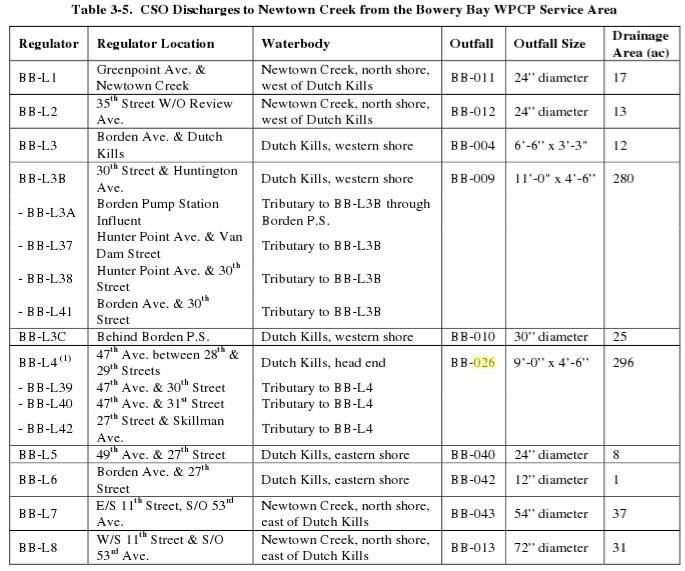
and from the same document this text and chart
The Low Level service area contains 46 regulators, of which 19 interconnected regulators discharge to the Newtown Creek during wet weather through the 13 CSOs. Of these 13 CSOs, 6 discharge to the tributary Dutch Kills (BB-004, 009, 010, 026, 040, and 042), and 6 discharge to Newtown Creek(BB-011, 012, 013, 014, 015, and 043). An additional 2-feet, 8-inches x 4-foot outfall, BB-049, is listed in the Bowery Bay WPCP SPDES permit as discharging to Dutch Kills near 21st Street, but no further information is available such as which regulator it is connected to.