Posts Tagged ‘newtown creek’
Burgundy Crow

– photo by Mitch Waxman
Wandering along the border between Ridgewood, Brooklyn, and Maspeth one afternoon- heading for one of the demoniac terminus points of the Newtown Creek’s tributaries found on Metropolitan Avenue, I realized that I was very much on the wrong side of the tracks.
from wikipedia
The majority of the neighborhood covers a large hill, more than likely part of the glacial moraine that created Long Island, which starts at Metropolitan Avenue, rises steeply for about two blocks, then slopes down gently. A good example of just how steep the hill is can be found at Our Lady of the Miraculous Medal Parish. The Front Entrance of the Church, which is at street level on 60th Place, is almost level with the second floor of the Parish school right next door.
Major streets in Ridgewood include Forest Avenue, Fresh Pond Road, Myrtle Avenue, and Metropolitan (“Metro”) Avenue. All of these streets are narrow two-lane roads (with parking lanes), and the high volume on these streets can cause traffic tie-ups during rush hour. The intersection of Fresh Pond and Metropolitan is especially notorious for being a bottleneck. The main shopping areas are on Myrtle Avenue and Fresh Pond Road. Other, smaller shopping strips are located on Metropolitan Avenue, Forest Avenue, and Seneca Avenue.

– photo by Mitch Waxman
Shabby and poorly kept, these industrial neighborhood scenes observed in this angle between neighborhoods bred paranoia in your humble narrator, who is always given to musings and imaginings.
The people who work here, and even worse- those who live in the shadowed alcoves between buildings and along the rail culverts- would care little for the gentle ways and informed manner of one like myself. There are people, and other entities, which enjoy things around these parts exactly as they are.
from wikipedia
The area known today as Maspeth was chartered by Dutch and English settlers in the mid-17th century. The Dutch had purchased land in the area known today as Queens in 1635, and within a few years began chartering towns. In 1642 they settled Maspat, under a charter granted to Rev. Francis Doughty. Maspat became the first European settlement in Queens. The settlement was leveled the following year in an attack by Native Indians, and the surviving settlers returned to Manhattan. It wasn’t until nine years later, in 1652, that settlers ventured back to the area, settling an area slightly inland from the previous Maspat location. This new area was called Middleburg, and eventually developed into what is now the town of Elmhurst, bordering Maspeth. Following the immigration waves of the 19th century, Maspeth was home to a shanty town of Boyash (Ludar) Gypsies between 1925 and 1939, though this was eventually bulldozed.
The name “Maspeth” is derived from the name of Mespeatches Indians, one of the 13 main Indian tribes that inhabited Long Island. It is translated to mean “at the bad waterplace” relating to the many stagnant swamps that existed in the area.

– photo by Mitch Waxman
My wanderings have brought me into contact with the high minded, the educated, and the entitled. From their offices in Manhattan, they spin a tale of “brownfield remediation” and “environmental reclamation” about the creek lands. They believe in policy, and regulation, and the force of law. Many have never walked these streets, and to quote a professor from a certain Manhattan university who was the institutions expert on this place- “ewww, it smells”.
She said this directly before one of her assistants, who wore sandals to Newtown Creek, stepped into a pile of animal droppings.
They also know nothing about the Crows.
from wikipedia
The scrap industry contributed $65 billion in 2006 and is one of the few contributing positively to the U.S. balance of trade, exporting $15.7 billion in scrap commodities in 2006. This imbalance of trade has resulted in rising scrap prices during 2007 and 2008 within the United States. Scrap recycling also helps reduce greenhouse gas emissions and conserves energy and natural resources. For example, scrap recycling diverts 145,000,000 short tons (129,464,286 long tons; 131,541,787 t) of materials away from landfills. Recycled scrap is a raw material feedstock for 2 out of 3 pounds of steel made in the U.S., for 60% of the metals and alloys produced in the U.S., for more than 50% of the U.S. paper industry’s needs, and for 33% of U.S. aluminum. Recycled scrap helps keep air and water cleaner by removing potentially hazardous materials and keeping them out of landfills.

– photo by Mitch Waxman
This Crow, who we will refer to as “Burgundy Crow” or “BC”, was visiting a scrap yard with his load of cast off mattresses. I have witnessed, although I was to cowardly to use my camera to record it, such men burning the bedding in Greenpoint to free the steel coil springs from the fabric- and I have seen the end product being sold as scrap. “Red Crow” was mentioned in a Newtown Pentacle posting a while back, as was “Blue Crow“.
This is not the sort of industry that the people who run Manhattan believe to exist, and represent an underground cash based economy of subsistence labor which most would prefer not to mention at cocktail parties. It wouldn’t matter to them anyway, as the Crows currently do not deal or compete in speculative Real Estate- which is all that Western Queens represents to them.
from a recent Queenstribune report
A recent achievement is a new grant program that will use financial incentives to spur the cleanup and redevelopment of contaminated lands known as brownfields. More than $9 million in City funds will be available over the next several years to fund environmental planning, investigation and cleanup.
“As our population continues to grow, turning contaminated land into usable space will allow us to develop new housing, create more open space, and spur new job growth,” Bloomberg said. “By awarding grants to those committed to cleaning up and developing brownfield sites, we can start revitalizations that may not otherwise have occurred, and that will bring real benefits to local neighborhoods.”
St. Raphael’s

Click here for the Flickr Slideshow, which I’ve just become aware, hasn’t been displaying in the usual fashion here at NP.com.
– photos by Mitch Waxman
I just happened to be passing St. Raphael’s on Greenpoint Avenue on Saturday the 14th of August, and found this splash of color illuminating the fossilized heart of this- your Newtown Pentacle.
wonderful epics of a nameless city

– photo by Mitch Waxman
This is not the world you know, this unmentioned and currently undefended border between Brooklyn and Queens, where the requiescant waters of the Newtown Creek gurgle and splash. Beyond the Pulaski Bridge- where an observable and otherworldly colour stains animal, and structure, and vegetable- the heavy industries which conspire to sustain the shining city of Manhattan spread out under the Newtown sun.
from nycedc.com
The Newtown Creek according to the Army Corps of Engineers (ACE) had a listing of 26 piers with a total of 8,483 feet of berthing space. However, only 16 piers with a total of 4,986 feet of berthing space are in use by 12 firms. Furthermore, six firms are using their 1,952 feet of pier berthing space and waterfront facilities occasionally only. The waterfront activity is primarily for ship and barge.

– photo by Mitch Waxman
Along its path, the bulkheaded shorelines of the Newtown Creek reveal the rotted timber and risible decay associated with exposure to the poisons and refuse of the vast human hive, and its associated infestations. The waters have been observed, personally, to host a surprising variety of life forms- including a dizzying array of non vertebrates. Within the cemented and artificial shores, internal voids and long abandoned pipelines shelter teeming populations of rodent forms, and unguessable possibilities present themselves when discussing what else may be hiding down there, in flooded cellar and forgotten basement.
from wikipedia
The creek begins near the intersection of 47th Street and Grand Avenue on the Brooklyn-Queens border 40°43′06″N 73°55′27″W at the intersection of the East Branch and English Kills. It empties into the East River at 40°44′14″N 73°57′40″W (2nd Street and 54th Avenue in Long Island City) opposite Bellevue Hospital in Manhattan at 26th Street. Its waterfront, and that of its tributaries Dutch Kills, Whale Creek, Maspeth Creek and English Kills, are heavily industrialized.
The creek has no natural waterflows. Its outgoing flow of 14,000 million gallons/year consists of combined sewer overflow, urban runoff, raw domestic sewage, and industrial wastewater. Being estuarine, the creek is largely stagnant. Since there is no current in the creek, sludge has congealed into a 15-foot thick layer of “black mayonnaise” on the creek bed.

– photo by Mitch Waxman
Just after passing the yawning mouth of the malign Dutch Kills, one encounters a scrap metal operation, which operates a car shredding operation. The great mill utilizes the “Newtown Creek Dock” and is owned and operated by the Hugo Neu Schnitzer East Co.
In a nutshell, the way that things work is:
Hugo Neu Schnitzer East Co. (HNSEC from this point) receives the metal glass and plastic collected by the DSNY and private contractors at its Hunts Point bulkheads in the Bronx, New Jersey, and Brooklyn…
- HNSEC then barges certain materials to Newtown Creek, where bulk metal is separated from the less valuable plastic and virtually worthless glass.
- A preliminary sorting of plastic and glass is performed, while the bulk metal is loaded onto barges.
- The metals are shipped by barge to other facilities, and offered for sale on the worldwide commodities markets.
According to those principalities who authored and designed this system, it reduces the per ton cost of processing the waste stream as well as reducing the reliance on automotive conveyance for it and nourishes the maritime industry.
from a nytimes.com article of 2004
One of the toughest challenges with recycling has always been finding markets for the recycled goods, whose resale can then help defray the costs of the program. In announcing a 20-year recycling contract yesterday, the Bloomberg administration said it had solved that problem by encouraging a company to find those markets.

– photo by Mitch Waxman
As is the way of things, Hugo Neu merged with Sim Group in 2005, and formed one of the largest recycling conglomerates in the world. According to our friends at Habitatmap, whose stout adherence to the scientific method and stalwart advocacy of the unvarnished truth has both terrified and impressed your humble narrator, the composite company- SimsMetal- is the largest single source of air pollution to be found along the modern Newtown Creek.
from simsmm.com
Sims Metal Management was originally established in 1917 by Albert Sims, a Sydney-based recycled metals dealer. The business was incorporated as Albert G. Sims Limited in 1928 and was renamed Simsmetal Limited in 1968.
In 1970, it merged with Consolidated Metal Products Limited and the merged ASX-listed company was named Sims Consolidated Limited. In 1979, Sims Consolidated Limited was acquired by Peko-Wallsend Limited and subsequently delisted. Sims Consolidated Limited was then acquired by North Limited (previously known as North Broken Hill Holdings Limited, and then North Broken Hill Peko Limited) in 1988. In 1989, North Limited sold the business to Elders Resources NZFP Limited, a diversified resources company.
In 1990, Carter Holt Harvey Limited made a successful takeover bid for Elders Resources NZFP Limited and divested that company’s non-forestry businesses, which included Sims. Sims changed its name to Simsmetal Limited in 1990 and relisted on the ASX in 1991. Simsmetal Limited changed its name to Sims Group Limited in 2003.
Sims Metal Management’s corporate strategy includes leading industry consolidation through acquisitions. Over a number of years, with experience gained from numerous international acquisitions, Sims Metal Management has established strict acquisition criteria. The acquisition criteria require that any acquisition target holds the number one or number two market position, delivers access to domestic and international customers, offers a sound platform for future growth and, above all else, will likely enhance shareholder value. The acquisition criteria have underpinned Sims Metal Management’s strong track record of international expansion.
In October 2005, Sims Group Limited merged with the recycling businesses of Hugo Neu Corporation, a privately owned U.S. corporation. The merger created a new ASX listed company named Sims Group Limited, which is traded under the ASX code “SGM.”

– photo by Mitch Waxman
I am told by knowledgeable sources that much of this scrap metal will eventually find its way to the mercantile courts of far away Asia, with the bulk of it headed to the smokestacks of China. This is less recycling and waste disposal than it is mining, if one actually takes a step back and looks at it.
from wikipedia
The scrap industry contributed $65 billion in 2006 and is one of the few contributing positively to the U.S. balance of trade, exporting $15.7 billion in scrap commodities in 2006. This imbalance of trade has resulted in rising scrap prices during 2007 and 2008 within the United States.[2] Scrap recycling also helps reduce greenhouse gas emissions and conserves energy and natural resources. For example, scrap recycling diverts 145,000,000 short tons (129,464,286 long tons; 131,541,787 t) of materials away from landfills. Recycled scrap is a raw material feedstock for 2 out of 3 pounds of steel made in the U.S., for 60% of the metals and alloys produced in the U.S., for more than 50% of the U.S. paper industry’s needs, and for 33% of U.S. aluminum. Recycled scrap helps keep air and water cleaner by removing potentially hazardous materials and keeping them out of landfills.

– photo by Mitch Waxman
Frequently observed on the East River, these barges of shredded steel and metal maintain a regular schedule back and forth from the Newtown Creek. This particular barge is the 886 gross ton Cape Lucy, a 146 foot long freight vessel operated by the Inland Barge Corporation, and constructed by Bethlehem Steel in 1953.
Always fascinated by minutia, your humble narrator wonders if this barge is a “leave behind” from the construction of the Pulaski Bridge by the self same Bethlehem Steel in 1953.
from nyc.gov
In 1881, the New York City Department of Street Cleaning was created in response to the public uproar over litter-lined streets and disorganized garbage collection. Originally called the Department of Street Cleaning, the agency took over waste responsibilities from the New York City Police Department. In 1933, the name was changed to the Department of Sanitation.
Throughout the 1880’s, 75% of NYC’s waste was dumped into the Atlantic Ocean. In 1895, Commissioner George Waring instituted a waste management plan that eliminated ocean dumping and mandated recycling. Household waste was separated into three categories: food waste, which was steamed and compressed to eventually produce grease (for soap products) and fertilizer; rubbish, from which paper and other marketable materials were salvaged; and ash, which along with the nonsalable rubbish was landfilled. The Police Department, under the direction of its Commissioner, Theodore Roosevelt, enforced the recycling law.

– photo by Mitch Waxman
Heavy equipment and esoteric machinery is always on display at this location, and it attracts no small amount of attention from area photographic enthusiasts. Proximity to the Newtown Creek Waste Water Treatment Plant Nature Walk, with its wide open sight lines and panoramic scope, no doubt aids in the fame of this place. These shots, however, were captured from onboard a boat which was plying the volatile surface of the Newtown Creek.
from wikipedia
Critics dispute the net economic and environmental benefits of recycling over its costs, and suggest that proponents of recycling often make matters worse and suffer from confirmation bias. Specifically, critics argue that the costs and energy used in collection and transportation detract from (and outweigh) the costs and energy saved in the production process; also that the jobs produced by the recycling industry can be a poor trade for the jobs lost in logging, mining, and other industries associated with virgin production; and that materials such as paper pulp can only be recycled a few times before material degradation prevents further recycling. Proponents of recycling dispute each of these claims, and the validity of arguments from both sides has led to enduring controversy.

– photo by Mitch Waxman
Weirdly organic, the Sennebogen hydraulic loaders which effortlessly move the scrap from land to barge seem to be a favored item for the scrap industry to purchase (and Sims Metal in particular), valued for its mechanical advantages and engineering accumen. Sennebogen, like the fabled Steinway clan which has left such an indelible stamp on the surrounding communities, is a German corporation operated by a single family and founded by an enigmatic sire.
from sennebogen-na.com
RICHMOND, CA – The existing pedestal crane at the 18-acre Sims Metal Management scrap metal yard in Richmond, California had become a bit of a production liability for Jesse Garcia, Sims NW Equipment Manager. Repairs to the pedestal crane were difficult and Garcia often found himself having to lease replacement equipment to keep up production on the yard’s shear when the crane went down. When it came time to replace the crane, Garcia chose a SENNEBOGEN 840 R special, a purpose-built material handler that gives him the mobility and problem-free reliability and uptime he was seeking.
“Metal on metal”
“A scrap yard is a tough environment – it’s constant metal on metal. You need dependable equipment that is built for this application. SENNEBOGEN machines are purpose-built for handling scrap metal, they’re not just retrofitted excavators,” says Garcia. “Our tracked SENNEBOGEN 840 R special is perfect for this application. We can move it in and out for quick, easy maintenance, and should the shear go down, we can utilize it elsewhere in the yard.”

– photo by Mitch Waxman
Forgotten by modernity, even your humble narrator had to consult with one of the “Rabbi’s” to double confirm that this dock was originally the location of the “Manure Dock”, where Manhattan’s human waste products, animal carcasses, and organic waste would be barged to.
Journalists of the era referred to it as the “Offal dock“.
Some of the redolant cargo would be shipped untreated to points East by the LIRR to be utilized as fertilizer on the bountiful farms which once typified the eastern counties, and some percentage of it was processed by local commercial rendering operations owned by the likes of Conrad Wessel and Peter Cooper who saw the rotting filth as a raw material for various food products- aspic, isenglass, and gelatin amongst others. The remnants of that process, which involved the usage of high pressure steam and other state of the art victorian technologies, were further processed into glues, waxes, and potent acids.
from wikipedia
Where a cargo is coarser in size than minerals, commonly for scrap metal, then an orange-peel grab may be used instead of a shell. These have six or eight segments of “peel” independently hinged around a central core. They are better able to grab at an uneven load, rather than just scooping at small pieces. If the load is made of long thin pieces, a grab may also be able to carry far more than a single “grabful” at one time.
Although orange-peel grabs may be hung from cables on a jib, they’re also commonly mounted directly onto a jib. This is more suitable for grabbing at awkward loads that might otherwise tend to tip a hanging grab over. They may also use hydraulics to control the segments rather than weight and hoist cables.

– photo by Mitch Waxman
The concept of recycling is nothing new, here in the megalopolis of New York, and then as now- it was the Newtown Creek and its surrounding communities that absorbed and absolved Manhattan’s sins. The stink, as reported in the late 19th century, that arose from this section of the Creek was legendary even to those hardened by close quartered tenement conditions and the press of an unventilated and crowded city which counted its draft animals in the hundreds of thousands.
Imagine a hot August day in Manhattan, 100 years ago, and that same day… on a slick of oily water some 4 miles long that defined the undefended border between the cities of Long Island City, Newtown, Greenpoint, Bushwick, and Williamsburg.
Pictured above is the DonJon towing Tug Peter Andrew, part of the DonJon Marine fleet that handles the metal and other recyclables trade from Newtown Creek to and from the Newtown Creek to the other links in the waste stream scattered about the New York Harbor archipelago. Photo is from last year, and was shot on the East River.
from donjon.com
Donjon Marine Co., Inc. offers the marine community full-service solutions to meet your every need in the field of marine salvage, dredging, material recycling and related services. Founded in 1964 by Mr. J. Arnold Witte, Donjon’s President and Chief Executive Officer, Donjon Marine’s principal business activities were marine salvage, marine transportation, and related services. Today Donjon Marine is a true provider of multifaceted marine services. Donjon’s controlled expansion into related businesses such as dredging, ferrous and non-ferrous recycling and heavy lift services are a natural progression, paralleling our record of solid technical and cost-effective performance.
Historic Tug at Newtown Creek

Vintage Tugboat at Newtown Creek – photo by Mitch Waxman
A rare opportunity to ride up the Newtown Creek was recently enjoyed by your humble narrator, and on my journey up that maligned cataract I spotted an artifact of New York Harbor’s glorious past sneaking past Hunters Point.
from epa.gov
Blue-claw crabs, bluefish, weakfish, striped bass, and other species inhabit the creek, and fishing and crabbing for human consumption occurs [Ref. 7, pp. 2, 5; 8, p. 11; 21, p. 13; 22, pp. 1-2; 24, p. 143; 52, p. 93; 68, p. 3; 69, p. 1]. Subsistence fishing has been observed in Newtown Creek at Dutch Kills, and crabbing for consumption has been observed at the end of Manhattan Avenue in Brooklyn [Ref. 7, p. 5; 21, p. 13; 22, pp. 1-2; 68, p. 3; 69, p. 1]. These locations are both within the zone of contamination for the Newtown Creek site [Figure 2 of this HRS documentation record]. Therefore, Actual Contamination is documented, and the target fishery is evaluated for Actual Human Food Chain Contamination.

the W O Decker at Newtown Creek – photo by Mitch Waxman
Wooden hulled, its spitting steam boilers have long been replaced by modern diesel engines, this little (52 feet long) tugboat is the W O Decker.
also from epa.gov
Beginning in the late 1800s and continuing into the 1930s, Newtown Creek was widened, deepened, and lined with bulkheads to accommodate the growing traffic, leading to the destruction of all its freshwater sources [Ref. 8, p. 10; 12,
p. 52]. During World War II, the government commandeered factories along the creek to make military equipment, such as a factory that made aluminum for fighter planes [Ref. 11, p. 14]. At that time, Newtown Creek was the busiest industrial port in the Northeast, with tanker traffic lining its length [Ref. 7, p. 1; 11, p. 13]. The national highway system built after the war took business away from the nation’s waterways, leading to a rapid decline in the level of industry along Newtown Creek [Ref. 7, pp. 1-2].

the W O Decker passing by the “Greenpoint Manufacturing and Design Center” – photo by Mitch Waxman
A “historic place” the Decker was originally called the Russell 1 when it was built in 1930 for the Newtown Creek Towing Company, who were specialists in berthing and towing heavy cargo along the crowded and narrow waterway.
from gmdconline.org
The Greenpoint Manufacturing and Design Center (GMDC) started in the late 1980s as an innovative intersection of two interests: reclaiming derelict factories in North Brooklyn’s Greenpoint neighborhood and sustaining industry and manufacturing in New York City. The organization formally incorporated in 1992.
From its initial purchase and redevelopment of a large facility at 1155 Manhattan Avenue for use by light manufacturers and artisans, GMDC has since expanded and today is the only nonprofit industrial developer in New York City. The organization acquires, develops, and manages industrial real estate that provides small and medium-sized manufacturing enterprises with affordable, flexible production space.

In the shot above, The Decker is passing the Newtown Creek Waste Water Treatment Facility in Greenpoint, Brooklyn – photo by Mitch Waxman
The Decker is currently a high end tour vessel, operated by and out of the South Street Seaport in Manhattan.
from seany.org
The wooden tugboat W.O. Decker was built in Long Island City, Queens in 1930 for the Newtown Creek Towing Company, a firm specializing in berthing ships and barges in the creek that separates Brooklyn and Queens. Originally called the Russell I for the towing company’s owners, she was renamed the W.O. Decker in 1946 after being sold to the Decker family’s Staten Island tugboat firm.

The shield wall of the Shining City, framed by Long Island City on the right and industrial Brooklyn on the left with the Pulaski Bridge just at Horizon – photo by Mitch Waxman
The vessel I was aboard continued on toward the Greenpoint Avenue Bridge, but the Decker turned in the narrow part of the Newtown Creek near the confluence of its tributaries Whale Creek and Dutch Kills.
Check out this 1896 article at the NYTimes, which actually interviews the manager of Newtown Creek Towing Company, John Russell, for whom the Decker was originally named.
Our friends at the Working Harbor Committee are actually doing a few tours this summer on the Decker- click here for more
Ruby M. at Whale Creek

– photo by Mitch Waxman
Someone recently told me that this, your Newtown Pentacle, was a mere paparazzi rag for infrastructure and heavy industry- which made me laugh out loud.
Then, depressed, disturbed, and frightened by even good natured criticism I retreated into a sulking and jealous rage. All ‘effed up, I threw together my little ensemble of camera bag and headphones and set off for the Newtown Creek. When I got to the Pulaski Bridge, it was open and I realized that I had just missed a Tugboat passing through. ARRGHH!!!
What I did see though, was this flatbed truck carrying what appears to be remnants of a Roosevelt Island Tramway tower in the direction of Greenpoint.
“Could this be some sort of super Crow?” thought your humble narrator…
– photo by Mitch Waxman
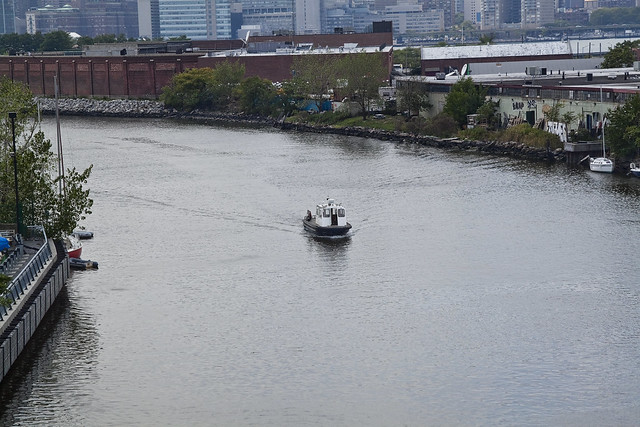
Brutally hot, vast misty shelves of humid air blanketed the terrain when the Pulaski reconstituted itself into its roadway configuration via those electrical engines that operate its double bascule mechanism. Tepid, the fetid air flow’s tortuous languor augmented that remarkable and certain odor which distinguishes the Newtown Creek watershed. At the apex of the arc which spans this part of that storied rivulet, this small boat was spied.

– photo by Mitch Waxman
As its markings indicate, this is the Emily Miller. A “Job” or Utility boat, Emily Miller is 31 feet long, 185 HP and based at Pier 7 1/2 in Staten Island at Miller’s Launch.
from millerslaunch.com
Miller’s Launch is a marine service company based on the North Shore of Staten Island, New York. With satellite terminals throughout New York, New Jersey and Connecticut, we have provided first-class service to the marine industry since 1977.

– photo by Mitch Waxman
Nothing special, really, but since I missed the Tug… I decided to take some shots of it passing anyway. For a waterway that was once the busiest on Earth, the relative scarcity of traffic on Newtown Creek these days makes any vessel plying its poison expanse notable.

– photo by Mitch Waxman
My endless wanderings found your humble narrator once more at the Newtown Creek Waste Water Treatment Plant Nature Walk, always an easy egress point for observing the malefic realities of Newtown Creek and one of the few water level access points open to the general public along the great canal. To my wonder and joy, I found the tugboat that I had missed when the Pulaski (and this post) opened.

– photo by Mitch Waxman
The tug is the Ruby M. operated by Dann Towing, but once once known as he Texaco Fire Chief when it was built in 1967 at the Jakobson Shipyard in Oyster Bay. Steel hulled, it is 95 feet long and has a gross tonnage of 197. It was sitting astride Whale Creek, and maneuvering a barge into position. Tugboats are seldom observed at work this close, and certainly -in my limited experience- it is a rare thing to see one in such a nearly static position relative to the camera.
Normally, you have to shoot fast to capture one, as it is hurtling past.
The Newtown Creek Waste Water Treatment Plant, incidentally, sits on the site of one those insane fires which Greenpoint seems to have been quite prone to and distinguished by during the heady days of the industrial revolution. Check out this NYtimes article from 1900 which describes the horror.

– photo by Mitch Waxman
Daring contact with that which might exist in the shallow depths, your humble narrator descended those threatening steps found at the Nature Walk, and was rewarded with this found composition. Unlike most of the photos presented here, its presence is not meant to advance a narrative or illustrate a point- I just think its a neat shot.

– photo by Mitch Waxman
Having little else to do, I hung around for a while to see if the Ruby M. was about to do something interesting. It didn’t, just repositioning itself further up the creek and tying off to a different barge than the one they had just delivered. Emily Miller’s role in the transaction seemed to have been completed as well, as it advanced past the rail bridges spanning the Dutch Kills tributary of the Newtown Creek.


