Posts Tagged ‘ny harbor’
grin horribly

– photo by Mitch Waxman
Prurient thrills and visual stimulation help to attenuate the shocking reality of my daily existence, a non ending series of humiliating but overwhelmingly dull events. Referring to the biblical quotation, your humble narrator is neither hot nor cold, and is instead merely lukewarm. Unlike the stout seamen and union workers who staff the gargantuan cargo docks of Port Elizabeth Newark, it is my lot to always disappoint and or fail those who count upon me.
Sometimes the burden is overwhelming.

– photo by Mitch Waxman
These shots were gathered upon a trip produced but he Working Harbor Committee, and are notable simply because they depict the Gantry Cranes and ship loading action at night. This is fairly typical for the workers of the port, a twenty four hour operation which keeps the wheels of commerce spinning here at the heart of the Megalopolis. There is always something making its way here which needs tending, a juggernaut of consumer goods and foodstuffs.

– photo by Mitch Waxman
The agenda of the powerful and elite is one that we all must follow, or so I am told by those closer to the source of all things. Therefore, untold fortunes will soon be spent to rearrange this bridge to accommodate the needs of these dock facilities, which will further it’s role as an economic engine. Said monies, of course, will be gathered from or passed onto the populace at large. The docks serve this populace, it is in their best interest, I am told.
The message of this Maritime Sunday is a tepid one, as stated above. It’s not good, nor bad. It just is.
Also- Upcoming Newtown Creek tours and events:

for more information on the November 9th Newtown Creek Magic Lantern Show, click here

for an expanded description of the November 11th Newtown Creek tour, please click here
forbidden zone

– photo by Mitch Waxman
Consultations with the elder tomes, Armbruster and Riker amongst others, an activity entered into during an innocent pursuit of certain historical lore about the area surrounding the conjunction of Grand Street/Avenue and the fabled Newtown Creek, revealed- or rather suggested- blasphemous realities difficult to digest. Needing a walk, and desiring to be warmed by the burning thermonuclear eye of god itself, your humble narrator found himself scuttling forth and somehow ended up at the hidden relict known to some as the Maspeth Avenue Plank Road. It was there that a corpse was discovered.
from wikipedia
Horseshoe crabs resemble crustaceans, but belong to a separate subphylum, Chelicerata, and are therefore more closely related to arachnids e.g spiders and scorpions. The earliest horseshoe crab fossils are found in strata from the late Ordovician period, roughly 450 million years ago.

– photo by Mitch Waxman
Long time readers of this, your Newtown Pentacle, are familiar with the spot. The wooden structure visible is the last remains of the Maspeth Toll Bridge Co.’s Plank Road- which last crossed the Newtown Creek in 1875. Connecting the ancient community of Maspeth and Newtown with the hellish expanse of Furmans Island (home to Peter Cooper’s Glue Factory and Conrad Wissel’s Night Soil and Offal Dock, amongst other notorious or malodorous occupants), the Plank Road today exists as a destination for Newtown Creek devotees and fetishists. One did not expect to find a cadaver there, especially not of a creature whose origins stretch back to the Ordovician age.
from wikipedia
For most of the Late Ordovician, life continued to flourish, but at and near the end of the period there were mass-extinction events that seriously affected planktonic forms like conodonts, graptolites, and some groups of trilobites (Agnostida and Ptychopariida, which completely died out, and the Asaphida, which were much reduced). Brachiopods, bryozoans and echinoderms were also heavily affected, and the endocerid cephalopods died out completely, except for possible rare Silurian forms. The Ordovician–Silurian Extinction Events may have been caused by an ice age that occurred at the end of the Ordovician period as the end of the Late Ordovician was one of the coldest times in the last 600 million years of earth history.

– photo by Mitch Waxman
Given its size, the departed was likely a female, and it was fairly apparent from both olfactory and visual inspection that it had emerged from the water and mounted its cairn several days before you humble narrator stumbled upon it. Clearly, its eyes had been chewed away by some scavenger. Often have I been told that this specie exists in Newtown Creek, but never have I beheld a specimen along it. Truly- who can guess, all there is, that might be buried down there?
from wikipedia
Xiphosura is an order of marine chelicerates which includes a large number of extinct lineages and only four recent species in the family Limulidae, which include the horseshoe crabs. The group has hardly changed in millions of years; the modern horseshoe crabs look almost identical to prehistoric genera such as the Jurassic Mesolimulus, and are considered to be living fossils. The most notable difference between ancient and modern forms is that the abdominal segments in present species are fused into a single unit in adults.

– photo by Mitch Waxman
Often has the thought occurred to me. The relatively sudden change in the chemistry of both water and sediment over the last couple of hundred years- what process has that begun in the genome of local specie? Those who cannot adapt to the “new normal” will wither and die off, while others will alter themselves to thrive in the environment they find themselves in. Such is the very nature of life upon this world. Creatures such as this Horseshoe Crab have persisted, generation after generation, through asteroid hits and volcanic calamity and ice age. Surely they can adapt to the petroleum and chemicals in the water. They have seen dinosaurs come and go, these creatures.
from wikipedia
The Atlantic horseshoe crab, Limulus polyphemus, is a marine chelicerate arthropod. Despite its name, it is more closely related to spiders, ticks, and scorpions than to crabs. Horseshoe crabs are most commonly found in the Gulf of Mexico and along the northern Atlantic coast of North America. A main area of annual migration is Delaware Bay, although stray individuals are occasionally found in Europe.
The other three species in the family Limulidae are also called horseshoe crabs. The Japanese horseshoe crab (Tachypleus tridentatus) is found in the Seto Inland Sea, and is considered an endangered species because of loss of habitat. Two other species occur along the east coast of India: Tachypleus gigas and Carcinoscorpius rotundicauda. All four are quite similar in form and behavior.

– photo by Mitch Waxman
The province of science fiction, such industrially adapted animals might thrive on petroleum derivates, taking advantage of other species inability to exist in such places. It has happened before, sudden environmental change. Unfortunately, it is rather simple creatures like the horseshoe crab and those smaller who are most likely to survive. Always, it is the apex predators who dominate the landscape that die off, which in modern times – unfortunately- is us.
from wikipedia
It is generally agreed that the Chelicerata contain the classes Arachnida (spiders, scorpions, mites, etc.), Xiphosura (horseshoe crabs) and Eurypterida (sea scorpions, extinct). The extinct Chasmataspida may be a sub-group within Eurypterida. The Pycnogonida (sea spiders) were traditionally classified as chelicerates, but some features suggest they may be representatives of the earliest arthropods from which the well-known groups such as chelicerates evolved

– photo by Mitch Waxman
Imagine the earth of a century or two from now- flooded and with vast reserves of carbon dioxide loosed within the atmosphere. Contrary to doomsayers fantasies of some parched Sahara, the historic record suggests- based on the fossil record of eras when CO2 existed in concentrations well beyond any modern day greenhouse gas scenario- that the planet will host vast forests as opportunist trees and plants drink in the stuff. We will be long gone, of course, either having escaped into space or extinct because of changes in rainfall, habitable land, and climate which will render large scale agriculture a quaint memory. If and when the monsoons fail to arrive in China and India, we will know the end is nigh.
Of course, these CO2 rich epochs were also marred by incredibly vast fires. The smoke from forest fires which consumed whole continents contributed to palls of smoke blotting out the sun which eventually cooled the planet and caused ice ages. Additionally, the precipitate of this smoke, carried down by rain, changed the pH of the oceans which dissolved the shells of mollusks and burned away the coral reefs. Ask the Xiphosura, they’ll tell you all about it, unless we wipe them all out first.
from pbs.org
With its armored shell, ancient anatomy, and 350-million-year lineage, the horseshoe crab almost seems too inconspicuous to stir up controversy. Yet this humble creature is at the very center of a collision between three completely different species.
For many decades, humans have harvested the horseshoe crab for use as fishing bait. Since the 1970s, we have also used horseshoe crab blood for medical purposes. But we may have gone too far. Horseshoe crab numbers have declined significantly since the early 1990’s. And, naturally, so did their egg numbers.
Also- Upcoming Newtown Creek tours and events:
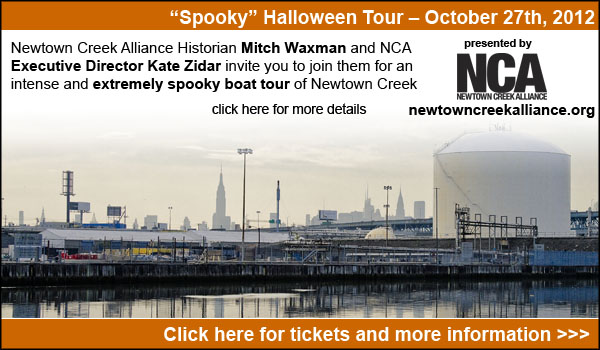
for more information on the October 27th Newtown Creek Boat Tour, click here
for more information on the November 9th Newtown Creek Magic Lantern Show, click here
for an expanded description of the November 11th Newtown Creek tour, please click here
gleaming image

– photo by Mitch Waxman
It should be mentioned that under normal circumstance, the narration recited on board one of the Newtown Creek boat tours which I’ve been a part of in the recent past has been “the straight story”. By that, I mean that the normal narrative which readers of this blog have grown used to is toned down a bit, and a more mainstream presentation is offered. There are still plenty of “night soil and offal dock” stories, but as I have a relatively short amount of time to tell the story of Newtown Creek, a lot of the more… colourful… stuff gets trimmed out. Luckily, the Newtown Creek Alliance is producing a “spooky” Halloween tour this Saturday (October 27), and I get to go to town on this one.

– photo by Mitch Waxman
In addition to weaving the Blissville Banshee, Maspeth Gypsies, and witch panics into my speech- there are two other factors which make this tour special. First and foremost is the price, subsidized by grant money from the NYCEF fund of the Hudson River Foundation – which allows NCA to offer the trip at an amazing price of just $25. Secondly, the time at which we will be embarking is late in the afternoon, which should offer spectacular sunset lighting of the Creek for photographers and sensitives alike.

– photo by Mitch Waxman
This is a two hour excursion, leaving from Manhattan’s South Sea Seaport on board a comfortable NY Water Taxi (which, yes, has bathroom facilities). NCA is encouraging the wearing of seasonal costuming to celebrate and acknowledge the Halloween holiday. Scheduled speakers include your humble narrator and NCA Executive Director Kate Zidar. Whatever there is, which cannot possibly exist, lurking in the Black Mayonnaise which underlies the cursed waters of that cataract of agony known as the Newtown Creek has refused to make an appearance sans ritual sacrifice- something NCA cannot have any involvement with due to the intricacies of its 501/3c non profit status. The thing in the megalith will be watching, however.

– photo by Mitch Waxman
The question of what sort of costume I will be wearing is still up in the air. Attempts to borrow a death cloak have so far been unsuccessful, despite the fact that several people I know own such raiments. Click the banner just below this paragraph for ticketing information and fulfillment. Do you dare to enter this nightmare world of the Newtown Creek, or will you instead cling to the illusion of sanity which exists beyond its banks?
Also- Upcoming Newtown Creek tours and events:
for more information on the October 27th Newtown Creek Boat Tour, click here
for more information on the November 9th Newtown Creek Magic Lantern Show, click here
for an expanded description of the November 11th Newtown Creek tour, please click here
quieter bazaars

– photo by Mitch Waxman
Mer de Beaufort, or the Beaufort Sea, is a body of water found north of Alaska and Canada which is frozen over most of the year. Beneath it are significant reserves of natural gas and petroleum, which are exploited by and fought over by both Canadian and United States interests. Due to its severe weather and ice bound condition, little to no commercial fishing happens, and it is home to a large colony of Beluga Whales and other cetacean megafauna. Most of the folks who live there are aboriginal- ethnic Inuvialuit Inuits and Native Americans.
It’s also a tugboat.
Built in 1971, by Main Iron Works of Houma, Louisiana (hull #258) as the Corsair for Interstate Oil Transportation of Philadelphia, Pennsylvania.
At the time Interstate Oil Transportation operated two fleets. Their Northeast Fleet or “Green Fleet” operated in Philadelphia, Pennsylvania. And their Southern Fleet or “White fleet” which operated out of Tampa, Florida.

– photo by Mitch Waxman
Recently, the Kirby Corporation bought a large outfit operating in NY Harbor called K-Sea. Beaufort Sea was a K-Sea tug, now it’s one of the hundreds owned and operated by the Texas based Kirby. The acquisition, apparently, was driven by a desire to strengthen their coastal towing capabilities in the field of refined petroleum and other barge shipped volatile liquids. An extensive corporate history, which reads like something out of an Ayn Rand book, can be perused here.
from kirbycorp.com
The New York Division operates tank barges ranging in capacity from 1,800 barrels to 81,000 barrels, and tugboats from 400 to 3,400 horsepower. This division services a wide variety of customers in both the refined and residual petroleum trades. Many of the barges in the New York fleet are engaged in the delivery of bunker fuel to ships. The NY Division vessels also transport gasoline, diesel fuel, jet fuel, ethanol and other refined products for local and regional customers. In the residual fuel sector, power generating customers rely on New York division vessels for floating storage and transportation of heavy fuel oil to local power plants.

– photo by Mitch Waxman
The actual Beaufort Sea- as in the section of the Arctic Ocean which is found between Point Barrow, Prince Peters Island, Banks Island, and the northern coast of Alaska and Canada’s Northwest Territories- seems like a fascinating place whose native peoples live a kind of life one can scarcely imagine as your humble narrator lives in a place called Queens. Hearty, a maritime Sunday shout out goes to both the native people of some far away coast and to the crew of the Beaufort Sea Tug.
from workboat.com
Kirby Corp. is buying K-Sea Transportation Partners in a deal that expands the giant tank-barge operator’s business into the coastwise petroleum transport trade.
The Houston company’s latest and largest acquisition this year is valued at $600 million — $335 million for K-Sea’s equity and $265 million in assumed debt — and is expected to close by July.
The two companies share oil company and refinery customers, so the transaction announced Sunday combines complementary rather than competing businesses. Kirby operates 825 inland tank barges and 222 towboats, as well as four offshore dry-cargo barges and four tugs. K-Sea has 58 coastal tank barges and 63 tugs that operate along the U.S. coasts as well as Alaska and Hawaii.
Also- Upcoming Newtown Creek tours and events:
for more information on the October 27th Newtown Creek Boat Tour, click here
for more information on the November 9th Newtown Creek Magic Lantern Show, click here
for an expanded description of the November 11th Newtown Creek tour, please click here
raised place

– photo by Mitch Waxman
That’s the Marie J. Turecamo, a Moran tug, getting all iconic on the East River. This tug has been discussed in earlier posts at this, your Newtown Pentacle, specifically the posting “Circumnavigation 1” from which the following is quoted:
…along came the Marie J. Turecamo tugboat- a 2,250 HP twin screw tug operated by Moran Towing. It was originally built as the Traveller in 1968, by Tangier Marine Transport which operated out of the Main Iron Works facility in Houma, LA.
from morantug.com
Moran is a leading provider of marine towing and transportation services, a 150-year-old corporation that was founded as a small towing company in New York Harbor and grew to preeminence in the industry. The cornerstone of our success has been a long-standing reputation for safe, efficient service, achieved through a combination of first-rate people and outstanding vessels and equipment.
Over the course of its history Moran has steadily expanded and diversified, and today offers a versatile range of services stemming from its core capabilities in ship docking, contract towing, LNG activities and marine transportation. Our tug fleet serves the most ports of any operator in the eastern United States, and services LNG terminals along the U.S. East and Gulf Coasts and the West Coast of Mexico. The Moran barge fleet serves the U.S. Atlantic and Pacific Coasts, the Great Lakes, the inland waters of the U.S. eastern seaboard, and the Gulf of Mexico. We also provide worldwide marine transportation services, including operations in the Caribbean and periodic voyages to South America and overseas waters.
Another appearance of the tug, wherein it played a similar iconic role and chewed a different bit of harbor scenery was in the posting “curious customs“.
Also- Upcoming tours…

for an expanded description of the October 20th Newtown Creek tour, please click here
for more information on the October 27th Newtown Creek Boat Tour, click here
for more information on the November 9th Newtown Creek Magic Lantern Show, click here
for an expanded description of the November 11th Newtown Creek tour, please click here


 The Newtown Pentacle