Posts Tagged ‘ny harbor’
visual landmarks

– photo by Mitch Waxman
Just a short posting, as today isn’t just maritime sunday, it’s also Easter Sunday at this- your Newtown Pentacle. Enjoy the holiday, unlike the crews of the many Tugs which are undoubtedly hard at work while you’re reading this.
primitive ruins
– photo by Mitch Waxman
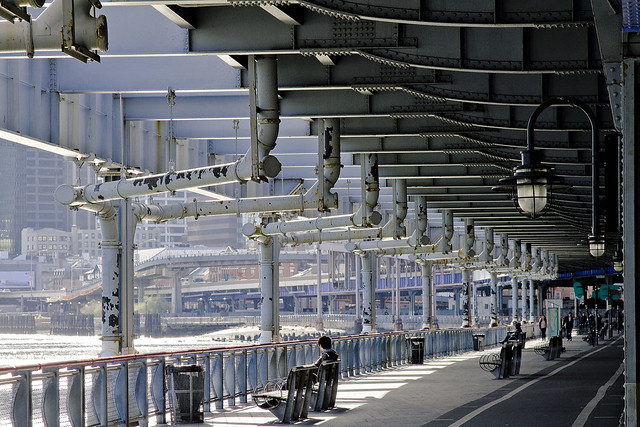
Recent business brought me to Manhattan, and an opportunity to walk along the East River while moving downtown presented itself. A spectacular promenade has recently emerged along the coast of the Shining City, much of which is unfortunately cement. Shiny and new, the sections above Corlears Hook made me a little nervous, as if one had wandered into an architect’s drawing populated by spandex wearing fitness models riding bicycles and running determinedly. Downtown, between East River Bridge Two and One (Manhattan and Brooklyn) this waterfront parkland was just grungy and old enough to feel lived in, by ordinary folk.

– photo by Mitch Waxman
It is difficult to complain about these open air trottoirs, which allow the citizenry a chance to gaze at the splendors of the harbor, especially given what these areas were like a mere 20-30 years ago. Trash strewn and off limits, New York had left its waterfront to rot away. The great shame of it all, and this is where the kvetching and Monday morning quarterbacking comes in, is that the infrastructure of docks and wharfs which literally made New York great is gone- never to return. Once something becomes a park, it is virtually impossible for it to return to other usage. No ship will be arriving here ever again.

– photo by Mitch Waxman
It’s the way of things, of course, and long ago was it decided that maritime interests were unimportant to Manhattan. So few are the docks on the island nowadays that it is scantly possible to find a berth. Word has it that the various waterfront vision plans include the usage of “temporary” or “floating” docks at some point in the future, but the days when a ship could unexpectedly arrive in the City- laden with some mysterious cargo from the south seas- seem to be over.
outward course

– photo by Mitch Waxman
The Kimberly Poling was observed recently, as it headed west along the infamous Newtown Creek, and has sailed directly into Maritime Sunday at this- your Newtown Pentacle. The tug is owned by Poling and Cutler, and we recently examined one of their other tugs on this self same stretch of the Creek- the Crystal Cutler.
The name of the game in the shipping industry is to never transport an empty container. As such- after disgorging the petroleum cargo carried by its fuel barge to Newtown Creek, the Kimberly Poling took on another load for transport.
from marcon.com
Marcon International, Inc. is pleased to announce the sale of the US Flag Twin Screw Tug “Jaguar” from Mobro Marine, Inc. to P&C Kimberly Poling, LLC. “Jaguar” was built by Main Iron Works in 1994. She measures 105′ LOA x 34′ beam x 15′ depth. The vessel is powered by two EMD 12-645E2 main engines, producing 3000 total BHP at 900 RPM. Reintjes gears drive two 93″ x 91″ fixed pitch propellers in kort nozzles producing an estimated 40 tons bollard pull. The vessel is fitted with fully air-conditioned accommodations for 7 crew in 4 cabins. “Jaguar” will work for her new owners in the US Northeast. Marcon acted as sole broker in the transaction.

– photo by Mitch Waxman
Within the double walled steel tanks of the fuel barge, which is the Edwin A Poling by the way, can be found several thousand gallons of Diet Coca Cola, no doubt pumped in from the Coca Cola bottling plant on 58th street in Maspeth.
Carbonated beverages can be quite volatile when subjected to the rolling waves of the open harbor and as such precautions must be observed. The Captain of the Kimberly Poling must personally ensure that there are no “Mentos” brand mints onboard, for instance.
Founded in 1995, Poling Cutler began operations near the time the former Poling Transportation went out of business.
The Founders of the new company were Ed Poling, whose grandfather started the former Poling company, and Gary Cutler who spent years working in the financial world before getting involved in Marine Transportation.

– photo by Mitch Waxman
The “Dr. Pepper drama”, which played out over three days off the coast of Nassau Island during the winter of 1997- known as the “Bahamian Belch”- is still quite fresh in the mind of the maritime community. Accordingly, Coast Guard penalties for the improper transportation of and off loading of all soft drinks are quite severe.
The barge is most likely bound for Staten Island, which has been experiencing extreme shortages of the stuff since the spring of 2010.
Newtown Creek was designated a Significant Maritime and Industrial Area (SMIA) in the NYC Department of City Planning ‘s 1992 Comprehensive Waterfront Plan for its characteristic clusters of industrial businesses and water-dependent uses. In the 2010 update of this plan, Vision 2020, Newtown Creek maintains its place as New York City’s largest SMIA in terms of both land area and employment. After losing half its jobs from 1992 to 2008, the number of jobs in Newtown Creek SMIA grew by nearly 1,400 (totaling 15,000 jobs) from 2000 to 2008.

– photo by Mitch Waxman
The carbonation of the cargo is causative rather than coincidental as to why the barge is riding so high in the water, as the frothy action of the pressurized bubbles in the beverage buoy it up. The Maritime Shipping Association sees this sector of the business expanding exponentially and demand for the diet drink doubling within the decade.
It is good to know, on this the 1st of April, that the thirst of Staten Islanders will be satiated.
from wikipedia
Diet Coke (also known as Diet Coca-Cola, Coca-Cola light or Coke Light) is a sugar-free soft drink produced and distributed by The Coca-Cola Company. It was first introduced in the United States on August 9, 1982, as the first new brand since 1886 to use the Coca-Cola trademark. The product quickly overtook the soft drink Tab in sales.
Diet Coke was sweetened with aspartame after the sweetener became available in the United States in 1983; to save money, this was originally in a blend with saccharin. After Diet Rite cola advertised its 100 percent use of aspartame, and the manufacturer of NutraSweet (then, G.D. Searle & Company) warned that the NutraSweet trademark would not be made available to a blend of sweeteners, Coca-Cola switched the formula to 100 percent NutraSweet. Diet Coke from fountain dispensers still contains some saccharin to extend shelf life.
sight within

– photo by Mitch Waxman
Maritime Sunday is here once again, and this time around your Newtown Pentacle is focusing in on something most New Yorkers wouldn’t believe exists within the five boroughs- graving or dry docks. These shots are of the Cadell yard, along the Staten Island border formed by the Kill Van Kull.
from wikipedia
A floating drydock is a type of pontoon for dry docking ships, possessing floodable buoyancy chambers and a “U” shaped cross-section. The walls are used to give the drydock stability when the floor or deck is below the surface of the water. When valves are opened, the chambers fill with water, causing the drydock to float lower in the water. The deck becomes submerged and this allows a ship to be moved into position inside. When the water is pumped out of the chambers, the drydock rises and the ship is lifted out of the water on the rising deck, allowing work to proceed on the ship’s hull.

– photo by Mitch Waxman
Tugs, in particular, take a lot of abuse. Towing hundreds of millions of tons through choppy waters puts terrific strain on their hull and superstructure. Just like the family car, they occasionally need to head for a garage to be inspected and repaired- or just painted to avoid the corruption of oxidation.
from caddelldrydock.com
CADDELL DRY DOCK AND REPAIR CO., INC (Caddell) accommodates a wide variety of marine vessels on its floating dry docks and piers. The Caddell facility is one of the largest full service shipyards in the New York Metropolitan Area. In addition to our dry docking services, we offer pier side repair work available on our network of eight piers with crane operations able to extend up to 200′ and capable handling loads up to 6500 tons. Caddell has carried on the noble maritime tradition and legacy of a uniquely exceptional shipyard by providing quality and prompt service at competitive prices for the surounding New York City region for more than a century.

– photo by Mitch Waxman
Like a lot of heavy industries, the graving docks have largely left New York City. Large facilities at Atlantic Basin in Red Hook and other places have simply been left to rot away. The ones in Staten Island seem to be hanging on, doing essential work that keeps the harbor moving.
from globalsecurity.org
Building and repairing boats and ships was Staten Island’s most important industry before the First World War. One of the Island’s earliest and most important shipyards belonged to William and James M. Rutan. Their shipyard produced about a 100 schooners and sloops per year. There were 17 shipyards on Staten Island by 1880, located on the North Shore, in Stapleton and in Tottenville. Tugs, propeller yachts and coal barges were built there. US Navy and international shipping in the late 1800s produced a need for large shipyards. They could be found along the Kill van Kull near Mariners Harbor and Port Richmond. In 1901-1902, Townsend and Downey Shipyard built the Meteor III, an imperial yacht for Kaiser Wilhelm. By the 1920s, 18 shipyards employed 6,800 people.

– photo by Mitch Waxman
This is from the Brooklyn Navy Yard, and shows the other sort of drydock, a granite pit outfitted with sea walls and gargantuan pumping mechanisms that can accommodate all but the very largest shipping.
from wikipedia
On the eve of World War II, the yard contained more than five miles (8 km) of paved streets, four drydocks ranging in length from 326 to 700 feet (99 to 213 meters), two steel shipways, and six pontoons and cylindrical floats for salvage work, barracks for marines, a power plant, a large radio station, and a railroad spur, as well as the expected foundries, machine shops, and warehouses. In 1937 the battleship North Carolina was laid down. In 1938, the yard employed about ten thousand men, of whom one-third were Works Progress Administration (WPA) workers. The battleship Iowa was completed in 1942 followed by the Missouri which became the site of the Surrender of Japan 2 September 1945. On 12 January 1953, test operations began on Antietam, which emerged in December 1952 from the yard as America’s first angled-deck aircraft carrier.
The US Navy took possession of PT 109 on 10 July 1942, and the boat was delivered to the Brooklyn Navy Yard for fitting.
This boat was sunk in the Pacific in August 1943 and became famous years later when its young commander, Lt. John F. Kennedy, entered politics.
At its peak, during World War II, the yard employed 70,000 people, 24 hours a day.
acquired archaism
– photo by Mitch Waxman
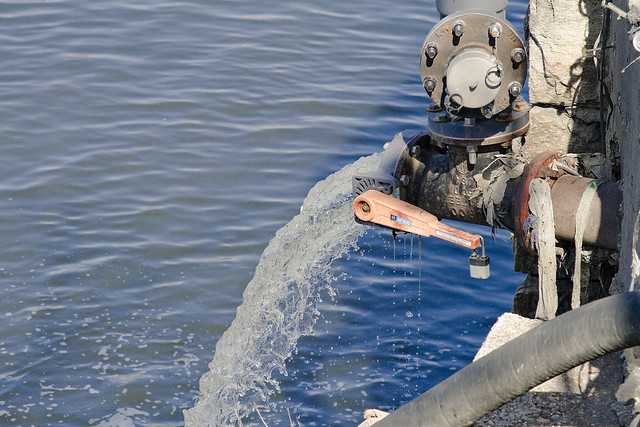
The internationalists and potentates whose congress calls itself the so called United Nations would have you observe “World Water Day” on this date. This cabal of diplomats, intriguers, and acolytes desire you to imagine and contemplate the assertion that at least a sixth of the living human infestation has no reliable access to pure water. From their headquarters in the Shining City of Manhattan- designed by the gallic crypto fascist LeCorbusier- their edict rings out, and we all must take heed of “Agenda 21”. Pictured in the shot above is the largest source of fresh water flowing into the Newtown Creek, some two to three miles from their base.
from wikipedia
World Water Day has been observed on 22 March since 1993 when the United Nations General Assembly declared 22 March as World Day for Water.
This day was first formally proposed in Agenda 21 of the 1992 United Nations Conference on Environment and Development (UNCED) in Rio de Janeiro, Brazil. Observance began in 1993 and has grown significantly ever since; for the general public to show support, it is encouraged for the public to not use their taps throughout the whole day, the day has become a popular Facebook trend.
The UN and its member nations devote this day to implementing UN recommendations and promoting concrete activities within their countries regarding the world’s water resources. Each year, one of various UN agencies involved in water issues takes the lead in promoting and coordinating international activities for World Water Day. Since its inception in 2003, UN-Water has been responsible for selecting the theme, messages and lead UN agency for the World Day for Water.

– photo by Mitch Waxman
Burgeoning, the human infestation continues to intensify upon the skin of the planet, threatening to overwhelm the fragile biosphere with a monoculture of killer apes. Sophistry and numerical manipulation make the case for Agenda 21 to play out, attempting to induce guilt and damned realization into the mainly western minds of the post industrial world, those who are well fed and watered. Your humble narrator plans on not flushing the toilet today, much to the chagrin of both “Our Lady of the Pentacle” and our little dog Zuzu. Additionally, none of us will eat or drink. A fast day will be observed for the suffering multitudes.
from unwater.org
There are 7 billion people to feed on the planet today and another 2 billion are expected to join by 2050. Statistics say that each of us drinks from 2 to 4 litres of water every day, however most of the water we ‘drink’ is embedded in the food we eat: producing 1 kilo of beef for example consumes 15,000 litres of water while 1 kilo of wheat ’drinks up’ 1,500 litres.
When a billion people in the world already live in chronic hunger and water resources are under pressure we cannot pretend the problem is ‘elsewhere’.

– photo by Mitch Waxman
The unfortunate truth, globally, is that much of the fresh water which the human infestation might consume is fouled by sewage. Whether it is agricultural lagoons of animal waste, municipal infrastructure or lack thereof, or outright industrial effluent- this is the true issue which Agenda 21 ignores. If you want to save the multitudes of the developing world- eliminate malaria and a host of other pathogens almost overnight- build sanitary sewers. Of course, we haven’t managed to swing this in New York City let alone sub Saharan Africa, so you might as well despair.
from nycgovparks.org
Social Hour: World Water Day, Thursday, March 22, 2012. 6:30 P.M.–8:00 P.M.
Celebrate World Water Day by learning more about the Croton Reservoir and Central Park’s historic role in supplying New York City with fresh drinking water. Co-presented with the NYC Department of Environmental Protection.
This event is recommended for adults (18 and over) only.
Provided at no cost to you! No advance registration. More details, including rain plans and directions, are on the Central Park Conservancy calendar.


 The Newtown Pentacle